
Automotive Flywheel Market Size and Share
Market Overview
| Study Period | 2020 - 2032 |
|---|---|
| Market Size (2027) | USD 10.11 Billion |
| Market Size (2032) | USD 11.87 Billion |
| Growth Rate (2027 - 2032) | 3.26 % |
| Fastest Growing Market | Asia-Pacific |
| Largest Market | Asia-Pacific |
| Market Concentration | Medium |
Major Players *Disclaimer: Major Players sorted in no particular order Image © Mordor Intelligence. Reuse requires attribution under CC BY 4.0. | |
Automotive Flywheel Market Analysis by Mordor Intelligence
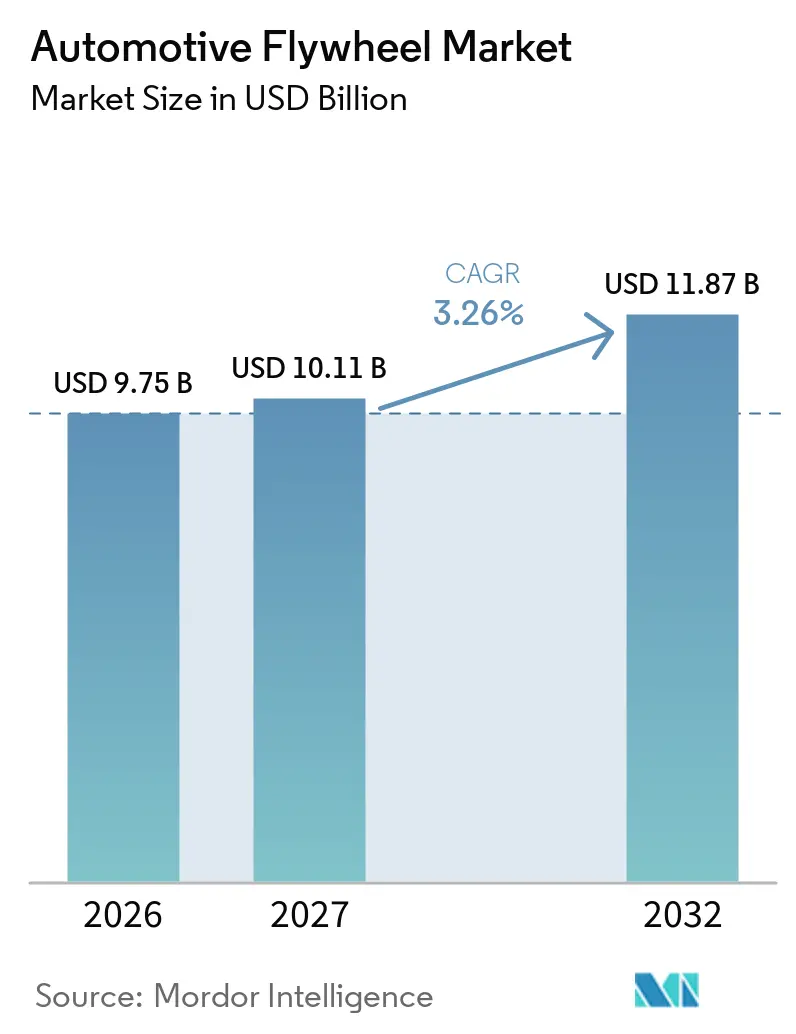
The automotive flywheel market size was valued at USD 9.75 billion in 2026 and is forecast to grow from USD 10.11 billion in 2027 to USD 11.87 billion by 2032, at a CAGR of 3.26% over 2027-2032. The automotive flywheel market continues to depend on the large base of internal-combustion and hybrid vehicles already in service. Vehicle production also supports demand, especially in markets where internal-combustion vehicles and entry-level hybrids remain common. Electrification narrows the addressable volume for conventional designs, particularly on battery-electric platforms. At the same time, dual-mass systems, hybrid modules, and replacement demand are shifting revenue toward more complex products and service packages.
Key Report Takeaways
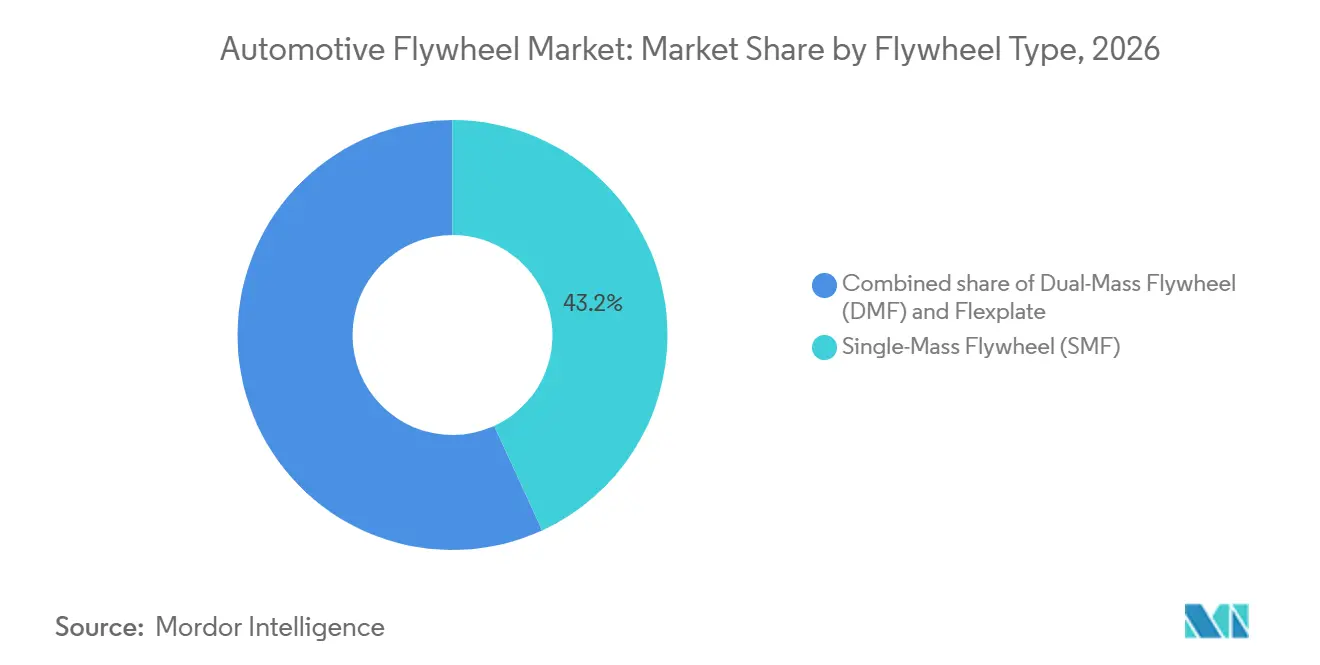
- By flywheel type, single-mass flywheels held a 43.15% revenue share in 2026, while dual-mass flywheels are forecast to grow at a 5.75% CAGR through 2032.
- By material, cast iron held a 62.35% revenue share in 2026, while aluminum is forecast to grow at a 4.71% CAGR through 2032.
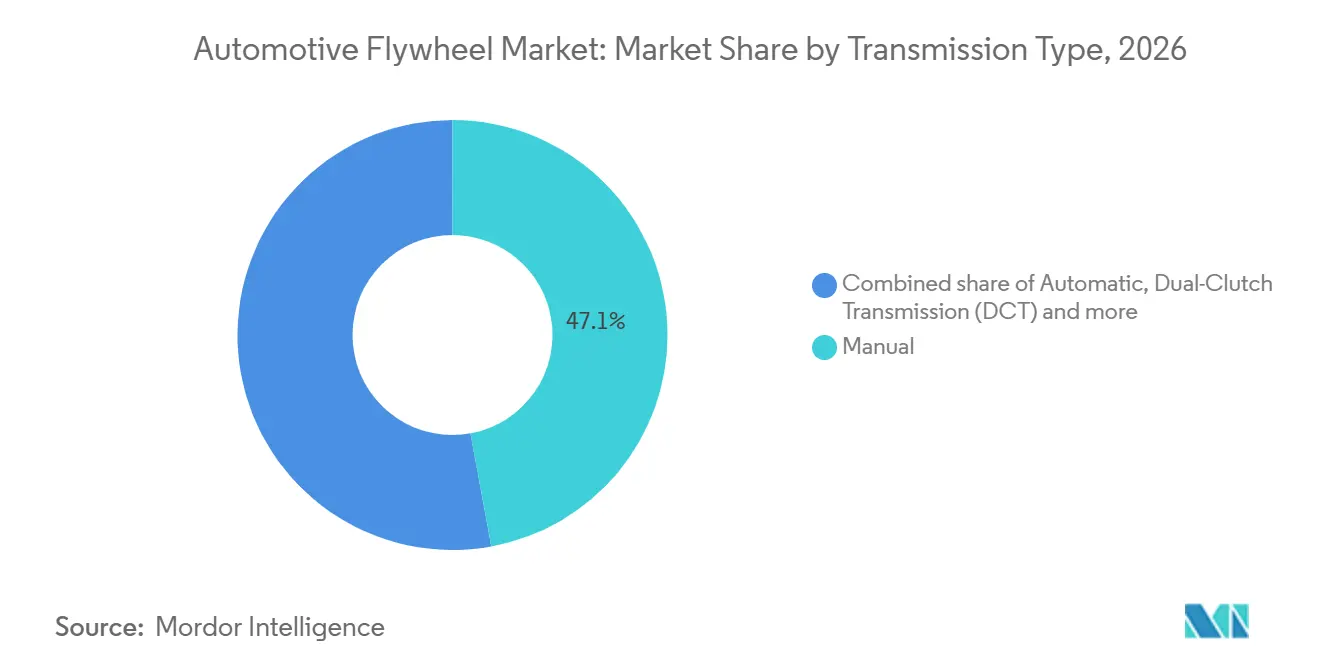
- By transmission type, manual transmission flywheels held a 47.12% revenue share in 2026, while dual-clutch transmissions are forecast to grow at a 5.22% CAGR through 2032.
- By vehicle type, passenger cars held a 82.04% revenue share in 2026, while medium and heavy commercial vehicles are forecast to grow at a 4.13% CAGR through 2032.
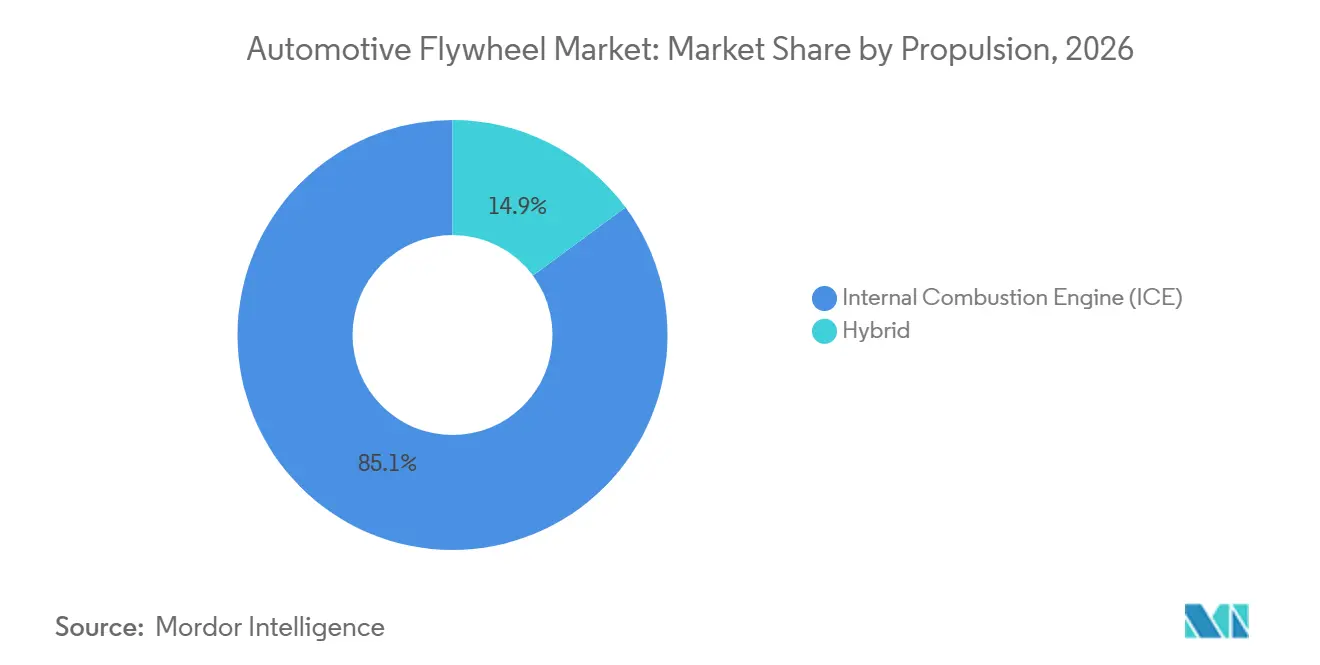
- By propulsion, ICE vehicles held an 85.13% revenue share in 2026, while hybrid vehicles are forecast to grow at a 7.03% CAGR through 2032.
- By sales channel, OEM channels held a 69.34% revenue share in 2026, while the aftermarket is forecast to grow at a 3.86% CAGR through 2032.
- By geography, Asia-Pacific held a 44.86% revenue share in 2026 and is forecast to grow at a 4.58% CAGR through 2032.
Note: Market numbers in this report are based on Mordor Intelligence's proprietary estimation framework, which combines nine months of actuals with Q4 projections for base year 2026.
Market Trends and Insights
Drivers Impact Analysis of Automotive Flywheel Market*
| Driver | (~) % Impact on CAGR Forecast | Geographic Relevance | Impact Timeline |
|---|---|---|---|
| Global Vehicle Production and Installed-Fleet Expansion | +1.0% | Global | Short term (≤ 2 years) |
| Dual-Mass Flywheel Adoption for Torsional-Vibration Control | +0.8% | North America and Europe, expanding in Asia-Pacific | Medium term (2–4 years) |
| Aging Vehicle Fleets and Clutch-Flywheel Replacement Demand | +0.5% | Global, with early gains in India and South America | Medium term (2–4 years) |
| Hybrid Powertrain Integration Through P2 Modules | +0.4% | Global, led by Europe and China | Long term (≥ 4 years) |
| Commercial-Vehicle Torque and Durability Requirements | +0.4% | Asia-Pacific, North America, Middle East and Africa | Medium term (2–4 years) |
| Lightweight Flywheel Development for Fuel-Efficiency Improvement | +0.2% | North America, Europe, and Japan | Long term (≥ 4 years) |
| Source: Mordor Intelligence | |||
Global Vehicle Production and Installed-Fleet Expansion
Vehicle production determines the annual OEM attachment base for flywheel assemblies. Worldwide output rose from 92.7 million units in 2024 to 96.4 million units in 2025[1]. Asia-Pacific produced 59.2 million vehicles in 2025, equivalent to more than 61% of world output. China produced 34.5 million vehicles, while India produced 6.5 million units during the year. These production centers remain important because their output includes many ICE and entry-level hybrid vehicles that retain a mechanical flywheel requirement. This mix makes regional production trends more relevant to the automotive flywheel market than global production totals alone.
Dual-Mass Flywheel Adoption for Torsional-Vibration Control
Turbocharged and downsized engines place greater torsional loads on drivetrain components. Dual-mass flywheels isolate these loads more effectively than simpler single-mass systems. The automotive flywheel market therefore benefits when manufacturers seek improved vibration control in DCT and automated manual transmission applications. Schaeffler launched the LuK RepSet 2CT DMF in April 2025, combining a dual-mass flywheel and double clutch for vehicles with wet and dry double-clutch transmissions. The product shows that the European installed base is large enough to support dedicated bundled replacement solutions. Valeo also positioned its Pendulum Dual Mass Flywheel Gen.2 for dual wet clutch applications within its DWC FullPACK range, reinforcing the technical link between advanced flywheels and DCT service demand.
Aging Vehicle Fleets and Clutch-Flywheel Replacement Demand
Replacement demand gives the automotive flywheel market support beyond new vehicle production. Vehicles equipped with early dual-mass flywheel systems are moving into normal replacement intervals. This creates demand for matched flywheel and clutch packages, especially where workshops need a complete repair solution. Valeo expanded its DMF FULLPACK offer with new part numbers aimed at independent workshops servicing dual-mass flywheel applications. Schaeffler also expanded its LuK concentric pneumatic clutch actuator range for heavy commercial vehicle repairs in January 2026. Catalog coverage and installation guidance can help established suppliers retain replacement business when low-cost alternatives are available.
Hybrid Powertrain Integration Through P2 Modules
P2 hybrid systems make the flywheel part of the connection between the combustion engine and electric drive. BorgWarner describes a P2 module in which the dual-mass flywheel is integrated with the traction motor and engine disconnect clutch [2]. This arrangement gives the component both damping and interface functions within the powertrain. It also allows automakers to add hybrid capability to established vehicle platforms without a complete powertrain redesign. Schaeffler positions its high-voltage P2 hybrid module as a route to lower fuel consumption under specified drive cycles. Hybrid flywheel demand is forecast to grow at a 7.03% CAGR through 2032, making this architecture a key path for higher-value flywheel content during the forecast period.
Restraints Impact Analysis of Automotive Flywheel Market*
| Restraint | (~) % Impact on CAGR Forecast | Geographic Relevance | Impact Timeline |
|---|---|---|---|
| Battery-Electric Vehicle Powertrains Eliminating Conventional Flywheel Demand | -1.1% | Global, concentrated in Europe, China, and North America | Long term (≥ 4 years) |
| Declining Manual-Transmission Penetration in Passenger Vehicles | -0.8% | Europe, North America, and China | Medium term (2–4 years) |
| High Replacement Cost and Specialized Servicing Requirements for Dual-Mass Flywheels | -0.4% | Emerging markets, including South America, Southeast Asia, and Middle East and Africa | Medium term (2–4 years) |
| Low-Cost Imports, Counterfeit Parts, and Inconsistent Aftermarket Quality | -0.3% | South America, Middle East and Africa, and non-core Asia-Pacific | Short term (≤ 2 years) |
| Source: Mordor Intelligence | |||
Battery-Electric Vehicle Powertrains Eliminating Conventional Flywheel Demand
Battery-electric vehicles do not require a conventional flywheel between an engine and transmission. Their single-speed drivetrains remove the mechanical role served by a flywheel in an ICE vehicle. This limits new conventional flywheel nominations on battery-electric platforms. The effect is most visible where battery-electric models form a larger part of premium OEM development programs. The automotive flywheel market retains a buffer because the vehicle parc still includes a large number of ICE and hybrid vehicles. P2 hybrids are also important because they retain a higher-value flywheel assembly within a partly electrified powertrain.
Declining Manual-Transmission Penetration in Passenger Vehicles
Manual transmission platforms have traditionally been a major application for single-mass flywheels. Their declining use reduces the growth potential for simpler flywheel designs in passenger cars. Automatic, DCT, and automated manual systems are taking a larger role in many passenger vehicle programs. This change redirects demand within the automotive flywheel market toward flexplates and dual-mass flywheels rather than ending all mechanical flywheel demand. Passenger cars held the dominant share of 2026 automotive flywheel revenue, so a lower manual share can affect the broader product mix. Cost-sensitive passenger and commercial vehicle markets continue to preserve demand for manual applications, which moderates this restraint.
*Our forecasts treat driver/restraint impacts as directional, not additive. The impact forecasts reflect baseline growth, mix effects, and variable interactions.
Automotive Flywheel Market Segment Analysis
By Flywheel Type:
Dual-Mass Technology Supports Higher-Value DemandSingle-mass flywheels held 43.15% of the automotive flywheel market share in 2026. Their position reflects a cost advantage and continued use in manual-transmission compact vehicles across Asia, South America, and Eastern Europe. These products remain suitable where vehicle affordability and service simplicity have greater weight in purchasing decisions. Flexplates serve automatic transmission applications, particularly in North America and in premium vehicle programs. Together, these established designs ensure that the automotive flywheel market continues to have several product paths rather than a single technology base.
Dual-mass flywheels are forecast to grow at a 5.75% CAGR through 2032. Their damping capability is relevant to engines that create higher torque pulses across a narrow operating range. The automotive flywheel market size for dual-mass assemblies is supported by DCT and hybrid applications, where vibration control and precise component matching matter. Schaeffler's LuK RepSet 2CT DMF combines a dual-mass flywheel with a double clutch for wet and dry double-clutch transmission systems. This type of package reduces the risk of incompatible replacement components, while P2 modules create another route for use with the engine disconnect clutch.

By Material:
Cast Iron Retains Scale While Aluminum Gains UseCast iron held a 62.35% material revenue share in 2026. Its leading position rests on cost competitiveness, machinability, and established supply chains in Asia, Brazil, and Eastern Europe. Foundries can produce cast iron parts at scale for conventional passenger and commercial vehicle programs. Steel remains relevant in applications requiring high fatigue resistance, including performance and commercial vehicles. Composite and other materials continue to occupy narrow positions within the material mix.
Aluminum is forecast to grow at a 4.71% CAGR through 2032. Lighter flywheels can support vehicle mass reduction when manufacturers seek improved fuel economy. The U.S. Department of Energy states that a 10% reduction in vehicle weight can improve fuel economy by 6%-8%. In September 2026, NHTSA finalized a reset of CAFE standards, lowering passenger-car stringency to about 0.9–1% per year through model year 2031[3].
By Transmission Type:
DCT Applications Expand as Manual Platforms MatureManual transmission flywheels accounted for 47.12% of 2026 revenue. The installed base of manual vehicles remains substantial, particularly across cost-sensitive markets. This base supports both OEM fitment and replacement needs in the automotive flywheel market. Automatic transmissions create demand for flexplates and related torque converter assemblies. Automated manual transmissions also serve a growing commercial vehicle niche in Asia because they can combine manageable cost with fuel-efficiency benefits.
Dual-clutch transmissions are forecast to grow at a 5.22% CAGR through 2032. Their expansion supports demand for dual-mass products designed for higher speed, torque, and vibration-control requirements. The automotive flywheel market benefits when DCT adoption expands because advanced flywheel fitment can lift the value of each service event. This shift reduces reliance on simple manual-platform products and encourages transmission-specific repair support.
By Vehicle Type:
Commercial Vehicle Replacement Supports GrowthPassenger cars held 82.04% of automotive flywheel revenue in 2026. Their scale reflects global passenger vehicle production and the broad use of flywheel configurations across compact, mid-size, and premium models. Light commercial vehicles provide a secondary demand base through delivery and fleet applications. These vehicles need durable powertrain components because utilization can be high. Passenger cars will therefore remain the main source of volume during the forecast period.
Medium and heavy commercial vehicles are forecast to grow at a 4.13% CAGR through 2032. Their role in the automotive flywheel market is linked to torque requirements, component durability, and replacement activity. Schaeffler’s June 2026 launch of LuK clutch technology and RepSet kits for Mercedes-Benz Actros, Arocs, Atego, and Econic trucks rated up to 2,800 Nm shows continued investment in heavy-duty driveline service. Commercial vehicles can sustain demand even when passenger car manual transmission volumes decline. Their service needs favor parts built for high load and repeated replacement work.
By Propulsion:
Hybrid Vehicles Create the Fastest-Growing Demand PathICE vehicles held 85.13% of automotive flywheel revenue in 2026. This share reflects the large installed base of combustion-powered vehicles and continued production in markets with gradual electrification. ICE vehicles remain the central volume source for conventional flywheel assemblies. The replacement cycle further extends their contribution because existing vehicles need service parts throughout their operating lives. The automotive flywheel market therefore remains closely tied to the size and age profile of the ICE vehicle parc.
Hybrid vehicles are forecast to grow at a 7.03% CAGR through 2032, the highest rate across the listed segmentation types. Hybrid demand can support higher-value assemblies rather than only additional low-cost unit volume. Each P2 vehicle retains a flywheel attachment that a pure battery-electric platform would not need, extending the commercial relevance of advanced mechanical designs.
By Sales Channel:
OEM Contracts Lead While Aftermarket Demand BuildsOEM channels accounted for 69.34% of automotive flywheel revenue in 2026. Long-cycle contracts between Tier-1 suppliers and vehicle manufacturers support this position within the automotive flywheel market. Schaeffler, ZF, Valeo, EXEDY, AISIN, and regional Chinese suppliers participate in OEM sourcing across major production regions. OEM customers require documented performance, application compatibility, and dependable production quality. These conditions can favor suppliers with long-running vehicle platform relationships.
The aftermarket is forecast to grow at a 3.86% CAGR through 2032. First-generation dual-mass flywheel vehicles are reaching service intervals where a combined clutch and flywheel replacement may be needed. The automotive flywheel market size in the aftermarket depends on catalog depth, clear fitting support, and matched parts. These requirements can make direct substitution difficult and strengthen the position of suppliers that provide workshop guidance.
Geography Analysis
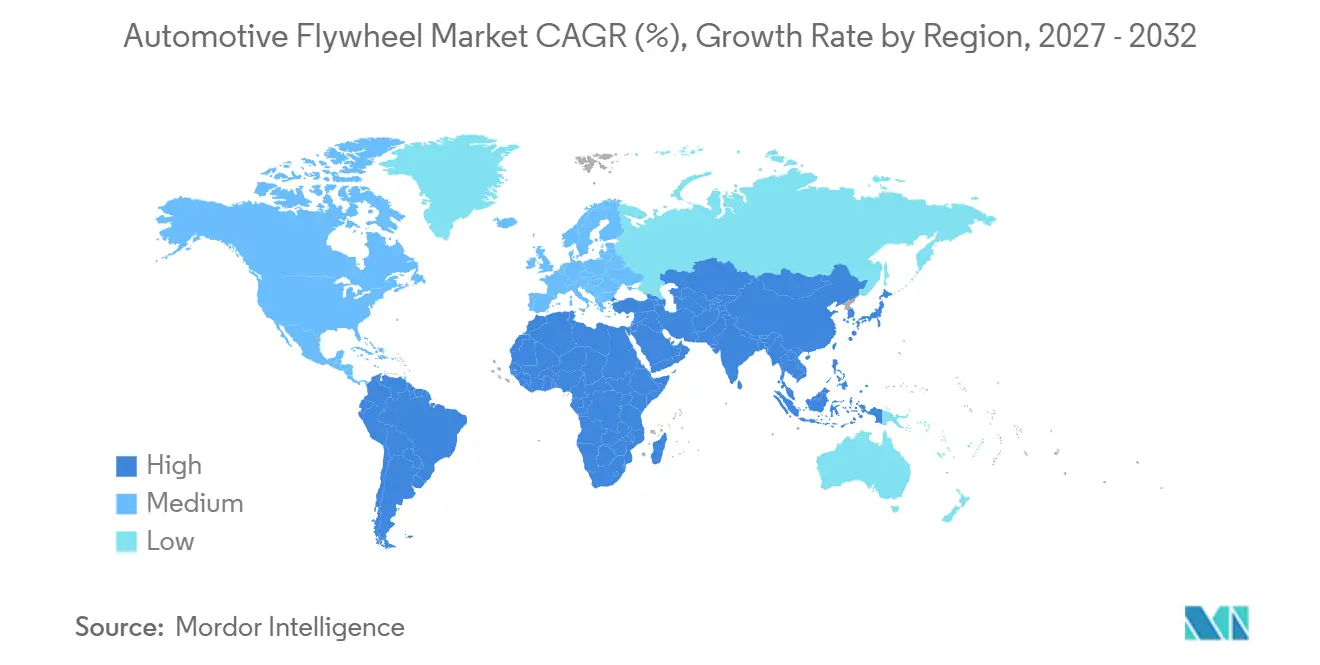
Asia-Pacific held 44.86% of the automotive flywheel market share in 2026 and is forecast to grow at a 4.58% CAGR through 2032. The region combines the world's largest vehicle production base with growing powertrain complexity. China produced 34.5 million vehicles in 2025, and India produced 6.5 million units. Thailand, Indonesia, and Vietnam are important assembly locations for Japanese and Korean automakers. Their output includes ICE and mild-hybrid vehicles that continue to require flywheel assemblies.
Europe remains a major center for dual-mass flywheel development, premium vibration engineering, and replacement demand. Germany, France, the United Kingdom, Italy, and Spain support OEM co-development work for Schaeffler, Valeo, and ZF. The automotive flywheel market size in Europe also benefits from replacement demand for vehicles fitted with early dual-mass systems. North America has a lower passenger car manual transmission base, but commercial vehicle servicing remains an important demand source. Fuel-economy and emissions requirements continue to encourage interest in lighter component configurations.
South America retains cost-sensitive demand for single-mass designs and cast iron flywheel blanks. Brazil produced 2.64 million vehicles in 2025, making it the region's main vehicle production center. Brazilian foundries such as Tupy supply cast iron and CGI-based powertrain components from the region. Middle East and Africa demand is linked to fleet expansion, logistics activity, and the continued economic role of ICE servicing. Turkey also provides a commercial vehicle manufacturing base that connects European and Middle Eastern supply needs.
Competitive Landscape
The automotive flywheel market is moderately consolidated at the OEM supply level. Schaeffler, through LuK, ZF Friedrichshafen through Sachs, and Valeo have broad portfolios across flywheel types, transmission systems, vehicle classes, and replacement channels. Their positions rest on engineering capability and established relationships with vehicle manufacturers. Long product-development cycles and application-specific quality validation make it difficult for a new supplier to displace an approved supplier during one vehicle program. These factors maintain meaningful entry barriers at the OEM supply level.
Schaeffler launched the LuK RepSet 2CT DMF in April 2025 for wet and dry double-clutch applications. The kit combines a dual-mass flywheel and double clutch in one package. Schaeffler also released the LuK 6R80 TorCon torque converter in 2026 for Ford F-150 and Transit vehicles equipped with 6R80 transmissions. These actions broaden aftermarket participation and can simplify component choice for workshops.
EXEDY, AISIN, Ningbo Hongxie Clutch, and SPEC Clutch serve focused positions in Asian OEM supply and performance aftermarket channels. They compete through regional coverage, application choice, and price positioning. Chinese precision casting and forging suppliers are gaining relevance in commercial vehicle single-mass flywheel applications, which can increase price pressure in volume-oriented automotive flywheel market products. The strongest opportunities remain in hybrid-compatible dual-mass designs and service-ready replacement kits, favoring suppliers with commercial vehicle and hybrid exposure.
Automotive Flywheel Industry Leaders
-
Schaeffler AG
-
ZF Friedrichshafen AG
-
Valeo SE
-
EXEDY Corporation
-
Aisin Corporation
- *Disclaimer: Major Players sorted in no particular order

Automotive Flywheel Market Companies Covered in this Report
- Schaeffler AG
- ZF Friedrichshafen AG
- Valeo SE
- Eaton Corporation plc
- BorgWarner Inc.
- Linamar Corporation
- EXEDY Corporation
- Aisin Corporation
- AMS Automotive LLC
- Skyway Precision, Inc.
- Ace Manufacturing & Parts Co., Inc.
- Tupy S.A.
- Hyundai Transys Inc.
- Ningbo Hongxie Clutch Co., Ltd.
- Holley Inc.
- SPEC Clutch, Inc.
- Ram Automotive Company, Inc.
- Tilton Engineering, Inc.
Recent Industry Developments in Automotive Flywheel Market
- June 2026: Schaeffler introduced LuK clutch technology and LuK RepSet aftermarket kits for Mercedes-Benz Actros, Arocs, Atego, and Econic trucks, covering applications rated up to 2,800 Nm.
- January 2026: Schaeffler expanded its LuK concentric pneumatic clutch actuator range for heavy commercial vehicle clutch repairs.
- June 2025: Tupy secured an order for compacted graphite iron cylinder blocks for a 13-liter North American commercial vehicle engine, with production at Tupy Mexico from late 2026.
- April 2025: Schaeffler launched the LuK RepSet 2CT DMF kit, combining a dual-mass flywheel and double clutch for vehicles with wet and dry double-clutch transmissions.
Global Automotive Flywheel Market Report Scope
The scope includes segmentation by flywheel type (single-mass flywheel (SMF), dual-mass flywheel (DMF), and flexplate), material (cast iron, steel, aluminum, and other materials), transmission type (manual, automatic, dual-clutch transmission (DCT), and automated manual transmission (AMT)), vehicle type (passenger cars, light commercial vehicles, and medium and heavy commercial vehicles), propulsion type (internal combustion engine (ICE) and hybrid), and sales channel (original equipment manufacturer (OEM) and aftermarket). The analysis also covers regional-level segmentation, including North America, Europe, Asia-Pacific, South America, and the Middle East and Africa. Market size and growth forecasts are presented by value in USD and volume in Units.
Segmentation Overview
| Single-Mass Flywheel (SMF) |
| Dual-Mass Flywheel (DMF) |
| Flexplate |
| Cast Iron |
| Steel |
| Aluminum |
| Other Materials |
| Manual |
| Automatic |
| Dual-Clutch Transmission (DCT) |
| Automated Manual Transmission (AMT) |
| Passenger Cars |
| Light Commercial Vehicles |
| Medium and Heavy Commercial Vehicles |
| Internal Combustion Engine (ICE) |
| Hybrid |
| Original Equipment Manufacturer (OEM) |
| Aftermarket |
| North America | United States |
| Canada | |
| Rest of North America | |
| Europe | Germany |
| United Kingdom | |
| France | |
| Italy | |
| Spain | |
| Russia | |
| Rest of Europe | |
| Asia-Pacific | China |
| Japan | |
| India | |
| South Korea | |
| Indonesia | |
| Thailand | |
| Australia | |
| Rest of Asia-Pacific | |
| South America | Brazil |
| Argentina | |
| Chile | |
| Colombia | |
| Rest of South America | |
| Middle East and Africa | Turkey |
| Saudi Arabia | |
| United Arab Emirates | |
| South Africa | |
| Egypt | |
| Nigeria | |
| Rest of Middle East and Africa |
| By Flywheel Type | Single-Mass Flywheel (SMF) | |
| Dual-Mass Flywheel (DMF) | ||
| Flexplate | ||
| By Material | Cast Iron | |
| Steel | ||
| Aluminum | ||
| Other Materials | ||
| By Transmission Type | Manual | |
| Automatic | ||
| Dual-Clutch Transmission (DCT) | ||
| Automated Manual Transmission (AMT) | ||
| By Vehicle Type | Passenger Cars | |
| Light Commercial Vehicles | ||
| Medium and Heavy Commercial Vehicles | ||
| By Propulsion | Internal Combustion Engine (ICE) | |
| Hybrid | ||
| By Sales Channel | Original Equipment Manufacturer (OEM) | |
| Aftermarket | ||
| By Geography | North America | United States |
| Canada | ||
| Rest of North America | ||
| Europe | Germany | |
| United Kingdom | ||
| France | ||
| Italy | ||
| Spain | ||
| Russia | ||
| Rest of Europe | ||
| Asia-Pacific | China | |
| Japan | ||
| India | ||
| South Korea | ||
| Indonesia | ||
| Thailand | ||
| Australia | ||
| Rest of Asia-Pacific | ||
| South America | Brazil | |
| Argentina | ||
| Chile | ||
| Colombia | ||
| Rest of South America | ||
| Middle East and Africa | Turkey | |
| Saudi Arabia | ||
| United Arab Emirates | ||
| South Africa | ||
| Egypt | ||
| Nigeria | ||
| Rest of Middle East and Africa | ||
Key Questions Answered in the Report
How large is the automotive flywheel market?
The market was valued at USD 9.75 billion in 2026 and is forecast to grow from USD 10.11 billion in 2027 to USD 11.87 billion by 2032, at a 3.26% CAGR.
Why are hybrid vehicles important for flywheel suppliers?
Hybrid vehicles are forecast to grow at a 7.03% CAGR, and P2 designs retain a dual-mass flywheel between the engine and electric drive.
Which region is expected to grow the fastest?
Asia-Pacific is forecast to grow at a 4.58% CAGR through 2032, supported by its large vehicle production base and rising hybrid adoption.
How important is the aftermarket for flywheel suppliers?
The aftermarket is forecast to grow at a 3.86% CAGR as vehicles equipped with early dual-mass flywheel systems enter replacement intervals.