
Automotive Fabric Market Size and Share
Market Overview
| Study Period | 2022 - 2032 |
|---|---|
| Market Size (2027) | USD 42.46 Billion |
| Market Size (2032) | USD 54.53 Billion |
| Growth Rate (2027 - 2032) | 5.13 % |
| Fastest Growing Market | Asia-Pacific |
| Largest Market | Asia-Pacific |
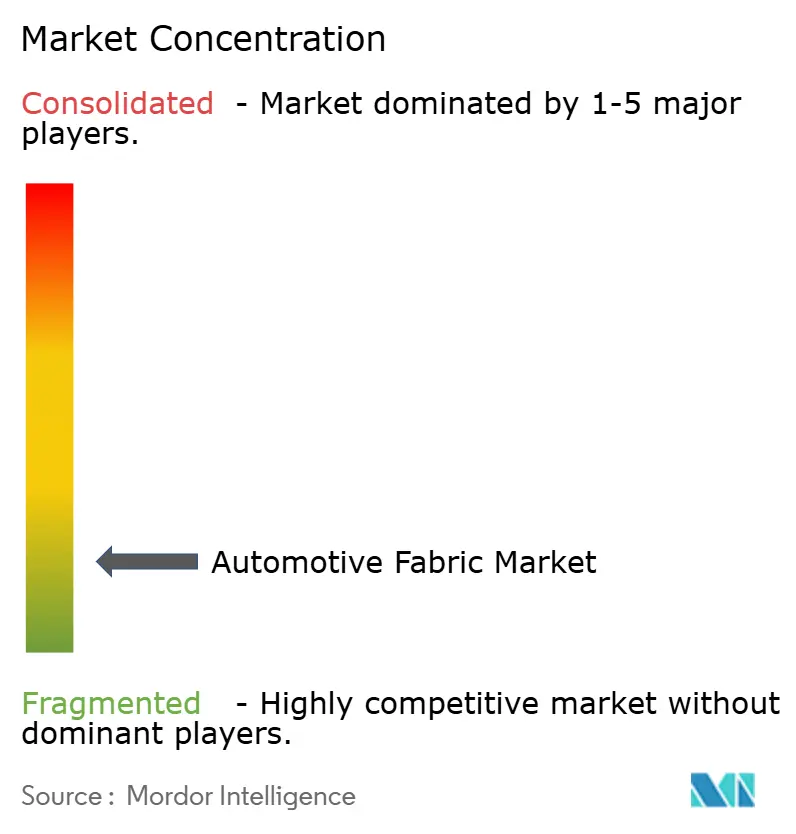
| Market Concentration | Low |
Major Players *Disclaimer: Major Players sorted in no particular order Image © Mordor Intelligence. Reuse requires attribution under CC BY 4.0. | |
Automotive Fabric Market Analysis by Mordor Intelligence
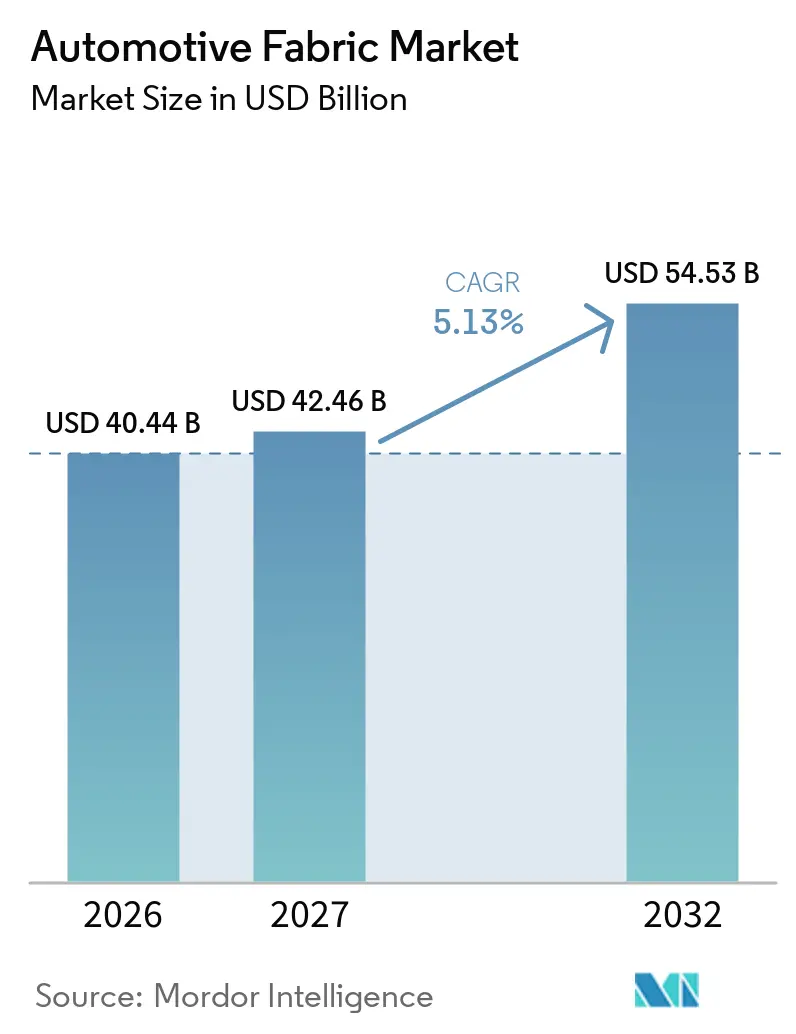
The Automotive Fabric Market size was valued at USD 40.44 billion in 2026 and is estimated to grow from USD 42.46 billion in 2027 to reach USD 54.53 billion by 2032, at a CAGR of 5.13% during the forecast period (2027-2032). The automotive fabric market is supported by vehicle production growth in Asian and emerging manufacturing centers, where vehicle programs are adding safety and interior content. Electric vehicle designs are raising demand for lighter cabin materials and more effective acoustic insulation because road and wind noise are more apparent without engine noise. Safety rules also create a stable demand for airbag cushions and seat belt webbing because these materials are specified in vehicle safety systems. Suppliers are responding through recycled-content materials, local production capacity, and interior systems that can be disassembled more easily at the end of life. The automotive fabric market also faces pressure from resin-price movements and lengthy qualification cycles for new recycled and bio-based grades.
Key Report Takeaways
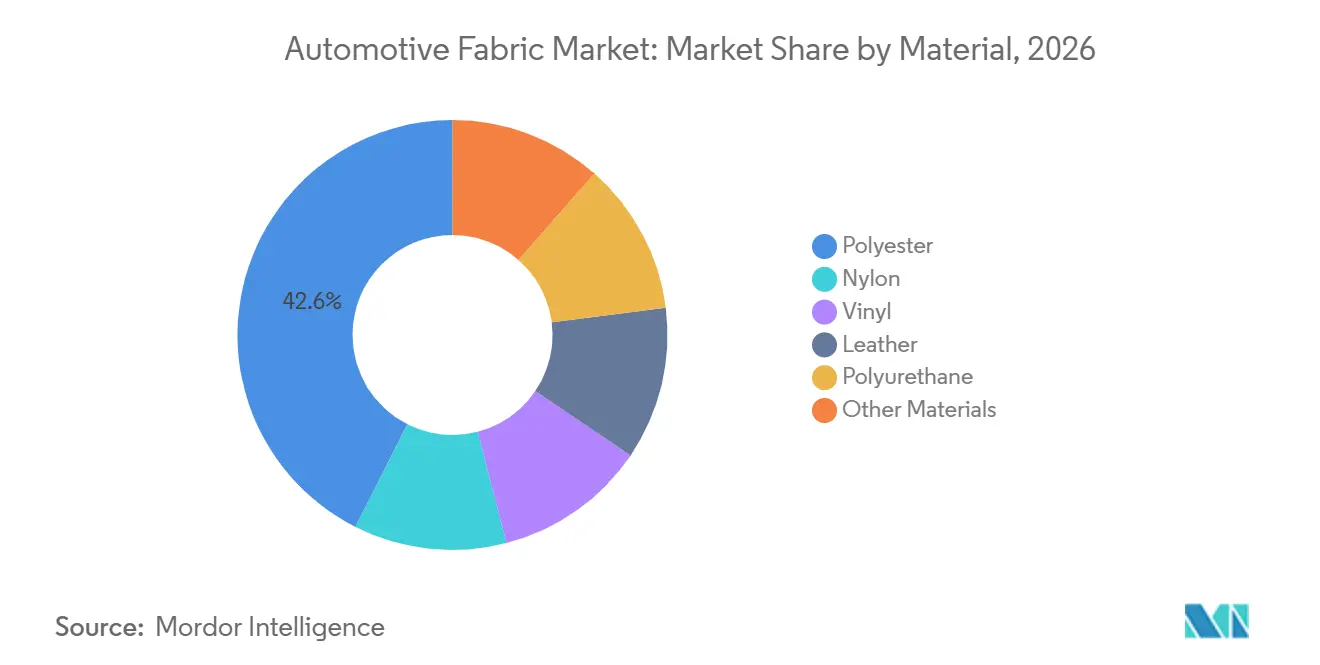
- By material, polyester held 42.56% of the automotive fabric market share in 2026, while polyurethane is forecast to advance at a 5.45% CAGR through 2032.
- By application, upholstery held 44.81% of the automotive fabric market share in 2026, while airbags are forecast to advance at a 5.81% CAGR through 2032.
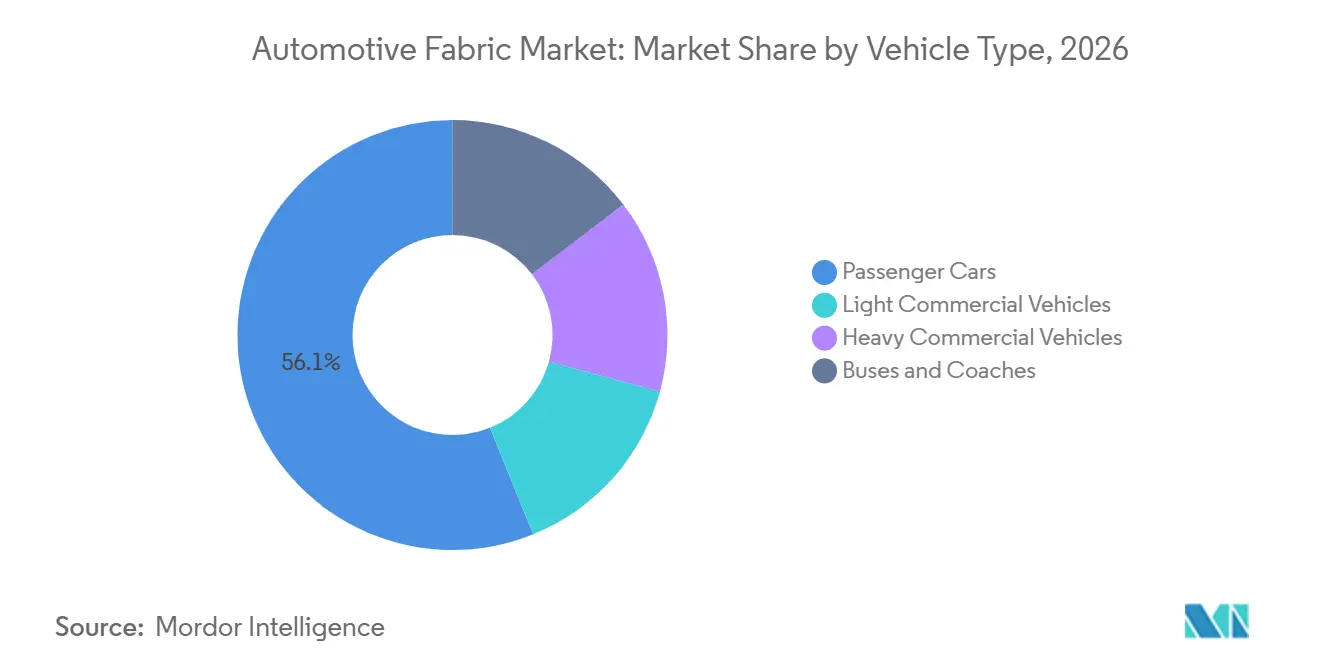
- By vehicle type, passenger cars held 56.12% of the automotive fabric market share in 2026, while light commercial vehicles are forecast to advance at a 6.05% CAGR through 2032.
- By geography, Asia-Pacific held 38.28% of the automotive fabric market share in 2026 and is forecast to advance at a 5.72% CAGR through 2032.
Note: Market numbers in this report are based on Mordor Intelligence's proprietary estimation framework, which combines nine months of actuals with Q4 projections for base year 2026.
Market Trends and Insights
Drivers Impact Analysis of Automotive Fabric Market*
| Driver | (~) % Impact on CAGR Forecast | Geographic Relevance | Impact Timeline |
|---|---|---|---|
| Vehicle Production Growth in Asia and Emerging Markets | +1.6% | APAC core, spillover to Global | Long term (≥ 4 years) |
| Mandatory Airbag, Seat-Belt and Interior Safety Content | +1.2% | Global, concentrated in North America and South Asia | Short term (≤ 2 years) |
| EV Lightweighting and Cabin Acoustic Requirements | +1.0% | China and Europe leading, expanding to North America | Medium term (2–4 years) |
| Premiumization and Interior Customization | +0.8% | North America, Europe, China premium segment | Long term (≥ 4 years) |
| Recycled and Bio-Based Material Specifications | +0.6% | EU and North America, with growing adoption in APAC | Medium term (2–4 years) |
| Source: Mordor Intelligence | |||
Vehicle Production Growth in Asia and Emerging Markets
Vehicle manufacturing in Asia and emerging economies remains the largest demand driver for the automotive fabric market. These countries can raise fabric content per vehicle as safety and interior features become more widely specified. Antolin opened plants in Rayong, Thailand, and Cikarang, Indonesia, in September 2025 to serve regional vehicle makers, including BYD, Changan, Ford, VinFast, Hyundai, and Mitsubishi. The investments show that suppliers are placing capacity close to expected production growth rather than waiting for volumes to rise.
Mandatory Airbag, Seat-Belt, and Interior Safety Content
Safety regulations support demand in the automotive fabric market for airbag cushions and seat belt webbing because these products are fabric-intensive and cannot be removed from compliant vehicle designs. India made 6 airbags standard for all passenger-vehicle variants from October 1, 2025, which increased the minimum airbag content required in each vehicle. In the United States, front seat belt reminder systems were required to comply by September 1, 2026, and rear seat belt reminder systems must comply by September 1, 2027[1]. Curtain, knee, and rear-seat airbags account for much of this expansion. The April 2025 United States Council for Automotive Research (USCAR) Frontal Airbag Performance Specification also sets validation requirements for driver, passenger, and knee airbag systems.
EV Lightweighting and Cabin Acoustic Requirements
Electric vehicle cabins require materials that address both weight and noise control, creating a technical demand stream for the automotive fabric market. Peer-reviewed research identifies sound-package systems as important to noise, vibration, and harshness performance in new-energy vehicles. A 2025 study found that lightweight thermoplastic headliner systems could provide up to 20% higher high-frequency sound absorption while reducing material weight compared with conventional polyurethane foam assemblies. Autoneum launched Flexi-Light PET (Polyethylene Terephthalate) in July 2025, a polyester felt acoustic insulation product containing up to 90% recycled fibers and designed to match polyurethane foam performance. The product connects acoustic performance with recycled-content requirements in the automotive fabric market. Toray also advanced its flame-retardant Garfen composite for EV battery-compartment applications where thermal protection requirements exceed those of standard cabin textiles. These applications broaden the role of technical textiles beyond visible interior surfaces.
Premiumization and Interior Customization
Premium vehicle programs are changing the material mix used for seating and interior trim in the automotive fabric market. Adient plc noted in 2025 that polyurethane and polyvinyl chloride (PVC) materials were replacing leather in some mid-range vehicles as soft-touch synthetic materials improved. These alternatives can provide a similar tactile finish with lower weight and lower volatile organic compound emissions. Polyurethane-coated fabrics, therefore, have an opportunity in programs where leather once marked a higher vehicle position. In China, vehicle makers are specifying antimicrobial, easy-clean, and scent-neutral interior materials for premium and family-oriented models. This specification shift rewards fabric suppliers that can offer functional surfaces together with consistent color, durability, and vehicle-grade validation. It also raises the importance of customization, because material selection becomes part of how vehicle makers distinguish cabin designs.
Restraints Impact Analysis of Automotive Fabric Market*
| Restraint | (~) % Impact on CAGR Forecast | Geographic Relevance | Impact Timeline |
|---|---|---|---|
| Petrochemical Feedstock Price Volatility | -0.8% | Global | Short term (≤ 2 years) |
| High Qualification Costs for Recycled and Bio-Based Fabrics | -0.6% | Global, EU and North America most exposed | Medium term (2–4 years) |
| Slow Cost Pass-Through in Tier-1 Supply Contracts | -0.4% | Global | Short term (≤ 2 years) |
| Source: Mordor Intelligence | |||
Petrochemical Feedstock Price Volatility
Polyester, nylon, and polyurethane rely on petroleum-derived feedstocks, making their production economics sensitive to oil and resin prices. The International Energy Agency (IEA) placed Intercontinental Exchange (ICE) Brent crude near USD 64 per barrel in October 2025, down USD 11 per barrel year to date. Lower crude prices can reduce input costs, but price uncertainty makes planning more difficult for fabric manufacturers. Suppliers working under long-term fixed-price vehicle contracts may not be able to reprice quickly if resin costs rise. Vehicle makers can also seek rapid price reductions when input prices fall. This imbalance can put smaller and mid-sized suppliers under more pressure than larger integrated companies.
High Qualification Costs for Recycled and Bio-Based Fabrics
New automotive fabric grades must pass flammability, volatile organic compound, ultraviolet stability, and abrasion tests before series production approval. The process can exceed USD 50,000 per material grade and take 18 to 36 months under International Automotive Task Force (IATF) 16949 and vehicle-maker validation protocols. Recycled and bio-based grades require additional work because post-consumer feedstock can vary from one batch to another. Suppliers must demonstrate consistent compounding and performance before a vehicle program can approve a material. The revised EU End-of-Life Vehicles Directive is expected to require minimum recycled-plastic content in new vehicles from 2030 onward. This creates immediate demand for approved recycled materials while the qualification period remains fixed. The gap between policy timing and material approval limits how quickly sustainable fabric programs can move into high-volume production.
*Our forecasts treat driver/restraint impacts as directional, not additive. The impact forecasts reflect baseline growth, mix effects, and variable interactions.
Automotive Fabric Market Segment Analysis
By Material:
Polyester’s Scale Advantage Meets Polyurethane’s Premiumization PullPolyester held 42.56% of the automotive fabric market share in 2026, supported by abrasion resistance, dimensional stability, and compatibility with recycled-content manufacturing. It remains the broadest commercial option for seating, trim, carpets, and acoustic materials where manufacturers need consistent performance at scale. Autoneum’s Flexi-Light PET demonstrates the movement from virgin polyester toward recycled feedstocks, with up to 90% recycled fibers in an acoustic insulation system. The product is designed to deliver acoustic performance comparable to polyurethane foam. Nylon retains an important role in high-tenacity safety applications, particularly airbag cushions, because of its strength requirements. Vinyl remains present in mass-market seating but faces competition from soft-touch synthetic alternatives with lower volatile organic compound profiles.
Polyurethane is forecast to be the fastest-growing material at a 5.45% CAGR from 2027 to 2032. Vehicle makers are specifying polyurethane-coated fabrics as leather substitutes across mid-range and high-volume programs, particularly where a soft-touch finish must be delivered with lower weight and lower off-gassing. In 2025, Lotus used yarn made from 50% post-consumer textile waste and 50% recycled polyester for Eletre and Emeya EV seat-back sections, with the production chain located in Western Europe. Bio-based polyamide PA56, bamboo, and flax remain at an earlier commercial stage, but Chinese and European vehicle makers are evaluating them for recyclability compliance and interior differentiation. The automotive fabric market, therefore, balances established material performance with new recycled-content, traceability, and end-of-life requirements.

By Application:
Upholstery’s Revenue Leadership and Airbags’ Regulatory TailwindUpholstery accounted for 44.81% of the automotive fabric market size in 2026 because it uses more surface area per vehicle than any other individual application. A standard 5-seat passenger car requires fabric across seating surfaces, related trim, and supporting interior assemblies, making upholstery a stable demand base for the automotive fabric market. Carpets and floor coverings are the second-largest application group and increasingly use nonwoven layers that combine thermal and acoustic functions. This is particularly useful in electric vehicles, where underfloor battery packaging changes conventional floor-panel designs and places greater value on efficient use of space. Headliners, roof liners, door panels, trunk liners, package trays, and insulation complete the wider application mix, while airbags are projected to grow at a 5.81% CAGR through 2032.
The October 2025 Indian six-airbag requirement increased fabric demand across the passenger-vehicle fleet. The USCAR specification reinforces the importance of approved fabric grades in airbag system validation. Safety belts maintain a steady demand because mandatory content rules are expanding in key markets. Belts, hoses, and tire reinforcement are a specialized technical-fabric group with requirements closer to industrial textiles than visible interior trim. The automotive fabric market gains a more stable demand base when regulations increase the number of safety components required in each vehicle.
By Vehicle Type:
Passenger Cars Anchor Revenue, While Light Commercial Vehicles Lead GrowthPassenger cars held 56.12% of the automotive fabric market in 2026, reflecting their broad range of upholstery, carpet, headliner, door-panel, trunk-liner, and safety-system applications. This segment also shows how premiumization can raise fabric value per unit because buyers and vehicle makers seek more comfort, visual differentiation, and easier-to-clean interior surfaces. Toyota Boshoku Corporation displayed a mono-material cover sheet and mono-material door trim at the 2025 Human-Vehicle Technology Expo in Yokohama. The components were developed for easier disassembly and improved recyclability through the company’s foam-in-place technology. The automotive fabric market benefits when passenger-car material choices address design, compliance, and end-of-life requirements together.
Light commercial vehicles are projected to record the highest vehicle-type CAGR at 6.05% from 2027 to 2032, supported by fleet purchasing linked to e-commerce logistics across Asia and the Americas. LCV cabins need durable and easy-clean materials that can handle intensive commercial use while complying with recycled-content specifications set by vehicle makers. Heavy commercial vehicles require safety equipment and driver-comfort materials for long-haul use. Buses and coaches support fabric demand through public transit fleet procurement in APAC and Middle East and Africa markets, where infrastructure investment can create repeated replacement cycles. The automotive fabric industry serves these vehicle categories with materials selected for durability, safety, acoustic control, and cabin comfort.
Geography Analysis
APAC Automotive Fabric Market
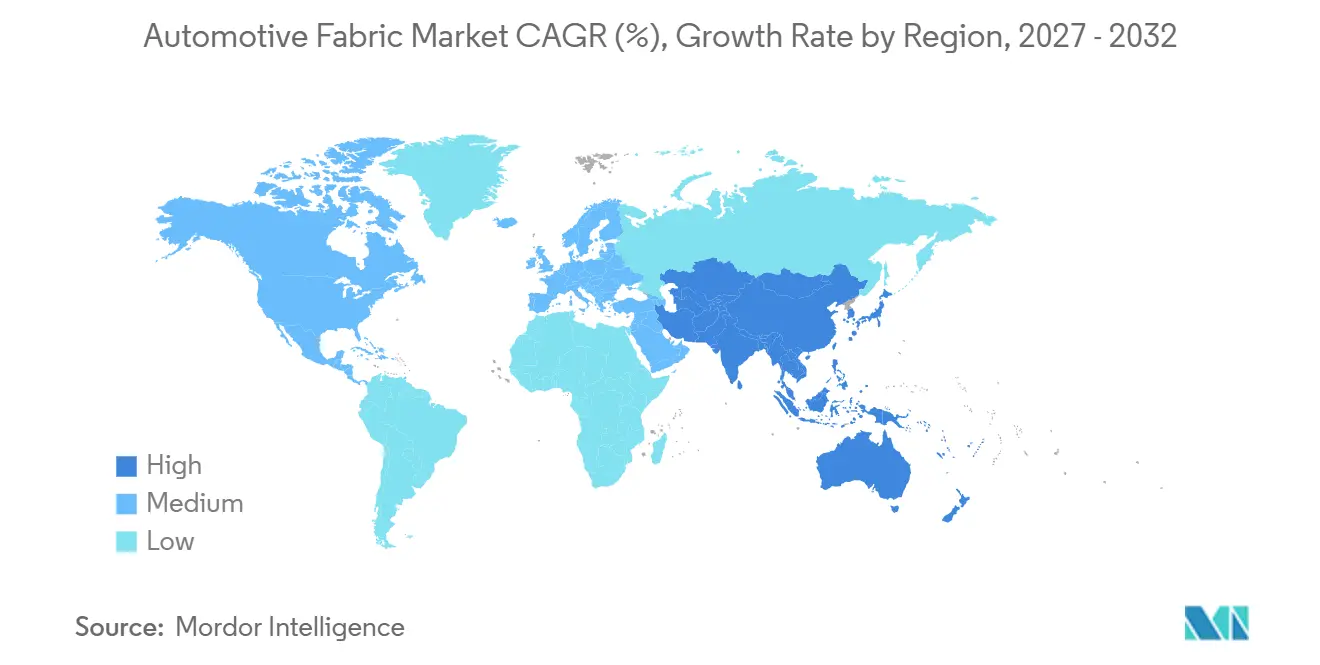
Asia-Pacific held 38.28% of the automotive fabric market in 2026 and is projected to grow at a 5.72% CAGR through 2032. China, India, Japan, South Korea, and ASEAN production hubs account for more than half of global light-vehicle output. India’s 6 airbag requirement increased airbag-fabric procurement per passenger vehicle. Toyota Boshoku Corporation received approval in February 2025 for a second manufacturing plant in IMT Bawal, Rewari, India, with capital investment of INR 4.3 billion, equivalent to USD 52 million. Antolin’s Thailand and Indonesia plants support local supply for interior-component programs.
North America Automotive Fabric Market
North America’s demand is supported by trucks and SUVs with larger cabin surfaces and higher fabric use per vehicle. The amended Federal Motor Vehicle Safety Standards (FMVSS) No. 208 sets 2026 and 2027 deadlines for front and rear seat belt reminder systems. Those deadlines create continued demand for seat belt webbing across the domestic vehicle fleet. Adient reported a USD 480 million investment program for factories in Mexico and Europe, supporting seating and trim activities. The automotive fabric market in the region rewards suppliers that combine scale, automated production, and established relationships with vehicle makers.
EMEA and South America Automotive Fabric Market
Europe has mature demand centered on Germany, France, Italy, and the United Kingdom, where premium-vehicle production supports higher-value interior materials. The expected revised EU End-of-Life Vehicles Directive is making recycled content a more important procurement consideration. Autoneum introduced Ultra-Silent at IAA 2025 with up to 70% recycled fibers for EV frunk and underbody acoustic applications and E-Fiber Shield, a mica-free, flame-retardant battery-safety material rated to 1,400°C. South America is centered on Brazilian vehicle production, while Saudi Arabia and South Africa remain smaller but strategically relevant markets for EV acoustic and thermal materials.
Competitive Landscape
The automotive fabric market is highly fragmented, with the top five players including Adient plc, Lear Corp., Toyota Boshoku Corporation, Forvia, and Autoliv. Specialized interior-fabric companies include SEIREN CO., LTD., Sage Automotive Interiors, SUMINOE Co., Ltd., Haartz, and Acme Mills Company, while Joyson Safety Systems is a close passive-safety competitor. Integrated interior-system suppliers such as Antolin, Autoneum, Yanfeng, Toyota Boshoku Corporation, Forvia, Adient plc, and Lear Corp. combine materials with value-added assembly.
Automation is becoming more important in large seating and trim program awards because it supports repeatable quality, capacity, and cost discipline. Adient plc expanded its Chongqing Technical Center in February 2025 to provide full technical capabilities for Chinese Original Equipment Manufacturer (OEM) seating programs. Antolin opened plants in Thailand and Indonesia to place acoustic foam and headliner capacity closer to Asian vehicle makers[2]. In the automotive fabric market, local engineering support, production reliability, and customer proximity matter alongside material quality.
Sustainability credentials matter in procurement because vehicle makers seek verified recycled content, certification, and life-cycle documentation. Toyota Boshoku Corporation’s mono-material interior components offer a route toward easier recycling and simplified end-of-life handling. Autoneum’s Flexi-Light PET incorporates recycled material content while maintaining vehicle-grade acoustic performance. The automotive fabric market remains competitive because suppliers must meet cost, compliance, sustainability, and vehicle-program timing requirements at the same time.
Automotive Fabric Industry Leaders
-
Adient plc
-
Lear Corp.
-
Toyota Boshoku Corporation
-
Forvia
-
Autoliv
- *Disclaimer: Major Players sorted in no particular order
Automotive Fabric Market Companies Covered in this Report
- Acme Mills Company
- Adient plc
- Antolin
- Autoliv
- Autoneum
- Forvia
- Haartz
- Joyson Safety Systems
- Lear Corp.
- Sage Automotive Interiors
- SEIREN CO., LTD.
- SRF Limited
- SUMINOE Co., Ltd.
- Toyota Boshoku Corporation
- Yanfeng
Recent Industry Developments in Automotive Fabric Market
- June 2026: Jaguar Land Rover (JLR) unveiled its Cornerstone circular-design concept vehicle, developed with more than 40 Tier 1 and raw-material suppliers and incorporating 49 more sustainable components, including recycled seat foam and new FlexAir seat technology. The project supports the automotive fabric market by encouraging recycled and lower-impact materials in vehicle seating and interior applications.
- July 2025: Howa Tramico began using Fibroline’s solvent-free dry powder impregnation technology for manufacturing automotive headliners, the fabric-covered interior linings installed on vehicle ceilings. The development supports the automotive fabric market by advancing lower-solvent manufacturing processes for interior textiles and enabling more efficient production of lightweight acoustic and thermal insulation components.
Global Automotive Fabric Market Report Scope
Automotive fabrics are textile and flexible material solutions designed for use in vehicle interiors and functional components. They provide durability, comfort, protection, and performance characteristics suited to automotive operating conditions.
The Automotive Fabric Market is segmented by material, application, vehicle type, and geography. By material, the market is segmented into polyester, nylon, vinyl, leather, polyurethane, and other materials. By application, the market is segmented into upholstery, carpets and floor coverings, airbags, safety belts, headliners and roof liners, door panels and trim, trunk liners and package trays, acoustic and thermal insulation, and belts, hoses and tire reinforcement. By vehicle type, the market is segmented into passenger cars, light commercial vehicles, heavy commercial vehicles, and buses and coaches. The report also covers the market size and forecasts for automotive fabrics across 16 countries. For each segment, the market sizing and forecasts have been done on the basis of value (USD).
Segmentation Overview
| Polyester |
| Nylon |
| Vinyl |
| Leather |
| Polyurethane |
| Other Materials |
| Upholstery |
| Carpets and Floor Coverings |
| Airbags |
| Safety Belts |
| Headliners and Roof Liners |
| Door Panels and Trim |
| Trunk Liners and Package Trays |
| Acoustic and Thermal Insulation |
| Belts, Hoses and Tire Reinforcement |
| Passenger Cars |
| Light Commercial Vehicles |
| Heavy Commercial Vehicles |
| Buses and Coaches |
| Asia-Pacific | China |
| India | |
| Japan | |
| South Korea | |
| ASEAN Countries | |
| Rest of Asia-Pacific | |
| North America | United States |
| Canada | |
| Mexico | |
| Europe | Germany |
| United Kingdom | |
| France | |
| Italy | |
| NORDIC Countries | |
| Russia | |
| Rest of Europe | |
| South America | Brazil |
| Argentina | |
| Rest of South America | |
| Middle East and Africa | Saudi Arabia |
| South Africa | |
| Rest of Middle East and Africa |
| By Material | Polyester | |
| Nylon | ||
| Vinyl | ||
| Leather | ||
| Polyurethane | ||
| Other Materials | ||
| By Application | Upholstery | |
| Carpets and Floor Coverings | ||
| Airbags | ||
| Safety Belts | ||
| Headliners and Roof Liners | ||
| Door Panels and Trim | ||
| Trunk Liners and Package Trays | ||
| Acoustic and Thermal Insulation | ||
| Belts, Hoses and Tire Reinforcement | ||
| By Vehicle Type | Passenger Cars | |
| Light Commercial Vehicles | ||
| Heavy Commercial Vehicles | ||
| Buses and Coaches | ||
| By Geography | Asia-Pacific | China |
| India | ||
| Japan | ||
| South Korea | ||
| ASEAN Countries | ||
| Rest of Asia-Pacific | ||
| North America | United States | |
| Canada | ||
| Mexico | ||
| Europe | Germany | |
| United Kingdom | ||
| France | ||
| Italy | ||
| NORDIC Countries | ||
| Russia | ||
| Rest of Europe | ||
| South America | Brazil | |
| Argentina | ||
| Rest of South America | ||
| Middle East and Africa | Saudi Arabia | |
| South Africa | ||
| Rest of Middle East and Africa | ||
Key Questions Answered in the Report
What is the size of the automotive fabric market?
The Automotive Fabric Market size was valued at USD 40.44 billion in 2026 and is estimated to grow from USD 42.46 billion in 2027 to reach USD 54.53 billion by 2032, at a CAGR of 5.13% during the forecast period (2027-2032).
Which material held the largest share in 2026?
Polyester held a 42.56% share in 2026 because it supported durable and recycled-content applications.
Which application is projected to grow fastest through 2032?
Airbags are projected to grow at a 5.81% CAGR through 2032, supported by expanding safety requirements.
Why are EVs affecting automotive fabric demand?
EVs require lightweight interior materials and improved acoustic insulation to address battery weight and cabin noise.