
Automotive Dealer Management System Market Size and Share
Market Overview
| Study Period | 2020 - 2032 |
|---|---|
| Market Size (2027) | USD 9.33 Billion |
| Market Size (2032) | USD 13.61 Billion |
| Growth Rate (2027 - 2032) | 7.84 % |
| Fastest Growing Market | Asia-Pacific |
| Largest Market | North America |
| Market Concentration | Medium |
Major Players *Disclaimer: Major Players sorted in no particular order Image © Mordor Intelligence. Reuse requires attribution under CC BY 4.0. | |
Automotive Dealer Management System Market Analysis by Mordor Intelligence
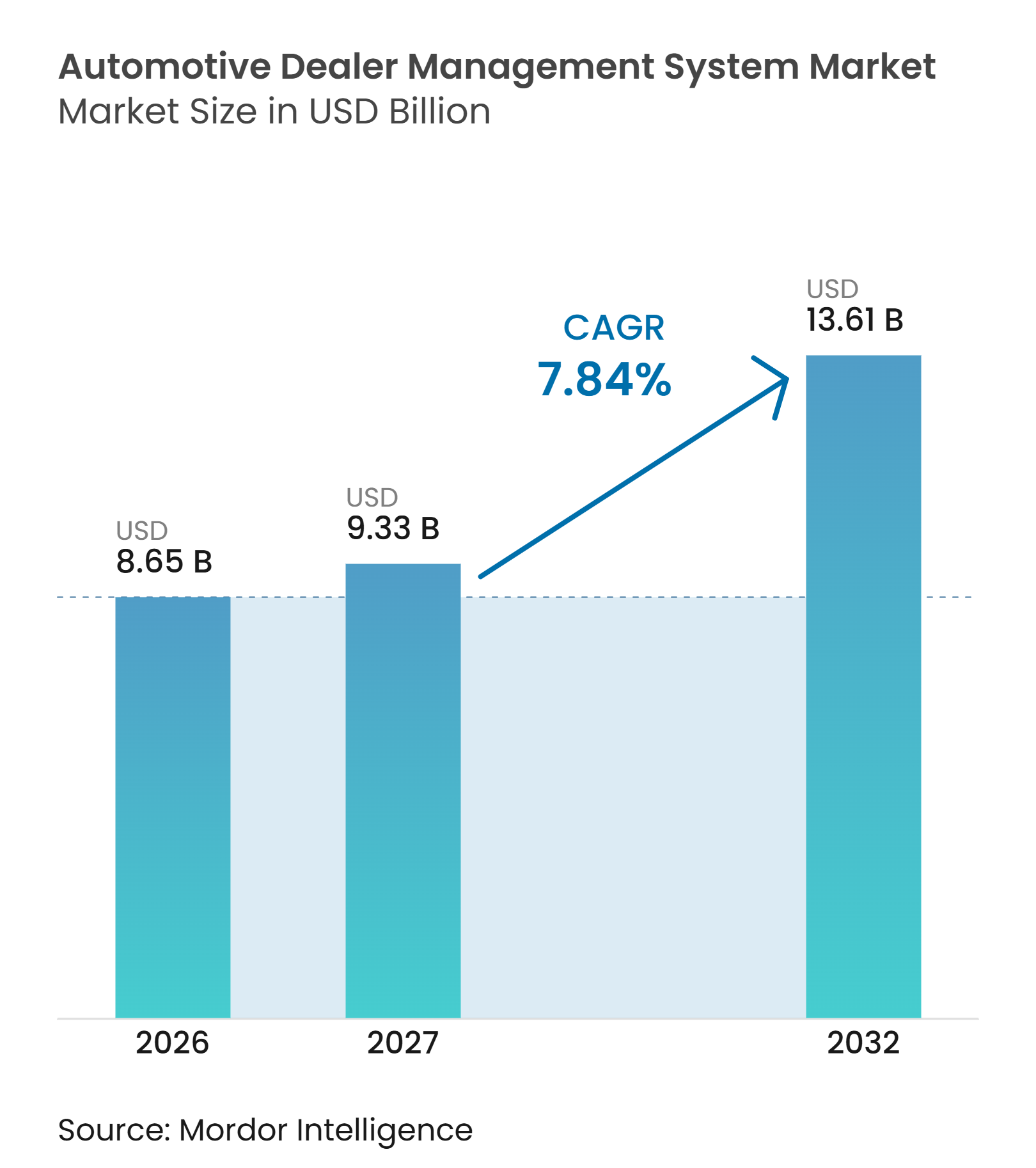
The automotive dealer management system market size was valued at USD 8.65 billion in 2026 and is expected to grow from USD 9.33 billion in 2027 to USD 13.61 billion by 2032, at a CAGR of 7.84% during 2027-2032. The automotive dealer management system market is shifting from separate back-office tools toward connected platforms that link sales, service, parts, inventory, accounting, and customer records. Dealers are placing more weight on systems that support digital retailing, data exchange, and recurring customer engagement. The move toward agency sales models, electric vehicle service processes, and larger dealer groups is increasing the value of a shared operational record. Vendors are responding by extending cloud platforms into financing, document workflows, analytics, and aftersales activities. Security, data access restrictions, and difficult system migrations remain material limits on adoption and vendor expansion.
Key Report Takeaways
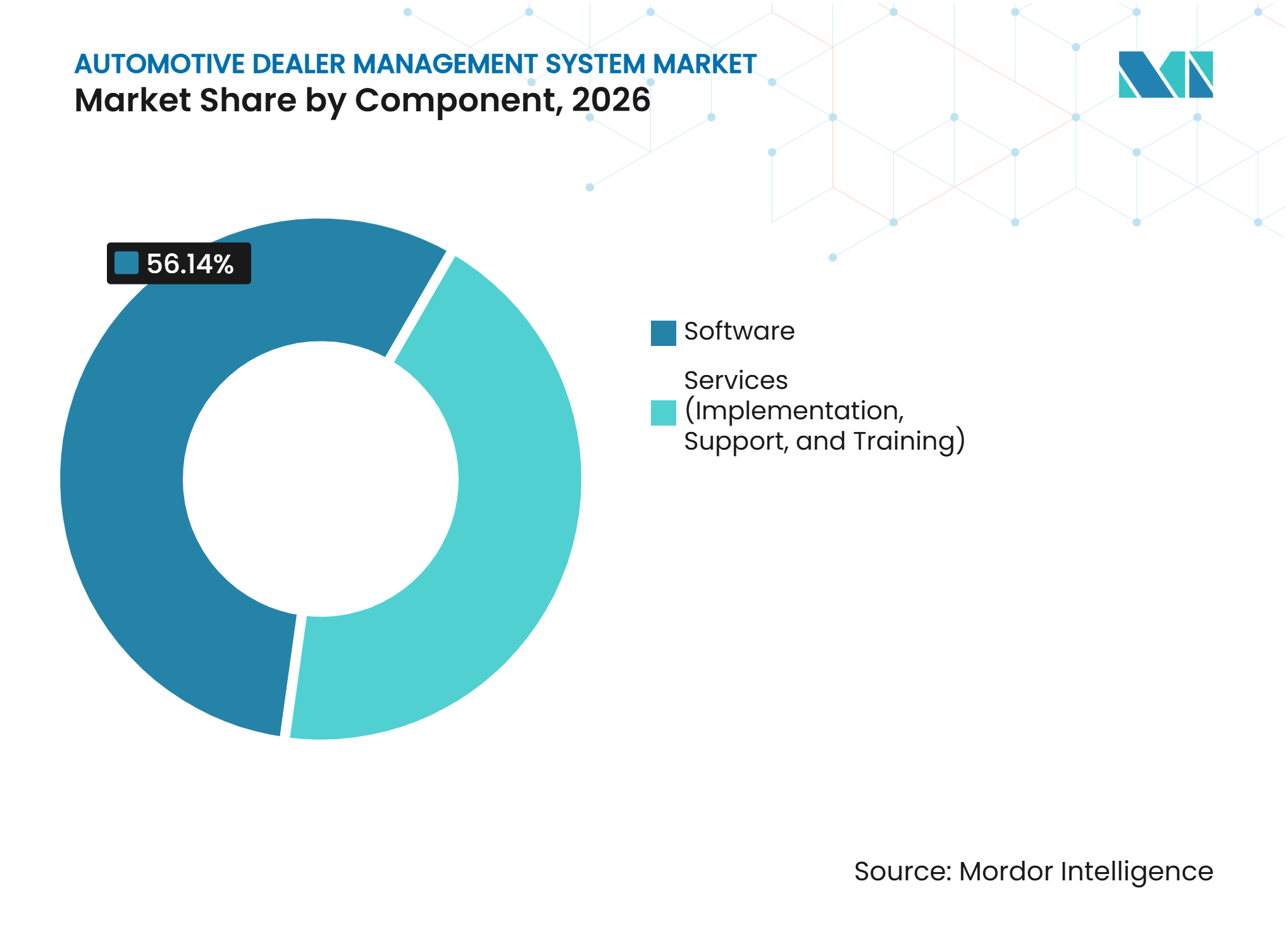
- By component, software held a 56.14% share in 2026, while services are projected to grow at an 8.55% CAGR through 2032.
- By deployment, cloud/SaaS held a 65.03% share in 2026 and is projected to grow at a 10.93% CAGR through 2032.
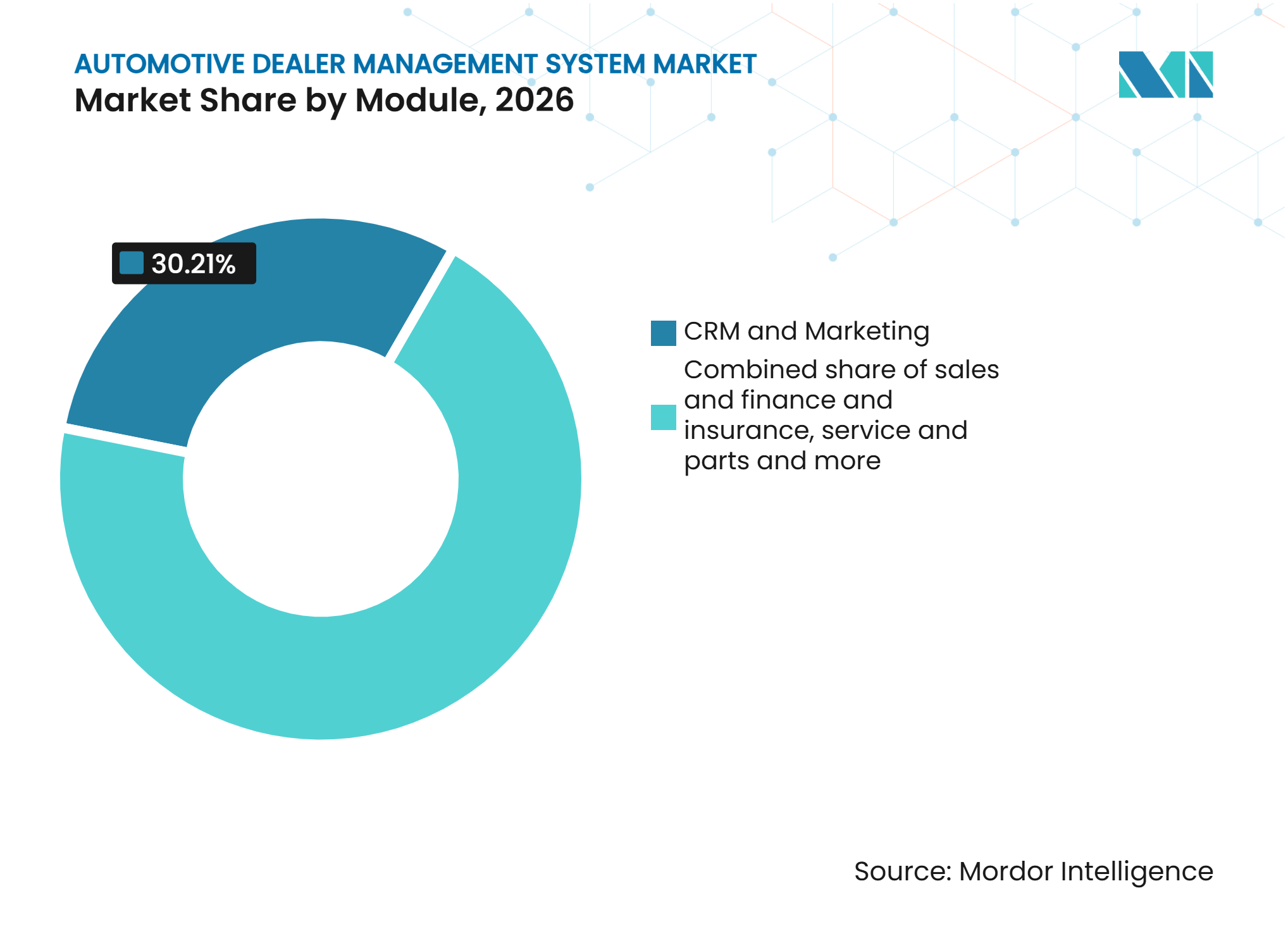
- By module, CRM and marketing held a 30.21% share in 2026, while accounting and finance is projected to grow at a 9.28% CAGR through 2032.
- By dealership type, franchise dealers held a 67.33% share in 2026, while independent dealers are projected to grow at an 11.62% CAGR through 2032.
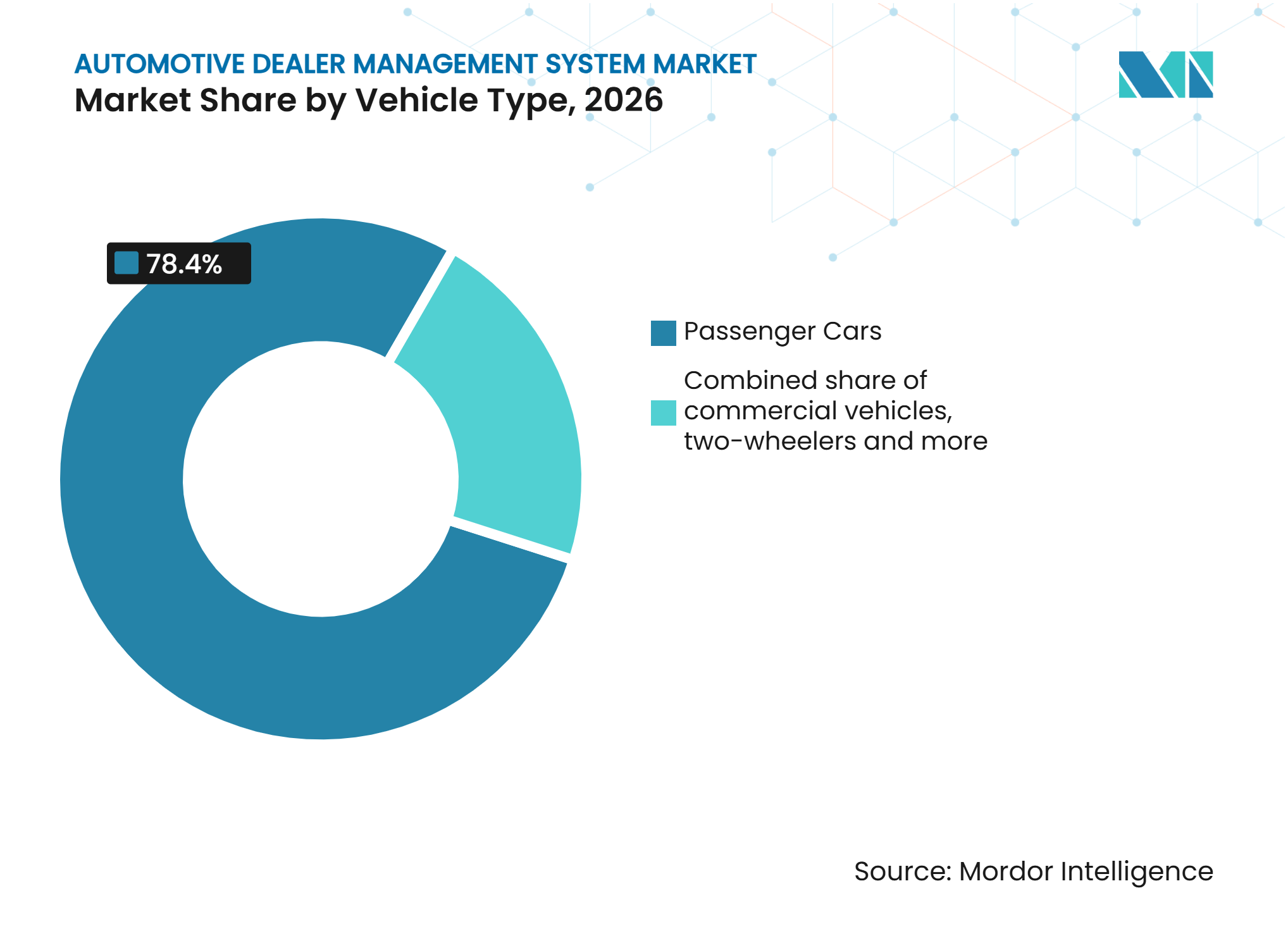
- By vehicle type, passenger cars held a 78.40% share in 2026, while commercial vehicles are projected to grow at a 10.33% CAGR through 2032.
- By dealer size, large dealers and dealer groups held a 49.16% share in 2026, while medium dealers are projected to grow at an 11.04% CAGR through 2032.
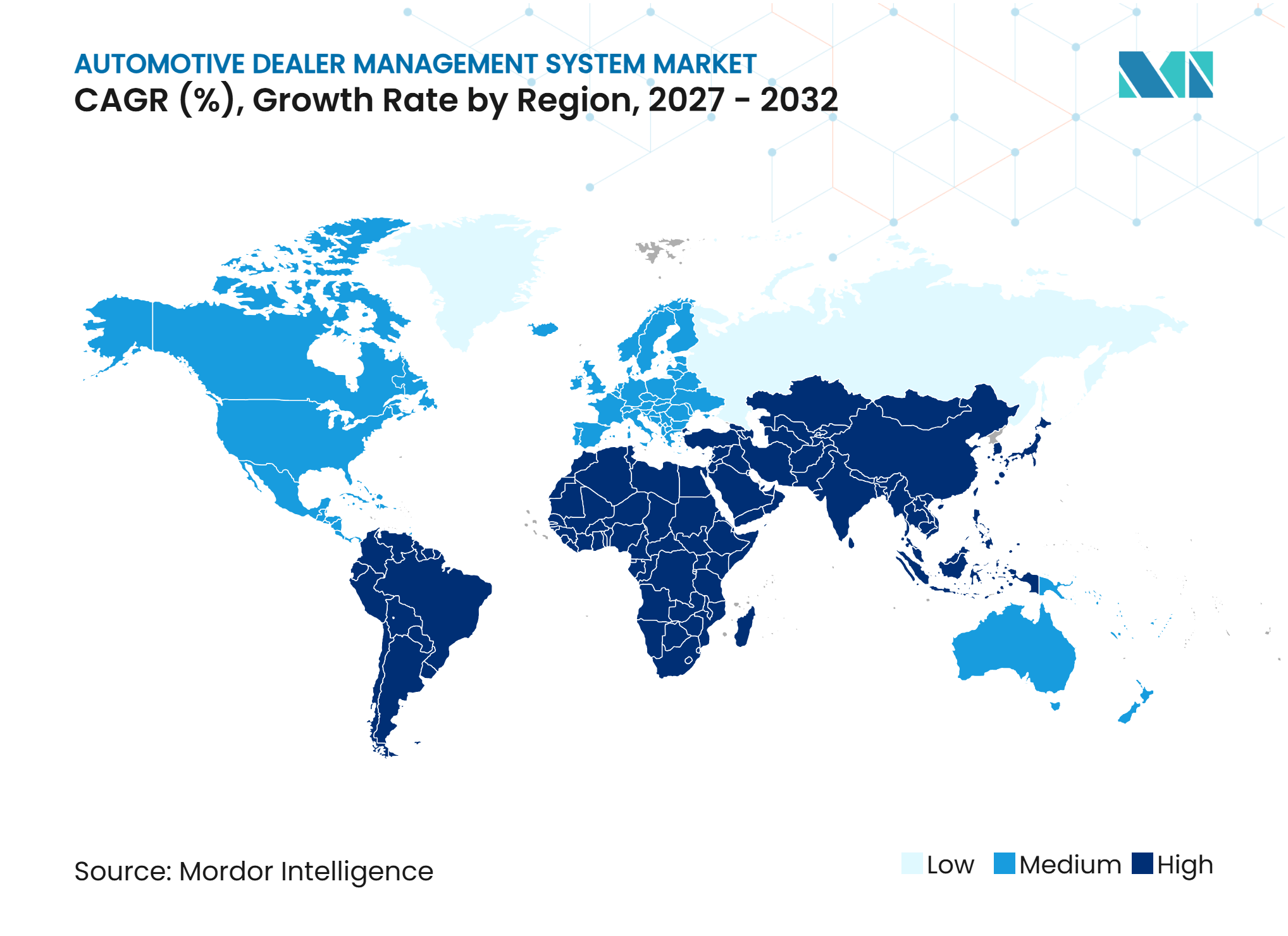
- By geography, North America held a 39.11% share in 2026, while Asia-Pacific is projected to grow at a 9.74% CAGR through 2032.
Note: Market numbers in this report are based on Mordor Intelligence's proprietary estimation framework, which combines nine months of actuals with Q4 projections for base year 2026.
Market Trends and Insights
Drivers Impact Analysis of Automotive Dealer Management System Market*
| Driver | (~) % Impact on CAGR Forecast | Geographic Relevance | Impact Timeline |
|---|---|---|---|
| Dealership Digitization and Omnichannel Retail | +1.8% | Global | Short term (≤ 2 years) |
| Cloud and SaaS Adoption Across Dealer Networks | +1.5% | Global, Asia-Pacific core | Medium term (2–4 years) |
| Multi-Rooftop Consolidation and Centralized Control | +1.0% | North America and Europe | Medium term (2–4 years) |
| OEM Integration and Compliance Data Exchange | +0.8% | Global | Medium term (2–4 years) |
| EV Service and Battery-Warranty Workflow Complexity | +0.7% | Asia-Pacific, Europe, and North America | Medium term (2–4 years) |
| Agency-Model and Digital-Retail Workflow Orchestration | +0.6% | Europe and North America | Long term (≥ 4 years) |
| Source: Mordor Intelligence | |||
Dealership Digitization and Omnichannel Retail
The automotive dealer management system market is benefiting as dealers connect online lead generation with in-store transactions. Cox Automotive reported that nearly half of franchise dealers offered a fully online purchase experience in 2025. The same study found that stronger-performing dealers were 53% more likely to use artificial intelligence in their operations[1]. A connected DMS can bring customer records, pricing, financing, document signing, and appointment data into the same workflow. That connection makes the platform more important to the dealer because a replacement can disrupt several customer-facing processes at once. Vendors that provide native payment, financing, and document features can reduce reliance on disconnected integrations.
Cloud and SaaS Adoption Across Dealer Networks
Cloud delivery is central to expansion in the automotive dealer management system market because it supports continuous updates and multi-location access. Cloud platforms can connect third-party applications through application programming interfaces and can scale without a dealer buying local hardware. Subscription pricing also links vendor revenue to the number of locations operated by a dealer group. Each acquired rooftop can become an additional recurring software subscription under a group agreement. In Thailand, Senior Com introduced the cloud-native DV Platform in July 2025 for sales, service, and spare parts workflows. This type of greenfield deployment differs from the replacement cycle found in mature dealer networks.
Multi-Rooftop Consolidation and Centralized Control
Larger dealer groups are raising demand for shared reporting, centralized accounting, and consistent inventory processes across locations. CDK Global renewed its relationship with Hudson Automotive Group in January 2025, supporting 51 dealership locations through a multi-year agreement [2]. A single DMS reduces the need for separate vendor relationships and fragmented reporting across rooftops. Tekion stated that Dutch Miller Auto Group unified 13 locations on its platform and removed more than 12 third-party systems and vendors. The case shows why group-wide platforms can become difficult to replace once accounting, inventory, customer, and service processes depend on the same data layer. The automotive dealer management system market therefore gives vendors a reason to prioritize group analytics and inter-store functions.
OEM Integration and Compliance Data Exchange
OEM connectivity is becoming more significant because warranty claims, vehicle registration, repair histories, and parts records depend on reliable data exchange. PBS Systems enabled direct Hyundai warranty claim submission in Canada in February 2025, removing the need to enter claims separately through a portal [3]. Electric vehicle service processes add fields for battery condition, charging history, and warranty administration. Agency-model structures also require systems to support commissions and manufacturer-controlled contracts instead of conventional dealer gross-margin arrangements. Keyloop introduced Sales Hub in June 2026 to support sales workflows for vehicle manufacturers and retailers. These requirements favor vendors that can maintain certified integrations and adapt core workflows without adding manual work.
Restraints Impact Analysis of Automotive Dealer Management System Market*
| Restraint | (~) % Impact on CAGR Forecast | Geographic Relevance | Impact Timeline |
|---|---|---|---|
| Legacy-System Integration and Migration Costs | -1.2% | Global | Short term (≤ 2 years) |
| Cybersecurity, Privacy, and Data-Residency Obligations | -0.8% | Global | Short term (≤ 2 years) |
| Dealer Switching Costs and Operational Downtime | -0.5% | Global | Medium term (2–4 years) |
| OEM Data-Access Asymmetry and API Gatekeeping | -0.4% | Global | Long term (≥ 4 years) |
| Source: Mordor Intelligence | |||
Legacy-System Integration and Migration Costs
Replacing a DMS requires the transfer of customer files, repair orders, inventory, parts pricing, accounting records, and OEM connections. Dealers must preserve daily retail operations while the migration takes place. The work becomes more difficult for groups that operate many rooftops because a simultaneous cutover can create broad operational disruption. A phased approach limits disruption but can extend the transition across a long implementation period. Legacy systems therefore retain an advantage when the expected benefit of change does not clearly exceed implementation cost and downtime. The automotive dealer management system market must address this obstacle through stronger migration services, proven onboarding methods, and practical training.
Cybersecurity, Privacy, and Data-Residency Obligations
Dealer platforms store consumer identity, vehicle, finance, service, and transaction information, which makes security controls a core buying requirement. Motility Software Solutions, part of Reynolds and Reynolds, disclosed a data security incident affecting about 766,000 individuals in September 2025 [4]. The incident reinforced the operational and reputational consequences of weaknesses in dealer technology systems. Privacy obligations can require audit trails, breach-response processes, and controls over where customer records are processed. Vendors pursuing Europe also need to account for GDPR requirements when designing cloud deployments. OEM restrictions on access to customer, warranty, and repair records can further limit the value dealers obtain from a new platform.
*Our forecasts treat driver/restraint impacts as directional, not additive. The impact forecasts reflect baseline growth, mix effects, and variable interactions.
Automotive Dealer Management System Market Segment Analysis
By Component:
Software Provides the Core Revenue BaseSoftware accounted for 56.14% of the automotive dealer management system market share in 2026. Its position reflects recurring license structures across dealer rooftops and the central role of the DMS in daily operations. Software subscriptions cover the functions that dealers use to process sales, manage service appointments, maintain parts records, and complete accounting tasks. Cloud delivery has increased the value of those subscriptions because vendors can add functions without a separate local installation. The software offering also serves as the base for connected CRM, analytics, financing, and service modules. Vendors therefore compete on the depth of their platform and the quality of the integrations surrounding it.
Services are forecast to grow at an 8.55% CAGR through 2032. Implementation, support, training, and configuration work increase as dealer platforms add EV workflows, analytics, and OEM-specific processes. Larger deployments need specialized support because they often connect multiple rooftops, brands, and legacy applications. Service revenue can remain important after go-live as dealer groups revise workflows or add locations. This creates a second revenue stream alongside the software subscription. Vendors that offer structured onboarding and certified services can reduce migration concerns and strengthen long-term customer relationships.


By Deployment:
Cloud/SaaS Leads Adoption and GrowthCloud/SaaS accounted for 65.03% of the automotive dealer management system market share in 2026. It is also forecast to grow at a 10.93% CAGR through 2032, which shows that the conversion from on-premises systems is still progressing. Cloud systems offer frequent feature updates, remote access, and simpler scaling for dealer groups. They can support real-time connections with CRM, inventory, finance, and OEM data systems. Cloud delivery also reduces the need to buy and maintain local servers.
On-premises systems remain relevant for some large groups with existing contracts and complex local configurations. They can also appeal where connectivity is inconsistent, or deployment rules make public-cloud architecture harder to use. However, feature gaps may widen when cloud platforms receive continuous updates for analytics, lead scoring, parts planning, and data synchronization. This can make the older model less attractive during a replacement decision. The remaining on-premises installed base is therefore a meaningful conversion opportunity. The automotive dealer management system market will depend on vendors making that transition less disruptive.
By Module:
CRM and Marketing Hold the Largest PositionCRM and marketing held a 30.21% market share in 2026. CRM and marketing leads because vendors increasingly bundle lead management, digital retail and retention tools into the DMS subscription. Dealers use these tools to manage inquiries, customer follow-up, service reminders, and retention activity across the vehicle ownership cycle. The module is important because customer records connect vehicle sales with finance, service, parts, and repeat purchases. Its role expands when online retail channels send more leads into the dealer workflow. A unified customer record can help staff avoid duplicate outreach and support more consistent communication. CDK Global introduced a Customer Data Platform at NADA 2026 to unify fragmented customer information across dealer departments.
Accounting and Finance is forecast to grow at a 9.28% CAGR through 2032. Multi-rooftop groups need timely financial consolidation, while digital audit trails support more controlled financial processes. The module links closely with sales and finance, and insurance workflows because every transaction needs accurate payment, tax, and accounting treatment. Inventory Management also has an expanding role as EV records require additional vehicle attributes. Service and Parts remain essential because their records support repair work and warranty administration. Analytics and Reporting is receiving vendor attention because groups want comparable performance visibility across their locations.


By Dealership Type:
Franchise Dealers Hold the Largest PositionFranchise dealers accounted for a 67.33% market share in 2026. Their leading position reflects OEM requirements for warranty submission, registration, compliance reporting, and approved data exchange. These requirements favor platforms that already have recognized OEM connections. The dealer must maintain dependable links between the showroom, service department, parts operation, and manufacturer systems. Certification can therefore carry more weight than price alone in a franchise selection process. This structure gives established providers an advantage, while also increasing the importance of keeping integrations current.
Independent dealers are forecast to grow at an 11.62% CAGR through 2032. Cloud vendors are tailoring platforms to independent and buy-here-pay-here operators that need practical inventory, collections, customer, and compliance functions. CDK Global launched its Fundamentals Suite in March 2025 for smaller franchise and independent dealerships. The segment is distinct because it does not always need the same OEM certification layer as franchise operators. It can still require audit trails, consumer notification tools, and credit-provider connections. Providers that offer clear pricing and lower implementation effort can be better suited to this group.
By Vehicle Type:
Passenger Cars Remain the Broadest Demand BasePassenger cars accounted for a 78.40% market share in 2026. The result follows the broad presence of passenger vehicle franchises and independent dealerships across global retail networks. These locations need software for common processes such as vehicle sales, service booking, repair orders, parts management, and customer contact. Passenger vehicle workflows provide the basic demand base for most DMS platforms. Vendors often build their shared workflow architecture around these high-volume processes. They then adapt the platform for commercial and specialist vehicle categories.
Commercial vehicles are forecast to grow at a 10.33% CAGR through 2032. Fleet electrification and route-based telematics create service, warranty, and data requirements beyond many passenger vehicle configurations. Commercial operators may need to manage multi-asset contracts, uptime commitments, driver records, and more complex maintenance schedules. These needs support deeper links between service planning and vehicle data. Two-wheelers and powersports or recreational vehicle dealers also present targeted opportunities in selected regions. Blackpurl launched Blackpurl 2 in July 2025 for trailer, powersports, recreational vehicle, golf car, and equipment dealerships. The automotive dealer management system market has room for specialized platforms where standard automotive processes do not fit the dealer’s operating model.
By Dealer Size:
Large Groups Define Enterprise RequirementsLarge dealers and dealer groups accounted for a 49.16% market share in 2026. Their importance stems from high vendor billings and from their demand for centralized reporting, multi-brand integration, and financial consolidation. These groups often set the functional requirements that shape enterprise product roadmaps. A vendor serving a large group must support consistent processes across several locations without losing local visibility. The relationship can become durable because each additional rooftop increases the number of connected workflows.
Medium dealers are forecast to grow at an 11.04% CAGR through 2032. This group is moving beyond spreadsheet-based management and entering fuller DMS deployment cycles. Cloud platforms are attractive because they avoid the hardware investment associated with earlier technology models. Medium operators increasingly seek the reporting and operational visibility used by large groups, but they remain sensitive to total ownership cost. Vendors are adapting enterprise features for smaller operating footprints.
Geography Analysis
North America
North America held a 39.11% market share in 2026. The region benefits from a large base of franchise dealerships, established OEM links, and ongoing replacement of older dealer systems. Cloud adoption leaves room for further conversion among dealers still using locally installed platforms. Canada adds requirements around bilingual support and franchise-specific OEM connections. The automotive dealer management system market size in the region also benefits from dealer interest in connected data, AI-enabled features, and more unified customer records.
Dealer groups in North America are likely to remain a major source of enterprise demand because they need common controls across multiple sites. CDK Global’s Hudson Automotive Group renewal shows the value of long-term group agreements for major providers. Security requirements are also becoming more visible in platform selection following recent incidents in the dealer technology supply chain. Vendors need to show controlled handling of customer records and workable response processes. These needs support greater attention to information security certifications and audit evidence during dealer procurement.
Asia-Pacific
Asia-Pacific is forecast to grow at a 9.74% CAGR through 2032. India, Southeast Asia, and China offer greenfield opportunities where dealer digital systems can be deployed without extensive legacy replacement work. Mercedes-Benz India and Zoho launched the SKYLine DMS across the company’s India dealer network in October 2025. The deployment illustrates demand for cloud-based dealer processes and links to manufacturer systems. Regional growth also comes from expanding new-energy vehicle networks that need digital service and battery-warranty workflows.
Japan represents a more structured path to expansion through OEM-led standardization. Pinewood.AI reached a five-year agreement with Volkswagen Group Japan in April 2025 for Volkswagen and Audi dealers, followed by an agreement for Porsche Centers in Japan in September 2025. China introduces a separate compliance factor because data sovereignty can require local infrastructure or local cloud partnerships. This raises deployment costs but may also limit cross-border competition. Vendors need regional operating models rather than a single uniform platform plan. Cloud systems can gain adoption quickly in countries that skip the on-premises stage.
Europe, South America, and Middle East and Africa
Europe is shaped by agency-model development and data governance requirements. Agency selling changes the deal structure because manufacturers can set pricing and hold customer contracts while dealers receive commissions. Platforms must therefore accommodate different sales, accounting, and customer data processes. GDPR remains a central compliance factor for providers handling customer information through cloud systems. Pinewood.AI deployments at dealer groups in the United Kingdom show that platform competition is increasing as dealers adapt to these workflow changes.
South America offers growth through expanding franchise networks and interest in cloud platforms that reduce local server investment. Regional suppliers can compete where they understand tax, language, and regulatory differences across national markets. In the Middle East and Africa, premium brand expansion in Gulf Cooperation Council countries supports demand for enterprise dealer systems. Keyloop stated in September 2025 that its Fusion platform would be rolled out in South Africa in 2026. The mixed regional opportunity depends on vendor willingness to localize compliance, integration, and support models. It also favors platforms that can serve developing dealer networks without imposing complex on-premises infrastructure.
Competitive Landscape
Market Concentration
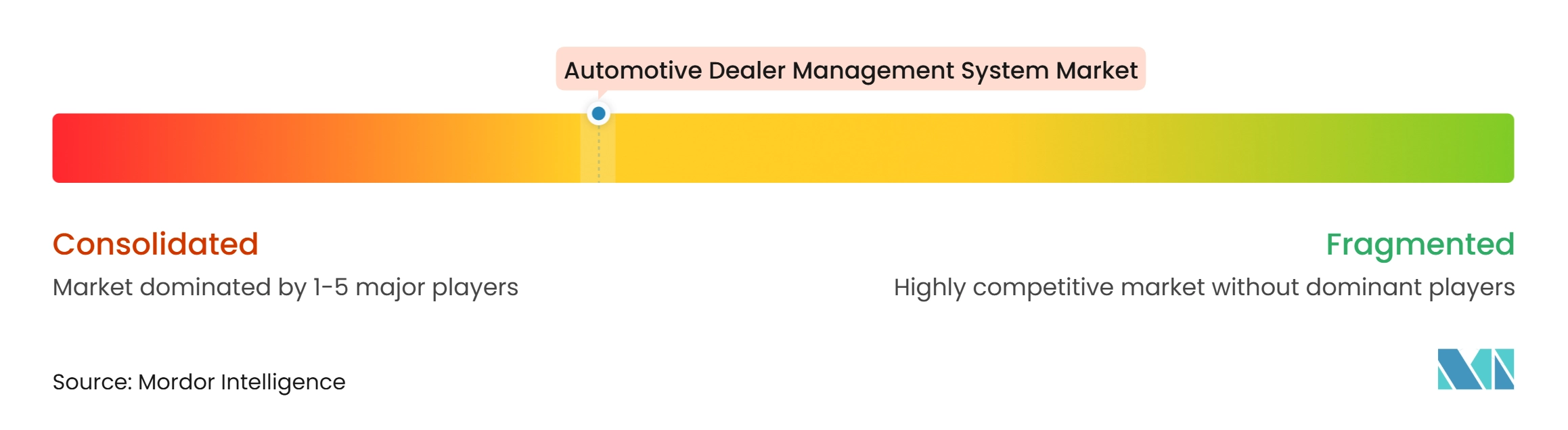
The automotive dealer management system market is moderately concentrated because established providers have long-standing dealer relationships, installed systems, and certified OEM connections. CDK Global, Reynolds and Reynolds, and Cox Automotive remain prominent in North American franchised dealer networks, where the reliability of accounting, service, warranty, and retail processes carries substantial weight in platform selection. Their legacy positions do not remove competitive pressure, but they raise the standard for a new supplier because a replacement must preserve daily operations while delivering a clear improvement in usability, integration, or commercial value. The automotive dealer management system market also includes Tekion, Keyloop, and Pinewood.AI, which are pursuing cloud-based alternatives for enterprise groups and mid-sized accounts that want a more connected technology architecture.
Implementation quality also carries a premium, because the product is used by sales staff, finance teams, service advisers, parts managers, accountants, and group executives with different daily needs. Cloud-focused challengers can counter that advantage when they provide a clearer interface, faster releases, and fewer disconnected products around the core record. Competition is therefore not defined only by software features, because adoption also depends on training quality, dealer confidence in support, and the ability to make a complex transition manageable.
Sales teams need customer and vehicle information when responding to leads. Finance teams need accurate deal, payment, and compliance information. Service and parts teams need repair histories, appointments, inventory records, and warranty processes that work without delay. Accounting teams need transactions to move into financial records with consistent controls. Group leadership needs a dependable view across locations without waiting for manual reporting. Vendors need to explain how data will move, how staff will be trained, how business continuity will be protected, and how future functions will be introduced. Dealers will also assess whether a provider has the financial and operational capacity to support a long-term relationship. These questions matter more as the DMS becomes the common record for customer, vehicle, service, parts, and financial activity.
Automotive Dealer Management System Industry Leaders
-
CDK Global, Inc.
-
The Reynolds and Reynolds Company
-
Cox Automotive, Inc.
-
Tekion Corporation
-
Solera Holdings, Inc.
- *Disclaimer: Major Players sorted in no particular order
Automotive Dealer Management System Market Companies Covered in this Report
- CDK Global, Inc.
- The Reynolds and Reynolds Company
- Cox Automotive, Inc.
- Solera Holdings, Inc.
- Tekion Corporation
- Keyloop Group Limited
- Pinewood Technologies PLC
- Quorum Information Technologies Inc.
- Dominion Enterprises
- PBS Systems Inc.
- Blackpurl
- Frazer Computing, Inc.
- Excellon Software
- DealerBuilt, LLC
- Autologica S.A.
- Nextlane
- Titan DMS
- BiT Dealership Software, Inc.
Recent Industry Developments in Automotive Dealer Management System Market
- June 2026: Keyloop unveiled Sales Hub, an end-to-end sales management solution for franchised retailers and vehicle manufacturers, at Fusion Live London, with full UK rollout planned for the second half of 2026.
- April 2026: Keyloop launched Sales Hub for Canadian dealers as part of its Fusion automotive retail platform.
- January 2026: CDK Global launched a built-in Customer Data Platform at NADA 2026 to unify customer data across dealership departments.
- October 2025: Mercedes-Benz India and Zoho launched SKYLine, a cloud-based dealer management system for the Mercedes-Benz India dealer network.
Global Automotive Dealer Management System Market Report Scope
The scope includes segmentation by component (software and services [implementation, support, and training]), deployment (cloud/SaaS and on-premises), module (sales, finance, and insurance, service and parts, inventory management, CRM and marketing, accounting and finance, and analytics and reporting), dealership type (franchise dealers and independent dealers), vehicle type (passenger cars, commercial vehicles, two-wheelers, and powersports/RV), and dealer size (small dealers, medium dealers, and large dealers/dealer groups). By geography, the market is segmented into North America (United States, Canada, and Rest of North America), Europe (Germany, United Kingdom, France, Italy, Spain, Russia, Netherlands, Poland, and Rest of Europe), Asia-Pacific (China, Japan, India, South Korea, Australia, Indonesia, Thailand, and Rest of Asia-Pacific), South America (Brazil, Argentina, Chile, Colombia, and Rest of South America), and Middle East and Africa (Saudi Arabia, United Arab Emirates, Israel, Turkey, South Africa, Egypt, Nigeria, and Rest of Middle East and Africa). The market forecasts are provided in terms of value (USD).
Segmentation Overview
| Software |
| Services (Implementation, Support, and Training) |
| Cloud/SaaS |
| On-Premises |
| Sales and F&I |
| Service and Parts |
| Inventory Management |
| CRM and Marketing |
| Accounting and Finance |
| Analytics and Reporting |
| Franchise Dealers |
| Independent Dealers |
| Passenger Cars |
| Commercial Vehicles |
| Two-Wheelers |
| Powersports/RV |
| Small Dealers |
| Medium Dealers |
| Large Dealers/Dealer Groups |
| North America | United States |
| Canada | |
| Rest of North America | |
| Europe | Germany |
| United Kingdom | |
| France | |
| Italy | |
| Spain | |
| Russia | |
| Netherlands | |
| Poland | |
| Rest of Europe | |
| Asia-Pacific | China |
| Japan | |
| India | |
| South Korea | |
| Australia | |
| Indonesia | |
| Thailand | |
| Rest of Asia-Pacific | |
| South America | Brazil |
| Argentina | |
| Chile | |
| Colombia | |
| Rest of South America | |
| Middle East and Africa | Saudi Arabia |
| United Arab Emirates | |
| Israel | |
| Turkey | |
| South Africa | |
| Egypt | |
| Nigeria | |
| Rest of Middle East and Africa |
| By Component | Software | |
| Services (Implementation, Support, and Training) | ||
| By Deployment | Cloud/SaaS | |
| On-Premises | ||
| By Module | Sales and F&I | |
| Service and Parts | ||
| Inventory Management | ||
| CRM and Marketing | ||
| Accounting and Finance | ||
| Analytics and Reporting | ||
| By Dealership Type | Franchise Dealers | |
| Independent Dealers | ||
| By Vehicle Type | Passenger Cars | |
| Commercial Vehicles | ||
| Two-Wheelers | ||
| Powersports/RV | ||
| By Dealer Size | Small Dealers | |
| Medium Dealers | ||
| Large Dealers/Dealer Groups | ||
| By Geography | North America | United States |
| Canada | ||
| Rest of North America | ||
| Europe | Germany | |
| United Kingdom | ||
| France | ||
| Italy | ||
| Spain | ||
| Russia | ||
| Netherlands | ||
| Poland | ||
| Rest of Europe | ||
| Asia-Pacific | China | |
| Japan | ||
| India | ||
| South Korea | ||
| Australia | ||
| Indonesia | ||
| Thailand | ||
| Rest of Asia-Pacific | ||
| South America | Brazil | |
| Argentina | ||
| Chile | ||
| Colombia | ||
| Rest of South America | ||
| Middle East and Africa | Saudi Arabia | |
| United Arab Emirates | ||
| Israel | ||
| Turkey | ||
| South Africa | ||
| Egypt | ||
| Nigeria | ||
| Rest of Middle East and Africa | ||
Key Questions Answered in the Report
What is the projected growth rate for automotive dealer management systems?
The category is forecast to grow at a 7.84% CAGR from 2027 to 2032, reaching USD 13.61 billion by 2032.
Why are dealerships moving to cloud DMS platforms?
Cloud systems offer continuous updates, remote access, and easier scaling across rooftops, while cloud/SaaS is projected to grow at a 10.93% CAGR through 2032.
Which automotive dealer management system component has the largest share?
Software held a 56.14% share in 2026 because it supports recurring platform subscriptions and core dealer workflows.
Which dealership type is growing fastest in DMS adoption?
Independent dealers are forecast to grow at an 11.62% CAGR through 2032 as vendors offer lower-overhead cloud solutions.
What is driving DMS demand for commercial vehicle dealers?
Fleet electrification, telematics, complex service planning, and commercial warranty workflows support a 10.33% projected CAGR through 2032.
Which region is growing fastest for dealer management systems?
Asia-Pacific is projected to grow at a 9.74% CAGR through 2032, supported by dealer digitization and new-energy vehicle networks.