
Automotive Control Cable Market Size and Share
Market Overview
| Study Period | 2020 - 2032 |
|---|---|
| Market Size (2027) | USD 8.11 Billion |
| Market Size (2032) | USD 9.45 Billion |
| Growth Rate (2027 - 2032) | 3.11 % |
| Fastest Growing Market | Asia-Pacific |
| Largest Market | Asia-Pacific |
| Market Concentration | Medium |
Major Players *Disclaimer: Major Players sorted in no particular order Image © Mordor Intelligence. Reuse requires attribution under CC BY 4.0. | |
Automotive Control Cable Market Analysis by Mordor Intelligence
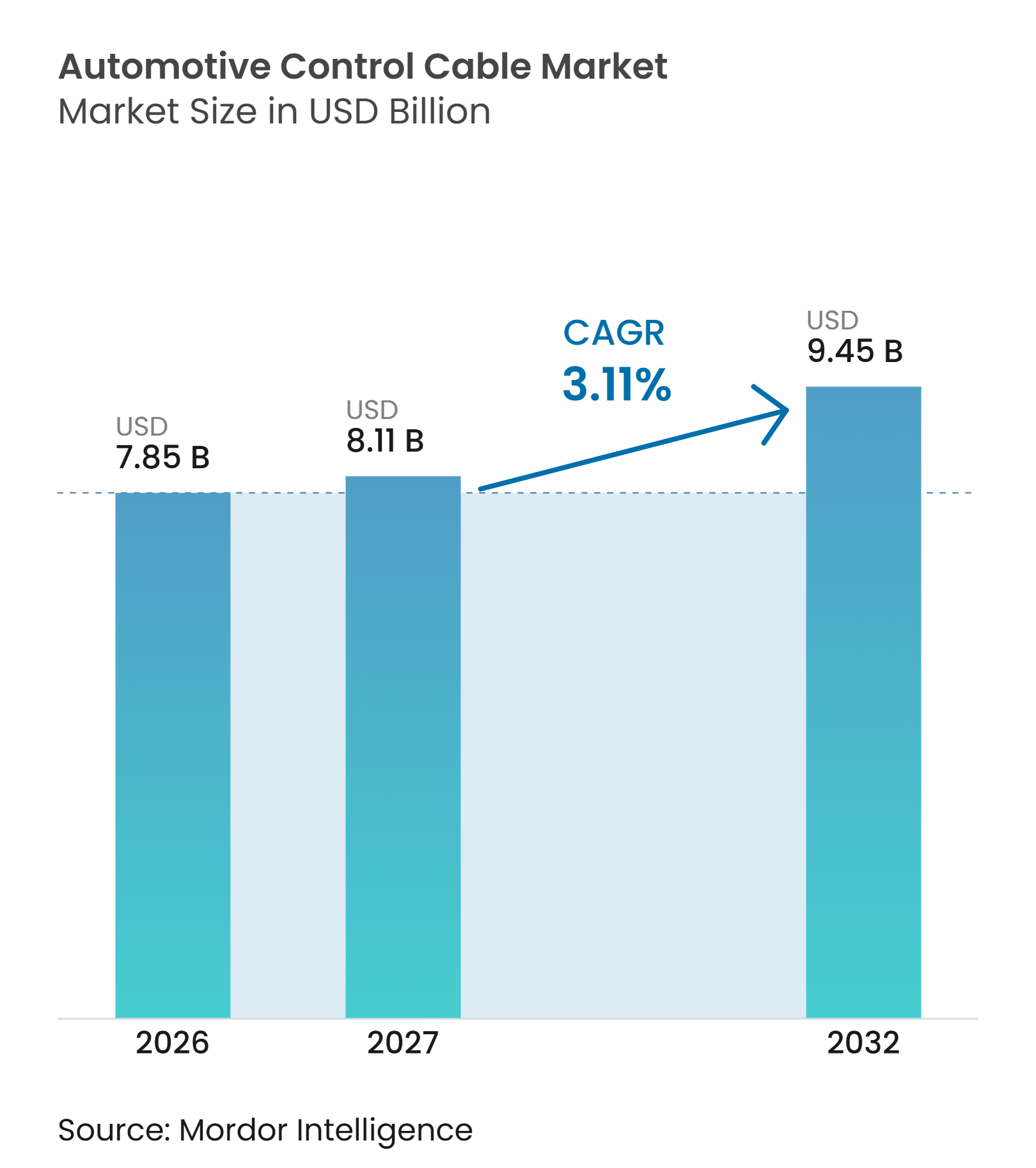
The automotive control cable market size was valued at USD 7.85 billion in 2026 and is expected to grow from USD 8.11 billion in 2027 to USD 9.45 billion by 2032, at a CAGR of 3.11% during 2027-2032. Mechanical cables remain important where vehicle makers need low-cost, compact, and dependable actuation for body, brake, and interior functions. Demand is supported by two-wheeler and commercial vehicle production in Asia-Pacific, along with replacement needs from older vehicles in North America and Europe. Electrification reduces cable content in some powertrain and braking systems, but it also keeps mechanical actuation relevant for hood release, trunk release, fuel-filler latches, seat adjustment, and HVAC controls. This split is shaping product planning across the automotive control cable market, with suppliers shifting capacity toward body, interior, and two-wheeler applications. Competitive activity increasingly centers on local manufacturing, OEM program wins, and integrated door or mechatronic modules rather than standalone cable supply.
Key Report Takeaways
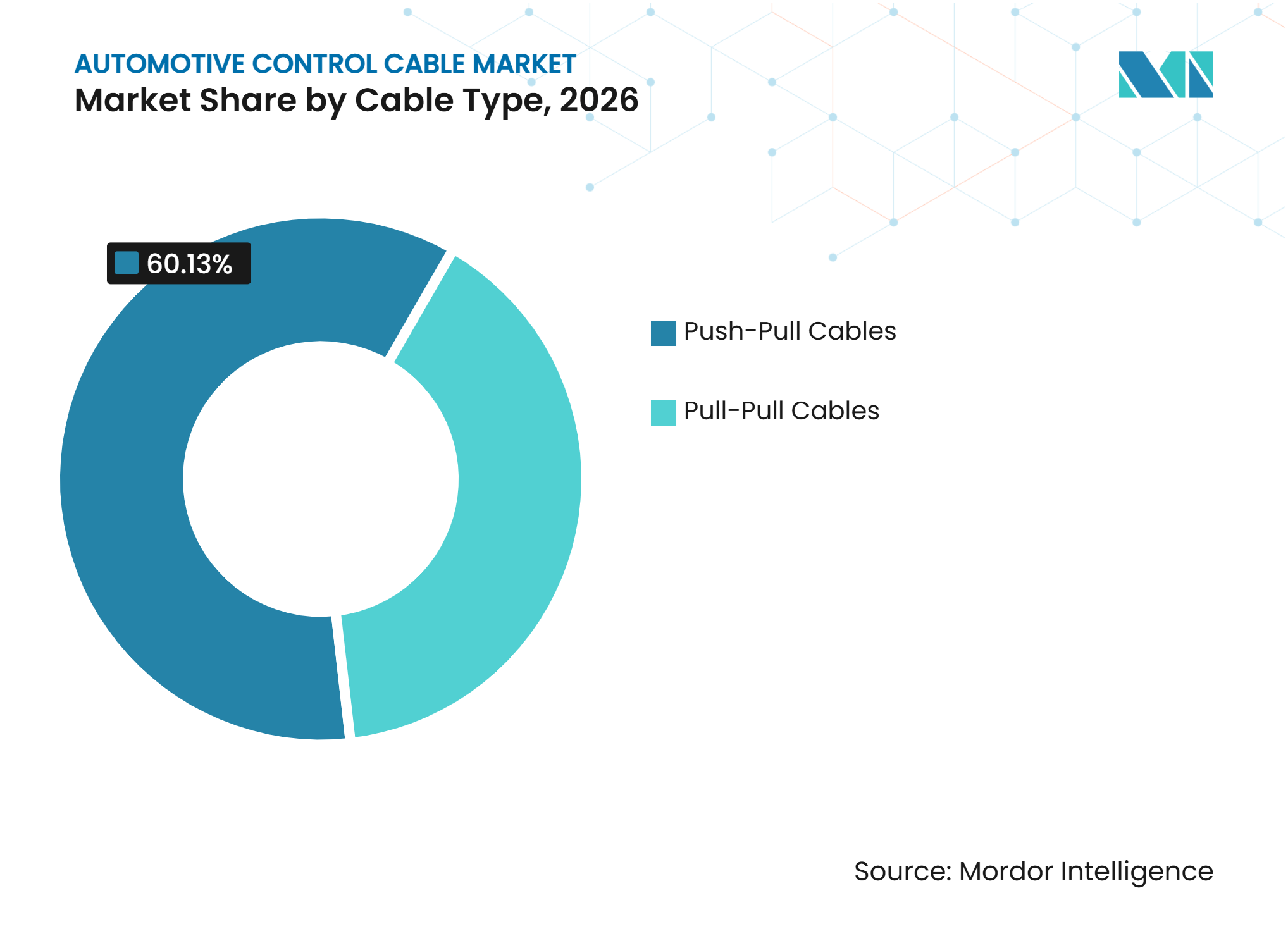
- By cable type, push-pull cables held a 60.13% share in 2026, while pull-pull cables are forecast to grow at a 4.23% CAGR through 2032.
- By application, parking brake cables held a 23.33% share in 2026, while others, including fuel lid and HVAC controls, are projected to grow at a 5.49% CAGR through 2032.
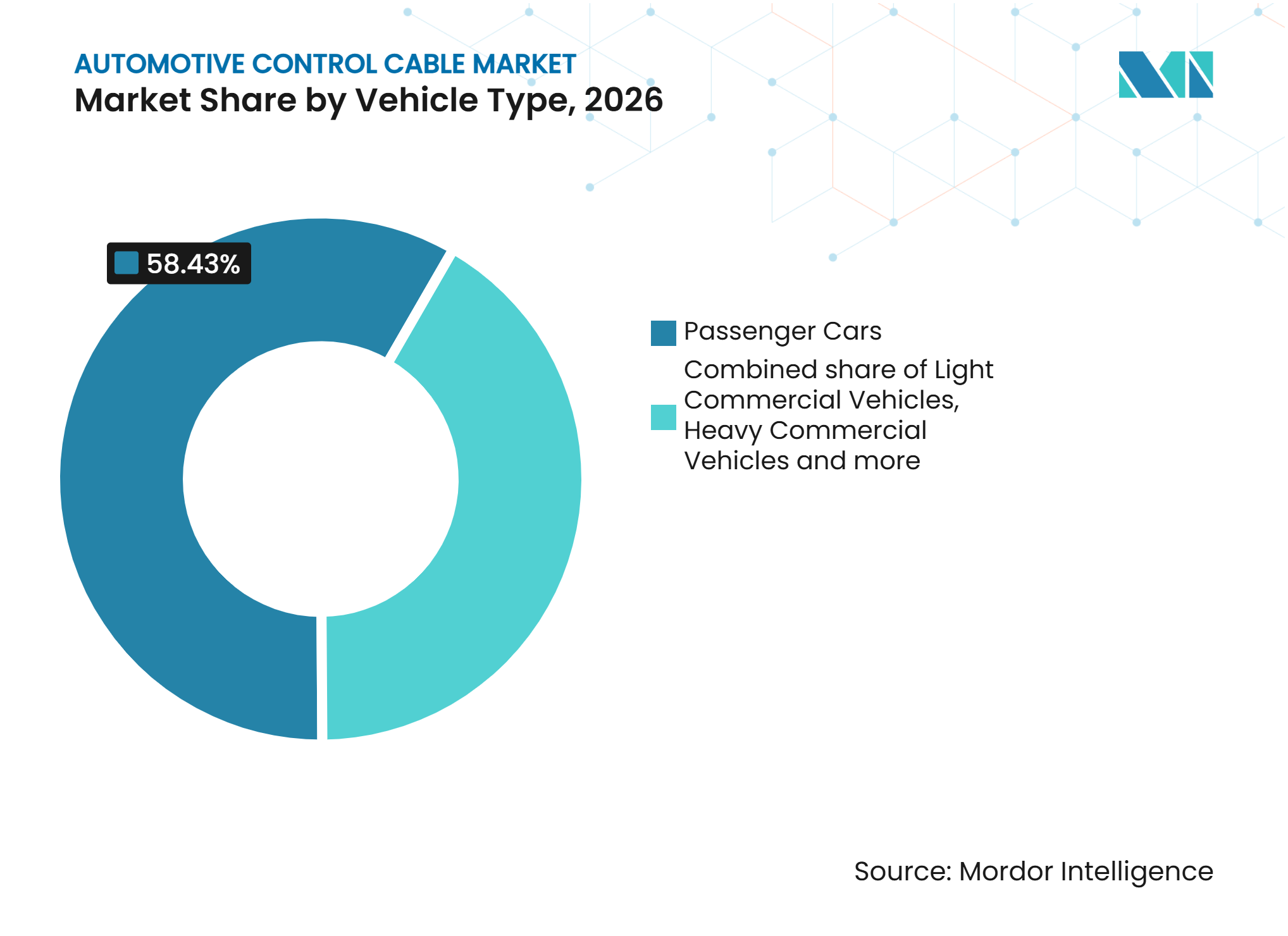
- By vehicle type, passenger cars held a 58.43% share in 2026, while heavy commercial vehicles are forecast to expand at a 5.16% CAGR through 2032.
- By sales channel, OEM held an 80.83% share in 2026, while aftermarket is projected to grow at a 5.71% CAGR through 2032.
- By geography, Asia-Pacific held a 50.13% share in 2026 and is forecast to expand at a 4.75% CAGR through 2032.
Note: Market numbers in this report are based on Mordor Intelligence's proprietary estimation framework, which combines nine months of actuals with Q4 projections for base year 2026.
Market Trends and Insights
Drivers Impact Analysis of Automotive Control Cable Market*
| Driver | (~) % Impact on CAGR Forecast | Geographic Relevance | Impact Timeline |
|---|---|---|---|
| Rising Vehicle Production and Installed Base in Emerging Markets | +0.6% | Asia-Pacific, South America, and Middle East and Africa | Medium term (2–4 years) |
| High Replacement Demand from Cable Wear, Corrosion, and Vehicle Aging | +0.5% | Global, especially North America, Europe, and South Asia | Short term (≤ 2 years) |
| Cost and Packaging Advantages Versus Electronic Actuation | +0.4% | Global, especially price-sensitive Asia-Pacific and South America | Long term (≥ 4 years) |
| Persistent Manual-Transmission and Two-Wheeler Cable Fitment | +0.3% | Asia-Pacific, Middle East and Africa, and South America | Long term (≥ 4 years) |
| Cable Content Retained in Body, Interior, and Safety Functions of Electrified Vehicles | +0.2% | Global, led by Europe and North America | Medium term (2–4 years) |
| Localized Sourcing and Platform-Cost Pressure in Asia-Pacific and Other Low-Cost Hubs | +0.2% | Asia-Pacific, Morocco, and Mexico | Medium term (2–4 years) |
| Source: Mordor Intelligence | |||
Rising Vehicle Production and Installed Base in Emerging Markets
Vehicle assembly and the growing in-service fleet create parallel demand for original equipment and replacement cables. India produced more than 34.7 million vehicles across categories in FY2025-26, including 26.69 million two-wheelers[1]. Two-wheeler domestic sales exceeded 20.5 million units in calendar year 2025, up 4.9% year over year. Motorcycles and scooters use cables for functions such as clutch, throttle, brake, and speedometer operation, which gives this vehicle class a high cable requirement per unit. This production base provides a steady volume foundation for the automotive control cable market even as premium passenger cars add more electronic controls. Demand also benefits from replacement cycles as the vehicle parc expands across South and Southeast Asia.
High Replacement Demand from Cable Wear, Corrosion, and Vehicle Aging
Replacement demand is less dependent on annual vehicle production than OEM demand. The average age of light vehicles in the United States reached 12.8 years in 2025, supporting a large installed base that requires ongoing maintenance. Cable wear, corrosion, and fatigue can require replacement of parking brake, clutch, and hood-release cables over a vehicle’s service life. Remsons Industries secured a seven-year, INR 3,000 million control cable supply order from Stellantis North America in May 2025 for Jeep Wrangler and RAM platforms, which will also add to the future service-parts population in the region[2]. Long-running OEM programs of this kind also create the installed base that later drives replacement demand. Older fleets in Europe and North America therefore support the automotive control cable market through parts distributors, workshops, and online channels.
Cost and Packaging Advantages Versus Electronic Actuation
Mechanical control cables remain attractive in entry-level and mid-priced vehicles because they are simple to package and do not require electronic control hardware. Their use can help automakers control the cost of body and comfort functions when vehicle programs already carry higher spending on batteries, sensors, and safety electronics. ISO 26262 applies functional-safety requirements to electrical and electronic systems, which can add development and validation work for by-wire functions. These factors make cables practical for secondary functions such as hood release and selected parking or HVAC controls. The automotive control cable market also benefits where the manual fallback function is valued by vehicle designers and service networks. The cost advantage is most relevant in India, Indonesia, Brazil, and other markets with a large share of value-focused vehicle configurations.
Persistent Manual-Transmission and Two-Wheeler Cable Fitment
Manual-transmission and two-wheeler platforms continue to provide a durable cable demand base. India produced 1.17 million commercial vehicles in FY2025-26, compared with 1.03 million in FY2024-25. The country also exported nearly 4.94 million two-wheelers in 2025, a 24.2% increase from the prior year. These vehicle classes commonly retain mechanical throttle, clutch, gear-shift, and brake cable systems because serviceability and purchase price remain important. Suprajit Engineering continued to win new cable programs in FY2025-26, including electric-vehicle cable contracts. This demand pattern gives the automotive control cable market a level of insulation from the faster electrification of premium passenger car systems.
Restraints Impact Analysis of Automotive Control Cable Market*
| Restraint | (~) % Impact on CAGR Forecast | Geographic Relevance | Impact Timeline |
|---|---|---|---|
| Electronic Throttle, Shift-by-Wire, and Electronic Parking-Brake Substitution | -0.6% | Global, concentrated in Europe, North America, China, and South Korea | Short term (≤ 2 years) |
| OEM Design Migration Toward Zonal and Mechatronic Architectures | -0.4% | Europe, North America, and China | Medium term (2–4 years) |
| Qualification, Traceability, and Warranty Requirements Raise Supplier Costs | -0.3% | Global, especially Tier-2 suppliers serving European and North American OEMs | Long term (≥ 4 years) |
| Steel, Polymer, and Freight Cost Volatility Compresses Cable Margins | -0.2% | Global, especially export-oriented producers in India and China | Short term (≤ 2 years) |
| Source: Mordor Intelligence | |||
Electronic Throttle, Shift-by-Wire, and Electronic Parking-Brake Substitution
Electronic actuation is reducing demand for mechanical cables in selected powertrain and braking applications. Bosch planned the market launch of its brake-by-wire system from fall 2025 and expects more than 5.5 million vehicles worldwide to use brake-by-wire by 2030. ZF also announced a major OEM order for its hybrid brake-by-wire system in January 2025. HI-LEX resolved in July 2026 to liquidate HI-LEX America, citing lower demand for control cables as vehicle architectures change. The effect is most visible in premium passenger car braking and powertrain systems, where electronic architectures are adopted earlier. It does not remove the requirement for mechanical actuation in all body and interior functions.
OEM Design Migration Toward Zonal and Mechatronic Architectures
Zonal electrical architectures consolidate vehicle functions into fewer controllers and can replace cables in electronically managed interior systems. This transition raises the risk for suppliers concentrated in seat adjustment, door-latch, and HVAC cable programs for premium vehicles. HI-LEX announced in July 2026 that it will reorganize its domestic production operations in Japan in stages through FY2028, while expanding its integrated door-system business. IATF 16949 remains an important quality-management framework for automotive production and related service parts organizations. Suppliers moving from cable assemblies to integrated modules face greater requirements for traceability, testing, systems engineering, and warranty performance. These demands can increase the cost of participation, particularly for smaller suppliers that lack module-level engineering resources.
*Our forecasts treat driver/restraint impacts as directional, not additive. The impact forecasts reflect baseline growth, mix effects, and variable interactions.
Automotive Control Cable Market Segment Analysis
By Cable Type:
Push-Pull Cables Lead While Pull-Pull Cables Gain UsePush-pull cables held a 60.13% share of the automotive control cable market in 2026. They can transmit force in both tension and compression, which makes them suitable for transmission, clutch, parking brake, hood-release, and seat-adjustment applications. Their broad fitment across manual vehicles and body systems keeps them central to OEM cable specifications. The installed base also supports recurring replacement demand from the aftermarket. This scale advantage makes push-pull cables the principal volume segment in the automotive control cable market.
Pull-pull cables are projected to grow at a 4.23% CAGR from 2027 to 2032. They are used where two-way tension movement supports controlled operation, including motorcycle throttle systems and HVAC blend-door controls. Their fitment in premium two-wheeler throttle grips also supports designs that require a more specific resistance and response feel. Both cable types benefit from lower-friction liners and improved conduit materials that can reduce operating resistance. These design improvements can extend service life and support a better value proposition for OEM sourcing teams. The cable type mix is therefore likely to remain balanced between high-volume push-pull use and more focused pull-pull applications.


By Application:
HVAC and Body Controls Support the Growth ProfileParking brake cables held a 23.33% share of the automotive control cable market in 2026. Their large installed base reflects the continuing use of mechanical parking brakes across older vehicles and many value-oriented new vehicle platforms. Replacement demand remains meaningful because parking-brake systems are exposed to road conditions, moisture, and regular use. Electronic parking-brake adoption is a clear restraint in new premium passenger cars. Bosch and ZF product launches show that brake-by-wire systems are advancing in this part of the vehicle fleet. The replacement pool nevertheless remains important for cable suppliers.
Other applications, including fuel lid and HVAC controls, are forecast to grow at a 5.49% CAGR through 2032. This group benefits as demand shifts away from powertrain functions toward body and interior functions. Hood and trunk release, door-latch, seat-adjustment, and fuel-filler applications are less exposed to immediate substitution in lower-priced vehicles. Mechanical HVAC blend-door controls also remain relevant in value-focused B- and C-segment models. The automotive control cable industry can use these applications to offset losses in accelerator, clutch, gear-shift, and parking-brake cables. Suppliers that package cable assemblies with latches or trim modules may have stronger access to new programs.
By Vehicle Type:
Passenger Cars Remain the Volume BasePassenger cars held 58.43% of the automotive control cable market share in 2026. Their volume position reflects global passenger vehicle production and broad use of cables across body, interior, and service applications. However, premium passenger cars face the most direct loss of mechanical throttle, clutch, and parking-brake content. Electronic controls are more likely to appear first in these platforms because their higher prices can absorb the added system cost. The remaining demand increasingly concentrates in body functions and in lower-priced passenger car configurations. This makes application selection more important than passenger car volume alone.
Heavy commercial vehicles are forecast to grow at a 5.16% CAGR through 2032. Trucks and buses retain mechanical gear-shift, throttle, and parking-brake cable functions in many regions because durability, repair access, and operating cost matter. India’s commercial vehicle output rose to 1.17 million units in FY2025-26. Light commercial vehicles provide an intermediate demand base, with strong cable content in developing-market configurations. Two-wheelers remain especially important because price-sensitive motorcycles and scooters retain several mechanical cable functions. The automotive control cable industry therefore depends on a vehicle mix that extends well beyond passenger cars.


By Sales Channel:
OEM Retains Scale and Aftermarket Grows FasterThe OEM channel held an 80.83% share of the automotive control cable market in 2026. Cable sets are often specified with the vehicle platform and supplied by qualified Tier-1 manufacturers in large production volumes. Multi-year OEM programs provide suppliers with predictable demand, but they also require engineering support, tooling investment, and strict quality performance. IATF 16949 certification is an important entry requirement for suppliers seeking such vehicle programs. The channel remains central because it creates the installed cable population that feeds replacement sales later.
The aftermarket is forecast to grow at a 5.71% CAGR through 2032. Older vehicles create recurring demand for parking brake, clutch, throttle, hood-release, and related cable replacements. The 12.8-year average age of US light vehicles in 2025 illustrates the size of this maintenance opportunity. Long-running OEM programs, such as Remsons’ Stellantis North America order, create the installed base that later supports vehicle-specific replacement parts programs. Organized distributors and digital parts channels may improve availability of cable kits compared with traditional workshop-led sales. This supports higher replacement penetration across the automotive control cable market.
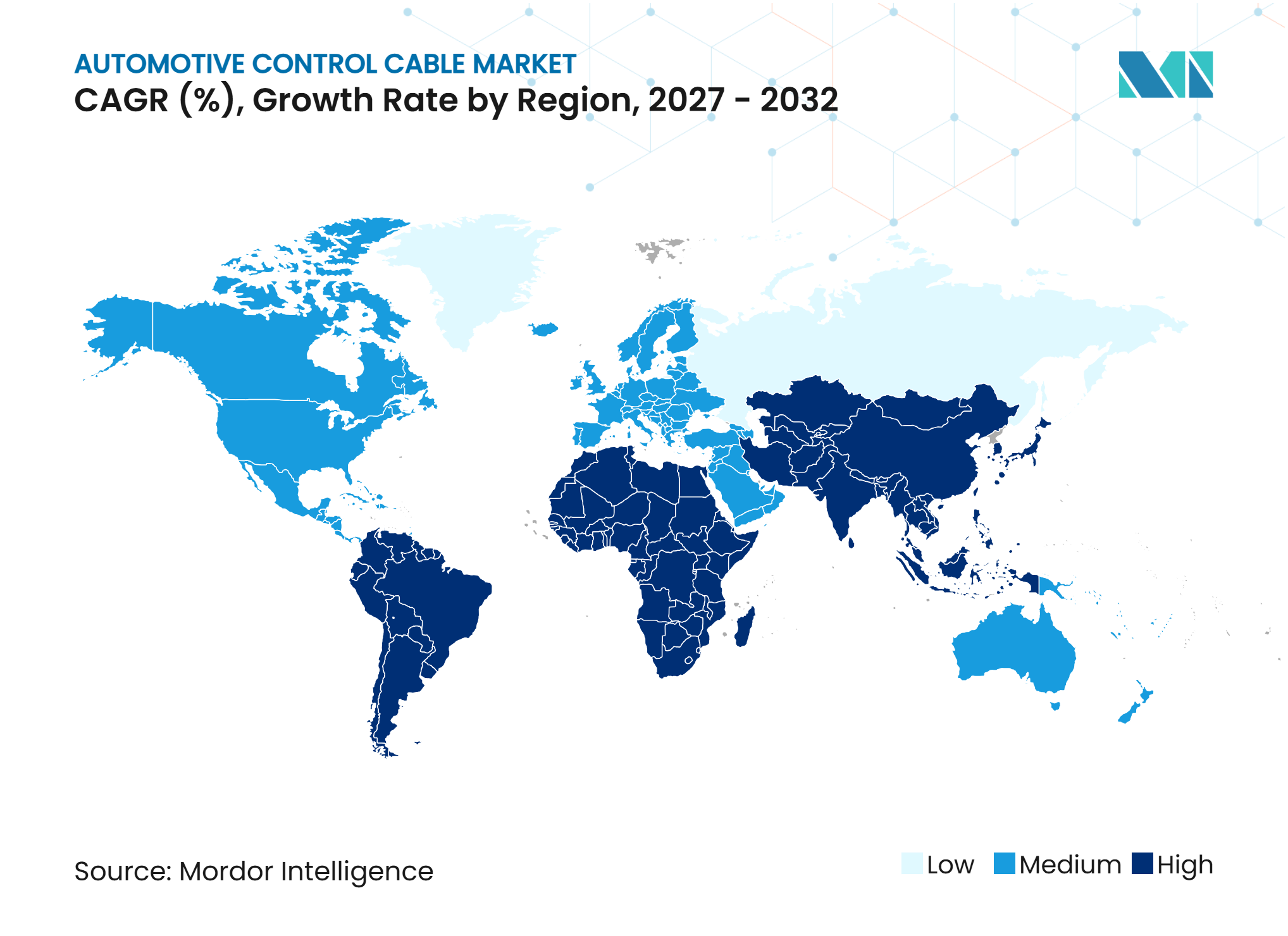
Geography Analysis
Asia-Pacific
Asia-Pacific held 50.13% of the automotive control cable market share in 2026 and is projected to grow at a 4.75% CAGR through 2032. India’s 26.69 million two-wheeler output in FY2025-26 gives the region a substantial base for cable demand. The region also combines manual-transmission passenger car and light commercial vehicle production with a growing replacement base in Indonesia, Vietnam, the Philippines, and other markets. Suprajit Engineering and Chuo Spring formed a joint venture in India to make control cables for regional OEM production. China’s shift to electronic parking brakes creates pressure on new passenger-car cable content, but two-wheelers, commercial vehicles, and body controls still provide demand. Local supply networks and price-sensitive vehicle programs make Asia-Pacific the main volume center for the automotive control cable market.
Europe
Europe is supported by its mature vehicle parc, established aftermarket networks, and the purchasing influence of German, French, and Italian vehicle manufacturers. Remsons secured an INR 800 million order from Ford Otosan in Turkey for spare-wheel winches in June 2025. This illustrates how OEM programs supplying the European market can create opportunities for producers operating from other regions. Central and Eastern European locations offer a nearshore supply option that can combine lower production cost with IATF 16949 compliance. The growth of zonal architectures at European automakers is a long-term challenge for comfort and interior cable applications. Suppliers with module-level designs and local engineering support are better positioned to serve this changing customer base. Europe remains relevant because of its service parts demand and its role in setting technical specifications for global vehicle platforms.
North America, South America, and Middle East and Africa
North America has less clutch and manual gear-shift cable demand because automatic-transmission pickup trucks and SUVs dominate many sales. HI-LEX’s 2026 decision to liquidate HI-LEX America highlights the pressure that electrification and cost structures can place on local cable operations. The region retains replacement demand from its aging vehicle fleet, particularly for parking brake, hood-release, body, and seat functions. South America, especially Brazil, retains favorable conditions where manual transmissions and repair-led replacement demand remain common. Remsons signed a technical licensing agreement with AUSUS Automotive Systems do Brasil to transfer cable and actuation technology for Brazilian customers. Middle East and Africa also offer a longer-term aftermarket opportunity because imported used vehicles retain conventional mechanical systems. Morocco is emerging as a supply base that can serve African demand and European supply chains.
Competitive Landscape
Market Concentration
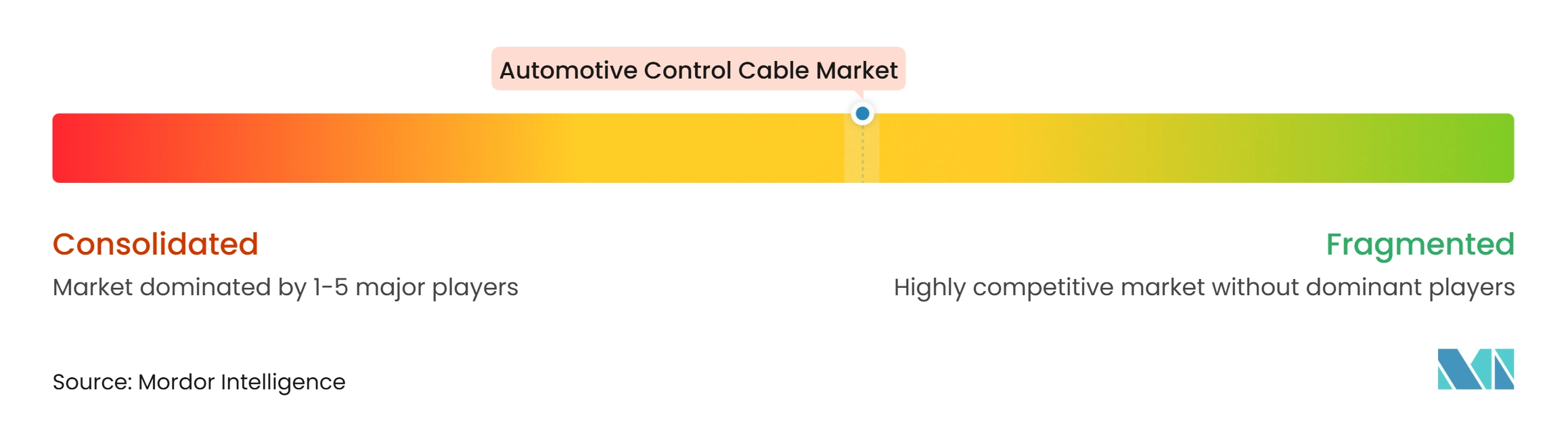
The automotive control cable market has moderate concentration at the global OEM tier, led by vertically integrated suppliers such as HI-LEX Corporation and Suprajit Engineering, with Ficosa, Küster, and Spark Minda holding established OEM positions in Europe and India. A wider group of regional manufacturers and aftermarket distributors competes on price, location, and replacement part availability. OEM cable programs often run across multi-year vehicle lifecycles, which creates switching barriers once suppliers have completed tooling and validation. Quality certification and stable manufacturing performance are important competitive requirements. IATF 16949 remains a core automotive quality framework that supports these barriers. As vehicle architectures change, suppliers are seeking revenue beyond standalone wire-and-conduit assemblies.
HI-LEX is pursuing this shift through a domestic restructuring that reduces its production-site footprint and increases attention on integrated door-system products. The company also completed the acquisition of Hi-Lex Act in November 2025, adding door-latch and power-slide-door capabilities. Suprajit is expanding its manufacturing and engineering footprint through the Chuo Spring joint venture in India. Remsons has pursued long-duration aftermarket and OEM supply orders in North America and Turkey while building Indian capacity. These actions show that scale, regional access, and integrated products are becoming more important than cable manufacturing capacity alone.
Automated inspection, digital design tools, and robust end-of-line testing can help suppliers improve consistency and reduce warranty exposure. The strategic opportunity lies in door modules, latches, and body-actuation systems where cable design can be paired with higher-value components. The aftermarket also offers room for companies that can build vehicle-specific kits, distribution coverage, and reliable parts availability. Suppliers focused only on premium powertrain cable programs face the strongest substitution risk. Those with exposure to two-wheelers, commercial vehicles, body functions, and regional replacement markets have broader demand coverage. The competitive position of the automotive control cable market is therefore shaped by product mix and OEM integration rather than by unit capacity alone.
Automotive Control Cable Industry Leaders
-
HI-LEX Corporation
-
Suprajit Engineering Limited
-
Ficosa International, S.A.
-
Küster Holding GmbH
-
Spark Minda
- *Disclaimer: Major Players sorted in no particular order
Automotive Control Cable Market Companies Covered in this Report
- HI-LEX Corporation
- Suprajit Engineering Limited
- Ficosa International, S.A.
- Küster Holding GmbH
- Cable Manufacturing and Assembly, Inc. (Cablecraft Motion Controls)
- Grand Rapids Controls, LLC
- Chuo Spring Co., Ltd.
- Orscheln Products L.L.C.
- Sila Holding Industriale S.p.A.
- Remsons Industries Limited
- Kwangjin Co., Ltd.
- Ningbo Gaofa Automotive Control System Co., Ltd.
- THAI STEEL CABLE PUBLIC COMPANY LIMITED
- Samvardhana Motherson International Limited
- Spark Minda
- WR Controls Group AB
- Cofle S.p.A.
- Tata AutoComp Systems Limited
- Kyung Chang Industrial Co., Ltd.
Recent Industry Developments in Automotive Control Cable Market
- September 2026: ASK GTD Control Cables, a joint venture of ASK Automotive and Germany-based T.D. Holding GmbH, began commercial production of sunroof and helix control cables for passenger vehicles at its Karoli facility in Rajasthan, India.
- August 2026: Brepafin, the holding company of Italy-based gearshift control and flexible cable maker Sila Group, announced a two-stage acquisition of switch manufacturer Vimercati Group, expected to close in early 2027.
- July 2026: HI-LEX Corporation resolved to liquidate its US subsidiary HI-LEX America and to reorganize its domestic production in Japan, citing lower demand for control cables.
- May 2026: Suprajit Engineering’s global cables and mechatronics division secured new contracts worth about USD 12 million per year, including its largest electric-vehicle cable contract from a North American automaker, to be supplied from its Matamoros, Mexico plant.
Global Automotive Control Cable Market Report Scope
The automotive control cable market is segmented by cable type, application, vehicle type, sales channel, and geography. By cable type, the market is segmented into push-pull cables and pull-pull cables. By application, the market is segmented into accelerator/throttle, clutch, parking brake, gear shift/transmission, hood and trunk release, door latch, seat adjustment, and others (fuel lid, HVAC). By vehicle type, the market is segmented into passenger cars, light commercial vehicles, heavy commercial vehicles, and two-wheelers. By sales channel, the market is segmented into OEM and aftermarket. By geography, the market is segmented into North America, Europe, Asia-Pacific, South America, and the Middle East and Africa. North America includes the United States, Canada, and Mexico; Europe includes Germany, France, the United Kingdom, Italy, Spain, Russia, Poland, and Rest of Europe; Asia-Pacific includes China, Japan, India, South Korea, Thailand, Indonesia, Vietnam, and Rest of Asia-Pacific; South America includes Brazil, Argentina, Colombia, and Rest of South America; and Middle East and Africa includes Saudi Arabia, the United Arab Emirates, South Africa, Egypt, Turkey, and Rest of Middle East and Africa. The market sizes and forecasts are provided in terms of value (USD) and volume (units) for all the above segments.
Segmentation Overview
| Push-Pull Cables |
| Pull-Pull Cables |
| Accelerator/Throttle |
| Clutch |
| Parking Brake |
| Gear Shift/Transmission |
| Hood and Trunk Release |
| Door Latch |
| Seat Adjustment |
| Others (Fuel Lid, HVAC) |
| Passenger Cars |
| Light Commercial Vehicles |
| Heavy Commercial Vehicles |
| Two-Wheelers |
| OEM |
| Aftermarket |
| North America | United States |
| Canada | |
| Mexico | |
| Europe | Germany |
| France | |
| United Kingdom | |
| Italy | |
| Spain | |
| Russia | |
| Poland | |
| Rest of Europe | |
| Asia-Pacific | China |
| Japan | |
| India | |
| South Korea | |
| Thailand | |
| Indonesia | |
| Vietnam | |
| Rest of Asia-Pacific | |
| South America | Brazil |
| Argentina | |
| Colombia | |
| Rest of South America | |
| Middle East and Africa | Saudi Arabia |
| United Arab Emirates | |
| South Africa | |
| Egypt | |
| Turkey | |
| Rest of Middle East and Africa |
| By Cable Type | Push-Pull Cables | |
| Pull-Pull Cables | ||
| By Application | Accelerator/Throttle | |
| Clutch | ||
| Parking Brake | ||
| Gear Shift/Transmission | ||
| Hood and Trunk Release | ||
| Door Latch | ||
| Seat Adjustment | ||
| Others (Fuel Lid, HVAC) | ||
| By Vehicle Type | Passenger Cars | |
| Light Commercial Vehicles | ||
| Heavy Commercial Vehicles | ||
| Two-Wheelers | ||
| By Sales Channel | OEM | |
| Aftermarket | ||
| By Geography | North America | United States |
| Canada | ||
| Mexico | ||
| Europe | Germany | |
| France | ||
| United Kingdom | ||
| Italy | ||
| Spain | ||
| Russia | ||
| Poland | ||
| Rest of Europe | ||
| Asia-Pacific | China | |
| Japan | ||
| India | ||
| South Korea | ||
| Thailand | ||
| Indonesia | ||
| Vietnam | ||
| Rest of Asia-Pacific | ||
| South America | Brazil | |
| Argentina | ||
| Colombia | ||
| Rest of South America | ||
| Middle East and Africa | Saudi Arabia | |
| United Arab Emirates | ||
| South Africa | ||
| Egypt | ||
| Turkey | ||
| Rest of Middle East and Africa | ||
Key Questions Answered in the Report
What is the automotive control cable market size?
The automotive control cable market was valued at USD 7.85 billion in 2026 and is projected to reach USD 9.45 billion by 2032, growing at a 3.11% CAGR during 2027-2032.
Which vehicle category is expected to show the fastest cable demand growth?
Heavy commercial vehicles are projected to grow at a 5.16% CAGR through 2032, supported by continuing use of mechanical control systems.
Which region leads demand for automotive control cables?
Asia-Pacific held a 50.13% share in 2026 and is projected to grow at a 4.75% CAGR through 2032, supported by two-wheeler production and localized supply.
How does vehicle electrification affect cable suppliers?
Electrification reduces cable demand in some braking and powertrain systems, while body, interior, and two-wheeler functions continue to support mechanical cable demand.