
Automotive Cockpit Domain Controller Market Size and Share
Market Overview
| Study Period | 2020 - 2032 |
|---|---|
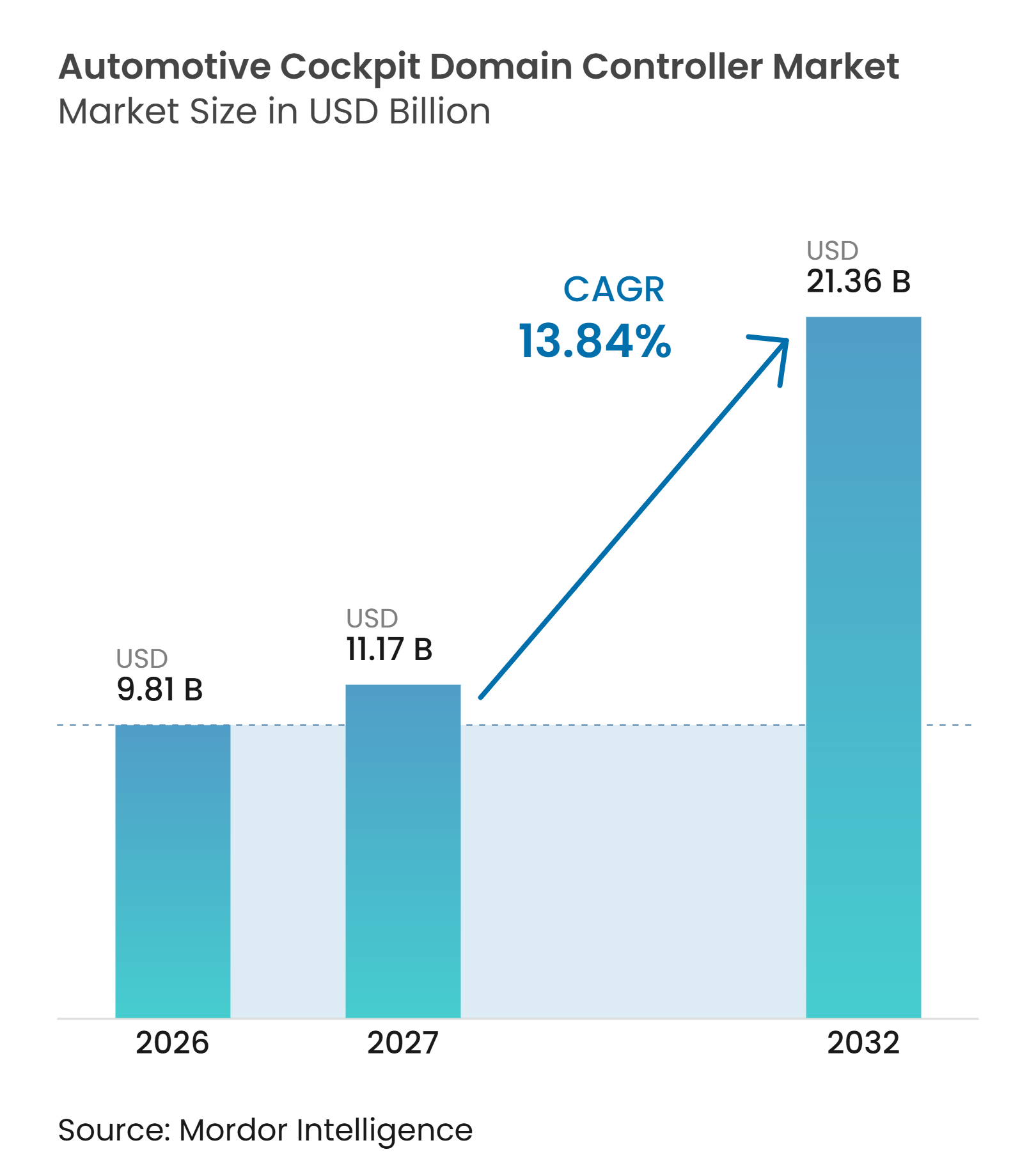
| Market Size (2027) | USD 11.17 Billion |
| Market Size (2032) | USD 21.36 Billion |
| Growth Rate (2027 - 2032) | 13.84 % |
| Fastest Growing Market | Asia-Pacific |
| Largest Market | Asia-Pacific |
| Market Concentration | Medium |
Major Players *Disclaimer: Major Players sorted in no particular order Image © Mordor Intelligence. Reuse requires attribution under CC BY 4.0. | |
Automotive Cockpit Domain Controller Market Analysis by Mordor Intelligence
The automotive cockpit domain controller market size was valued at USD 9.81 billion in 2026 and is expected to grow from USD 11.17 billion in 2027 to USD 21.36 billion by 2032, at a CAGR of 13.84% during 2027-2032. The market is moving from separate electronic control units toward centralized compute platforms that manage clusters, infotainment, head-up displays, rear entertainment, and driver monitoring functions. This change increases the software content carried by each vehicle and makes updates after sale more important to vehicle programs. Demand is also supported by vehicle makers that want fewer control units, less wiring, and a simpler electronics bill of materials. Semiconductor supply risk has made these integrated designs more important because fewer processors can reduce exposure to a complex component stack. The automotive cockpit domain controller market is becoming more dependent on suppliers that can combine qualified hardware, safety software, cybersecurity controls, and vehicle-level validation.
Key Report Takeaways
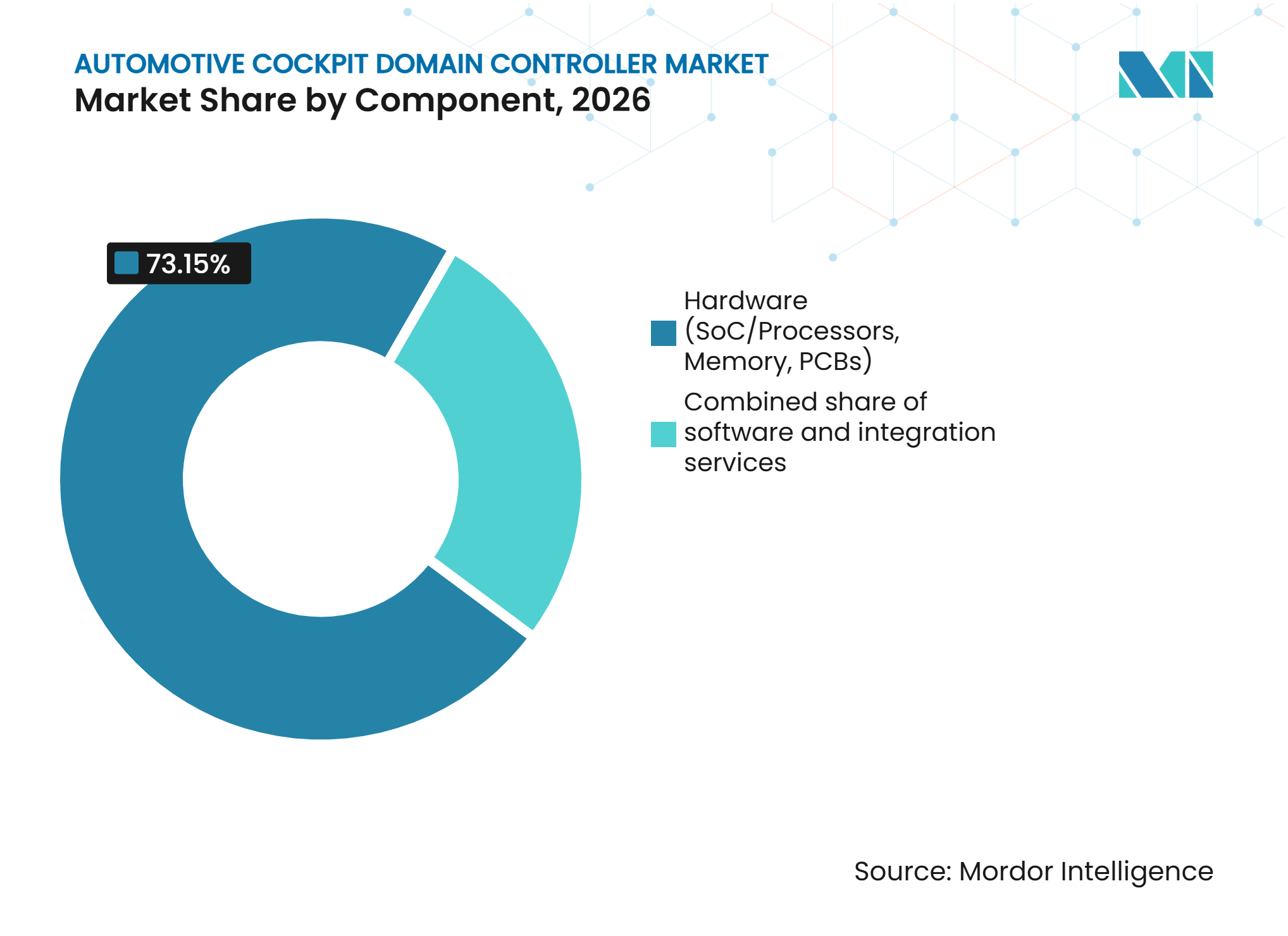
- By component, hardware held a 73.15% share in 2026, while integration services are projected to grow at a 17.25% CAGR through 2032.
- By display integration, 4–5 displays held a 49.33% share in 2026, while 6+ displays are projected to grow at a 20.14% CAGR through 2032.
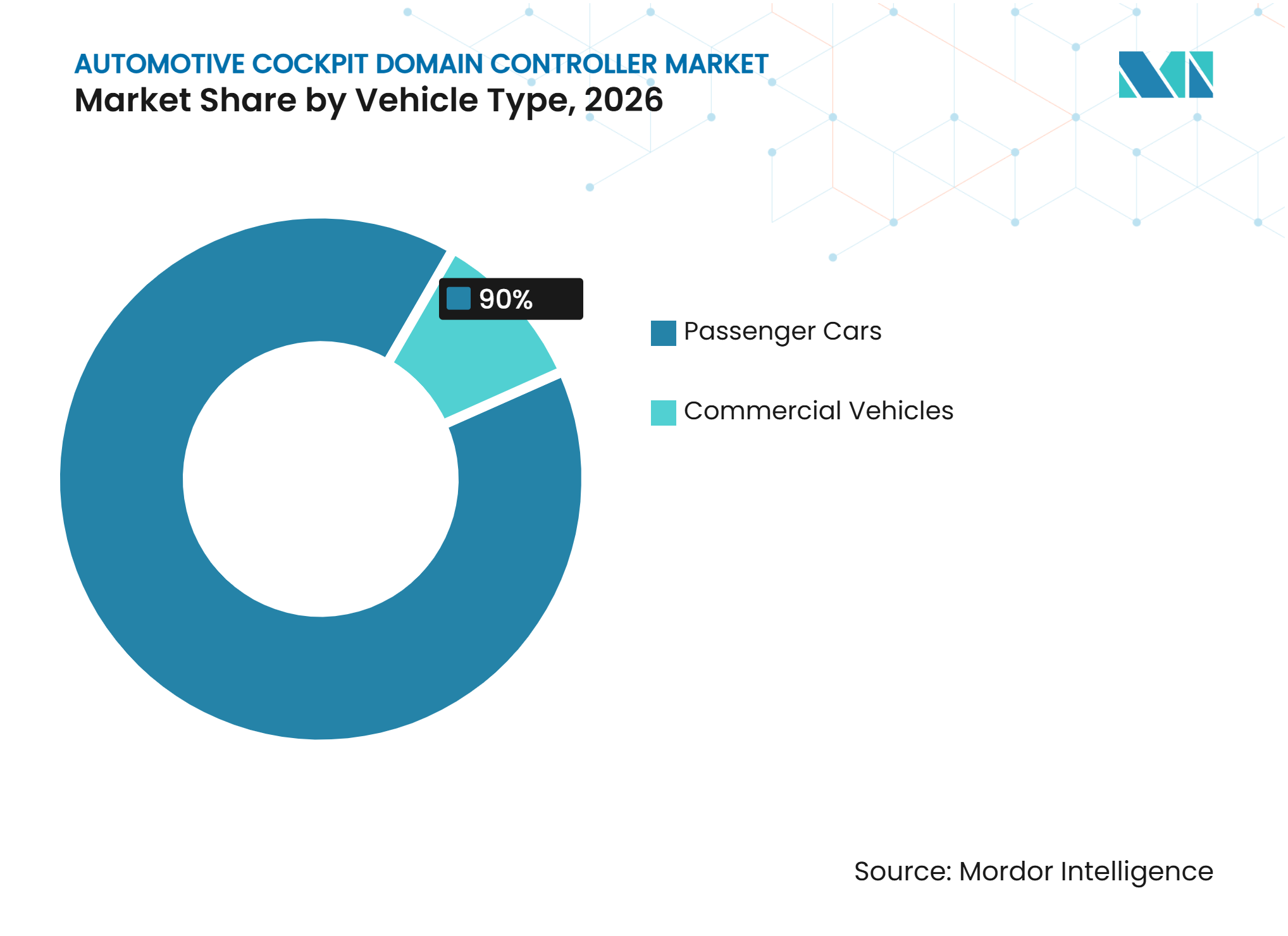
- By vehicle type, passenger cars held a 90.00% share in 2026, while commercial vehicles are projected to grow at a 16.12% CAGR through 2032.
- By propulsion, internal combustion engine vehicles held a 63.18% share in 2026, while electric vehicles are projected to grow at a 19.34% CAGR through 2032.
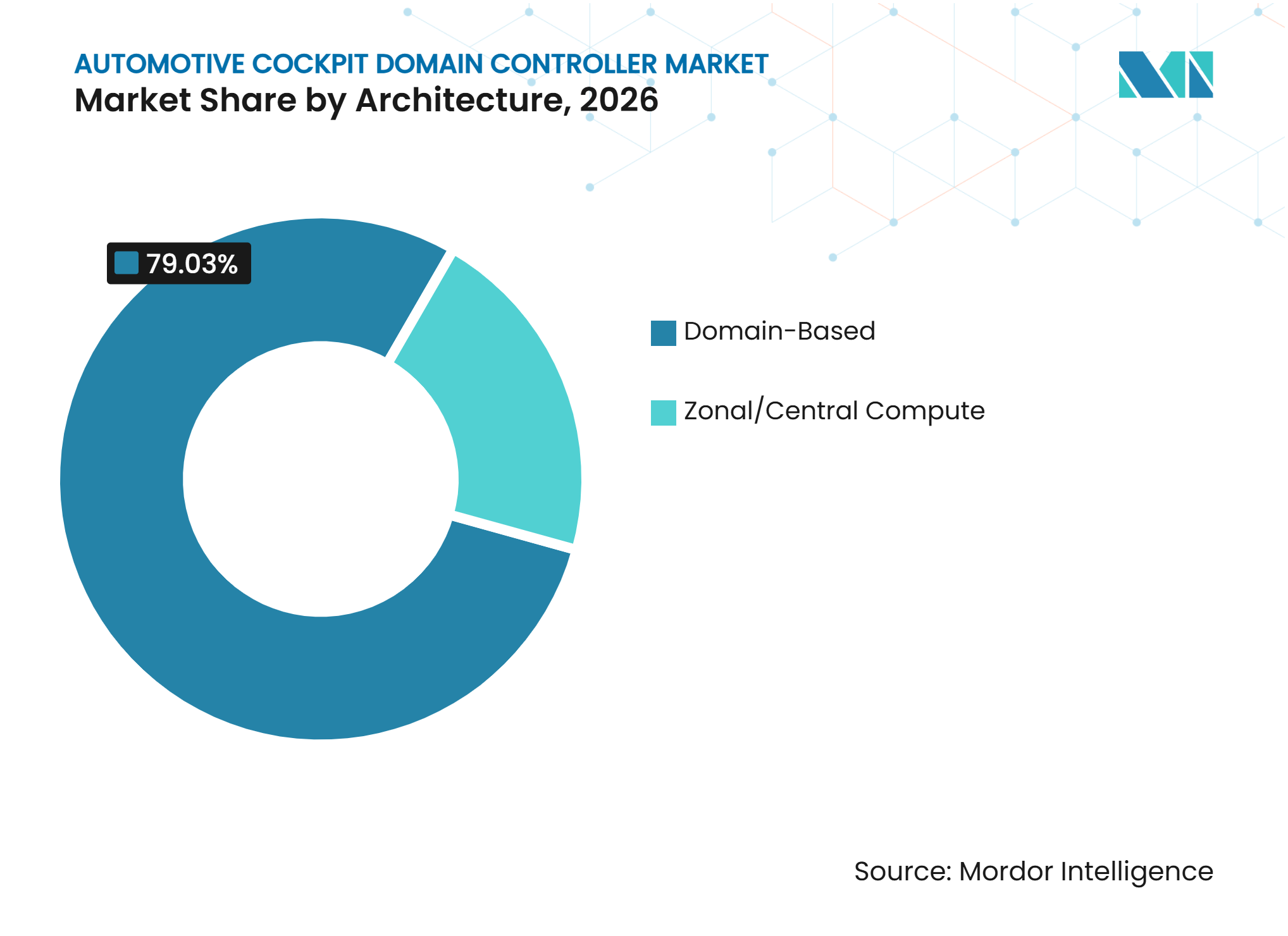
- By architecture, domain-based systems held a 79.03% share in 2026, while zonal/central compute systems are projected to grow at a 22.45% CAGR through 2032.
- By sales channel, OEMs held a 98.00% share in 2026 and are projected to grow at a 13.90% CAGR through 2032.
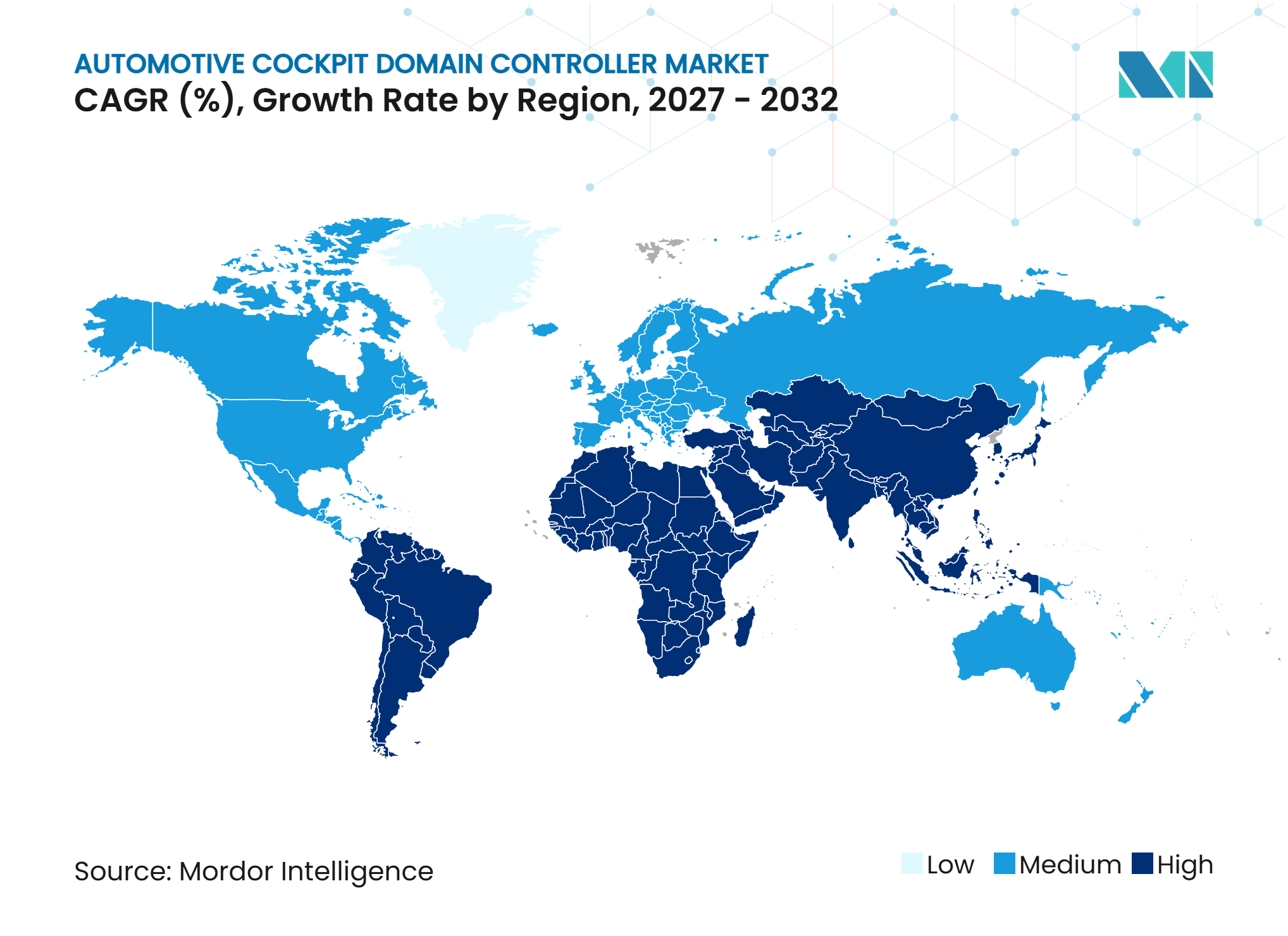
- By geography, Asia-Pacific held a 48.50% share in 2026 and is projected to grow at a 14.88% CAGR through 2032.
Note: Market numbers in this report are based on Mordor Intelligence's proprietary estimation framework, which combines nine months of actuals with Q4 projections for base year 2026.
Market Trends and Insights
Drivers Impact Analysis of Automotive Cockpit Domain Controller Market*
| Driver | (~) % Impact on CAGR Forecast | Geographic Relevance | Impact Timeline |
|---|---|---|---|
| Rising Multi-Display Cockpit Integration in New Vehicle Programs | +3.0% | Global, led by China and Europe | Short term (≤ 2 years) |
| Software-Defined Vehicle Platforms Increasing Demand for Consolidated Cockpit Compute | +2.8% | Global | Medium term (2–4 years) |
| Growing Use of High-Performance Automotive SoCs and Virtualization | +2.5% | Global, led by China and North America | Medium term (2–4 years) |
| China-Led Intelligent-Cockpit Deployment Expanding Controller Volumes | +2.5% | Asia-Pacific, with spillover to Middle East and Africa and South America | Short term (≤ 2 years) |
| Electric Vehicle Architectures Accelerating Centralized Cockpit Electronics | +2.0% | China, Europe, and North America | Medium term (2–4 years) |
| OEM Pressure to Reduce ECU Count, Wiring Complexity, and Bill of Materials | +1.5% | Global | Long term (≥ 4 years) |
| Source: Mordor Intelligence | |||
Rising Multi-Display Cockpit Integration in New Vehicle Programs
Multi-display layouts now extend beyond premium models as vehicle makers use screens to differentiate mainstream vehicles. Camera monitor systems approved as replacements for exterior mirrors add further display outputs that must be managed in the cockpit. This raises the need for a controller that can coordinate separate operating environments, resolutions, and refresh rates on shared compute hardware. The automotive cockpit domain controller market also has to support display systems that vary by trim level while keeping the core electronics platform consistent. Samsung Display presented a 34-inch dual-OLED dashboard panel at IAA Mobility 2025 that can work as one surface or two independent displays, showing the higher display loads facing cockpit platforms [1].
Software-Defined Vehicle Platforms Increasing Demand for Consolidated Cockpit Compute
Software-defined vehicle programs are changing the cockpit controller from a program-specific unit into a platform that can be updated across the vehicle life cycle. Elektrobit introduced its EB civion suite at CES 2026 to provide cloud-native tools, middleware, and cockpit development assets for vehicle makers. These tools support shorter development cycles and more consistent software deployment across vehicle lines. In the automotive cockpit domain controller market, this makes software release management a core part of supplier delivery rather than a secondary service. In July 2026, Qualcomm reported record quarterly automotive revenue of about USD 1.59 billion, up 61% year on year, driven by Snapdragon cockpit and driver-assistance platforms. The scale of these platform families provides suppliers and vehicle manufacturers with a clearer foundation for long-term development planning.
Growing Use of High-Performance Automotive SoCs and Virtualization
High-performance system-on-chip designs allow the automotive cockpit domain controller market to support graphics, driver monitoring, voice interfaces, and connected applications on fewer processors. SemiDrive presented its 4nm X10 chip at Auto Shanghai 2025 with a 40-TOPS neural processing unit and support for an on-device multimodal model [2]. The design illustrates how cockpit functions can perform more processing within the vehicle rather than relying on a continuous cloud connection. Hypervisor software can keep a safety-related instrument cluster separate from an Android environment on the same controller. This arrangement helps suppliers reduce hardware duplication while addressing the functional safety needs of mixed criticality systems. It also allows the automotive cockpit domain controller market to serve feature-rich cabins without requiring separate processors for every software function.
China-Led Intelligent-Cockpit Deployment Expanding Controller Volumes
China provides a large deployment base for intelligent cockpit systems, which supports controller volumes and supplier learning across multiple vehicle programs. Local vehicle makers have introduced connected cabin functions and multi-screen layouts in mainstream models, extending advanced cockpit features beyond premium vehicles. This scale helps domestic suppliers develop software, validation, and manufacturing capabilities that can support overseas bids. Desay SV announced in September 2025 that it would offer its intelligent-driving domain controllers, including the NVIDIA DRIVE AGX Thor-based IPU14, to global automakers, showing how Chinese suppliers are using domestic program experience to enter international markets [3]. The automotive cockpit domain controller market benefits as suppliers use Chinese program volume to improve product maturity and broaden their international customer base.
Restraints Impact Analysis of Automotive Cockpit Domain Controller Market*
| Restraint | (~) % Impact on CAGR Forecast | Geographic Relevance | Impact Timeline |
|---|---|---|---|
| High Functional-Safety, Cybersecurity, and Thermal-Management Costs | -1.5% | Global | Medium term (2–4 years) |
| Volatile Automotive Semiconductor and Memory Supply | -1.2% | Global, acute in Europe and Japan | Short term (≤ 2 years) |
| Legacy Software and Vehicle-Program Validation Complexity | -1.0% | Global, pronounced in North America and Europe | Long term (≥ 4 years) |
| OEM Insourcing and Platform Standardization Pressure on Tier-1 Margins | -0.9% | China and Europe | Medium term (2–4 years) |
| Source: Mordor Intelligence | |||
High Functional-Safety, Cybersecurity, and Thermal-Management Costs
A cockpit controller that supports both a safety-related cluster and consumer applications needs extensive validation, cybersecurity work, and thermal design. UN Regulation No. 155 requires a Cybersecurity Management System for new vehicle type approvals in its covered markets [4]. The requirement carries into supplier specifications through cybersecurity engineering, incident response, and software update controls. Smaller suppliers can find the cost of validated software, active cooling, and post-production monitoring difficult to absorb. These demands can lengthen the engineering work required before a controller enters series production. The automotive cockpit domain controller market therefore favors suppliers that can use established validation systems across several vehicle programs.
Volatile Automotive Semiconductor and Memory Supply
Cockpit domain controllers depend on processors, memory, power-management chips, and related components from several supply tiers. A disruption at any point can delay production because these systems combine more components than simpler vehicle electronics. ACEA warned in October 2025 that the Nexperia chip supply disruption could halt European vehicle assembly lines within days. Suppliers and vehicle makers are responding through dual-sourcing reviews and closer attention to the origin of critical components. These measures add complexity to procurement and validation, particularly when a substitute component requires software or hardware changes.
*Our forecasts treat driver/restraint impacts as directional, not additive. The impact forecasts reflect baseline growth, mix effects, and variable interactions.
Automotive Cockpit Domain Controller Market Segment Analysis
By Component:
Services Gain Weight as Hardware Remains the Core SpendHardware accounted for 73.15% of the automotive cockpit domain controller market share in 2026, reflecting the expense of automotive-qualified processors, memory, printed circuit boards, and thermal systems. Hardware remains necessary because a controller has to meet vehicle safety, durability, and cybersecurity requirements before it can support advanced software features. Processors also need sufficient graphics, neural processing, and connectivity capability to serve several displays and applications. This keeps the hardware portion large even as software becomes more important.
Integration services are forecast to expand at a 17.25% CAGR through 2032, the highest rate among components. The integration services segment covers operating-system certification, hypervisor setup, software integration, and over-the-air update validation. These activities grow as vehicle makers use common processor families across more models and expect suppliers to manage program-specific software differences. Visteon stated in its 2025 annual report that SmartCore wins emphasize advanced graphics, more software content, and artificial intelligence workloads. Middleware and human-machine interface software sit between the hardware and services layers. Their importance rises when a platform must coordinate displays, audio, cameras, connectivity, and driver monitoring without compromising safety functions.



By Display Integration:
Six-Plus Displays Raise Processing NeedsThe 4–5 display tier held 49.33% of the automotive cockpit domain controller market share in 2026, making it the established layout for mid-range and premium passenger vehicle programs. This configuration usually combines the instrument cluster, central infotainment display, head-up display, and rear-seat or passenger display functions. It offers vehicle makers a known route to provide a richer cabin interface without redesigning every electronic subsystem. It also gives suppliers a practical baseline for shared cockpit computing.
The 6+ display tier is forecast to grow at a 20.14% CAGR through 2032. Larger screen counts require more graphics bandwidth, display synchronization, and software control. The automotive cockpit domain controller market size for these configurations grows as Chinese vehicle makers introduce panoramic and multi-screen layouts in a wider range of models. The Yangwang U7, which went on sale in China in March 2025, combines three front displays with an augmented-reality head-up display. Entry-level 2–3 display systems remain relevant in commercial vehicles and emerging markets. Visteon showcased its Entry Cockpit platform at CES 2026, enabling smartphone projection on displays under seven inches for cost-sensitive vehicle programs.
By Vehicle Type:
Passenger Cars Lead While Commercial Platforms ExpandPassenger cars accounted for a 90.00% market share in 2026 because they have historically carried more cabin electronics and consumer-facing digital features. Buyers increasingly expect connected navigation, large displays, audio controls, and personalized cabin settings in passenger vehicles. These functions create a broad installed base for cockpit controller programs within the automotive cockpit domain controller market. The passenger car segment also benefits from higher production volumes than heavy-duty vehicle categories.
Commercial vehicles are forecast to grow at a 16.12% CAGR through 2032. Commercial vehicle adoption is supported by fleet telematics, driver monitoring requirements, and the potential to consolidate control units on high-use platforms. Fleet operators can benefit when a unified controller brings vehicle information, driver interfaces, and connected services into a more manageable system. Visteon reported USD 1.1 billion in commercial vehicle and two-wheeler awards in 2025, including a cockpit controller win with a major commercial vehicle maker. This is an adjacent opportunity rather than a replacement for passenger vehicle demand. Suppliers will need robust hardware and long-term service support to meet commercial fleet requirements.

By Propulsion:
ICE Volumes Remain Large as Electric Vehicles Set the PaceInternal combustion engine vehicles held a 63.18% market share in 2026 because they still form the largest share of global vehicle production. Cockpit upgrades are largely independent of propulsion type, so connected displays and computing platforms can be used in ICE, hybrid, plug-in hybrid, range-extended, and battery-electric models. Existing ICE programs also provide a wide base for feature upgrades during model refreshes. This helps maintain demand for controller hardware across different powertrain choices in the automotive cockpit domain controller market.
Electric vehicles are forecast to grow at a 19.34% CAGR through 2032. Battery-electric programs are usually designed with more integrated electrical architectures and can adopt centralized computing earlier in the development process. Vehicle makers also use digital cockpit functions to distinguish electric models where mechanical differences are less visible to buyers. Electric programs nevertheless provide an important early environment for testing new zonal and central computing layouts.
By Architecture:
Zonal and Central Compute Move Into ProductionDomain-based architecture held a 79.03% market share in 2026 because it remains the qualified design in many current vehicle programs. Suppliers and vehicle makers have already invested in its software, validation, and production processes. Changing the architecture during a vehicle life cycle can introduce cost and execution risk. As a result, domain-based systems will remain in production for many years across the automotive cockpit domain controller market.
Zonal and central compute platforms are forecast to grow at a 22.45% CAGR through 2032. BMW stated that its Neue Klasse electrical architecture uses four high-performance computers and a wiring harness that is 600 meters shorter and 30% lighter than the previous generation. General Motors introduced a centralized computing platform in October 2025 for electric and gas vehicles that uses zone aggregators rather than numerous point-to-point connections. These programs show why the automotive cockpit domain controller market is shifting toward controllers with broader vehicle-level responsibilities. The transition will be gradual because vehicle program cycles commonly extend across several years. Suppliers therefore need to support legacy domain systems while preparing platforms for zonal and central designs.
By Sales Channel:
OEM Supply Remains the Only Scalable RouteOEMs represented a 98.00% market share in 2026 and are projected to grow at a 13.90% CAGR through 2032. A cockpit controller must be designed into the vehicle electrical architecture, display arrangement, safety case, and software-release process. This makes factory installation the practical route for most controller-class systems. Aftermarket products can add limited display or connectivity functions, but they cannot readily replace a factory-integrated controller. The channel structure gives vehicle makers substantial influence over supplier selection and program timing in the automotive cockpit domain controller market.
Visteon launched 86 products for 19 vehicle makers in 2025 and recorded USD 7.4 billion in new business wins, including USD 2.1 billion in SmartCore and infotainment wins. The result shows the scale and long qualification cycle of OEM cockpit programs. The aftermarket remains more relevant for commercial vehicle retrofits and simpler emerging-market installations. OEM relationships also give suppliers a route to provide follow-on software, validation, and lifecycle support. This reinforces the value of broad engineering capacity in the automotive cockpit domain controller industry.
Geography Analysis
North America: Premium Programs and Silicon Partnerships Support Demand
North America held a 23.50% share of the automotive cockpit domain controller market in 2026, supported by active electronics programs at major vehicle makers in the region. Visteon reported in April 2026 that new launches, including a digital cluster on the Infiniti QX65 in North America, supported its first-quarter results. Qualcomm was named BMW Group’s lead compute silicon provider for digital cockpit and automated driving through the next decade in July 2026. Qualcomm and Stellantis also expanded their work across cockpit, connectivity, and driver-assistance platforms for future vehicle architectures. These programs place advanced processor platforms at the center of North American vehicle launches. The region benefits from established engineering operations, but suppliers must manage demanding functional safety and cybersecurity requirements.
Asia-Pacific: China Anchors the Largest and Fastest-Growing Region
Asia-Pacific held a 48.50% share of the automotive cockpit domain controller market in 2026 and is projected to grow at a 14.88% CAGR through 2032, driven by China’s high volume of intelligent cockpit installations and growing digital content in India, South Korea, and Southeast Asia. China’s vehicle makers continue to bring multi-screen layouts, connected services, and software features into mainstream models. Local suppliers are using domestic scale to develop products for overseas qualification. Chinese suppliers such as Desay SV are using domestic program scale to pursue overseas cockpit and cross-domain programs. Visteon introduced SmartCore Pro for Mahindra’s XUV 7XO in January 2026, which points to expanding cockpit content in India. The automotive cockpit domain controller market size in the region also benefits from vehicle programs that can introduce newer electrical architectures without extensive legacy constraints. Supply localization and software support will matter as the region moves from rapid installation growth toward broader platform standardization.
Europe, South America, and Middle East and Africa: Compliance and Early-Stage Adoption Shape Demand
Europe’s adoption is influenced by the EU General Safety Regulation and the UNECE WP.29 framework, which raise the baseline for safety, cybersecurity, and driver-monitoring functions. AUMOVIO offers a scalable cockpit high-performance computing platform designed to manage multiple displays, camera-based driver monitoring, and surround-view functions on a single system-on-chip. South America remains at an earlier stage, with Brazil serving as the primary demand point through localized programs from large vehicle makers. The Middle East and Africa start from a smaller base, with premium demand in Saudi Arabia and the UAE supporting initial advanced-cockpit adoption. South Africa and Turkey can provide later opportunities as local manufacturing and procurement of digital vehicle systems develop across the automotive cockpit domain controller market.
Competitive Landscape
Market Concentration
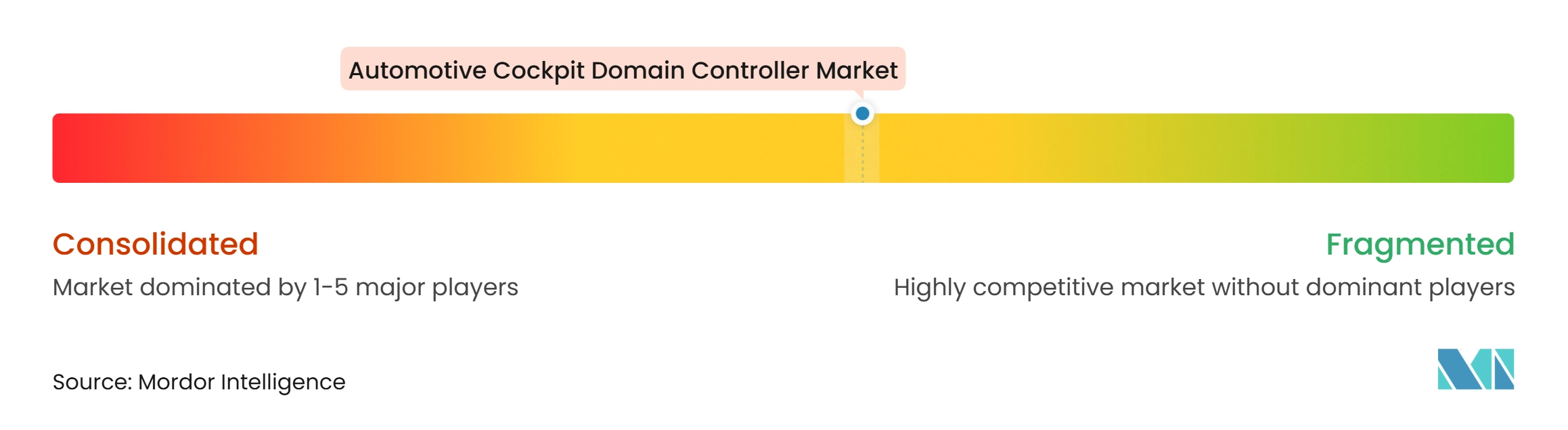
The automotive cockpit domain controller market is moderately concentrated among established Tier-1 suppliers, although Chinese suppliers are increasing competitive pressure. Visteon generated USD 3.8 billion in net sales in 2025 and secured USD 7.4 billion in new business wins. Its SmartCore platform positions the company around advanced graphics, software, and artificial intelligence workloads. Desay SV is building international visibility as it offers its domain controller portfolio, including NVIDIA Thor-based cross-domain platforms, to global automakers. This creates greater competition for traditional global suppliers in new vehicle programs.
Suppliers are also seeking differentiation through software and high-performance compute platforms. FORVIA’s Cockpit UX Engine won two global innovation awards, including the German Innovation Award 2025, reflecting its focus on software-based cabin experiences. Continental announced in April 2025 that its Automotive group sector would operate as AUMOVIO, which supports a more focused automotive technology position. AUMOVIO’s high-performance cockpit platform is designed for simultaneous display, camera, and driver-monitoring functions. These moves show that companies in the automotive cockpit domain controller market are competing on platform breadth rather than only on individual display modules.
Semiconductor suppliers are gaining influence as vehicle programs move toward cockpit-driving integration on common compute hardware. Qualcomm’s Snapdragon and NVIDIA DRIVE platforms give vehicle makers a basis for consolidating functions that once used separate controllers. Suppliers still need to provide system integration, safety evidence, thermal design, and lifecycle software support around those chips. The automotive cockpit domain controller industry therefore has room for global Tier-1 suppliers and capable local specialists.
Automotive Cockpit Domain Controller Industry Leaders
-
AUMOVIO SE
-
Robert Bosch GmbH
-
Visteon Corporation
-
Aptiv PLC
-
Samsung Electronics Co., Ltd.
- *Disclaimer: Major Players sorted in no particular order
Automotive Cockpit Domain Controller Market Companies Covered in this Report
- Visteon Corporation
- Aptiv PLC
- AUMOVIO SE
- Robert Bosch GmbH
- Samsung Electronics Co., Ltd.
- Huizhou Desay SV Automotive Co., Ltd.
- Panasonic Automotive Systems Co., Ltd.
- DENSO Corporation
- Hyundai Mobis Co., Ltd.
- FORVIA SE
- LG Electronics Inc.
- Marelli Holdings Co., Ltd.
- Ningbo Joyson Electronic Corp.
- NXP Semiconductors N.V.
- Renesas Electronics Corporation
- MediaTek Inc.
- ECARX Holdings Inc.
- NVIDIA Corporation
- Valeo SE
- Magna International Inc.
Recent Industry Developments in Automotive Cockpit Domain Controller Market
- July 2026: Qualcomm was named BMW Group's lead compute silicon provider for digital cockpit and automated driving systems through the next decade.
- July 2026: Mazda selected Panasonic Automotive Systems' cockpit domain controller for the all-new CX-5.
- May 2026: Stellantis and Qualcomm expanded their partnership to adopt Snapdragon Digital Chassis cockpit, connectivity, and driver-assistance platforms across next-generation STLA Brain vehicle architectures.
- January 2026: Visteon presented SmartCore HPC, a high-performance cockpit domain controller rated at 700 trillion operations per second, at CES 2026.
Global Automotive Cockpit Domain Controller Market Report Scope
The scope includes segmentation by component (hardware [SoC/processors, memory, PCBs], software [hypervisor, RTOS, middleware, HMI], and integration services), display integration (2–3 displays, 4–5 displays, and 6+ displays), vehicle type (passenger cars and commercial vehicles), propulsion type (internal combustion engine [ICE] and electric), architecture (domain-based and zonal/central compute), and sales channel (OEM and aftermarket). By geography, the market is segmented into North America (United States, Canada, and Rest of North America), Europe (Germany, France, United Kingdom, Italy, Spain, Russia, and Rest of Europe), Asia-Pacific (China, Japan, South Korea, India, Southeast Asia, Australia, and Rest of Asia-Pacific), South America (Brazil, Argentina, Colombia, and Rest of South America), and Middle East and Africa (Saudi Arabia, United Arab Emirates, Israel, Turkey, South Africa, Egypt, and Rest of Middle East and Africa). The market forecasts are provided in terms of value (USD) and volume (units).
Segmentation Overview
| Hardware (SoC/Processors, Memory, PCBs) |
| Software (Hypervisor, RTOS, Middleware, HMI) |
| Integration Services |
| 2–3 Displays |
| 4–5 Displays |
| 6+ Displays |
| Passenger Cars |
| Commercial Vehicles |
| Internal Combustion Engine (ICE) |
| Electric |
| Domain-Based |
| Zonal/Central Compute |
| OEM |
| Aftermarket |
| North America | United States |
| Canada | |
| Rest of North America | |
| Europe | Germany |
| France | |
| United Kingdom | |
| Italy | |
| Spain | |
| Russia | |
| Rest of Europe | |
| Asia-Pacific | China |
| Japan | |
| South Korea | |
| India | |
| Southeast Asia | |
| Australia | |
| Rest of Asia-Pacific | |
| South America | Brazil |
| Argentina | |
| Colombia | |
| Rest of South America | |
| Middle East and Africa | Saudi Arabia |
| United Arab Emirates | |
| Israel | |
| Turkey | |
| South Africa | |
| Egypt | |
| Rest of Middle East and Africa |
| By Component | Hardware (SoC/Processors, Memory, PCBs) | |
| Software (Hypervisor, RTOS, Middleware, HMI) | ||
| Integration Services | ||
| By Display Integration | 2–3 Displays | |
| 4–5 Displays | ||
| 6+ Displays | ||
| By Vehicle Type | Passenger Cars | |
| Commercial Vehicles | ||
| By Propulsion | Internal Combustion Engine (ICE) | |
| Electric | ||
| By Architecture | Domain-Based | |
| Zonal/Central Compute | ||
| By Sales Channel | OEM | |
| Aftermarket | ||
| By Geography | North America | United States |
| Canada | ||
| Rest of North America | ||
| Europe | Germany | |
| France | ||
| United Kingdom | ||
| Italy | ||
| Spain | ||
| Russia | ||
| Rest of Europe | ||
| Asia-Pacific | China | |
| Japan | ||
| South Korea | ||
| India | ||
| Southeast Asia | ||
| Australia | ||
| Rest of Asia-Pacific | ||
| South America | Brazil | |
| Argentina | ||
| Colombia | ||
| Rest of South America | ||
| Middle East and Africa | Saudi Arabia | |
| United Arab Emirates | ||
| Israel | ||
| Turkey | ||
| South Africa | ||
| Egypt | ||
| Rest of Middle East and Africa | ||
Key Questions Answered in the Report
What is the projected size of the automotive cockpit domain controller market?
The automotive cockpit domain controller market is projected to reach USD 21.36 billion by 2032, from USD 11.17 billion in 2027, at a 13.84% CAGR.
Which component leads cockpit controller demand?
Hardware leads demand with 73.15% of 2026 revenue, while integration services have the highest projected growth at 17.25% CAGR through 2032.
Which vehicle type offers the fastest growth for cockpit controllers?
Commercial vehicles are forecast to grow at a 16.12% CAGR through 2032 as fleet connectivity, driver monitoring, and control-unit consolidation expand.
Which region is growing fastest for automotive cockpit controllers?
Asia-Pacific is forecast to grow at a 14.88% CAGR through 2032, supported by China’s deployment scale and expanding digital content in India and other markets.