
Automotive Ceramics Market Size and Share
Market Overview
| Study Period | 2022 - 2032 |
|---|---|
| Market Size (2027) | USD 3.01 Billion |
| Market Size (2032) | USD 3.92 Billion |
| Growth Rate (2027 - 2032) | 5.46 % |
| Fastest Growing Market | Asia-Pacific |
| Largest Market | Asia-Pacific |
| Market Concentration | Medium |
Major Players *Disclaimer: Major Players sorted in no particular order Image © Mordor Intelligence. Reuse requires attribution under CC BY 4.0. | |
Automotive Ceramics Market Analysis by Mordor Intelligence
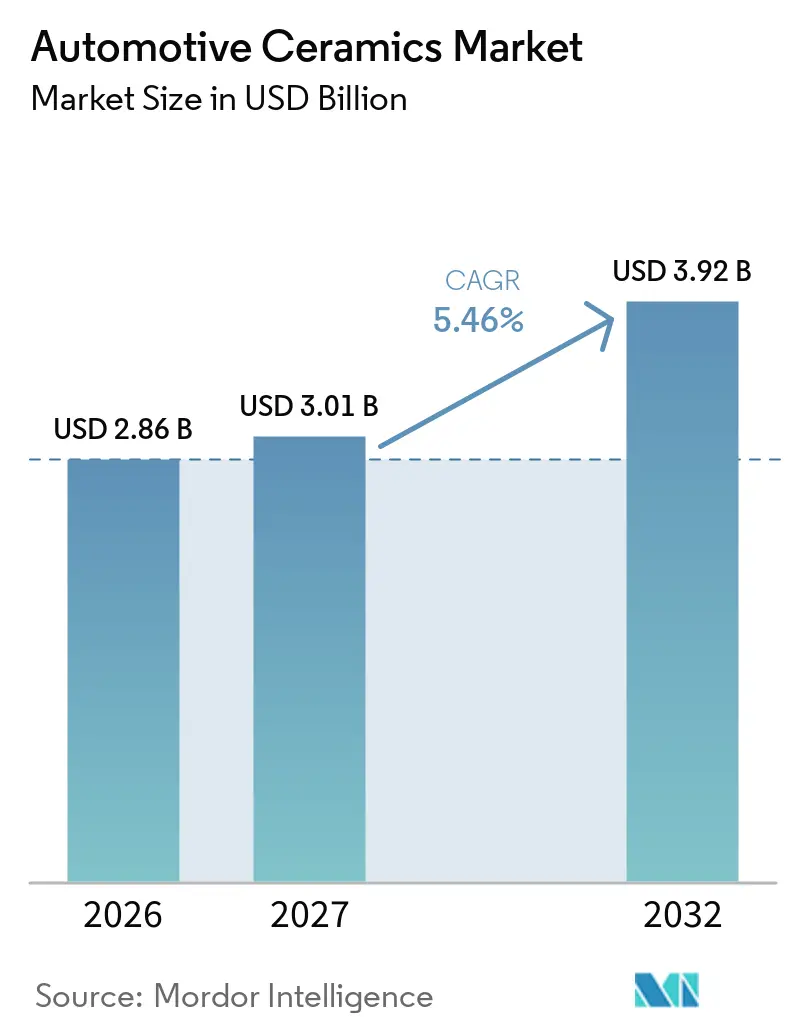
The Automotive Ceramics Market size was valued at USD 2.86 billion in 2026 and is estimated to grow from USD 3.01 billion in 2027 to reach USD 3.92 billion by 2032, at a CAGR of 5.46% during the forecast period (2027-2032). The automotive ceramics market is supported by two sources of demand, such as stricter exhaust-emission requirements for internal-combustion vehicles and expanding use of ceramics in electric vehicle power systems. Tighter regulations are raising the technical requirements for catalytic substrates, gasoline particulate filters, and electrically heated catalyst systems. At the same time, electrification is increasing demand for ceramic power substrates, sensor packages, and battery thermal-management components. The transition carries a timing risk because a rapid move to battery-electric vehicles could reduce exhaust-related demand before power-electronics applications reach comparable scale, while slower electric vehicle adoption would preserve conventional ceramic demand but delay higher-margin growth areas.
Key Report Takeaways
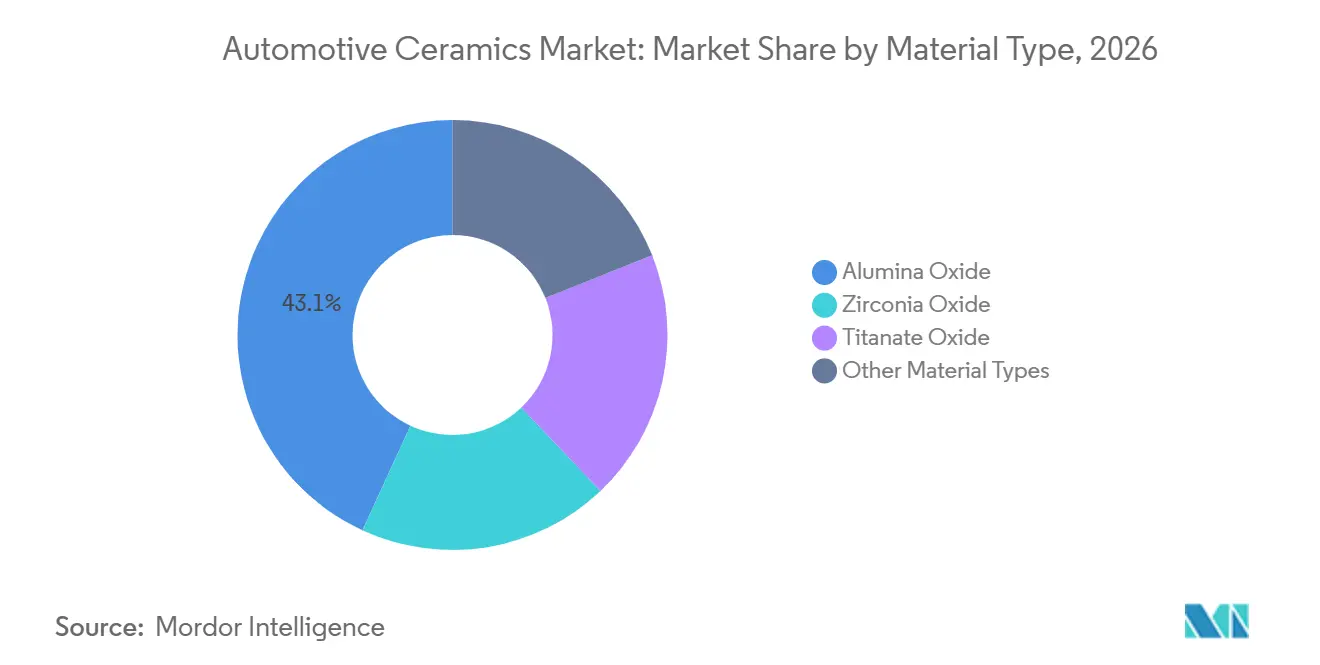
- By material type, alumina oxide held 43.12% of the automotive ceramics market share in 2026, while zirconia oxide is forecast to advance at a 5.91% CAGR through 2032.
- By application, automotive electronics held 32.78% of the automotive ceramics market share in 2026 and is forecast to advance at a 6.07% CAGR through 2032.
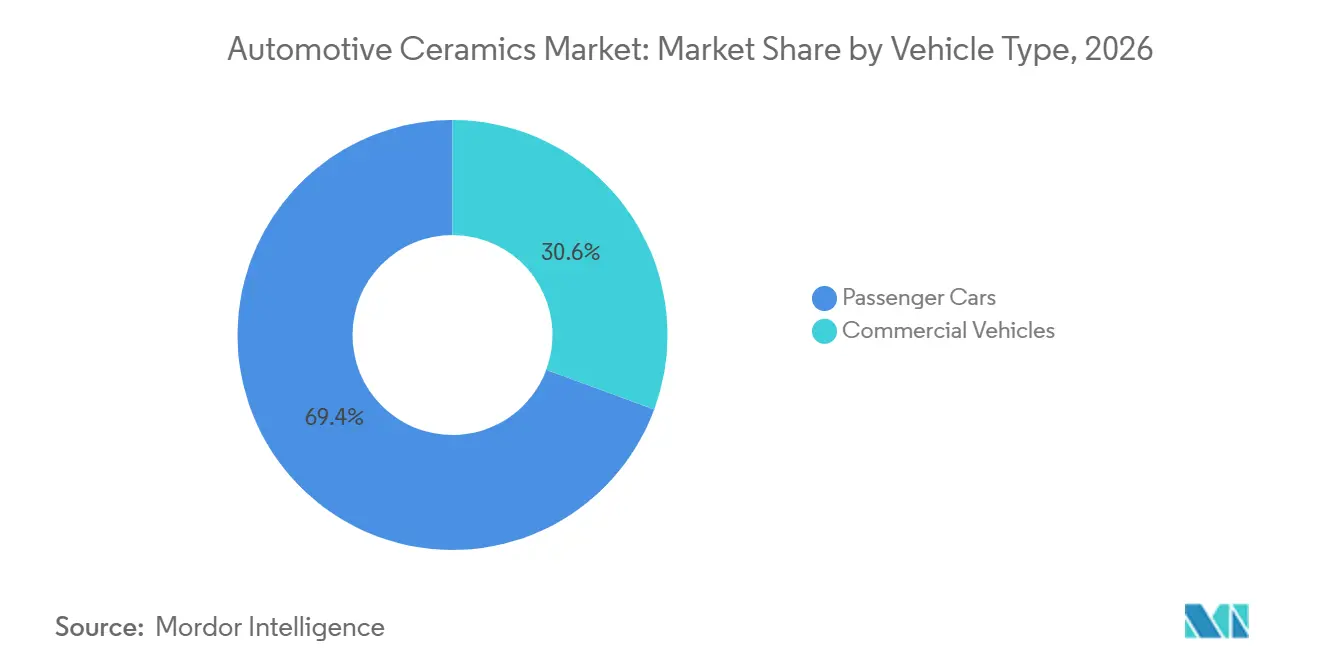
- By vehicle type, passenger cars held 69.37% of the automotive ceramics market share in 2026, while commercial vehicles are forecast to advance at a 6.69% CAGR through 2032.
- By geography, Asia-Pacific held 38.05% of the automotive ceramics market share in 2026 and is forecast to advance at a 6.42% CAGR through 2032.
Note: Market numbers in this report are based on Mordor Intelligence's proprietary estimation framework, which combines nine months of actuals with Q4 projections for base year 2026.
Market Trends and Insights
Drivers Impact Analysis of Automotive Ceramics Market*
| Driver | (~) % Impact on CAGR Forecast | Geographic Relevance | Impact Timeline |
|---|---|---|---|
| Tightening Global Emission Standards | +1.2% | Global; concentrated near-term effect in EU, North America, and China | Medium term (2-4 years) |
| Vehicle Lightweighting for Fuel Efficiency and Range | +1.0% | Global; most acute in North America and Europe where CAFE and CO₂ fleet-average standards are strictest | Medium term (2-4 years) |
| Electrification-Driven Demand for Ceramic Power-Electronics Substrates | +0.9% | APAC core, spillover to North America and EU | Long term (≥ 4 years) |
| Expansion of Hybrid and Commercial-Vehicle Aftertreatment | +0.7% | Asia-Pacific, South America, and MEA; spillover to EU for heavy-duty vehicles | Short term (≤ 2 years) |
| Miniaturized High-Temperature Sensor and Insulation Integration | +0.5% | Global, with early gains in Japan, South Korea, and Germany | Long term (≥ 4 years) |
| Source: Mordor Intelligence | |||
Tightening Global Emission Standards
Regulatory requirements are shortening compliance timelines for vehicle manufacturers and increasing the need for ceramic components that maintain catalytic performance through wider temperature ranges. The European Union adopted the Euro 7 implementing act for light-duty vehicles on June 17, 2025, introducing on-board monitoring and extended vehicle-protection requirements that extend certified emissions compliance over the vehicle life. These requirements favor premium cordierite and silicon carbide substrates that can meet more demanding durability needs in the automotive ceramics market. The U.S. Environmental Protection Agency’s final Multi-Pollutant Emissions Standards set tighter nitrogen oxide, fine particulate matter, and non-methane organic gas limits for light-duty and medium-duty vehicles from model year 2027 through 2032[1]. Electrically heated catalyst systems add another demand area because they use ceramic heating elements that operate at 48 V, currents of 200-240 A, and temperatures up to 350 °C. China’s XB/T 505-2025 standard for cordierite honeycomb substrates in gasoline and hybrid vehicles took effect in July 2026 and supports demand for locally specified, higher-quality substrates.
Vehicle Lightweighting for Fuel Efficiency and Range
Ceramics can reduce component weight compared with cast iron and steel while retaining performance in demanding thermal and mechanical environments. A 2025 materials study found that graded ceramics provided higher flexural strength than homogeneous ceramics across thermal-shock temperature differences. This performance supports their use in applications such as braking systems, drivetrains, and battery enclosures. Corning Incorporated states that its FLORA substrate can reduce catalytic-substrate mass by up to 35% and improve cold-start regulated emissions by up to 20% compared with standard cordierite. Lower mass can help vehicle manufacturers address fuel efficiency and electric-vehicle range requirements at the same time. This expands component opportunities in the automotive ceramics market. For ceramics suppliers, the shift makes precision processing and fast qualification more important as original equipment manufacturers assess a broader set of vehicle components.
Electrification-Driven Demand for Ceramic Power-Electronics Substrates
Electric vehicle inverters, direct-current to direct-current converters, and onboard chargers require substrates that provide electrical insulation and thermal conductivity. Zirconia-toughened alumina substrates can offer flexural strength above 700 MPa, fracture toughness of at least 3.5 MPa·√m, and dielectric strength above 25 kV/mm. These properties support smaller power-module packages while maintaining thermal integrity. The move from silicon insulated-gate bipolar transistor devices to silicon carbide metal-oxide-semiconductor field-effect transistor devices in 800 V platforms increases the need for substrates that handle concentrated thermal gradients and repeated thermal shock. This technical shift supports higher-value demand in the automotive ceramics market. KYOCERA Corporation began joint research with the National Institute of Advanced Industrial Science and Technology in January 2025 to standardize thermal-diffusivity measurement for silicon nitride substrates thinner than 0.5 mm. NGK Corporation also identified power-electronics substrates, gasoline particulate filters, and silicon carbide diesel particulate filters as development areas in its 2026-2035 management plan.
Expansion of Hybrid and Commercial-Vehicle Aftertreatment
Hybrid vehicles create challenging operating conditions for exhaust aftertreatment because intermittent combustion can let the catalyst cool during electric-only driving. When the engine restarts, sharper cold-start emissions can occur before the catalyst returns to its operating temperature. A 2025 Society of Automotive Engineers (SAE) paper found that transitional operation in plug-in hybrid vehicles can increase nitrogen oxide emissions and require thermal-management solutions compatible with Euro 7 requirements. This increases the relevance of ceramic heater elements and resilient substrate designs. In commercial and off-highway vehicles, proposed California Air Resources Board Tier 5 limits would reduce particulate matter limits from 0.02 g/kWh to 0.005 g/kWh, supporting demand for high-filtration silicon carbide diesel particulate filter materials. These needs support the automotive ceramics market. IBIDEN identified commercial and industrial vehicle demand from China and India as an important area for its ceramics operations, where filter and aftertreatment volumes can remain durable as passenger-vehicle electrification progresses.
Restraints Impact Analysis of Automotive Ceramics Market*
| Restraint | (~) % Impact on CAGR Forecast | Geographic Relevance | Impact Timeline |
|---|---|---|---|
| High Ceramic Material and Manufacturing Cost | -0.6% | Global; most pronounced in North America and Europe where labor and energy costs are elevated | Medium term (2-4 years) |
| Energy-Intensive Firing and Processing | -0.4% | Global; particularly challenging in EU under carbon cost compliance frameworks | Medium term (2-4 years) |
| Long-Term ICE Volume Erosion from Full Electrification | -0.3% | Europe and China (leading EV markets); delayed effect in South America and MEA | Long term (≥ 4 years) |
| Source: Mordor Intelligence | |||
High Ceramic Material and Manufacturing Cost
High-purity raw materials, sintering, and precision finishing make automotive ceramic parts more expensive to produce than many comparable metal parts. The cost difference is especially significant for silicon nitride and silicon carbide components, while alumina remains closer to cost parity in suitable applications. This helps explain why alumina continues to lead the material mix despite the performance benefits of premium alternatives. Complex component geometries also create yield pressure during finishing and raise unit costs. These costs can limit adoption in price-sensitive parts of the automotive ceramics market. Producers are assessing advanced sintering methods, including spark plasma and microwave sintering, to improve grain-boundary control and lower processing temperatures. Automotive quality-management requirements under International Automotive Task Force 16949 can support incumbent retention but can also constrain pricing flexibility during negotiations with large Tier 1 buyers.
Energy-Intensive Firing and Processing
Ceramic sintering requires high-temperature kilns and close thermal control, which create substantial energy costs and a carbon burden. The European Union Carbon Border Adjustment Mechanism entered its definitive phase in January 2026 and places a greater focus on embedded greenhouse-gas emissions in imported goods[2]. This can affect advanced ceramic supply relationships between Asian manufacturers and European vehicle customers. Research in the Journal of Advanced Ceramics reported that microwave cold sintering can reduce energy consumption by more than 97% and improve mechanical and dielectric properties by 50%-95% compared with conventional pressureless approaches. Automotive-scale throughput and consistent surface finish remain development challenges for this method. Energy-price volatility can moderate investment in the automotive ceramics market. It also makes it harder for producers running long cycles to provide fixed long-term prices to original equipment manufacturers.
*Our forecasts treat driver/restraint impacts as directional, not additive. The impact forecasts reflect baseline growth, mix effects, and variable interactions.
Automotive Ceramics Market Segment Analysis
By Material Type:
Alumina Oxide Leads, While Zirconia Oxide ExpandsAlumina oxide held 43.12% of the automotive ceramics market share in 2026 because it has broad volume use across catalytic substrates, spark-plug insulators, thick-film control-unit boards, and direct-bonded copper modules. It remains suitable when performance requirements do not justify the cost premium of zirconia-based materials. Titanate oxide continues to serve high-dielectric and piezoelectric applications with steady demand. Silicon carbide and silicon nitride are used more often in premium applications that require filtration, thermal shock resistance, or thin-substrate performance. KYOCERA Corporation’s joint research with the National Institute of Advanced Industrial Science and Technology focuses on evaluation methods for silicon nitride substrates below 0.5 mm, which could support production-scale use in electric vehicle inverter modules.
Zirconia oxide is projected to advance at a 5.91% CAGR through 2032. Its growth is linked to electric vehicle power modules, where conventional alumina can reach performance limits under repeated thermal cycling. Zirconia-toughened alumina combines alumina and zirconia to provide strength above 700 MPa and thermal conductivity above 27 W/(m·K). These properties can help insulated-gate bipolar transistor and silicon carbide module designers reduce package size while retaining thermal reliability. The material, therefore, serves applications where battery-system packaging constraints raise the value of compact and durable interfaces.

By Application:
Automotive Electronics Leads Both Scale and GrowthAutomotive electronics held a 32.78% of the automotive ceramics market share in 2026 and is projected to advance at a 6.07% CAGR through 2032. Its scale reflects ceramic content in sensors, control systems, power conversion, and high-voltage electronics. The category includes engine-control-unit substrates, microelectromechanical system sensor packages, radar and light detection and ranging housings, multilayer ceramic capacitors, and power-module substrates. Ceramic content rises with the level of advanced driver-assistance systems and vehicle electrification. This makes reliability, package size, and thermal performance central purchasing requirements.
Engine parts and automotive exhaust systems continue to provide much of the current revenue base because emissions rules increase the complexity of catalytic converters and particulate filters. Ceramic filters, honeycomb substrates, and insulation components remain important for the internal-combustion and hybrid vehicle fleet. Braking systems provide a developing opportunity where manufacturers assess aluminum-ceramic composite discs to reduce unsprung mass in electric vehicles. Cummins Inc. and consortium partners completed Project Brunel in March 2025, a 6.7-liter hydrogen internal-combustion engine program for medium-duty trucks and buses that used ceramic barrier coatings and a dedicated aftertreatment system.
By Vehicle Type:
Commercial Vehicles Grow Faster While Passenger Cars Remain the Revenue BasePassenger cars held 69.37% of the automotive ceramics market share in 2026 and remain the largest vehicle category. This segment supports demand across material and application groups because of its vehicle volume. Its internal content mix is changing as emission-control substrates and spark-plug insulators give way to power-electronics substrates, sensor packages, and ceramic-insulated battery components in newer platforms. The transition can preserve ceramics revenue even when some internal-combustion component volumes decline. Established producers can use existing material, manufacturing, and qualification capabilities to serve both conventional and electrified passenger-car applications.
Commercial vehicles are projected to advance at a 6.69% CAGR through 2032. Tighter heavy-duty emissions rules in North America, Europe, and Asia increase the use of diesel particulate filters, selective catalytic reduction systems, and aftertreatment heater components in trucks and buses. Proposed Tier 5 particulate limits point to a need for higher-filtration ceramic materials in off-highway and heavy-duty engines. Battery-electric heavy trucks still face range and payload constraints in long-haul and off-highway use. These operating limits can sustain demand for diesel and hybrid systems, along with their ceramic aftertreatment components, through the forecast period.
Geography Analysis
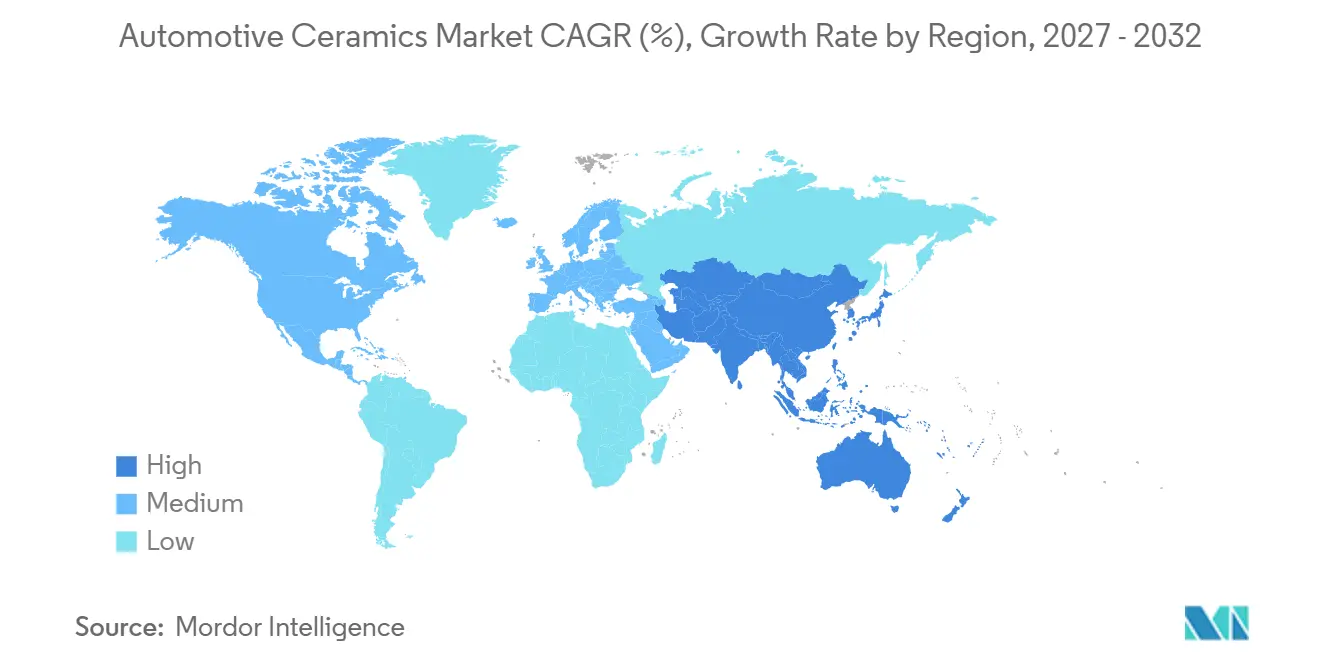
Asia-Pacific held 38.05% of the automotive ceramics market share in 2026 and is projected to advance at a 6.42% CAGR through 2032. China combines high vehicle production with increasingly demanding emissions standards, which supports a large regional base for ceramic substrates and filters. China’s XB/T 505-2025 standard took effect in July 2026 and sets quality parameters for cordierite honeycomb substrates used in gasoline and hybrid-vehicle emissions purification. The standard supports local demand and supply-chain localization. Japan remains a major base for precision automotive ceramics, supported by integrated production operations across Japan and China.
India is an important growth location because Bharat Stage 6 Phase II rules support demand for catalytic converters and sensor ceramics. Its developing local production base continues to operate alongside growing demand for high-specification components. South Korea adds regional strength in multilayer ceramic capacitors and other electronic components for automotive systems. Association of Southeast Asian Nations (ASEAN) countries are expanding as vehicle assembly locations, which increases the need for exhaust-treatment and electronics ceramics. Together, these markets give the automotive ceramics market demand across both conventional powertrain and electrification applications.
North America is supported by the United States Environmental Protection Agency’s multi-year emissions phase-in for model years 2027-2032, which gives qualified local suppliers a visible demand horizon. Canada and Mexico participate through integrated Tier 1 supply chains under the United States-Mexico-Canada Agreement. In Europe, Euro 7 requirements increase substrate durability and heater specifications even as internal-combustion vehicle shares decline. Germany remains central to the procurement of advanced automotive ceramics, while France and Italy contribute manufacturing capacity. Nordic markets show how electrification can shift demand from exhaust substrates toward power electronics and sensor packages. South America and Middle East and Africa remain smaller, growing markets that rely on internal-combustion production, regulatory tightening, and imports of high-specification ceramics.
Competitive Landscape
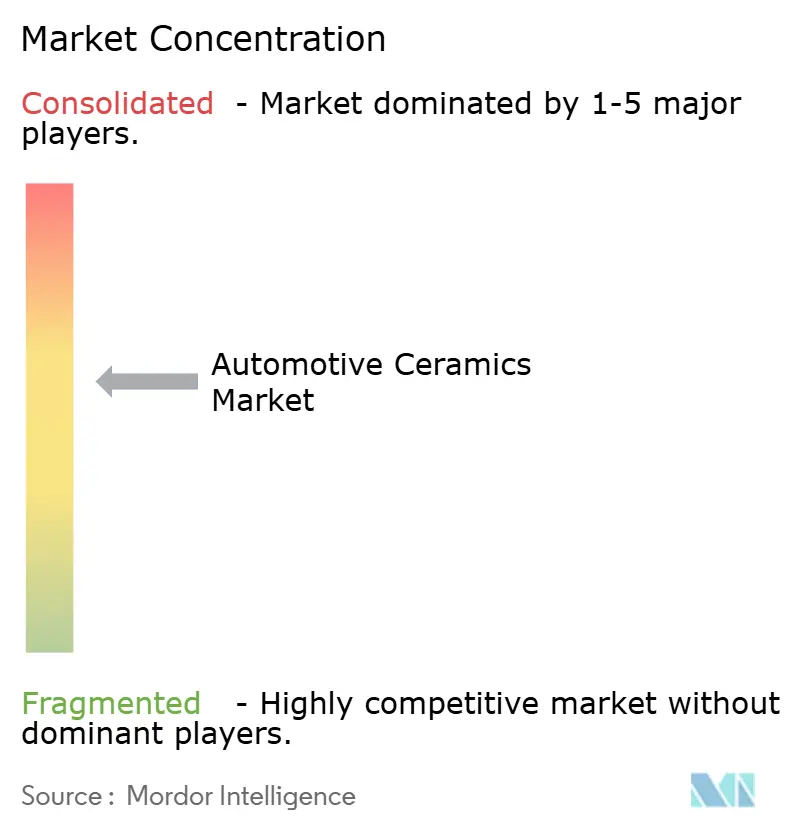
The automotive ceramics market is moderately concentrated, with the top five players including NGK Corporation, Corning Incorporated, DENSO CORPORATION, IBIDEN, and KYOCERA Corporation. These companies participate across materials, substrates, filters, electronic ceramics, sensing, and specialized components. Their competitive positions depend on manufacturing quality, application knowledge, and the ability to meet automotive qualification requirements.
NGK Corporation’s 2026-2035 management plan describes its Automotive Ceramics Business as a cash-generating business that will maximize existing resources, while growth investment moves toward digital-society applications. The strategy shows how established producers are balancing mature exhaust ceramics with faster-growing advanced-materials opportunities. Corning Incorporated continues to use its FLORA substrate platform to reduce substrate mass by up to 35% and improve cold-start regulated emissions by up to 20% relative to standard cordierite. CeramTec GmbH identified precision piezo technology, ceramic brake components, and ceramic solutions for pump and valve systems as core areas for future vehicle requirements. These moves reflect investment in applications where material performance and qualification requirements limit simple price competition.
Mid-sized and regional suppliers can compete by providing application-specific formulations and faster component-level qualification. Ceramic binder jetting can reduce precision-grinding requirements and improve yields for complex shapes, but automotive-scale throughput and surface finish still require development. Open opportunities remain in thermal substrates for 800 V electric vehicle platforms and ceramic barrier coatings for hydrogen internal-combustion engines. International Automotive Task Force 16949 quality requirements create a retention advantage for qualified incumbents and a meaningful barrier for new suppliers. The automotive ceramics market, therefore, combines stable demand in emissions control with differentiated competition in electrification and automotive electronics.
Automotive Ceramics Industry Leaders
-
NGK Corporation
-
Corning Incorporated
-
DENSO CORPORATION
-
IBIDEN
-
KYOCERA Corporation
- *Disclaimer: Major Players sorted in no particular order
Automotive Ceramics Market Companies Covered in this Report
- 3M
- Almatis
- CeramTec GmbH
- CoorsTek, Inc.
- Corning Incorporated
- DENSO CORPORATION
- Dyson Technical Ceramics
- Elan Technology
- IBIDEN
- KYOCERA Corporation
- McDanel Advanced Materials
- Morgan Advanced Materials
- NGK Corporation
- Niterra Co., Ltd.
- Saint-Gobain
Recent Industry Developments in Automotive Ceramics Market
- April 2026: Murata Manufacturing Co., Ltd. began mass production of seven automotive-qualified multilayer ceramic capacitors (MLCCs) designed for advanced driver-assistance systems, autonomous driving applications, and vehicle power lines. The launch supports the automotive ceramics market by expanding compact ceramic electronic components that improve circuit stability and enable greater functionality in modern vehicles.
- March 2026: Cosmo Consumer, a division of Cosmo First Limited, launched Cosmo Guard, a nano-ceramic coating for automotive surface protection designed to improve gloss, hydrophobicity, and resistance to scratches and environmental exposure. The launch supports the automotive ceramics market by expanding the use of ceramic-based materials in vehicle exterior protection and surface-treatment applications.
Global Automotive Ceramics Market Report Scope
Automotive ceramics are advanced ceramic materials used in vehicle components that require heat resistance, wear resistance, electrical insulation, or mechanical strength. These materials support reliable operation under demanding thermal, mechanical, and electrical conditions in modern vehicles.
The Automotive Ceramics Market is segmented by material type, application, vehicle type, and geography. By material type, the market is segmented into alumina oxide, zirconia oxide, titanate oxide, and other material types. By application, the market is segmented into engine parts, automotive exhaust systems, automotive electronics, braking systems, and other applications. By vehicle type, the market is segmented into passenger cars and commercial vehicles. The report also covers the market size and forecasts for automotive ceramics across 15 countries. For each segment, the market sizing and forecasts have been done on the basis of value (USD).
Segmentation Overview
| Alumina Oxide |
| Zirconia Oxide |
| Titanate Oxide |
| Other Material Types |
| Engine Parts |
| Automotive Exhaust Systems |
| Automotive Electronics |
| Braking Systems |
| Other Applications |
| Passenger Cars |
| Commercial Vehicles |
| Asia-Pacific | China |
| India | |
| Japan | |
| South Korea | |
| ASEAN Countries | |
| Rest of Asia-Pacific | |
| North America | United States |
| Canada | |
| Mexico | |
| Europe | Germany |
| United Kingdom | |
| France | |
| Italy | |
| NORDIC Countries | |
| Rest of Europe | |
| South America | Brazil |
| Argentina | |
| Rest of South America | |
| Middle East and Africa | Saudi Arabia |
| South Africa | |
| Rest of Middle East and Africa |
| By Material Type | Alumina Oxide | |
| Zirconia Oxide | ||
| Titanate Oxide | ||
| Other Material Types | ||
| By Application | Engine Parts | |
| Automotive Exhaust Systems | ||
| Automotive Electronics | ||
| Braking Systems | ||
| Other Applications | ||
| By Vehicle Type | Passenger Cars | |
| Commercial Vehicles | ||
| By Geography | Asia-Pacific | China |
| India | ||
| Japan | ||
| South Korea | ||
| ASEAN Countries | ||
| Rest of Asia-Pacific | ||
| North America | United States | |
| Canada | ||
| Mexico | ||
| Europe | Germany | |
| United Kingdom | ||
| France | ||
| Italy | ||
| NORDIC Countries | ||
| Rest of Europe | ||
| South America | Brazil | |
| Argentina | ||
| Rest of South America | ||
| Middle East and Africa | Saudi Arabia | |
| South Africa | ||
| Rest of Middle East and Africa | ||
Key Questions Answered in the Report
What is the size of the automotive ceramics market?
The automotive ceramics market size was valued at USD 2.86 billion in 2026 and is estimated to grow from USD 3.01 billion in 2027 to reach USD 3.92 billion by 2032, at a CAGR of 5.46% during the forecast period (2027-2032).
What is driving demand for automotive ceramics?
Tighter emissions requirements, electric vehicle power electronics, hybrid aftertreatment needs, lightweighting, and vehicle electronics are supporting demand.
Which material type is projected to advance fastest through 2032?
Zirconia oxide is projected to advance at a 5.91% CAGR through 2032, supported by use in electric vehicle power-module substrates.
Which application held the largest share in 2026?
Automotive electronics held a 32.78% share in 2026.