
Automotive Carbon Thermoplastic Market Size and Share
Market Overview
| Study Period | 2022 - 2032 |
|---|---|
| Market Size (2027) | USD 532.5 Million |
| Market Size (2032) | USD 992.88 Million |
| Growth Rate (2027 - 2032) | 13.27 % |
| Fastest Growing Market | Asia-Pacific |
| Largest Market | Asia-Pacific |
| Market Concentration | Medium |
Major Players *Disclaimer: Major Players sorted in no particular order Image © Mordor Intelligence. Reuse requires attribution under CC BY 4.0. | |
Automotive Carbon Thermoplastic Market Analysis by Mordor Intelligence
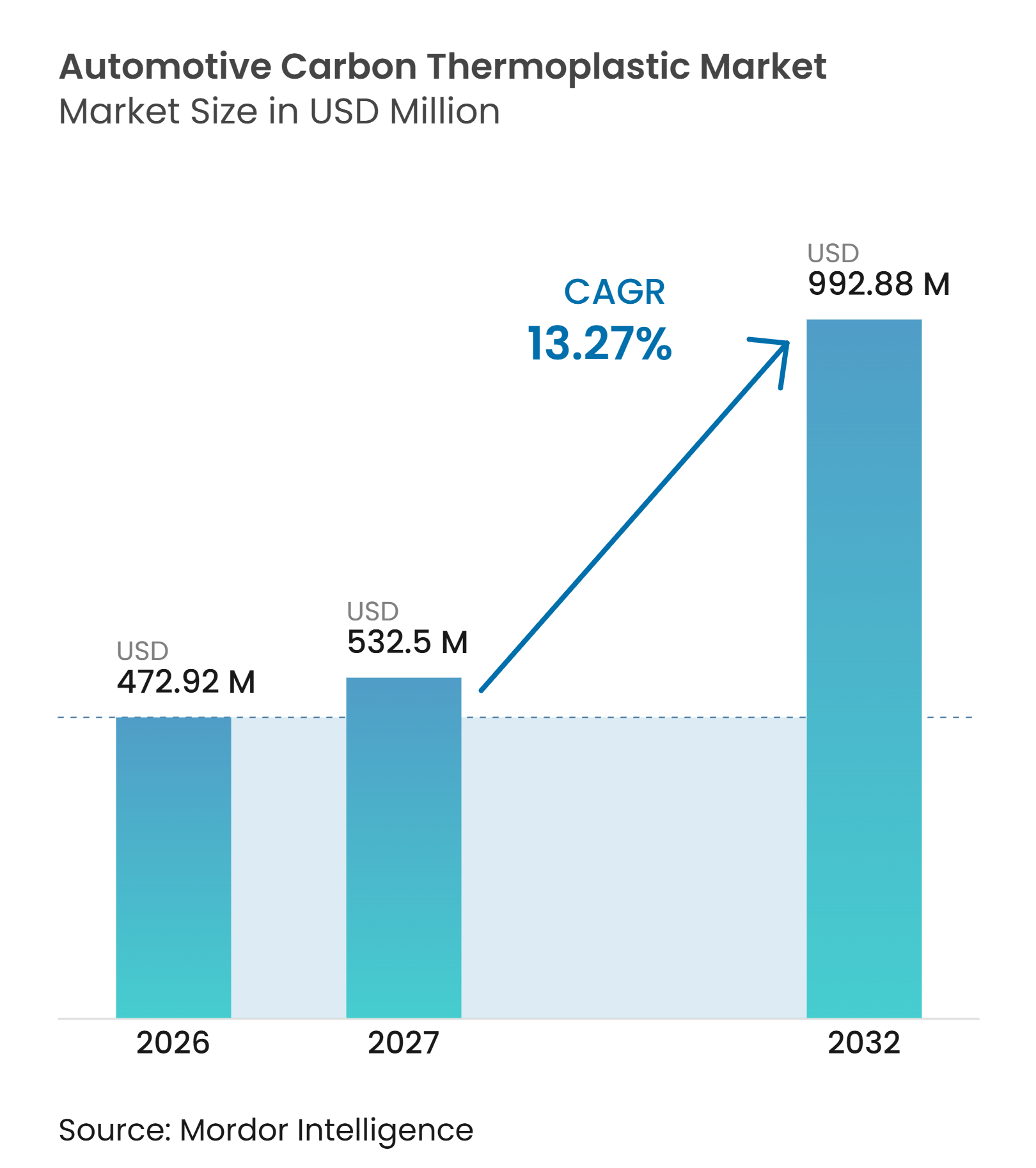
The Automotive Carbon Thermoplastic Market size was valued at USD 472.92 million in 2026 and is estimated to grow from USD 532.50 million in 2027 to reach USD 992.88 million by 2032, at a CAGR of 13.27% during the forecast period (2027-2032). The automotive carbon thermoplastic market is benefiting from electric vehicle programs that need to offset the mass added by battery packs while maintaining driving range. Carbon fiber-reinforced thermoplastics can reduce component weight and support faster production than many thermoset composite processes, including automated stamping cycles as short as 90 seconds. Processing improvements also allow suppliers to combine inserts, reinforcement, and molded features in fewer manufacturing steps. This reduces part count and can limit secondary work such as fastening and adhesive bonding. Material cost and the immature recovery system for continuous-fiber composites remain the main limits on broader adoption in the automotive carbon thermoplastic market.
Key Report Takeaways
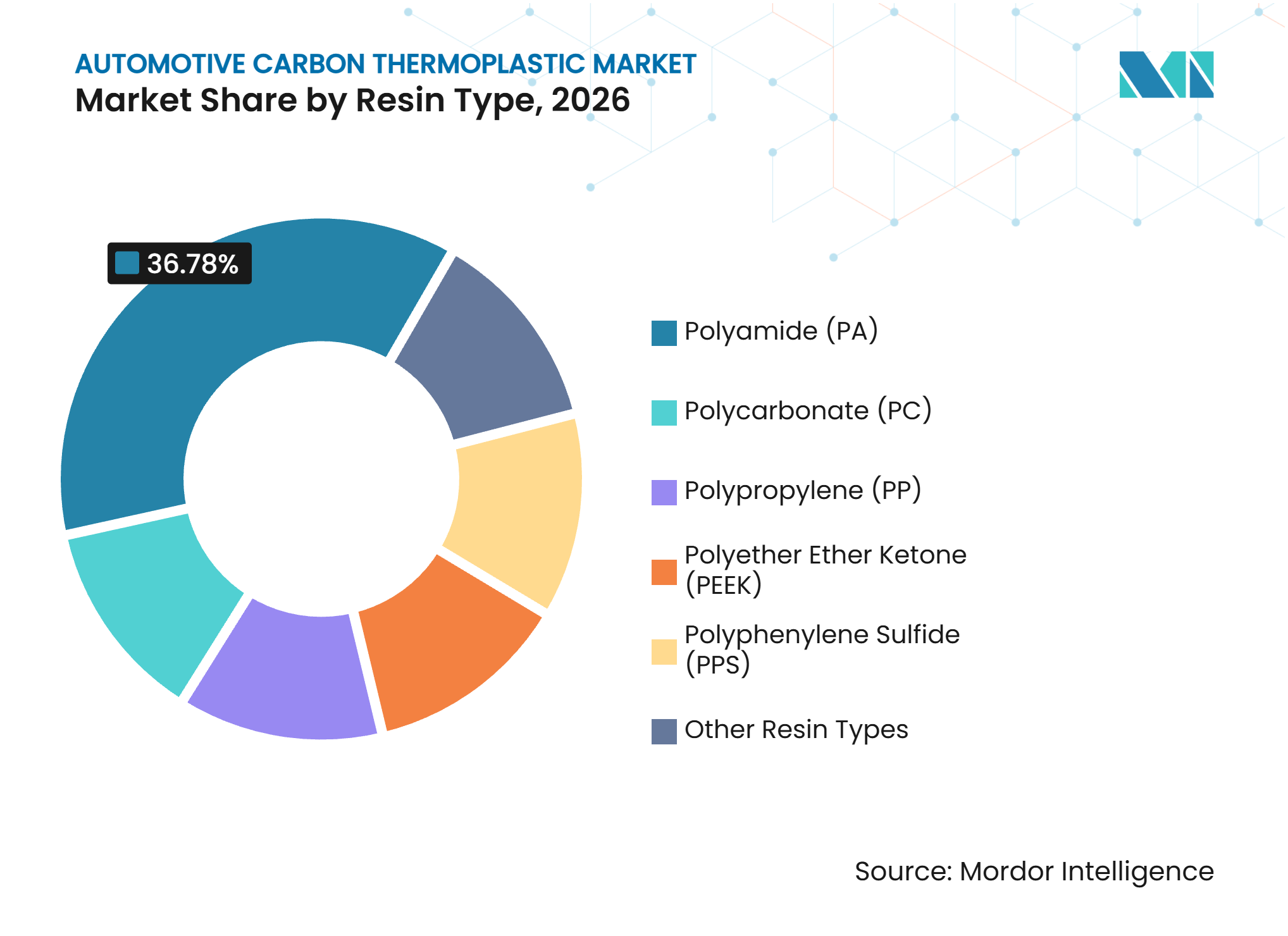
- By resin type, polyamide (PA) held 36.78% of the automotive carbon thermoplastic market share in 2026, while polyether ether ketone (PEEK) is forecast to advance at a 14.19% CAGR through 2032.
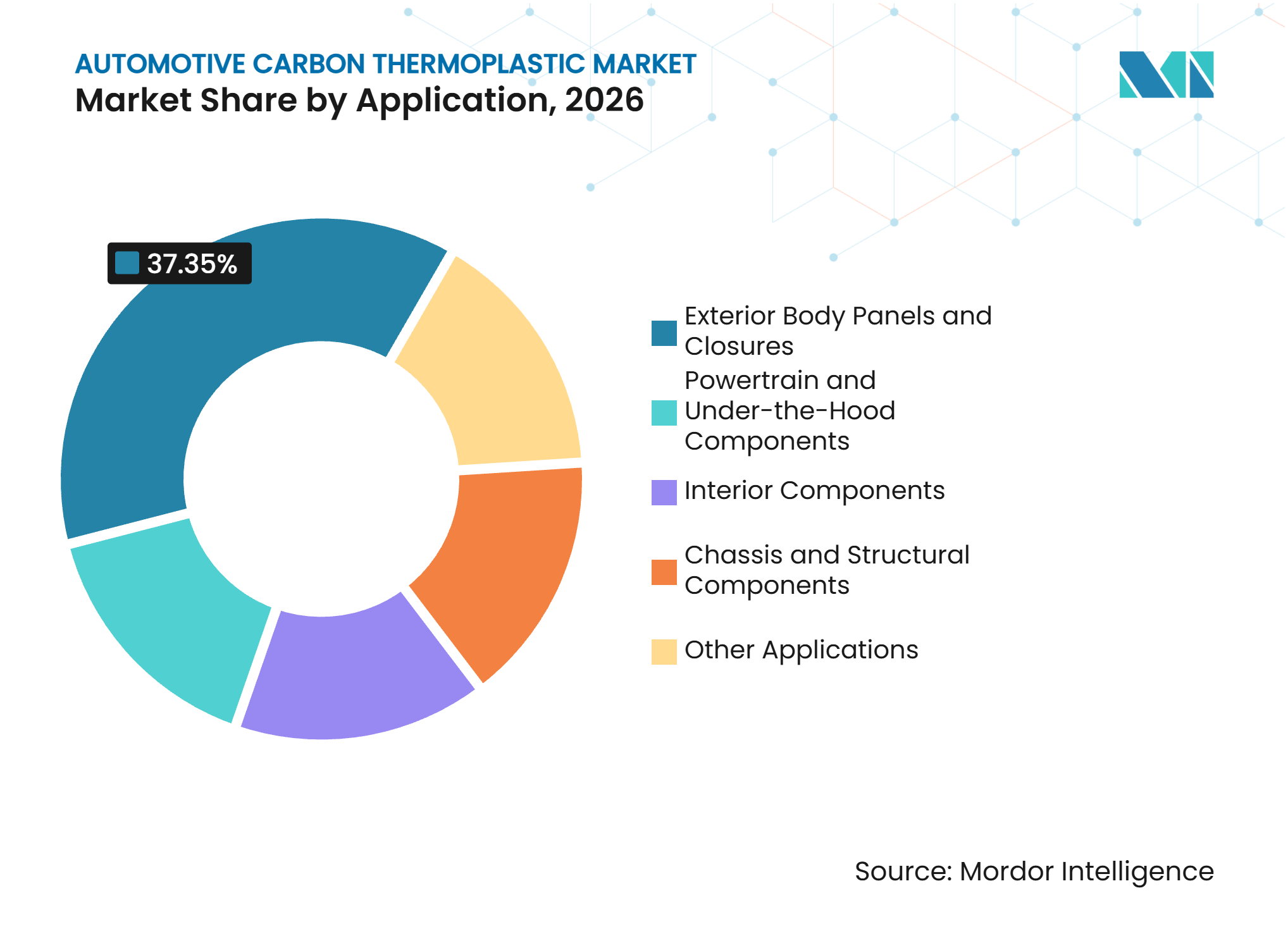
- By application, exterior body panels and closures held 37.35% of the automotive carbon thermoplastic market share in 2026 and are forecast to advance at a 15.06% CAGR through 2032.
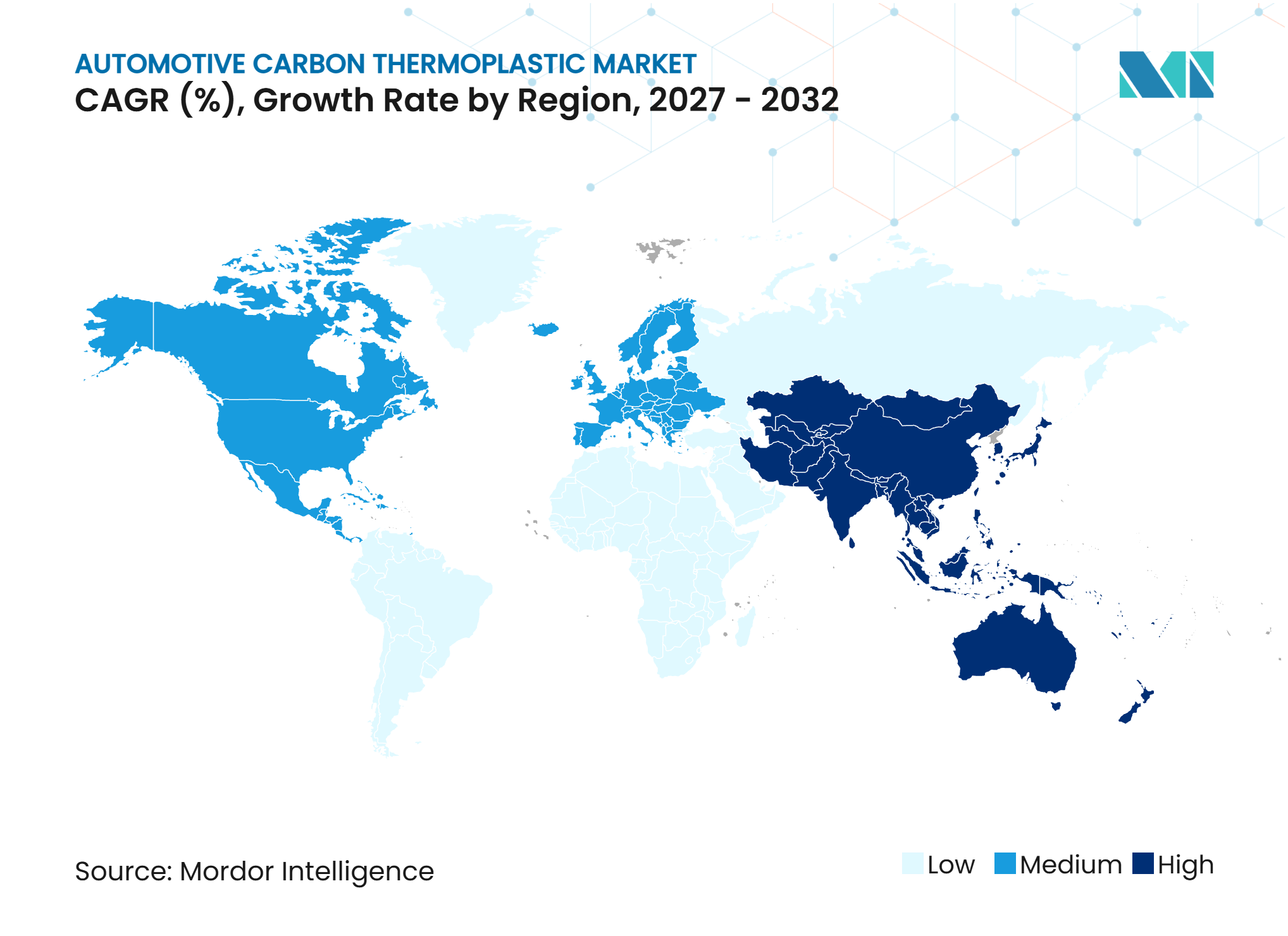
- By geography, Asia-Pacific held 40.12% of the automotive carbon thermoplastic market share in 2026 and is forecast to advance at a 14.68% CAGR through 2032.
Note: Market numbers in this report are based on Mordor Intelligence's proprietary estimation framework, which combines nine months of actuals with Q4 projections for base year 2026.
Market Trends and Insights
Drivers Impact Analysis of Automotive Carbon Thermoplastic Market*
| Driver | (~) % Impact on CAGR Forecast | Geographic Relevance | Impact Timeline |
|---|---|---|---|
| Vehicle Lightweighting for EV Range and Emissions Compliance | +3.5% | Global, North America, EU, APAC core | Short term (≤ 2 years) |
| Rapid-Cycle Processing and Automated High-Volume Production | +2.8% | Global, concentration in Germany, Japan, South Korea, US | Medium term (2-4 years) |
| Metal Replacement in Structural and Under-the-Hood Components | +2.2% | APAC core, spillover to North America and EU | Medium term (2-4 years) |
| Electrification-Driven Demand for Thermally Stable Electrical Components | +1.8% | Global, APAC and North America priority | Medium term (2-4 years) |
| Integrated Hybrid Molding and Part Consolidation | +1.2% | EU and Japan, spillover to North America | Long term (≥ 4 years) |
| Source: Mordor Intelligence | |||
Vehicle Lightweighting for EV Range and Emissions Compliance
The automotive carbon thermoplastic market is increasingly tied to the need to reduce vehicle mass in battery electric vehicles. The U.S. Department of Energy states that a 10% vehicle weight reduction can improve fuel or energy economy by 6%-8%[1]. Battery packs typically add 300-600 kg, so lighter structures can extend range or support a smaller battery pack. The National Highway Traffic Safety Administration reset the Corporate Average Fuel Economy program in 2025, keeping fuel economy a statutory consideration for manufacturers. Lower structural weight can also reduce battery capacity requirements and the cost associated with those requirements. This relationship supports continued material investment across the automotive carbon thermoplastic market.
Rapid-Cycle Processing and Automated High-Volume Production
Traditional thermoset carbon fiber manufacturing often required long curing periods that did not suit high-volume automotive production. Thermoplastic matrices allow a different production route through automated stamp forming and overmolding. A 2025 study documented a fully automated 90-second cycle for a structural automotive panel and process parameters relevant to plants producing 80,000-100,000 units annually. SABIC introduced its MEGAMOLDING platform at K 2025 for large thermoplastic parts, with reported cycles under 90 seconds for parts up to 1.3 m by 1.8 m. Automated production can reduce direct labor content and improve manufacturing consistency. As equipment costs are spread over more output, the automotive carbon thermoplastic market can address a wider set of volume programs.
Metal Replacement in Structural and Under-the-Hood Components
Metal replacement is moving beyond premium vehicles as manufacturers look for simpler assembly and fewer individual parts. BASF and WAL Low Carbon Technology presented a commercial vehicle air tank at CHINAPLAS 2025 using Ultramid polyamide. The companies reported a 10%-20% weight reduction compared with aluminum and more than 50% compared with steel. Thermoplastic composite processing can form complex shapes that may avoid secondary assembly steps. This is useful in structural and under-the-hood systems where corrosion resistance and integrated geometry matter. It gives the automotive carbon thermoplastic market a route into applications where the main value comes from part consolidation rather than weight alone.
Integrated Hybrid Molding and Part Consolidation
Integrated hybrid molding combines an organosheet insert with a fiber-filled thermoplastic in a single press cycle. This approach has moved from demonstration activity toward series production for parts such as battery covers and cross-car beams. The process reduces the need for riveting, adhesive bonding, and separate reinforcement parts. It can, therefore, offset some of the material cost premium through lower tooling complexity and fewer operations. The effect is most relevant for body panels and under-the-hood assemblies that can combine several functions in one component. These process gains support the automotive carbon thermoplastic market where manufacturers need both weight reduction and repeatable production speed.
Restraints Impact Analysis of Automotive Carbon Thermoplastic Market*
| Restraint | (~) % Impact on CAGR Forecast | Geographic Relevance | Impact Timeline |
|---|---|---|---|
| Carbon Fiber and High-Performance Resin Cost Premium | -2.5% | Global, most acute in South America, MEA, and price-sensitive APAC markets | Short term (≤ 2 years) |
| Limited End-of-Life Recycling Infrastructure and Design Standards | -1.8% | EU, compliance risk; APAC and North America | Medium term (2-4 years) |
| Anisotropy, Moisture Management, and Crash-Validation Complexity | -1.2% | Global | Long term (≥ 4 years) |
| Source: Mordor Intelligence | |||
Carbon Fiber and High-Performance Resin Cost Premium
Carbon fiber remains more expensive than glass fiber, which limits its use below premium vehicle programs. Carbon fiber costs 5-15 times as much per kilogram as glass fiber, while polyether ether ketone costs USD 60-150 per kg compared with USD 2-5 per kg for polyamide. This cost profile directs use toward parts where reduced mass can be measured against range, battery, or performance value. Chinese producers are increasing T300 and T700 capacity, which can narrow the cost gap in standard-modulus applications. SGL Carbon reported a 12.7% decline in Composite Solutions revenue in 2025 amid price pressure in the automotive supply chain. The automotive carbon thermoplastic market may also face regional supply differences if trade measures affect Chinese composite imports.
Limited End-of-Life Recycling Infrastructure and Design Standards
Regulation (EU) 2026/1738 entered into force on August 13, 2026, and requires carbon fiber-reinforced polymer components to be dismantled, separated, and recovered rather than treating carbon fiber as a hazardous substance[2]. The regulation also requires 15% recycled plastic content in new vehicles from 2032 and 25% from 2036. Suppliers must, therefore, demonstrate recovery pathways and obtain recycled thermoplastic matrices. Continuous-fiber thermoplastic recycling remains at pilot scale, although Asahi Kasei Corporation has developed an electrolyzed sulfuric acid process intended to preserve continuous fiber strength. International Organization for Standardization (ISO) 19350:2025 provides a method for assessing recycled carbon fiber tensile strength distribution and interfacial shear strength. The lack of broadly adopted design standards can slow qualification for recycled materials in the automotive carbon thermoplastic market.
*Our forecasts treat driver/restraint impacts as directional, not additive. The impact forecasts reflect baseline growth, mix effects, and variable interactions.
Automotive Carbon Thermoplastic Market Segment Analysis
By Resin Type:
Polyamide Leads While Polyether Ether Ketone AdvancesPolyamide held 36.78% of the market share in 2026. Its processing range of 230-290 °C, cost of USD 2-5 per kg, and suitability for established injection molding and stamping processes support use in door modules, instrument panel carriers, and seat structures. Polyamide offers a practical balance between performance, cost, and manufacturing speed. It is suitable for parts that must meet daily production requirements without moving to a specialized resin platform. Its established supply base also helps component makers retain familiar processing methods when they change reinforcement formats. Asahi Kasei Corporation presented LEONA polyamide grades with per- and polyfluoroalkyl substances (PFAS)-free, low-friction properties for automotive gear assemblies and actuators at K 2025. These grades show how the material is extending beyond conventional structural use. The resin can be reinforced in formats that suit both stamped laminates and molded components. Its use on established equipment can reduce the manufacturing change required for suppliers entering composite programs. Polyamide remains the reference resin for applications that need high-volume production without the cost profile of high-performance polymers.
Polyether ether ketone is projected to advance at a 14.19% CAGR through 2032. The automotive carbon thermoplastic market size for this resin is supported by demand for high-voltage electric vehicle parts that need thermal stability above 250 °C. These requirements are especially relevant where a component is exposed to hot fluids, electrical loads, or tightly controlled clearances. Polyether ether ketone, therefore, has a narrower application base than polyamide, but commands use in parts where its performance characteristics are necessary. Its cost profile means that selection is most defensible where commodity thermoplastics cannot meet the operating conditions. This positions it in electrical and thermal-management components rather than in broad interior applications. Polyphenylene sulfide (PPS) is also used in under-the-hood and electric powertrain systems because it resists automatic transmission fluid, coolant, and battery electrolytes. Celanese Corporation developed Fortron PPS FX75T1 R for high-pressure electric vehicle cooling circuits. Polycarbonate has a stable role in optics-related components, including head-up display lenses and panoramic roof structures. Polypropylene remains relevant for interior and underbody parts, while newer options such as polyetherimide, polyetherketoneketone, bio-based PA11, and low-melt polyaryletherketone address specialized performance requirements.



By Application:
Exterior Body Panels and Closures Lead Both Scale and GrowthExterior body panels and closures held 37.35% of the market share in 2026. The segment is also projected to advance at a 15.06% CAGR through 2032. Premium and performance vehicle manufacturers use visible carbon composite surfaces for appearance and reduced mass. Mainstream electric vehicle manufacturers also use hoods, tailgates, and roofs to obtain greater weight savings across large panel areas. The automotive carbon thermoplastic market application suits parts that can deliver a clear mass benefit without compromising visible-surface quality. It also allows manufacturers to bring structural support and exterior styling features closer together in a single assembly. These parts can provide a practical starting point because their weight contribution is visible at the vehicle level. Their design also gives suppliers an opportunity to integrate local reinforcement where loads are concentrated. Hexcel Corporation introduced HexPly M949 at JEC World 2025 to improve cosmetic carbon surface consistency by limiting white spots and pinholes. SABIC also received a U.S. patent for a hybrid composite tailgate that combines continuous-fiber thermoplastic laminates with injection-molded thermoplastic structures.
Interior components benefit from the design flexibility of injection-molded and overmolded systems for door panels, instrument panels, and seat shells. Chassis and structural components include B-pillars, floor panels, and front-end carriers, where energy absorption and lower mass support safety and efficiency targets. The University of Delaware reported a 60% mass reduction against steel for a carbon fiber-reinforced thermoplastic B-pillar that met Federal Motor Vehicle Safety Standard 214 side-impact requirements. Parts in these categories need tailored fiber orientation and appropriate geometry to meet vehicle-level load requirements. They also give manufacturers an opportunity to replace multiple metal elements with a more integrated molded design. Interior programs can use the same forming and molding flexibility without the cosmetic demands placed on exterior panels. Structural programs require more extensive validation, but can benefit from energy absorption and lower component mass. Powertrain and under-the-hood components use polyphenylene sulfide and polyether ether ketone to resist heat and chemicals. Envalior demonstrated an electric vehicle battery enclosure prototype using continuous fiber-reinforced polypropylene laminates with a long glass fiber polypropylene core at JEC World 2025. These applications create multiple demand routes within the automotive carbon thermoplastic industry.

Geography Analysis
Asia-Pacific
Asia-Pacific held 40.12% of the market share in 2026 and is projected to advance at a 14.68% CAGR through 2032. China has an integrated supply chain that extends from polyacrylonitrile precursor production to finished automotive composites. In February 2025, the China International Economic-Technical Cooperation Promotion Association issued a draft technical specification for automotive carbon fiber-reinforced thermoplastic composites for public consultation. Japan remains focused on high-end carbon fiber and advanced composites. Japan Bank for International Cooperation supported a USD 300 million financing package for Toray Composite Materials America in June 2025 to expand carbon fiber capacity for high-pressure hydrogen tank applications.
North America
The automotive carbon thermoplastic market in North America is supported by electric vehicle platform development, reshoring activity, and capabilities transferred from aerospace thermoplastic processing. The Corporate Average Fuel Economy reset in 2025 adjusted federal targets, while vehicle range economics continued to influence material choices. Avient Corporation reported that its Polystrand carbon fiber-reinforced thermoplastic tapes extended heavy truck composite floor life by 20%-25% while reducing weight. Federal Motor Vehicle Safety Standard No. 305a also requires credible evidence of electric powertrain integrity and favors suppliers with validation support.
Europe, South America, and Middle East and Africa
The automotive carbon thermoplastic market in Europe is being reshaped through supplier strategies under Regulation (EU) 2026/1738, which takes effect for its main provisions from September 2028 and creates material recovery obligations for carbon fiber-reinforced polymer components. Syensqo introduced ReGen composite products intended to add recycled content without requiring changes to original equipment manufacturer processes. Envalior brought a Tepex convertible roof beam into series production with a German premium manufacturer in 2025. South America remains early in adoption, with Brazil leading regional activity as electric vehicle policy and manufacturing investment develop. Middle East and Africa offer a longer-term opening through vehicle assembly and industrial diversification programs in Saudi Arabia and South Africa.
Competitive Landscape
Market Concentration
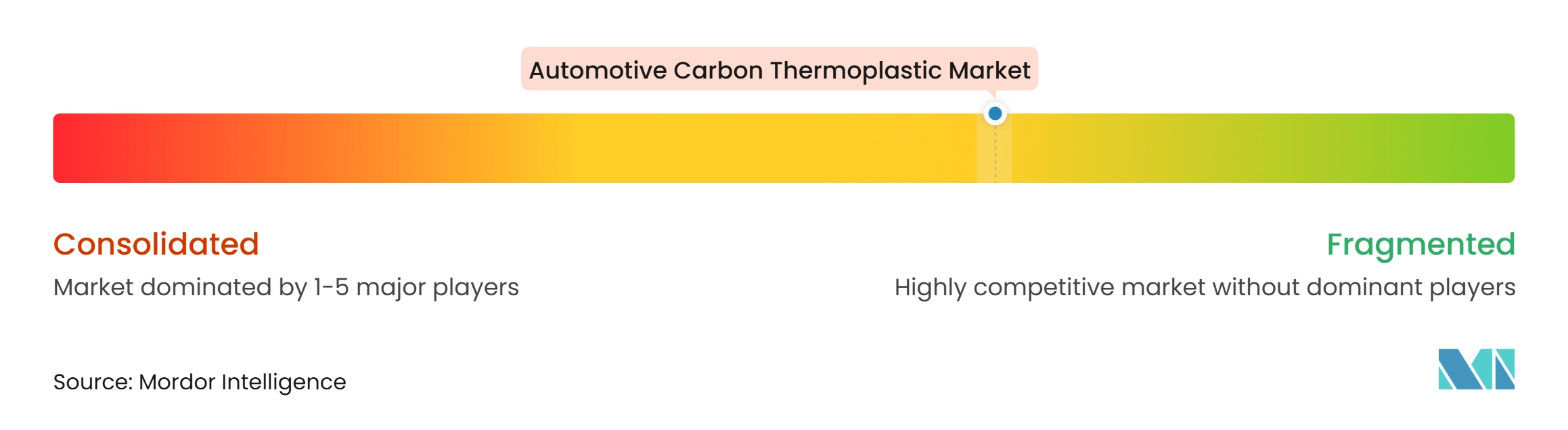
The automotive carbon thermoplastic market is moderately concentrated, with the top five players including Mitsubishi Chemical Group Corporation, BASF, TORAY INDUSTRIES, INC., Teijin Limited, and Solvay. The automotive carbon thermoplastic market has concentration in upstream carbon fiber supply and broader fragmentation among downstream compounders, resin suppliers, and part manufacturers. Current specialty-material activities formerly associated with LANXESS and Solvay are also conducted through Envalior and Syensqo, respectively. Scale remains important because automotive customers require stable supply and consistent production quality.
Leading suppliers are extending their roles beyond material supply. Arkema markets PEKK systems and unidirectional carbon fiber tapes for converters, which supports a more integrated position in the value chain. SABIC introduced MEGAMOLDING to combine materials, process data, and tooling guidance for large thermoplastic parts. Mitsubishi Chemical Group Corporation began a phased carbon fiber capacity expansion at its Tokai and Sacramento plants, targeting close to twice its current capacity for high-end applications by 2027. These moves show the need to support customer production programs as well as raw-material supply.
Recycling is becoming another basis for competition in the automotive carbon thermoplastic market. Asahi Kasei Corporation is developing a continuous-fiber recovery process using electrolyzed sulfuric acid. Syensqo and Vartega formed a collaboration to use post-industrial recycled carbon fiber from North American sites in high-performance applications. ISO 19350:2025 and European vehicle circularity requirements favor companies that can demonstrate material traceability, recycled-content performance, and qualification data.
Automotive Carbon Thermoplastic Industry Leaders
-
Mitsubishi Chemical Group Corporation
-
BASF
-
TORAY INDUSTRIES, INC.
-
Teijin Limited
-
Solvay
- *Disclaimer: Major Players sorted in no particular order
Automotive Carbon Thermoplastic Market Companies Covered in this Report
- Arkema
- Asahi Kasei Corporation
- Avient Corporation
- BASF
- Celanese Corporation
- CompLam Material Co., Ltd.
- Ensinger
- Hexcel Corporation
- Jiangsu Qiyi Technology Co., Ltd
- LANXESS
- Mitsubishi Chemical Group Corporation
- SABIC
- SGL Carbon
- Solvay
- Teijin Limited
- TORAY INDUSTRIES, INC.
Recent Industry Developments in Automotive Carbon Thermoplastic Market
- July 2026: Mitsubishi Chemical Group Corporation introduced a new series of high-performance carbon fiber prepregs designed for advanced industrial applications. The development supports the automotive carbon thermoplastic market by expanding the availability of advanced carbon-fiber composite materials for lightweight vehicle components and structural applications.
- June 2025: Arkema and Hexcel Corporation unveiled a PEKK/carbon fiber thermoplastic emergency exit door demonstrator under the HELUES project. The forming and overmolding process achieved a production cycle of less than 2 minutes and reduced assembly operations by up to 90%, supporting the automotive carbon thermoplastic market through faster composite manufacturing, reduced production complexity, and improved processing efficiency.
Global Automotive Carbon Thermoplastic Market Report Scope
Automotive carbon thermoplastics are lightweight composite materials that combine carbon fiber reinforcement with thermoplastic polymer resins. They provide high strength, stiffness, impact resistance, and design flexibility for vehicle components while supporting weight reduction and manufacturing efficiency.
The Automotive Carbon Thermoplastic Market is segmented by resin type, application, and geography. By resin type, the market is segmented into polyamide (PA), polyether ether ketone (PEEK), polyphenylene sulfide (PPS), polycarbonate (PC), polypropylene (PP), and other resin types. By application, the market is segmented into exterior body panels and closures, interior components, chassis and structural components, powertrain and under-the-hood components, and other applications. The report also covers the market size and forecasts for automotive carbon thermoplastics across 16 countries. For each segment, the market sizing and forecasts have been done on the basis of value (USD).
Segmentation Overview
| Polyamide (PA) |
| Polyether Ether Ketone (PEEK) |
| Polyphenylene Sulfide (PPS) |
| Polycarbonate (PC) |
| Polypropylene (PP) |
| Other Resin Types |
| Exterior Body Panels and Closures |
| Interior Components |
| Chassis and Structural Components |
| Powertrain and Under-the-Hood Components |
| Other Applications |
| Asia-Pacific | China |
| India | |
| Japan | |
| South Korea | |
| ASEAN Countries | |
| Rest of Asia-Pacific | |
| North America | United States |
| Canada | |
| Mexico | |
| Europe | Germany |
| United Kingdom | |
| France | |
| Italy | |
| NORDIC Countries | |
| Russia | |
| Rest of Europe | |
| South America | Brazil |
| Argentina | |
| Rest of South America | |
| Middle East and Africa | Saudi Arabia |
| South Africa | |
| Rest of Middle East and Africa |
| By Resin Type | Polyamide (PA) | |
| Polyether Ether Ketone (PEEK) | ||
| Polyphenylene Sulfide (PPS) | ||
| Polycarbonate (PC) | ||
| Polypropylene (PP) | ||
| Other Resin Types | ||
| By Application | Exterior Body Panels and Closures | |
| Interior Components | ||
| Chassis and Structural Components | ||
| Powertrain and Under-the-Hood Components | ||
| Other Applications | ||
| By Geography | Asia-Pacific | China |
| India | ||
| Japan | ||
| South Korea | ||
| ASEAN Countries | ||
| Rest of Asia-Pacific | ||
| North America | United States | |
| Canada | ||
| Mexico | ||
| Europe | Germany | |
| United Kingdom | ||
| France | ||
| Italy | ||
| NORDIC Countries | ||
| Russia | ||
| Rest of Europe | ||
| South America | Brazil | |
| Argentina | ||
| Rest of South America | ||
| Middle East and Africa | Saudi Arabia | |
| South Africa | ||
| Rest of Middle East and Africa | ||
Key Questions Answered in the Report
What is the size of the automotive carbon thermoplastic market?
The automotive carbon thermoplastic market size was valued at USD 472.92 million in 2026 and is estimated to grow from USD 532.50 million in 2027 to reach USD 992.88 million by 2032, at a CAGR of 13.27% during the forecast period (2027-2032).
What is driving demand for automotive carbon thermoplastics?
Battery electric vehicle lightweighting, rapid automated production, metal replacement, and high-voltage electrical components support demand as manufacturers seek lower mass and more integrated parts.
Which resin type held the largest share in 2026?
Polyamide (PA) held a 36.78% share in 2026 because it balances cost, processing compatibility, and performance across high-volume molded and stamped automotive components.
Which application is projected to grow fastest through 2032?
Exterior body panels and closures are projected to advance at a 15.06% CAGR through 2032, supported by use in hoods, tailgates, roofs, and other large vehicle surfaces.