
Automotive Active Seat Belt System Market Size and Share
Market Overview
| Study Period | 2020 - 2032 |
|---|---|
| Market Size (2027) | USD 4.71 Billion |
| Market Size (2032) | USD 6.91 Billion |
| Growth Rate (2027 - 2032) | 7.97 % |
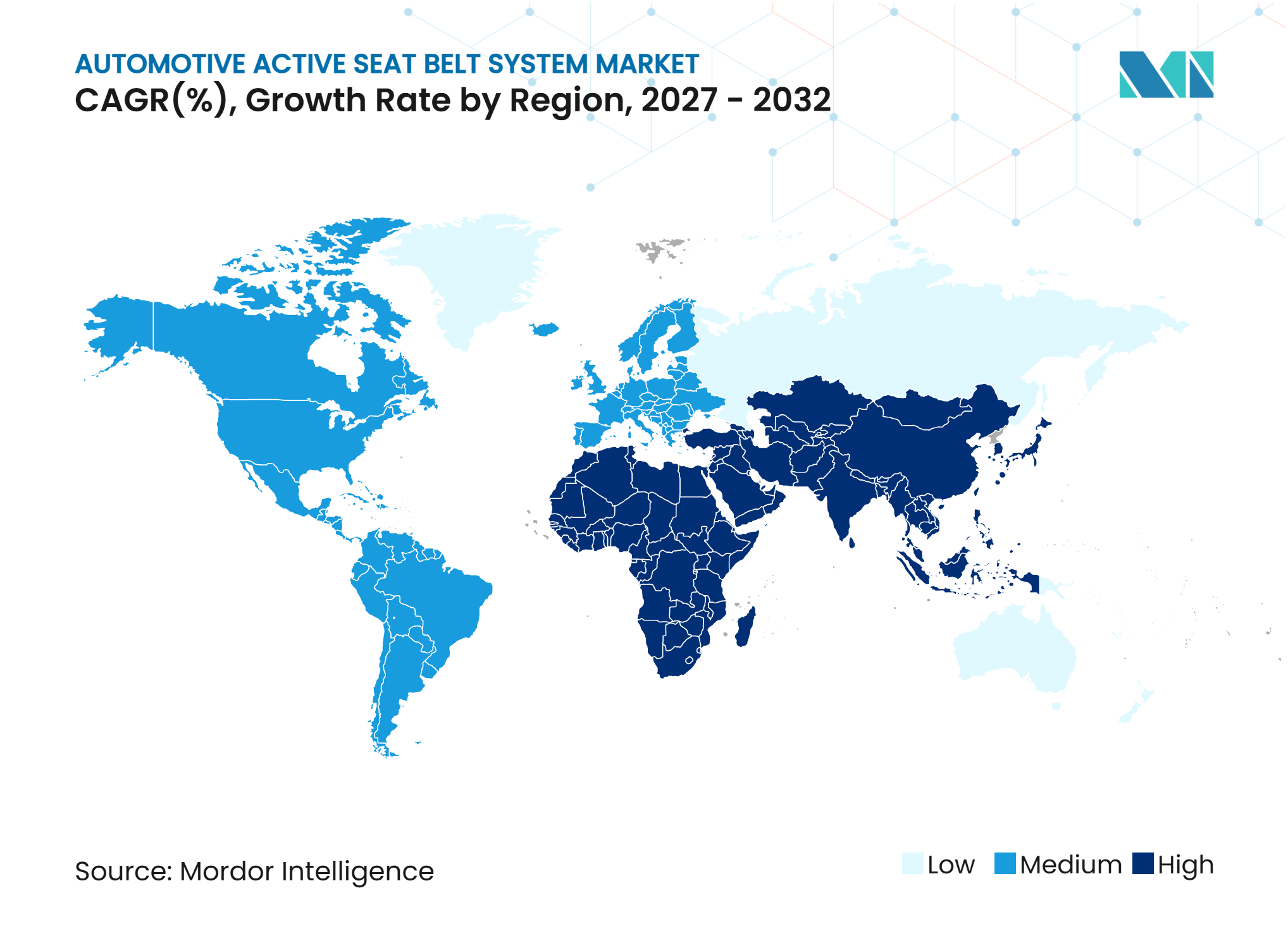
| Fastest Growing Market | Asia-Pacific |
| Largest Market | Middle East and Africa |
| Market Concentration | Medium |
Major Players *Disclaimer: Major Players sorted in no particular order Image © Mordor Intelligence. Reuse requires attribution under CC BY 4.0. | |
Automotive Active Seat Belt System Market Analysis by Mordor Intelligence
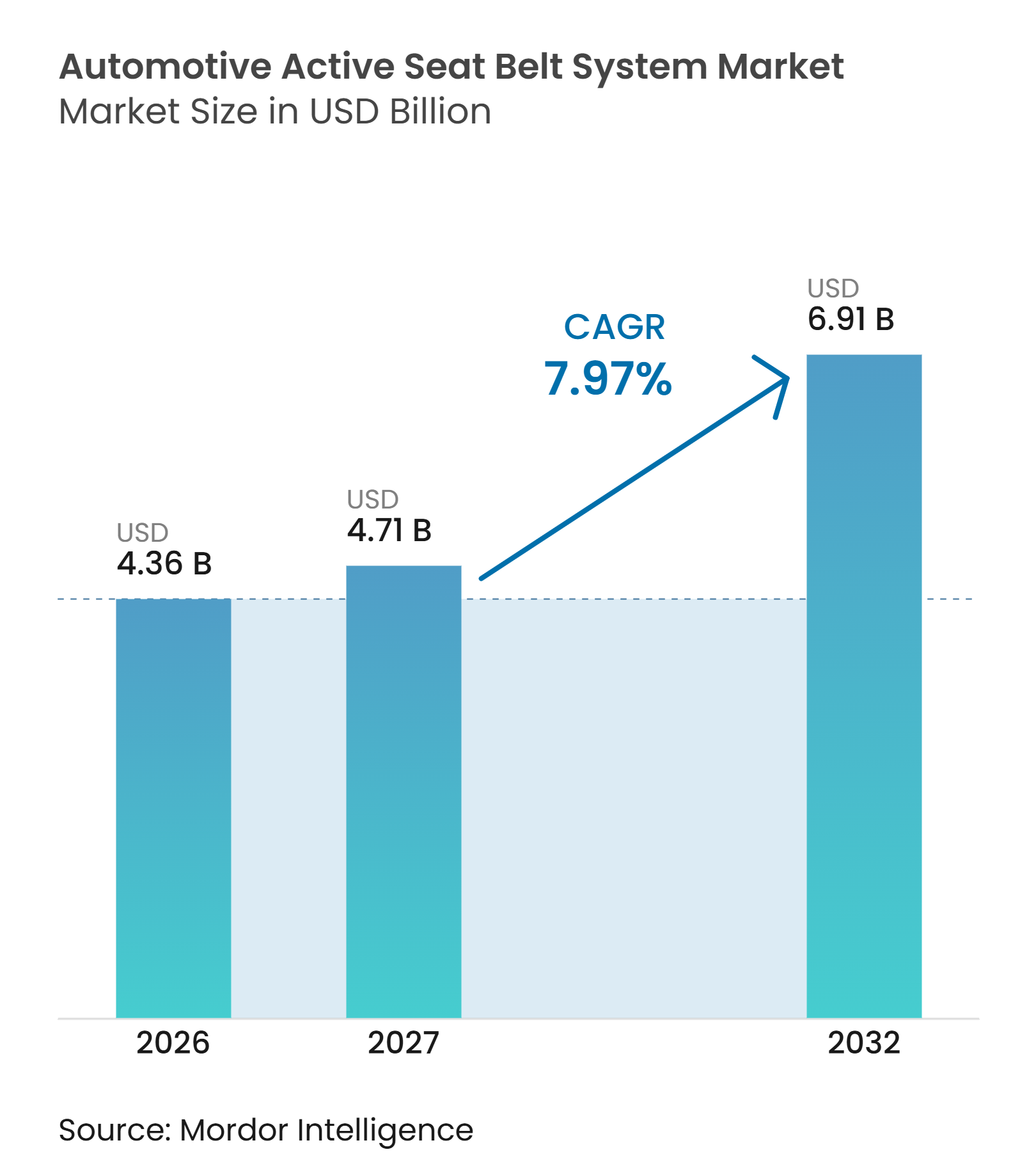
The automotive active seat belt system market size was valued at USD 4.36 billion in 2026, is estimated at USD 4.71 billion in 2027, and is projected to reach USD 6.91 billion by 2032, growing at a CAGR of 7.97% from 2027 to 2032. The Automotive active seat belt system market is moving from restraint designs that act only during a crash toward systems that can respond before an anticipated impact. Motorized pre-pretensioners, safety electronic control units, and advanced driver-assistance system inputs are becoming increasingly integrated in new vehicle programs. Rules for rear-seat reminders and occupant monitoring are shortening the time available for manufacturers to update vehicle designs. Suppliers that can combine mechanical restraint expertise with electronic validation are better placed to support these programs. Cost remains a practical constraint in lower-priced vehicles, but regulatory requirements continue to support demand across premium and high-volume models[1].
Key Report Takeaways
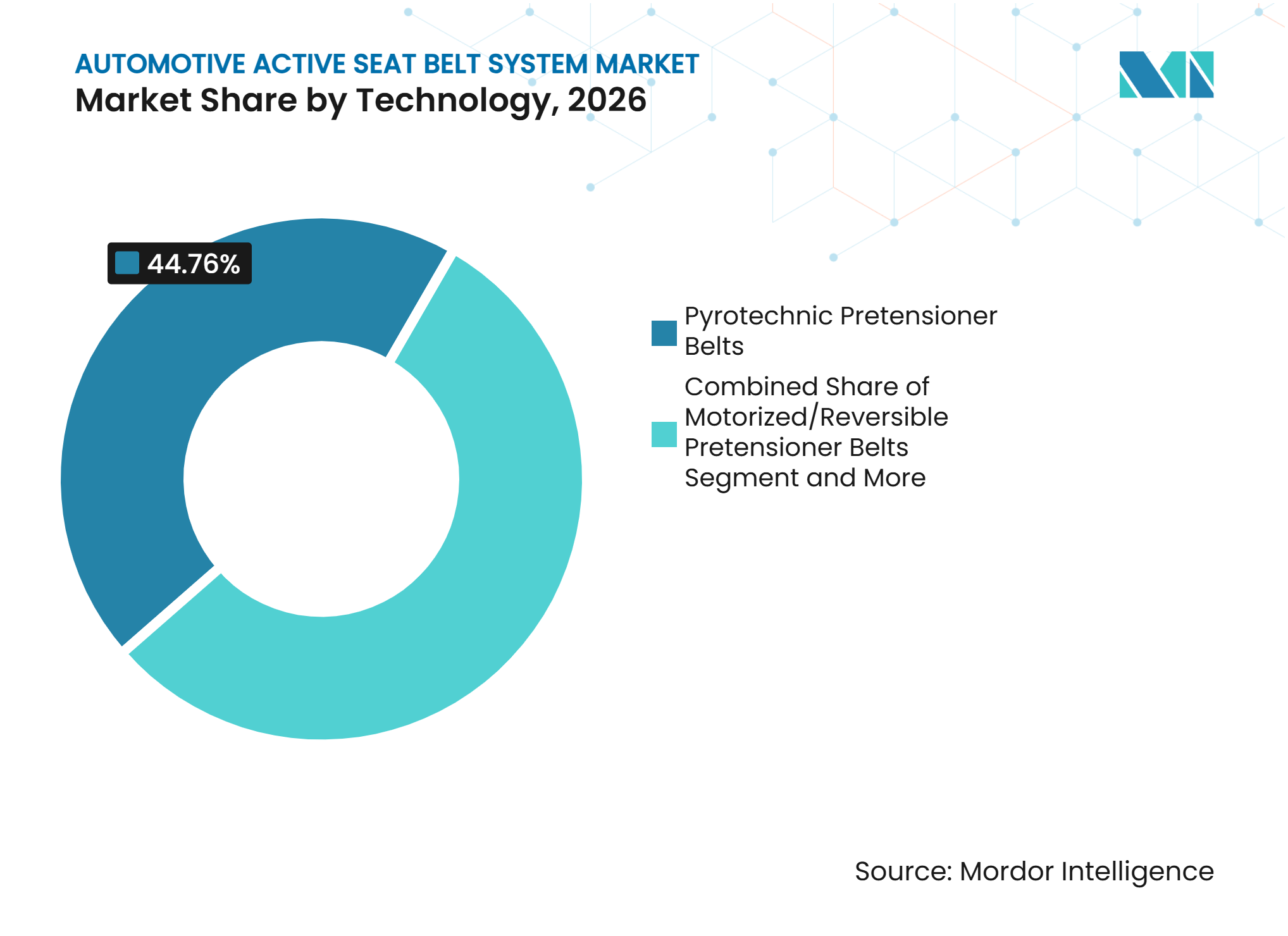
- By technology, Pyrotechnic Pretensioner Belts held 44.76% of the Automotive Active Seat Belt System Market share in 2026, while Motorized/Reversible Pretensioner Belts are forecast to grow at a 9.01% CAGR through 2032.
- By component, Retractors and Pretensioners accounted for 63.29% of the Automotive Active Seat Belt System Market share in 2026, while ECU and Sensors are forecast to grow at an 8.77% CAGR through 2032.
- By seat position, Front Seats held 79.31% of revenue share in 2026, while Rear Seats are forecast to grow at an 8.65% CAGR through 2032.
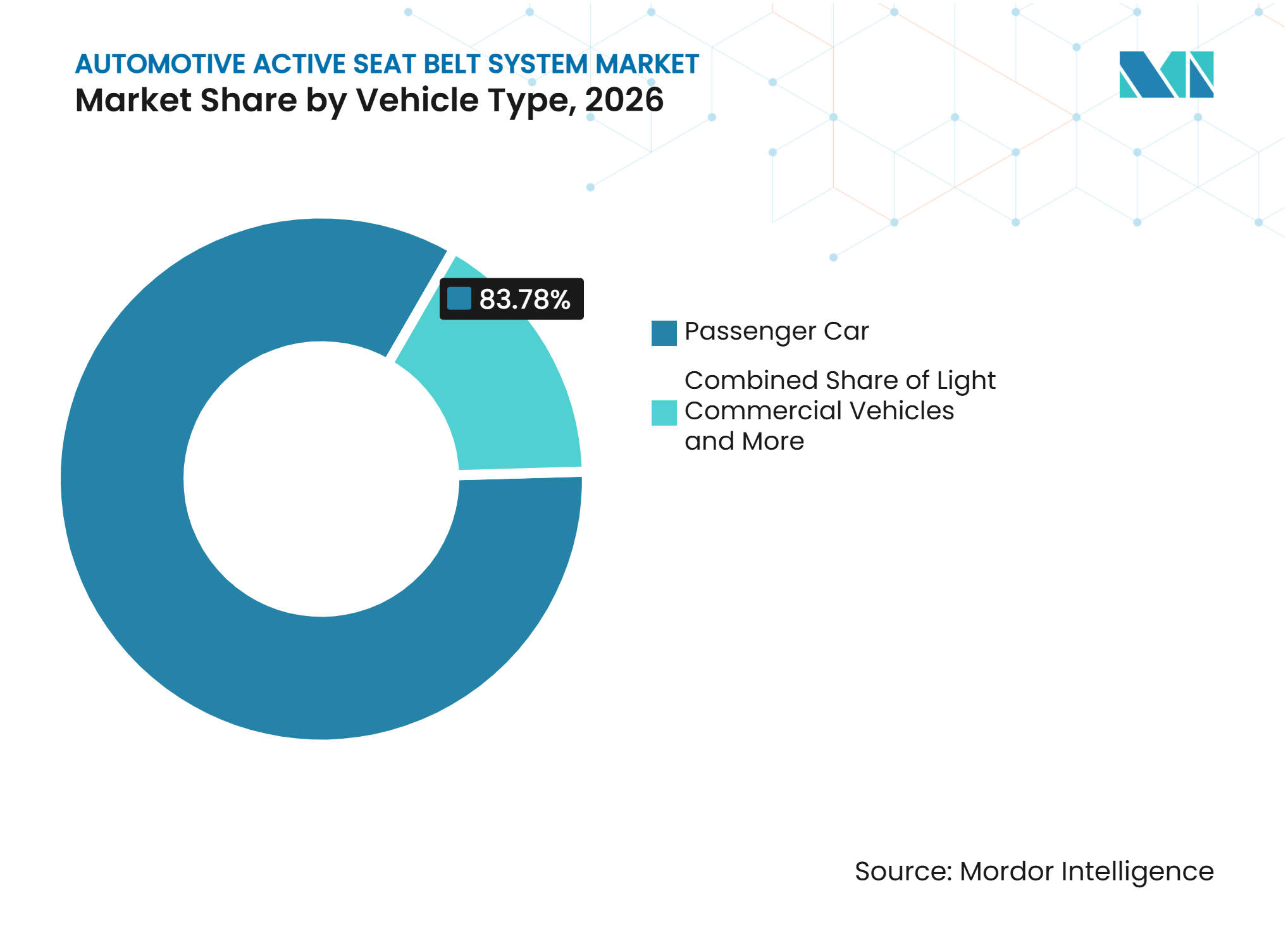
- By vehicle type, Passenger Cars accounted for 83.78% of revenue share in 2026, while Heavy Commercial Vehicles are forecast to grow at an 8.87% CAGR through 2032.
- By sales channel, OEM held 89.38% of revenue share in 2026, while Aftermarket is forecast to grow at an 8.48% CAGR through 2032.
- By geography, Asia-Pacific held 42.74% of revenue share in 2026, while the Middle East and Africa is forecast to grow at an 8.39% CAGR through 2032.
Note: Market numbers in this report are based on Mordor Intelligence's proprietary estimation framework, which combines nine months of actuals with Q4 projections for base year 2026.
Market Trends and Insights
Drivers Impact Analysis of Automotive Active Seat Belt System Market*
| Driver | (~) % Impact on CAGR Forecast | Geographic Relevance | Impact Timeline |
|---|---|---|---|
| Mandatory Rear-Seat Belt Reminders and Higher NCAP Weighting | +1.5% | Global, concentrated in North America, Europe, and Asia-Pacific | Short term (≤ 2 years) |
| ADAS-Triggered Pre-Crash Occupant Positioning | +1.3% | Global, strongest in high-income markets, North America, Europe, Japan, and South Korea | Medium term (2-4 years) |
| Electrification-Driven Integration of Restraint ECUs and High-Voltage Safety Architectures | +1.2% | Asia-Pacific core, China, with spillover to Europe and North America | Medium term (2-4 years) |
| Motorized Belt Functions for Haptic Warnings and Automated-Driving Handover | +0.9% | Europe, Japan, North America, and Asia-Pacific premium segments | Long term (≥ 4 years) |
| Inflatable and Adaptive Restraints for Rear-Seat and Vulnerable Occupants | +0.8% | North America, Europe, and China | Medium term (2-4 years) |
| Seat-Integrated Active Restraints for Flexible and Autonomous Cabins | +0.7% | Asia-Pacific, Europe, and North America | Long term (≥ 4 years) |
| Source: Mordor Intelligence | |||
Mandatory Rear-Seat Belt Reminders and Higher NCAP Weighting
Rear-seat compliance is an immediate driver of volume for the Automotive Active Seat Belt System Market through 2027. The U.S. National Highway Traffic Safety Administration finalized amendments to Federal Motor Vehicle Safety Standard No. 208 in January 2025. The rule requires seat belt warning systems, with compliance deadlines in September 2026 for front outboard seats and September 2027 for rear seats. Euro NCAP’s 2026 occupant-monitoring protocol awards up to 10 points for seat-belt monitoring and ties full performance to rear-seat occupancy detection [2]. These requirements encourage manufacturers to add sensors and reminder functions to programs that previously used simpler rear-seat systems. Delaying that work can weaken consumer safety ratings at a time when ratings remain visible in vehicle purchasing decisions.
ADAS-Triggered Pre-Crash Occupant Positioning
Motorized pre-pretensioners link crash avoidance systems with occupant protection in the Automotive Active Seat Belt System Industry. These reversible modules remove belt slack when the vehicle detects a potential collision and release tension once the threat has passed. The systems receive commands during the threat-assessment stage to reposition occupants and optimize restraint performance before a potential impact. This functionality supports integrating seat belt and advanced driver-assistance system data before a crash. It also enables suppliers to differentiate their offerings beyond conventional impact-triggered restraint hardware.
Electrification-Driven Integration of Restraint ECUs and High-Voltage Safety Architectures
Electric vehicles require suppliers to reconsider restraint calibration because vehicle mass and body structures can change crash pulses. states that greater mass and stiffness in electric vehicles may require revisions to restraint test methods and calibration. This need increases the value of safety ECUs that can coordinate restraint decisions with wider vehicle data. China’s scale of electric vehicle production makes the Asia-Pacific region a central location for this integration work. Vehicle makers can use these systems to tailor pretensioner firing characteristics and load-limiter settings to platform requirements. The result is greater demand for suppliers that combine mechanical restraint engineering with electronic and software validation capability.
Adaptive Motorized Restraints for Rear Seats and Flexible Cabins
The automotive active seat belt system market is expanding beyond single-crash applications. Motorized systems can apply staged tension during hard braking and provide physical warnings to occupants. Volvo Cars has introduced a multi-adaptive safety belt that uses interior and exterior sensor data to adjust load settings based on occupant characteristics and crash severity. Advanced rear-seat restraint configurations can reduce the risk of whole-body injury compared with baseline designs featuring inflatable elements. China’s automotive standardization plan identifies active pretensioner seat belts as a subject for standards research. These developments are supporting investment in adaptive rear-seat systems and restraint designs for reclined or flexible cabin layouts.
Restraints Impact Analysis of Automotive Active Seat Belt System Market*
| Restraint | (~) % Impact on CAGR Forecast | Geographic Relevance | Impact Timeline |
|---|---|---|---|
| High System Cost and Calibration Burden in Cost-Sensitive Vehicles | -1.2% | Global, most acute in South Asia, Southeast Asia, South America, and Africa | Medium term (2-4 years) |
| Pyrotechnic Handling, Serviceability, and End-of-Life Constraints | -0.8% | Global, with high compliance cost in Europe, North America, and Japan | Long term (≥ 4 years) |
| False-Positive Risk, Comfort Trade-Offs, and Consumer Acceptance of Reversible Tensioning | -0.6% | North America, Europe, and high-income Asia-Pacific | Medium term (2-4 years) |
| Limited Rear-Seat Sensorization and Inconsistent Regulatory Harmonization | -0.5% | Emerging Asia-Pacific, Middle East and Africa, and South America | Short term (≤ 2 years) |
| Source: Mordor Intelligence | |||
Cost, Calibration, and Acceptance Barriers
Cost differences across vehicle segments limit the near-term adoption of advanced systems in the automotive active seat belt system industry. Higher costs of motorized pretensioners, safety ECUs, and occupancy sensors primarily restrict their adoption to higher-value vehicles. Each restraint program also requires vehicle-specific engineering for crash pulses, belt-force limits, and driver-assistance communication protocols. Suppliers must complete extensive validation before a design enters production. False alerts and uncomfortable belt-tension events may further hinder consumer acceptance, particularly in markets where drivers have limited exposure to active restraint systems.
Pyrotechnic Handling and Uneven Service Readiness
Pyrotechnic pretensioners remain central to the automotive active seat belt system market, although their use creates servicing and end-of-life obligations. Their transport and handling remain subject to hazardous-goods regulations in many jurisdictions. Updated performance and validation requirements apply to pyrotechnic pretensioners used in retractors, buckles, and anchors. Spent modules require specialized replacement and disposal processes that are not uniformly available across service networks. Rear-seat sensors also remain unevenly deployed in emerging markets, where regulatory and inspection systems vary. These factors slow the transition to active systems in lower-cost vehicle programs, even as long-term safety requirements support adoption.
*Our forecasts treat driver/restraint impacts as directional, not additive. The impact forecasts reflect baseline growth, mix effects, and variable interactions.
Automotive Active Seat Belt System Market Segment Analysis
By Technology:
Motorized Systems Expand the Functional RangePyrotechnic Pretensioner Belts accounted for 44.76% of the Automotive Active Seat Belt System Market share in 2026. Their position reflects established manufacturing scale, long-standing crash-performance records, and lower unit costs. They remain a practical choice for platforms where the restraint system is designed to operate during a collision. Manufacturers can leverage established lines and supplier relationships when specifying these systems for cost-sensitive vehicles. Their installed base also supports continuing demand for replacement parts and validation services. The technology, therefore, remains important as vehicle makers add other forms of active control.
Motorized and reversible pretensioner belts are forecast to expand at a 9.01% CAGR through 2032, the fastest technology rate in the Automotive Active Seat Belt System Market. Their core advantage is the ability to tighten the belt before a crash and reset it after a non-crash event. Autoliv identifies reversible operation and electronic commands as key features of its pre-pretensioner design. Inflatable seat belts continue to play a key role in rear-seat protection, particularly for occupants of varying body sizes. Mechanical, pneumatic, and dual-mode systems also retain uses in specialty and commercial applications where electronic complexity or pyrotechnic handling is less suitable.



By Component:
Electronics Add Value to Established HardwareRetractors and pretensioners are projected to account for 63.29% of the Automotive Active Seat Belt System Industry in 2026. These components form the core actuation and load-management layer of every seat belt assembly. Their large share reflects decades of investment in production by global restraint system suppliers.
ECUs and sensors are forecast to grow at a CAGR of 8.77% through 2032, representing the highest growth rate among components. Occupancy detection systems, safety electronic control units, and sensor signals support rear-seat reminders and more tailored restraint responses. Euro NCAP monitoring criteria further increase the relevance of these inputs to vehicle safety ratings. Buckles and webbing remain stable components of the bill of materials. Webbing advancements focus on reducing weight and improving fiber durability to support mass-management priorities in electric vehicles. The Automotive Active Seat Belt System Market therefore encourages suppliers to combine mechanical products with electronics and software validation capabilities.
By Seat Position:
Rear Seats Gain Safety ContentFront seats are projected to account for 79.31% of the automotive active seat belt system market share in 2026. This leadership reflects the long history of front-seat regulations and the earlier adoption of pretensioners, load limiters, and occupant-sensing technologies. Active restraint systems for front-row occupants are well established across many higher-income vehicle models. Several platforms already offer motorized pre-pretensioners and variable force limiters, with calibrations refined through multiple product cycles and crash-test programs. This established installed base provides front-seat systems with a durable volume foundation.
Rear seats are forecast to grow at a CAGR of 8.65% through 2032, driven by regulations and safety rating systems that address historical protection gaps. Rear-seat warning requirements and occupant monitoring criteria are accelerating the adoption of sensing and reminder functions. Advanced rear-seat belt configurations incorporating pretensioners and load limiters can substantially improve occupant protection compared with conventional belt designs. ZF LIFETEC has developed mechanical decoupling technology in its SPR6.1 system to manage loads on rear occupants with varying body weights. This segment is expected to generate incremental demand for sensing technologies, restraint controls, and adaptable force-management systems.
By Vehicle Type:
Commercial Vehicles Add Electronic Safety ContentPassenger cars accounted for 83.78% of the automotive active seat belt system market share in 2026. This share reflects global production volumes and the historical focus of occupant protection regulations on M1 passenger vehicles. Updated requirements for new M1 and N1 type approvals are being applied to passenger car programs, which remain the primary channel through which suppliers can scale active restraint technologies. High-volume electric vehicle launches in Asia also support the integration of electronic restraint functions. Suppliers can distribute development costs across larger production runs in this vehicle category.
Heavy commercial vehicles are forecast to grow at an 8.87% CAGR through 2032, the highest growth rate among all vehicle types. Truck and vocational vehicle programs are incorporating more safety electronics as fleet operators prioritize occupant protection and liability management. Light commercial vehicles occupy a middle position, as fleet buyers balance compliance requirements against total vehicle cost. Commercial platforms may have longer development cycles, but their usage profiles can favor systems that provide warnings and improved occupant control. The automotive active seat belt system market is therefore expanding beyond passenger car applications. The pace of this growth depends on the rate at which safety requirements are introduced for truck cabs and commercial fleets.

By Sales Channel:
OEM Design-In Remains DecisiveOEM accounted for 89.38% of the Automotive Active Seat Belt System Market share in 2026. Active restraint products require integration with vehicle structures, electronic control units, crash calibration, and safety validation. These requirements make standard retrofit activity difficult for motorized retractors and sensor-based systems. Supplier qualification cycles can run for 18-36 months for a production program. Vehicle makers also need to coordinate belt hardware with airbag, seat, and electronic-control functions. Consequently, the OEM channel remains the central route to volume for the Automotive Active Seat Belt System Market.
Aftermarket is forecast to grow at an 8.48% CAGR through 2032. Growth is linked to the rising installed base of active restraint systems that need inspection, diagnostic work, or replacement after deployment. USCAR-48 provides common validation requirements for replacement pyrotechnic pretensioners. Mandatory inspection programs in countries such as Germany and Japan can also require restraint functions to operate correctly. The segment remains smaller because core active functions cannot be added through routine distribution channels. Its opportunity is concentrated in service, calibration, and certified replacement activities.
Geography Analysis
Asia-Pacific
Asia-Pacific held 42.74% of the automotive active seat belt system market share in 2026. China combines high vehicle output with standards that require updated restraint and reminder systems for new M1 and N1 approvals starting July 2025. The country's electric vehicle production also creates demand for restraint systems calibrated for different vehicle mass and structures. Japan's 2025 type-approval references align with updated UNECE Regulation No. 16 and UN R174 requirements. This regulatory influence supports ongoing integration of reminder functions and advanced seat belt designs. India adds another source of demand as Bharat NCAP increases its focus on adult-occupant protection. Regional manufacturing scale gives suppliers a practical reason to localize electronics, retractor production, and testing.
Middle East and Africa
Middle East and Africa is forecast to grow at an 8.39% CAGR through 2032, making it the fastest-growing geographic segment in the automotive active seat belt system market. Growth is supported by larger Gulf vehicle fleets and broader adoption of UNECE-aligned vehicle safety rules. The United Arab Emirates updated its traffic and vehicle safety requirements through Federal Decree-Law No. 14 of 2024, which came into force on March 29, 2025. Saudi Arabia's seat belt requirements for all occupants also support demand for compliant vehicle equipment. Premium vehicle imports remain important to regional value, as advanced restraint equipment is more commonly standard on those models. Enforcement modernization can increase attention to seat belt use and restraint maintenance, improving conditions for replacement demand.
Europe, North America, and South America
Europe remains a technology-intensive region, as Euro NCAP's 2026 protocol places added emphasis on occupant monitoring and adaptive protection. North America is implementing changes to Federal Motor Vehicle Safety Standard No. 208 warning systems for the 2026 and 2027 production programs. Adient and Autoliv introduced the Z-Guard dynamic seat safety system in October 2025 for reclined and flexible seating positions. South America provides incremental volume through Brazilian vehicle production and domestic supplier activity. Mature regions are likely to lead software validation and adaptive-system deployment, while South America is more likely to adopt these functions as vehicle platforms and regulatory requirements advance.
Competitive Landscape
Market Concentration
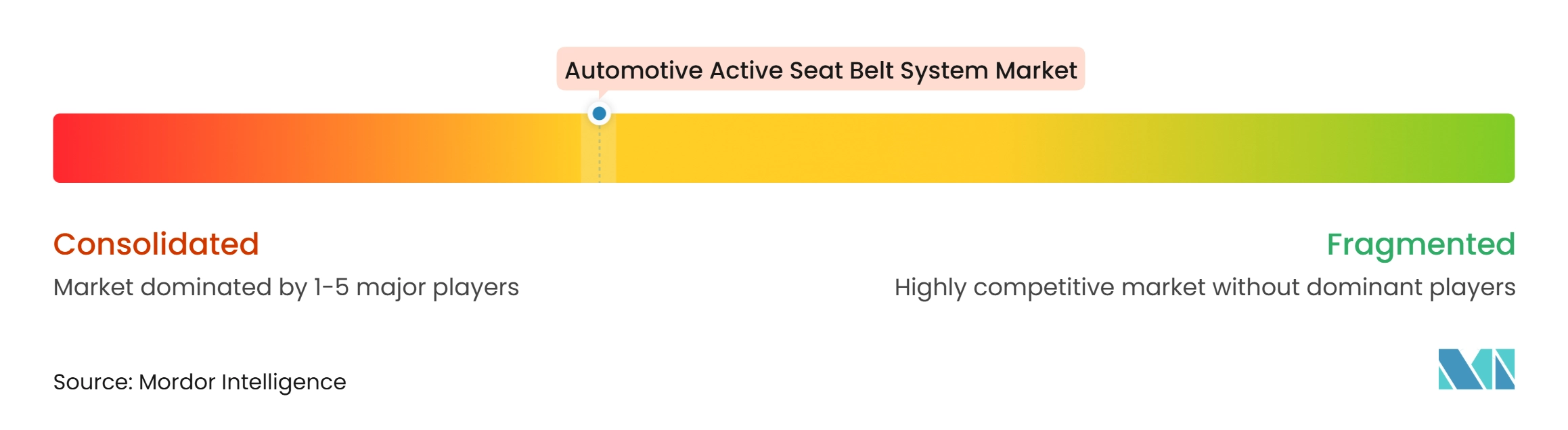
The automotive active seat belt system market has a concentrated structure in the global active restraint supply. Autoliv holds a major share of the global seat belt market. Its range includes pyrotechnic initiators, seat belt products, and pre-pretensioner solutions. ZF LIFETEC competes through variable force limiters, seat-integrated retractors, and virtual testing tools. Joyson Safety Systems has production scale and an established presence in China following the Takata acquisition. Tokai Rika, Hyundai Mobis, and Ashimori benefit from close OEM relationships. Daicel and Nippon Kayaku remain relevant suppliers of pyrotechnic initiators and gas generators.
Competition increasingly depends on the ability to validate software, sensors, and mechanical hardware together. ZF LIFETEC demonstrated camera- and sensor-fusion systems at InCabin 2025 that classify occupants in real time to enable more personalized airbag and belt deployment. Autoliv announced a joint venture with Hangsheng Electric in October 2025 to develop pre-pretensioner mechatronic integration and electronic seat belt solutions in China. Adient and Autoliv also introduced Z-Guard in October 2025, combining adjustable belt routing, dual pretensioners, and airbags for reclined seating. These developments indicate that suppliers are addressing both vehicle automation and varied occupant postures, while also increasing the value of proprietary testing and integration capability.
There remains room for products that reduce the cost of active restraints in entry-level vehicles. A reported USD 140 difference in passive safety content per vehicle between medium- and low-income markets and high-income markets points to this need. Lower-cost rear-seat occupancy detection is another opportunity where suppliers can meet reminder requirements without premium sensor arrays. Pyrotechnic systems will continue to be used where cost and established production matter most. Motorized systems are more likely to be selected when a vehicle requires pre-crash tensioning, haptic communication, or a resettable function. The largest suppliers are therefore balancing scale in established hardware with investment in electronic integration. This mix supports a competitive environment led by large Tier 1 companies but shaped by regional partnerships and specialized technology suppliers.
Automotive Active Seat Belt System Industry Leaders
-
Autoliv Inc.
-
ZF Friedrichshafen AG
-
Tokai Rika Co., Ltd.
-
Ashimori Industry Co., Ltd.
-
Joyson Safety Systems
- *Disclaimer: Major Players sorted in no particular order
Automotive Active Seat Belt System Market Companies Covered in this Report
- Autoliv Inc.
- ZF Friedrichshafen AG
- Joyson Safety Systems
- Tokai Rika Co., Ltd.
- Ashimori Industry Co., Ltd.
- Hyundai Mobis Co., Ltd.
- Daicel Corporation
- Toyoda Gosei Co., Ltd.
- Nippon Kayaku Co., Ltd.
- DENSO Corporation
- Robert Bosch GmbH
- AUMOVIO SE
- GWR Safety Systems
Recent Industry Developments in Automotive Active Seat Belt System Market
- September 2026: South Korea's Wooshin Safety Systems invested KRW 72.7 billion (USD 54 million) to establish an automotive seat belt component plant in Iksan, North Jeolla Province. The company will acquire and renovate an existing plant site and buildings, and install new production lines for retractors and buckles, which are key components of seat belt systems. Production is scheduled to begin in February 2027.
- July 2026: Autoliv Inc. (Autoliv) has developed InfraRed Webbing. This advanced seatbelt concept integrates infrared-enabled webbing into the seatbelt structure to enable enhanced occupant detection and classification, helping improve safety decisions inside the vehicle. The system supports non-contact occupant sensing and helps prevent interlock misuse while maintaining seatbelt flexibility, comfort, and safety performance.
Global Automotive Active Seat Belt System Market Report Scope
The Automotive Active Seat Belt System Market is Segmented by Technology (Motorized/Reversible Pretensioner Belts, Pyrotechnic Pretensioner Belts, Inflatable Seat Belts, and Others), Component (Retractor and Pretensioner, Buckle, Webbing, and ECU and Sensors), Seat Position (Front Seats, Rear Seats), Vehicle Type (Passenger Cars, Light Commercial Vehicles, and Heavy Commercial Vehicles), Sales Channel (OEM and Aftermarket), and Geography (North America, South America, Europe, Asia-Pacific, and Middle East and Africa). The Market Forecasts are Provided in Terms of Value (USD) and Volume (Units).
Segmentation Overview
| Motorized/Reversible Pretensioner Belts |
| Pyrotechnic Pretensioner Belts |
| Inflatable Seat Belts |
| Others (Mechanical, Pneumatic, and Dual-Mode Systems) |
| Retractor and Pretensioner |
| Buckle |
| Webbing |
| Others (ECU and Sensors) |
| Front Seats |
| Rear Seats |
| Passenger Cars |
| Light Commercial Vehicles |
| Heavy Commercial Vehicles |
| OEM |
| Aftermarket |
| North America | United States |
| Canada | |
| Rest of North America | |
| South America | Brazil |
| Argentina | |
| Chile | |
| Rest of South America | |
| Europe | Germany |
| United Kingdom | |
| France | |
| Italy | |
| Spain | |
| Russia | |
| Rest of Europe | |
| Asia-Pacific | China |
| Japan | |
| India | |
| South Korea | |
| Australia | |
| Indonesia | |
| Rest of Asia-Pacific | |
| Middle East and Africa | Saudi Arabia |
| United Arab Emirates | |
| Turkey | |
| South Africa | |
| Egypt | |
| Rest of Middle East and Africa |
| By Technology | Motorized/Reversible Pretensioner Belts | |
| Pyrotechnic Pretensioner Belts | ||
| Inflatable Seat Belts | ||
| Others (Mechanical, Pneumatic, and Dual-Mode Systems) | ||
| By Component | Retractor and Pretensioner | |
| Buckle | ||
| Webbing | ||
| Others (ECU and Sensors) | ||
| By Seat Position | Front Seats | |
| Rear Seats | ||
| By Vehicle Type | Passenger Cars | |
| Light Commercial Vehicles | ||
| Heavy Commercial Vehicles | ||
| By Sales Channel | OEM | |
| Aftermarket | ||
| By Geography | North America | United States |
| Canada | ||
| Rest of North America | ||
| South America | Brazil | |
| Argentina | ||
| Chile | ||
| Rest of South America | ||
| Europe | Germany | |
| United Kingdom | ||
| France | ||
| Italy | ||
| Spain | ||
| Russia | ||
| Rest of Europe | ||
| Asia-Pacific | China | |
| Japan | ||
| India | ||
| South Korea | ||
| Australia | ||
| Indonesia | ||
| Rest of Asia-Pacific | ||
| Middle East and Africa | Saudi Arabia | |
| United Arab Emirates | ||
| Turkey | ||
| South Africa | ||
| Egypt | ||
| Rest of Middle East and Africa | ||
Key Questions Answered in the Report
What is driving growth in the automotive active seat belt system sector?
Updated rear-seat reminder rules, occupant monitoring requirements, and the integration of pre-crash functions with driver-assistance systems support growth.
How large is the automotive active seat belt system sector?
It is expected to grow from USD 4.36 billion in 2026 to USD 6.91 billion by 2032, at an 7.97% CAGR.
Which active seat belt technology is growing fastest?
Motorized and reversible pretensioner belts are projected to grow at a 9.01% CAGR through 2032.
Which region leads demand for active seat belt systems?
Asia-Pacific held 42.74% of revenue share in 2026, supported by vehicle production scale and updated safety requirements.
Why does the OEM channel dominate active seat belt sales?
OEM accounted for 89.38% of revenue share in 2026 because these systems need vehicle-level engineering, calibration, and safety validation.