
Automotive Active Bonnet Market Size and Share
Market Overview
| Study Period | 2020 - 2032 |
|---|---|
| Market Size (2027) | USD 2.42 Billion |
| Market Size (2032) | USD 3.58 Billion |
| Growth Rate (2027 - 2032) | 8.11 % |
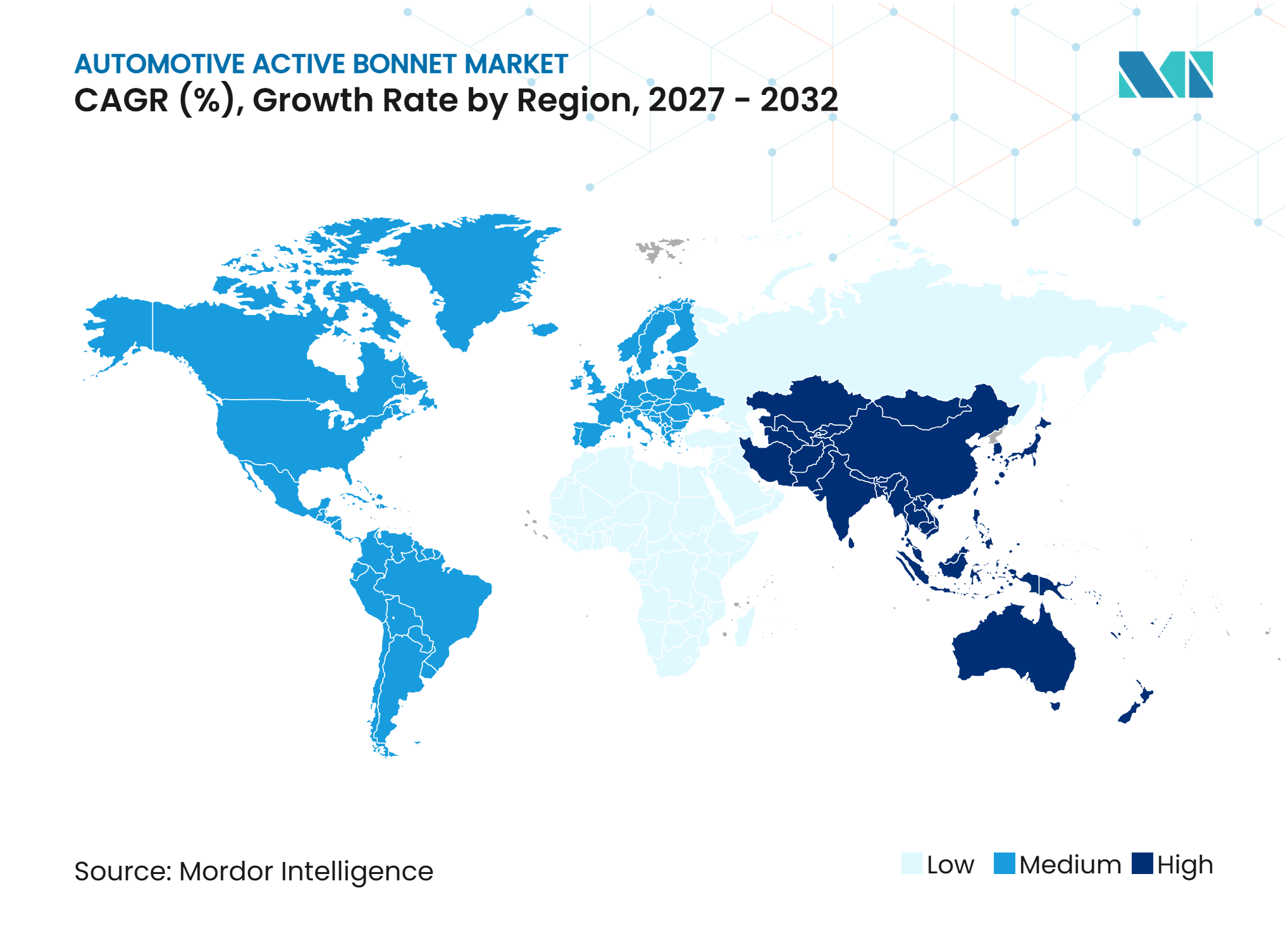
| Fastest Growing Market | Asia-Pacific |
| Largest Market | Europe |
| Market Concentration | Medium |
Major Players *Disclaimer: Major Players sorted in no particular order Image © Mordor Intelligence. Reuse requires attribution under CC BY 4.0. | |
Automotive Active Bonnet Market Analysis by Mordor Intelligence
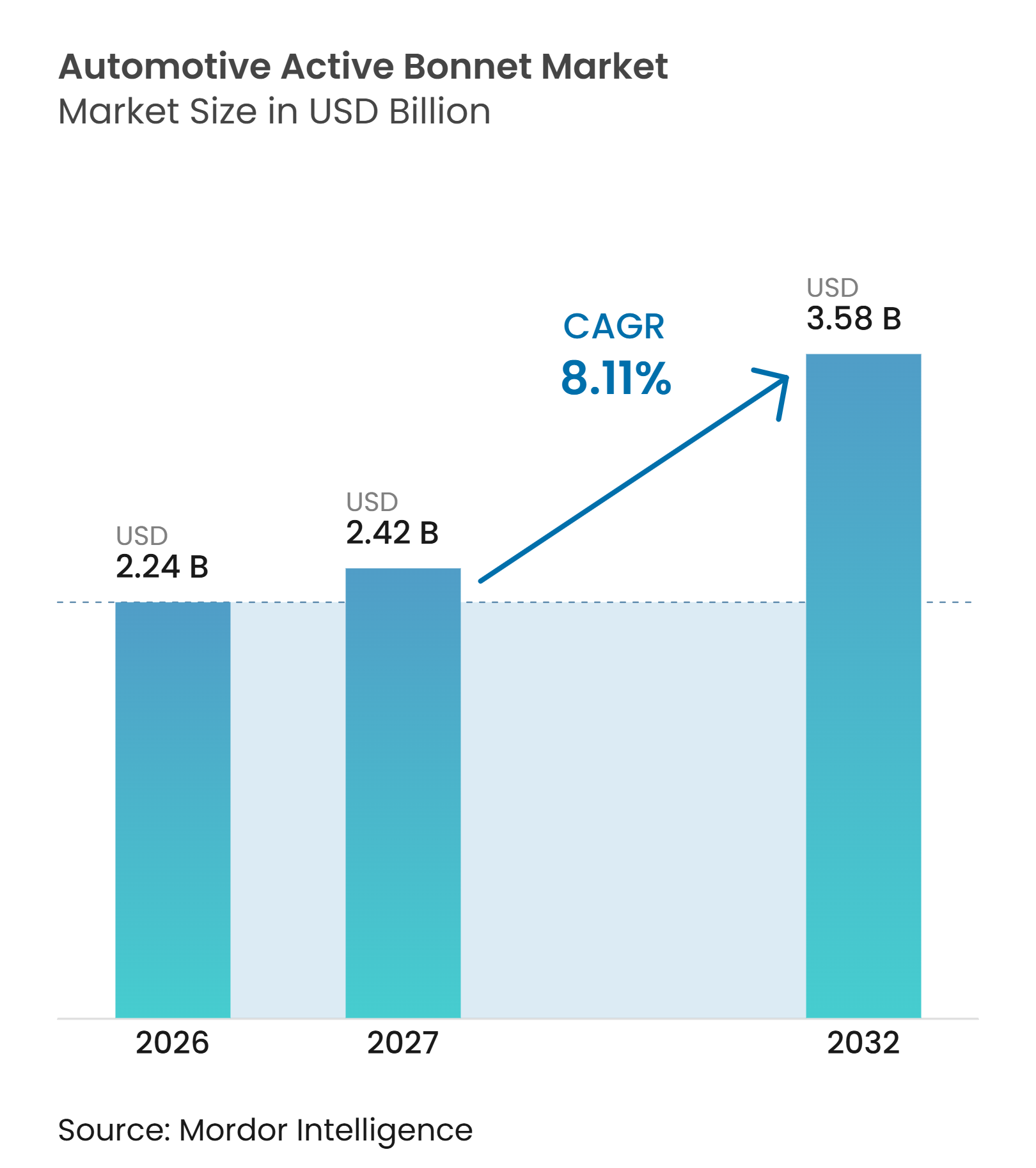
The automotive active bonnet market size was valued at USD 2.24 billion in 2026 and is expected to grow from USD 2.42 billion in 2027 to USD 3.58 billion by 2032, at a CAGR of 8.11% during 2027-2032. The automotive active bonnet market is shaped by pedestrian protection rules, vehicle architecture, and the need to integrate sensors with restraint systems. Deployable bonnet systems can create added clearance between the hood and hard underbody parts during a pedestrian impact. Electric vehicles and other low-clearance designs can make that clearance harder to achieve with a fixed hood. Suppliers therefore need to combine mechanical engineering, sensing, electronics, and validation work in a single vehicle program. The opportunity in the automotive active bonnet market is strongest where manufacturers seek consistent pedestrian protection across several regions.
Key Report Takeaways
- By actuator type, pyrotechnic systems held 59.35% of the automotive active bonnet market share in 2026, while electromagnetic/reversible systems are projected to record a 12.66% CAGR through 2032.
- By sensor type, pressure tube sensors held 40.93% of the automotive active bonnet market share in 2026, while camera/radar fusion is projected to record a 13.48% CAGR through 2032.
- By component, actuators/lifters held a 45.02% share in 2026, while ECUs are projected to record a 10.32% CAGR through 2032.
- By vehicle type, passenger cars held an 86.67% share in 2026, while commercial vehicles are projected to record a 9.39% CAGR through 2032.
- By sales channel, OEMs held a 93.42% share in 2026, while the aftermarket is projected to record an 8.90% CAGR through 2032.
- By geography, Europe held a 43.52% share in 2026, while Asia-Pacific is projected to record a 9.81% CAGR through 2032.
Note: Market numbers in this report are based on Mordor Intelligence's proprietary estimation framework, which combines nine months of actuals with Q4 projections for base year 2026.
Market Trends and Insights
Drivers Impact Analysis of Automotive Active Bonnet Market*
| Driver | (~) % Impact on CAGR Forecast | Geographic Relevance | Impact Timeline |
|---|---|---|---|
| Rising Euro NCAP and Pedestrian-Safety Compliance Requirements | +2.5% | Global, with strongest immediate pull in Europe and China | Short term (≤ 2 years) |
| Expansion of Active Safety Content in Premium and Electric Vehicles | +2.0% | Global, concentrated in China, Europe, and North America | Medium term (2–4 years) |
| Integration of Camera, Radar, and Pressure-Based Pedestrian Sensing | +1.2% | Global, technology development concentrated in Europe and Japan | Medium term (2–4 years) |
| Increasing Use of Pyrotechnic Hood Lifters in Low-Clearance Vehicle Platforms | +0.8% | Asia-Pacific, Europe | Medium term (2–4 years) |
| Growing Demand for Reversible Protection on Repeated-Event and Pre-Crash Architectures | +0.6% | Europe, North America | Long term (≥ 4 years) |
| Expansion of Pedestrian-Protection Assessments in China, Korea, and United States NCAP Programs | +0.3% | Asia-Pacific and North America | Long term (≥ 4 years) |
| Source: Mordor Intelligence | |||
Rising Euro NCAP and Pedestrian-Safety Compliance Requirements
Euro NCAP’s vulnerable road user protocol places close attention on how a vehicle protects people outside the cabin[1]. Vehicles with deployable bonnet systems require evidence that the system provides sufficient clearance after deployment. This makes active bonnet design a vehicle-level decision, rather than a late component choice. Manufacturers must coordinate the hood, hinges, sensors, control logic, and underhood layout. UN Regulation No. 127 also provides a type-approval framework for pedestrian safety in participating markets[2]. Suppliers with tested hardware, documented processes, and adaptable designs can reduce automakers' workload. The automotive active bonnet market benefits when manufacturers develop platforms for several regulatory settings.
Expansion of Active Safety Content in Premium and Electric Vehicles
Premium vehicles often introduce new safety features before they become common across wider vehicle ranges. Active bonnet systems fit this pattern because they require close coordination with vehicle design and validation. Battery-electric vehicles can have front-end layouts that reduce passive deformation space above rigid electrical or structural parts. A deployable bonnet can create added room during an impact when the fixed hood alone cannot meet the intended protection outcome. Each vehicle still has its own hood shape, structure, pedestrian protection target, and cost plan. Suppliers can support adoption by offering compact systems suited to different layouts. The automotive active bonnet market therefore follows broader changes in vehicle architecture, not only the shift to electric propulsion.
Integration of Camera, Radar, and Pressure-Based Pedestrian Sensing
A deployable bonnet must distinguish a pedestrian impact from other events before it activates. Pressure sensing remains useful because it can detect deformation in the bumper area. Camera and radar inputs can add information before physical contact occurs. Combining those inputs can help the vehicle assess an event with greater context. The control unit must then make a reliable decision within the operating conditions set for the vehicle. Suppliers need to show how sensors, the controller, and the actuator work as a single system. The automotive active bonnet market increasingly values this integration as pre-crash functions become more relevant.
Increasing Use of Pyrotechnic Hood Lifters in Low-Clearance Vehicle Platforms
Low-clearance front-end designs create a demanding setting for pedestrian protection. The bonnet must move enough to separate from hard parts beneath it during a qualifying event. Pyrotechnic lifters are relevant because they can provide a fast, forceful movement within limited space. Their packaging can be adapted to hinge or latch locations, depending on the vehicle structure. Manufacturers must also manage safe installation, triggering, repair procedures, and end-of-life handling. Suppliers need to match actuator stroke to hood geometry and the required clearance. The automotive active bonnet market continues to rely on these systems where a fixed hood cannot provide sufficient deformation space.
Restraints Impact Analysis of Automotive Active Bonnet Market*
| Restraint | (~) % Impact on CAGR Forecast | Geographic Relevance | Impact Timeline |
|---|---|---|---|
| High System and Validation Cost Relative to Passive Bonnet Design | -1.8% | Global, most acute in the mass-market passenger car segment | Short term (≤ 2 years) |
| False Deployment, Serviceability, and Post-Event Replacement Risk | -1.2% | Global | Medium term (2–4 years) |
| Limited Retrofit Economics in the Global Aftermarket | -0.6% | South America, Middle East and Africa | Long term (≥ 4 years) |
| Regional Differences in Pedestrian-Test Protocols and Sensor-Validation Evidence | -0.4% | Global | Medium term (2–4 years) |
| Source: Mordor Intelligence | |||
High System and Validation Cost Relative to Passive Bonnet Design
An active bonnet adds parts that a fixed hood does not need, including actuators, sensors, wiring, control electronics, and specially designed hinges or latches. Each part must work with the vehicle structure and its wider safety systems. The automaker must validate the finished vehicle rather than relying only on component-level testing. Vehicle makers also need access to test facilities, engineering resources, and evidence for their target markets. Changes to the hood, bumper, or sensor layout can require further checks. These costs and timing demands are harder to absorb in lower-priced programs. The automotive active bonnet market is strongest where safety ratings or vehicle positioning justify the added work. Late design changes can make adoption still more difficult.
False Deployment, Serviceability, and Post-Event Replacement Risk
A pyrotechnic unit is generally replaced after it activates, even when other parts of the vehicle have limited damage. The vehicle also needs inspection to confirm that sensing and control elements remain suitable for service. Automakers must consider parts availability, technician training, repair instructions, and customer downtime. These issues matter to insurers, fleet operators, and vehicle owners. False activation is also an important concern because the system must avoid firing after road debris, sensor contamination, or ambiguous impacts. At the same time, it cannot delay action when pedestrian protection is required. The automotive active bonnet market needs reliable detection and clear repair guidance to support confidence in the system. Service networks must be prepared before volume deployment begins.
*Our forecasts treat driver/restraint impacts as directional, not additive. The impact forecasts reflect baseline growth, mix effects, and variable interactions.
Automotive Active Bonnet Market Segment Analysis
By Actuator Type:
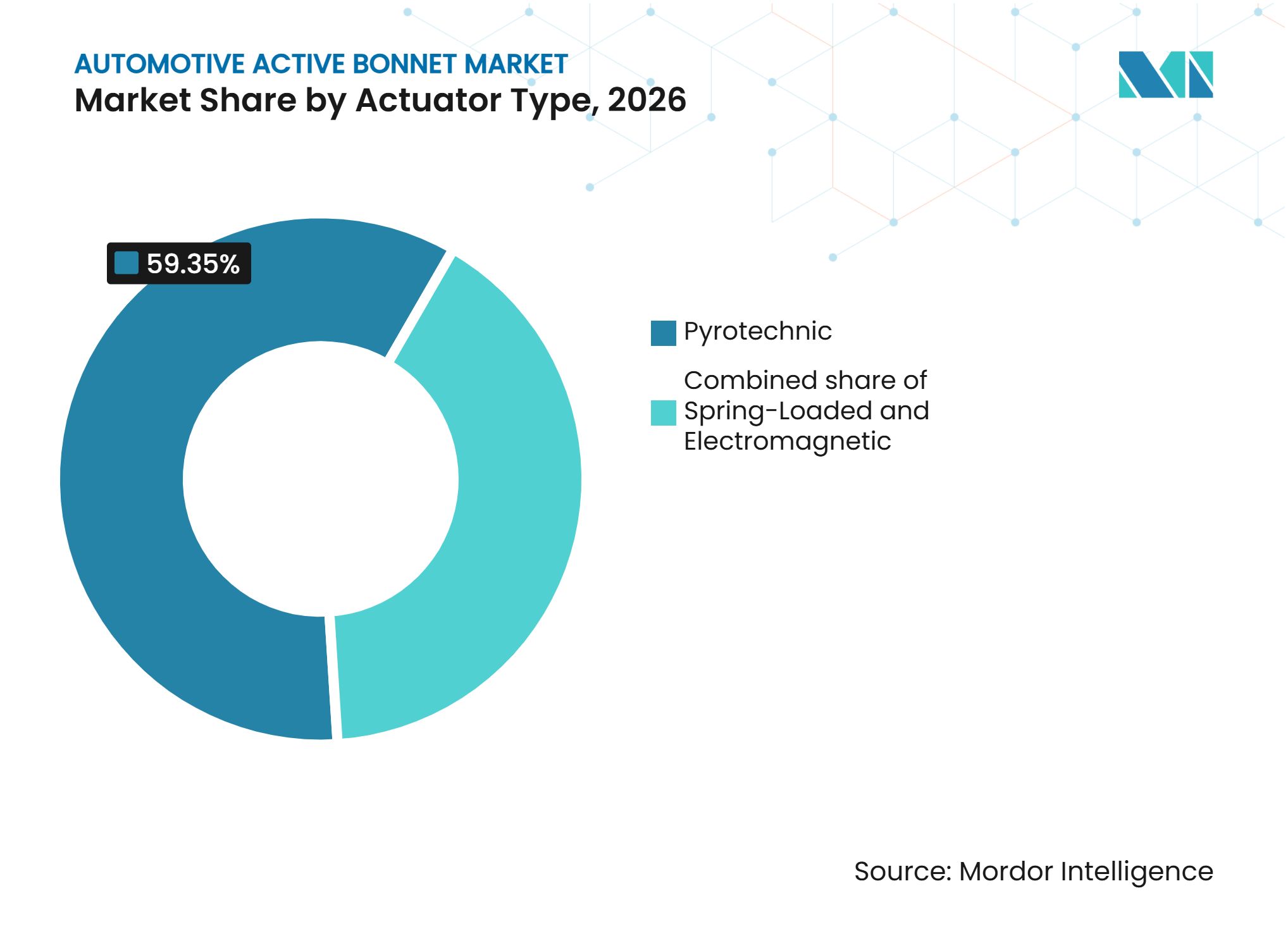
Pyrotechnic Systems Lead, Reversible Systems AdvancePyrotechnic systems held 59.35% of the automotive active bonnet market share in 2026. Their position reflects the need for a fast and dependable method to raise the hood during an impact. These systems can be integrated into the hinge or latch area based on the vehicle structure. They are familiar to automakers that already use pyrotechnic safety devices in other applications. Their use also fits low-clearance front-end designs where the hood needs a strong initial lift. This keeps pyrotechnic actuators important in the automotive active bonnet market.
Electromagnetic/reversible systems are projected to grow at a 12.66% CAGR through 2032. Their appeal comes from the potential to support pre-crash functions and reduce replacement needs after certain activations. These designs still need to prove durability, reset performance, and integration with vehicle sensing. Their adoption is likely to depend on whether the benefits justify added complexity. Hybrid approaches can combine a reversible mechanism with a separate protection response for severe events. The automotive active bonnet industry may use these designs first where advanced sensing is already part of the vehicle program.



By Sensor Type:
Pressure Tubes Remain Established, Fusion Sensing ExpandsPressure tube sensors held 40.93% of the automotive active bonnet market share in 2026. They remain relevant because they can detect deformation in the bumper area with a well-established design approach. Their use fits systems that activate after physical contact. They can also support cost-conscious programs where automakers seek proven components. The sensor needs to be matched to the bumper structure and impact paths of each vehicle. This makes pressure tubes a continuing part of the automotive active bonnet market.
Camera/radar fusion is projected to grow at a 13.48% CAGR through 2032. Combined sensing can give the vehicle information before a bumper contact event occurs. It can also provide more context for deciding whether to prepare or activate a protection system. The value of the approach depends on the quality of the software and the interaction between sensors. Vehicle makers will need to assess performance across lighting, weather, and front-end design conditions. The automotive active bonnet industry is likely to give more attention to fusion where pre-crash protection is a vehicle priority.
By Component:
Actuators and Lifters Anchor Systems, ECUs Gain ImportanceActuators/lifters held 45.02% of the automotive active bonnet market share in 2026. They are the physical parts that create the added hood clearance required by the system. Their design must match the hood weight, hinge geometry, and intended movement path. The choice of component affects packaging, repair procedures, and the final structure of the vehicle. Suppliers need to ensure that lifters work with the rest of the pedestrian protection system. This leaves actuators/lifters central to the automotive active bonnet market.
ECUs are projected to grow at a 10.32% CAGR through 2032. The controller receives sensor inputs and determines when to activate the protection function. It must operate within a wider vehicle safety architecture and support appropriate diagnostic functions. As systems use more sensor inputs, the controller has a larger role in interpreting those inputs. This can make software capability an important supplier differentiator. The automotive active bonnet industry is expected to rely more heavily on ECUs as sensing and decision requirements become more detailed.
By Vehicle Type:
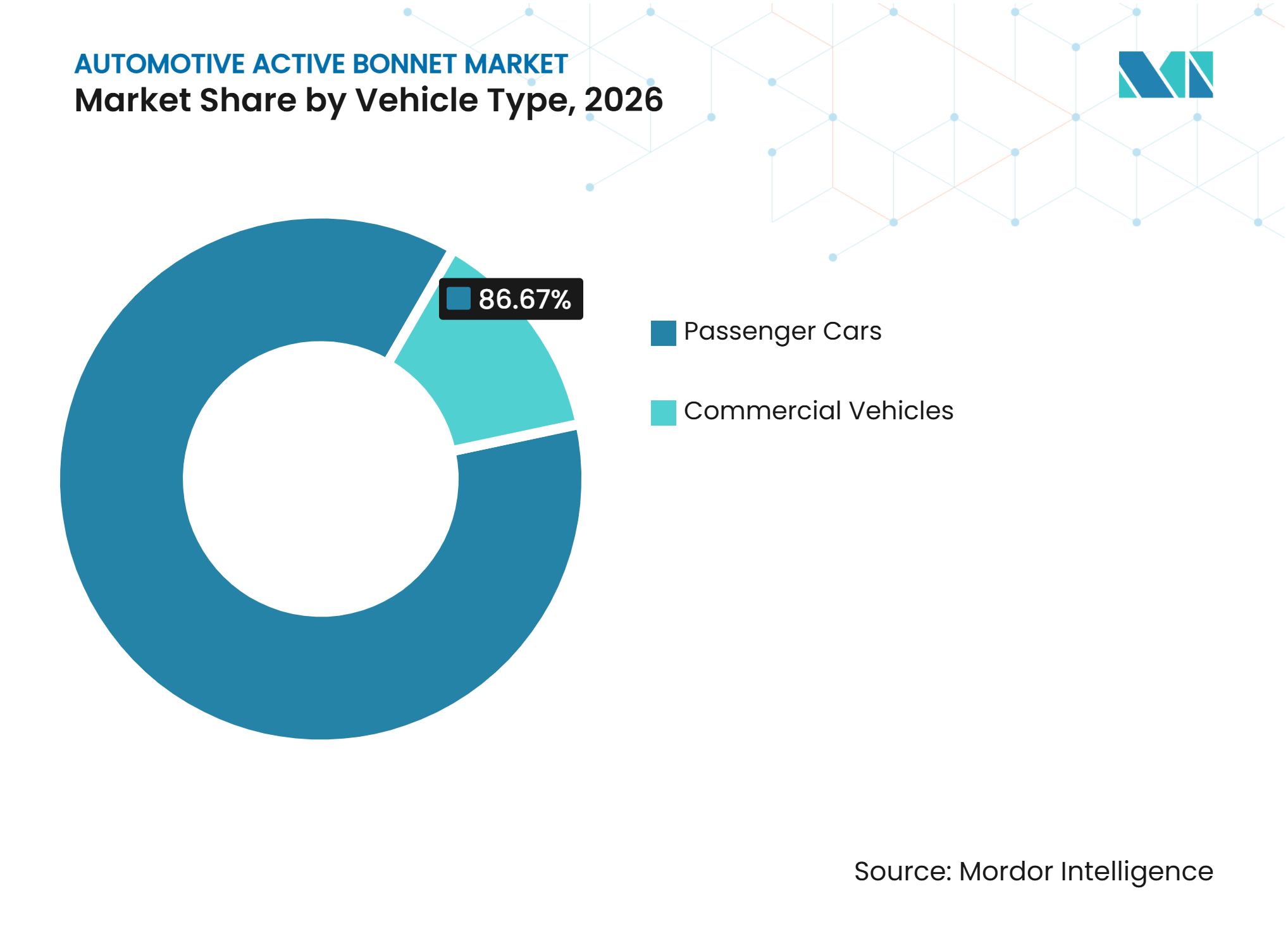
Passenger Cars Lead, Commercial Vehicles Build PresencePassenger cars held 86.67% of the automotive active bonnet market share in 2026. Pedestrian protection ratings and consumer safety expectations directly influence this vehicle category. Passenger cars also include many premium and electric platforms where active bonnet packaging is relevant. Automakers can use the system to support safety objectives without changing the overall vehicle purpose. The fitment decision remains closely linked to the vehicle’s front-end design. This makes passenger cars the main foundation of the automotive active bonnet market.
Commercial vehicles are projected to grow at a 9.39% CAGR through 2032. Light commercial vehicles often operate in urban areas where interactions with pedestrians are frequent. Their front-end design and usage patterns can pose a distinct pedestrian-protection challenge. Manufacturers may adopt active bonnet systems as safety requirements expand across more vehicle classes. Fleet buyers may also consider repair support and vehicle downtime before accepting the added system. The automotive active bonnet industry has room to grow in this category as light commercial platforms receive more advanced safety content.

By Sales Channel:
OEM Integration Determines AccessOEMs held 93.42% of the automotive active bonnet market share in 2026. The system must be integrated with the vehicle structure, electrical architecture, and safety controls during development. Original equipment suppliers work with automakers before production begins to define those connections. The design cannot usually be replicated through a simple aftermarket installation. Vehicle-specific validation also supports the importance of original equipment fitment. This gives OEM channels a defining role in the automotive active bonnet market.
The aftermarket is projected to grow at an 8.90% CAGR through 2032 as the equipped vehicle parc ages and post-deployment replacements rise. Automakers retain control over system specification because they are responsible for the complete vehicle’s performance. Suppliers must meet program timing, quality, and validation expectations set by each customer. The sales process can begin well before a vehicle reaches production. This favors suppliers with engineering support as well as component manufacturing capability. The automotive active bonnet industry remains tied to long product-development cycles and platform-level supply agreements.
Geography Analysis
Europe held 43.52% of the automotive active bonnet market share in 2026. The region’s position is supported by its established pedestrian-protection assessment environment and experienced safety-supply base. Automakers selling into European markets closely consider the effect of safety features on vehicle assessment outcomes. The region also has suppliers with experience in actuators, restraint systems, sensing, and automotive electronics. These capabilities support development of deployable bonnet systems for local and exported vehicles. Europe is an important reference point because its protocols can influence global platforms sold in several regions. This creates a practical reason for automakers to seek systems that can be adapted across related models. It also gives European development teams a continuing role in setting common engineering expectations.
Asia-Pacific is projected to grow at a 9.81% CAGR through 2032. China is a major hub for vehicle development, especially for electric and export-oriented platforms. Manufacturers in the region increasingly design products for domestic and international safety expectations. Japan and South Korea contribute through established vehicle and component supply networks. India and Australia provide further potential as vehicle safety requirements and model offerings evolve. The automotive active bonnet market can expand as automakers apply higher protection content across a broader range of regional platforms. Local engineering support matters because vehicle designs and customer needs differ across the region. Suppliers that combine local responsiveness with proven system knowledge are better placed to support these programs.
North America, South America, the Middle East, and Africa have varied conditions for active bonnet adoption. In the United States, NHTSA has added crashworthiness pedestrian protection to its New Car Assessment Program but deferred its start from model year 2026 to model year 2027. Imported vehicles can bring these systems into other regions even where local requirements are less developed. Premium models are often the first entry point because they carry more advanced safety content. Repair support and replacement parts can be less accessible outside major urban centers, which affects ownership and fleet decisions. The automotive active bonnet market across these regions will depend on regulation, vehicle imports, and the development of qualified service networks. A clear repair process can be as important as the original system design in markets with dispersed service coverage. Suppliers must therefore consider parts logistics alongside original equipment opportunities.
Competitive Landscape
Market Concentration

The automotive active bonnet market remains moderately concentrated. Large safety suppliers have the resources to manage validation work, vehicle-program support, and global production expectations. Autoliv, AUMOVIO SE, ZF Friedrichshafen AG, DENSO CORPORATION, and Toyoda Gosei Co., Ltd. are among the companies active in relevant safety, sensing, and actuation capabilities. Competition is not limited to the actuator itself because system performance depends on sensing, electronics, and vehicle integration. Specialists can still compete by offering a distinct actuator design, hinge arrangement, or sensing capability. The automotive active bonnet market rewards suppliers that can address these linked needs. Customers also value consistent engineering support from concept work through series production.
Autoliv signed a global strategic cooperation framework agreement with Great Wall Motor in July 2026 covering integrated safety systems, supply-chain collaboration, and international expansion. Its activity shows how safety suppliers are positioning themselves near fast-growing electric vehicle programs. AUMOVIO SE has presented safety technologies that link sensing with passive restraint deployment, supporting integrated safety architectures. ZF LIFETEC began a capacity expansion at its Xi'an base in March 2026 that adds 1.8 million hood lifters a year. These moves reflect competition for vehicle programs that need both local support and global technical capability. The automotive active bonnet industry is increasingly shaped by suppliers that can support customers across several markets. Local partnerships can help suppliers respond to design changes and production needs without losing the benefit of a global technology base.
Competition also depends on the ability to manage cost. Automakers need systems that fit their safety objectives without creating avoidable complexity in the vehicle. Suppliers are therefore developing modular designs that can be adapted to more than one platform. A strong validation record can help a supplier win repeat business when a customer uses similar vehicle architectures. New entrants may find opportunities in reversible actuators, sensor integration, or compact packaging. The automotive active bonnet market is likely to remain competitive because no single capability fully determines success. Product design, testing support, manufacturing discipline, and customer relationships all affect the final supplier decision.
Automotive Active Bonnet Industry Leaders
-
Autoliv, Inc.
-
AUMOVIO SE
-
ZF Friedrichshafen AG
-
DENSO CORPORATION
-
Toyoda Gosei Co., Ltd.
- *Disclaimer: Major Players sorted in no particular order
Automotive Active Bonnet Market Companies Covered in this Report
- Autoliv, Inc.
- ZF Friedrichshafen AG
- Ningbo Joyson Electronic Corp.
- AUMOVIO SE
- Robert Bosch GmbH
- DENSO CORPORATION
- Aptiv PLC
- Magna International Inc.
- Hyundai Mobis Co., Ltd.
- Daicel Corporation
- Nippon Kayaku Co., Ltd.
- Toyoda Gosei Co., Ltd.
- Gestamp Automoción, S.A.
- Multimatic Inc.
- Ashimori Industry Co., Ltd.
- Astotec Automotive GmbH
- Forvia SE
- OPmobility SE
- Samvardhana Motherson International Ltd.
Recent Industry Developments in Automotive Active Bonnet Market
- October 2026: STMicroelectronics introduced four automotive safety combination sensors for airbag deployment and other active and passive safety systems in mass-market vehicles.
- July 2026: Autoliv and Great Wall Motor signed a global strategic cooperation framework agreement covering integrated safety systems, supply-chain collaboration, and GWM's international expansion.
- March 2026: ZF LIFETEC broke ground on a capacity expansion at its Xi'an base that adds 1.8 million hood lifters and 4.1 million hybrid inflators of annual capacity.
- September 2025: NHTSA delayed the addition of crashworthiness pedestrian protection to its New Car Assessment Program from model year 2026 to model year 2027.
Global Automotive Active Bonnet Market Report Scope
The Automotive Active Bonnet Market is segmented by Actuator Type, Sensor Type, Component, Vehicle Type, Sales Channel, and Geography. By Actuator Type, the market is segmented into Pyrotechnic, Spring-Loaded/Mechanical, and Electromagnetic/Reversible. By Sensor Type, the market is segmented into Pressure Tube Sensors, Accelerometers, Fiber-Optic Sensors, and Camera/Radar Fusion. By Component, the market is segmented into Actuators/Lifters, Sensors, ECU, and Others (Hinges). By Vehicle Type, the market is segmented into Passenger Cars and Commercial Vehicles. By Sales Channel, the market is segmented into OEM and Aftermarket. By Geography, the market is segmented into North America (United States, Canada, and Mexico), Europe (Germany, United Kingdom, France, Italy, Spain, Sweden, Russia, Poland, and Rest of Europe), Asia-Pacific (China, Japan, South Korea, India, Australia, New Zealand, and Rest of Asia-Pacific), South America (Brazil, Argentina, Chile, Colombia, and Rest of South America), and Middle East and Africa (Saudi Arabia, United Arab Emirates, Turkey, South Africa, Israel, and Rest of Middle East and Africa). Market forecasts are provided in terms of Value (USD).
Segmentation Overview
| Pyrotechnic |
| Spring-Loaded/Mechanical |
| Electromagnetic/Reversible |
| Pressure Tube Sensors |
| Accelerometers |
| Fiber-Optic Sensors |
| Camera/Radar Fusion |
| Actuators/Lifters |
| Sensors |
| ECU |
| Others (Hinges) |
| Passenger Cars |
| Commercial Vehicles |
| OEM |
| Aftermarket |
| North America | United States |
| Canada | |
| Mexico | |
| Europe | Germany |
| United Kingdom | |
| France | |
| Italy | |
| Spain | |
| Sweden | |
| Russia | |
| Poland | |
| Rest of Europe | |
| Asia-Pacific | China |
| Japan | |
| South Korea | |
| India | |
| Australia | |
| New Zealand | |
| Rest of Asia-Pacific | |
| South America | Brazil |
| Argentina | |
| Chile | |
| Colombia | |
| Rest of South America | |
| Middle East and Africa | Saudi Arabia |
| United Arab Emirates | |
| Turkey | |
| South Africa | |
| Israel | |
| Rest of Middle East and Africa |
| By Actuator Type | Pyrotechnic | |
| Spring-Loaded/Mechanical | ||
| Electromagnetic/Reversible | ||
| By Sensor Type | Pressure Tube Sensors | |
| Accelerometers | ||
| Fiber-Optic Sensors | ||
| Camera/Radar Fusion | ||
| By Component | Actuators/Lifters | |
| Sensors | ||
| ECU | ||
| Others (Hinges) | ||
| By Vehicle Type | Passenger Cars | |
| Commercial Vehicles | ||
| By Sales Channel | OEM | |
| Aftermarket | ||
| By Geography | North America | United States |
| Canada | ||
| Mexico | ||
| Europe | Germany | |
| United Kingdom | ||
| France | ||
| Italy | ||
| Spain | ||
| Sweden | ||
| Russia | ||
| Poland | ||
| Rest of Europe | ||
| Asia-Pacific | China | |
| Japan | ||
| South Korea | ||
| India | ||
| Australia | ||
| New Zealand | ||
| Rest of Asia-Pacific | ||
| South America | Brazil | |
| Argentina | ||
| Chile | ||
| Colombia | ||
| Rest of South America | ||
| Middle East and Africa | Saudi Arabia | |
| United Arab Emirates | ||
| Turkey | ||
| South Africa | ||
| Israel | ||
| Rest of Middle East and Africa | ||
Key Questions Answered in the Report
What is an automotive active bonnet system?
It is a pedestrian protection system that raises the hood during a qualifying impact to create added space above hard parts under the hood.
What is the automotive active bonnet market size forecast?
The automotive active bonnet market size is projected to rise from USD 2.42 billion in 2027 to USD 3.58 billion by 2032, at an 8.11% CAGR.
Which actuator type leads automotive active bonnet adoption?
Pyrotechnic systems led with a 59.35% share in 2026 because they provide a fast hood-lifting response for vehicle-specific pedestrian protection designs.
Which sensor approach is forecast to grow fastest for active bonnet systems?
Camera/radar fusion is projected to grow at a 13.48% CAGR through 2032, supported by the need for earlier and more informed detection.