
Autogas Market Size and Share
Market Overview
| Study Period | 2022 - 2032 |
|---|---|
| Market Size (2027) | USD 60.68 Billion |
| Market Size (2032) | USD 77.69 Billion |
| Growth Rate (2027 - 2032) | 5.07 % |
| Fastest Growing Market | Asia-Pacific |
| Largest Market | Asia-Pacific |
| Market Concentration | Low |
Major Players *Disclaimer: Major Players sorted in no particular order Image © Mordor Intelligence. Reuse requires attribution under CC BY 4.0. | |
Autogas Market Analysis by Mordor Intelligence
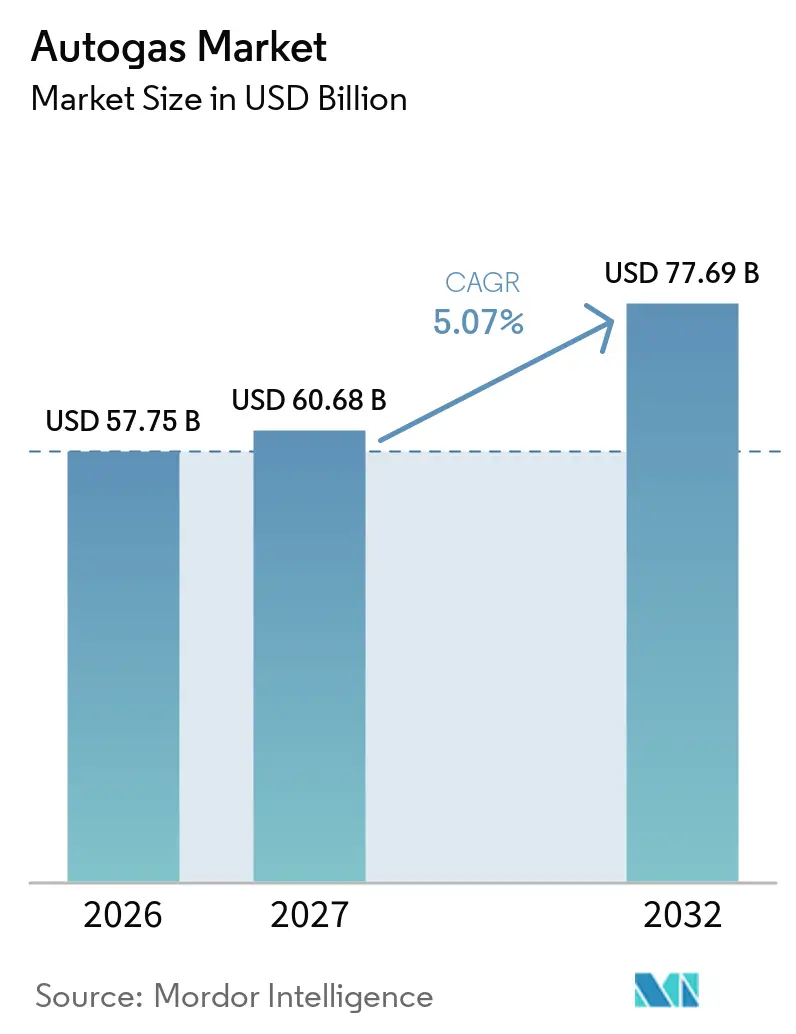
The Autogas Market size is expected to grow from USD 57.75 billion in 2026 to USD 60.68 billion in 2027 and is forecast to reach USD 77.69 billion by 2032 at 5.07% CAGR over 2027-2032. The autogas market benefits from an installed base of 28.3 million LPG vehicles and a network of 82,000 refueling stations, which gives fleet operators a practical fuel option where charging access remains limited.[1] Demand is moving toward commercial users because rapid refueling and operating costs carry more weight in their vehicle decisions. Producers and fuel distributors are responding by expanding certified systems, factory-fitted vehicles, and supply arrangements for large fleets. The autogas market also faces policy risk because conversion demand responds closely to taxes, incentives, and rules governing access to urban areas. Renewable liquid gas and renewable dimethyl ether programs may help existing stations remain useful as vehicle emissions standards tighten.
Key Report Takeaways
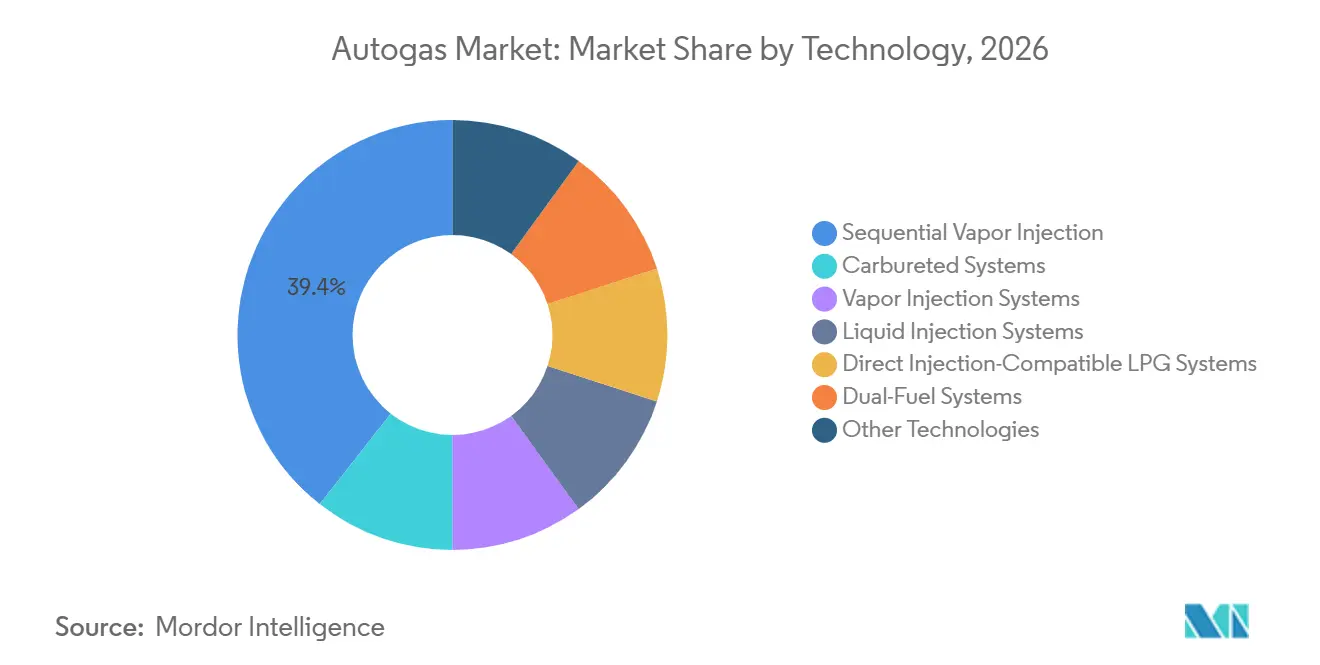
- By technology, Sequential Vapor Injection held 39.4% revenue share in 2026, while Liquid Injection Systems recorded the highest projected CAGR at 5.8% through 2032.
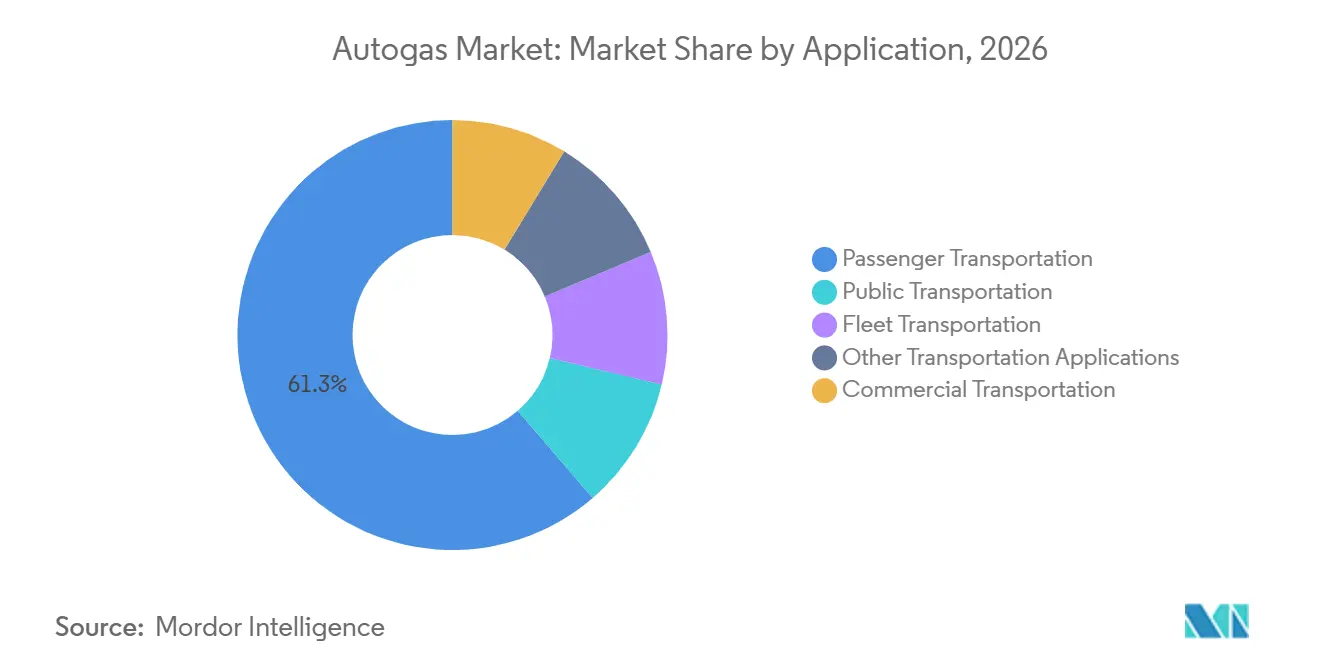
- By application, Passenger Transportation accounted for 61.3% of the autogas market size in 2026, while Fleet Transportation is forecast to expand at a 5.4% CAGR through 2032.
- By geography, Asia-Pacific held 39.7% of the global autogas market in 2026 and is forecast to grow at a 5.7% CAGR through 2032.
Note: Market numbers in this report are based on Mordor Intelligence's proprietary estimation framework, which combines nine months of actuals with Q4 projections for base year 2026.
Market Trends and Insights
Drivers Impact Analysis of Autogas Market*
| Driver | (~) % Impact on CAGR Forecast | Geographic Relevance | Impact Timeline |
|---|---|---|---|
| Lower Total Cost of Ownership for High-Utilization Fleets | +1.2% | Global, highest in Asia-Pacific, Turkey, and Poland | Medium term (2-4 years) |
| Urban Air-Quality Regulation and Low-Emission-Zone Compliance | +0.9% | Europe, India, and South Korea | Short term (≤ 2 years) |
| Existing LPG Supply and Refueling Infrastructure | +0.8% | Global, densest in Turkey, South Korea, Poland, and Italy | Long term (≥ 4 years) |
| Expansion of Factory-Fitted and Certified Retrofit Systems | +0.7% | Europe, South Korea, and India | Medium term (2-4 years) |
| Fleet Energy Diversification and Fuel-Supply Resilience | +0.6% | Global, most acute in Indonesia and India | Medium term (2-4 years) |
| Digital Fleet Optimization and Predictive Autogas Operations | +0.4% | South Korea, Turkey, and Europe | Long term (≥ 4 years) |
| Source: Mordor Intelligence | |||
Lower Total Cost of Ownership for High-Utilization Fleets
Fleet operators are becoming more important to the autogas market because their vehicles cover long daily distances and spend little time idle. LPG held 85% of South Korea's 1-ton truck segment in 2026, while rapid refueling helped delivery operators preserve vehicle availability. The Korea LPG Association reported that LPG captured 84.2% of this segment in 2024, before reaching 85% in 2026. These results show why conversion costs and fuel prices can matter more than a vehicle's purchase price for high-use fleets. Standardized fuel use also gives retailers more predictable volumes and encourages operators to maintain stations in fleet corridors. This relationship supports the autogas market where commercial buyers need lower running costs without longer refueling stops.
Urban Air-Quality Regulation and Low-Emission-Zone Compliance
City rules can expand or limit the autogas market because access to business districts affects the value of a converted vehicle. Spain has treated autogas vehicles as ECO-labelled vehicles, helping eligible users retain access to low-emission zones. France reduced the scope of its earlier low-emission-zone rollout, leaving Paris and Lyon as the locations with fully binding restrictions in mid-2026. LPG can provide lower nitrogen oxide emissions than diesel in urban use once aftertreatment systems are active, according to research presented to the European Geosciences Union.[2] This evidence supports the role of LPG as a transitional option in vehicle rules that focus on local pollutants. The autogas market, therefore, depends on whether national and city authorities recognize this role in their access and compliance frameworks.
Existing LPG Supply and Refueling Infrastructure
Existing stations are a central advantage for the autogas market because motorists can use a fuel network without changing normal refueling routines. Turkey had more than 5.25 million LPG vehicles and 10,600 stations in June 2026, with LPG vehicles accounting for 30% of its car park. Poland had 7,400 stations, while Italy had 4,600 outlets supporting 3.25 million LPG cars. Station density can support more conversions because drivers face fewer concerns about fuel availability. Higher vehicle density also helps station operators maintain sales volumes, which strengthens the case for continued investment. SHV Energy opened its 16th Indian LPG filling plant in Coimbatore in 2025, adding capacity in a market where certified retrofit demand is still developing.
Expansion of Factory-Fitted and Certified Retrofit Systems
Factory-fitted vehicles support the autogas market by removing the need for buyers to decide on a conversion after purchasing a car. Factory-fitted systems represented nearly 80% of Italian LPG registrations by 2023, with Renault and Dacia models leading the volume. Certified retrofit systems remain important where the existing vehicle stock offers the largest conversion opportunity. Italy renewed its conversion incentives from June 26, 2026, through March 31, 2030, for eligible M1 vehicles, providing a longer policy period for installers and system suppliers. The policy supports a technology-neutral route for vehicle owners who cannot replace a vehicle immediately. Standards such as ISO 15500 and national approval requirements also make engineering quality and installer certification important competitive factors.
Restraints Impact Analysis of Autogas Market*
| Restraint | (~) % Impact on CAGR Forecast | Geographic Relevance | Impact Timeline |
|---|---|---|---|
| Electrification Incentives and Zero-Emission-Vehicle Mandates | -1.1% | Global, most acute in the European Union, urban South Korea, and China | Short term (≤ 2 years) |
| Uneven Refueling Coverage and Conversion-Service Quality | -0.7% | South America, Southeast Asia, and Middle East and Africa | Medium term (2-4 years) |
| Policy and Tax-Incentive Volatility | -0.5% | Europe and South Korea | Medium term (2-4 years) |
| Residual-Value and Long-Term Asset-Planning Uncertainty | -0.4% | Global fleet and leasing markets | Long term (≥ 4 years) |
| Source: Mordor Intelligence | |||
Electrification Incentives and Zero-Emission-Vehicle Mandates
Electrification programs create a direct constraint on the autogas market in dense urban areas. The Netherlands is introducing emission-free zones in 29 municipalities from 2025 through 2030, which will exclude LPG vehicles after transitional arrangements expire. In South Korea, battery-powered purpose-built vehicle sales rose from 978 units in 2024 to 5,008 units in 2025. That change occurred even while LPG held 85% of the 1-ton truck segment in 2026. Fleet buyers with long replacement cycles must now consider the risk that a vehicle may lose access to selected urban routes before the end of its useful life. The autogas market remains relevant where charging and grid capacity are not ready for heavy fleet use, but its role can narrow where zero-emission rules become binding.
Uneven Refueling Coverage and Conversion-Service Quality
Uneven station coverage limits the autogas market even where LPG supply and retail price conditions are favorable. Argentina has substantial gas resources, but its automotive LPG base remained near 8,000 vehicles and 6 equipped filling stations in 2026. This gap shows that low fuel prices alone do not build a viable conversion ecosystem. The Indian Auto LPG Coalition called for a national retrofit policy in 2025 and highlighted certified conversion centers as a requirement for broader use in polluted cities. Modern direct-injection engines require accurate liquid-injection calibration and higher-quality installation than older vehicle designs. Weak service standards can create emissions or cold-start problems and reduce confidence among both fleet managers and regulators.
*Our forecasts treat driver/restraint impacts as directional, not additive. The impact forecasts reflect baseline growth, mix effects, and variable interactions.
Autogas Market Segment Analysis
By Technology:
Liquid Injection Gains Importance in Modern Engine PlatformsSequential Vapor Injection held 39.4% of the autogas market share in 2026 and remained the most familiar system for installers working with multi-point petrol engines. Its large installed base reflects decades of use in Poland, Italy, and Turkey. Poland registered 125,000 LPG conversion systems in 2024, and many used this established configuration. Liquid Injection Systems are projected to grow at a 5.8% CAGR through 2032, the strongest rate among the technology categories. Direct-injection petrol engines require more accurate fuel delivery, which makes liquid-phase systems more suitable for current vehicle designs. The autogas market size for liquid injection is supported by factory-fitted vehicles that need tighter air-fuel control. Italian factory-fitted systems operating with liquid injection represented nearly 80% of new LPG registrations by 2023. This shift raises the value of calibration, certification, and original equipment relationships in the autogas industry.
Carbureted systems are declining because they mainly remain in older vehicle fleets in lower-income parts of Southeast Asia and the Middle East. Vapor Injection and Sequential Vapor Injection continue to serve established retrofit applications where vehicle designs do not require liquid delivery. Direct Injection-Compatible LPG systems are gaining relevance because they can address the needs of newer petrol engines without giving up LPG's operating-cost benefit. Dual-fuel arrangements have a separate role in commercial trucking, particularly in South American applications. PERC, Stanadyne, and Katech presented a medium-duty direct-injection system at ACT Expo in June 2025 that delivered LPG at pressures up to 200 bar. The demonstration produced 401 hp and 464 lb-ft of torque from a GM 6.6L V8 after a 250-hour durability test. Hyundai and Kia have also applied Turbo LPG Direct Injection in the Porter 2 and Bongo 3, showing that direct-injection LPG can reach mass-market commercial vehicles. The autogas market is therefore moving toward systems with greater engineering content rather than abandoning established retrofit formats at once.

By Application:
Fleet Demand Is Increasing Within Transport UsePassenger Transportation accounted for 61.3% of the autogas market size in 2026, supported by large vehicle populations in Turkey, Poland, Italy, and South Korea. Turkey had more than 5.25 million LPG vehicles in June 2026. Poland had 3.5 million LPG vehicles, and Italy had 3.25 million LPG cars, which provided a strong base for passenger use. South Korea had 1.86 million LPG cars at the end of 2024, its first annual fleet increase in 14 years. Passenger demand remains important because existing owners, dealers, installers, and stations already understand the fuel. It also gives distributors a broad retail volume base beyond commercial accounts. This broad base continues to support the autogas industry in countries with long-standing conversion activity.
Fleet Transportation is forecast to grow at a 5.4% CAGR through 2032, faster than the other application groups. Logistics firms and public agencies place more value on predictable refueling times and fleet-wide operating costs than individual motorists. SK Gas and Hyundai Motor offered discounts and fuel support for Porter 2 LPG commercial vehicle buyers in April 2026, targeting business and agricultural users. Commercial Transportation also benefits where LPG trucks replace discontinued diesel models. South Korea's transport-sector LPG consumption rose in 2024 and 2025 after a long decline as T-LPDi trucks gained use. Public Transportation, including taxi and urban bus fleets in Thailand, Indonesia, and India, remains a stable volume base. Other Transportation Applications include taxis and agricultural three-wheelers in emerging markets. These uses broaden the autogas market beyond private passenger cars and make energy diversification more relevant to fleet planners.
Geography Analysis
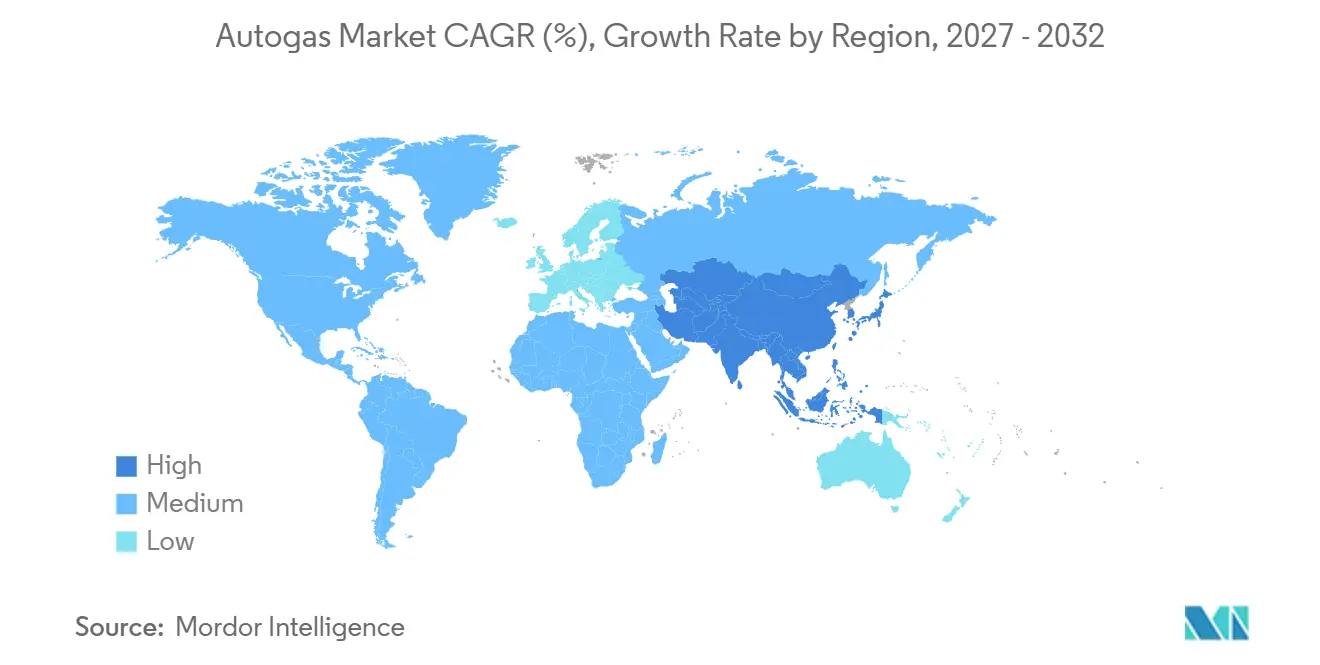
Asia-Pacific held 39.7% of global revenue in 2026 and is forecast to grow at a 5.7% CAGR through 2032. South Korea is a key contributor because 1-ton LPG truck registrations rose from 2,430 units in 2023 to 91,632 units in 2024, before reaching 78,642 units in 2025. LPG self-refueling became legal in South Korea in November 2025, improving convenience for commercial users. The International Energy Agency states that LPG powers around 2% of the global car fleet and up to 10% of the fleet in countries including South Korea. India is developing its certified retrofit base through calls for national policy and added filling capacity. Thailand's 708,000-vehicle autogas fleet and Indonesia's growing but subsidy-sensitive demand add to the regional base.
Europe is the second-largest geography in the autogas market, with Turkey, Poland, and Italy accounting for a large share of global consumption. Turkey's 10,600 stations and more than 5.25 million LPG vehicles show the depth of its established retail network. Aygaz held 24.6% of Turkey's LPG retail sales in May 2026 and increased wholesale volumes by 6% year over year in the first half. Poland and Italy together represented 3 quarters of European Union autogas cars. Poland remains Europe's largest retrofit market with 3.5 million vehicles, while Italy is the leading example of factory-fitted adoption. Italy renewed its incentive program through March 2030, although new registrations declined in early 2026. European rules on vehicle carbon dioxide emissions and low-emission zones will continue to shape demand across the region.
North America relies mainly on fleet and school-bus applications, where certified conversion systems serve medium-duty operators. Growth in this region depends on state-level incentives and fleet procurement choices rather than a unified federal mandate. South America has supply potential, but Argentina's limited station base prevents its favorable LPG price conditions from supporting broad conversion volumes. The Middle East and Africa face a different short-term issue because supply disruption has raised import costs and reduced retail margins in parts of Southeast Asia. Indonesia added energy subsidies in 2026 after the Strait of Hormuz disruption, which increased uncertainty for LPG importers. These conditions show that the autogas market develops differently where upstream supply, conversion services, and retail investment do not advance together.
Competitive Landscape
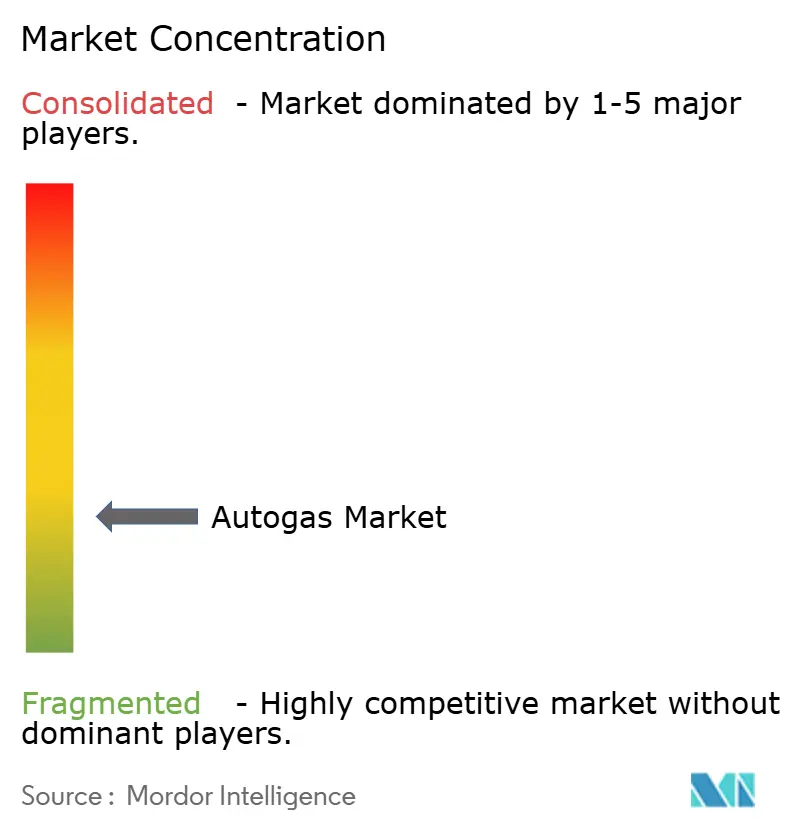
The global autogas market is moderately fragmented, with fuel distributors, vehicle-system suppliers, and vehicle manufacturers holding different positions in the value chain. Shell, BP, TotalEnergies, SHV Energy, PETRONAS, and Indian Oil Corporation have advantages in LPG sourcing, terminals, and branded retail operations. These assets help distributors maintain customer relationships after a vehicle has been converted. SHV Energy's Horizons 2026-2029 strategy includes renewable liquid gas and renewable dimethyl ether pathways alongside conventional LPG. This approach reflects a need to protect station assets as carbon requirements become more demanding. Aygaz is also strengthening logistics through its contract for 2 dual-fuel VLGC vessels, which can support its Turkish LPG supply position. Distribution leaders compete on reliable supply, network reach, and their ability to manage changes in fuel demand.
System manufacturers compete through fuel-delivery design, software calibration, homologation, and original equipment relationships. Liquid injection and direct-injection-compatible systems are more complex than older vapor-based designs. PERC, Stanadyne, and Katech demonstrated a 200-bar LPG direct-injection system for medium-duty use in June 2025, providing an example of technology investment aimed at commercial fleets. Prins Autogassystemen showed the Kia Niro tri-fuel system in 2025, combining petrol, electric, and LPG operation in one vehicle architecture. This type of offering positions LPG as a complement to partial electrification rather than only a replacement for conventional petrol. South Korean suppliers are also using digital tools for LPG trading and procurement, making cost control more important in markets with volatile feedstock prices. The competitive position of a system supplier increasingly depends on certified performance in newer engines.
Opportunities remain in countries where LPG supply is available but automotive conversion services and station networks are incomplete. Argentina and Indonesia are examples because both have potential demand but limited conditions for scaled vehicle conversion. Factory fitment is another opening in locations that have not reached Italy's high level of original-equipment LPG adoption. The sale of Westport Fuel Systems' light-duty LPG business for USD 60 million in July 2025 showed that some companies are shifting capital toward heavy-duty gaseous-fuel platforms. This change can leave room for suppliers that remain focused on passenger and light-commercial LPG systems. Fleet energy diversification is also encouraging distributors to offer dedicated commercial programs rather than passive retail supply. The autogas market remains competitive because no single company controls both global vehicle-system technology and retail fuel access.
Autogas Industry Leaders
-
SHV Energy N.V.
-
UGI Corporation
-
TotalEnergies SE
-
Shell plc
-
China Petroleum and Chemical Corporation
- *Disclaimer: Major Players sorted in no particular order
Autogas Market Companies Covered in this Report
- AmeriGas Partners, L.P.
- Aygaz Anonim ?irketi
- BP p.l.c.
- China Petroleum & Chemical Corporation
- DCC plc
- Eni S.p.A.
- Ferrellgas Partners, L.P.
- Flogas Britain Limited
- Gilbarco Veeder-Root
- Hexagon Ragasco AS
- Indian Oil Corporation Limited
- Origin Energy Limited
- PetroChina Company Limited
- PETRONAS Dagangan Berhad
- Prins Autogassystemen B.V.
- QatarEnergy
- Reliance Industries Limited
- Repsol, S.A.
- Roush CleanTech
- Shell plc
- SHV Energy N.V.
- SK Gas Co., Ltd.
- SK Gas Co., Ltd.
- Suburban Propane Partners, L.P.
- TotalEnergies SE
- UGI Corporation
- Westfalen AG
- Westport Fuel Systems Inc.
Recent Industry Developments in Autogas Market
- June 2026: The Türkiye LPG Association confirmed the country's autogas market stood at over 5 million LPG-powered vehicles supported by 10,600 stations, with annual volume reaching 3.3 million tons. Türkiye alternates between first and second place globally in autogas consumption.
- April 2026: The Türkiye LPG Association confirmed the country's autogas market stood at over 5 million LPG-powered vehicles supported by 10,600 stations, with annual volume reaching 3.3 million tons. Türkiye alternates between first and second place globally in autogas consumption.
- July 2025: Westport Fuel Systems completed the sale of its Light-Duty segment, which included LPG conversion systems, to Heliaca Investments for total consideration of USD 60 million. The transaction marked a deliberate pivot away from passenger-vehicle LPG and toward heavy-duty CNG and LNG platforms.
Global Autogas Market Report Scope
Autogas is the common term for liquefied petroleum gas (LPG) used as a clean-burning alternative fuel in vehicle engines.
The global autogas market is segmented by technology, application, and geography. By technology, the market is segmented into carbureted systems, vapor injection systems, sequential vapor injection, liquid injection systems, direct injection-compatible LPG systems, dual-fuel systems, and other technologies. By application, the market is segmented into passenger transportation, commercial transportation, public transportation, fleet transportation, and other transportation applications. The report also covers the market size and forecasts for the global autogas market across 24 countries in the key regions. For each segment, market sizing and forecasts are provided in terms of value (USD).
Segmentation Overview
| Carbureted Systems |
| Vapor Injection Systems |
| Sequential Vapor Injection |
| Liquid Injection Systems |
| Direct Injection-Compatible LPG Systems |
| Dual-Fuel Systems |
| Other Technologies |
| Passenger Transportation |
| Commercial Transportation |
| Public Transportation |
| Fleet Transportation |
| Other Transportation Applications |
| North America | United States |
| Canada | |
| Mexico | |
| Europe | Germany |
| France | |
| Italy | |
| Spain | |
| United Kingdom | |
| Poland | |
| Russia | |
| Rest of Europe | |
| Asia-Pacific | China |
| India | |
| Japan | |
| South Korea | |
| Indonesia | |
| Thailand | |
| Rest of Asia-Pacific | |
| South America | Brazil |
| Argentina | |
| Chile | |
| Rest of South America | |
| Middle East and Africa | Saudi Arabia |
| United Arab Emirates | |
| Egypt | |
| South Africa | |
| Morocco | |
| Rest of Middle East and Africa |
| By Technology | Carbureted Systems | |
| Vapor Injection Systems | ||
| Sequential Vapor Injection | ||
| Liquid Injection Systems | ||
| Direct Injection-Compatible LPG Systems | ||
| Dual-Fuel Systems | ||
| Other Technologies | ||
| By Application | Passenger Transportation | |
| Commercial Transportation | ||
| Public Transportation | ||
| Fleet Transportation | ||
| Other Transportation Applications | ||
| By Geography | North America | United States |
| Canada | ||
| Mexico | ||
| Europe | Germany | |
| France | ||
| Italy | ||
| Spain | ||
| United Kingdom | ||
| Poland | ||
| Russia | ||
| Rest of Europe | ||
| Asia-Pacific | China | |
| India | ||
| Japan | ||
| South Korea | ||
| Indonesia | ||
| Thailand | ||
| Rest of Asia-Pacific | ||
| South America | Brazil | |
| Argentina | ||
| Chile | ||
| Rest of South America | ||
| Middle East and Africa | Saudi Arabia | |
| United Arab Emirates | ||
| Egypt | ||
| South Africa | ||
| Morocco | ||
| Rest of Middle East and Africa | ||
Key Questions Answered in the Report
What is the projected growth rate for global autogas through 2032?
The Autogas Market size is expected to grow from USD 57.75 billion in 2026 to USD 60.68 billion in 2027 and is forecast to reach USD 77.69 billion by 2032 at 5.07% CAGR over 2027-2032.
Which technology is growing fastest in autogas systems?
Liquid Injection Systems have the highest projected growth rate, with a 5.8% CAGR through 2032, as newer direct-injection engines need more precise fuel delivery.
Why are fleets adopting LPG vehicles?
Fleet operators value lower operating costs and rapid refueling. LPG held 85% of South Korea's 1-ton truck segment in 2026.
Which region leads global autogas demand?
Asia-Pacific led with 39.7% share in 2026 and is forecast to grow at a 5.7% CAGR through 2032.
How does factory fitment affect LPG vehicle adoption?
Factory-fitted systems reduce the need for a later conversion decision. They accounted for nearly 80% of Italian LPG registrations by 2023.
What limits further use of LPG in transportation?
Zero-emission mandates, inconsistent refueling networks, uneven conversion quality, and changing tax incentives can limit future vehicle conversions.