
Authentication Compliance Management Services Market Size and Share
Market Overview
| Study Period | 2021 - 2032 |
|---|---|
| Market Size (2027) | USD 14.14 Billion |
| Market Size (2032) | USD 29.16 Billion |
| Growth Rate (2027 - 2032) | 15.58 % |
| Fastest Growing Market | Asia-Pacific |
| Largest Market | North America |
| Market Concentration | Medium |
Major Players *Disclaimer: Major Players sorted in no particular order Image © Mordor Intelligence. Reuse requires attribution under CC BY 4.0. | |
Authentication Compliance Management Services Market Analysis by Mordor Intelligence
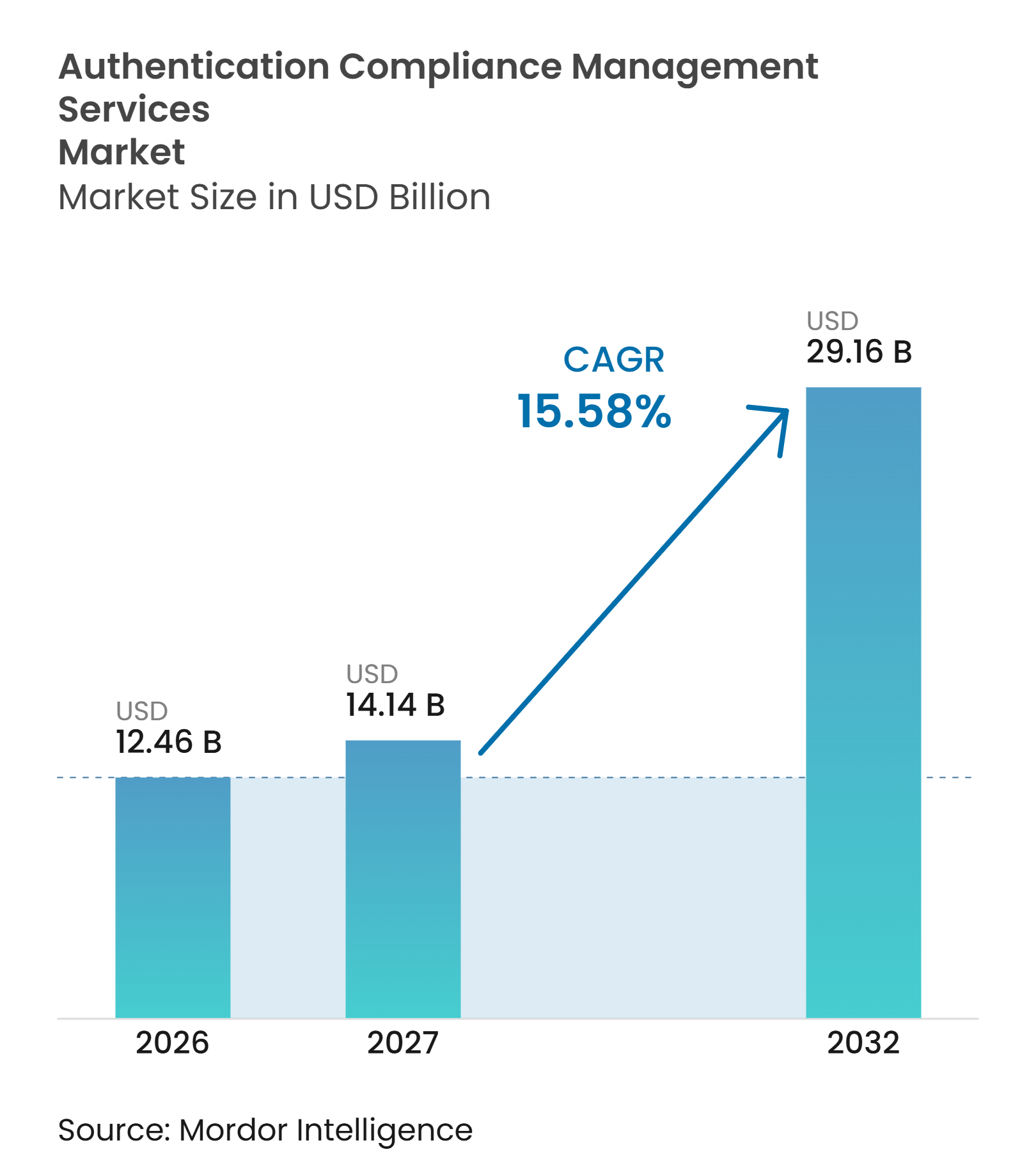
The Authentication Compliance Management Services Market size is projected to expand from USD 12.46 billion in 2026 and USD 14.14 billion in 2027 to USD 29.16 billion by 2032, registering a CAGR of 15.58% between 2027 and 2032. Demand is being supported by AI-assisted fraud, tighter rules for KYC, AML, sanctions screening, and digital identity, and the move toward remote and embedded financial services. Firms are replacing isolated verification tools with platforms that combine document checks, biometric liveness, watchlist screening, and ongoing monitoring. This creates an advantage for providers that can manage decisions across the customer lifecycle rather than only at onboarding. North America remains the largest regional opportunity, while Asia-Pacific is expected to expand faster as fintech adoption and digital identity programs develop. Competition is becoming more focused on orchestration, data networks, certification, and the ability to meet local regulatory requirements.
Key Report Takeaways
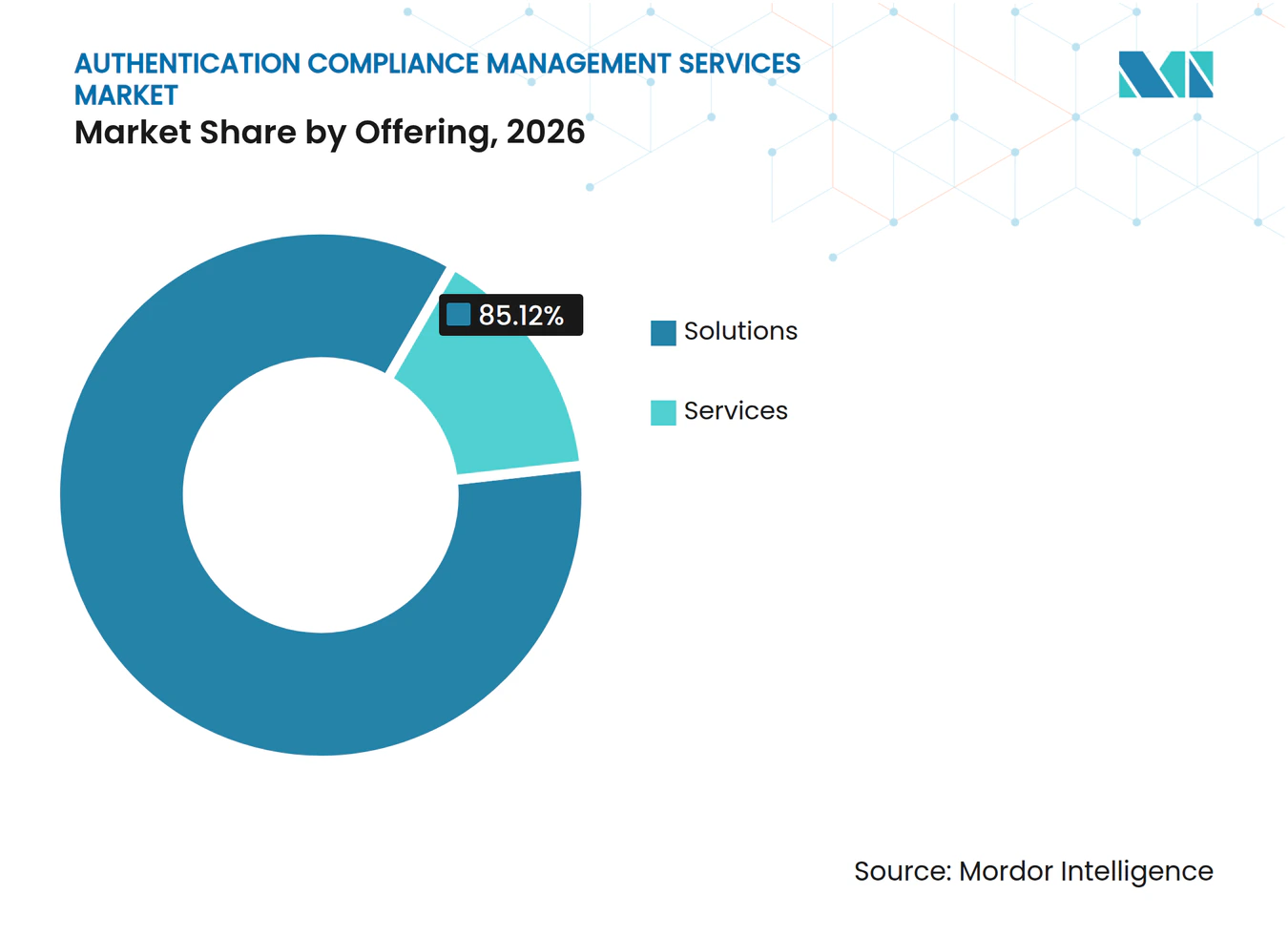
- By offering, Solutions held 85.12% of the market in 2026 and are projected to expand at a 15.91% CAGR through 2032.
- By solution type, Identity Verification and Document Authentication accounted for 25.32% of the market in 2026, while Authentication Policy and Workflow Orchestration is projected to expand at a 15.87% CAGR through 2032.
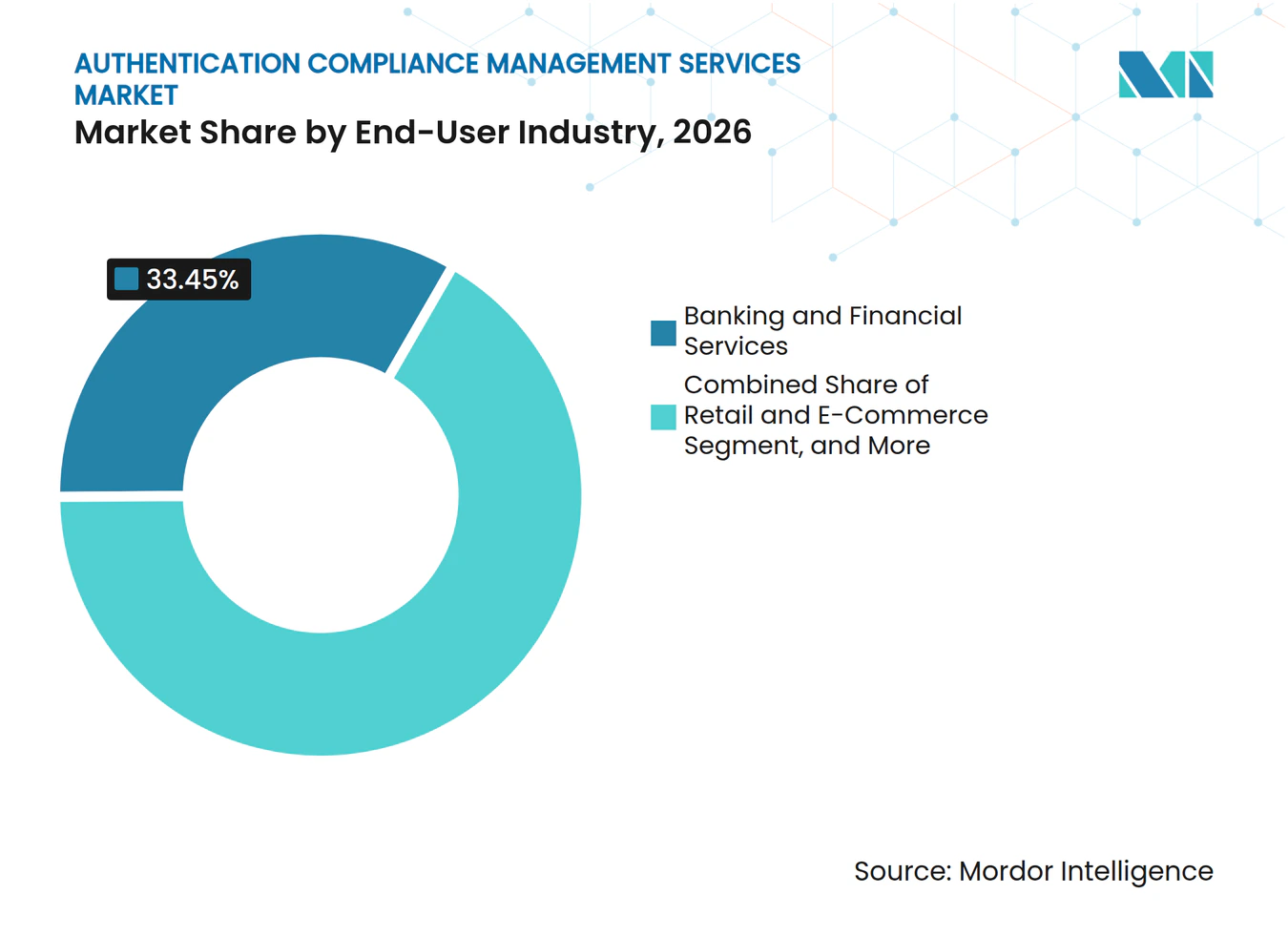
- By end-user industry, Banking and Financial Services held 33.45% of the market share in 2026, while Fintech and Payment Service Providers are projected to expand at a 15.82% CAGR through 2032.
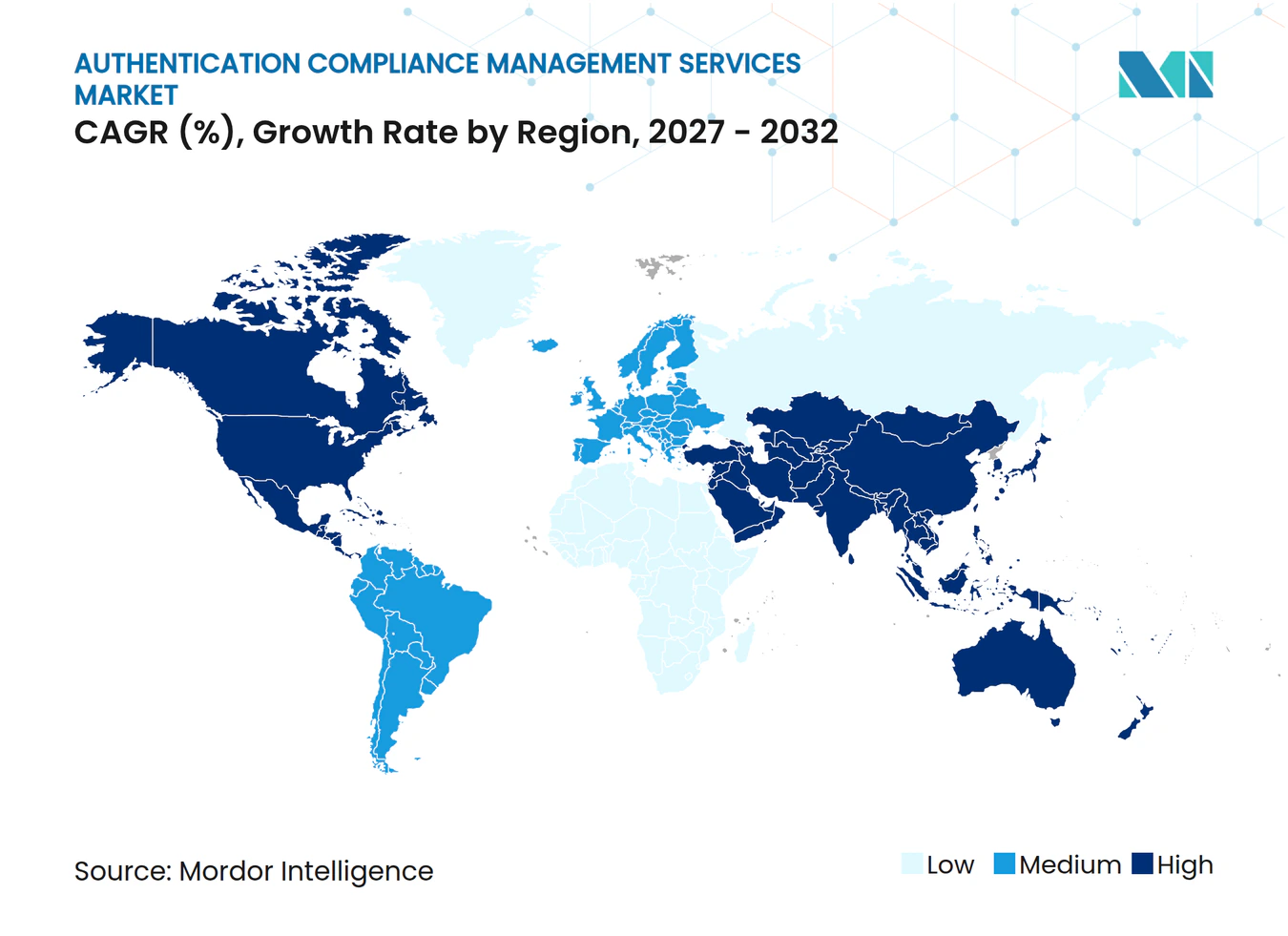
- By geography, North America accounted for 43.17% of the market share in 2026, while Asia-Pacific is projected to expand at a 15.74% CAGR through 2032.
Note: Market numbers in this report are based on Mordor Intelligence's proprietary estimation framework, which combines nine months of actuals with Q4 projections for base year 2026.
Market Trends and Insights
Drivers Impact Analysis of Authentication Compliance Management Services Market*
| Driver | (~) % Impact on CAGR Forecast | Geographic Relevance | Impact Timeline |
|---|---|---|---|
| Escalating Digital Fraud, Deepfakes, and Synthetic Identities | +3.5% | Global, with acute concentration in North America, Asia-Pacific, and South America | Short term (≤ 2 years) |
| Tightening KYC, AML, Sanctions, and Digital Identity Enforcement | +3.2% | Global, with highest penalty volumes in North America and Europe | Medium term (2–4 years) |
| Expansion of Remote Onboarding and Embedded Finance | +2.4% | Global, with advanced adoption in North America and Europe | Medium term (2–4 years) |
| Cross-Border Digital Identity Interoperability Initiatives | +1.8% | Europe, South America, Asia-Pacific, and the Middle East and Africa | Long term (≥ 4 years) |
| Enterprise Shift Toward Continuous Authentication and Lifecycle Monitoring | +1.5% | North America and Europe, with early adoption in Singapore and the UAE | Medium term (2–4 years) |
| Compliance Automation Demand From Underserved SMEs and Digital Platforms | +1.2% | Asia-Pacific, South America, and Africa | Long term (≥ 4 years) |
| Source: Mordor Intelligence | |||
Escalating Digital Fraud, Deepfakes, and Synthetic Identities
Fraud schemes are increasingly designed to bypass separate verification controls across the customer journey. Entrust reported that injection attacks rose 40% year over year, and deepfakes represented 1 in 5 biometric fraud attempts.[1] These attacks inject manipulated video into verification systems instead of presenting a face to a camera. The Authentication Compliance Management Services Market is therefore placing greater value on controls that can detect attacks inside the verification channel. LexisNexis Risk Solutions also reported an 8-fold increase in synthetic identity fraud and found that it represented 11% of global fraud. Providers are responding by combining device, document, biometric, and transaction signals within one decision process. The operating challenge is no longer limited to forged documents during initial onboarding. A customer can present a genuine document while an attacker compromises the live capture process or uses a synthetic identity across later transactions. ISO/IEC 30107-3 presentation attack detection is becoming an important reference point for biometric liveness procurement. Vendors also need tools that identify injection risks at the server side, rather than relying only on a selfie comparison. This requirement favors platforms that continually review risk signals and update policies as new attack patterns appear. It also narrows the gap between fraud prevention and compliance operations within the Authentication Compliance Management Services Market.
Tightening KYC, AML, Sanctions, and Digital Identity Enforcement
KYC, AML, sanctions, and digital identity rules are making compliance technology a necessary operating expense for regulated organizations. Regulation EU 2024/1624 establishes a more uniform anti-money-laundering framework across the European Union and applies from July 2027.[2] The framework requires obliged entities to accept qualifying digital identity proofs for remote onboarding. The Anti-Money Laundering Authority published draft technical standards on customer due diligence in September 2026, including requirements for electronic identification in KYC processes. These measures increase the need for audit trails, jurisdictional controls, and consistent case handling. For buyers, regulatory change creates a practical need to prove how each decision was made. A compliance platform must support identity checks, sanctions screening, case management, and evidence retention in a form that can be reviewed later. This makes multi-jurisdictional coverage more valuable than a narrow verification feature. The Authentication Compliance Management Services Market benefits when organizations replace manual processes that cannot scale across products or territories. Providers with configurable rules can adapt a common platform to local obligations without rebuilding each workflow. This flexibility is particularly relevant for financial institutions that operate across several markets and face different onboarding standards.
Expansion of Remote Onboarding and Embedded Finance
Remote onboarding is becoming a standard part of digital service delivery, increasing the need for dependable remote identity checks. The European Commission adopted 7 implementing regulations for the EU Digital Identity Wallet in July 2025. Commission Implementing Regulation EU 2025/846 on cross-border identity matching entered into force in May 2025. These measures support more consistent identity interactions across services and borders. They also increase pressure on service providers to accept trusted digital credentials in remote workflows. The Authentication Compliance Management Services Market gains when remote onboarding requires stronger evidence and ongoing controls. Embedded finance adds complexity because financial services are delivered inside retail, workforce, mobility, and software journeys. These models may involve a platform, a financial institution, a merchant, and an end customer in the same transaction path. Each participant needs defined permissions and a way to verify the identity and role of the others. Compliance becomes a continuing lifecycle activity rather than a one-time onboarding check. Platforms that apply rules across B2B, B2B2C, and B2B2X relationships can address this requirement more effectively than standalone document-checking tools. This favors suppliers that combine identity verification with access controls, monitoring, and revocation capabilities.
Cross-Border Digital Identity Interoperability Initiatives
Digital identity interoperability programs are moving from pilots toward operating frameworks in several regions. The Organization of American States stated in April 2026 that idLAC allows citizens of Brazil and Uruguay to access each other’s digital services.[3] The organization reported that 12 South American countries had committed to the framework and that at least 6 were expected to have operational capabilities by the end of 2026. The Western Balkans Six also committed to interoperable digital identity wallets aligned with the European Digital Identity Wallet approach in October 2025. These initiatives create a need for systems that can recognize credentials issued by multiple trusted authorities. Interoperability does not eliminate national rules, but it can make cross-border identity checks more practical. Vendors need to connect to federated trust systems and use accepted protocols such as OpenID Connect and W3C Verifiable Credentials. The OpenID Foundation reported activity across more than 45 countries and 25 organizations through the SIDI Hub in 2025. Early integration can help a platform participate in new cross-border service corridors as they become available. This is a long-term opportunity because technical standards, legal recognition, and user adoption must all develop together. The Authentication Compliance Management Services Market can benefit as organizations need tools to manage these complex trust relationships.
Restraints Impact Analysis of Authentication Compliance Management Services Market*
| Restraint | (~) % Impact on CAGR Forecast | Geographic Relevance | Impact Timeline |
|---|---|---|---|
| Fragmented Global Regulatory and Data Residency Requirements | -1.8% | Global, most acute in Asia-Pacific and the Middle East and Africa | Long term (≥ 4 years) |
| High Integration and Change Management Costs in Legacy Environments | -1.4% | North America and Europe, where core banking systems are oldest | Medium term (2–4 years) |
| Privacy, Consent, and Biometric Bias Exposure | -1.0% | Europe, North America, and Asia-Pacific markets with biometric privacy laws | Medium term (2–4 years) |
| Adversarial Generative AI Spoofing and Model Drift | -0.8% | Global | Short term (≤ 2 years) |
| Source: Mordor Intelligence | |||
Fragmented Global Regulatory and Data Residency Requirements
Different local regulations can make it costly to deploy the same compliance service across multiple countries. Chile’s Comisión para el Mercado Financiero issued NCG 538 in June 2025, requiring biometric strong customer authentication for payment issuers and financial service providers. The rule requires biometric authentication for client interactions from July 2026. Israel’s Securities Authority also issued a February 2025 directive for payment companies using online identification technologies in AML processes. These frameworks create separate needs for local technical integration, audit records, and approved verification methods. For smaller vendors, localized data storage and certification requirements can reduce the number of countries that can be served profitably. Larger platforms are better placed to absorb these fixed costs and reuse their compliance expertise across customers. This can strengthen switching costs when a buyer already depends on a provider’s local implementation. It can also slow entry into markets where the rules are changing quickly. The Authentication Compliance Management Services Market remains attractive, but providers need local legal, data, and operational capabilities to capture demand. Organizations seeking to expand across borders may favor a platform with existing regional coverage even if its initial cost is higher.
High Integration and Change Management Costs in Legacy Environments
Established financial institutions often operate core systems that were not designed for API-based compliance orchestration. Replacing or adding a KYC or AML decision layer can require model reviews, staff retraining, control testing, and regulatory approval. These requirements make the implementation process longer than a typical software deployment. Organizations under formal enforcement actions can face additional limits on the speed of process change. The result is a preference for tools that can operate as an overlay rather than requiring a full replacement. This can delay revenue conversion within the Authentication Compliance Management Services Market. Core platform replacement cycles commonly extend for 12-18 months. The cost is not limited to integration work because compliance teams must validate the revised process and demonstrate control continuity. Vendors that offer modular deployment can reduce this burden by adding liveness, watchlist screening, or workflow components in stages. Such a model allows a customer to improve controls while keeping its existing operating framework in place. It also supports recurring vendor relationships after the first module is installed. The restraint remains material where legacy technology, regulatory scrutiny, and limited internal technical capacity occur together.
*Our forecasts treat driver/restraint impacts as directional, not additive. The impact forecasts reflect baseline growth, mix effects, and variable interactions.
Authentication Compliance Management Services Market Segment Analysis
By Offering:
Software Platforms Hold the Largest PositionSolutions held 85.12% of the market in 2026 and are projected to expand at a 15.91% CAGR through 2032. This result shows that buyers prefer integrated software platforms over service-only engagements. Organizations increasingly want document verification, liveness checks, watchlist screening, and workflow rules to operate through one interface. A unified platform can reduce the burden of linking separate tools and maintaining separate evidence trails. It can also provide a more consistent view of customer and transaction risk. The Solutions category includes the software layer that supports verification, screening, monitoring, decisioning, and case management. Its position reflects the need to apply controls at higher transaction volumes without expanding manual teams at the same pace.
The Services category covers managed compliance operations, outsourced regulatory reporting, and third-party case review. It remains relevant for mid-tier institutions and regulated firms that lack specialist compliance technology staff. Services can also support organizations that need independent review while operating under an enforcement order. Certification expectations, including ISO/IEC 27001-related procurement requirements, encourage buyers to select providers with clear controls and documented operating practices. Platform providers that add managed services can use operational knowledge from live cases to improve their products. Service-only providers may face tighter margins as automation handles a larger share of repeatable verification tasks. The Authentication Compliance Management Services Market therefore favors offerings that combine software scale with targeted human support.


By Solution Type:
Identity Verification Leads While Orchestration Expands FastestIdentity Verification and Document Authentication accounted for 25.32% of the Authentication Compliance Management Services Market share in 2026. Document authenticity is a foundational requirement because regulated onboarding begins with evidence of who the customer is. Biometric Authentication and Liveness has moved from a premium feature toward a standard control for remote onboarding. FATF stated in February 2025 that non-face-to-face onboarding does not need to be high risk when sound biometric liveness controls are used. This position supports adoption of stronger liveness checks across digital onboarding processes. KYC, KYB, and customer due diligence functions remain closely linked to identity verification because a verified identity must be assessed for regulatory risk.
Authentication Policy and Workflow Orchestration is projected to expand at a 15.87% CAGR through 2032. Buyers are moving beyond the purchase of individual tools and toward platforms that direct each transaction through the appropriate verification sequence. Rules can vary by customer type, geography, product, transaction value, or risk signal. AML, sanctions, PEP, and adverse-media screening form a connected demand pool because firms need to evaluate customer risk against several sources. Transaction monitoring and risk scoring become more important as embedded finance services increase transaction activity. Case management and regulatory reporting create recurring demand from firms that must document investigations and file suspicious activity reports. The market position of orchestration reflects its ability to connect these functions in a traceable operating process.
By End-User Industry:
Banking Leads Demand While Fintech and Payment Providers Expand FasterBanking and Financial Services held 33.45% of the market in 2026. Banks require KYC, AML, sanctions screening, and transaction monitoring across a large number of customer relationships. These obligations apply to consumer, business, and correspondent banking activities. The sector also manages high-value transactions, which increases the cost of fraud or compliance failure. As a result, financial institutions need platforms that can support both high-volume onboarding and detailed investigations. Their established control requirements make banking a core source of demand for identity and compliance technology. The sector also requires integrations with core banking, payment, and customer relationship systems.
Fintech and Payment Service Providers are projected to expand at a 15.82% CAGR through 2032. Digital-first operators need compliance capabilities similar to incumbent banks but often without the same internal compliance infrastructure. Insurance and retail and e-commerce are also relevant demand pools as risk-based identity requirements extend into adjacent digital transactions. Chile’s Subtel required telecommunications companies to use biometric verification for customer interactions from February 4, 2025. Gaming and online gambling are exposed to rapid fraud activity and require controls that can balance conversion with risk management. Healthcare and life sciences are earlier-stage users of these tools, with demand tied to patient identity verification. These end-user patterns broaden the Authentication Compliance Management Services Market beyond traditional financial crime use cases.


Geography Analysis
North America Authentication Compliance Management Services Market
North America held 43.17% of the Authentication Compliance Management Services Market share in 2026. The United States supports this position through its large base of regulated financial institutions, payment firms, and fintech companies. Bank Secrecy Act, OFAC, and FinCEN-related obligations create a continuing need for KYC, AML, screening, and monitoring tools. Payment-adjacent firms face material enforcement exposure when their controls do not meet requirements. Mexico’s Llave MX digital identity framework also adds a formal identity mechanism that businesses requiring digital identity verification must accept. This gives the region several drivers for sustained platform adoption.
Europe Authentication Compliance Management Services Market
Europe has a significant regulatory upgrade cycle. The EU Anti-Money Laundering Regulation applies from July 2027 and aims to create more consistent AML obligations across member states. The European Digital Identity Wallet program requires member states to provide wallets to citizens by the end of 2026. This creates an opportunity for vendors that can support trusted digital credentials and remote onboarding. In Germany, IDnow and Docusign launched a joint solution in September 2025 that combines eID-based identity verification with qualified electronic signatures for AML-compliant onboarding. The United Kingdom is also clarifying how certified digital identity services can interact with money laundering rules.
APAC, South America and MEA Authentication Compliance Management Services Market
Asia-Pacific is projected to expand at a 15.74% CAGR through 2032, making it the fastest-growing regional opportunity. India’s UIDAI Aadhaar ecosystem demonstrates biometric identity verification at substantial scale. Singapore has strong AML expectations and a well-developed digital financial-services environment. China’s rising AML penalty value in 2025 also points to a stronger need for compliance investment. South America is developing cross-border digital identity capability through the idLAC initiative between Brazil and Uruguay. The Middle East and Africa start from a smaller base but benefit from expanding enforcement and digital identity infrastructure. The Authentication Compliance Management Services Market requires providers to adjust to significant regulatory and operating differences across these regions.
Competitive Landscape
Market Concentration
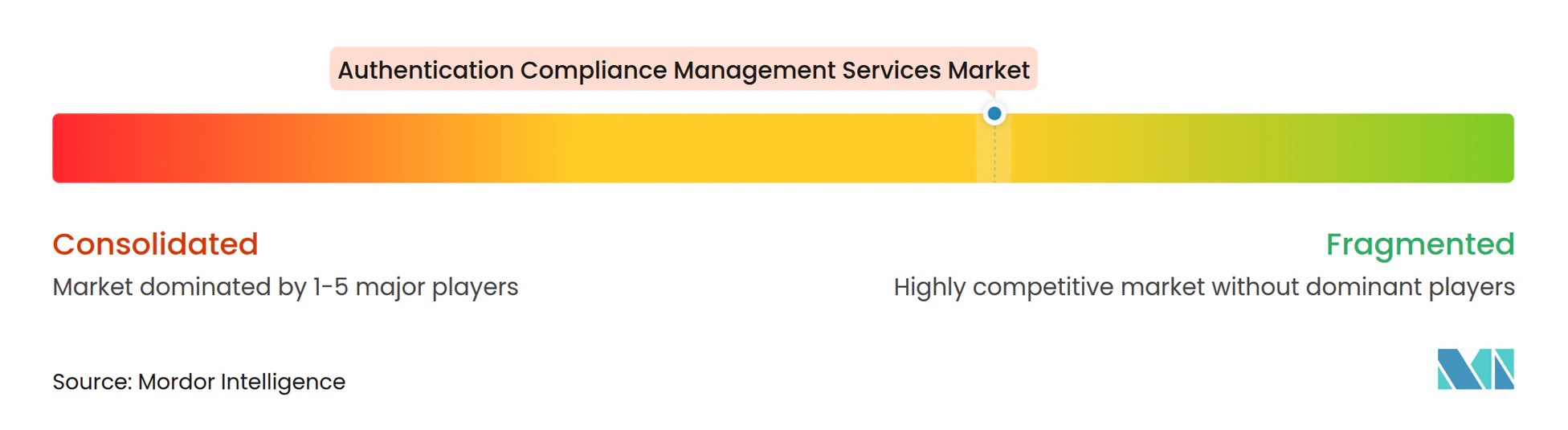
The Authentication Compliance Management Services Market is moderately fragmented in verification and more concentrated in orchestration. Specialist providers focus on document authentication or biometric liveness. Broader platforms combine identity verification, AML screening, case management, and workflow controls. This creates a divide between narrow feature providers and providers that support an end-to-end compliance process. Competition is moving away from individual features and toward the strength of a provider’s decisioning network. A network built from many customer interactions can identify recurring fraud patterns that a single customer cannot see alone.
Jumio launched Cross-Transaction Risk in April 2025, using a privacy-preserving network of more than 32 million known identities. The company stated that the capability delivered an average 28% increase in fraud detections across its customer base. ISO/IEC 30107-3 Level 2 liveness certification is also becoming an important procurement requirement. Vendors with accredited testing are better placed to compete for enterprise programs that require evidence of biometric performance. In March 2026, Jumio stated that its Liveness Premium solution had processed more than 100 million authentication transactions since its June 2025 launch. These actions show that certification, operating scale, and network intelligence are becoming central competitive tools.
Socure acquired Fravity in August 2026 after announcing a USD 156 million strategic growth investment at a USD 5.2 billion valuation. The acquisition added agentic fraud, risk, and compliance automation capabilities to the RiskOS platform. Socure also introduced Remote Verifier in July 2026 to use live agents for consumers who could not be instantly verified through automated methods. Smaller challengers, including iDenfy, ComplyCube, and Shufti Pro, compete through transparent pricing and self-service integration. Their approach targets fintech, gaming, and other digital businesses that may be underserved by larger providers.
Authentication Compliance Management Services Industry Leaders
-
LexisNexis Risk Solutions
-
Experian plc
-
Thales S.A.
-
Jumio Corporation
-
Trulioo Information Services Inc.
- *Disclaimer: Major Players sorted in no particular order
Authentication Compliance Management Services Market Companies Covered in this Report
- Thales S.A.
- Experian plc
- LexisNexis Risk Solutions Inc.
- Trulioo Information Services Inc.
- Jumio Corporation
- IDnow GmbH
- Persona Identities, Inc.
- Socure, Inc.
- iDenfy UAB
- Shufti Pro Ltd.
- ComplyCube Ltd.
- ID-Pal Limited
- Vouched, Inc.
- Intellicheck, Inc.
- AuthenticID, Inc.
- Innovatrics, s.r.o.
- Daon, Inc.
- Facephi Biometria, S.A.
- IDVerse Limited
- Regula Forensics Inc.
- Mitek Systems, Inc.
- Veriff OÜ
- Sum and Substance Ltd
Recent Industry Developments in Authentication Compliance Management Services Market
- October 2026: Socure reported Q3 2026 results including USD 42.7 million in new bookings and a doubled customer count exceeding 6,000, tracking toward USD 450 million in annual recurring revenue by year-end.
- September 2026: AMLA published its final draft Regulatory Technical Standards on Customer Due Diligence under Article 28(1) of the EU Anti-Money Laundering Regulation, Regulation EU 2024/1624, specifying requirements for electronic identification means in KYC workflows ahead of the AMLR’s July 2027 effective date.
- August 2026: Socure raised USD 156 million in a strategic growth investment led by Summit Partners, with participation from Goldman Sachs Alternatives, Wells Fargo, and Docusign, at a USD 5.2 billion valuation. Socure simultaneously acquired Fravity, an agentic AI platform that automates fraud, risk, and compliance investigations, and integrated its capabilities into RiskOS as RiskOS_Agents.
- July 2026: Socure launched Remote Verifier, enabling 100% identity verification coverage by adding live agents to its automated platform for the fewer than 1% of consumers not instantly verified. The service was intended to increase financial inclusion across financial-services and government use cases.
Global Authentication Compliance Management Services Market Report Scope
The Authentication Compliance Management Services Market comprises specialized consulting, implementation, monitoring, auditing, and managed services designed to help organizations ensure that their authentication systems, identity verification processes, access controls, and credential management practices comply with regulatory requirements, industry standards, and cybersecurity frameworks.
The Authentication Compliance Management Services Market Report is Segmented by Offering (Solutions, Services), Solution Type (Identity Verification and Document Authentication, Biometric Authentication and Liveness, KYC, KYB, and Customer Due Diligence, AML, Sanctions, PEP, and Adverse-Media Screening, Transaction Monitoring and Risk Scoring, Case Management and Regulatory Reporting, Authentication Policy and Workflow Orchestration), End-User Industry (Banking and Financial Services, Fintech and Payment Service Providers, Insurance, Retail and E-Commerce, Telecommunications and Information Technology, Gaming and Online Gambling, Healthcare and Life Sciences, Other End-User Industries), and Geography (North America [United States, Canada, Mexico], South America [Brazil, Argentina, Colombia, Rest of South America], Europe [United Kingdom, Germany, France, Italy, Spain, Russia, Rest of Europe], Asia-Pacific [China, Japan, India, South Korea, Singapore, Australia, Rest of Asia-Pacific], Middle East [Saudi Arabia, United Arab Emirates, Turkey, Israel, Rest of Middle East], and Africa [South Africa, Nigeria, Egypt, Kenya, Rest of Africa]). The Market Forecasts are Provided in Terms of Value (USD).
Segmentation Overview
| Solutions |
| Services |
| Identity Verification and Document Authentication |
| Biometric Authentication and Liveness |
| KYC, KYB, and Customer Due Diligence |
| AML, Sanctions, PEP, and Adverse-Media Screening |
| Transaction Monitoring and Risk Scoring |
| Case Management and Regulatory Reporting |
| Authentication Policy and Workflow Orchestration |
| Banking and Financial Services |
| Fintech and Payment Service Providers |
| Insurance |
| Retail and E-Commerce |
| Telecommunications and Information Technology |
| Gaming and Online Gambling |
| Healthcare and Life Sciences |
| Other End-User Industries |
| North America | United States |
| Canada | |
| Mexico | |
| South America | Brazil |
| Argentina | |
| Colombia | |
| Rest of South America | |
| Europe | United Kingdom |
| Germany | |
| France | |
| Italy | |
| Spain | |
| Russia | |
| Rest of Europe | |
| Asia-Pacific | China |
| Japan | |
| India | |
| South Korea | |
| Singapore | |
| Australia | |
| Rest of Asia-Pacific | |
| Middle East | Saudi Arabia |
| United Arab Emirates | |
| Turkey | |
| Israel | |
| Rest of Middle East | |
| Africa | South Africa |
| Nigeria | |
| Egypt | |
| Kenya | |
| Rest of Africa |
| By Offering | Solutions | |
| Services | ||
| By Solution Type | Identity Verification and Document Authentication | |
| Biometric Authentication and Liveness | ||
| KYC, KYB, and Customer Due Diligence | ||
| AML, Sanctions, PEP, and Adverse-Media Screening | ||
| Transaction Monitoring and Risk Scoring | ||
| Case Management and Regulatory Reporting | ||
| Authentication Policy and Workflow Orchestration | ||
| By End-User Industry | Banking and Financial Services | |
| Fintech and Payment Service Providers | ||
| Insurance | ||
| Retail and E-Commerce | ||
| Telecommunications and Information Technology | ||
| Gaming and Online Gambling | ||
| Healthcare and Life Sciences | ||
| Other End-User Industries | ||
| By Geography | North America | United States |
| Canada | ||
| Mexico | ||
| South America | Brazil | |
| Argentina | ||
| Colombia | ||
| Rest of South America | ||
| Europe | United Kingdom | |
| Germany | ||
| France | ||
| Italy | ||
| Spain | ||
| Russia | ||
| Rest of Europe | ||
| Asia-Pacific | China | |
| Japan | ||
| India | ||
| South Korea | ||
| Singapore | ||
| Australia | ||
| Rest of Asia-Pacific | ||
| Middle East | Saudi Arabia | |
| United Arab Emirates | ||
| Turkey | ||
| Israel | ||
| Rest of Middle East | ||
| Africa | South Africa | |
| Nigeria | ||
| Egypt | ||
| Kenya | ||
| Rest of Africa | ||
Key Questions Answered in the Report
What is the size of the Authentication Compliance Management Services Market?
The Authentication Compliance Management Services Market size is projected to expand from USD 12.46 billion in 2026 and USD 14.14 billion in 2027 to USD 29.16 billion by 2032, registering a CAGR of 15.58% between 2027 and 2032.
What is driving demand for authentication compliance services?
Rising synthetic identity fraud, deepfakes, remote onboarding, and stricter KYC, AML, sanctions, and digital identity requirements are increasing demand.
Which offering leads authentication compliance management services?
Solutions lead with an 85.12% share in 2026 and are projected to expand at a 15.91% CAGR through 2032.
Which solution type is expanding fastest?
Authentication Policy and Workflow Orchestration is projected to expand at a 15.87% CAGR through 2032 as buyers seek centralized decisioning.
Which end-user segment is growing fastest?
Fintech and Payment Service Providers are projected to expand at a 15.82% CAGR through 2032 because digital-first firms need strong controls without legacy infrastructure.
Which region is projected to expand fastest?
Asia-Pacific is projected to expand at a 15.74% CAGR through 2032, supported by fintech adoption and digital identity initiatives.