
Market Overview
| Study Period | 2020 - 2031 |
|---|---|
| Forecast Data Period | 2026 - 2031 |
| Base Year Market Size (2025) | USD 20.05 Billion |
| Market Size (2026) | USD 21.24 Billion |
| Market Size (2031) | USD 28.36 Billion |
| Growth Rate (2026 - 2031) | 5.95 % |
| Market Concentration | Medium |
Major Players *Disclaimer: Major Players sorted in no particular order Image © Mordor Intelligence. Reuse requires attribution under CC BY 4.0. | |
Austria ICT Market Analysis by Mordor Intelligence
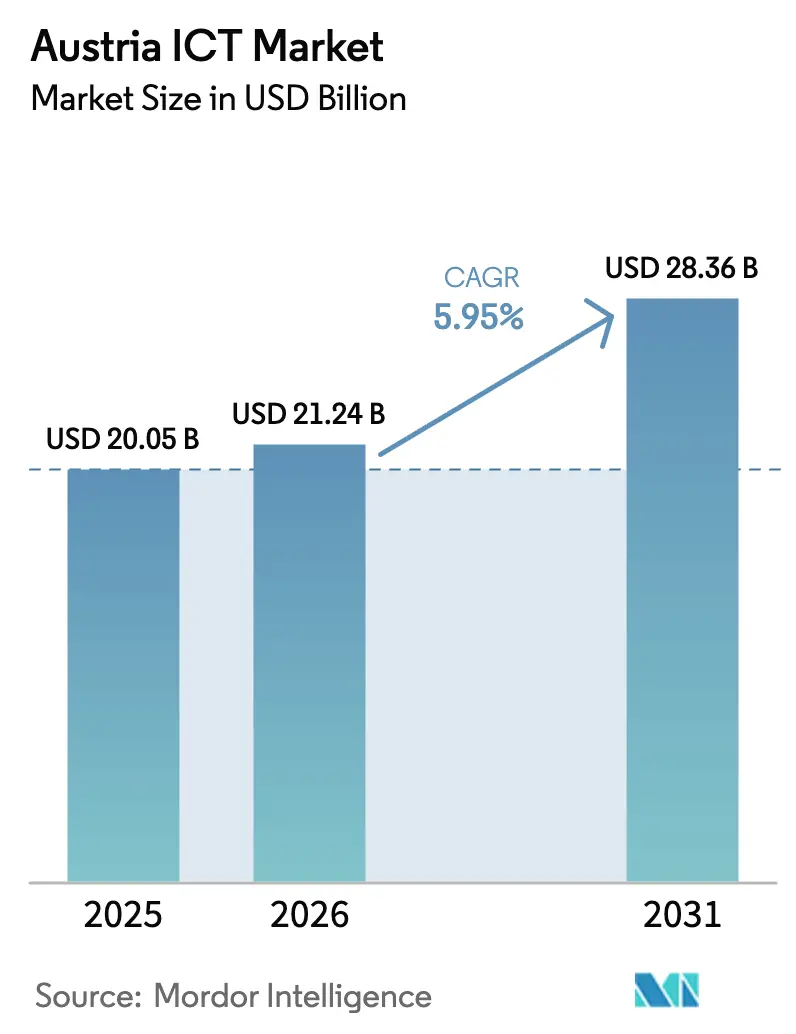
Austria ICT market size in 2026 is estimated at USD 21.24 billion, growing from 2025 value of USD 20.05 billion with 2031 projections showing USD 28.36 billion, growing at 5.95% CAGR over 2026-2031. Digital-bridge positioning between Western Europe and the CEE region, Vienna’s ascent as a hyperscale data-center hub, and aggressive public-sector digitalization sustain the current growth curve. Federal cloud-first rules, EU-funded SME up-skilling grants, and nationwide 5G + FTTH roll-outs generate steady enterprise and household demand. Competitive intensity deepens as global hyperscalers and incumbent telecom operators contest contracts that increasingly require data-sovereignty compliance. Nonetheless, the Austria ICT market encounters structural friction from a chronic talent shortfall, elevated electricity tariffs for data-center operators, and economic caution within export-oriented manufacturers.
Key Report Takeaways
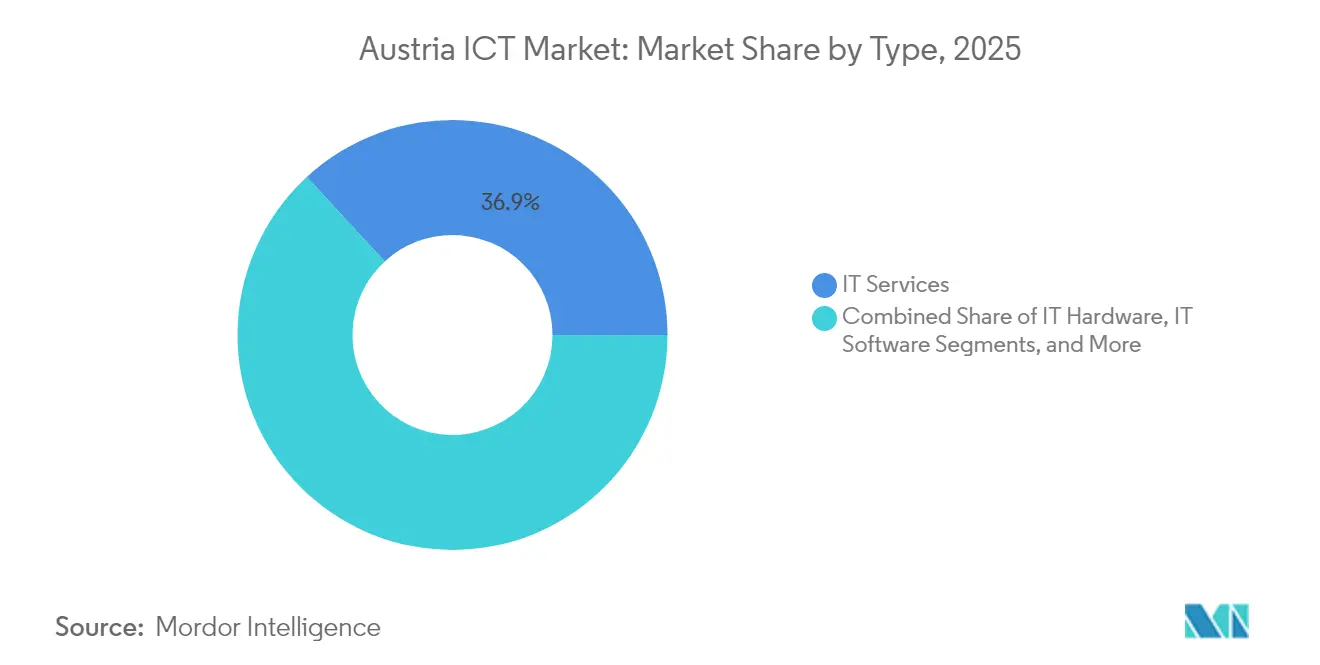
- By type, IT services led with 36.85% of the Austria ICT market share in 2025; cloud services are projected to expand at a 6.18% CAGR through 2031.
- By enterprise size, large enterprises held 62.80% of the Austria ICT market size in 2025, while SMEs record the highest projected CAGR at 6.5% to 2031.
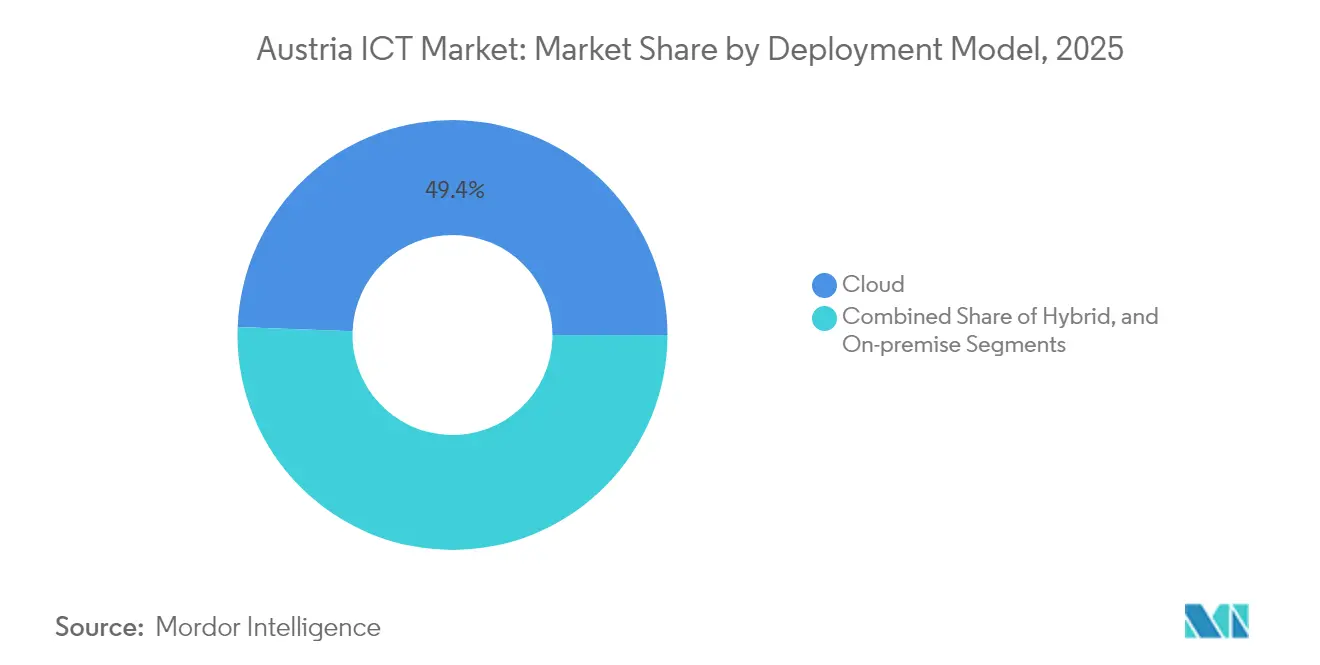
- By deployment model, cloud captured 49.40% revenue share in 2025 and is advancing at a 6.55% CAGR through 2031.
- By end-user vertical, government and public administration accounted for a 17.10% share of the Austria ICT market size in 2025, whereas gaming and esports will accelerate at a 6.85% CAGR to 2031.
Note: Market size and forecast figures in this report are generated using Mordor Intelligence’s proprietary estimation framework, updated with the latest available data and insights as of 2026.
Austria ICT Market Trends and Insights
Drivers Impact Analysis*
| Driver | (~) % Impact on CAGR Forecast | Geographic Relevance | Impact Timeline |
|---|---|---|---|
| Digital-transformation of public services | +1.2% | Vienna and state capitals | Medium term (2-4 years) |
| Nationwide 5G and FTTH deployment | +0.9% | Urban centers first | Short term (≤ 2 years) |
| EU-funded SME up-skilling subsidies | +0.7% | Rural emphasis | Medium term (2-4 years) |
| Federal cloud-first procurement | +0.8% | Countrywide | Short term (≤ 2 years) |
| Near-shoring CEE data-center workloads | +0.6% | Vienna metro & Lower Austria | Long term (≥ 4 years) |
| Vienna smart-city carbon-neutral goals | +0.4% | Vienna region | Medium term (2-4 years) |
| Source: Mordor Intelligence | |||
5G and Fiber Infrastructure Acceleration Drives Enterprise Spending
Nationwide 5G availability combined with fiber-to-the-home connections to 1.2 million households creates the low-latency backbone required for cloud migration and Industry 4.0 roll-outs. Manufacturing clusters in Upper Austria and Styria now pilot real-time analytics and IoT sensor grids reliant on sub-10 ms round-trip times. Operators reported 15% growth in enterprise data-service revenue after businesses increased their Austria ICT market budgets by 8.2% in 2024.
EU Digital Upskilling Subsidies Unlock SME Potential
The KMU.DIGITAL program disburses grants covering up to 80% of cloud, cybersecurity, and e-commerce costs for eligible firms. With USD 327 million allocated through 2027, SMEs that join post 23% productivity gains, catalyzing peer adoption across the 330,000-strong SME base. Participation already reaches 35% in Tyrol and Vorarlberg, underscoring untapped demand in eastern regions.
Federal Cloud-First Policies Create Vendor Consolidation Pressure
Since 2024, every new federal IT project must be cloud-evaluated first, repurposing a USD 3.47 billion annual segment. Procurement centralization through the Federal Computing Center standardizes architectures and favors suppliers with hybrid cloud capabilities. European providers and local data centers gain a sovereignty edge as ministries insist on in-country data residency.[1]
Vienna Smart-City Initiatives Generate Specialized ICT Demand
A USD 890 million pipeline in smart grids, digital twins, and urban analytics emerges as Vienna pursues carbon neutrality by 2040. The 2024 digital-twin launch requires dense IoT sensing and edge processing across 220,000 public buildings, steering opportunities toward vendors with proven municipal integration credentials. Comparable programs budgeted at USD 445 million spread to Graz, Linz, and Salzburg through 2027.
Restraints Impact Analysis*
| Restraint | (~) % Impact on CAGR Forecast | Geographic Relevance | Impact Timeline |
|---|---|---|---|
| Tight IT-talent pipeline | -0.8% | Vienna and Graz hubs | Short term (≤ 2 years) |
| Macroeconomic slowdown | -0.6% | Manufacturing belts | Medium term (2-4 years) |
| Cyber-sovereignty limits on hyperscalers | -0.4% | Federal and enterprise | Long term (≥ 4 years) |
| High electricity costs for data centers | -0.3% | Vienna and Lower Austria | Medium term (2-4 years) |
| Source: Mordor Intelligence | |||
IT Talent Shortage Constrains Service Delivery
Austria posts 24,000 unfilled ICT vacancies against 3,200 annual graduates, inflating wages 12% each year. Cybersecurity proves most constrained, with 75% of firms unable to source specialists, forcing premium consultancies or project delays. Salary bands of USD 98,000-130,000 for senior roles erode service-provider margins and limit the Austria ICT market’s capacity to scale.
Economic Uncertainty Delays Enterprise Transformation
Energy-cost volatility and supply-chain disruptions erode manufacturing cash flows, prompting 7% cuts in mid-market ICT budgets during 2024. CFOs defer multi-year modernization and focus on essential compliance projects, lengthening decision cycles and tempering the Austria ICT market growth in export-oriented industries.[2]
*Our forecasts treat driver/restraint impacts as directional, not additive. The impact forecasts reflect baseline growth, mix effects, and variable interactions.
Segment Analysis
By Type: Services Leadership Amid Cloud Transformation
The segment accounts for 36.85% of the Austria ICT market share in 2025 while cloud services log a 6.18% CAGR, underscoring a pivot from on-premises assets to consumption-based models. The Austria ICT market size tied to IT services benefits from outsourcing appetite among 330,000 SMEs lacking internal staff. Demand for hybrid-cloud architectures strengthens as companies seek performance parity with sovereignty compliance.
Hardware refresh cycles stay stable in manufacturing and banking yet shift toward edge-optimized devices supporting IoT analytics. SaaS subscriptions lift software growth, while security outlays climb as daily incident ratios surge to 22%. Telecom operators leverage fiber and 5G footprints to bundle transformation consulting, creating convergence between connectivity and IT outsourcing.

By Enterprise Size: SME Acceleration Challenges Large-Enterprise Dominance
Large enterprises deliver 62.80% of 2025 revenue but their incremental expansion moderates as projects mature. EU grants push SMEs to a 6.5% CAGR, injecting fresh volume into the Austria ICT market size. Standardized migration bundles from firms such as CANCOM Austria reduce cost and complexity, accelerating adoption among resource-constrained owners.
SMEs now view cloud storefronts and cybersecurity certification as prerequisites for export contracts, while large enterprises reallocate budgets toward AI optimization and continuous compliance. Vendors capable of offering modular solutions, regional language support, and bundled financing capture the outsized momentum in this customer tier.
By Deployment Model: Cloud Dominance Reflects Sovereignty Concerns
Cloud deployments hold 49.40% of 2025 revenue and rise at 6.55% CAGR. Hybrid architectures dominate design briefs, allowing sensitive workloads to remain on-premise while benefiting from public-cloud elasticity. The Austria ICT market share for on-premise infrastructure stabilizes in regulated health and banking segments where in-country data residency is mandated.
Federal cloud-first rules accelerate SaaS adoption, yet procurement clauses favor European providers to mitigate extraterritorial jurisdiction risks. This dynamic spurs hyperscalers to open Vienna regions and offer contractual sovereignty add-ons, while local integrators orchestrate multi-cloud governance for risk-averse enterprises.
By End-User Industry Vertical: Gaming Disrupts Traditional Hierarchies
Government and public entities absorb 17.10% of 2025 spending, propelled by 117 federal digital measures. Gaming and esports lead growth at 6.85% CAGR as Austria’s 5.3 million player base and official sport recognition trigger infrastructure upgrades. BFSI digitization advances with AI advisory pilots, whereas manufacturing trails the EU cloud-adoption average, highlighting latent upside.
Healthcare spending normalizes post-pandemic but telemedicine and electronic records keep momentum. Retail and logistics funnel double-digit e-commerce growth into omnichannel fulfillment and last-mile analytics, diversifying revenue for platform providers in the Austria ICT industry.
Geography Analysis
Vienna commands roughly 44% of Austria ICT market spending due to federal government projects, financial services headquarters, and concentrated data center capacity. Microsoft’s USD 1.09 billion region plus AtlasEdge edge nodes deepen the capital’s gravity for hyperscale and edge workloads, enabling sub-5 ms connectivity to major EU metros.
Industrialized Upper Austria and Styria rank next in value as automotive and machinery clusters deploy IoT, MES, and predictive maintenance stacks. Western states Tyrol and Vorarlberg exhibit the highest SME grant uptake at 35%, signaling robust grassroots digitalization despite smaller population bases.
Austria’s EU membership and stable regulatory climate allow ICT providers to pilot GDPR-compliant services locally and then export across the single market. Netskope’s Vienna launch typifies suppliers leveraging central location, skilled labor, and pan-EU rail-and-fiber corridors to serve CEE customers seeking sovereign cloud access.
Regulatory Landscape
Austria ICT regulation is anchored in the Telecommunications Act 2021 (TKG 2021), under which the Telekom-Control Commission (TKK) oversees competition matters, spectrum assignment, network cooperation, and net neutrality monitoring, with the Austrian Regulatory Authority for Broadcasting and Telecommunications (RTR) acting as TKK's office. The Signature and Trust Services Act (SVG) also places trust-services supervision with the TKK, tightening requirements for identity, e-signature, and related digital-trust offerings used across government and regulated industries.
On the public-sector demand side, the Digital Austria Act 2.0 sets out a framework for interoperable digital government and more centralized IT procurement across federal, state, and municipal levels. In practice, this raises the bar for suppliers that can support standardized architectures, data residency expectations, and secure-cloud requirements embedded in public administration procurement and service delivery.
Value Chain Analysis
Austria's ICT value chain starts with connectivity and infrastructure build-out (fiber backbones, last-mile FTTH, and 5G radio access), then moves into data center capacity, cloud platforms, and systems integration for enterprises and public administration. A1 Telekom Austria is a key upstream enabler, with a fiber network spanning about 75,500 km and reported 86% 5G population coverage in Austria as of early 2026, supporting enterprise connectivity, private networking, and cloud access across regions.
In the midstream layer, cross-border transport and low-latency routes reinforce Austria's role as a bridge into CEE workloads: A1 Austria, Eurofiber, and Quantcom completed a high-performance dark fiber route between Frankfurt and Vienna in December 2025 to support cloud and AI data transfer. Downstream, integrators and managed service providers package migration, cybersecurity, and operations for SMEs and large enterprises, while the Federal Computing Centre (BRZ) sets standards for cloud and IT services used in public administration, shaping vendor qualification and interoperability expectations across the ecosystem.
Competitive Landscape
The Austria ICT market features moderate fragmentation where top telecom incumbents, global cloud platforms, and mid-sized integrators share influence. A1 Telekom Austria extends beyond connectivity into managed services, while Magenta Telekom and Hutchison Drei monetize 5G private-network projects. Hyperscalers Microsoft, AWS, and Google intensify regional hiring after local-zone launches, heightening price and service competition.
Data-sovereignty clauses elevate European clouds and Vienna-based colocation specialists that guarantee in-country data residency. CANCOM Austria, T-Systems, and Bechtle exploit this opening by integrating multi-cloud orchestration with cybersecurity operations centers that address the talent shortage pain point for mid-market clients.
Global consultancies such as Capgemini, Accenture, and Atos chase large-enterprise outsourcing renewals but must localize to Austria’s German-language workflows and stringent public-sector procurement rules. SME-tailored bundles, managed detection-and-response offerings, and vertical smart-city solutions remain fertile whitespace for agile domestic providers.
Austria ICT Industry Leaders
-
A1 Telekom Austria AG
-
Amazon Web Services, Inc.
-
Atos SE
-
Capgemini SE
-
Cisco Systems, Inc.
- *Disclaimer: Major Players sorted in no particular order

Market Opportunities and Future Outlook
Network-led enterprise digitization continues to offer clear whitespace, supported by spectrum availability and ongoing fiber programs. In April 2026, Austria auctioned the 2.3 GHz and 2.6 GHz bands (EUR 39.41 million proceeds), expanding the toolkit for operators and service providers to deliver higher-capacity 5G, including private-network and low-latency use cases tied to Industry 4.0 and campus deployments. A1 Telekom Austria's long-dated investment program (EUR 1 billion for 2022-2031, focused on broadband and fiber expansion in Austria) also supports demand for edge connectivity, managed networks, and bundled ICT services that turn connectivity upgrades into recurring IT and security engagements.
Public-sector digital sovereignty initiatives create procurement-driven opportunities for cloud, cybersecurity, and shared platforms, particularly for vendors that can meet in-country processing expectations and standardized architectures. The national Digital Decade roadmap cites 85 measures with a total budget of EUR 4.07 billion, with 83% of public funding allocated to expire by end-2026, which concentrates execution into active program windows. Digital Austria Act 2.0 and the GovTech-Austria initiative also reference common AI infrastructure, secure cloud usage, and shared procurement, favoring suppliers that combine sovereign-ready cloud patterns, identity and trust services, and operations capabilities aligned to public-administration requirements.
Recent Industry Developments
- May 2026: Atos Austria secured a contract from ÖBB Personenverkehr AG to renew Internet-on-Board systems and modernize train and land-side infrastructure. The transport ICT modernization contract expands end-to-end system integration in the Austrian rail sector and strengthens Atos Austria's footprint in critical transport connectivity. The deal positions Atos Austria to pursue additional rail and public-sector digitalization opportunities in the region.
- April 2026: A1 Telekom Austria Group extended 2.6 GHz spectrum holdings in Austria for 11 million EUR. The nationwide spectrum asset extension supports 5G coverage expansion and enterprise services, enabling private-network opportunities and cloud-enabled services. This expansion reinforces Austria's digital infrastructure resilience and supports new private-network deployments for industry verticals.
- January 2026: Atos Austria extended IT outsourcing partnership with Kreditschutzverband von 1870 (KSV1870) for five years, including OpenShift managed services. The outsourcing commitment strengthens critical public-sector IT infrastructure and cloud-native service delivery. The arrangement improves Atos Austria's position as a trusted provider for essential public sector digitally enabled operations.
Research Methodology Framework and Report Scope
Market Definition and Coverage
For this methodology, the Austria ICT market covers spending in Austria on information technology and communications technologies. That includes hardware, software, IT services, and telecom services used by businesses and public sector bodies.
Scope exclusions: consumer electronics retail (such as TVs and appliances) and non-ICT professional services are not counted.
Segmentation Overview
- By Type
- IT Hardware
- Computer Hardware
- Networking Equipment
- Peripherals
- IT Software
- IT Services
- Managed Services
- Business Process Services
- Business Consulting Services
- Cloud Services
- IT Infrastructure
- IT Security
- Communication Services
- IT Hardware
- By Enterprise Size
- Small and Medium Enterprises
- Large Enterprises
- By Deployment Model
- On-premise
- Cloud
- Hybrid
- By End-user Industry Vertical
- Government and Public Administration
- BFSI
- Energy and Utilities
- Retail, E-commerce and Logistics
- Manufacturing and Industry 4.0
- Healthcare and Life Sciences
- (Up/Mid/Down-stream)
- Gaming and Esports
Data Sources, Market Sizing, and Validation
Desk Research
We start by building a clean fact base on Austria-level digital activity and spend signals, then map those signals to ICT categories so the model inputs tie to observable indicators. Public sources used for this step include Statistik Austria releases on enterprises and households, RTR telecommunications reports for Austria, Eurostat ICT usage and broadband indicators, OECD digital economy tables, and the EU Commission Digital Decade scoreboards.
To connect those indicators to market value, we also review annual reports and investor decks of relevant operators and service providers, public procurement portals and tender notices for ICT projects, and reputable press coverage on large rollouts (for example 5G, fiber, data centers, and cloud programs). Select paid subscriptions are used only to speed up company financial lookups, track news, and cross-check patent activity, after which assumptions are kept simple enough to be reproduced. The sources listed here are illustrative only, and many other documents were used for data collection, validation, and clarification.
Primary Interviews and Surveys
We use interviews and surveys with Austrian telecom, IT services, software, hardware distribution, and enterprise technology stakeholders. Their responses help test secondary revenue pools, clarify bundled-service treatment and replacement timing, and compare budget and demand assumptions before final totals are set. Re-contact is used when responses differ from official turnover or demand signals.
Distribution of primary research fieldwork respondents
| Company type | Respondent position |
|---|---|
| Top tier: 24% | CXOs: 18% |
| Mid tier: 54% | Functional/Unit leaders: 30% |
| Smaller Players: 22% | Managers: 52% |
Market-Sizing & Forecasting
Sizing is built using top-down and bottom-up logic together, but it is led by a top-down demand pool reconstructed from Austria-specific telecom service revenue signals, enterprise ICT adoption indicators, and public sector digital spend patterns. Once that total is shaped, we corroborate it using selective bottom-up checks such as sampled vendor revenue attribution to Austria, channel feedback on unit volumes, and an ASP times volume build for a few measurable items (like telecom subscriptions and selected hardware categories). Adjustments are made only where the gap is explainable.
Key inputs used in the model include telecom ARPU and subscriber movement, broadband and 5G coverage and uptake, enterprise cloud adoption momentum, IT services staffing availability and billing rate direction, and public sector digitization programs that create multi-year demand. For forecasting, we rely on scenario analysis supported by trend smoothing, where growth is flexed based on macro conditions, regulated telecom price pressure, and the expected pace of modernization projects. Where bottom-up pieces do not cover smaller private firms or fragmented service lines, we fill the gap with calibrated factors anchored to respondent feedback and observable industry totals.
Data Validation & Update Cycle
We run variance checks at several points so that the final numbers do not shift only because one input changes unexpectedly. Model outputs are compared with independent signals like telecom revenue direction, business ICT usage indicators, and reported investment cycles, then anomalies are reviewed and resolved before sign-off.
If a large new contract, regulatory change, or sharp pricing shift is observed, experts are re-contacted to confirm whether it is structural or temporary, and assumptions are updated accordingly. Reports are refreshed annually, with interim updates for material events, and a final pre-delivery review is completed so the published view reflects the latest available information.
Mordor Intelligence's Austria Ict Market Size Measured Against Other Published Estimates
It is normal to see different published values for Austria ICT because sources count different pieces of spend, use different base years, and convert currencies at different points in time. The gaps can also come from how telecom services are treated versus IT services, and whether the estimate is closer to domestic supplier revenue or end-user spending.
Consumer electronics revenue (like TVs and appliances) is kept outside Mordor Intelligence's scope, which can pull the market value down versus figures that treat the wider IKT industry as a single revenue pool. Another repeat driver is currency timing, where euro-based totals are converted using a different year average rate, and some publications mix vendor revenue rankings with end-user spend, which can double count partner pass-through in IT services.
Benchmark comparison
| Source | Market Size | Gaps in Research Methodology |
|---|---|---|
| Mordor Intelligence | USD 20.05 B (2025) | |
| Trade Journal A | USD 34.70 B (2024) | Uses a domestic IKT company revenue total (Top-1000 ranked firms) in EUR and then converts to USD, which can include adjacent electronics, resale pass-through, and non-end-user revenue in the total. |
| Industry Publisher B | USD 18.05 B (2024) | Shows a lower value for an earlier year and appears to apply a faster long-term growth path with limited clarity on whether telecom services and cloud infrastructure spend are fully counted. |
Across the three figures, the spread mainly comes from what is counted as ICT versus wider IKT revenue, and from how euro denominated totals are translated into USD for a given year. By keeping the scope tied to end-user ICT spend categories and by cross-checking the totals against telecom and enterprise demand signals, the result stays easier to trace back to clear drivers and repeatable steps.
Key Questions Answered in the Report
What is the current value of the Austria ICT market?
The Austria ICT market stands at USD 21.24 billion in 2026.
How fast is the Austria ICT market expected to grow?
The market is projected to rise to USD 28.36 billion by 2031, reflecting a 5.95% CAGR.
Which segment shows the highest revenue share?
IT services lead with 36.85% of 2025 revenue.
Which deployment model is growing fastest?
Cloud deployments post the highest CAGR at 6.55% through 2031.
Why is the talent shortage a concern for providers?
Austria faces 24,000 unfilled ICT roles, pushing wages up and constraining project capacity.
Which vertical is expanding most rapidly?
Gaming and esports record the strongest growth at a 6.85% CAGR to 2031.