
Australia Student Accommodation Market Size and Share
Market Overview
| Study Period | 2021 - 2032 |
|---|---|
| Forecast Data Period | 2027 - 2032 |
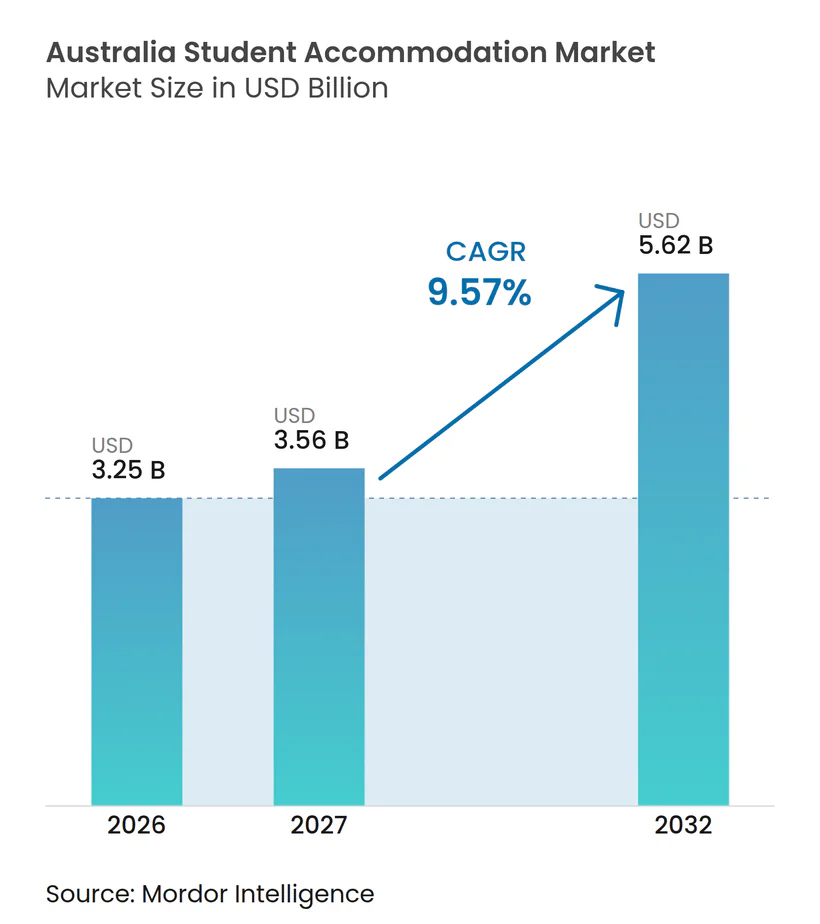
| Base Year Market Size (2026) | USD 3.25 Billion |
| Market Size (2027) | USD 3.56 Billion |
| Market Size (2032) | USD 5.62 Billion |
| Growth Rate (2027 - 2032) | 9.57 % |
| Market Concentration | High |
Major Players *Disclaimer: Major Players sorted in no particular order Image © Mordor Intelligence. Reuse requires attribution under CC BY 4.0. | |
Australia Student Accommodation Market Analysis by Mordor Intelligence
The Australia Student Accommodation Market size is expected to increase from USD 3.25 billion in 2026 to USD 3.56 billion in 2027 and reach USD 5.62 billion by 2032, growing at a CAGR of 9.57% over 2027-2032.
The Australia student accommodation market is supported by a large gap between student demand and purpose-built student accommodation (PBSA) supply. PBSA covers housing designed and managed specifically for students. Australia remains an important destination for international higher education, while housing delivery has become more closely linked to university enrollment trends. The national planning framework gives institutions a stronger reason to incorporate accommodation into their growth plans. This creates opportunities for operators that can deliver housing near campuses and adapt their room mix to different affordability needs.
Key Report Takeaways
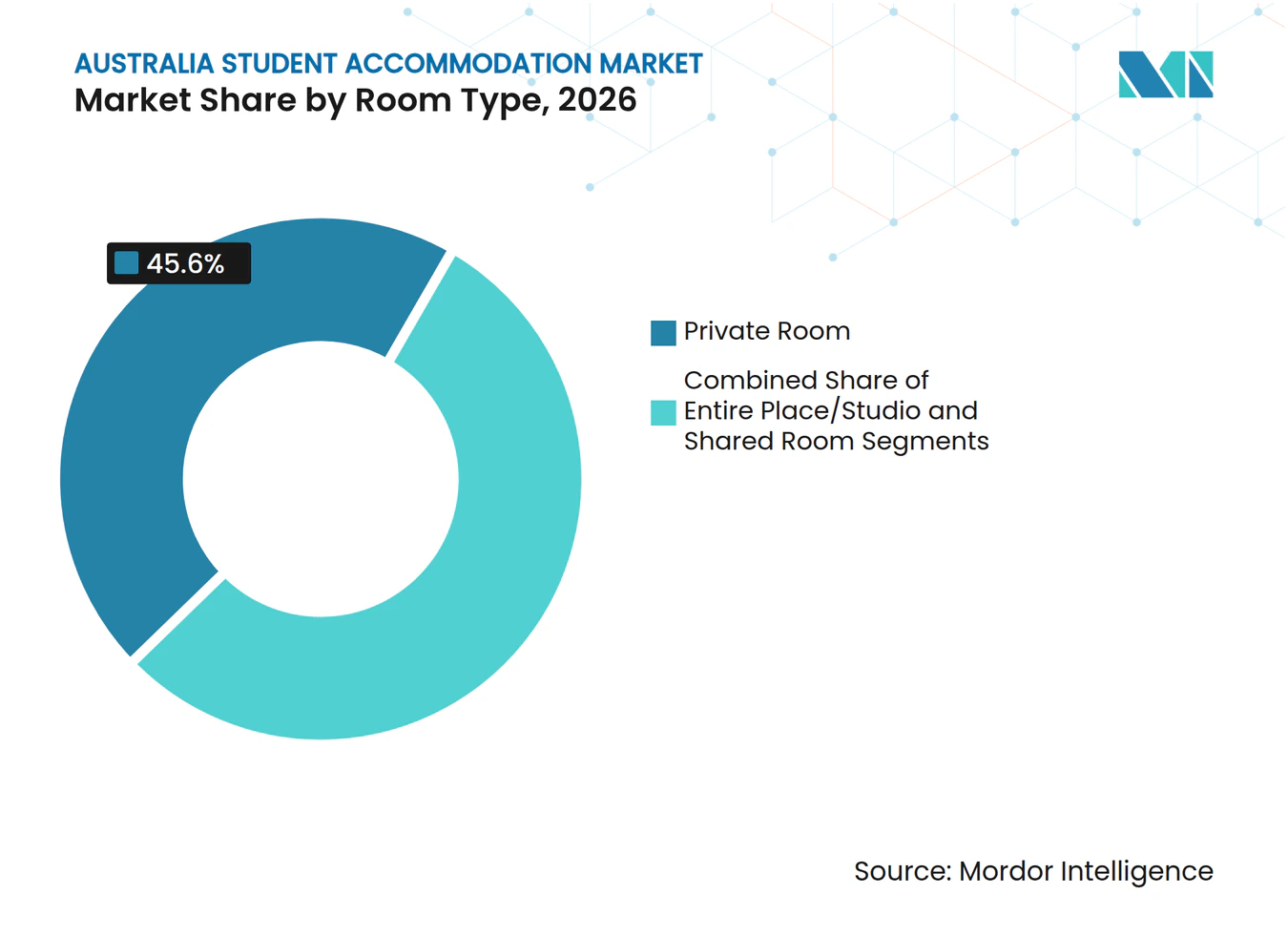
- By room type, private rooms held 45.6% of the Australia student accommodation market share in 2026, while shared rooms are forecast to grow at a CAGR of 10.55% through 2032.
- By student type, international students accounted for 59.9% of the Australia student accommodation market share in 2026, while domestic students are forecast to grow at a CAGR of 10.22% through 2032.
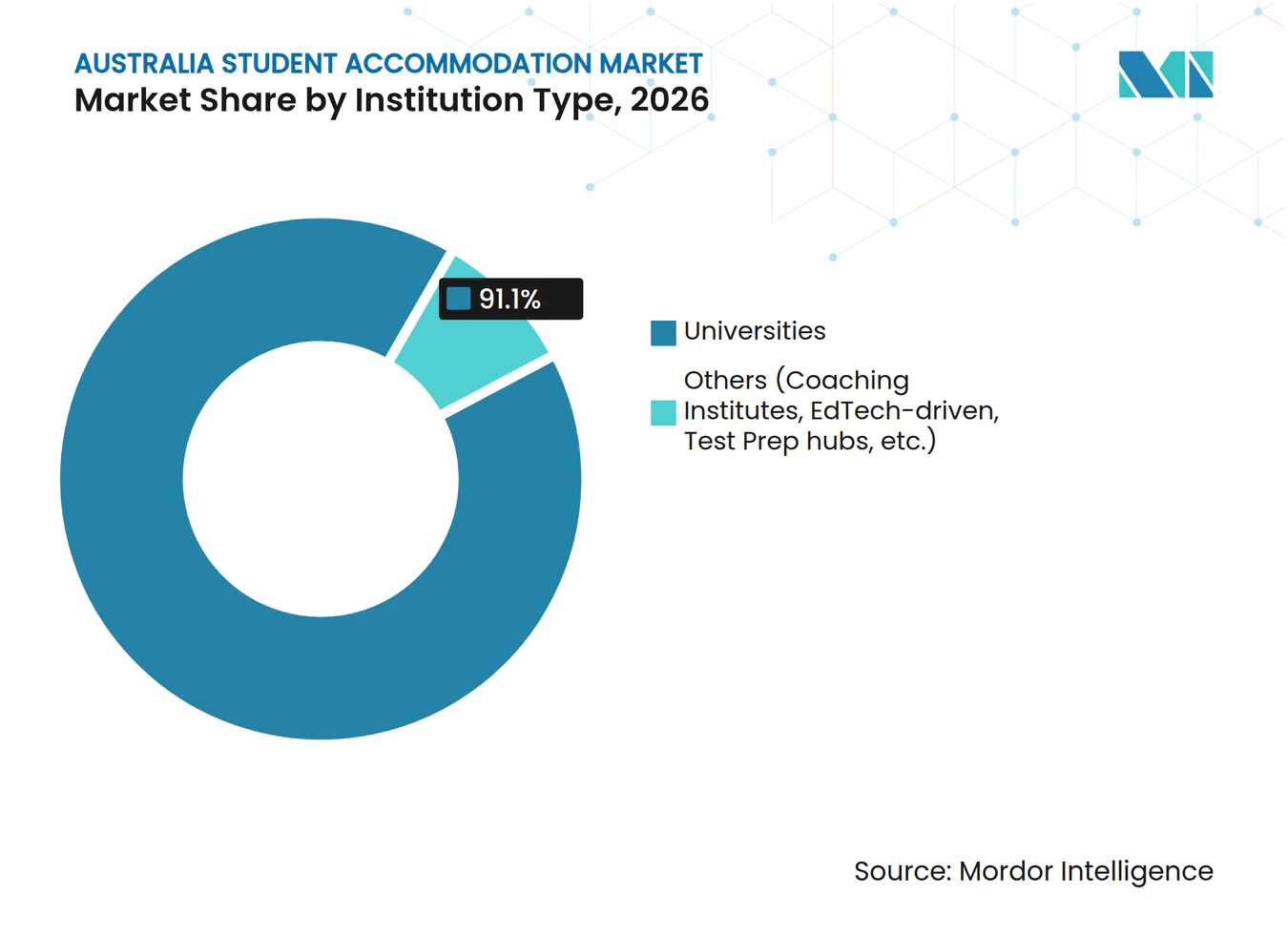
- By institution type, universities held 91.1% of the Australia student accommodation market share in 2026 and are forecast to grow at a CAGR of 10.33% through 2032.
- By key city, Melbourne accounted for 30.2% of the Australia student accommodation market share in 2026, while Perth is forecast to grow at a CAGR of 10.65% through 2032.
Note: Market numbers in this report are based on Mordor Intelligence's proprietary estimation framework, which combines nine months of actuals with Q4 projections for base year 2026.
Market Trends and Insights
Drivers Impact Analysis of Australia Student Accommodation Market*
| Drivers | (~) % Impact on CAGR Forecast | Geographic Relevance | Impact Timeline |
|---|---|---|---|
| Limited PBSA Capacity in Major University Markets | +2.5% | National, concentrated in Melbourne and Sydney | Short term (≤ 2 years) |
| Institutional Investment in Managed Accommodation | +2.0% | National, with early gains in Melbourne, Perth, and Sydney | Medium term (2-4 years) |
| Tight Conventional Rental Markets | +1.5% | Major capitals, strongest in Perth and Melbourne | Short term (≤ 2 years) |
| University Partnerships with Private Operators | +1.3% | National, led by Melbourne, Sydney, and Perth | Medium term (2-4 years) |
| Preference for Secure, Amenity-Rich Housing | +1.0% | Sydney, Melbourne, and Brisbane | Medium term (2-4 years) |
| Regional University Growth | +0.7% | Gold Coast, Darwin, Wollongong, Newcastle, and Geelong | Long term (≥ 4 years) |
| Source: Mordor Intelligence | |||
Limited PBSA Capacity Sustaining Demand
The Australian student accommodation market faces a significant supply gap, as purpose-built student accommodation (PBSA) serves only 7% of tertiary students. The planned pipeline of 34,000 beds through 2029 would increase coverage to only 9%, indicating a substantial unmet housing need. The Australian Bureau of Statistics reported that approvals rose from 1,684 rooms in 2021-22 to 5,178 rooms in 2023-24, reflecting increased development activity in response to supply shortfalls[1]. Central Melbourne and inner Sydney present challenges for new projects due to limited sites near universities. As a result, well-located, professionally operated assets with strong campus connectivity retain strong appeal. The market stands to benefit most in areas where approval processes and site availability allow projects to advance from planning to construction.
Institutional Investment Supporting Managed Accommodation
Institutional capital gives established operators greater capacity to acquire, develop, and manage student housing. In April 2025, Scape converted its core fund into an open-ended vehicle and consolidated additional portfolios, expanding its pool of long-term capital[2]. This model supports a steadier development program by providing investors a structured route to enter and exit the fund. In the Australia student accommodation market, large platforms can also distribute operating costs across more properties and build stronger booking networks. Smaller providers may find it harder to access similar funding or compete for high-cost sites. The result is increased interest in partnerships, portfolio transactions, and specialist operating platforms.
Tight Conventional Rental Markets Supporting PBSA Demand
Low vacancy rates in conventional rentals are making PBSA a more attractive option for students seeking accommodation close to campus. Perth recorded a rental vacancy rate of 0.7% in late 2025, while Brisbane also reported a vacancy rate below 1%. PBSA consolidates rent, utilities, internet, security, and shared facilities into a single payment, simplifying total living cost planning. This format also reduces the need to furnish a room or set up separate service accounts. Operators are responding by offering room types suited to both first-year international students and domestic students who previously rented in shared houses. The Australian student accommodation market is likely to retain this advantage while rental supply remains constrained in major university cities.
University Partnerships with Private Operators Accelerating Delivery
University partnerships can reduce the land and delivery risks that private developers face near major campuses. Edith Cowan University appointed UniLodge as the operator of its on-campus accommodation in September 2026 following a competitive procurement process. These arrangements allow universities to improve housing access without directly managing every residence, while giving operators access to demand linked to enrolment and campus services. The Department of Education stated that 31 of 32 universities had their 2026 growth applications approved, with housing commitments tied to those allocations[3]. As a result, the Australian student accommodation market is becoming more closely connected to university planning and compliance decisions.
Restraints Impact Analysis of Australia Student Accommodation Market*
| Restraints | (~) % Impact on CAGR Forecast | Geographic Relevance | Impact Timeline |
|---|---|---|---|
| International Student Visa Restrictions and Enrollment Uncertainty | -1.5% | National, strongest for Sydney and Melbourne research universities | Short term (≤ 2 years) |
| High Land and Construction Costs | -1.2% | Sydney and Melbourne, spreading to Perth | Medium term (2-4 years) |
| Lengthy Planning Approvals and Zoning Restrictions | -0.8% | Victoria and New South Wales, less restrictive in Western Australia and South Australia. | Long term (≥ 4 years) |
| High Accommodation Fees and Student Living Costs | -0.6% | National | Medium term (2-4 years) |
| Source: Mordor Intelligence | |||
International Student Visa Restrictions and Enrollment Policy Uncertainty
The national planning level for international student commencements increased from 270,000 in 2025 to 295,000 in 2026. While the higher level supports university demand, operators still need to plan carefully around visa processing timelines and student arrival schedules. Changes effective in October 2026 restrict many temporary visa holders from applying for a student visa while in Australia and limit family member inclusions. These rules can affect occupancy timing, particularly at newly opened buildings with large numbers of international residents. Universities and operators need to align room delivery, leasing schedules, and enrollment forecasts more closely. This constraint is most visible in large cities where new supply is arriving alongside more controlled student intake.
High Land Acquisition and Construction Costs
High land, material, labor, and financing costs are making new PBSA projects increasingly difficult to fund. Victoria's land tax arrangements have increased effective development costs for some projects by 30%, limiting the progression of approved schemes into construction. Developers in Sydney also face a shortage of sites close to major universities, pushing projects toward adaptive reuse or less central locations. More flexible planning rules may be needed to make projects feasible across a wider range of sites in the Australian student accommodation market. A defined planning framework for PBSA could reduce uncertainty for both developers and local authorities. Without such changes, the shortage of beds may persist even where demand is evident.
*Our forecasts treat driver/restraint impacts as directional, not additive. The impact forecasts reflect baseline growth, mix effects, and variable interactions.
Australia Student Accommodation Market Segment Analysis
By Room Type:
Private Rooms Lead While Shared Rooms Improve AffordabilityPrivate rooms held 45.6% of the Australia student accommodation market share in 2026. This dominance reflects demand from first-year international students who value separate tenancy and predictable weekly payments. A typical private room includes utilities, internet, building access, study areas, and wellbeing services. These features reduce the practical challenges associated with renting a conventional apartment. Private rooms also give operators a clear premium product for students who prioritize privacy. The segment remains important in inner-city university precincts where commuting distance and security influence accommodation choices.
Shared rooms are forecast to expand at a 10.55% CAGR through 2032. The format offers a lower-cost alternative for domestic students and for those accustomed to communal living. Shared units can help operators broaden their customer base when studio rents become unaffordable. New projects are incorporating a wider mix of two-bedroom and three-bedroom configurations rather than relying on a single room format. Yugo Perth University Campus includes shared apartments, and UniLodge Perth Central includes cluster rooms. This range of formats gives the Australia student accommodation market a more practical response to affordability pressures.



By Student Type:
International Students Anchor Revenue While Domestic Demand ExpandsInternational students accounted for a 59.9% share in 2026. This group remains central to occupancy, as many international students arrive without an established local rental network. Australia had more than 550,000 international higher education students, reflecting the scale of potential demand. The national planning level links growth more directly to housing delivery and encourages universities to take accommodation planning seriously. Higher education enrollment grew 2% year over year during January through May 2026 under moderated intake settings. Operators with clear booking processes, transparent pricing, and strong student support can maintain an advantage with this group.
Domestic students are projected to grow at a 10.22% CAGR through 2032. Rising private rental costs and low vacancy rates are leading more domestic students to consider purpose-built student accommodation (PBSA). Regional universities received the largest proportional increases in national planning-level allocations, which can increase housing needs in smaller university cities. Flexible leases and lower-cost shared rooms can make the product more accessible to this group. Domestic demand can also reduce reliance on a single source of international enrollment, broadening the Australia student accommodation market beyond its traditional international student base.
By Institution Type:
Universities Remain the Main Source of DemandUniversities accounted for 91.1% of the Australia student accommodation market in 2026. Large university campuses concentrate enrollment, transport links, teaching facilities, and student services in ways that support dedicated housing. Research-intensive universities in Sydney and Melbourne generate dense local demand, while regional campuses are creating new growth locations. The national planning framework gives housing a more direct role in university expansion, as institutions seeking enrollment growth are required to demonstrate how they will support students with suitable accommodation. This makes university agreements a core part of long-term development planning.
Universities are also forecast to record a 10.33% CAGR through 2032. Edith Cowan University's central Perth campus can accommodate up to 10,000 students and has helped stimulate nearby housing activity. Other providers, including coaching and education technology businesses, remain smaller parts of demand but may offer operators a way to utilize rooms outside the standard academic calendar. South Australia has updated its planning code to include self-contained dwellings within student accommodation definitions, while Western Australia has issued a draft PBSA position statement. These changes can allow more campuses and providers to participate in the Australia student accommodation market.

Geography Analysis
Melbourne accounted for 30.2% of the Australia student accommodation market share in 2026. Its concentration of universities and central education precincts supports demand for housing within a short trip of campus. The city has the country's largest purpose-built student accommodation pipeline, with more than 12,000 beds across various development stages, but high land tax and construction costs are delaying some projects. RMIT University and Scape committed to the State Library Exchange in September 2026, combining student housing and public transport within the same precinct.
Perth is forecast to grow at a 10.65% CAGR through 2032, the highest rate among the key city segments. Edith Cowan University's new central business district campus is generating demand close to the city center. New developments are adding private rooms, shared apartments, and cluster rooms, offering students more choices at different price points. Perth recorded 13% purpose-built student accommodation rental growth in Semester 2 2025, reflecting a tight supply position. The Western Australian planning authority's draft position statement seeks more consistent assessment criteria across local governments, which may improve project delivery.
Sydney has the largest identified shortage, with 25,000 unmet beds in its Central and Inner West precincts. Limited sites near major universities continue to restrict new supply, supporting the value of existing well-located properties. Brisbane opened UniLodge Brisbane City with 1,182 beds in Semester 2 2026, its first new purpose-built student accommodation building since 2022. Regional cities are also attracting investment as students consider options beyond the largest capitals. Griffith University opened a 460-bed Gold Coast tower in August 2026, while Charles Darwin University began a 352-bed Darwin project in July 2026.
Competitive Landscape
Market Concentration
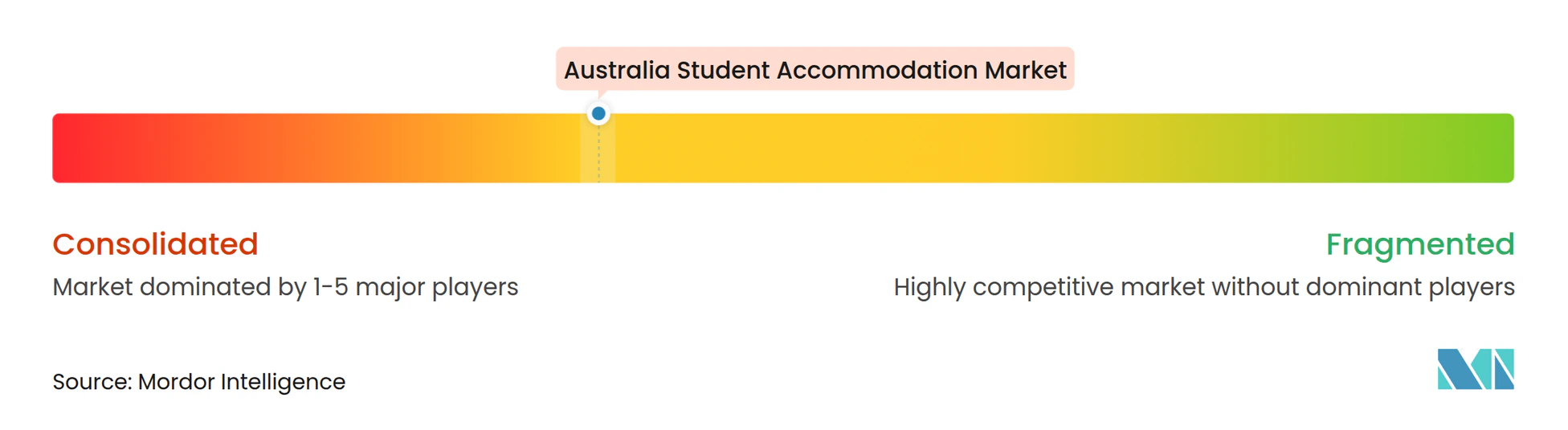
The Australia student accommodation market has a tiered structure. The five largest operators account for the majority share of capacity, while many smaller providers have limited access to institutional capital. UniLodge Australia and Scape have the largest operating footprints. Larger operators can distribute digital systems, booking operations, and student support services across a wider portfolio, which can improve efficiency. However, location quality and university relationships remain important competitive factors. The gap between larger platforms and smaller providers is supporting continued consolidation.
Platform investment is changing competitive behavior. Greystar entered the market through a 2025 acquisition and launched the Accolade by Greystar brand, targeting 10,000 beds under management by 2027. Scape restructured its capital base in 2025 through an open-ended fund, supporting long-term ownership and development. These developments indicate that scale is increasingly built through funds, acquisitions, and partnerships rather than individual developments alone. Operators unable to secure capital may focus on university management contracts or specific regional niches. As a result, consolidation pressure in the Australia student accommodation market is increasing.
Product design and technology are also shaping competition. UniLodge Perth Central uses a digital platform for room bookings, building access, and community engagement. Operators are introducing shared rooms, flexible lease structures, and targeted student support to address affordability concerns. A peer-reviewed study identified flexible leasing and expanded university-backed support as effective measures to improve access for domestic students. Premium properties can differentiate through wellness features, private rooms, and high-quality common spaces. The strongest competitive positions are likely to combine location, affordability, digital operations, and a reliable university relationship.
Australia Student Accommodation Industry Leaders
-
Scape
-
UniLodge Australia
-
Campus Living Villages
-
Yugo
-
GSA
- *Disclaimer: Major Players sorted in no particular order
Australia Student Accommodation Market Companies Covered in this Report
- Scape
- UniLodge Australia
- Campus Living Villages
- Yugo
- GSA
- Iglu
- Journal Student Living
- Student One
- Wee Hur Holdings
- Cedar Pacific
- Centurion Corporation
- Dwell Student Living
- The Switch
- Australian Unity
- Pamoja Capital
- Nuveen
- Atira Student Living
- Greystar
- University of Sydney Accommodation
- University of Melbourne Accommodation
Recent Industry Developments in Australia Student Accommodation Market
- September 2026: ECU appointed UniLodge Australia as the new operator of its on-campus accommodation, replacing Campus Living Villages following a competitive procurement process. This transition extends UniLodge's university accommodation management presence in Western Australia.
- August 2026: Griffith University opened a 460-bed student accommodation tower at its Gold Coast campus, developed in partnership with Campus Living Villages. This brought the total on-campus capacity at the site to nearly 1,000 beds, demonstrating the expansion of PBSA investment into regional university markets.
- July 2026: Construction has commenced on a 352-bed student accommodation project for Charles Darwin University in Darwin's CBD. The project, supported by an Australian Government loan, is being delivered by Campus Living Villages and Darwin-based DCOH, with completion expected in late 2028.
Australia Student Accommodation Market Report Scope
Segmentation Overview
| Entire Place/Studio |
| Private Room |
| Shared Room |
| Domestic |
| International |
| Universities |
| Others (Coaching Institutes, EdTech-driven, Test Prep hubs, etc.) |
| Sydney |
| Melbourne |
| Brisbane |
| Perth |
| Rest of Australia |
| By Room Type | Entire Place/Studio |
| Private Room | |
| Shared Room | |
| By Student | Domestic |
| International | |
| By Institution Type | Universities |
| Others (Coaching Institutes, EdTech-driven, Test Prep hubs, etc.) | |
| By Key Cities | Sydney |
| Melbourne | |
| Brisbane | |
| Perth | |
| Rest of Australia |
Key Questions Answered in the Report
What is the forecast growth rate for Australia student accommodation through 2032?
The sector is forecast to grow at a 9.57% CAGR from 2027 to 2032, rising from USD 3.25 billion in 2026 to USD 5.62 billion by 2032. The forecast reflects continued demand for professionally managed rooms near university campuses, particularly where conventional rental stock remains limited.
What is driving demand for purpose-built student accommodation in Australia?
A limited PBSA supply, tight private rental markets, international enrollment, and stronger university accommodation planning are supporting demand. These factors make properties with inclusive rents, reliable service, and good transport access particularly relevant to students and their families.
Which room type has the largest share in Australia student accommodation?
Private rooms lead with a 45.6% share in 2026, while shared rooms are projected to grow fastest at a 10.55% CAGR through 2032. Shared configurations give students a lower-cost option when private room rents are difficult to manage, while private rooms retain value for residents who prioritize privacy.
Which student group accounts for the largest share of accommodation demand?
International students account for a 59.9% share in 2026, while domestic students are expected to grow at a 10.22% CAGR through 2032. A wider domestic customer base can help operators balance demand across different enrollment patterns and make better use of varied room configurations.
Which city is expected to grow fastest for student accommodation in Australia?
Perth is forecast to grow at a 10.65% CAGR through 2032, supported by new university capacity, low rental vacancy, and a growing PBSA pipeline. The city’s planning direction and new CBD campus are supporting further development interest from operators and capital partners.