
Australia Liquid Packaging Cartons Market Size and Share
Market Overview
| Study Period | 2021 - 2032 |
|---|---|
| Forecast Data Period | 2027 - 2032 |
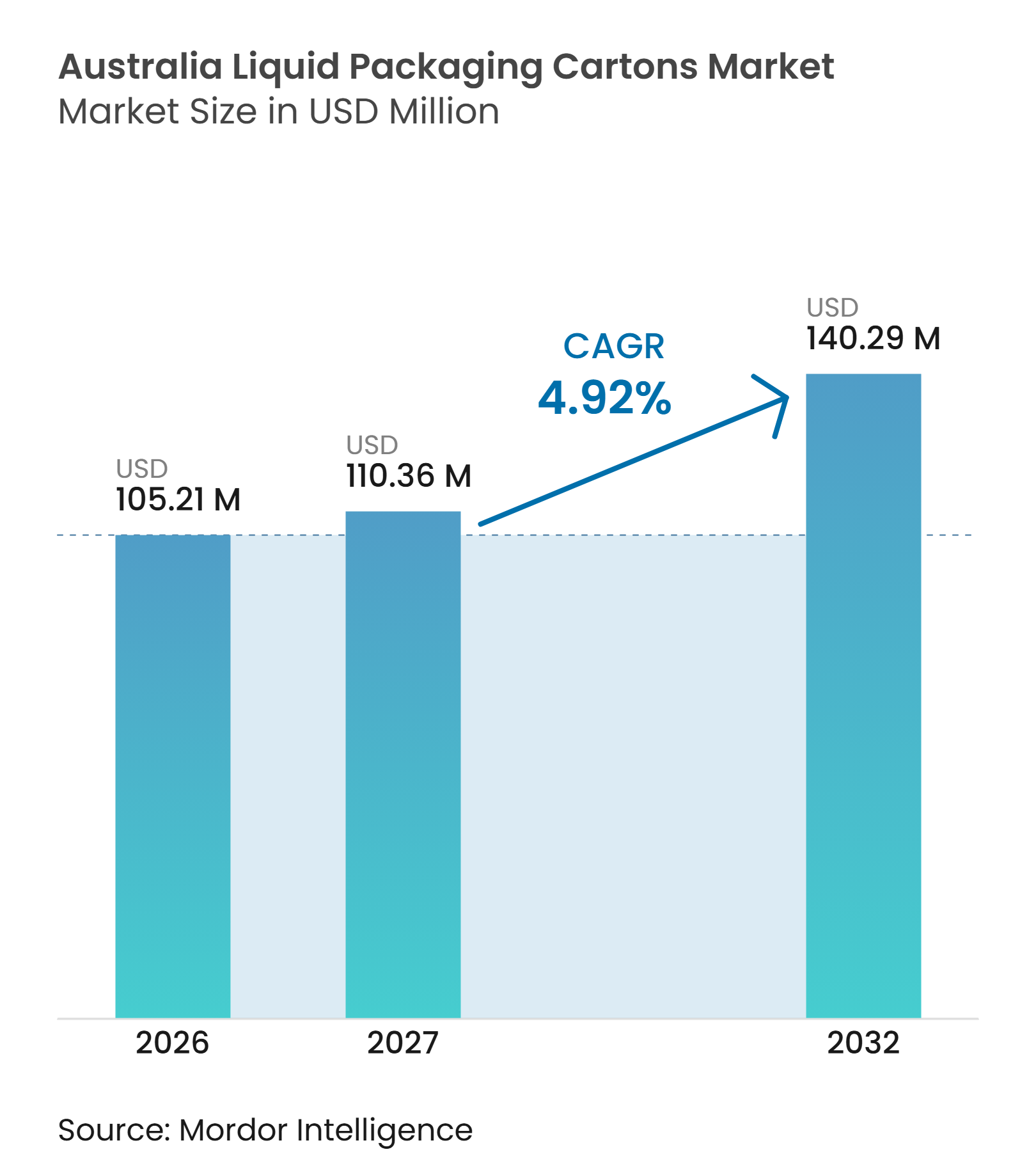
| Base Year Market Size (2026) | USD 105.21 Million |
| Market Size (2027) | USD 110.36 Million |
| Market Size (2032) | USD 140.29 Million |
| Growth Rate (2027 - 2032) | 4.92 % |
| Market Concentration | Medium |
Major Players *Disclaimer: Major Players sorted in no particular order Image © Mordor Intelligence. Reuse requires attribution under CC BY 4.0. | |
Australia Liquid Packaging Cartons Market Analysis by Mordor Intelligence
The Australia liquid packaging cartons market size is valued at USD 105.21 million in 2026 and is forecast to reach USD 140.29 million by 2032, growing at a CAGR of 4.92% during 2027-2032. Aseptic formats benefit from the need to move long-life beverages over long distances without a refrigerated supply chain. This advantage is relevant for dairy, juice, plant-based drinks, and export-oriented beverage production. Retailers also value packs that use storage space efficiently and reduce freight weight compared with glass formats. Materials redesign is becoming central to supplier competition as carton producers seek to reduce their use of aluminum and increase paper content. The Australia liquid packaging cartons market therefore combines stable demand from established dairy products with new use cases in single-serve, functional, and plant-based beverages.
Key Report Takeaways
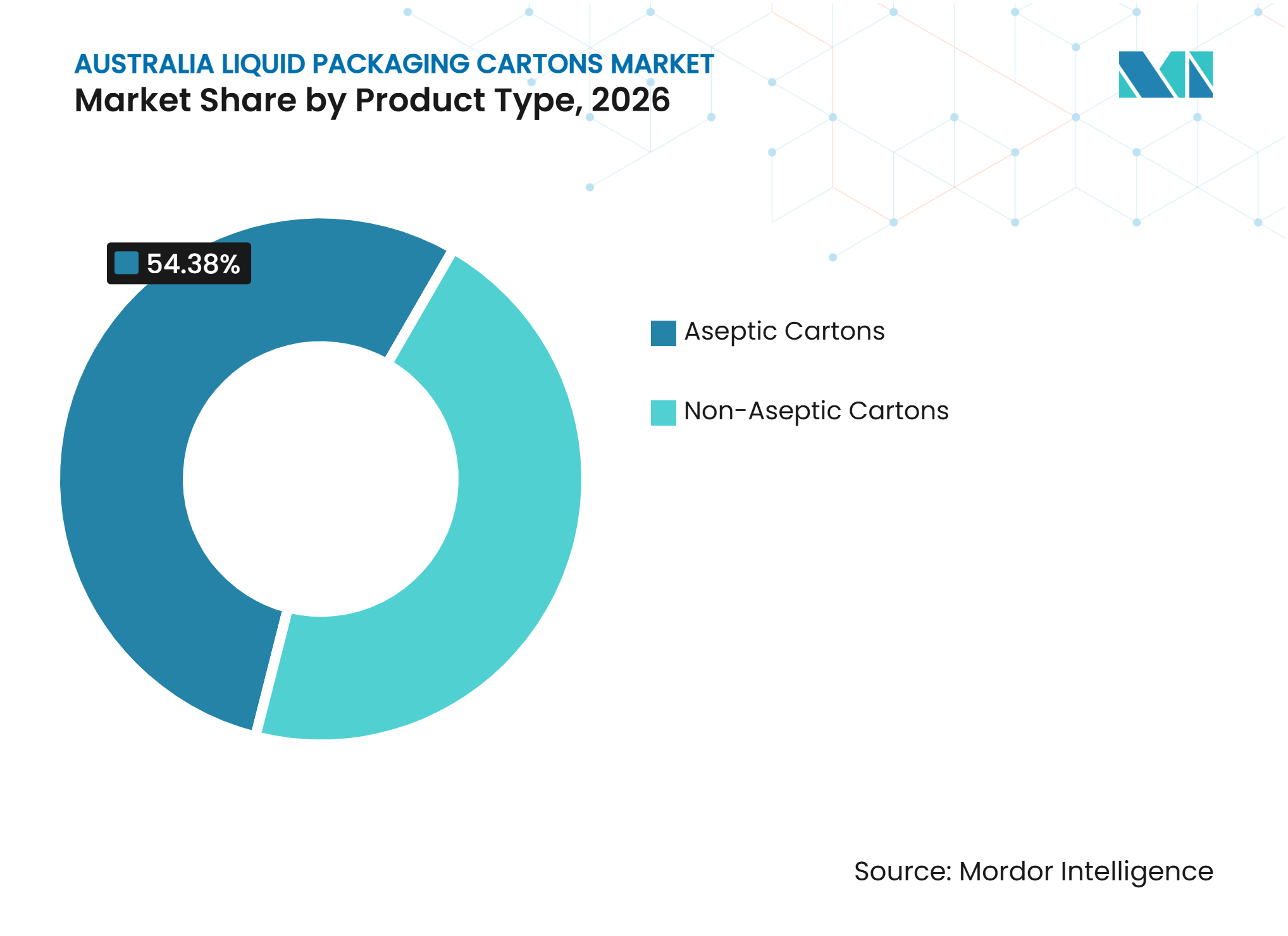
- By product type, aseptic cartons held 54.38% of the Australia liquid packaging cartons market share in 2026 and are projected to expand at a 5.68% CAGR through 2032.
- By application, milk accounted for 46.29% of the Australia liquid packaging cartons market size in 2026, while plant-based beverages are projected to record the highest CAGR of 5.82% through 2032.
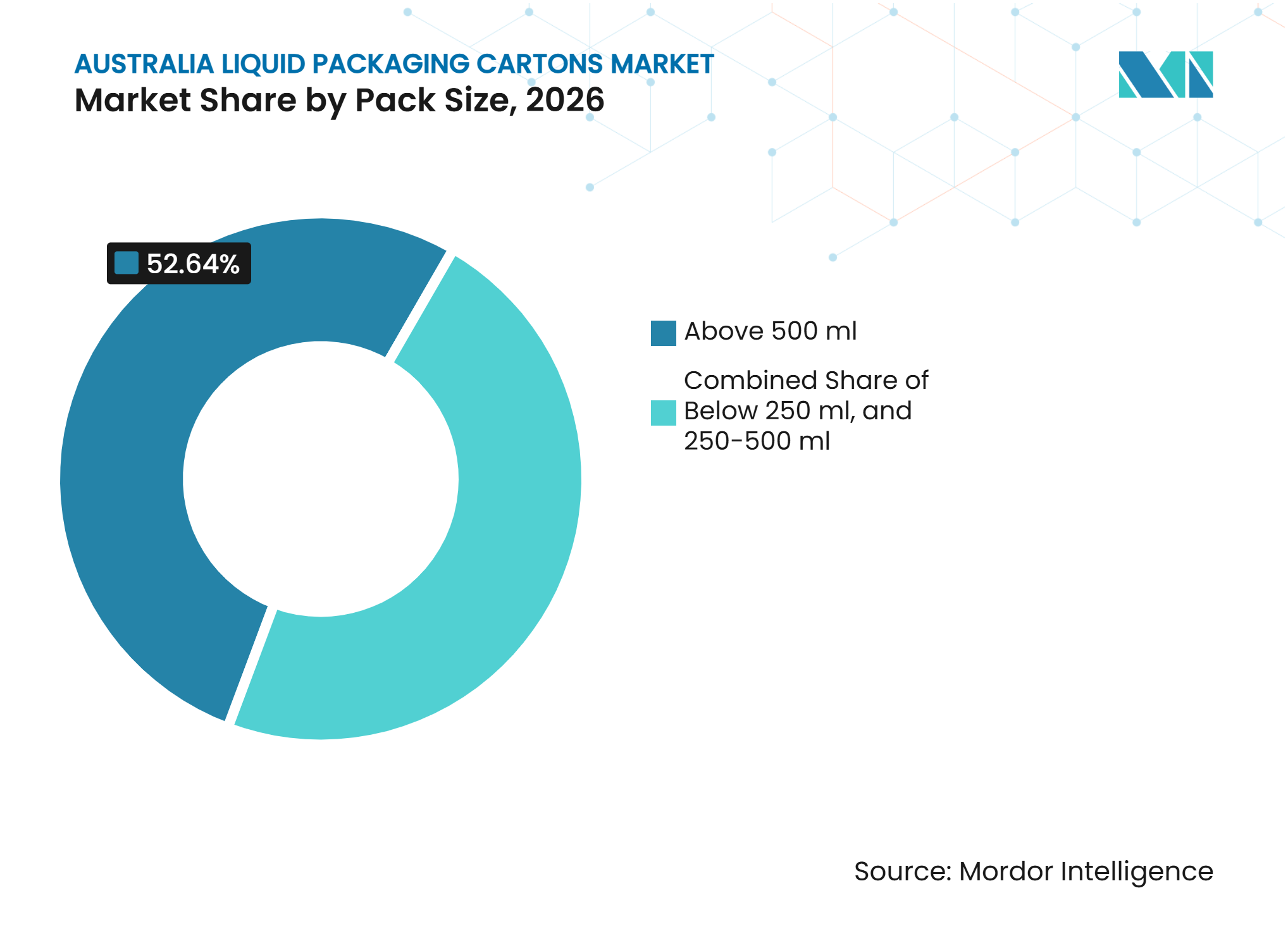
- By pack size, above 500 ml formats held 52.64% of the market in 2026, while 250-500 ml packs are projected to expand at a 5.74% CAGR through 2032.
- By geography, Victoria, New South Wales, and Queensland lead demand through their dairy processing and beverage manufacturing base, while Western Australia is adding single-serve aseptic filling capacity.
Note: Market numbers in this report are based on Mordor Intelligence's proprietary estimation framework, which combines nine months of actuals with Q4 projections for base year 2026.
Market Trends and Insights
Drivers Impact Analysis of Australia Liquid Packaging Cartons Market*
| Driver | (~) % Impact on CAGR Forecast | Geographic Relevance | Impact Timeline |
|---|---|---|---|
| Growth in Plant-Based and Functional Beverages | +1.8% | National, with strongest volume gains in New South Wales, Victoria, and Queensland | Long term (≥ 4 years) |
| Demand for Ambient Distribution and Extended Shelf Life | +1.2% | National, with a strong benefit in Western Australia, Northern Territory, and rural South Australia | Medium term (2-4 years) |
| Retail Preference for Lightweight, Space-Efficient Packs | +0.7% | National, most relevant in high-velocity metropolitan retail formats | Short term (≤ 2 years) |
| Growth in Portion-Controlled and On-the-Go Formats | +0.5% | National, with early gains in urban convenience retail and food service | Medium term (2-4 years) |
| Packaging Circularity Targets and Recyclability-Led Redesign | +0.3% | National, with early adoption in South Australia, Australian Capital Territory, and New South Wales | Medium term (2-4 years) |
| Australian Export-Oriented Dairy and Beverage Processing | +0.2% | Queensland, Victoria, and Western Australia dairy export corridors | Long term (≥ 4 years) |
| Source: Mordor Intelligence | |||
Growth in Plant-Based and Functional Beverages
Plant-based drinks are expanding the range of products that require long-life packaging. Australia’s plant-based dairy category grew 5.2% in 2025, while the wider dairy category grew 3.6%, supporting demand for ambient beverage formats. The Australia liquid packaging cartons market benefits because oat, almond, macadamia, soy, and other alternatives are commonly sold in shelf-stable formats. Noumi’s Ingleburn site produces long-life plant-based drinks for domestic and export channels, showing how this demand is concentrated around specialist filling capability.[1] Its FY2026 investor material reported that plant-based export sales rose 9.8%, which links export activity with additional packaging demand.[2] The Australia liquid packaging cartons market gains volume when brands add plant-based varieties because these products can use existing aseptic systems while reaching chilled and ambient retail channels.
Demand for Ambient Distribution and Extended Shelf Life
Ambient distribution remains a key reason processors select aseptic cartons. The format can provide a shelf life of up to 12 months at room temperature, helping suppliers reach regional communities and export destinations without continuous refrigeration. The United States Department of Agriculture estimated Australian milk production at 8.6 million metric tons in 2026, 1.4% above the prior year, preserving the supply base for long-life dairy production.[3] The Australian liquid packaging cartons market is tied to this processing base because UHT milk requires packaging that protects product quality under variable transit conditions. Noumi stated that exports accounted for 40.4% of dairy long-life revenue in FY2026, up from 30.2% in FY2025. This change shows why carton demand increasingly depends on supply chains that extend beyond local supermarket distribution.
Retail Preference for Lightweight, Space-Efficient Packs
Grocery buyers assess packaging weight, pallet efficiency, shelf dimensions, and transport cost alongside product price. These factors favor carton formats in high-volume categories such as milk and juice. Lightweight packs can improve truck and warehouse utilization compared with heavier glass containers. Their rectangular shape also helps retailers organize shelf space and replenish core products efficiently. The Australia liquid packaging cartons market is supported when retailers favor formats that combine visible branding with compact storage. This preference is important in metropolitan stores where frequent replenishment and high turnover increase the value of efficient packs.
Growth in Portion-Controlled and On-the-Go Formats
Single-serve cartons are widening the addressable product range beyond household milk and juice. The 250-500 ml format is projected to expand at a 5.74% CAGR through 2032, supported by food service dairy, RTD coffee, premium juice, wine, and other portable beverages. This shift allows brands to bring aseptic products into convenience and impulse channels. It also gives smaller producers a route to products that do not need a large multi-serve packaging run. The Australia liquid packaging cartons market can therefore capture demand from categories traditionally supplied in glass, cans, or chilled plastic. Portion control is also relevant to school milk, airline catering, and institutional food service, where individual servings are useful.
Restraints Impact Analysis of Australia Liquid Packaging Cartons Market*
| Restraint | (~) % Impact on CAGR Forecast | Geographic Relevance | Impact Timeline |
|---|---|---|---|
| Fragmented Recovery of Foil-Lined Cartons | -0.5% | National, most acute outside major metropolitan container deposit scheme networks | Long term (≥ 4 years) |
| High Capital Intensity of Aseptic Filling Ecosystems | -0.4% | National | Medium term (2-4 years) |
| Paperboard, Polymer, and Aluminum Input-Cost Volatility | -0.3% | Global disruptions flowing through to Australian converters | Short term (≤ 2 years) |
| Structural Competition from PET, HDPE, and Flexible Pouches | -0.2% | National, most relevant in ambient juice and dairy-free beverages | Medium term (2-4 years) |
| Source: Mordor Intelligence | |||
Fragmented Recovery of Foil-Lined Cartons
Recovery remains a constraint for conventional aseptic cartons that combine paperboard, polyethylene, and aluminum foil. Many local recycling systems do not have the specialist separation capability needed for this material structure. This can create confusion for households and reduce confidence in carton recycling claims. The Australia liquid packaging cartons market faces a reputational challenge when consumers perceive multilayer packs as difficult to recycle. The issue is not limited to household sorting because recyclers also need a viable return on material recovery. Carton fiber and foil composites may be less valuable than clean streams of recovered paper or aluminum.
High Capital Intensity of Aseptic Filling Ecosystems
Aseptic carton production requires specialized filling, sterilization, cleaning, inspection, and maintenance systems. This creates a material investment barrier for small and medium-sized food and beverage producers. These companies may find chilled formats, pouches, or outsourced production easier to access. The constraint is particularly relevant when brands have uncertain volume forecasts or several package sizes. The Australia liquid packaging cartons market can therefore remain concentrated among larger dairy and beverage processors with established filling infrastructure. New entrants often need contract filling to participate in shelf-stable categories.
*Our forecasts treat driver/restraint impacts as directional, not additive. The impact forecasts reflect baseline growth, mix effects, and variable interactions.
Australia Liquid Packaging Cartons Market Segment Analysis
By Product Type:
Aseptic Formats Lead as Material Design ChangesAseptic cartons held 54.38% of the market in 2026 and are projected to grow at a 5.68% CAGR through 2032. This position reflects their role in shelf-stable milk, juice, plant-based drinks, and liquid food products. The category benefits from demand for ambient distribution across long domestic routes and export corridors. It also benefits from retail interest in formats that reduce dependence on refrigerated racking. The Australian liquid packaging cartons market size for aseptic formats is driven by processors that require reliable product protection during storage and transit.
SIG launched Terra Alu-free + Full Barrier in July 2025 as a full-barrier aseptic carton material without an aluminum layer for 1-liter multi-serve packs. The material contains more than 80% paper and can lower the carbon footprint of standard SIG multi-serve aseptic cartons by up to 61% when combined with forest-based polymers. This development matters because it preserves the barrier performance expected from long-life packs while reducing reliance on aluminum. Suppliers are using this type of redesign to improve recovery prospects and manage material exposure. It also shows that the leading product type is undergoing active technical change rather than relying only on existing demand.


By Application:
Dairy Anchors Volume While Plant-Based Beverages Gain GroundMilk accounted for 46.29% of the Australia liquid packaging cartons market size in 2026. This share reflects the established UHT and long-life dairy processing base in Victoria, New South Wales, and Queensland. The format supports milk products that need ambient shelf life for domestic distribution and export. The United States Department of Agriculture projected Australian milk production at 8.6 million metric tons in 2026, thereby sustaining the raw material base for dairy processors. Milk will remain the primary volume application because consumers and retailers continue to use multi-serve long-life formats.
Plant-based beverages are projected to record the fastest application CAGR of 5.82% during 2027-2032. The segment includes almond, oat, macadamia, soy, coconut, and related products. Noumi’s Ingleburn operation is a useful example because it serves long-life plant-based beverages for retail and export channels. These products usually require shelf-stable protection, creating a direct link with aseptic carton capacity. The rising share of this application is important because it adds growth without displacing the core dairy demand base.
By Pack Size:
Multi-Serve Formats Hold Scale While 250-500 ml Packs ExpandAbove 500 ml formats accounted for 52.64% of the market in 2026. The segment is led by multi-serve UHT milk and juice sold through major grocery channels. One-liter and 1.5-liter packs remain familiar purchase units for households buying dairy products and pantry beverages. Their dimensions fit established retail shelves, warehouse systems, and replenishment processes. This makes multi-serve cartons the foundation of carton volume across mainstream grocery retail.
The 250-500 ml segment is projected to expand at a 5.74% CAGR during 2027-2032. It is supported by food service dairy, RTD coffee, premium juice, single-serve wine, and portable beverage products. This size range is suited to convenience retail and occasions where consumers want a single portion. It also lets beverage producers introduce formats that differ from the standard multi-serve pack. The Australia liquid packaging cartons market benefits because these new uses broaden the role of cartons in premium and on-the-go categories.

Geography Analysis
Victoria, New South Wales, and Queensland
Victoria, New South Wales, and Queensland form the core manufacturing base for the Australia liquid packaging cartons market. Victoria’s Gippsland and Murray-Darling regions supply raw milk for UHT and long-life products. Noumi’s Shepparton facility produces long-life dairy milk and exports it to 24 countries, making it an important link between domestic processing and overseas demand. New South Wales adds specialist plant-based beverage production through Noumi’s Ingleburn facility. Rabobank reported a 9% year-over-year increase in Australian fluid milk exports in 2025/26, with improved conditions in Victoria and stronger results in New South Wales. Queensland contributes functional beverages and RTD products, particularly in the 250-500 ml format. Together, these states combine dairy scale, specialist beverage production, and access to large consumer markets.
Western Australia
Western Australia is developing from a consumption location into a production and export hub for portion-controlled aseptic beverages. The state is relevant to the Australia liquid packaging cartons market because it is adding capacity aimed at wine, RTD, and premium beverage products. Local contract-filling capability can help smaller producers access aseptic formats without owning a full filling line. The region also benefits from its location for export-oriented food and beverage activity. The format is useful in Western Australia because long domestic routes and export journeys increase the value of shelf stability. Container deposit scheme expansion can strengthen collection incentives across beverage formats. These conditions support an emerging role for the state in smaller cartons and new beverage applications.
South Australia, Tasmania, Australian Capital Territory, and Northern Territory
South Australia, Tasmania, the Australian Capital Territory, and the Northern Territory affect demand through recycling policy and collection systems rather than through the same concentration of beverage processing. Australia reached full container deposit scheme coverage in 2025 when Tasmania launched Recycle Rewards. South Australia’s mature refund system offers a long-running model for other jurisdictions. The Australian Capital Territory covers most beverage containers up to 3 liters, with exclusions for plain milk and large pure-juice containers. These rules influence how brands assess recovery pathways and compliance factors for carton formats. The Food and Beverage Carton Alliance’s design-for-recycling guidance provides a material-specific framework that supports the development of more recyclable liquid cartons. The Australia liquid packaging cartons market share of paper-dominant designs may improve when state collection programs and specialized recycling routes develop further.
Competitive Landscape
Market Concentration
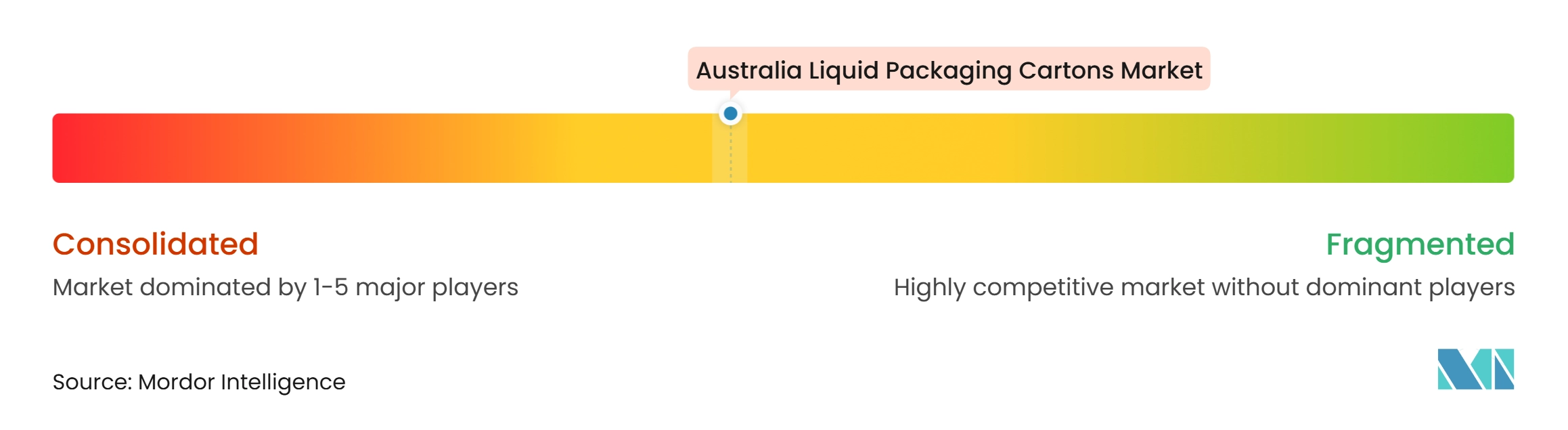
The Australia liquid packaging cartons market is moderately concentrated at the premium aseptic end. Tetra Pak has a strong position through long-term customer relationships, a broad range of carton formats, and an integrated filling-line ecosystem. SIG differentiates through its Adelaide presence, local product development, and focus on recycle-ready formats. Elopak addresses chilled and non-aseptic uses while also offering aluminum-free carton designs for ambient distribution. The competitive position of each supplier is shaped by format performance, service capability, and the ability to meet local recycling expectations. Smaller and independent aseptic converters can compete where buyers want an alternative source for standard UHT formats.
SIG has made several strategic moves that show how the competitive focus is changing. Its July 2025 launch of Terra Alu-free + Full Barrier provided a full-barrier 1-liter carton without an aluminum layer and with more than 80% paper content. In August 2025, SIG developed Australia’s first recycle-ready bag-in-box wine package with Hill-Smith Family Estates, Vinarchy, DeBortoli Wines, and Calabria Family Wines. SIG also partnered with PulPac in July 2025 to develop paper-based closures for aseptic cartons using Dry Molded Fiber technology. These moves show that materials, closures, and recycling compatibility are becoming key areas of competition. They also support a shift toward higher paper content without changing the basic value of ambient packaging.
The Food and Beverage Carton Alliance’s 2025 Design for Recycling Guidelines add a common framework for brands and converters seeking better recyclability outcomes. This can create a barrier for suppliers that cannot provide clear recycling documentation or compatible materials. Companies also need to manage paperboard, polymer, and aluminum input costs while maintaining barrier performance. Buyers are likely to prefer suppliers that can support filling equipment, material supply, design changes, and compliance needs together. The Australia liquid packaging cartons industry is consequently competing through technical service as well as product supply.
Australia Liquid Packaging Cartons Industry Leaders
-
Tetra Pak International S.A.
-
SIG Group AG
-
Elopak ASA
-
Greatview Aseptic Packaging Company Limited
-
Nippon Paper Industries Co., Ltd.
- *Disclaimer: Major Players sorted in no particular order
Australia Liquid Packaging Cartons Market Companies Covered in this Report
- Tetra Pak International S.A.
- SIG Group AG
- Elopak ASA
- Greatview Aseptic Packaging Company Limited
- Nippon Paper Industries Co., Ltd.
- Oji Holdings Corporation
- IPI S.r.l.
- Lamipak International Co., Ltd.
- UFlex Limited
- Stora Enso Oyj
- Shandong Bihai Packaging Materials Co., Ltd.
- Southern Packaging Group Co., Ltd.
- Lami Packaging (Kunshan) Co., Ltd.
- Qingdao Likang Food Packaging Technology Co., Ltd.
Recent Industry Developments in Australia Liquid Packaging Cartons Market
- October 2026: Alternicq Limited partnered with Pulpex Limited to introduce pulp fiber bottle technology and assess expansion opportunities, including Australia. The partnership reflects investment in fiber-based liquid packaging that competes with and complements carton formats. Focus on recyclable and renewable materials may support innovation and demand for fiber-based packaging in Australia’s beverage and liquid food sectors.
- October 2026: Pact Group and ALDI launched one of Australia’s largest recycled packaging initiatives, incorporating up to 50% locally recycled plastic into more than 19 million household product bottles annually. This initiative reflects the growing focus among retailers and brands on circular packaging, recycled content, and sustainability. These trends are influencing packaging material choices across the broader liquid packaging industry, including liquid cartons, and are accelerating demand for environmentally responsible packaging solutions.
- July 2025: SIG Group AG commercially launched SIG Terra Alu-free + Full barrier, the world’s first full-barrier aseptic carton material for 1-liter multi-serve packs without an aluminum layer, made from more than 80% paper. The material reduces the carbon footprint of standard SIG aseptic cartons by up to 61% when combined with forest-based polymers, is globally available at scale, and operates on existing SIG filling lines with minor low-cost adaptations.
- July 2025: SIG Group AG and PulPac announced an exclusive partnership to develop and scale paper-based closures for aseptic cartons using Dry Molded Fiber technology, targeting the same performance as conventional plastic closures. The program supports SIG’s commitment to reach 90% paper content in aseptic cartons by 2030, with an interim goal of 85% paper content, excluding closures, set for 2025.
Australia Liquid Packaging Cartons Market Report Scope
The Australia Liquid Packaging Cartons Market encompasses the manufacturing and supply of paperboard-based packaging solutions designed for the safe storage, transportation, and distribution of liquid beverages and food products. These cartons provide product protection, extended shelf life, and convenient handling while supporting efficient packaging and distribution. The market includes packaging solutions designed to maintain product freshness, prevent contamination, and meet evolving food safety and sustainability requirements. Growing consumption of packaged beverages, increasing demand for convenient and shelf-stable products, and the shift toward recyclable packaging materials drive market growth across India.
The Australia Liquid Packaging Cartons Market Report is Segmented by Product Type (Aseptic Cartons, and Non-Aseptic Cartons), Applications (Milk, Juices, Plant Based Beverages, Dairy Products Excluding Milk, Energy and Functional Drinks, Liquid Food, and Other Applications), and Pack Size (Below 250 ml, 250-500 ml, and Above 500 ml). The Market Forecasts are Provided in Terms of Value (USD).
Segmentation Overview
| Aseptic Cartons |
| Non-Aseptic Cartons |
| Milk |
| Juices |
| Plant Based Beverages |
| Dairy Products (Excluding Milk) |
| Energy and Functional Drinks |
| Liquid Food |
| Other Applications |
| Below 250 ml |
| 250-500 ml |
| Above 500 ml |
| By Product Type | Aseptic Cartons |
| Non-Aseptic Cartons | |
| By Applications | Milk |
| Juices | |
| Plant Based Beverages | |
| Dairy Products (Excluding Milk) | |
| Energy and Functional Drinks | |
| Liquid Food | |
| Other Applications | |
| By Pack Size | Below 250 ml |
| 250-500 ml | |
| Above 500 ml |
Key Questions Answered in the Report
What is the size of the Australia liquid packaging cartons market?
The Australia liquid packaging cartons market is valued at USD 105.21 million in 2026 and is forecast to reach USD 140.29 million by 2032 at a 4.92% CAGR.
Which product type leads Australia liquid packaging cartons demand?
Aseptic cartons lead with 54.38% share in 2026 and are projected to grow at a 5.68% CAGR through 2032.
Which application is growing fastest in Australia liquid packaging cartons?
Plant-based beverages are projected to record the highest application CAGR at 5.82% during 2027-2032.
Why are aseptic cartons important for Australian beverage producers?
They can provide up to 12 months of ambient shelf life, helping producers manage long domestic distribution routes and export shipments.
Which pack size is growing fastest for liquid packaging cartons in Australia?
The 250-500 ml segment is projected to expand at a 5.74% CAGR through 2032, driven by portable beverage and food-service uses.
What is limiting wider adoption of aseptic cartons in Australia?
Uneven recovery of foil-lined cartons and the high capital cost of aseptic filling systems remain the main constraints.