
Australia Air Filter Market Size and Share
| Study Period | 2019 - 2030 |
| Forecast Data Period | 2025 - 2030 |
| Historical Data Period | 2019 - 2023 |
| Market Size (2025) | USD 281.48 Million |
| Market Size (2030) | USD 405.75 Million |
| CAGR (2025 - 2030) | 7.59% |
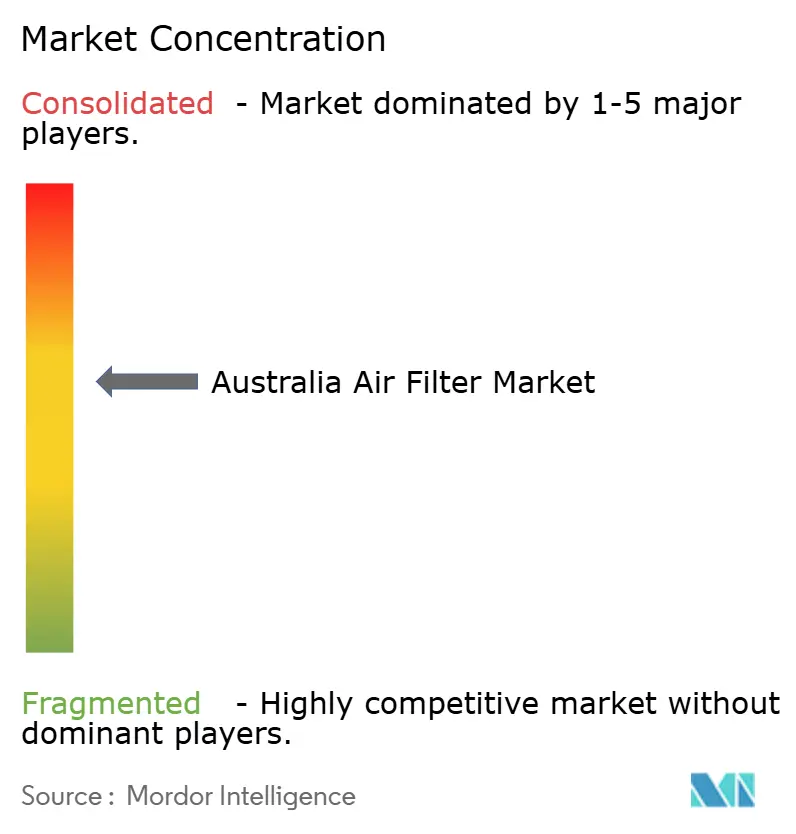
| Market Concentration | Medium |
Major Players *Disclaimer: Major Players sorted in no particular order |
Australia Air Filter Market Analysis by Mordor Intelligence
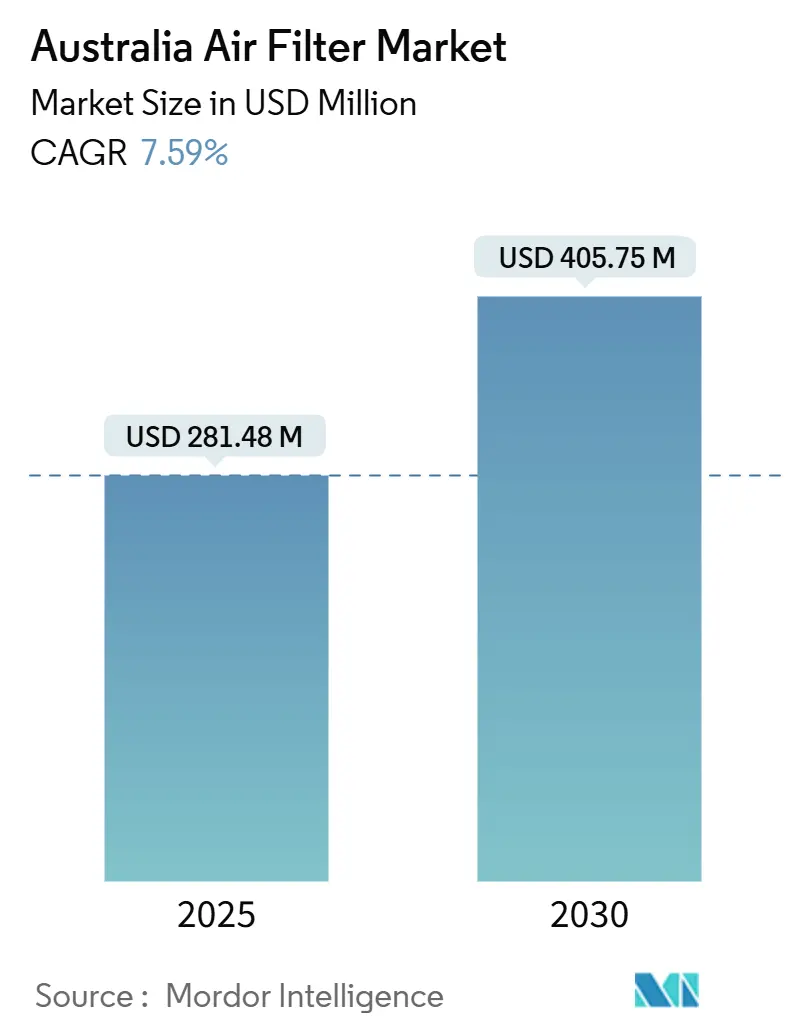
The Australia Air Filter Market size is estimated at USD 281.48 million in 2025, and is expected to reach USD 405.75 million by 2030, at a CAGR of 7.59% during the forecast period (2025-2030).
- Over the medium term, factors like increasing numbers of automobiles, government policies regarding pollution emission control parameters, and increasing industrialization & urbanization creating an increased demand for heating, ventilation, and air conditioning (HVAC) systems are expected to drive the Australia air filter market during the forecast period.
- On the other hand, high installation and maintenance costs, an increasing share of ZEVs (Zero Emissions Vehicles) on the road, and increased focus on decreasing carbon/GHG emissions with the growth of emission-free power generation sources (renewable energy) are expected to restrain the air filter market in the Australia during the forecast period.
- Nevertheless, improvements in living standards in developed countries and the development of green buildings with advancements in air purifiers and HVAC systems for a dust-free environment are expected to create opportunities for the air filter market in Australia.
Australia contributes to a system defined not by any single country or region but by the interaction of many. The global air filters market data by Mordor Intelligence represents that combined structure.
Australia Air Filter Market Trends and Insights
HEPA filters are Expected to Witness Significant Demand
- Mechanical air filters, like HEPA filters, capture airborne particles on their filter materials. These filters effectively trap larger particles, including dust, pollen, mold spores, and allergens from dust mites and cockroaches. In Australia, HEPA filter technologies have gained prominence in the healthcare sector, primarily due to their numerous advantages. HEPA, which stands for High-Efficiency Particulate Air, filters boast the capability to theoretically eliminate at least 99.97% of airborne particles, including dust, pollen, and bacteria, especially those measuring 0.3 microns (µm) in size. This 0.3-micron specification is recognized as the most penetrating particle size (MPPS).
- HEPA filters offer distinct advantages over other air filter types. They are the go-to filtration system in medical environments, such as hospitals and clinics, due to their superior efficiency in removing airborne inorganic dust and potentially harmful microscopic organisms. Unlike electrostatic precipitators (ESPs) and ionizers, which have their limitations—ESPs produce ozone and ionizers can cause particles to settle on surfaces—HEPA filters excel in capturing airborne particles. As extended-surface filters, HEPA filters possess a larger surface area, enhancing their efficiency in removing both larger and smaller airborne particles. Furthermore, they outpace pleated filters in eliminating respirable particles.
- A 2024 report by Swiss IQAir underscores the burgeoning demand for HEPA air purifiers in Australia. The report highlighted that while the annual average PM2.5 concentration in Australia met the WHO's guidelines at 4.5 μg/m³, several major cities—home to over 90% of the population—exceeded these guidelines by nearly sevenfold. Cities like Melbourne, Katoomba, and Canberra, among others, were notably affected.
- On October 21, 2024, the National Asthma Council Australia (NAC) presented concerning statistics from the Australian Bureau of Statistics: asthma-related deaths in Australia have returned to pre-pandemic levels. In 2023, Australia recorded 474 asthma-related fatalities, with a near-equal split of 325 females and 149 males, closely aligning with the 473 deaths from the previous year. Such statistics are poised to drive the increased adoption of HEPA air filters across Australia.
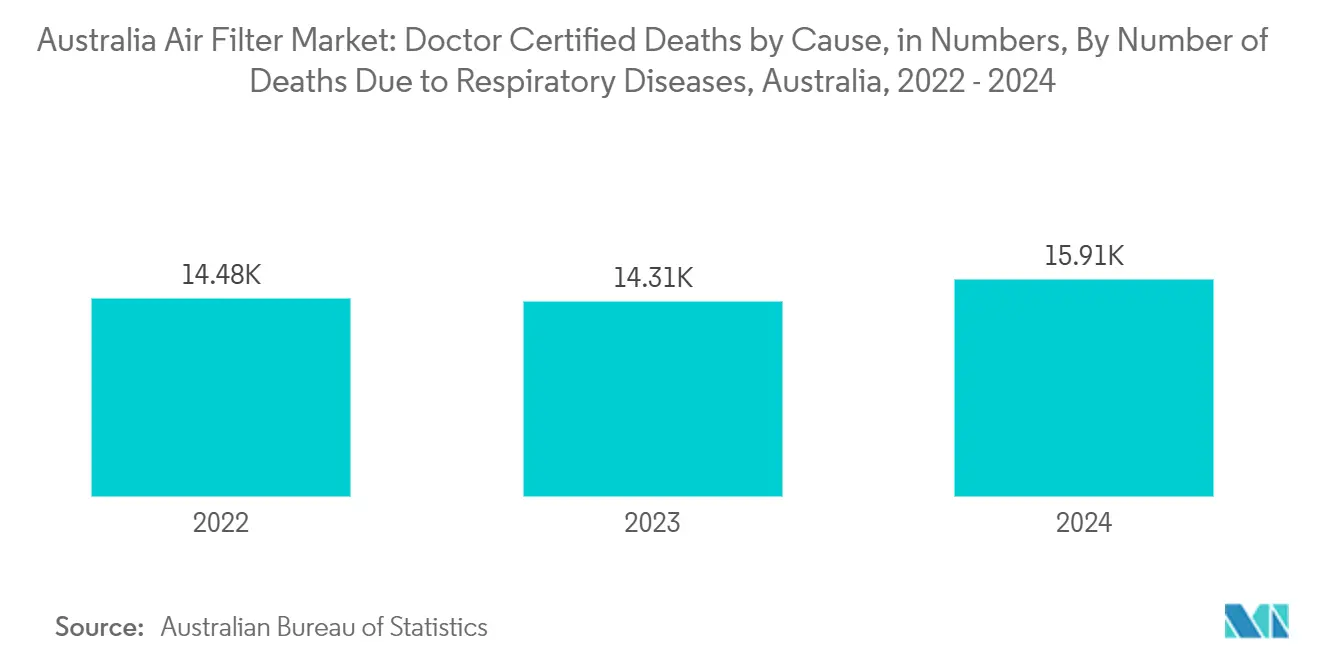
- Data from the Australian Bureau of Statistics indicates a rising trend in respiratory disease-related deaths in Australia. In 2024, 9.8% of all deaths were attributed to respiratory diseases, up from 9% in 2023 and 8.6% in 2022. Notably, chronic lower respiratory diseases, pneumonia, and influenza saw an uptick in their share of fatalities. This trend is likely to spur the adoption of HEPA air filters in the medical field across Australia in the coming years.
- In June 2024, Coway, a leading name in wellness technology, launched the Airmega 100 air purifier in Australia. This marks the debut of Airmega's cylindrical model, crafted as an affordable yet powerful solution for compact spaces. Aimed at Australians battling asthma and allergies, the Airmega 100 features a 360° air intake and a 3-stage HEPA filtration system. It efficiently purifies air in a 63m2 space every hour, capturing 99.999% of nano-sized particles down to 0.01 microns—smaller than most allergens, bacteria, mold, and pollen. Additionally, it neutralizes smoke and unpleasant odors, ensuring healthier indoor air. Such product introductions are set to fuel the growth of HEPA air filters in the Australian market.
- Given the aforementioned points, the High-Efficiency Particulate Air (HEPA) segment is poised to dominate the Australian air filter market in the coming years.


Rising Zero Emission EV Sales, Renewable Energy and Plans for Shutting Down of Coal Thermal Power Plants to Restrain the Market
- Australia has seen a surge in its electric vehicle (EV) sector, coinciding with a rise in renewable energy sources and the closure of coal power plants. With a legally binding target to achieve net-zero emissions by 2050, these developments are poised to diminish the demand for air filters. This is because the aforementioned shifts are expected to reduce greenhouse gases (GHG), carbon, and particulate matter (PM 2.5 and PM 10) in the nation's air.
- Government initiatives like The Safeguard Mechanism, the Australian Carbon Credit Unit (ACCU) Scheme, the Net Zero Plan, the National Clean Air Agreement, The Paris Agreement, and the Emissions Reduction Plan 2024–25 aim to curb carbon and GHG emissions. These efforts not only target a reduction in air pollution but also dampen the demand for air filters in Australia.
- In a significant move, Australia's coal power stations are now slated to close by 2038, five years ahead of previous estimates. Concurrently, the nation aims to triple its variable renewable energy capacity by 2030 and expand it sevenfold by 2050. These insights are drawn from the 2024 Integrated System Plan, a draft by the Australian Energy Market Operator (AEMO), which outlines a two-decade roadmap steering Australia away from coal dependency towards a renewable energy future, complemented by storage solutions.
- Traditionally, a standard internal combustion engine (ICE) vehicle, be it a car, bus, or truck, utilizes two air filters: one for the cabin and another for the engine. However, with the rise of EVs, the demand for air filters has diminished. This is because EVs, lacking an ICE, don't require a separate engine air filter. In January 2025, the Electric Vehicle Council highlighted a record surge in new electric vehicle sales in Australia for 2024, underscoring a steady demand for cleaner, economical cars. Data from the EVC and public sources revealed that Australia recorded sales of approximately 114,000 new battery electric vehicles (BEVs) and plug-in hybrid electric vehicles (PHEVs) in 2024. This surpassed the 2023 record of over 98,000 sales. The breakdown for 2024 showed around 91,000 BEVs and 23,000 PHEVs, accounting for nearly 9.65% of all new car sales, up from 8.45% in 2023.
- While the Electric Vehicle Council acknowledged the rising sales of EVs, they emphasized that it's not just due to Australians' growing preference. An expanding charging infrastructure, a wider array of competitively priced models, and ongoing purchase incentives have played pivotal roles in attracting new EV buyers. This surge in zero-emission BEVs has consequently led to a dwindling demand for air filters in Australia's automotive sector.
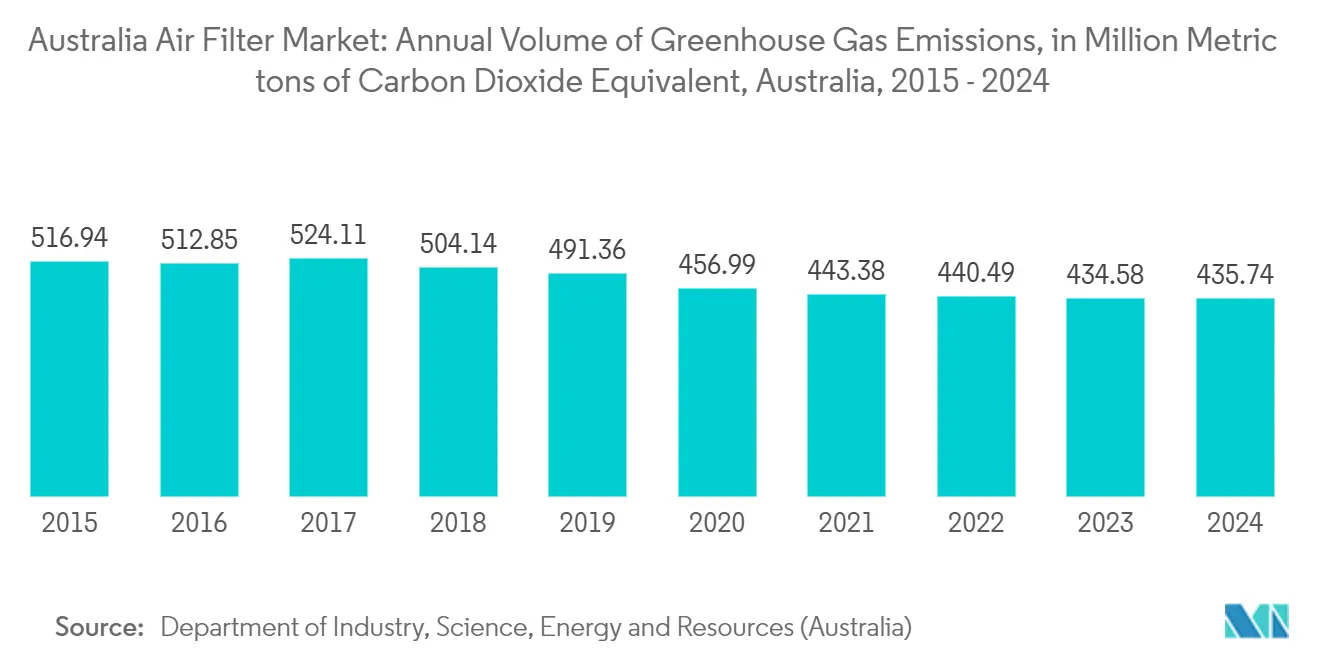
- Data from the Australian Government's Department of Industry, Science, Energy and Resources (Australia)'s dataset indicates a downward trend in Australia's total GHG emissions (measured in million metric tonnes of CO2 equivalent). Emissions dropped from 516.94 million tonnes in 2015 to 435.74 million tonnes in 2024. This declining trend suggests a potential decrease in the demand for air filters in the country during the forecast period.
- According to a 2025 report by the International Renewable Energy Agency (IRENA), Australia's renewable energy capacity surged from 55.5 GW in 2023 to 63.51 GW in 2024. This significant uptick in clean energy installations is anticipated to curtail GHG emissions, subsequently impacting the Australian air filter market.
- Given these developments, the rising sales of zero-emission EVs, the growth of renewable energy, and the phasing out of coal power are poised to restrain the air filter market in Australia.

The air filters market is analyzed by Mordor Intelligence across multiple other geographies, with in-depth regional assessments available for Africa and North America. This is complemented by country-specific insights for India, South Korea, Egypt, Italy, Oman, Kuwait, and Saudi Arabia, reflecting various localized market behavior and policy environments' coverage.
Competitive Landscape
The Australia air filter market is semi-consolidated. Some of the major players in the market (in no particular order) include Donaldson Company, Inc., The Camfil Group, Clyde-Apac Air Filtration, Dyson Limited, and American Air Filter Company, Inc., among others.
Australia Air Filter Industry Leaders
Donaldson Company, Inc.
The Camfil Group
Clyde-Apac Air Filtration
Dyson Limited
American Air Filter Company, Inc.
- *Disclaimer: Major Players sorted in no particular order

Recent Industry Developments
- April 2024: Ryco Filters, Australia's premier filter manufacturer, has unveiled a state-of-the-art air filter tailored for the country's challenging conditions. This innovation draws on advanced Air Filter technology, initially crafted for the GEN3 Supercar program. With a commitment to excellence, Ryco's engineers have tirelessly explored methods to enhance filter performance in fine dust scenarios. The newly launched Ryco NanoCel™ High Efficiency Air Filter underwent rigorous development and testing in Australia. Leveraging the nation's sole dedicated filtration laboratory, Ryco implemented stringent testing protocols. This ensured the new filter not only meets but surpasses Original Equipment (OE) standards, specifically attuned to Australia's unique climate and environmental challenges.
- October 2024: Australia kicked off a two-year transition to the AS/ISO 16890 standard, a move aimed at aligning with global best practices in air filter classification. This modern standard supersedes the older AS 1324, offering refined classifications centered on particulate matter (PM) sizes: PM1, PM2.5, and PM10. With this updated system, there's a heightened clarity on filter performance, especially concerning fine and ultrafine particles known to impact respiratory health.


Australia Air Filter Market Report Scope
Air filters, made from fibrous or porous materials, effectively eliminate solid particles like dust, pollen, mold, and bacteria from the air. Additionally, filters with adsorbents or catalysts, such as charcoal, can remove odors and gaseous pollutants, including volatile organic compounds and ozone. These filters play a crucial role in applications prioritizing air quality, especially in building ventilation systems and engines.
The Australian air filter market is segmented by type, end-users, and geography. By type, the market is segmented into cartridge filters, dust collectors, HEPA filters, baghouse filters, and other types. By end users, the market is segmented into residential, commercial, and industrial.
For each segment, the market sizing and forecasts have been done based on revenue (USD).
| Cartridge filters |
| Dust collectors |
| HEPA filters |
| Baghouse filters |
| Others |
| Residential |
| Commercial |
| Industrial |
| Type | Cartridge filters |
| Dust collectors | |
| HEPA filters | |
| Baghouse filters | |
| Others | |
| End User | Residential |
| Commercial | |
| Industrial |


Key Questions Answered in the Report
How big is the Australia Air Filter Market?
The Australia Air Filter Market size is expected to reach USD 281.48 million in 2025 and grow at a CAGR of 7.59% to reach USD 405.75 million by 2030.
What is the current Australia Air Filter Market size?
In 2025, the Australia Air Filter Market size is expected to reach USD 281.48 million.
Who are the key players in Australia Air Filter Market?
Donaldson Company, Inc., The Camfil Group, Clyde-Apac Air Filtration, Dyson Limited and American Air Filter Company, Inc. are the major companies operating in the Australia Air Filter Market.
What years does this Australia Air Filter Market cover, and what was the market size in 2024?
In 2024, the Australia Air Filter Market size was estimated at USD 260.12 million. The report covers the Australia Air Filter Market historical market size for years: 2019, 2020, 2021, 2022, 2023 and 2024. The report also forecasts the Australia Air Filter Market size for years: 2025, 2026, 2027, 2028, 2029 and 2030.
Page last updated on:
Australia Air Filter Market Report
Statistics for the 2025 Australia Air Filter market share, size and revenue growth rate, created by Mordor Intelligence™ Industry Reports. Australia Air Filter analysis includes a market forecast outlook for 2025 to 2030 and historical overview. Get a sample of this industry analysis as a free report PDF download.


 Your data is secure and never sold or shared.


