
Assistive Furniture Market Size and Share
Market Overview
| Study Period | 2021 - 2031 |
|---|---|
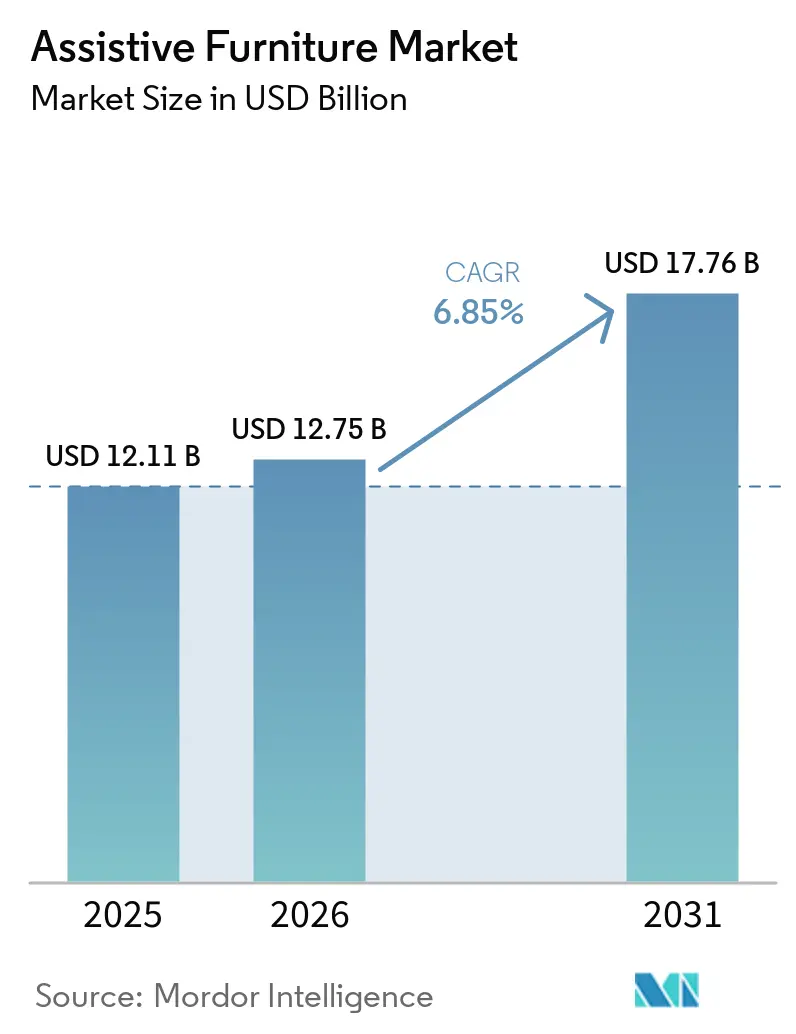
| Market Size (2026) | USD 12.75 Billion |
| Market Size (2031) | USD 17.76 Billion |
| Growth Rate (2026 - 2031) | 6.85 % |
| Fastest Growing Market | Asia-Pacific |
| Largest Market | North America |
| Market Concentration | Low |
Major Players *Disclaimer: Major Players sorted in no particular order Image © Mordor Intelligence. Reuse requires attribution under CC BY 4.0. | |
Assistive Furniture Market Analysis by Mordor Intelligence
The assistive furniture market size is expected to increase from USD 12.11 billion in 2025 to USD 12.75 billion in 2026 and reach USD 17.76 billion by 2031, growing at a CAGR of 6.85% over 2026-2031. The assistive furniture market is being shaped by population aging, disability prevalence, and the movement of care from inpatient settings into homes and community facilities. The population aged 65 and older exceeded the population aged under 5 between 2020 and 2025, while 1.3 billion people live with significant disability, expanding the need for products that support movement, positioning, and safer daily care[1]. Suppliers are responding through connected beds, bariatric equipment, and services that combine equipment supply with maintenance and upgrades. Reimbursement limits, different certification rules, and the operating costs of connected products continue to slow adoption in several settings. The assistive furniture market, therefore, rewards suppliers that can demonstrate clinical value, regulatory compliance, and practical support after installation.
Key Report Takeaways
- By product type, beds and sleep-support furniture led with 38.19% of the assistive furniture market share in 2025, while the same segment is projected to expand at a 7.16% CAGR through 2031.
- By form and operating mechanism, semi-electric furniture held 33.24% of the assistive furniture market share in 2025. In contrast, smart and IoT-enabled furniture is forecast to expand at a 7.57% CAGR through 2031.
- By material, metal and stainless steel held 42.78% of the assistive furniture market share in 2025, whereas wood and engineered wood are forecast to expand at a 7.82% CAGR through 2031.
- By application, elderly care and aging in place led with 32.44% of the assistive furniture market share in 2025, while the same segment is projected to expand at a 7.77% CAGR through 2031.
- By end user, hospitals and specialty clinics held 63.11% of the assistive furniture market share in 2025, whereas ambulatory surgical centers are forecast to expand at a 7.27% CAGR through 2031.
- By distribution channel, offline retail held 44.54% of the assistive furniture market share in 2025, whereas online retail and digital catalogs are forecast to expand at a 7.77% CAGR through 2031.
- By commercial model, capital purchase held 72.13% of the assistive furniture market share in 2025, whereas surge and short-term rental are forecast to expand at a 7.83% CAGR through 2031.
- By geography, North America led with 37.18% of the assistive furniture market share in 2025, while Asia-Pacific is projected to expand at a 7.10% CAGR through 2031.
Note: Market size and forecast figures in this report are generated using Mordor Intelligence’s proprietary estimation framework, updated with the latest available data and insights as of January 2026.
Global Assistive Furniture Market Trends and Insights
Drivers Impact Analysis*
| Driver | (~) % Impact on CAGR Forecast | Geographic Relevance | Impact Timeline |
|---|---|---|---|
| Aging in Place and Independent Living Demand | +2.60% | Global, with strong relevance in North America, Western Europe, Japan, and South Korea | Long term (≥ 4 years) |
| Growth in Disability and Mobility Limitation Prevalence | +1.40% | Global, with the largest absolute need in Asia-Pacific and lower-income countries | Medium term (2-4 years) |
| Expansion of Home Healthcare and Rehabilitative Care | +1.00% | North America, Western Europe, Japan, and South Korea | Medium term (2-4 years) |
| Smart Beds, Fall Prevention, and Caregiver Workflow Integration | +1.00% | North America and Western Europe | Short term (≤ 2 years) |
| Bariatric and Inclusive Care Requirements | +0.80% | North America, Europe, the Middle East, and Africa | Medium term (2-4 years) |
| Retrofit Demand from Existing Care Facilities | +0.40% | North America and Europe | Short term (≤ 2 years) |
| Source: Mordor Intelligence | |||
Aging in Place and Independent Living Demand
The assistive furniture market is moving toward steady replacement demand in homes rather than only periodic purchases by institutions. The number of people aged 60 and older is projected to rise from 1 billion in 2020 to 1.4 billion by 2030, increasing the need for residences that can support everyday care. This demographic shift makes home adaptation necessary before many people enter institutional care. Government health spending is also under pressure as care needs rise, which supports interest in solutions that can keep people safe at home for longer. Home healthcare and rehabilitation providers are adding beds, chairs, overbed tables, and transfer products to meet care needs after shorter hospital stays. Existing long-term-care facilities are also replacing older equipment to improve caregiver safety and resident mobility.
Care providers increasingly need furniture that can serve clinical needs without making residential spaces feel institutional. This widens demand beyond traditional hospital procurement and brings clinical-grade products into home settings. Beds with adjustable positioning, low heights, and easy transfers are important because they can reduce strain for both users and caregivers. Riser-reclining chairs and bathroom safety products support daily activities for people with reduced mobility. The assistive furniture market benefits when providers can bundle equipment, delivery, installation, and maintenance for families and care organizations. This model also creates a reason for suppliers to maintain local service networks rather than focus only on product sales.
Growth in Disability and Mobility Limitation Prevalence
The assistive furniture market is supported by the scale of disability and mobility limitations across age groups. WHO reports that 1.3 billion people, or 16.00% of the world population, experience significant disability. Disability affects 34.40% of adults aged 60 and older, concentrating need among a population that is growing in most regions. Eurostat reported that 23.9% of EU residents aged 16 and older had a long-standing activity limitation in 2024[2]. These figures support demand for equipment that makes movement, transfer, bathing, sleeping, and rehabilitation safer. The need is not restricted to residential care because mobility support is required in hospitals, rehabilitation centers, and private homes.
Mobility limitations are a major concern across the functional areas recorded in the World Bank Disability Data Hub. This makes furniture that supports safe movement a priority category for care providers. Transfer aids, height-adjustable surfaces, pressure-relieving cushions, and bathroom safety products help users manage tasks that might otherwise require direct caregiver assistance. The assistive furniture market also gains from the need to reduce avoidable injuries during transfers and repositioning. Suppliers that provide products for several points in a care pathway can serve a broader share of a facility's needs. This requirement is especially important where a single patient needs coordinated support across a bed, chair, bathing area, and transfer process.
Smart Beds, Fall Prevention, and Caregiver Workflow Integration
Smart and connected beds are becoming more relevant as hospitals seek measurable ways to prevent falls and manage caregiver workloads. A 2024 study of 1,300 patients found that an integrated IoT bed-exit system reduced bedside falls by 88% compared with traditional systems and detected 13.5 potential falls per day with near-zero false alarms[3]. A 2026 study reported 92.4% posture-classification accuracy and 87.6% fall-risk sensitivity for an intelligent bed platform using a CNN-LSTM model. These outcomes are moving connected features from optional equipment specifications toward formal procurement requirements. The assistive furniture market is affected because facilities can link bed investment to safety, staffing, and maintenance goals. Connected data can also support remote alerts and better coordination with nurse-call systems.
Fall prevention is a financial and clinical issue for hospitals and long-term-care providers. LINET states that up to 89% of ICU falls are avoidable, while a fall can cost GBP 2,600 (USD 3,507.6) per patient and extend a stay by up to 18 days[4]. Bed data can help staff prioritize rooms where a patient may be at risk of leaving the bed without support. It can also help suppliers offer predictive maintenance for motorized components and other hardware. Joerns Healthcare released EasyCare 2026 enhancements in April 2026, including AutoContour with ComfortChair integration and a higher safe working load for bariatric care. Such upgrades show how semi-electric and smart platforms can overlap as providers seek more functionality from each replacement cycle.
Bariatric and Inclusive Care Requirements
Bariatric care requirements are changing equipment specifications across care facilities. WHO reported in 2024 that more than 1 billion adults were living with obesity, while the CDC reported the United States adult obesity prevalence above 40% in December 2025. The same CDC data showed severe obesity affected 9.40% of the United States adults. A 2025 standards article stated that care settings should provide furniture that accommodates people across body sizes, including rise-recline chairs, high-capacity examination tables, and wide-base transfer equipment. This requirement positions inclusive furniture as part of clinical quality rather than a product for exceptional cases. The assistive furniture market is consequently supported by demand for stronger beds, chairs, transfer systems, shower benches, and toilet frames.
A bariatric patient pathway can require compatible equipment throughout a ward or care home. Providers need beds with suitable load capacity, chairs that support safe sit-to-stand movement, and transfer products that protect staff from injury. Electrically powered products can also support safe patient-handling programs. This creates a wider equipment need than a single specialized bed or chair. Suppliers must provide clear load ratings, maintenance support, and training because safety depends on a full care environment. The assistive furniture industry is also affected by the need for products that retain clinical performance without making a patient feel singled out by the design. This supports demand for inclusive models that fit both acute-care and residential-care settings.
Restraints Impact Analysis*
| Restraint | (~) % Impact on CAGR Forecast | Geographic Relevance | Impact Timeline |
|---|---|---|---|
| High Total Cost of Ownership and Reimbursement Gaps | -0.50% | North America, Europe, and emerging Asia-Pacific markets | Medium term (2-4 years) |
| Fragmented Standards and Procurement Requirements | -0.30% | Global, with strong relevance in emerging Asia-Pacific, the Middle East, and Africa | Long term (≥ 4 years) |
| Limited Awareness and Assessment Capacity in Emerging Markets | -0.20% | Sub-Saharan Africa, South and Southeast Asia, and Latin America | Long term (≥ 4 years) |
| Customization, Maintenance, and Spare Parts Complexity | -0.20% | Global, with strong relevance in distributed home care settings | Medium term (2-4 years) |
| Source: Mordor Intelligence | |||
High Total Cost of Ownership and Reimbursement Gaps
Reimbursement uncertainty can limit the purchase of higher-value products even when care providers recognize their clinical benefits. The United States Medicare generally reimburses durable medical equipment through a 13-month rental-to-own approach, while products outside the DMEPOS schedule can face denials or medical-necessity reviews. A MACPAC brief published in April 2026 stated that states must cover durable medical equipment under Medicaid, but coverage for specific assistive technology categories differs across state programs. This variation complicates national product and distribution strategies. Providers may delay purchases when they cannot determine whether a product will be covered. The assistive furniture market must therefore address the gap between clinical need and payer rules.
The cost issue extends beyond the initial purchase price. Connected beds can require software licenses, firmware updates, network connections, and technical service over their operating lives. Buyers with limited budgets may not fully account for these requirements when comparing a basic product with a connected platform. Rental and refurbishment can reduce the initial cost for some providers, but these approaches still depend on service capacity and product availability. Arjo reported that its ReNu refurbishment business recorded its strongest quarter to date in Q2 2026, indicating interest in alternatives to full replacement. The assistive furniture market will continue to depend on financing, service arrangements, and evidence that a higher-value product lowers downstream care costs.
Fragmented Standards and Procurement Requirements
Different standards and procurement rules can increase the time and cost required to bring powered furniture to multiple markets. Medical equipment suppliers may need to meet IEC 60601-1 electrical safety requirements, EN 50637:2017 bed-entrapment provisions, and EN 60601-2-52 requirements for medical beds. These standards are applied through different regulatory systems, including the EU MDR and the United States FDA requirements. Manufacturers can therefore face repeated validation, documentation, and regulatory review for products that serve similar clinical purposes. The assistive furniture market tends to favor suppliers with regulatory teams and established quality systems. Smaller manufacturers can find it harder to enter institutional channels or expand internationally.
LINET launched the Essenza 300 Junior+ in May 2026 as a platform designed to meet EN 50637:2017 and EN 60601-2-52 requirements for junior and adult patients. The product illustrates the engineering work needed to meet safety expectations across patient groups. Local certification, import rules, and tender requirements can further divide demand in South and Southeast Asia and in the Middle East and Africa. Limited occupational-therapy capacity and low awareness of formal assessment practices can reduce the quality of product selection in emerging markets. Maintenance networks and access to spare parts are also essential when a product is customized or installed in a distributed home-care setting. These barriers can favor local distribution partnerships that combine equipment access, training, installation, and after-sales support.
*Our forecasts treat driver/restraint impacts as directional, not additive. The impact forecasts reflect baseline growth, mix effects, and variable interactions.
Segment Analysis
By Product Type: Beds Lead Value and Growth
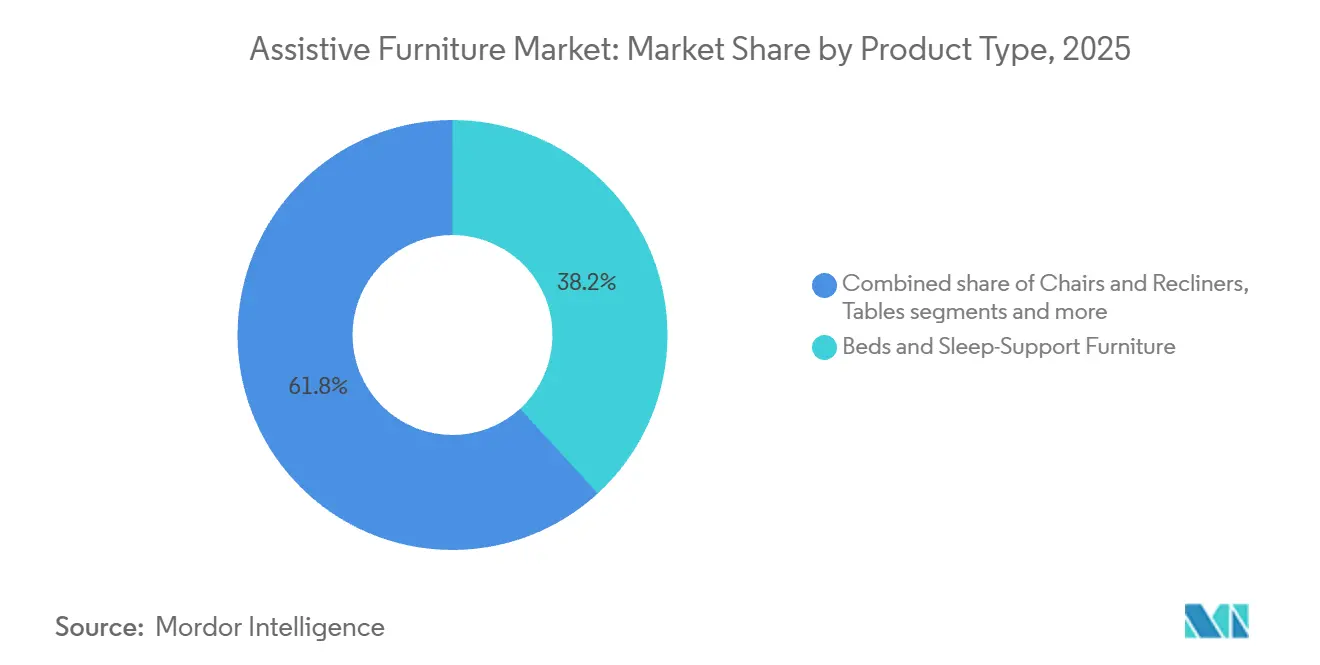
Beds and sleep-support furniture held 38.19% of the assistive furniture market share in 2025 and are projected to expand at a 7.16% CAGR through 2031. This combination of scale and growth reflects the central role of beds in fall prevention, pressure-injury management, caregiver ergonomics, and patient positioning. Hospital and care beds are also increasingly expected to connect with clinical information and nurse-call systems. Stryker launched the ProCeed hospital bed for non-United States markets in February 2025 with a fifth-wheel steering mechanism and a low bed height to address fall risk and caregiver strain. Smart beds, bariatric beds, and floor-level models are important sources of demand within the segment. These products give facilities options for different acuity levels while preserving a common approach to safety and positioning.
Chairs and recliners remain important for users who need support with sitting, standing, and daily activities. Riser-reclining, lift, and bariatric models are relevant in home care and long-term-care settings. Tables and work surfaces include overbed tables, adjustable products, and examination tables for rehabilitation and clinical use. Bathroom safety furniture gains attention because bathing and toileting areas can create a significant fall risk. Transfer and positioning products support safe handling for care teams. Cushions and mattress support surfaces remain important where pressure redistribution can reduce the risk of injury during longer periods in bed or seated care.

By Form and Operating Mechanism: Smart Platforms Gain on Semi-Electric Equipment
Semi-electric furniture accounted for 33.24% of the assistive furniture market share in 2025. Its position reflects the balance it offers between powered adjustment and the lower cost of a fully electric platform. Smart and IoT-enabled furniture is expected to record a 7.57% CAGR through 2031. A peer-reviewed 2025 synthesis reported that AI fall-prevention systems achieved AUROC results of 0.85 to 0.97 and that sensor-based surveillance reached 89% to 96% accuracy with multi-sensor fusion. These clinical results support the use of connected equipment in hospital procurement. The assistive furniture market is seeing a gradual move from basic adjustment features toward platforms that generate actionable information.
Fully electric products are gaining importance where organizations need documented safe patient-handling capability. They can provide more controlled positioning and reduce physical demands on staff. Manual and fixed-height furniture still serves price-sensitive community care and home care users who retain some ability to reposition themselves. Connected platforms can provide remote alerts for caregivers and help suppliers identify maintenance requirements before a product fails. This can justify a premium in high-acuity residential care when the equipment reduces supervision burdens. The shift does not remove the role of semi-electric equipment, but it makes feature upgrades more important at replacement.
By Material: Metal Retains Clinical Strength While Wood Gains Interest
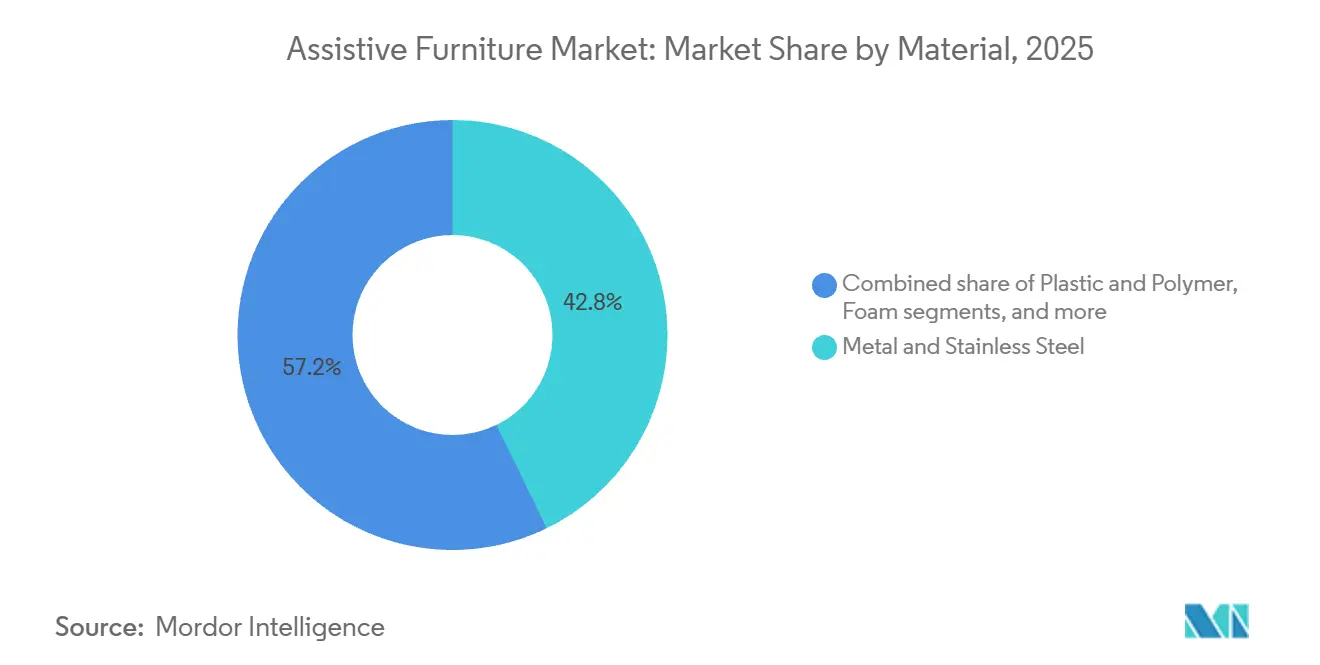
Metal and stainless steel held 42.78% of the assistive furniture market share in 2025. The material remains important in hospitals because it withstands hospital-grade cleaning, supports high loads, and is compatible with electrical safety requirements. It is particularly relevant for ICU and bariatric uses where durability and capacity are critical. Wood and engineered wood are forecast to grow at a 7.82% CAGR through 2031. A 2026 study found that cross-laminated timber and glue-laminated timber had lower and more stable climate-change impacts than metal-intensive manufacturing approaches. This evidence supports sustainability considerations in long-term-care construction and furniture procurement.
Wood is also relevant where providers want residential-care settings to feel less clinical. Swedish Wood documented the use of solid oak in clinical areas at LHL Hospital in Gardermoen, Oslo, based on tactility, warmth, and patient-calming considerations. Plastic and polymer materials remain useful in bathroom safety and pediatric products because they are easy to clean and suitable for wet environments. Foam and pressure-relieving materials are essential inputs for cushions and positioning surfaces. Fabric and upholstery remain important for chairs and comfort layers. Stiegelmeyer introduced its Libra variant deluxe in summer 2025 with choices of fabrics, imitation leather, and wood decor, showing that material choice can affect purchasing in nursing-home settings.
By Application: Elderly Care and Aging in Place Drive Adoption
Elderly care and aging in place held 32.44% of the assistive furniture market share in 2025 and are expected to grow at a 7.77% CAGR through 2031. The population aged 65 and older is expected to rise from 10.5% in 2025 to 19.6% by 2060. This is increasing the need for beds, chairs, transfer aids, and bathroom products that enable safer daily living. Demand is moving through home care channels as well as institutional settings. Products that combine comfort with clinical functionality are therefore becoming more relevant. This application supports the broader move toward residential care environments that can manage complex needs.
Disability assistance and injury rehabilitation are also important applications because a significant share of older adults live with disabilities. Post-surgery and transitional care create demand as recovery periods move out of inpatient settings. Pressure-injury prevention is increasingly important where providers are accountable for avoidable harm. Safe handling and transfer equipment can support compliance goals and reduce strain on caregivers. Daily living assistance remains a broad volume application for simpler products such as raised toilet seats and overbed tables. The assistive furniture industry benefits when suppliers can serve both basic household needs and more complex clinical needs through a connected product range.
By End User: Hospitals Hold the Largest Position While Ambulatory Surgical Centers Expand
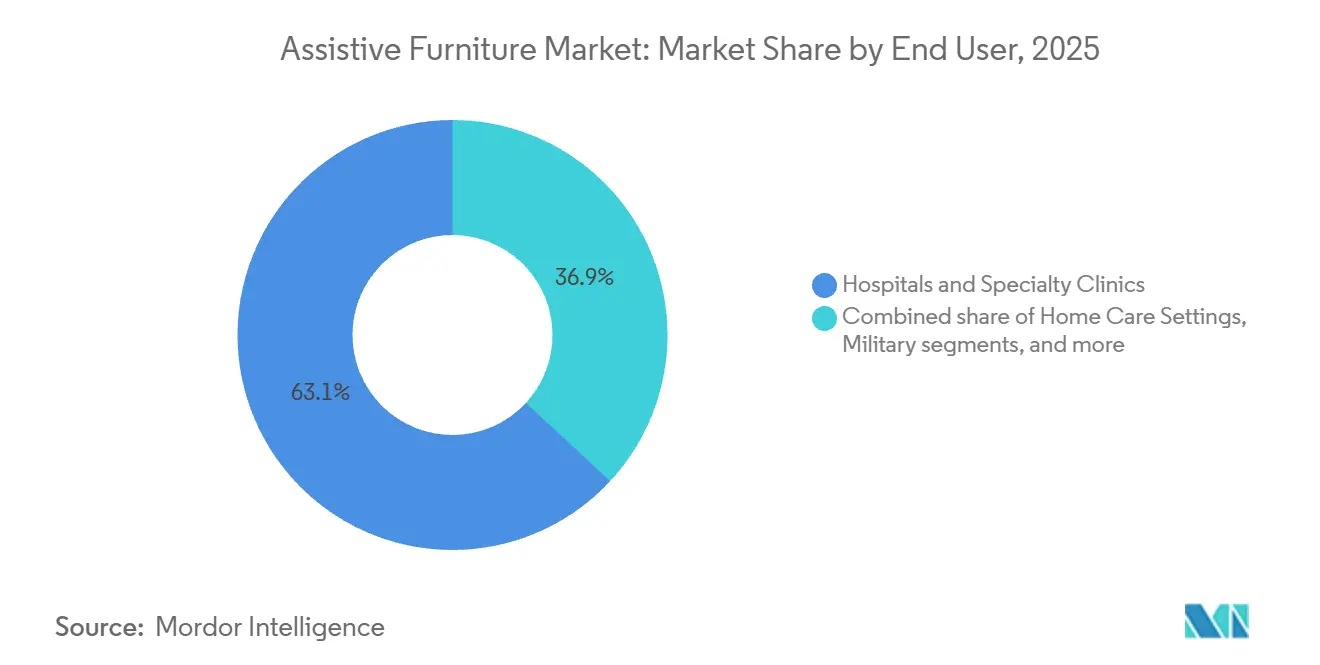
Hospitals and specialty clinics held 63.11% of the assistive furniture market share in 2025. Their buying power reflects high-acuity patient needs, formal accreditation requirements, and the scale of institutional procurement. These settings need full product suites that include beds, examination tables, transfer products, and support surfaces. Compliance with EU MDR, the IEC 60601 series, and FDA requirements favors manufacturers with established regulatory records. This supports the position of established suppliers in high-value hospital categories. It also places importance on technical training, planned maintenance, and documentation.
Ambulatory surgical centers are expected to grow at a 7.27% CAGR through 2031. These centers need equipment that supports efficient turnover, safe recovery, and connected perioperative workflows. Getinge opened a Digital OR Hub in Hamburg in June 2026 to advance digital perioperative workflow adoption and link devices with structured clinical data flows. Home care has a larger user population but typically creates lower average transaction values. Nursing homes and long-term-care facilities are increasingly using service agreements that combine supply, maintenance, and periodic replacement. Rehabilitation centers need examination tables, therapy tables, and positioning systems, while military and field hospitals require durable equipment for rapid deployment.
By Distribution Channel: Offline Channels Lead While Digital Ordering Expands
Offline retail held 44.54% of the assistive furniture market share in 2025. This reflects the need for professional fitting, reimbursement documentation, physical demonstrations, and local after-sales support for many clinical products. Direct tenders and institutional sales remain important for hospitals and care facilities. Dealers and distributors give suppliers reach in markets where direct sales networks are limited. These channels can also provide installation, training, and maintenance. The assistive furniture market continues to depend on physical service capabilities for complex and prescription-linked equipment.
Online retail and digital catalogs are projected to expand at a 7.77% CAGR through 2031. Digital channels are more suitable for standard products, including shower chairs, overbed tables, and grab bars that do not need professional fitting. Family caregivers are also more willing to use online purchasing for recognized household care needs. Online ordering can support product discovery and repeat purchases, while local delivery and clinical setup can address practical requirements. Blended fulfillment is therefore useful for products with moderate complexity. This channel is expanding without fully replacing the role of distributors and clinical providers.
By Commercial Model: Ownership Leads and Short-Term Rental Grow Faster
Capital purchase held 72.13% of the assistive furniture market share in 2025. Many healthcare organizations prefer ownership because it provides control over assets and supports established budgeting and depreciation practices. Long-term leasing offers an alternative for community care organizations that need predictable payments without large upfront commitments. Ownership also allows facilities to standardize equipment across several wards or sites. This can simplify staff training and the management of spare parts. The assistive furniture market still relies heavily on this conventional procurement approach.
Surge and short-term rentals are forecast to grow at a 7.83% CAGR through 2031. This model supports emergency deployment, seasonal rehabilitation demand, and providers that cannot secure conventional equipment financing. Rental can give community providers faster access to beds and transfer products during temporary increases in need. Refurbished products add another option for buyers who evaluate lifecycle cost and sustainability. Arjo reported strong performance in its ReNu refurbishment business during Q2 2026, showing that circular models can operate at scale. These models extend asset life while allowing providers to access equipment without full replacement costs.
Geography Analysis
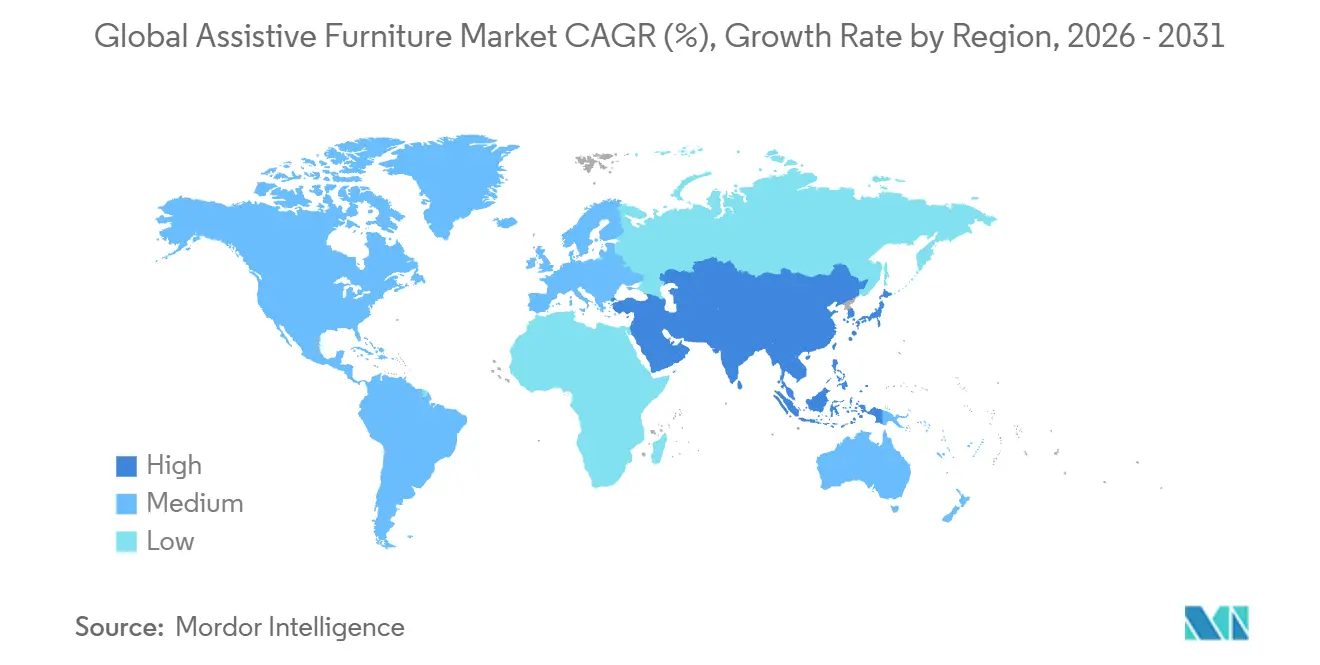
North America held 37.18% of the assistive furniture market share in 2025. The region benefits from a large older population, established reimbursement pathways, and a broad healthcare infrastructure. The United States Census Bureau reported in 2026 that baby boomers were ages 61 to 79 in 2025, creating a large cohort of first-time users of products that support aging in place. Medicare provides a reimbursement base for eligible durable medical equipment, although Medicaid coverage varies among states. The assistive furniture market benefits in North America from demand across hospitals, home care, long-term care, and rehabilitation. Europe is the second-largest regional area, supported by Germany's long-term-care demand and occupational safety requirements for motorized beds.
Asia-Pacific is forecast to expand at a 7.10% CAGR through 2031. Japan had 29.70% of its population aged 65 or older in 2025, the highest share globally. This creates a sustained need for premium care furniture across nursing homes and geriatric hospitals. Paramount Bed Holdings launched ParaDrive in June 2025 as a motorized drive option for its electric ALiUS ICU bed series in Japan. China led regional consumption by value in 2025 as hospital modernization programs funded clinical beds and patient-handling equipment. South Korea is expected to have the oldest population share globally by 2060, while Southeast Asia is experiencing an increasing demand through rising insurance coverage and hospital-network modernization.
South America, the Middle East, and Africa remain smaller parts of the assistive furniture market, but all have developing opportunities. Brazil supports regional demand through its older population, public health procurement, and private-hospital expansion in São Paulo. Saudi Arabia and the UAE are investing in hospital construction under national development plans, creating opportunities for suppliers that build regional distribution partnerships. South Africa and Nigeria are important healthcare markets in sub-Saharan Africa, although public financing and after-sales service gaps constrain penetration. Limited awareness and insufficient occupational-therapy capacity also affect product selection in Latin America and parts of Africa. Suppliers can address some of these barriers through local training, service networks, and products suited to budget conditions.
Competitive Landscape
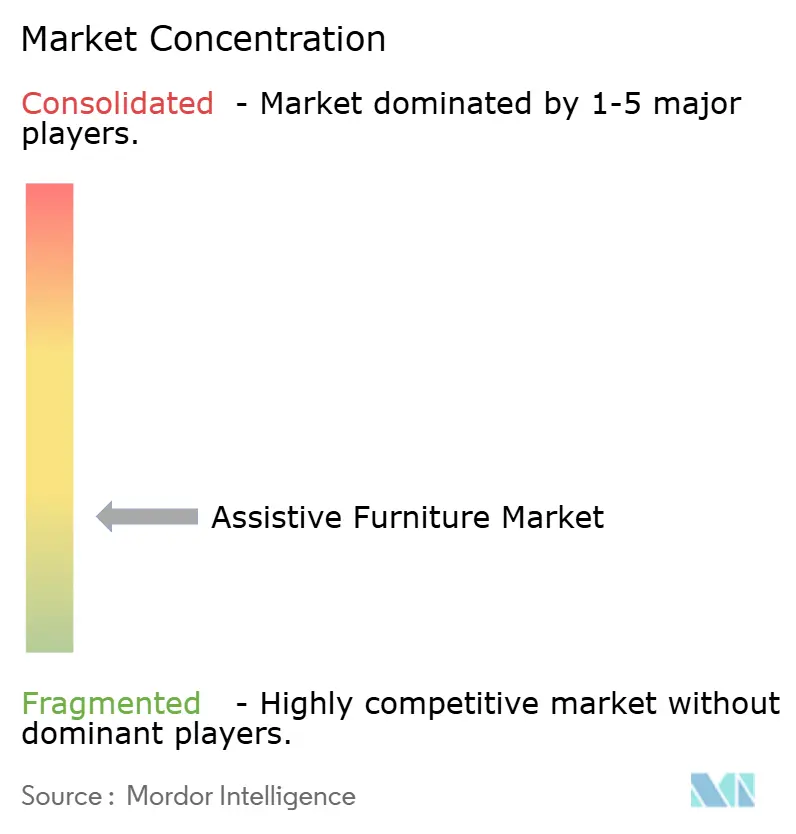
The assistive furniture market is moderately consolidated in premium acute-care products and fragmented across home care, long-term care, and developing regions. Stryker, Getinge, LINET Group, and Arjo compete in institutional procurement through certification, connected functionality, and clinical workflow support. IEC 60601-1 certification and ISO-compliant load-capacity testing remain key requirements for high-value institutional sales. Stryker's ProCuity and LINET's Multicare X compete through wireless connectivity, EHR and nurse-call integration, and fall-prevention capabilities. Arjo reported 4.70% organic growth in Q2 2026 and a seventh consecutive quarter of year-over-year United States growth, while also reporting currency, tariff, and mix pressures. These conditions show that scale does not remove exposure to reimbursement and operating-cost pressures.
Acquisitions and geographic expansion are prominent competitive approaches. Rhône Capital completed the combination of Invacare Europe and Asia-Pacific with Direct Healthcare Group in January 2026 to form DHCare, which operates in 16 countries and exports to more than 50 countries. DHCare also signed an agreement in 2026 to acquire Ottobock's Human Mobility division, subject to a planned H2 2026 close. The transaction extends its position across care beds, patient lifting, mobility, and power wheelchairs. Savaria acquired Vipal S.p.A. in Italy in July 2026, adding European elevator manufacturing capacity. This move reflects the value of local production and wider accessibility offerings.
Product development also centers on features that help providers manage safety, workload, and lifecycle cost. LINET's Essenza 300 Junior+ provides a dual-use platform for junior and adult patients under relevant bed safety standards. Joerns expanded functionality in its EasyCare 2026 platform through positioning and bariatric-care enhancements. Arjo's refurbishment activity shows that reuse and service models are becoming more visible alongside new-equipment sales. Suppliers with local service and training can compete more effectively where products require installation and ongoing maintenance. Affordable semi-electric equipment and connected home-care services remain areas where supplier offerings differ by region.
Assistive Furniture Industry Leaders
-
Stryker Corporation
-
Baxter International Inc.
-
Getinge AB
-
LINET Group SE
-
Paramount Bed Holdings Co., Ltd.
- *Disclaimer: Major Players sorted in no particular order
Recent Industry Developments
- July 2026: Savaria Corporation acquired Vipal S.p.A. in Ferentillo, Italy, a vertically integrated manufacturer of residential lifts and elevators with a 6,000 sq. m. owned factory, establishing European elevator manufacturing capability and advancing Savaria's 5-year revenue target of CAD 1.60 billion.
- June 2026: Getinge opened a Digital OR Hub in Hamburg, Germany, to accelerate development and adoption of digital perioperative workflow solutions, linking operating room modernization with connected devices and structured clinical data flows.
- May 2026: LINET UK launched the Essenza 300 Junior+, a dual-use acute hospital bed meeting EN 50637:2017 and EN 60601-2-52 for both junior and adult patients on a single platform, showcased at EBME EXPO 2026.
- April 2026: Joerns Healthcare released EasyCare 2026 enhancements, including integrated length extension, ComfortPause positioning reminders, AutoContour with ComfortChair integration, and expanded bariatric safe working load, delivered without added accessories or workflow changes
Global Assistive Furniture Market Report Scope
Assistive furniture is engineered to enhance the independence, safety, comfort, and mobility of individuals with age-related limitations, disabilities, or medical needs. The assistive furniture market is segmented by product type, form, operating mechanism, material, application, end user, commercial model, and geography. By product type, the market is segmented into beds and sleep-support furniture, chairs and recliners, tables and work surfaces, transfer and positioning furniture, bathroom safety furniture, mobility-integrated and access furniture, and cushions, mattresses, and support surfaces. By form and operating mechanism, it is segmented into manual and fixed-height furniture, semi-electric furniture, fully electric furniture, and smart and IoT-enabled furniture. By material, it is segmented into metal and stainless steel, plastic and polymer, foam and pressure-relieving materials, fabric and upholstery, and wood and engineered wood. By application, it is segmented into daily living assistance, disability assistance, elderly care, and ageing in place, injury rehabilitation, post-surgery and transitional care, pressure-injury prevention, and safe patient handling and transfer. By end user, it is segmented into home care settings, hospitals and specialty clinics, assisted living centers, nursing homes and long-term-care facilities, rehabilitation and physiotherapy centers, ambulatory surgical centers, and military and field hospitals. By commercial model, it is segmented into capital purchase, long-term lease, surge and short-term rental, and refurbished and reconditioned furniture. By geography, the market is segmented into North America, Europe, Asia-Pacific, South America, and the Middle East & Africa. The report offers the market size in value terms in USD for all the above-mentioned segments.
| Beds and Sleep-Support Furniture | General-Purpose and Adjustable Beds |
| ICU and Critical-Care Beds | |
| Pediatric and Maternity Beds | |
| Bariatric Beds | |
| Low-Height and Floor-Level Beds | |
| Smart and Connected Beds | |
| Chairs and Recliners | Riser-Reclining Chairs |
| Lift Chairs | |
| Clinical and Patient Chairs | |
| Bariatric Chairs and Recliners | |
| Shower and Toilet Chairs | |
| Tables and Work Surfaces | Overbed Tables |
| Height-Adjustable Tables | |
| Examination and Therapy Tables | |
| Dining and Activity Tables | |
| Transfer and Positioning Furniture | Patient Lifts and Transfer Aids |
| Sit-to-Stand Furniture | |
| Positioning Supports and Wedges | |
| Bathroom Safety Furniture | Grab Bars and Rails |
| Raised Toilet Seats and Frames | |
| Bathing Benches and Shower Chairs | |
| Mobility-Integrated and Access Furniture | Ramps and Threshold Systems |
| Wheelchair-Accessible Storage | |
| Door Openers and Access Hardware | |
| Cushions, Mattresses, and Support Surfaces | Pressure-Redistribution Cushions |
| Positioning Cushions and Wedges | |
| Low-Air-Loss and Alternating-Pressure Surfaces |
| Manual and Fixed-Height Furniture |
| Semi-Electric Furniture |
| Fully Electric Furniture |
| Smart and IoT-Enabled Furniture |
| Metal and Stainless Steel |
| Plastic and Polymer |
| Foam and Pressure-Relieving Materials |
| Fabric and Upholstery |
| Wood and Engineered Wood |
| Daily Living Assistance |
| Disability Assistance |
| Elderly Care and Ageing in Place |
| Injury Rehabilitation |
| Post-Surgery and Transitional Care |
| Pressure-Injury Prevention |
| Safe Patient Handling and Transfer |
| Home Care Settings |
| Hospitals and Specialty Clinics |
| Assisted Living Centers |
| Nursing Homes and Long-Term-Care Facilities |
| Rehabilitation and Physiotherapy Centers |
| Ambulatory Surgical Centers |
| Military and Field Hospitals |
| Direct Tender and Institutional Sales |
| Dealers and Distributors |
| Offline Retail |
| Online Retail and Digital Catalogs |
| Capital Purchase |
| Long-Term Lease |
| Surge and Short-Term Rental |
| Refurbished and Reconditioned Furniture |
| North America | Canada |
| United States | |
| Mexico | |
| South America | Brazil |
| Peru | |
| Chile | |
| Argentina | |
| Rest of South America | |
| Europe | United Kingdom |
| Germany | |
| France | |
| Spain | |
| Italy | |
| BENELUX (Belgium, Netherlands, and Luxembourg) | |
| NORDICS (Denmark, Finland, Iceland, Norway, and Sweden) | |
| Rest of Europe | |
| Asia-Pacific | India |
| China | |
| Japan | |
| Australia | |
| South Korea | |
| South East Asia (Singapore, Malaysia, Thailand, Indonesia, Vietnam, and the Philippines) | |
| Rest of Asia-Pacific | |
| Middle East and Africa | United Arab Emirates |
| Saudi Arabia | |
| South Africa | |
| Nigeria | |
| Rest of the Middle East and Africa |
| By Product Type | Beds and Sleep-Support Furniture | General-Purpose and Adjustable Beds |
| ICU and Critical-Care Beds | ||
| Pediatric and Maternity Beds | ||
| Bariatric Beds | ||
| Low-Height and Floor-Level Beds | ||
| Smart and Connected Beds | ||
| Chairs and Recliners | Riser-Reclining Chairs | |
| Lift Chairs | ||
| Clinical and Patient Chairs | ||
| Bariatric Chairs and Recliners | ||
| Shower and Toilet Chairs | ||
| Tables and Work Surfaces | Overbed Tables | |
| Height-Adjustable Tables | ||
| Examination and Therapy Tables | ||
| Dining and Activity Tables | ||
| Transfer and Positioning Furniture | Patient Lifts and Transfer Aids | |
| Sit-to-Stand Furniture | ||
| Positioning Supports and Wedges | ||
| Bathroom Safety Furniture | Grab Bars and Rails | |
| Raised Toilet Seats and Frames | ||
| Bathing Benches and Shower Chairs | ||
| Mobility-Integrated and Access Furniture | Ramps and Threshold Systems | |
| Wheelchair-Accessible Storage | ||
| Door Openers and Access Hardware | ||
| Cushions, Mattresses, and Support Surfaces | Pressure-Redistribution Cushions | |
| Positioning Cushions and Wedges | ||
| Low-Air-Loss and Alternating-Pressure Surfaces | ||
| By Form and Operating Mechanism | Manual and Fixed-Height Furniture | |
| Semi-Electric Furniture | ||
| Fully Electric Furniture | ||
| Smart and IoT-Enabled Furniture | ||
| By Material | Metal and Stainless Steel | |
| Plastic and Polymer | ||
| Foam and Pressure-Relieving Materials | ||
| Fabric and Upholstery | ||
| Wood and Engineered Wood | ||
| By Application | Daily Living Assistance | |
| Disability Assistance | ||
| Elderly Care and Ageing in Place | ||
| Injury Rehabilitation | ||
| Post-Surgery and Transitional Care | ||
| Pressure-Injury Prevention | ||
| Safe Patient Handling and Transfer | ||
| By End User | Home Care Settings | |
| Hospitals and Specialty Clinics | ||
| Assisted Living Centers | ||
| Nursing Homes and Long-Term-Care Facilities | ||
| Rehabilitation and Physiotherapy Centers | ||
| Ambulatory Surgical Centers | ||
| Military and Field Hospitals | ||
| By Distribution Channel | Direct Tender and Institutional Sales | |
| Dealers and Distributors | ||
| Offline Retail | ||
| Online Retail and Digital Catalogs | ||
| By Commercial Model | Capital Purchase | |
| Long-Term Lease | ||
| Surge and Short-Term Rental | ||
| Refurbished and Reconditioned Furniture | ||
| By Region | North America | Canada |
| United States | ||
| Mexico | ||
| South America | Brazil | |
| Peru | ||
| Chile | ||
| Argentina | ||
| Rest of South America | ||
| Europe | United Kingdom | |
| Germany | ||
| France | ||
| Spain | ||
| Italy | ||
| BENELUX (Belgium, Netherlands, and Luxembourg) | ||
| NORDICS (Denmark, Finland, Iceland, Norway, and Sweden) | ||
| Rest of Europe | ||
| Asia-Pacific | India | |
| China | ||
| Japan | ||
| Australia | ||
| South Korea | ||
| South East Asia (Singapore, Malaysia, Thailand, Indonesia, Vietnam, and the Philippines) | ||
| Rest of Asia-Pacific | ||
| Middle East and Africa | United Arab Emirates | |
| Saudi Arabia | ||
| South Africa | ||
| Nigeria | ||
| Rest of the Middle East and Africa | ||
Key Questions Answered in the Report
What is the projected value of the assistive furniture market by 2031?
The assistive furniture market is forecast to reach USD 17.76 billion by 2031, growing at a 6.85% CAGR from 2026.
Which product category leads assistive furniture demand?
Beds and sleep-support furniture led with 38.19% share in 2025 and are forecast to grow at a 7.16% CAGR through 2031.
Why are smart beds becoming more important in care settings?
Connected beds can support fall prevention, caregiver alerts, workflow coordination, and predictive maintenance. A 2024 study reported an 88.00% reduction in bedside falls with an integrated IoT bed-exit system.
Which end user has the largest share of demand?
Hospitals and specialty clinics held 63.11% share in 2025 because they manage high-acuity patients and require products that meet formal safety and compliance standards.
Which region is growing fastest?
Asia-Pacific is forecast to grow at a 7.10% CAGR through 2031, supported by Japan's older population, China's hospital modernization, and institutional-care expansion across the region.