
Asian Food Market Size and Share
Market Overview
| Study Period | 2022 - 2032 |
|---|---|
| Market Size (2027) | USD 39.53 Billion |
| Market Size (2032) | USD 58.21 Billion |
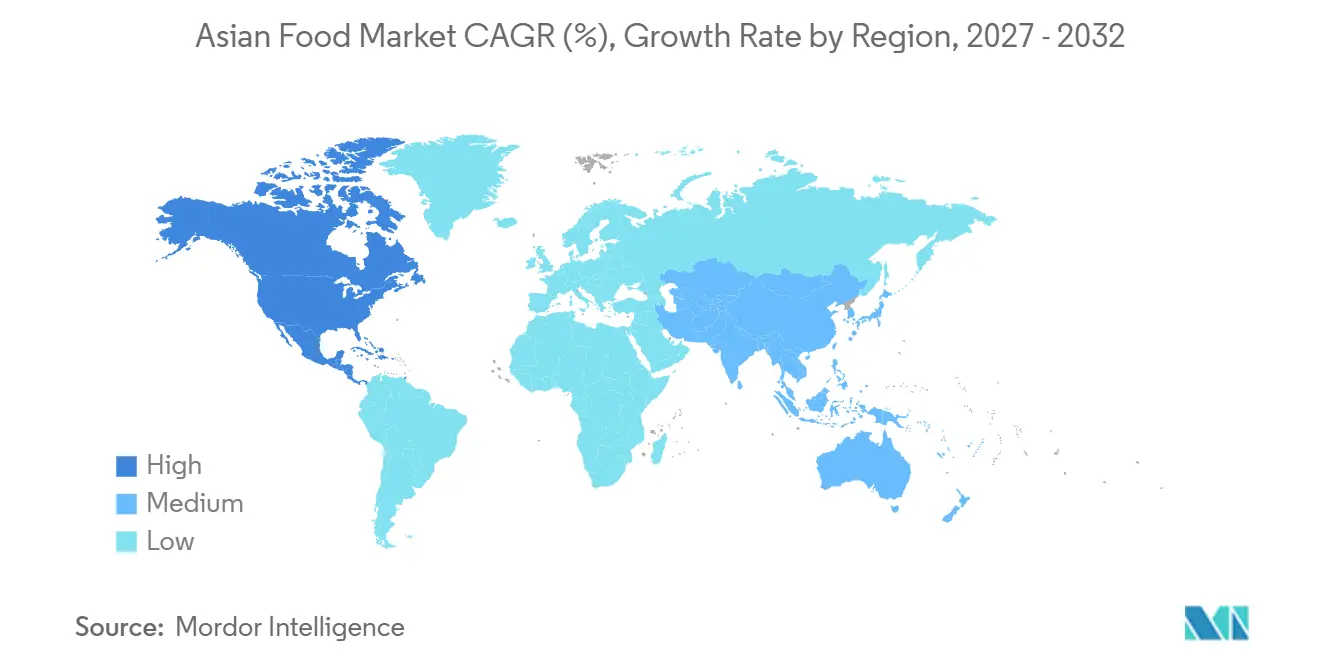
| Fastest Growing Market | North America |
| Largest Market | Asia-Pacific |
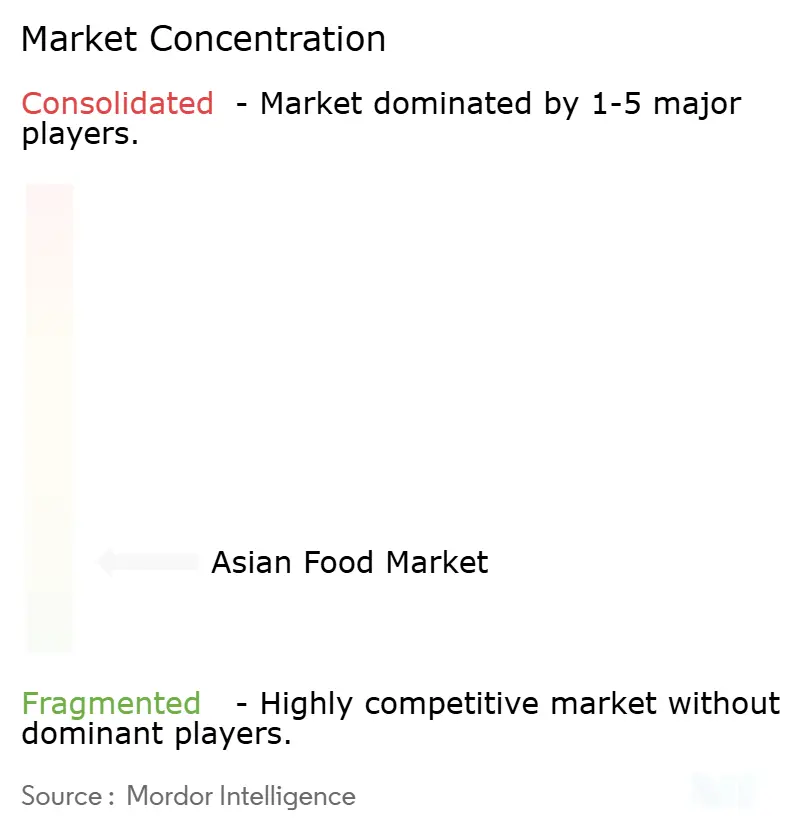
| Market Concentration | Low |
Major Players *Disclaimer: Major Players sorted in no particular order Image © Mordor Intelligence. Reuse requires attribution under CC BY 4.0. | |
Asian Food Market Analysis by Mordor Intelligence
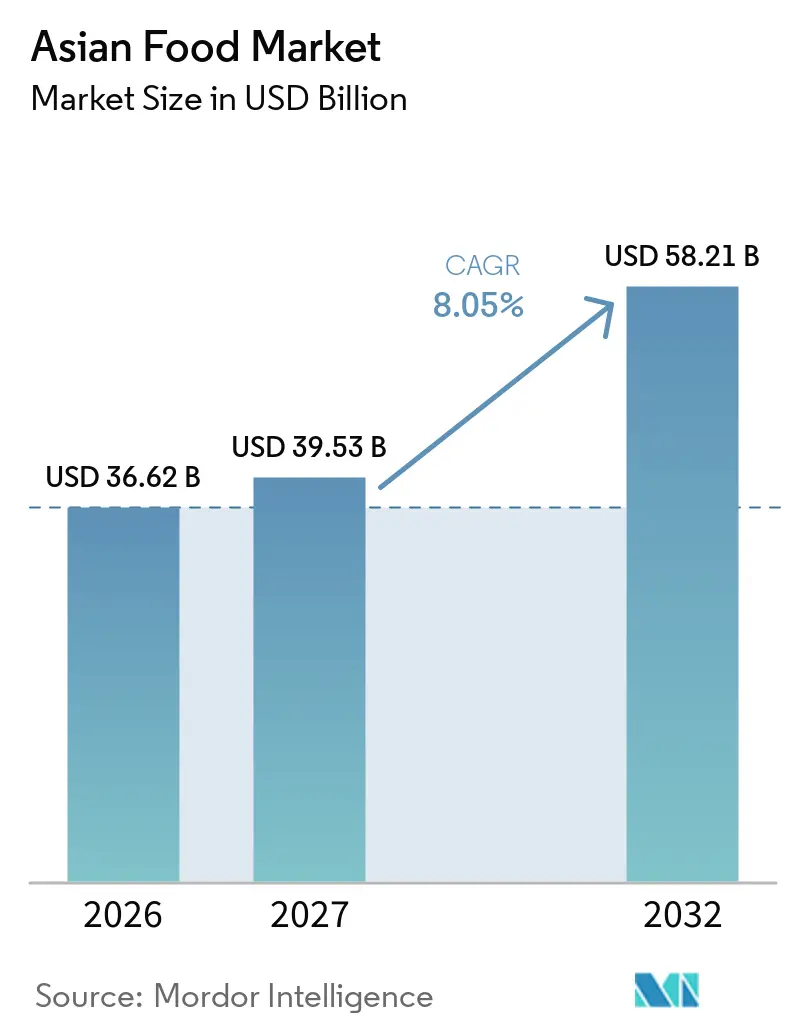
The Asian food market size was valued at USD 36.62 billion in 2026 and estimated to grow from USD 39.53 billion in 2027 to reach USD 58.21 billion by 2032, at a CAGR of 8.05% during the forecast period (2027-2032). Demand is rising as urban households have less time for cooking and seek convenient products that still reflect familiar regional flavors. Digital grocery, quick commerce, and specialty retail are widening access to imported and locally produced Asian foods. Korean cuisine and related cultural content are helping brands reach consumers beyond established diaspora communities. Product quality, food safety, and ingredient disclosure are becoming important points of differentiation, especially in higher-income urban markets. Growth remains limited by gaps in cold-chain coverage, fragmented regulations, price sensitivity, and the continued preference for fresh food in several Asian countries.
Key Report Takeaways
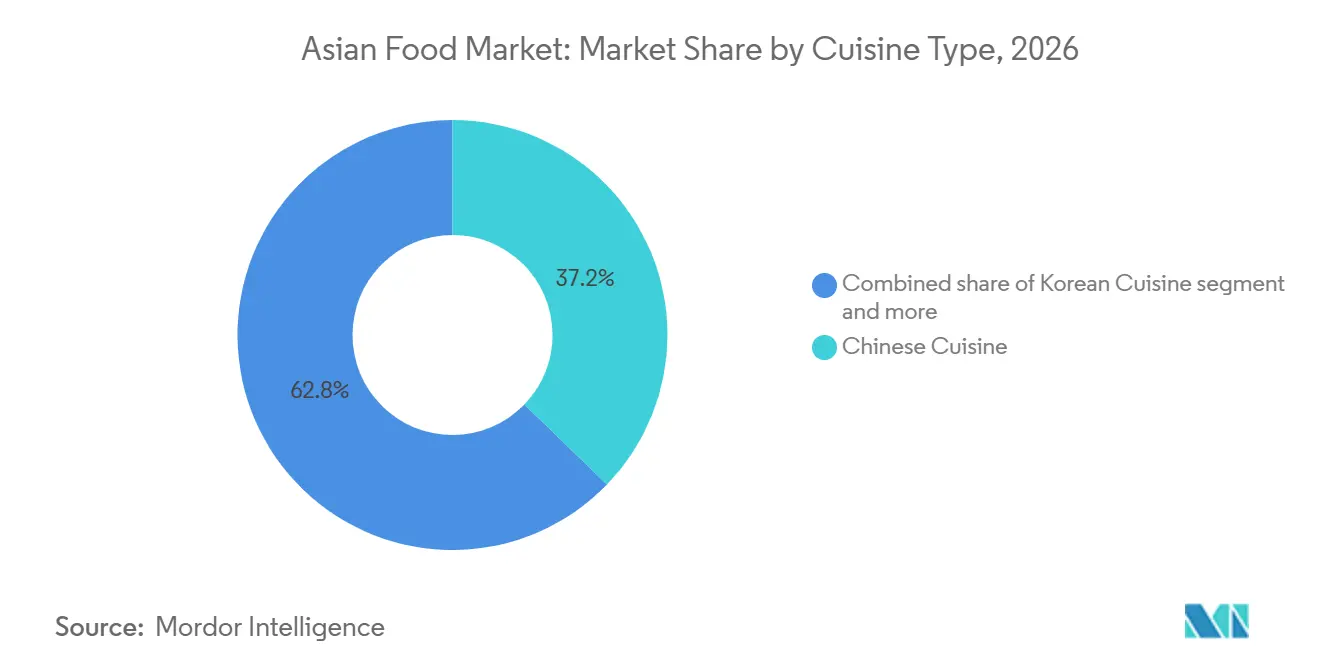
- By cuisine type, Chinese cuisine held 37.23% of the Asian food market share in 2026, while Korean cuisine is projected to grow at a 9.72% CAGR through 2032.
- By food type, non-vegetarian food accounted for 26.28% of the category in 2026, while vegetarian and vegan food are forecast to expand at a 9.58% CAGR through 2032.
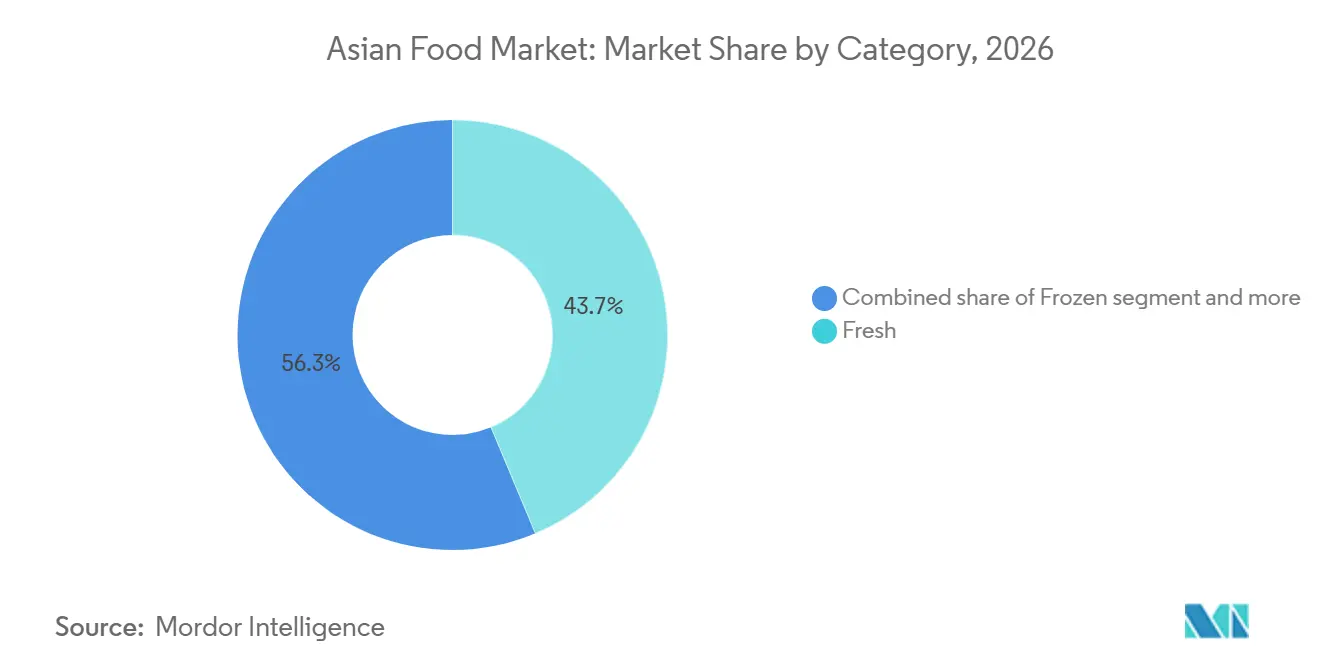
- By category, fresh products accounted for 43.65% of the Asian food market in 2026, while frozen products are expected to grow at a 9.20% CAGR through 2032.
- By distribution channel, off-trade accounted for 64.87% of the category in 2026, while on-trade is projected to grow at a 9.49% CAGR through 2032.
- By geography, Asia-Pacific accounted for 61.56% of the category in 2026, while North America is forecast to record a 9.41% CAGR through 2032.
Note: Market numbers in this report are based on Mordor Intelligence's proprietary estimation framework, which combines nine months of actuals with Q4 projections for base year 2026.
Market Trends and Insights
Drivers Impact Analysis of Asian Food Market*
| Driver | (~) % Impact on CAGR Forecast | Geographic Relevance | Impact Timeline |
|---|---|---|---|
| Urbanization and dual-income demand for convenience meals | +2.1% | Global, concentrated in China, India, Southeast Asia, and urban North America | Long term (≥ 4 years) |
| Digital grocery, quick commerce, and mobile-payment expansion | +1.4% | APAC core and North America | Medium term (2-4 years) |
| Demand for authentic and localized Asian flavors | +1.2% | Global, strongest in North America, Europe, and GCC | Medium term (2-4 years) |
| Food safety, hygiene, and ingredient transparency | +0.8% | China, India, Japan, and Southeast Asia | Long term (≥ 4 years) |
| Growth of frozen, ready-to-cook, and ready-to-eat formats | +1.0% | Global, strongest in Japan, Australia, the United States, and the United Kingdom | Medium term (2-4 years) |
| Korean Wave and social-media-led cuisine discovery | +1.1% | North America, Europe, GCC, Japan, and Southeast Asia | Short term (≤ 2 years) |
| Source: Mordor Intelligence | |||
Urbanization and Dual-Income Household Demand for Convenience Meals
Urbanization and the growth of dual-income households are increasing demand for foods that reduce preparation time without losing flavor or cultural familiarity. Current household routines favor products that simplify meal planning, preparation, and storage. In the Philippines, convenience stores remain an important food and beverage channel, with food and beverages generating 2-thirds of channel revenue[1]. These changes favor single-serve meals, meal kits, frozen products, and ready-to-eat formats across the Asian food market. Convenience is increasingly evaluated alongside nutrition, ingredient quality, and authenticity rather than speed alone. This gives suppliers an opportunity to build loyalty through formats that fit busy routines while preserving recognizable culinary cues.
Expansion of Digital Grocery, Quick Commerce, and Mobile Payments
Digital retail is making Asian food products easier to discover, purchase, and replenish. China has a mature online retail infrastructure for food and beverages. Search tools, recommendation systems, and fast delivery allow consumers to try products outside the conventional ethnic-food aisle. Mobile payment systems also make small and frequent food purchases easier in large urban markets. This supports repeat purchases of noodles, sauces, dumplings, snacks, and chilled meals. The Asian food market benefits when retailers use digital channels to combine discovery, convenience, and reliable fulfillment.
Rising Demand for Authentic and Localized Asian Flavors
Consumers increasingly seek products that deliver recognizable Asian flavors while fitting local eating habits and meal occasions. The Asian food market is supported by a broader shift from occasional trial toward regular home consumption of Korean, Japanese, Chinese, Indian, Thai, and other regional foods. Unilever Food Solutions reported that Chinese and Japanese cuisines ranked among the 5 leading global cuisines across age groups in its 2025 menu research, while Korean flavors had strong interest among Generation Z consumers. Authenticity is not identical across locations because consumers respond to different signals of provenance, flavor, and preparation. Brands can adapt portion sizes, pack formats, and heat levels without removing the elements that make a cuisine distinct. This balance is important for scaling the Asian food market through mainstream retailers and foodservice operators.
Growth of Frozen, Ready-to-Cook, and Ready-to-Eat Formats
Frozen, ready-to-cook, and ready-to-eat formats help consumers prepare Asian dishes with less time and less waste. They are particularly relevant in markets where households want restaurant-style meals but cannot make them from scratch every day. Better freezing technology and more disciplined temperature management are improving product consistency. Japanese frozen gyoza output rose 13% in 2025, reflecting continued demand for convenient frozen products. These formats give producers more options to serve supermarkets, convenience stores, online grocery platforms, and foodservice customers. Their growth also creates opportunities for regional dishes that need controlled storage but can travel more easily than fresh alternatives.
Restraints Impact Analysis of Asian Food Market*
| Restraint | (~) % Impact on CAGR Forecast | Geographic Relevance | Impact Timeline |
|---|---|---|---|
| Preference for Freshly Prepared Food and Traditional Wet Markets | -0.6% | China, Vietnam, Thailand, India, Indonesia; rural and peri-urban Southeast Asia | Long term (≥ 4 years) |
| Uneven Cold-Chain and Last-Mile Infrastructure | -0.7% | Southeast Asia (Indonesia, Philippines, Vietnam, Myanmar), South Asia, rural APAC | Medium term (2–4 years) |
| Price Sensitivity and Premium-Product Affordability Gaps | -0.5% | APAC emerging markets; lower-income tiers across Southeast Asia, India, South Asia | Long term (≥ 4 years) |
| Regulatory Fragmentation and Reformulation Costs | -0.4% | ASEAN cross-border trade; producers targeting multiple APAC markets simultaneously | Medium term (2–4 years) |
| Source: Mordor Intelligence | |||
Preference for Freshly Prepared Food and Traditional Wet Markets
Freshly prepared food and wet-market shopping remain central to food purchasing in China and much of Southeast Asia. These channels are valued for daily freshness, price visibility, perceived nutritional quality, and access to prepared dishes. This preference reduces the pace at which packaged Asian food can replace fresh meal occasions in lower-income and peri-urban areas. The constraint is especially relevant where consumers see wet-market products as more authentic than branded packaged alternatives. Suppliers can respond by focusing on occasions that fresh channels do not serve well, including travel, workplace meals, late-evening consumption, and home storage. Products with visible provenance and minimal-processing claims may narrow the quality gap, but they are unlikely to eliminate the role of traditional channels.
Uneven Cold-Chain and Last-Mile Infrastructure
Uneven cold-chain infrastructure restricts the geographic reach of frozen and chilled products in the Asian food market. The Global Cold Chain Alliance reported that weak cold-chain networks contribute significantly to transportation-related food loss in Southeast Asia. The burden is greatest outside major urban areas, where storage capacity, temperature-controlled transport, and reliable last-mile delivery are less developed. Japan also faces infrastructure renewal needs because 33% of its cold-storage floor space is in facilities at least 40 years old[2]. Public investment can improve national capacity, but commercial distribution networks still need equipment, trained operators, and sustained volumes. Until those systems improve, premium chilled and frozen foods will remain concentrated in cities and affluent retail corridors.
*Our forecasts treat driver/restraint impacts as directional, not additive. The impact forecasts reflect baseline growth, mix effects, and variable interactions.
Asian Food Market Segment Analysis
By Cuisine Type:
Chinese Cuisine Holds the Largest Share While Korean Cuisine Grows FastestChinese cuisine held 37.23% of the category in 2026. Its scale reflects wide availability of noodles, dumplings, sauces, and ready meals, as well as the strong presence of Chinese communities and restaurants across international markets. The category addresses everyday eating occasions through both shelf-stable and frozen products. Packaged Chinese food also benefits from consumer familiarity, which can reduce barriers to trial in mainstream grocery channels. Manufacturers are expanding beyond value-oriented staples with higher-quality frozen dumplings and soup dumplings for retail customers. These products appeal to consumers who want restaurant-style food that can be prepared at home. Chinese cuisine, therefore, remains an important volume base for the Asian food market.
Korean cuisine is forecast to grow at 9.72% CAGR through 2032. Demand is supported by global interest in Korean entertainment, online food content, spicy flavors, and convenient noodle and snack formats. Korean foodservice companies operated 4,644 overseas outlets in 56 countries as of December 2025[3]. This wider restaurant base helps consumers become familiar with bibimbap, kimchi, Korean fried chicken, ramen, and tteokbokki before encountering packaged versions. Export products can then move through specialty stores, large retailers, and digital marketplaces. Korean suppliers are also adapting flavor profiles and heat levels for local consumers while retaining Korean visual and culinary identifiers.

By Food Type:
Non-Vegetarian Food Leads While Vegetarian and Vegan Food Expands RapidlyNon-vegetarian food accounted for 26.28% of the category in 2026. Meat-based broths, dumplings, fried chicken, curries, and seafood products are common meal options in many countries. These products show the importance of bold, protein-led, convenience formats in global Asian food consumption. Non-vegetarian choices also have established demand in restaurants and retail, supporting product familiarity and repeat purchasing. Manufacturers can protect this position through quality protein sourcing, flavor innovation, and formats that meet household and foodservice needs. The breadth of cuisine styles gives the segment room to address both value and premium price points.
Vegetarian and vegan food is projected to record a 9.58% CAGR through 2032. Traditional Asian cooking provides a familiar base of tofu, tempeh, legumes, mushrooms, vegetables, and plant-based broths. This foundation can give Asian brands credibility when launching meat-free prepared foods. Health-related purchasing, demand for ingredient transparency, and interest in plant-forward eating are broadening the audience for these products. Producers can also use established regional dishes to avoid positioning plant-based food as a direct imitation of meat. Demand is likely to be strongest where convenient products offer recognizable taste, credible nutrition, and accessible prices. This gives vegetarian and vegan foods a meaningful role in the future Asian food market.
By Category:
Fresh Products Lead While Frozen Products Gain MomentumFresh products accounted for 43.65% of the Asian food market in 2026. Their leading position reflects the close connection between freshness and perceived culinary quality across Asian cuisines. Fresh noodles, prepared meals, produce-based ingredients, and chilled dishes can more directly replicate ordinary restaurant and home-cooked experiences than shelf-stable formats. These products have strong appeal in dense cities with active retail and foodservice systems. Their commercial reach is limited by short shelf life, handling costs, and the need for dependable temperature control. Retailers must carefully manage waste and replenishment, especially when expanding outside urban centers. Fresh products, therefore, remain important, but their role depends on local logistics and store capabilities.
Frozen products are forecast to advance at a 9.20% CAGR through 2032. Improved freezing methods, better product design, and growing cold-storage networks are helping suppliers offer foods with more consistent texture and flavor. Japanese frozen gyoza output increased 13% in 2025, illustrating continued demand for convenient frozen meal solutions. Frozen food offers retailers a longer shelf life and consumers a way to keep restaurant-style items at home. It also supports regional expansion when companies can maintain reliable storage and transport. Growth will depend on investment in cold-chain coverage and on products that overcome the older perception that frozen food is inferior to freshly made food.
By Distribution Channel:
Off-Trade Holds the Largest Share While On-Trade Grows FastestOff-trade channels accounted for 64.87% of the category in 2026. Supermarkets, hypermarkets, convenience stores, specialty stores, and e-commerce platforms support planned household purchases and pantry stocking. Specialty Asian stores remain important for authentic ingredients and new product trials. Large retailers help successful products reach a broader consumer base once demand has been established. Online retail offers another channel for consumers seeking specific cuisines, brands, or dietary formats. China’s established food and beverage e-commerce ecosystem demonstrates how digital retail can expand product visibility. Off-trade will remain essential because it combines routine shopping, a broad assortment, and home consumption.
On-trade is projected to grow at 9.49% CAGR through 2032. Restaurant growth helps consumers discover regional cuisines before they purchase sauces, noodles, dumplings, and other products for home use. Korean foodservice outlets in the United States reached 1,106 by December 2025. Dining out also supports premiumization because consumers can experience dishes at full-service quality. Restaurant operators and packaged-food brands can reinforce each other when familiar flavors move between menus and supermarket shelves. Foodservice growth will be strongest in cities where young consumers, tourism, and multicultural dining are expanding. This channel can improve awareness for cuisines that remain underrepresented in packaged retail.
Geography Analysis
APAC Asian Food Market
Asia-Pacific accounted for 61.56% of the category in 2026. China provides a large demand base for noodles, dumplings, sauces, snacks, and online food purchases, while Japan and South Korea contribute product innovation and mature convenience-food ecosystems. India and Southeast Asia add large populations, growing urban areas, and diverse local food traditions. The region’s cold-chain networks are important for maintaining the quality and availability of frozen products. The region’s scale also makes it a production and export base for global brands. Food-safety coordination is relevant to trade because the Republic of Korea hosted the 3rd Asia-Pacific Food Regulatory Authority Summit in 2025. The Asian food market size in Asia-Pacific will remain supported by domestic consumption, product development, and regional supply networks.
North America Asian Food Market
North America is forecast to expand at a 9.41% CAGR through 2032. The United States is a key destination for Korean foodservice and packaged-food exporters, with Korean agri-food exports to North America increasing 21.7% year over year in the first quarter of 2025. Restaurants, specialty stores, conventional supermarkets, and e-commerce are widening the distribution base for Asian foods. Diaspora communities remain important, but demand is spreading toward consumers who are seeking restaurant-inspired meals and new flavor experiences. Canada and Mexico can benefit from cross-border brand recognition and retailer-led expansion from the United States. The region offers favorable conditions for premium frozen foods, sauces, noodles, and snacks because established grocery systems can support broad distribution. Market entry still requires products to fit local labeling, pricing, and taste expectations.
EMEA and South America Asian Food Market
Europe is a major non-Asia-Pacific consumption area, led by Germany, the United Kingdom, and France. Korean agri-food exports to Europe grew 34.1% in the first quarter of 2025, including higher exports of ramen, instant rice, and tteokbokki. These flows reflect opportunities for suppliers that can combine authentic positioning with local retail partnerships. South America offers a developing opportunity, supported by Japanese diaspora communities in Brazil and growing interest in Korean products. The Middle East and Africa also present opportunities for premium and halal-certified Asian foods, particularly in Gulf markets. Korean agri-food exports to the Gulf Cooperation Council rose 22.6% to USD 411.6 million in 2025. Trade patterns, product certification, and local distribution capacity will determine how quickly these regions contribute to the Asian food market.
Competitive Landscape
The Asian food market is fragmented because competition is divided by cuisine, format, and geography. Ajinomoto and Nissin have established global distribution and product development capabilities, while Korean companies such as CJ CheilJedang and Samyang Foods are expanding their presence in packaged meals, noodles, sauces, and frozen foods. CJ CheilJedang completed a KRW 100 billion, USD 68 million mandu production facility in Kisarazu, Japan, in September 2025, enabling local production of Bibigo dumplings and wider access to Japanese retail outlets. Nissin launched the GEKI spicy noodle range in the United States in October 2025, applying a Korean-style spicy format to the familiar instant noodle category. These investments show that large suppliers are using local production, product renovation, and retail execution to compete in specific markets rather than pursuing a uniform global offering.
Competitive differentiation rests on product authenticity, dependable quality, retail access, and the ability to adapt familiar foods for new markets. Nissin introduced Top Ramen HotPot Fusions Korean Spicy Beef at selected Sam’s Club stores in February 2025, adapting a Korean-inspired hot-pot concept for U.S. mass retail. Ajinomoto introduced Salt Answer and Palate Perfect in North America in June 2025 to help food manufacturers work on sodium reduction and flavor formulation. These examples show how companies can serve both consumer brands and business-to-business customers while responding to new requirements for taste, health, and convenience. Smaller businesses can develop positions in Thai, Vietnamese, Filipino, and halal-certified products, where packaged food availability is less developed than for Chinese, Japanese, and Korean cuisines.
The competitive environment favors companies that can manage food regulations, supply chains, and reformulation across several countries. Codex Alimentarius work in Asia-Pacific supports regulatory dialogue, but suppliers still need to meet local food safety, labeling, and ingredient requirements. This can raise costs for smaller exporters and benefit businesses with audited supply chains, established manufacturing partners, and compliance expertise. Digital retail and quick delivery improve access for newer brands, but reliable product availability remains essential for repeat purchase. Product collaborations and limited editions can attract new buyers when they are combined with dependable distribution and consistent quality. The Asian food industry remains competitive at the cuisine and channel level rather than dominated by a single company across all formats. Companies that pair cultural relevance with local manufacturing, strong cold-chain access, and clear labeling are more likely to build sustainable positions.
Asian Food Industry Leaders
-
Ajinomoto Co., Inc.
-
Nissin Foods Holdings Co., Ltd.
-
Nestlé S.A.
-
Toyo Suisan Kaisha, Ltd.
-
Unilever PLC
- *Disclaimer: Major Players sorted in no particular order
Asian Food Market Companies Covered in this Report
- Ajinomoto Co., Inc.
- Nissin Foods Holdings Co., Ltd.
- Nestlé S.A.
- Toyo Suisan Kaisha, Ltd.
- Unilever PLC
- Kikkoman Corporation
- Calbee, Inc.
- ITC Limited
- CJ CheilJedang Corporation
- Samyang Foods Co., Ltd.
- Nongshim Co., Ltd.
- Indofood CBP Sukses Makmur Tbk
- Thai President Foods Public Company Limited
- Uni-President Enterprises Corporation
- Tingyi Holding Corp.
- Lee Kum Kee Company Limited
- General Mills, Inc.
- McCormick and Company, Incorporated
- Conagra Brands, Inc.
- Tata Consumer Products Limited
Recent Industry Developments in Asian Food Market
- September 2025: CJ CheilJedang: Completed a KRW 100 billion (approximately USD 68 million) mandu production facility in Kisarazu, Chiba Prefecture, Japan, its first overseas manufacturing plant, enabling domestic supply of bibigo dumplings and accelerating Japan distribution to approximately 40,000 retail outlets, including AEON, Costco, Amazon, and Don Quijote.
- September 2025: Nissin Foods USA: Launched the GEKI spicy ramen line in the United States, featuring entirely new wavy noodles and no added MSG, competing directly with Korean-style spicy ramen formats and capitalizing on the global spicy food trend.
- February 2025: Nissin Foods USA: Launched Top Ramen HotPot Fusions Korean Spicy Beef at select Sam's Club outlets, adapting the traditional Asian hot-pot format for US mass-retail distribution and capturing the mainstreaming of Korean cuisine through a legacy brand.
Global Asian Food Market Report Scope
Asian food refers to dishes and ingredients originating from or inspired by Asian culinary traditions, including Chinese, Japanese, Indian, Korean, Thai, and other Asian cuisines. The Asian Food Market is segmented by cuisine type, food type, category, distribution channel, and geography. By cuisine type, the market includes Chinese, Japanese, Indian, Korean, Thai, and Other Asian Cuisines. By food type, the market is segmented into Vegetarian and Vegan Food and Non-Vegetarian Food. By category, the market is categorized into Fresh, Frozen, Canned, Dried Foods, and Other Categories. By distribution channel, the market is divided into On-Trade and Off-Trade, with Off-Trade further segmented into Supermarkets and Hypermarkets, Convenience Stores, Specialty Asian Food Stores, Online Retail, and Other Off-trade Channels. By geography, the report covers North America, South America, Europe, Asia-Pacific, and Middle East and Africa, with market size and forecasts provided for each region. The market sizing has been done in value terms in USD for all the abovementioned segments.
Segmentation Overview
| Chinese Cuisine |
| Japanese Cuisine |
| Indian Cuisine |
| Korean Cuisine |
| Thai Cuisine |
| Other Asian Cuisines |
| Vegetarian and Vegan Food |
| Non-Vegetarian Food |
| Fresh |
| Frozen |
| Canned |
| Dried Foods |
| Other Category |
| On-Trade | |
| Off-Trade | Supermarkets and Hypermarkets |
| Convenience Stores | |
| Specialty Asian Food Stores | |
| Online Retail | |
| Other Off-trade Channels |
| North America | United States |
| Canada | |
| Mexico | |
| Rest of North America | |
| South America | Brazil |
| Argentina | |
| Colombia | |
| Chile | |
| Rest of South America | |
| Europe | United Kingdom |
| Germany | |
| France | |
| Italy | |
| Spain | |
| Russia | |
| Sweden | |
| Belgium | |
| Poland | |
| Netherlands | |
| Rest of Europe | |
| Asia-Pacific | China |
| Japan | |
| India | |
| Thailand | |
| Singapore | |
| Indonesia | |
| South Korea | |
| Australia | |
| New Zealand | |
| Rest of Asia-Pacific | |
| Middle East and Africa | United Arab Emirates |
| South Africa | |
| Saudi Arabia | |
| Nigeria | |
| Egypt | |
| Morocco | |
| Turkey | |
| Rest of Middle East and Africa |
| By Cuisine Type | Chinese Cuisine | |
| Japanese Cuisine | ||
| Indian Cuisine | ||
| Korean Cuisine | ||
| Thai Cuisine | ||
| Other Asian Cuisines | ||
| By Food Type | Vegetarian and Vegan Food | |
| Non-Vegetarian Food | ||
| By Category | Fresh | |
| Frozen | ||
| Canned | ||
| Dried Foods | ||
| Other Category | ||
| By Distribution Channel | On-Trade | |
| Off-Trade | Supermarkets and Hypermarkets | |
| Convenience Stores | ||
| Specialty Asian Food Stores | ||
| Online Retail | ||
| Other Off-trade Channels | ||
| By Geography | North America | United States |
| Canada | ||
| Mexico | ||
| Rest of North America | ||
| South America | Brazil | |
| Argentina | ||
| Colombia | ||
| Chile | ||
| Rest of South America | ||
| Europe | United Kingdom | |
| Germany | ||
| France | ||
| Italy | ||
| Spain | ||
| Russia | ||
| Sweden | ||
| Belgium | ||
| Poland | ||
| Netherlands | ||
| Rest of Europe | ||
| Asia-Pacific | China | |
| Japan | ||
| India | ||
| Thailand | ||
| Singapore | ||
| Indonesia | ||
| South Korea | ||
| Australia | ||
| New Zealand | ||
| Rest of Asia-Pacific | ||
| Middle East and Africa | United Arab Emirates | |
| South Africa | ||
| Saudi Arabia | ||
| Nigeria | ||
| Egypt | ||
| Morocco | ||
| Turkey | ||
| Rest of Middle East and Africa | ||
Key Questions Answered in the Report
What is the projected value of the Asian food sector by 2032?
The Asian food market is forecast to reach USD 58.21 billion by 2032, growing at an 8.05% CAGR from 2027 to 2032. Urban convenience, wider distribution, and demand for diverse cuisines support this outlook across retail and foodservice channels.
Which cuisine leads Asian food sales?
Chinese cuisine led with 37.23% share in 2026, supported by wide availability of noodles, dumplings, sauces, and prepared foods. Its product range serves both household retail and foodservice occasions, from value-oriented staples to premium frozen offerings.
Which cuisine is expanding the fastest?
Korean cuisine is forecast to grow at a 9.72% CAGR through 2032, supported by global interest in Korean food and entertainment. Restaurant expansion, packaged-food availability, and wider digital distribution help sustain consumer discovery and repeat purchasing.
Why are frozen Asian foods gaining demand?
Frozen products are projected to grow at a 9.20% CAGR as product quality and cold-chain coverage improve. The format offers longer storage life, convenient preparation, and more reliable access to restaurant-style foods for busy households.