
Asia-Pacific Wheat Market Analysis by Mordor Intelligence
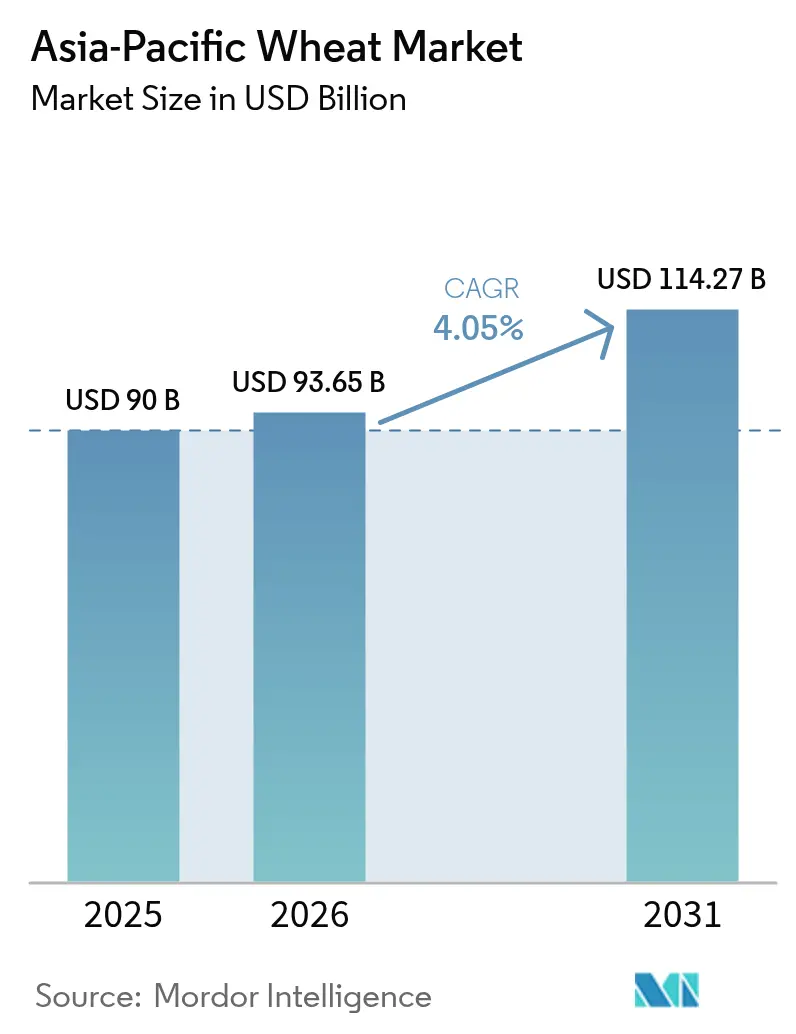
The Asia-Pacific wheat market size was valued at USD 90 billion in 2025 and estimated to grow from USD 93.65 billion in 2026 to reach USD 114.27 billion by 2031, at a CAGR of 4.05% during the forecast period (2026-2031). Strong population growth, higher disposable incomes, and growing preference for wheat-based bakery and convenience foods underpin this outlook. China’s large-scale cereal self-sufficiency policies, India’s record harvests, and sustained investments in climate-resilient varieties provide structural supply support. Capacity upgrades across Indonesia, Japan, and Australia shorten logistics lines and lower milling costs, while blockchain pilots enhance transparency that appeals to health-conscious urban consumers. Nevertheless, climate volatility and tariff changes inject periodic price swings that require agile sourcing and risk-management strategies.
Key Report Takeaways
- By geography, China led with 37.95% of the Asia-Pacific wheat market share in 2025. India is projected to record the highest 4.15% CAGR through 2031, supported by record harvests and expanded procurement.
Note: Market size and forecast figures in this report are generated using Mordor Intelligence’s proprietary estimation framework, updated with the latest available data and insights as of 2026.
Asia-Pacific Wheat Market Trends and Insights
Drivers Impact Analysis*
| Driver | (~) % Impact on CAGR Forecast | Geographic Relevance | Impact Timeline |
|---|---|---|---|
| Rising demand for high-protein wheat-based functional foods | +0.8% | China, Japan, and Australia | Medium term (2-4 years) |
| Government subsidies for climate-resilient wheat varieties | +1.2% | India, China, and Pakistan core markets | Long term (≥ 4 years) |
| Growing urban middle class adopting Westernized bakery products | +0.9% | India, China, and Vietnam | Medium term (2-4 years) |
| Expansion of Asia-Pacific flour-milling capacity | +0.7% | India, China, and Thailand | Short term (≤ 2 years) |
| Surge in cross-border e-commerce for specialty wheat flours | +0.4% | Asia-Pacific core, spill-over to urban canters | Short term (≤ 2 years) |
| Adoption of blockchain-based traceability | +0.3% | Australia and Japan | Long term (≥ 4 years) |
| Source: Mordor Intelligence | |||
Rising Demand for High-Protein Wheat-Based Functional Foods
Consumer shift toward protein-enriched and fiber-rich formulations is reshaping product portfolios across the Asia-Pacific wheat market. Nisshin Seifun Group’s Amuria flour, launched in 2024, with significantly more fiber than standard flour, achieved rapid adoption in Japanese retail channels. Rising life expectancy in developed economies and health awareness among millennials bolster sustained premium-priced demand. Manufacturers capitalize on this by bundling protein claims with clean labels to strengthen brand differentiation.
Government Subsidies for Climate-Resilient Wheat Varieties
Long-range food-security programs are accelerating the diffusion of drought-tolerant and heat-resistant seeds across the Asia-Pacific wheat market. China enlarged direct grain subsidies in 2024, boosting farm productivity in leading provinces. India’s minimum-support-price mechanism guaranteed returns on roughly 17% of wheat during the 2021/2022 marketing year, anchoring farmer incomes and encouraging uptake of hardy cultivars[1]. Australian trials of gene-edited wheat targeting high-yield gains complement these policies by supplying temperate-zone germplasm to regional breeders. Subsidy alignment with climate goals secures medium-term supply resilience and trims import bills.
Growing Urban Middle Class Adopting Westernized Bakery Products
Expanding metropolitan populations, shifting work patterns, and penetration of modern retail chains are widening the customer base for packaged breads, noodles, and pastries. Indonesia’s wheat consumption for feed alone is on track to reach 1.8 million metric tons in 2024/25, propelled by four new flour mills scheduled to come online by 2025[2]. The Philippines, fully import-dependent for its wheat requirement, runs existing mills at just half capacity, marking headroom for future processing expansion. These demand shifts occur independently of farm-level productivity and therefore reinforce market stability.
Expansion of Asia-Pacific Flour-Milling Capacity
Strategic capacity investments position regional players to capture growing domestic demand while reducing logistics costs through proximity advantages. Nisshin Seifun Group's completion of the Mizushima smart factory in Japan, featuring IoT, AI, and robotics integration with 550 metric tons daily capacity, represents next-generation milling efficiency targeting over 20% productivity improvements. These investments create regional processing hubs that enhance supply chain resilience while capturing value-added margins previously lost to imports.
Restraints Impact Analysis*
| Restraint | (~) % Impact on CAGR Forecast | Geographic Relevance | Impact Timeline |
|---|---|---|---|
| Increasing competition from alternative crops like rice and corn | -0.6% | India, China, and Southeast Asia | Medium term (2-4 years) |
| Vulnerability to climate change and extreme weather events | -1.1% | Australia, India, and Pakistan | Long term (≥ 4 years) |
| Soil degradation in major wheat belts reducing yields | -0.8% | India, China, and Pakistan | Long term (≥ 4 years) |
| Geopolitical export restrictions creating price volatility | -0.9% | China, Australia, and India-global trade | Short term (≤ 2 years) |
| Source: Mordor Intelligence | |||
Vulnerability to Climate Change and Extreme Weather Events
The 2024 Asia-Pacific Climate Report projected wheat yields in developing Asia could fall up to 45% under unchecked emissions scenarios by 2070[3]. Australia's wheat production demonstrates resilience through adaptive farming practices, with farmers achieving higher yields despite reduced rainfall, but climate risks remain elevated. Indian provinces registered production drops, stressing the need for irrigation investment and resilient genetics. These weather shocks undermine consistent raw-material flows and inflate insurance and hedging costs throughout the Asia-Pacific wheat market.
Geopolitical Export Restrictions Creating Price Volatility
Trade policy uncertainties and bilateral tensions disrupt established supply chains while creating artificial scarcity in import-dependent markets. China's cancellation of significant wheat shipments from the United States and Australia reflects strategic food security priorities over traditional trade relationships. Wheat experienced frequent export quotas and taxes during global crises, with Argentina and India as significant users of such measures. These disruptions force importers to diversify supply sources while accepting higher procurement costs.
*Our forecasts treat driver/restraint impacts as directional, not additive. The impact forecasts reflect baseline growth, mix effects, and variable interactions.
Geography Analysis
China commanded 37.95% of the Asia-Pacific wheat market size in 2025 on the strength of targeted self-sufficiency policies and efficient inland logistics. Robust domestic availability paired with selective tariff-rate quota allocations allowed the country to curtail inbound shipments even as flour consumption rose. Meanwhile, India’s surge in planted area and government procurement boosted transport-grade stocks and attracted investment into primary processing zones.
The Asia-Pacific wheat market size linked to Indian demand is forecast to surpass the previous year by the end of the decade, reflecting a 4.15% CAGR. Rising household incomes and urban bakery uptake stimulate consumption beyond traditional chapati and roti segments. India represents the fastest-growing node, reinforcing rural liquidity and enabling forward contracts that smooth intra-seasonal volatility. The Asia-Pacific wheat market share attributable to India will widen as domestic milling margins improve with new inland grain-rail corridors linking Punjab and Gujarat processing clusters to Southern consumption centers. Although export curbs instituted in 2022 remain, policy signals suggest phased relaxation once public cereal stocks exceed buffer norms.
Australia continues its role as the region’s swing supplier, shipping high-protein grades into Southeast Asian feed and noodle markets. Pakistan’s forecast record crop for 2024 cements South Asia’s aggregation of surplus, though logistical bottlenecks constrain immediate export scaling. The Regional Comprehensive Economic Partnership (RCEP) is gradually eroding tariff peaks, with 90% of goods due to reach zero duty within the next decade. Reduced documentary compliance lowers average border-clearance times, encouraging intra-bloc grain trade and reinforcing the Asia-Pacific wheat market’s integrated outlook.
Regulatory Landscape
Wheat trade and farm-gate pricing in Asia-Pacific are shaped by import licensing, tariff-rate quotas, and public procurement. In Indonesia, Ministry of Trade Regulation No. 11/2026 took effect on May 8, 2026, tightening controls by requiring import licenses and Ministry of Agriculture technical recommendations for feed wheat, which adds compliance steps for feed and flour supply chains.
China continues to use tariff-rate quotas as a primary gatekeeper for wheat inflows, with the 2026 wheat TRQ set at 9.636 million metric tons and most volume reserved for state trading, reinforcing the role of authorized importers in regional trade flows. India maintains restrictive trade settings in MY 2025/2026, including a ban on wheat and wheat product exports alongside a 40% import duty, while other policy moves (such as Thailand adjusting import conditions for competing feed grains effective January 1, 2026) affect relative feed-grain economics and can shift demand between wheat and substitutes.
Value Chain Analysis
The regional wheat value chain runs from seed and input suppliers through farm production (notably in India, China, and Australia), aggregation via traders and government agencies, storage and inland transport, milling, and downstream food and feed channels. Government intervention remains a structural feature: China raised its minimum wheat purchase price in September 2024 (CNY 2,380 per tonne), and India continues to rely on large-scale procurement and buffer stocking, including setting a 303 LMT procurement target for the 2026-27 Rabi marketing season and surpassing its revised buffer procurement target with 34.99 million tonnes.
Export logistics and processing modernization are key value-capture points. Australia functions as the region's swing supplier, and port access plus bulk-handling capacity shape competitiveness; activity at the Port of Geraldton illustrates diversification of export pathways through third-party shipping arrangements. On the processing side, investments such as Nisshin Seifun Group's Mizushima smart factory in Japan (550 metric tons/day, IoT/AI/robotics) point to higher throughput and traceable, specification-driven flour supply for bakery, noodle, and convenience-food manufacturers across Asia-Pacific.
Market Opportunities and Future Outlook
Opportunities in Asia-Pacific wheat increasingly focus on infrastructure that reduces losses and improves supply assurance, alongside value-added processing that shifts the commodity mix. Bangladesh's completion of the Khulna Package W-25 steel silo project (76,200 tonnes of storage) highlights capacity gaps in modern storage and handling across import-dependent and deficit markets, where improved warehousing can lower spoilage and stabilize milling supply.
A second opportunity is the expansion of wheat into higher-value derivatives and tighter supply-chain partnerships. Kazakhstan's investment agreement with Asia Altyn Dan LLP for a 1 million ton per year grain deep-processing plant in Akmola signals rising regional capacity to convert wheat into industrial and food ingredients (such as starches and gluten), creating more structured sourcing and offtake partnerships for Asia-based food and feed manufacturers. South Korea's Ministry of Agriculture, Food and Rural Affairs also initiated planning in July 2026 for overseas grain supply chains that include wheat production bases in Western Australia (Geraldton and Kwinana), reinforcing the role of origin-linked contracting and logistics integration as buyers seek more direct control of availability and quality.
Recent Industry Developments
- July 2026: South Korea's Ministry of Agriculture, Food and Rural Affairs announced plans to draw up a master plan by end-2026 to build overseas grain supply chains, explicitly pursuing wheat production bases in Western Australia (including Geraldton and Kwinana). The initiative strengthens origin-linked sourcing models and supports longer-term contracting structures tied to Australian export corridors.
- July 2025: ITC Limited announced a INR 20,000 crore (about USD 2.4 billion) investment plan over five years, with 35-40% allocated to FMCG and significant portions to agribusiness expansion, including international market penetration. For wheat-linked categories such as atta, biscuits, and other staples, the program supports scale-up in procurement, processing, and distribution across India and selected export markets.
- May 2024: Nisshin Seifun Group expanded its health-focused wheat flour portfolio in Japan with the launch of Amuria flour, positioned with higher fiber versus standard flour. The product supports premiumization in wheat-based foods and pushes millers and bakers toward tighter specification control and differentiated formulations.
Research Methodology Framework and Report Scope
Market Definition and Coverage
We size the Asia-Pacific wheat market as the value of wheat grain produced, traded, and consumed across the region, using country wheat balances and price realization to express the market in USD.
Scope exclusions: We exclude wheat-based processed products (such as flour, noodles, and bakery items) and focus only on wheat grain market value.
Segmentation Overview
- By Geography
- India
- Production Analysis (Volume)
- Consumption Analysis (Value and Volume)
- Import Analysis (Value and Volume)
- Export Analysis (Value and Volume)
- Price Trend Analysis
- China
- Production Analysis (Volume)
- Consumption Analysis (Value and Volume)
- Import Analysis (Value and Volume)
- Export Analysis (Value and Volume)
- Price Trend Analysis
- Japan
- Production Analysis (Volume)
- Consumption Analysis (Value and Volume)
- Import Analysis (Value and Volume)
- Export Analysis (Value and Volume)
- Price Trend Analysis
- Australia
- Production Analysis (Volume)
- Consumption Analysis (Value and Volume)
- Import Analysis (Value and Volume)
- Export Analysis (Value and Volume)
- Price Trend Analysis
- Pakistan
- Production Analysis (Volume)
- Consumption Analysis (Value and Volume)
- Import Analysis (Value and Volume)
- Export Analysis (Value and Volume)
- Price Trend Analysis
- India
Data Sources, Market Sizing, and Validation
Desk Research
Desk research starts by building a clean fact base on wheat output, use, and trade by country in Asia-Pacific. We referenced public datasets such as FAOSTAT, UN Comtrade, USDA PSD, and national agriculture ministries and statistical agencies, and then cross-checked policy notes from multilateral bodies such as the World Bank to understand price movements and market interventions.
After that, we used company annual reports and investor presentations from grain value-chain participants, along with reputable press and association websites, to confirm capacity additions, procurement trends, and import dependency signals. In a few cases, we used paid subscriptions for shipment-level import-export records and patent databases to validate trade direction and technology shifts in storage and handling. The sources listed above are illustrative only, and we reviewed many other public references for data collection, validation, and clarification.
Primary Interviews and Surveys
Primary work was used to confirm how demand is behaving in key importing and producing countries and to test pricing and volume assumptions that are not fully explained by public tables. We spoke with a mix of producers, traders, processors, logistics participants, and sector experts across APAC markets. Respondent input helped validate conversion factors, seasonality, and the practical impact of tariffs, quotas, and stock policies on volumes and landed pricing.
Distribution of primary research fieldwork respondents
| Company type | Respondent position |
|---|---|
| Top tier: 30% | CXOs: 13% |
| Mid tier: 49% | Functional/Unit leaders: 37% |
| Smaller Players: 21% | Managers: 50% |
Market-Sizing & Forecasting
The sizing model is built from the top down by reconstructing the regional wheat value from country wheat balances, which we then link to price series to convert volumes into USD market value. We start with production, imports, exports, and apparent consumption by country, and then apply representative price realization assumptions that reflect domestic and traded wheat dynamics.
To keep the totals realistic, we corroborate the output with selective bottom-up checks such as sampled price times volume for major import corridors, channel checks on typical contract pricing, and consistency checks against storage and milling throughput signals where relevant. Key inputs that shape the model include planted area and yield trends, exportable surplus and import dependency, government procurement and stock releases, harvest season timing, and freight plus currency effects that influence landed prices. For forecasting, we use scenario analysis because weather shocks and policy actions can move both volumes and prices quickly, and we align scenarios to expert views gathered during interviews. When a country series has gaps, we fill it using nearest-year relationships between output, trade, and prices, followed by re-checks for balance consistency.
Data Validation & Update Cycle
Validation is done in multiple steps so the totals stay consistent with real-world signals. We compare the model results with independent indicators such as trade balances, the direction of price trends, and year-to-year changes in production and consumption, then investigate any sharp jumps before sign-off.
We apply a second analyst review to country assumptions, currency conversions, and any manual adjustments so errors do not carry into the final tables. Reports are refreshed annually, and interim updates are triggered when material events occur, such as major policy changes, abnormal weather impacts, or unusually large price swings. Before delivery, the analyst performs a fresh pass on recent public releases so clients receive the most current view.
Mordor Intelligence's Asia Pacific Wheat Market Size Compared With Other Published Estimates
Published market values for wheat in Asia-Pacific can look far apart because sources do not always measure the same thing. They also use different base years, currencies, and price assumptions. In this market, the biggest drivers of variation are whether the value is built from wheat grain balances versus broader food categories, how domestic support prices are treated, and how import prices are converted into a regional average.
Production and trade balance consistency, along with cross-checks against country price trend series, are the checks that keep the Mordor Intelligence estimate tied to wheat grain value built from imports, exports, production, and consumption rather than wheat-derived processed items.
Benchmark comparison
| Source | Market Size | Gaps in Research Methodology |
|---|---|---|
| Mordor Intelligence | USD 90 B (2025) | |
| Trade Publisher A | USD 72.33 B (2024) | Anchored to an earlier base year and can apply a different price realization and currency timing, which shifts the USD value when wheat prices are volatile. |
| Consulting Firm B | USD 112.5 B (2023) | The scope appears to extend beyond wheat grain valuation, which can pull in adjacent wheat-related value pools and lift the reported market size. |
Overall, the differences are explained mostly by what is included in the market definition and the year and price assumptions used to convert volumes into value. A model that stays traceable to balances, trade, and price checks is simpler to replicate and update when new crop, trade, and policy data is released.
Key Questions Answered in the Report
How big is the Asia-Pacific wheat market in 2026?
The market stands at USD 93.65 billion in 2026, with a projected 4.05% CAGR to 2031.
Which country contributes the largest share of regional wheat spending?
China leads with 37.95% of regional value in 2025 due to its population scale and food-security policies.
How are processors responding to climate risks?
Companies adopt drought-tolerant seeds, invest in smart irrigation, and use blockchain tracking to secure resilient and transparent supply chains.
Are new technologies changing the milling sector?
Yes; smart factories like Nisshin Seifun's Mizushima plant deploy IoT and AI to lift productivity by 20% and reduce operating costs.
What impact do trade restrictions have on supply?
Export quotas and shipment cancellations raise price volatility, prompting importers to diversify origins and hold larger safety stocks.