
Asia-Pacific Warehouse Real Estate Market Size and Share
Market Overview
| Study Period | 2021 - 2032 |
|---|---|
| Forecast Data Period | 2027 - 2032 |
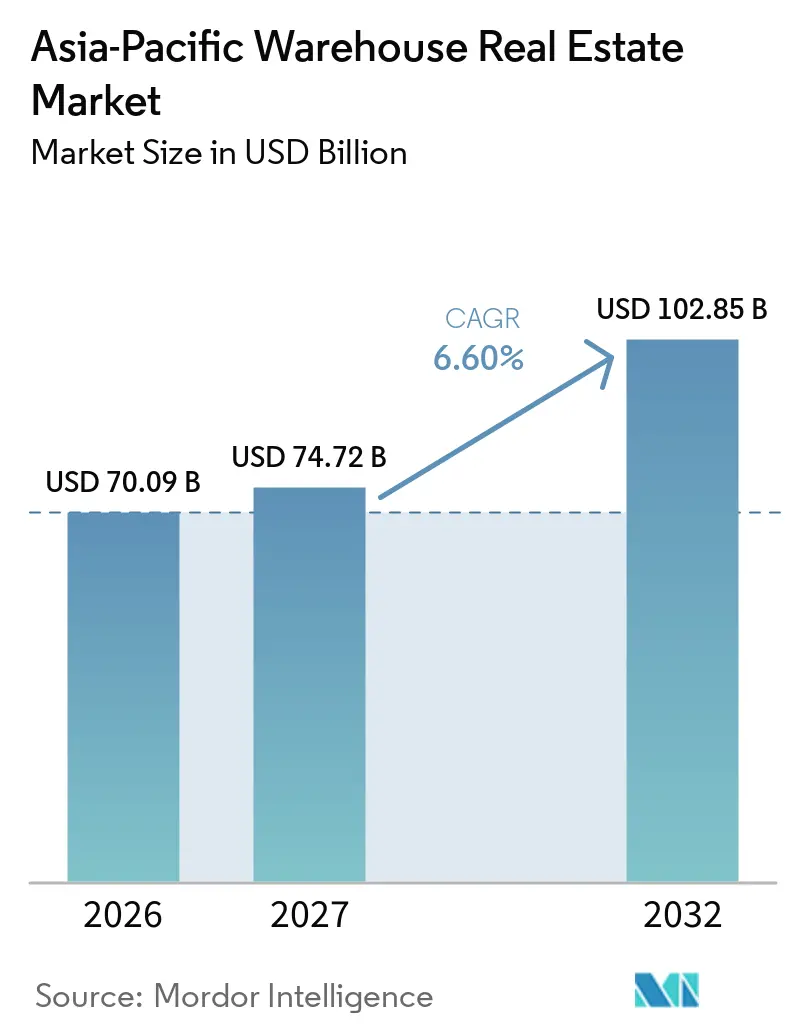
| Base Year Market Size (2026) | USD 70.09 Billion |
| Market Size (2027) | USD 74.72 Billion |
| Market Size (2032) | USD 102.85 Billion |
| Growth Rate (2027 - 2032) | 6.60 % |
| Market Concentration | Medium |
Major Players *Disclaimer: Major Players sorted in no particular order Image © Mordor Intelligence. Reuse requires attribution under CC BY 4.0. | |
Asia-Pacific Warehouse Real Estate Market Analysis by Mordor Intelligence
The Asia-Pacific Warehouse Real Estate Market size is projected to expand from USD 70.09 billion in 2026 and USD 74.72 billion in 2027 to USD 102.85 billion by 2032, registering a CAGR of 6.60% between 2027 and 2032.
The Asia-Pacific warehouse real estate market is moving beyond the supply surge seen through 2025, as new capacity is absorbed and development pipelines tighten in Australia, Japan, and Singapore. Tenants are concentrating their portfolios in better-located facilities and renewing leases for modern space, which is reducing effective vacancy in inner-city locations. Third-party logistics providers and e-commerce operators continue to support leasing demand, while manufacturers are placing more value on facilities that can support automation. China-plus-one manufacturing investment is broadening the addressable demand base in India and Southeast Asia. The Asia-Pacific warehouse real estate market also faces uneven conditions, as excess supply in some Chinese cities and currency exposure in Southeast Asia can affect investor returns.
Key Report Takeaways
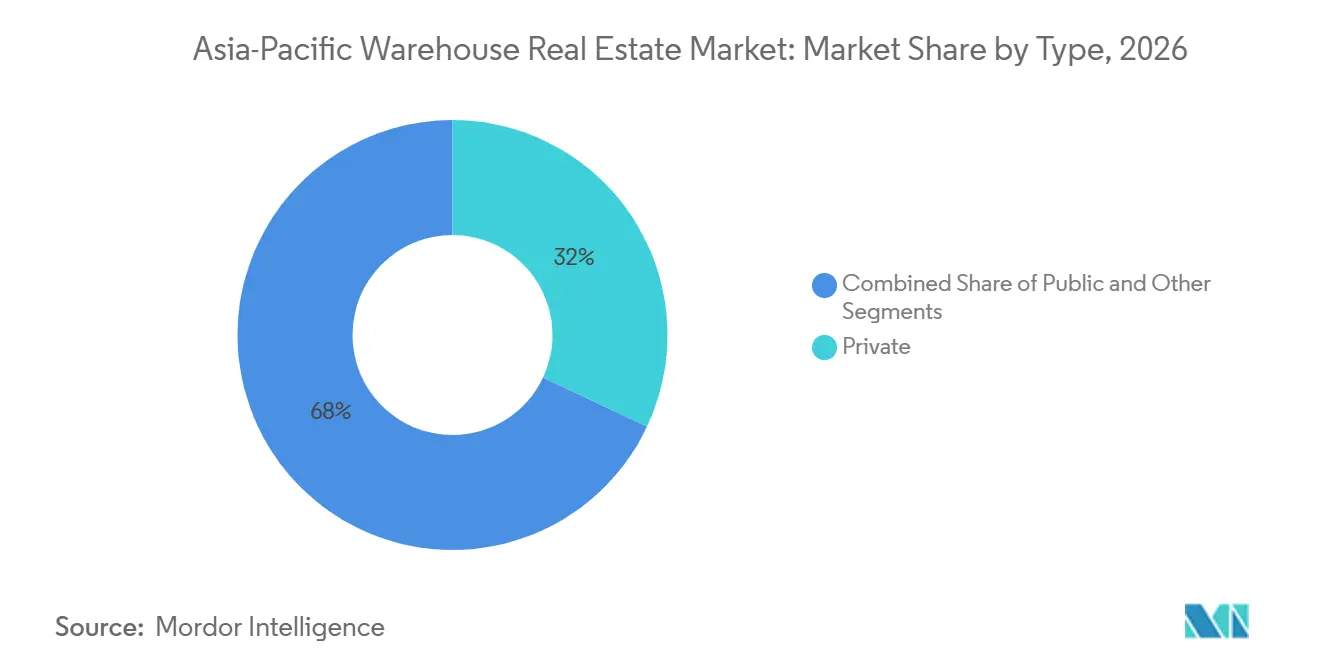
- By type, private warehouses held 32.00% of the Asia-Pacific warehouse real estate market share in 2026, while other warehouse types are forecast to grow at 8.10% CAGR through 2032.
- By temperature control, general warehouses accounted for 61.00% of the Asia-Pacific warehouse real estate market size in 2026, while refrigerated warehouses are projected to expand at 7.50% CAGR through 2032.
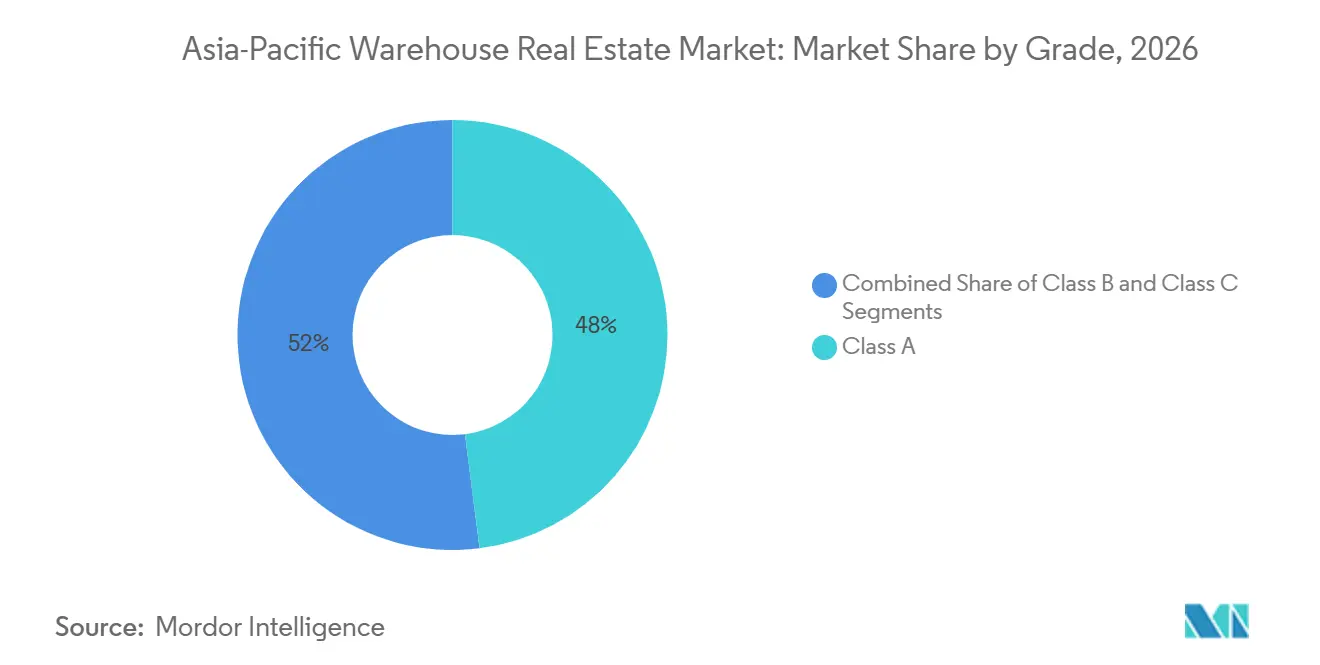
- By grade, Class A warehouses held 48.00% of the Asia-Pacific warehouse real estate market share in 2026, while Class A warehouses are forecast to grow at 9.20% CAGR through 2032.
- By warehouse size, large-scale warehouses held 36.00% of the Asia-Pacific warehouse real estate market size in 2026, while small-scale warehouses are forecast to grow at 9.10% CAGR through 2032.
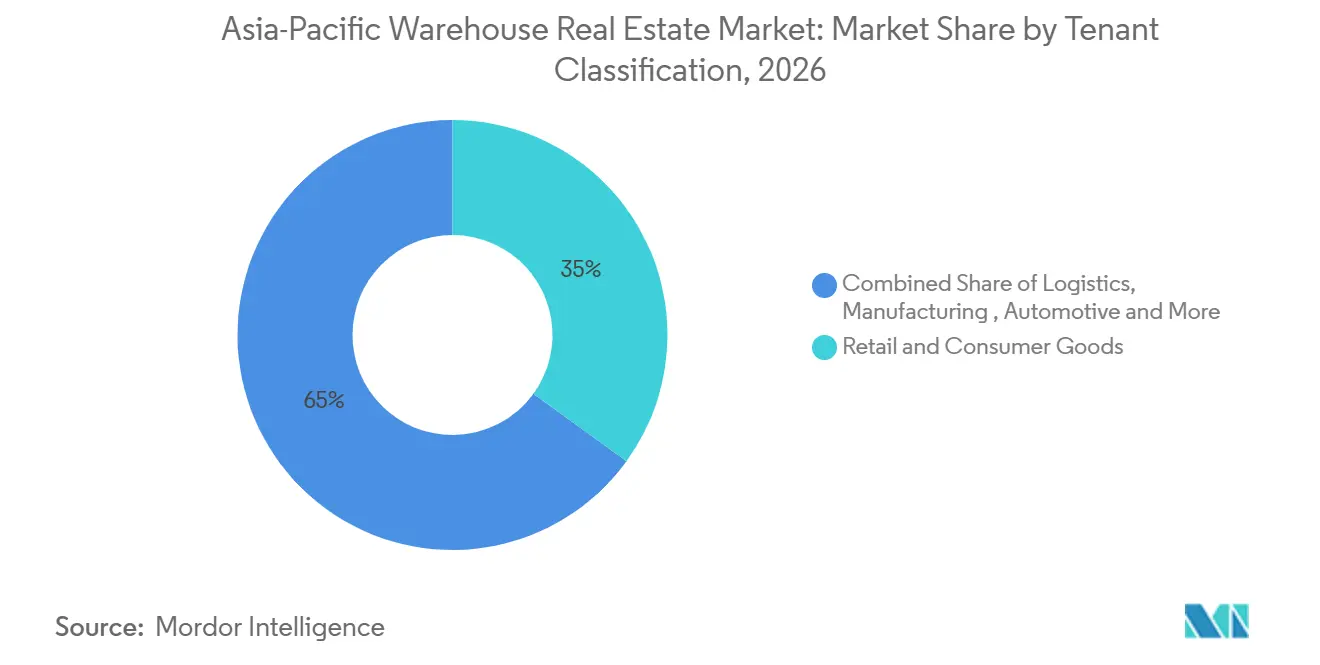
- By tenant classification, retail and consumer goods accounted for 35.00% of the Asia-Pacific warehouse real estate market size in 2026, while pharmaceuticals and healthcare are forecast to grow at 8.70% CAGR through 2032.
- By geography, China held 34.00% of the Asia-Pacific warehouse real estate market size in 2026, while India is forecast to expand at 9.40% CAGR through 2032.
Note: Market numbers in this report are based on Mordor Intelligence's proprietary estimation framework, which combines nine months of actuals with Q4 projections for base year 2026.
Market Trends and Insights
Drivers Impact Analysis of Asia-Pacific Warehouse Real Estate Market*
| Drivers | (~) % Impact on CAGR Forecast | Geographic Relevance | Impact Timeline |
|---|---|---|---|
| E-commerce Fulfillment Expansion | +2.0% | Asia-Pacific, especially China, India, South Korea, and Southeast Asia | Short term (≤ 2 years) |
| China-Plus-One Manufacturing Diversification | +1.2% | Vietnam, Indonesia, India, Malaysia, and Thailand | Medium term (2-4 years) |
| India National Logistics Policy | +0.9% | India, including Chennai, Bengaluru, Delhi-NCR, and Mumbai | Medium term (2-4 years) |
| Urban Infill and Last-Mile Logistics | +0.8% | India, South Korea, Australia, Japan, and Southeast Asian city centers | Short term (≤ 2 years) |
| Automation, Robotics, and High-Specification Facilities | +0.7% | Japan, South Korea, Australia, Singapore, and core Chinese cities | Medium term (2-4 years) |
| Pharmaceutical, Food, and Biologics Cold-Chain Investment | +0.6% | Japan, India, South Korea, Malaysia, Singapore, and Thailand | Long term (≥ 4 years) |
| Source: Mordor Intelligence | |||
Mobile-Commerce and E-commerce Fulfillment Expansion
E-commerce has become a central source of leasing demand for the Asia-Pacific warehouse real estate market. Quick-commerce operators in India are using small facilities within residential areas to support short delivery times. These locations need different layouts, power capacity, loading access, and floor strength than conventional warehouses. Larger e-commerce and third-party logistics tenants are also seeking facilities that can process higher order volumes and support automation. This is increasing the gap between modern properties and older stock that cannot be upgraded easily. The result is a stronger preference for locations that can serve dense urban demand while still meeting operating requirements.
China-Plus-One Manufacturing and Supply-Chain Diversification
Manufacturing diversification is creating demand for modern storage and light-industrial space across Southeast Asia and India. In Greater Jakarta, modern logistics warehouse occupancy reached 90% in the first quarter of 2025, supported by Chinese manufacturers entering the electric vehicle supply chain. These firms initially sought ready-to-lease factories and then turned to adapted warehouse space where suitable inventory was limited. Malaysia is seeing a comparable pattern in Penang, where electrical and electronics, medical instruments, and precision engineering investments are supporting industrial park demand. The current wave favors build-to-suit facilities and hybrid storage-plus-light-manufacturing formats. Those formats can support longer lease terms and require more capital from both landlords and occupiers.
India National Logistics Policy and Organized Warehousing
India’s National Logistics Policy is helping move warehouse demand toward more organized facilities. By August 2025, the Unified Logistics Interface Platform had facilitated more than 160 crore digital transactions across over 30 connected systems and tracked more than 75 million export-import containers across 101 Inland Container Depots[1]. The policy framework is reducing friction across logistics processes and supports greenfield warehouse development. Demand is increasingly directed toward modern facilities rather than older, unorganized stock. This matters because tenants need higher-quality buildings for inventory visibility, automation, and dependable operations. The Asia-Pacific warehouse real estate market benefits as India develops a broader pipeline of investment-grade logistics assets.
Urban Infill, Small-Bay and Last-Mile Logistics
Urban infill demand is expanding the role of small facilities in the Asia-Pacific warehouse real estate market. In India, quick-commerce platforms are converting smaller commercial premises into fulfillment hubs that typically serve a 2 km to 3 km delivery radius. Japan’s inner-city logistics locations also remain constrained because large ramp-up facilities cannot cover the same delivery corridors. Singapore’s Urban Redevelopment Authority and Land Transport Authority issued guidance for last-mile delivery infrastructure in mixed-use developments in 2026[2]. This reflects a broader shift in which logistics space is considered during urban planning. Small-bay assets in central locations can therefore serve tenants that cannot rely on outer-ring distribution centers alone.
Restraints Impact Analysis of Asia-Pacific Warehouse Real Estate Market*
| Restraints | (~) % Impact on CAGR Forecast | Geographic Relevance | Impact Timeline |
|---|---|---|---|
| Chinese Tier-Two and Tier-Three Oversupply | -0.8% | China, including tier-two and tier-three cities, the Greater Bay Area, Beijing, and Shanghai | Short term (≤ 2 years) |
| Currency Volatility and Higher Financing Costs | -0.5% | Indonesia, Vietnam, India, and Southeast Asia | Medium term (2-4 years) |
| Land Scarcity and Lengthy Infrastructure Approvals | -0.4% | Mumbai, Jakarta, Seoul, Sydney, and Singapore | Long term (≥ 4 years) |
| Power Reliability and Technology-Integration Costs | -0.3% | India’s tier-two cities, Indonesia, Vietnam, and the Philippines | Medium term (2-4 years) |
| Source: Mordor Intelligence | |||
Chinese Tier-Two and Tier-Three Oversupply and Vacancy
Excess supply in parts of China remains a material restraint for the Asia-Pacific warehouse real estate market. New capacity was added faster than net absorption in several tier-two and tier-three locations during the earlier development cycle. This has placed pressure on rents and reduced landlords’ ability to secure tenants quickly. The issue is more structural where manufacturing activity has shifted toward Southeast Asia and India. New non-bonded, high-specification supply is expected to slow, which may help the market clear over time. However, recovery will vary by city and will depend on local demand, available stock, and the pace of new construction.
Currency Volatility and Higher Local Financing Costs
Currency movements and financing costs can delay leasing and development decisions in fast-growing countries. Investors who report returns in USD can see local rental gains reduced when currencies weaken against the USD. UOB identified higher interest rates and rising supply costs as significant supply-chain management challenges for businesses across Southeast Asia[3]. Tenants may respond by leasing space in phases rather than committing to larger, longer-term requirements at once. This can slow the conversion of leasing interest into signed contracts. It also increases the value of flexible development programs and phased capital deployment.
*Our forecasts treat driver/restraint impacts as directional, not additive. The impact forecasts reflect baseline growth, mix effects, and variable interactions.
Asia-Pacific Warehouse Real Estate Market Segment Analysis
By Type:
Private Warehouses Hold the Largest Position While Other Formats Grow FasterPrivate warehouses held 32.00% of the Asia-Pacific warehouse real estate market in 2026. Large companies use dedicated facilities when they need control over building design, equipment, and daily operating processes. These facilities can support proprietary supply chains and tailor-made automation systems. They are especially relevant for manufacturers, retailers, and larger distributors that require stable capacity. The private model also lets tenants align floor specifications, power supply, and loading areas with their own equipment. This is why dedicated facilities remain important even as multi-tenant logistics platforms continue to expand.
Other warehouse types are projected to grow at 8.10% CAGR through 2032. This category includes bonded warehouses, government strategic reserves, and free-trade-zone facilities. Cross-border e-commerce is supporting demand for bonded space because it can defer import duties and shorten delivery times. Public warehouses retain a role for third-party logistics providers and smaller e-commerce firms that need flexibility. The division between public and private facilities is becoming less distinct as developers build single-tenant, build-to-suit properties owned by investment funds. The Asia-Pacific warehouse real estate industry is therefore supporting a wider range of ownership and operating arrangements.

By Temperature Control:
General Warehouses Lead While Refrigerated Space AdvancesGeneral warehouses accounted for 61.00% of the Asia-Pacific warehouse real estate market size in 2026. Their scale reflects broad demand from retail, manufacturing, e-commerce, and standard distribution activities. These facilities remain the foundation of logistics networks because they serve many product categories. Retailers use them for inventory positioning, while manufacturers use them for components and finished goods. Third-party logistics providers also rely on general warehouse capacity to serve several customers. The segment will remain essential even as specialized facilities capture more investment.
Refrigerated warehouses are forecast to grow at 7.50% CAGR through 2032. Pharmaceutical companies need multi-temperature storage for biologics, cell and gene therapies, and other sensitive products. Food and grocery distribution also require reliable cold storage as fresh e-commerce and quick commerce expand. DHL Group has committed capital to Asia-Pacific healthcare logistics through 2030, including new certified pharmaceutical hubs and expanded cold-chain capacity. Such facilities need controlled temperature zones, monitoring systems, and operating procedures that conventional warehouses do not provide. This raises the entry barrier for developers and favors assets designed for regulated storage from the outset.
By Grade:
Class A Warehouses Set the Standard for Modern Logistics DemandClass A warehouses held 48.00% of the Asia-Pacific warehouse real estate market in 2026. These facilities offer high clear heights, stronger floor loadings, modern loading areas, and more dependable power infrastructure. Occupiers use these characteristics to install automation and improve throughput. The segment also benefits from demand for energy-efficient building designs and better operating standards. Class A assets are usually concentrated in established logistics corridors and gateway-city markets. Their leading position shows that many institutional occupiers now treat modern specifications as a baseline requirement.
Class A is also the fastest-growing grade, with a forecast CAGR of 9.20% through 2032. Class B facilities remain relevant where modern supply is limited or cost sensitivity is high. Class C properties face greater pressure where older layouts cannot accommodate automation, high power needs, or compliance requirements. In gateway cities, higher land prices make it harder to justify lower-specification development on well-located sites. Goodman Group’s fiscal year 2026 report describes logistics and data-center co-development across Japan, Hong Kong, and Australia, reflecting a move toward more power-intensive sites. The Asia-Pacific warehouse real estate industry is therefore seeing a broader separation between modern premium properties and aging secondary stock.
By Warehouse Size:
Large Facilities Lead the Base While Small Formats Expand FastestLarge-scale warehouses held 36.00% of the Asia-Pacific warehouse real estate market in 2026. These properties support national distribution centers, e-commerce fulfillment hubs, and large manufacturing storage requirements. Their scale can reduce management intensity per square foot and accommodate long lease commitments. Institutional investors also value large facilities where tenants have strong credit profiles and operations are well established. Modern large-format space remains important in regional logistics corridors with highway access and deep labor pools. It will continue to anchor leasing volumes across the region.
Small-scale warehouses are projected to expand at 9.10% CAGR through 2032. These facilities are being used for last-mile logistics, dark stores, pharmaceutical distribution points, and dense urban delivery networks. Medium-scale buildings serve regional distribution and food distribution but face competition from both larger hubs and smaller city sites. The fastest growth is occurring where tenants need close access to consumers and cannot serve the area efficiently from a distant distribution center. Zoning, land availability, and building conversion opportunities will shape the supply response. Developers with urban land banks in Mumbai, Delhi-NCR, and Bengaluru may have an advantage in this part of the Asia-Pacific warehouse real estate market.
By Tenant Classification:
Retail Leads Current Demand While Healthcare Grows FastestRetail and consumer goods occupiers held 35.00% of the Asia-Pacific warehouse real estate market in 2026. Omnichannel inventory models require companies to position stock across multiple locations rather than rely only on centralized distribution centers. Food and beverage tenants add demand for both large-format and temperature-controlled space. Manufacturing users remain important in automotive, electronics, and chemicals supply chains. These tenants are valued by landlords because their operating needs can support longer commitments. Retail’s current scale reflects the continued importance of consumer distribution across Asia-Pacific.
Pharmaceuticals and healthcare are forecast to grow at 8.70% CAGR through 2032. Healthcare tenants need regulated space, qualified operators, and consistent temperature performance. Third-party logistics providers often operate between pharmaceutical shippers and landlords, but the quality requirements are set by the underlying healthcare customer. DHL Global Forwarding opened a dual-certified cold-chain facility in Malaysia in August 2025 for 15°C to 25°C and 2°C to 8°C storage. These requirements can support longer leases and higher effective rents at suitable facilities. The Asia-Pacific warehouse real estate market is consequently drawing more capital toward buildings that combine cold-chain capability with strong compliance processes.
Geography Analysis
China held 34.00% of the Asia-Pacific warehouse real estate market share in 2026, reflecting the scale of its logistics base. Conditions differ sharply by location, with supply pressure in some major and secondary markets affecting rents and vacancy. The earlier construction cycle added a large amount of modern capacity, and absorption has not been uniform. Western and central cities may stabilize earlier where manufacturing relocation and inland trade support demand. China will remain the region’s largest volume market because of its manufacturing footprint, domestic consumption, and distribution infrastructure. Yet investors are likely to distinguish more carefully between supply-constrained areas and locations with persistent overcapacity.
India is forecast to grow at 9.40% CAGR through 2032, the fastest rate among the geographic markets covered. The Asia-Pacific warehouse real estate market size in India is supported by logistics policy reforms, e-commerce growth, manufacturing investment, and wider use of organized Grade A facilities. Prologis has committed approximately USD 1 billion over 5 years to 7 years for Grade A logistics parks in Bengaluru, Chennai, Mumbai, Delhi, and Pune. Japan continues to require modern logistics space because of e-commerce demand and shortages in regional cities. Australia’s Sydney and Brisbane markets are positioned to benefit as the development pipeline tightens. South Korea is also attracting interest in dry logistics facilities that can support technology supply chains and advanced fulfillment operations.
Southeast Asia is an important part of the wider regional opportunity as manufacturing diversification continues. Malaysia’s Penang corridor is developing as a technology-oriented industrial logistics location with planned land supply near Bayan Lepas International Airport. Vietnam is also receiving new supply as its occupier base matures. Singapore remains important for high-value, technology-enabled logistics and investment management. Across the Asia-Pacific warehouse real estate market, geographic performance will depend on the balance of new construction, manufacturing activity, consumer demand, and infrastructure delivery.
Competitive Landscape
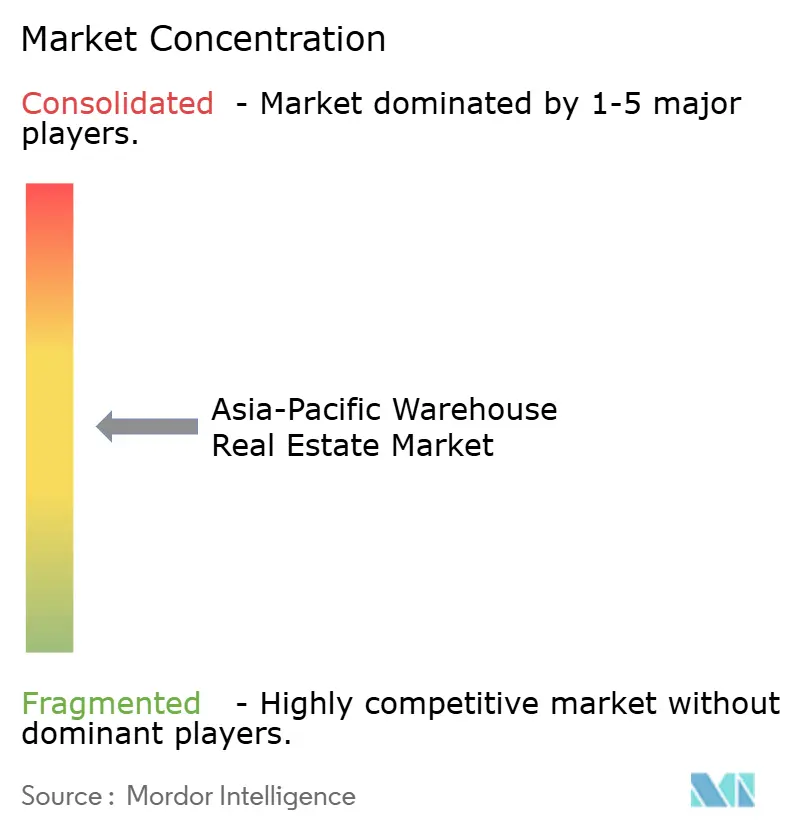
The Asia-Pacific warehouse real estate market is moderately concentrated among regional platform owners but remains fragmented across individual cities and countries. ESR Group, GLP, Goodman Group, Mapletree Investments, and CapitaLand Investment operate across several Asia-Pacific markets through development and fund-management platforms. Their advantages include access to institutional capital, local development teams, and relationships with large occupiers. ESR completed the full integration of LOGOS, creating a combined platform with USD 156 billion in assets under management and a USD 14 billion development workbook. This scale gives larger platforms an advantage when they need to fund multi-market projects. Local developers still retain an important role in markets where land sourcing and city-specific operating knowledge matter most.
Competition increasingly centers on modern specifications, sustainability credentials, and automation readiness. Charter Hall and Mitsubishi Estate Asia formed a joint venture in February 2026 to develop a 40,000-square-meter industrial and logistics estate at Laverton North in Melbourne, targeting a 5-Star Green Star rating. Prologis is expanding in India through logistics parks that combine development, leasing, design, financing, and property management capabilities. Goodman is also linking logistics development with data-center activity in selected Asia-Pacific markets. These strategies respond to occupiers that want reliable operations and fewer counterparties across multiple locations. They also make it more difficult for smaller firms to compete only on land availability or rental price.
Investment partnerships are another central feature of the competitive environment. ESR welcomed BNP Paribas Asset Management Alts and PGGM as co-investors in its Yokohama Sachiura Distribution Centre 3 in February 2026. CapitaLand Investment acquired a minority stake in Ally Logistic Property in January 2026 to expand smart logistics infrastructure across Asia-Pacific. Mitsui O.S.K. Lines also invested in the automated OMEGA 1 Singapore facility within a CapitaLand-managed logistics fund in January 2026. These moves show how platform owners are bringing together long-term capital, automation, and operating expertise. The Asia-Pacific warehouse real estate market has room for specialized developers in city-infill and pharmaceutical cold-chain facilities, but larger platforms remain better placed to serve large regional customers.
Asia-Pacific Warehouse Real Estate Industry Leaders
-
Goodman Group
-
GLP Pte. Ltd.
-
ESR Group Limited
-
Mapletree Investments Pte Ltd
-
CapitaLand Investment Limited
- *Disclaimer: Major Players sorted in no particular order
Asia-Pacific Warehouse Real Estate Market Companies Covered in this Report
- Goodman Group
- GLP Pte. Ltd.
- ESR Group Limited
- Mapletree Investments Pte Ltd
- CapitaLand Investment Limited
- Frasers Property Limited
- Prologis, Inc.
- LOGOS Property Group
- Link Logistics Real Estate
- Dexus
- Charter Hall Group
- Centuria Capital Group
- Keppel Ltd.
- Mitsui Fudosan Co., Ltd.
- Panattoni Development Company, Inc.
- Blackstone Real Estate
- AIMS APAC REIT
- VGP NV
- Mitsui & Co., Ltd.
- DHL Supply Chain
Recent Industry Developments in Asia-Pacific Warehouse Real Estate Market
- March 2026: Prologis, Inc. commenced construction of Prologis Park Redhills CPRR in North Chennai, a Grade A industrial and logistics park with total development potential of 1.1 million square feet. The project forms part of Prologis’ wider development commitment in Tamil Nadu across Hosur, Sriperumbudur, and Redhills.
- February 2026: Charter Hall Group and Mitsubishi Estate Asia established a joint venture to develop a 40,000-square-meter industrial and logistics estate at Laverton North, Melbourne, as the first stage of a broader development with 175,000 square meters of total potential. The project targets a 5-Star Green Star rating and construction commenced in January 2026.
- February 2026: ESR welcomed BNP Paribas Asset Management Alts and PGGM as co-investors in ESR Yokohama Sachiura Distribution Centre 3, a 4-story logistics campus exceeding 165,000 square meters at Yokohama City Port. The asset forms part of ESR’s 30-hectare logistics campus designed for high-quality, energy-efficient operations.
Asia-Pacific Warehouse Real Estate Market Report Scope
Segmentation Overview
| Public |
| Private |
| Others |
| General Warehouse |
| Refrigerated Warehouse |
| Class A |
| Class B |
| Class C |
| Small-Scale Warehouses, Under 50,000 sq ft |
| Medium-Scale Warehouses, 50,000-250,000 sq ft |
| Large-Scale Warehouses, Above 250,000 sq ft |
| Manufacturing |
| Retail and Consumer Goods |
| Food and Beverage |
| Pharmaceuticals and Healthcare |
| Logistics |
| Other End Users |
| China |
| India |
| Japan |
| South Korea |
| Australia |
| Indonesia |
| Rest of Asia-Pacific |
| By Type | Public |
| Private | |
| Others | |
| By Temperature Control | General Warehouse |
| Refrigerated Warehouse | |
| By Grade | Class A |
| Class B | |
| Class C | |
| By Warehouse Size | Small-Scale Warehouses, Under 50,000 sq ft |
| Medium-Scale Warehouses, 50,000-250,000 sq ft | |
| Large-Scale Warehouses, Above 250,000 sq ft | |
| By Tenant Classification | Manufacturing |
| Retail and Consumer Goods | |
| Food and Beverage | |
| Pharmaceuticals and Healthcare | |
| Logistics | |
| Other End Users | |
| By Countries | China |
| India | |
| Japan | |
| South Korea | |
| Australia | |
| Indonesia | |
| Rest of Asia-Pacific |
Key Questions Answered in the Report
What is the projected value of the Asia-Pacific warehouse real estate market by 2032?
The sector is forecast to reach USD 102.85 billion by 2032, growing at a 6.60% CAGR from 2027 to 2032.
Which warehouse type has the largest share in Asia-Pacific?
Private warehouses lead with 32.00% of revenue in 2026 because large occupiers need dedicated and configurable space.
Which warehouse format is growing fastest in the region?
Small-scale warehouses are projected to grow at 9.10% CAGR through 2032 as last-mile and urban fulfillment needs increase.
Why is refrigerated warehouse capacity expanding in Asia-Pacific?
Refrigerated space is forecast to grow at 7.50% CAGR because pharmaceutical, biologics, food, and fresh e-commerce supply chains need controlled storage.
Which country will grow fastest through 2032?
India is forecast to grow at 9.40% CAGR through 2032, supported by logistics reforms, manufacturing investment, and modern warehouse development.
What features do tenants seek in new warehouse facilities?
Tenants increasingly seek reliable power, strong floor loading, suitable loading access, automation compatibility, and temperature control where required.