
Asia-Pacific Technical Textile Manufacturing Market Size and Share
Market Overview
| Study Period | 2021 - 2032 |
|---|---|
| Forecast Data Period | 2027 - 2032 |
| Base Year Market Size (2026) | USD 132.70 Billion |
| Market Size (2027) | USD 143 Billion |
| Market Size (2032) | USD 205.30 Billion |
| Growth Rate (2027 - 2032) | 7.50 % |
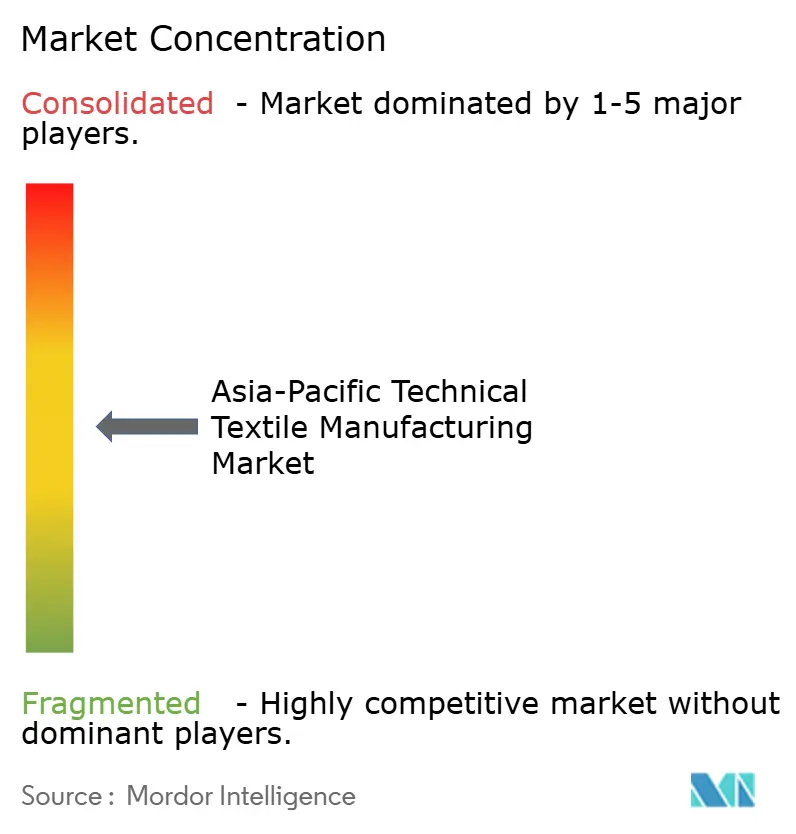
| Market Concentration | Medium |
Major Players *Disclaimer: Major Players sorted in no particular order Image © Mordor Intelligence. Reuse requires attribution under CC BY 4.0. | |
Asia-Pacific Technical Textile Manufacturing Market Analysis by Mordor Intelligence
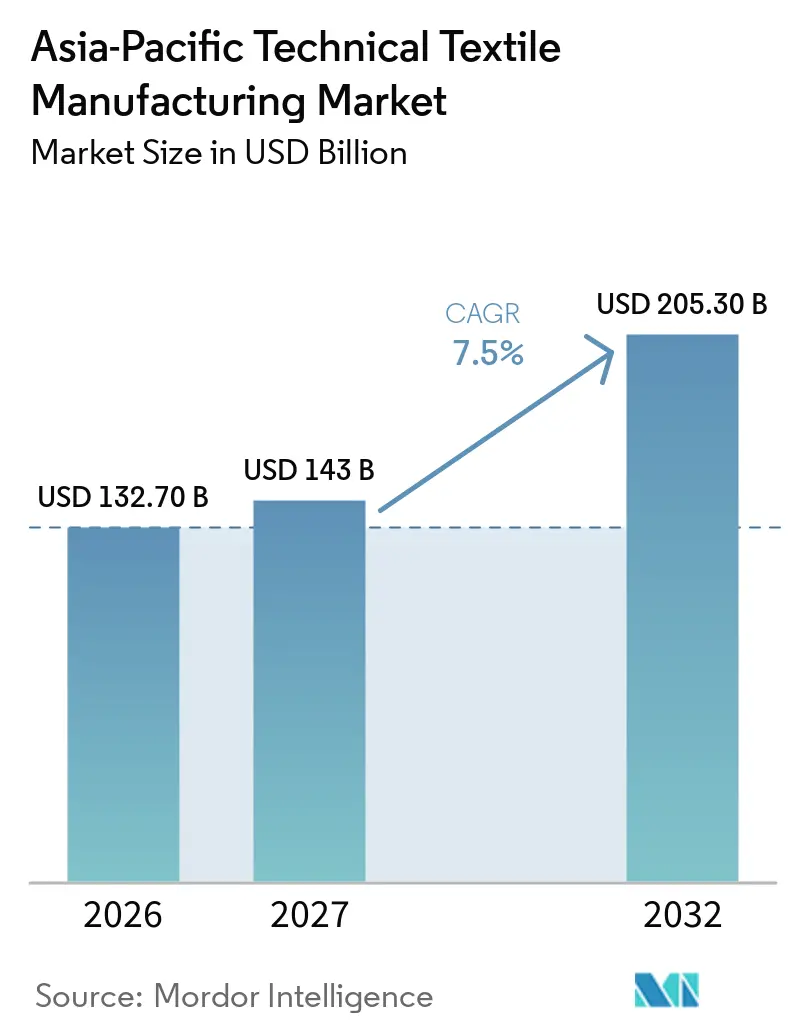
The Asia-Pacific Technical Textile Manufacturing Market size is projected to be USD 132.70 billion in 2026, USD 143 billion in 2027, and reach USD 205.30 billion by 2032, growing at a CAGR of 7.5% from 2027 to 2032.
The Asia-Pacific market is benefiting from the growing adoption of high-performance technical textiles across automotive, industrial, construction, and medical applications. Manufacturers are increasingly investing in specialized nonwoven fabrics, coated textiles, and composite reinforcement materials to meet requirements for thermal resistance, durability, lightweighting, and filtration efficiency. The expansion of electric vehicle manufacturing is creating opportunities for flame-resistant barriers, battery insulation, and acoustic materials, while infrastructure development is supporting demand for geotextiles, roofing membranes, and reinforcement fabrics. At the same time, companies are diversifying sourcing and production networks across India and Southeast Asia to improve supply-chain resilience and reduce dependence on concentrated manufacturing hubs. However, differences in technical standards, high investment requirements for advanced processing equipment, and fluctuating polymer prices continue to influence production economics. Suppliers that strengthen application-specific R&D, establish long-term partnerships with OEMs, and improve sustainable material capabilities are likely to gain a competitive advantage as demand shifts toward higher-value technical textile solutions.
Key Report Takeaways
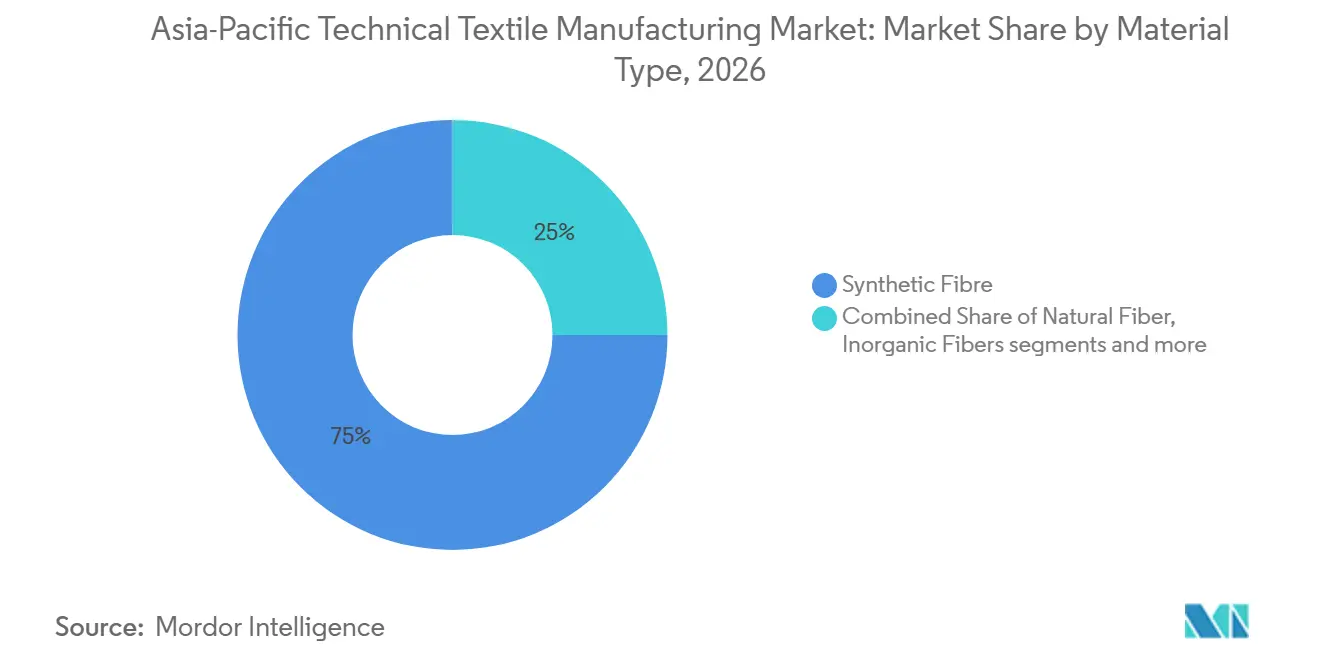
- By material type, synthetic fiber held 75% of the Asia-Pacific technical textile manufacturing market share in 2026, while regenerated and other specialty fibers are forecast to grow at 8.5% CAGR through 2032.
- By form and structure, nonwoven technical textiles accounted for 40% of the Asia-Pacific technical textile manufacturing market size in 2026 and are forecast to expand at 8.0% CAGR through 2032.
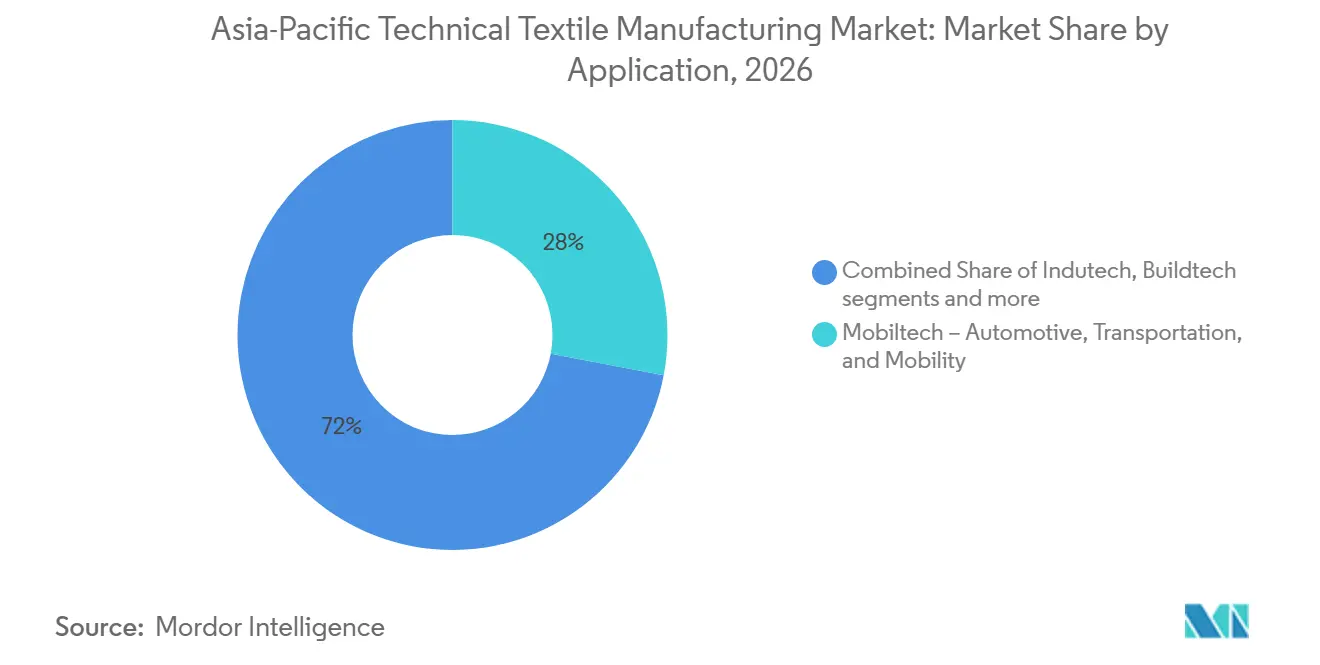
- By application, Mobiltech accounted for 28% of revenue in 2026 and is forecast to record the highest CAGR at 9.0% through 2032.
- By geography, China held 58% of regional production in 2026, while India is forecast to grow at 9.0% CAGR through 2032.
Note: Market numbers in this report are based on Mordor Intelligence's proprietary estimation framework, which combines nine months of actuals with Q4 projections for base year 2026.
Asia-Pacific Technical Textile Manufacturing Market Trends and Insights
Drivers Impact Analysis*
| Driver | (~) % Impact on CAGR Forecast | Geographic Relevance | Impact Timeline |
|---|---|---|---|
| Automotive Lightweighting and EV Thermal-Acoustic Systems | +1.8% | China, Japan, South Korea, India | Short term (≤ 2 years) |
| Infrastructure, Geotechnical, and Climate-Resilience Investment | +1.5% | China, India, Indonesia, Vietnam, Philippines | Medium term (2-4 years) |
| Medical, Hygiene, and Filtration Capacity Expansion | +1.2% | Asia-Pacific, concentrated in China, India, and Southeast Asia | Medium term (2-4 years) |
| China-Plus-One Manufacturing Diversification | +0.9% | India, Vietnam, Thailand, Indonesia | Medium term (2-4 years) |
| Government-Backed Technical-Textile Substitution and R&D | +0.7% | India, China, Vietnam | Long term (≥ 4 years) |
| Digital Traceability and Recycled-Fiber Qualification | +0.4% | Asia-Pacific exporters to EU markets, China, and India | Long term (≥ 4 years) |
| Source: Mordor Intelligence | |||
Automotive Lightweighting and EV Thermal-Acoustic Systems
The Asia-Pacific technical textile manufacturing market is gaining from the greater material intensity of battery-electric vehicle platforms. These vehicles use added thermal-management layers, battery-insulation barriers, acoustic dampening materials, and electromagnetic-shielding components. The battery-electric vehicles use 10-15 kilograms of nonwoven fabric, compared with 8-12 kilograms in a comparable internal-combustion vehicle. Asia-Pacific produced 48-50 million light vehicles in 2025, with China contributing more than 26 million units. Honda’s 0 Series program and Toyota Boshoku’s Integrated Cabin 2030 concept show how vehicle programs are moving textiles from trim applications toward functional, multi-system components.
Infrastructure, Geotechnical, and Climate-Resilience Investment
Infrastructure spending supports steady demand for geotextiles, drainage composites, and erosion-control fabrics across the Asia-Pacific technical textile manufacturing market. China’s 14th Five-Year Plan directs resources toward transport infrastructure, urban flood resilience, and coastal reclamation projects. The industry association identifies more than USD 150 billion in 2025 spending for Chinese highway and high-speed rail projects that use geotextiles for subgrade stabilization and drainage. India’s National Infrastructure Pipeline targets more than USD 1.4 trillion in cumulative investment through 2030, supporting road and rail demand for soil-reinforcement textiles. Indonesia, Vietnam, and the Philippines are investing in expressways, ports, and urban drainage upgrades. Procurement specifications in flood-prone areas increasingly favor products with documented long-service performance, which raises the standard for suppliers competing beyond price.
Medical, Hygiene, and Filtration Capacity Expansion
Medical, hygiene, and filtration applications are expanding demand for specialized technical textiles across Asia-Pacific, supported by healthcare infrastructure investment, infection-control requirements, and pharmaceutical manufacturing. The reported 1.863 million tons of meltblown, spunbond, and spunlace capacity in Southeast Asia in 2025, alongside utilization of 66.9%, indicates a growing production base with scope for improved capacity absorption. Demand for antimicrobial surgical drapes, advanced wound-care materials, and high-efficiency filtration media is encouraging manufacturers to move toward higher-value products with stricter performance and quality requirements. Vietnam’s reported medical-textile exports of more than USD 2.96 billion in 2025 also highlight opportunities to integrate regional manufacturing with international healthcare supply chains, supported by trade access under the CPTPP and EVFTA. In Japan, Asahi Kasei’s August 2025 decision to build a new Planova virus-removal hollow-fiber spinning facility further demonstrates investment in specialized filtration materials for biopharmaceutical production. These developments favor manufacturers with validated production processes, consistent product quality, and capabilities in advanced fiber technologies, although regulatory compliance, qualification timelines, and investment costs may constrain the entry of smaller suppliers.[1]
China-Plus-One Manufacturing Diversification
Trade-policy pressure is encouraging capacity additions outside China and is reshaping the Asia-Pacific technical textile manufacturing market. Kolon Industries announced a KRW 70 billion (USD 48.57 billion) investment in an integrated airbag-fabric plant in Ho Chi Minh City that covers weaving, processing, and coating. Hyosung TNC received approval for a USD 730 million bio-spandex facility in Vietnam that integrates bio-butanediol and bio-spandex manufacturing. Freudenberg Performance Materials expanded its Chennai operation in 2025, adding lines for cotton and polyester interlinings previously sourced from China. TWE Group started construction of a Bhopal nonwovens facility with space for up to 6 hygiene lines. These investments indicate that qualification activity is moving with manufacturing capacity, rather than being limited to commodity production.
Restraints Impact Analysis*
| Restraint | (~) % Impact on CAGR Forecast | Geographic Relevance | Impact Timeline |
|---|---|---|---|
| Volatile Polymer, Energy, and Specialty-Fiber Input Costs | -2.0% | Asia-Pacific, especially India, China, and Southeast Asia | Short term (≤ 2 years) |
| High Qualification Cost and Long Customer Approval Cycles | -1.4% | Asia-Pacific exporters serving automotive, medical, and defense OEMs | Medium term (2-4 years) |
| Zero-Liquid-Discharge and Carbon-Compliance Capital Expenditure | -0.9% | India, China, Indonesia, Vietnam | Medium term (2-4 years) |
| Shortage of Process Engineers, Loom Operators, and Testing Talent | -0.7% | Vietnam, India, ASEAN | Long term (≥ 4 years) |
| Source: Mordor Intelligence | |||
Volatile Polymer, Energy, and Specialty-Fiber Input Costs
Polyester is a major channel through which oil-price changes affect the Asia-Pacific technical textile manufacturing market. Polyester represented 59% of global fiber production in 2025, which leaves many regional textile supply chains exposed to paraxylene, purified terephthalic acid, and monoethylene glycol costs.[2] According to industry association reports, disruptions to oil-product flows through the Strait of Hormuz have raised uncertainty for these feedstocks. Chinese monoethylene glycol inventory fell 4% week on week in March 2026, adding difficulty for nonwoven and yarn producers planning production. Nylon producers face a similar issue because polymerization requires substantial energy inputs. Long-cycle automotive and infrastructure contracts limit the ability of suppliers to pass abrupt increases through to customers.
High Qualification Cost and Long Customer Approval Cycles
Qualification requirements restrict entry into premium portions of the Asia-Pacific technical textile manufacturing market. Automotive programs using IATF 16949 and VDA standards require validation for thermal performance, vibration, flammability, and long-term durability. The industry association states that approval can take 18-36 months before a supplier is added to an approved vendor list. The Asian Productivity Organization identified a mismatch between training capacity and practical requirements for advanced testing in Vietnam’s textile and garment sector.[3] The International Labour Organization reported that trained workers meet 40% of Vietnam’s textile-sector needs, delaying both testing and production ramp-up. Medical products also require ISO 13485 conformity assessment, and underused capacity can persist for 1-3 years after commissioning.
*Our forecasts treat driver/restraint impacts as directional, not additive. The impact forecasts reflect baseline growth, mix effects, and variable interactions.
Segment Analysis
By Material Type: Polymer Dominance Shifting as Circular Alternatives Scale
Synthetic fiber held 75% of the Asia-Pacific technical textile manufacturing market share in 2026. Polyester, polypropylene, and polyamide benefit from established processing systems in China, India, South Korea, and Thailand. Polyester serves tire cord fabrics, industrial yarns, filtration media, and nonwoven substrates. Polyamide and nylon are used in seatbelts, airbag cushions, and industrial ropes. Kolon Industries’ aramid business experienced an export-price recovery in 2025 as global demand rose 5% with the expansion of 5G networks. Polypropylene remains important for geotextiles and hygiene nonwovens because it provides chemical resistance and lower processing costs. Ultra-high-molecular-weight polyethylene is gaining use in cut-resistant protective materials and offshore ropes.
Regenerated and other specialty fibers are forecast to grow at 8.5% CAGR from 2027 to 2032, the highest rate among material categories. This part of the Asia-Pacific technical textile manufacturing market responds to growing demand for traceable and circular material supply chains. Grasim Industries introduced Raysileco in August 2025 as a traceable viscose filament yarn using TextileGenesis Fibercoin technology. Inorganic fibers, including carbon, glass, and basalt, retain high-value roles in aerospace, wind-energy, and construction composites. Toray Advanced Materials Korea completed a PPS-fiber expansion in 2025, adding high-temperature material capacity for automotive and electronics uses. Natural fibers and conductive specialty fibers continue to serve narrower applications. Jute-based geotextiles are used where Indian projects specify biodegradability. Material selection, therefore, increasingly combines mechanical performance, cost, regulatory treatment, and the ability to prove recycled or renewable content. Producers with integrated polymer, fiber, and fabric operations are better placed to control quality across that chain.

By Form and Structure: Nonwovens Drive Both Volume and Value Growth
Nonwoven technical textiles captured 40% of the Asia-Pacific technical textile manufacturing market size in 2026 and are forecast to grow at 8.0% CAGR through 2032. Spunbond, meltblown, needlepunch, and spunlace processes serve disposable hygiene products, filtration media, battery insulation, and geotextile reinforcement. This range lets producers supply applications with substantially different performance requirements. The LYCRA Company opened a facility in Yinchuan in November 2025, with an investment of more than RMB 800 million (USD 114.26 million) and an initial capacity of 30,000 tons of spandex. The facility illustrates continuing investment in performance-fiber inputs used across downstream textile forms.
Spunweb India added 2 spunbond lines in August 2025, bringing group capacity to 39,140 metric tons per year and directing supply toward packaging, agriculture, and industrial applications. Wisdom Group commissioned a 4.2-meter air-through bonding line in China in 2025 and reported annual air-through carding capacity above 45,000 tons. Woven technical textiles retain an important role in tire cord, industrial belting, geogrids, and woven filtration fabric. Their directional strength and dimensional stability remain difficult to match in some high-load uses. SRF maintained an FY26 capital expenditure plan of INR 22-23 billion (USD 244.9 - 256.0 million) and commissioned belting-fabric capacity and dipping-machine upgrades in 2025. Knitted, braided, yarn, cord, and roving products support seating, medical compression, marine, composite, aerospace, and pressure-vessel applications.
By Application: EV Transition Accelerates Mobiltech Demand
Mobiltech held 28% of application revenue in 2026 and is projected to grow at 9.0% CAGR through 2032. This application area has the highest forecast rate in the Asia-Pacific technical textile manufacturing market. Vehicle electrification increases demand for nonwoven battery-insulation layers, acoustic headliners, thermal-protection fleece, and seating materials designed for passive energy management. The requirements reflect noise, vibration, and thermal conditions that differ from those in conventional vehicles. OEM lightweighting programs add another route to increased textile use. Material suppliers must meet demanding qualification requirements before they can participate in these programs.
Indutech is the second-largest end-use cluster, supported by industrial belts, filtration media, conveyor substrates, and mechanical sealing. Manufacturing expansion across ASEAN supports demand for these process textiles. Buildtech includes geotextiles, roofing substrates, façade membranes, and tunnel liners, and benefits from transport and construction investment. Medtech has the highest average unit values and requires substantial research and development investment. Geotech, Protech, Agrotech, and Oekotech serve climate resilience, worker safety, agriculture, aquaculture, and environmental remediation. Packtech, Hometech, Clothtech, and Sporttech are smaller individually but collectively support demand for nonwovens and specialty yarns. Their contribution helps suppliers balance exposure to larger automotive, construction, and health care programs. The diversity of these applications also favors manufacturers with flexible process capability and a broad product-qualification base.
Geography Analysis
China held 58% of the Asia-Pacific technical textile manufacturing market share in 2026. Its position rests on integrated polymer supply, large-scale manufacturing infrastructure, and proximity to major automotive and construction markets. China’s 14th Five-Year Plan treats technical textiles as an advanced-materials priority and supports demand through infrastructure projects. Yanpai Filtration Technology ordered 2 high-performance needlepunch lines in December 2025, with commissioning planned for Q3 2026. Wisdom Group’s air-through bonding line also reflects investment in process capability. These projects suggest that Chinese producers are competing on technology and integration, rather than labor cost alone.
India is forecast to grow at 9.0% CAGR from 2027 to 2032, the fastest rate among geographies. The PLI Scheme for Textiles had 32 technical-textile applicants, with commitments of INR 15,681 crore (USD 1,745.3 million) and projected turnover of INR 90,422 crore (USD 10.1 billion) as of February 2026. The program covered 113 units under development across 17 states and 1 union territory. The National Technical Textiles Mission allocated USD 177 million across 168 research and development projects in carbon fiber, aramid, and high-performance geosynthetics. Japan and South Korea remain important high-value manufacturing centers. Toray Advanced Materials Korea expanded meta-aramid capacity to 5,400 tons per year, strengthening regional supply for heat-resistant protective materials and cable reinforcement.
Vietnam, Indonesia, Thailand, Malaysia, and the Philippines are absorbing supply-chain diversification investment. Vietnam combines CPTPP and EVFTA access, a 3-million-person textile workforce, and investment in technical nonwovens and fibers. Vietnam’s Decision No. 1643/QD-TTg targets a 15% reduction in textile energy consumption and a 20% reduction in water use by 2030. Indonesia and Thailand have established industrial-textile supply chains for geotextiles and filtration nonwovens. Malaysia and the Philippines are developing medical-textile demand through established pharmaceutical and medical-device ecosystems. Oceancash Pacific Berhad doubled its nonwoven capacity to 16,000 tons per year through 2025, targeting PPE and hygiene-media demand.
Competitive Landscape
The Asia-Pacific technical textile manufacturing market exhibits a medium level of market concentration. Toray, Teijin, and Asahi Kasei hold strong positions in high-value fiber, filtration, and engineered-material categories. Their advantages include long-standing customer relationships, technical research, and the ability to meet demanding performance requirements. Teijin launched Digital Product Passport-compliant aramid and carbon-fiber products in April 2025 using Circularise traceability technology. Asahi Kasei’s Planova facility decision is another example of investment in regulated, high-value applications. These actions connect material innovation with traceability and customer qualification.
Korean suppliers are expanding their regional production footprint through specialty materials. Hyosung TNC is building a bio-spandex position in Vietnam, while Kolon Industries is integrating airbag-fabric production in the same country. Indian companies such as SRF, Garware Technical Fibres, and Strata Geosystems are building domestic and export positions in tire cord, aquaculture nets, and geosynthetics. Chinese mid-tier producers are using vertical integration and automation to improve their competitive position. The LYCRA Company’s Yinchuan facility and Yanpai’s needlepunch investments demonstrate a focus on manufacturing technology. Producers serving automotive and medical customers are increasingly evaluated on verified sustainability data as well as material performance. Digital product passports can turn traceability from a compliance requirement into a differentiating feature during customer tenders. Southeast Asian manufacturers can also compete by shortening regional lead times for hygiene nonwovens and specialty fibers.
Automation is becoming a practical response to quality, yield, and workforce constraints. Rockwell Automation reported that 94% of regional manufacturers were investing in artificial intelligence to address operational and workforce challenges in 2025. This trend supports real-time production monitoring, quality control, and traceability in complex technical-textile production. The market opportunity is strongest where regional suppliers can qualify high-performance materials for defense and aerospace customers that currently depend on imports. Such business requires investment in testing, process control, and certified supply systems. Standard-volume segments remain more exposed to price competition and feedstock fluctuations. These conditions explain why scale alone does not secure leading positions across the Asia-Pacific technical textile manufacturing market. The premium end rewards firms that can maintain repeatable performance, document raw material origin, and satisfy long approval processes. Standard producers can still win business through regional supply security, cost discipline, and reliable delivery. The split between these models makes the competitive environment diverse across material types and customer groups.
Asia-Pacific Technical Textile Manufacturing Industry Leaders
-
Toray Industries, Inc.
-
Asahi Kasei Corporation
-
Teijin Limited
-
Toyobo Co., Ltd.
-
Mitsubishi Chemical Group Corporation
- *Disclaimer: Major Players sorted in no particular order
Recent Industry Developments
- February 2026: India’s Ministry of Textiles confirmed 113 manufacturing units under development by 91 PLI-scheme companies across 17 states; 84 new proposals since October 2025 amendments envisage INR 10,789 crore (USD 1,200.8 million) in investment and 86,740 new jobs, expanding the technical textile production base ahead of the March 2026 application deadline.
- October 2025: India’s Ministry of Textiles notified major amendments to the PLI Scheme for Textiles, halving the minimum investment threshold to INR 150 crore (USD 16.69 million) for Part-1 applicants, reducing the incremental turnover criterion from 25% to 10%, and extending the application portal deadline to March 31, 2026, to attract mid-size companies and MSMEs.
- August 2025: Asahi Kasei announced construction of a new spinning facility for its Planova virus-removal hollow-fiber filter in response to biopharmaceutical market growth; Planova FG1 launched in 2024 as a high-water-permeability variant, and the new capacity addresses growing demand from pharmaceutical manufacturers requiring GMP-compliant filtration media.
- November 2025: The LYCRA Company officially opened its largest global spandex production facility in Yinchuan, Ningxia Province, China, involving a total investment of more than RMB 800 million (USD 114.26 million) in partnership with Yinchuan Financial Capital Investment Group; initial capacity of 30,000 tons is designed to scale to 120,000 tons annually, addressing growing APAC demand for high-performance elastic fibers.
Asia-Pacific Technical Textile Manufacturing Market Report Scope
The Asia-Pacific Technical Textile Manufacturing Market Report is Segmented by Material Type (Natural Fiber, Synthetic Fiber, and More), by Form and Structure (Woven Technical Textiles, Nonwoven Technical Textiles, and More), by Application (Mobiltech – Automotive, Transportation, and Mobility, Indutech, and More), and by Geography (China, India, Japan, and More). The Market Forecasts are Provided in Terms of Value (USD).
| Natural Fiber | Cotton |
| Jute | |
| Others - Flex, Wool, Hemp, Coir, etc. | |
| Synthetic Fibre | Polyester |
| Polyamide / Nylon | |
| Polypropylene | |
| Polyethylene / UHMWPE | |
| Aramid and Other Specialty Synthetic Fibres | |
| Regenerated Fiber - Viscose, Lyocell, and Modal | |
| Inorganic Fibres (Glass, Carbon, Basalt, etc.) | |
| Others (Metallic, Conductive, and Other Specialty Fibres) |
| Technical Yarns, Cords, and Rovings |
| Woven Technical Textiles |
| Nonwoven Technical Textiles |
| Knitted Technical Textiles |
| Braided Technical Textiles |
| Other Engineered Textile Structures |
| Mobiltech - Automotive, Transportation, and Mobility |
| Indutech - Industrial and Manufacturing Applications |
| Buildtech - Building and Construction |
| Medtech - Medical and Hygiene |
| Protech - Personal and Property Protection |
| Agrotech - Agriculture, Horticulture, Forestry, and Fishing |
| Geotech - Geotextiles and Civil Engineering |
| Packtech - Packaging and Containment |
| Oekotech - Environmental Protection |
| Hometech - Furniture, Floor Coverings, and Domestic Technical Applications |
| Clothtech - Functional Components for Clothing and Footwear |
| Sporttech - Sports and Leisure Applications |
| China |
| India |
| Japan |
| South Korea |
| Indonesia |
| Vietnam |
| Thailand |
| Malaysia |
| Philippines |
| Rest of Asia-Pacific |
| By Material Type | Natural Fiber | Cotton |
| Jute | ||
| Others - Flex, Wool, Hemp, Coir, etc. | ||
| Synthetic Fibre | Polyester | |
| Polyamide / Nylon | ||
| Polypropylene | ||
| Polyethylene / UHMWPE | ||
| Aramid and Other Specialty Synthetic Fibres | ||
| Regenerated Fiber - Viscose, Lyocell, and Modal | ||
| Inorganic Fibres (Glass, Carbon, Basalt, etc.) | ||
| Others (Metallic, Conductive, and Other Specialty Fibres) | ||
| By Form and Structure | Technical Yarns, Cords, and Rovings | |
| Woven Technical Textiles | ||
| Nonwoven Technical Textiles | ||
| Knitted Technical Textiles | ||
| Braided Technical Textiles | ||
| Other Engineered Textile Structures | ||
| By Application | Mobiltech - Automotive, Transportation, and Mobility | |
| Indutech - Industrial and Manufacturing Applications | ||
| Buildtech - Building and Construction | ||
| Medtech - Medical and Hygiene | ||
| Protech - Personal and Property Protection | ||
| Agrotech - Agriculture, Horticulture, Forestry, and Fishing | ||
| Geotech - Geotextiles and Civil Engineering | ||
| Packtech - Packaging and Containment | ||
| Oekotech - Environmental Protection | ||
| Hometech - Furniture, Floor Coverings, and Domestic Technical Applications | ||
| Clothtech - Functional Components for Clothing and Footwear | ||
| Sporttech - Sports and Leisure Applications | ||
| By Geography | China | |
| India | ||
| Japan | ||
| South Korea | ||
| Indonesia | ||
| Vietnam | ||
| Thailand | ||
| Malaysia | ||
| Philippines | ||
| Rest of Asia-Pacific | ||
Key Questions Answered in the Report
What is the expected growth rate for Asia-Pacific technical textile manufacturing through 2032?
The Asia-Pacific technical textile manufacturing market is forecast to grow at 7.5% CAGR from 2027 to 2032 and reach USD 205.3 billion. This outlook reflects vehicle electrification, infrastructure demand, filtration needs, and investment in regional supply chains.
Which material category leads regional demand?
Synthetic fiber leads with 75% share in 2026, supported by established polyester, polypropylene, and polyamide processing systems. Regenerated and specialty fibers have the fastest outlook at 8.5% CAGR through 2032.
Which textile form is growing fastest in Asia-Pacific?
Nonwoven technical textiles are the largest form at 40% share in 2026 and the fastest-growing form at 8.0% CAGR through 2032. Their range of uses includes hygiene products, filtration, geotextiles, and vehicle insulation.
Why is vehicle electrification important for technical-textile suppliers?
Battery-electric vehicles require added insulation, thermal management, acoustic, and shielding materials. 10-15 kilograms of nonwoven fabric per battery-electric vehicle, compared with 8-12 kilograms in a conventional vehicle.
Which country is forecast to grow fastest through 2032?
India is forecast to grow at 9.0% CAGR, aided by PLI Scheme investment and the National Technical Textiles Mission.
What limits expansion in regional technical-textile supply?
Feedstock volatility, long customer-approval cycles, compliance investment, and gaps in process and testing skills are the main constraints. These barriers are most challenging for suppliers entering automotive, medical, and other highly regulated applications in the Asia-Pacific technical textile manufacturing market.