
Asia-Pacific STATCOM Market Size and Share
Market Overview
| Study Period | 2021 - 2032 |
|---|---|
| Forecast Data Period | 2027 - 2032 |
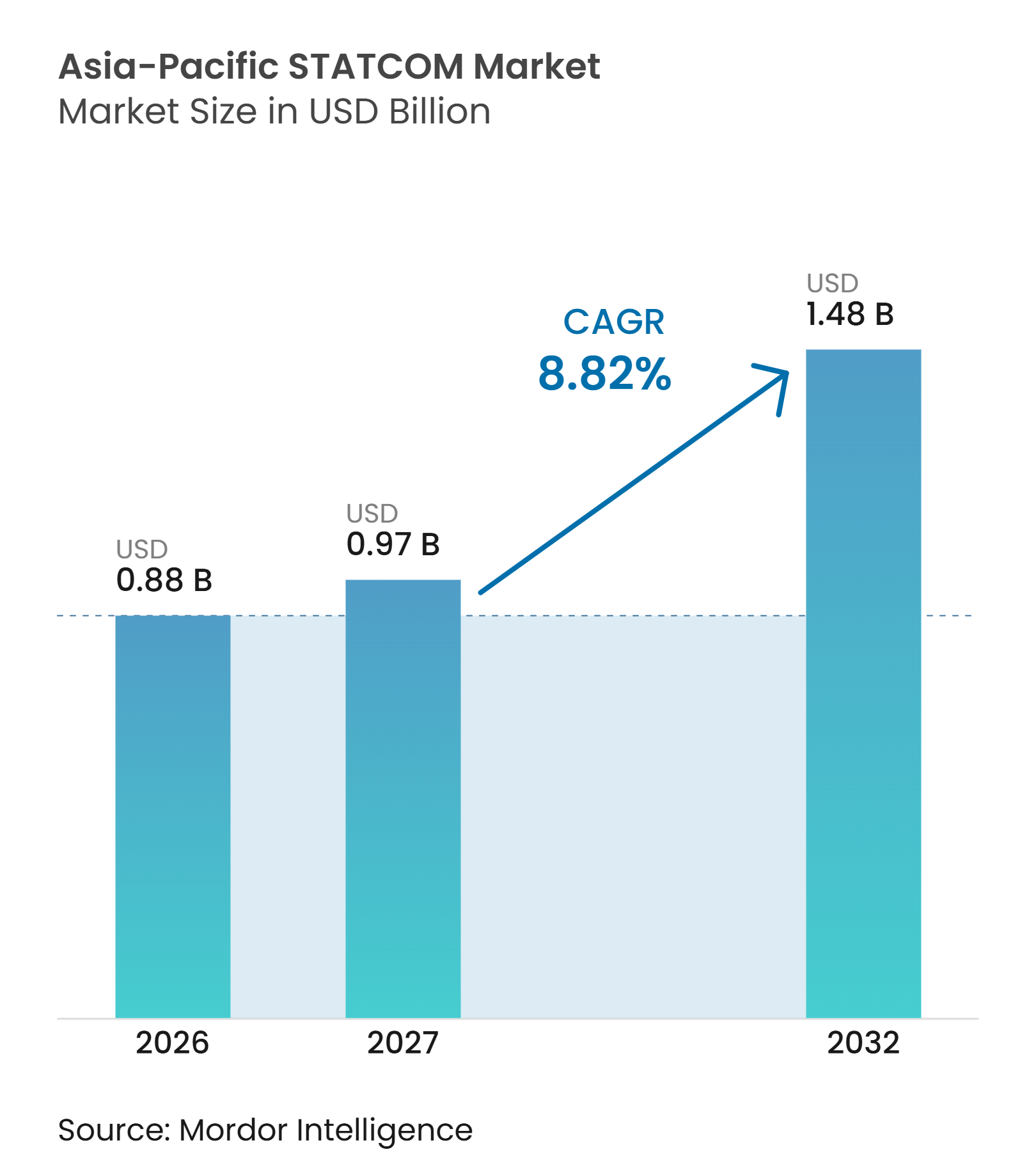
| Base Year Market Size (2026) | USD 0.88 Billion |
| Market Size (2027) | USD 0.97 Billion |
| Market Size (2032) | USD 1.48 Billion |
| Growth Rate (2027 - 2032) | 8.82 % |
| Market Concentration | Medium |
Major Players *Disclaimer: Major Players sorted in no particular order Image © Mordor Intelligence. Reuse requires attribution under CC BY 4.0. | |
Asia-Pacific STATCOM Market Analysis by Mordor Intelligence
The Asia-Pacific STATCOM market size was valued at USD 0.88 billion in 2026 and is estimated to grow from USD 0.95 billion in 2027 to reach USD 1.48 billion by 2032, at a CAGR of 8.82% during the forecast period (2027-2032). The Asia-Pacific STATCOM market is being shaped by a shift in grid investment toward fast voltage control and reactive power support as renewable generation replaces part of the conventional generation base. Renewable additions, long-distance transmission, and weaker grid conditions at renewable pooling stations are increasing the need for equipment capable of responding to voltage events. Procurement is also broadening beyond transmission substations as data centers, industrial facilities, and rail systems create more demanding power-quality requirements. Suppliers are responding with grid-forming configurations, modular converter designs, and longer-term component and service arrangements. High capital costs, long delivery cycles, and utility credit risk continue to limit the pace of deployment in several emerging Asian markets.
Key Report Takeaways
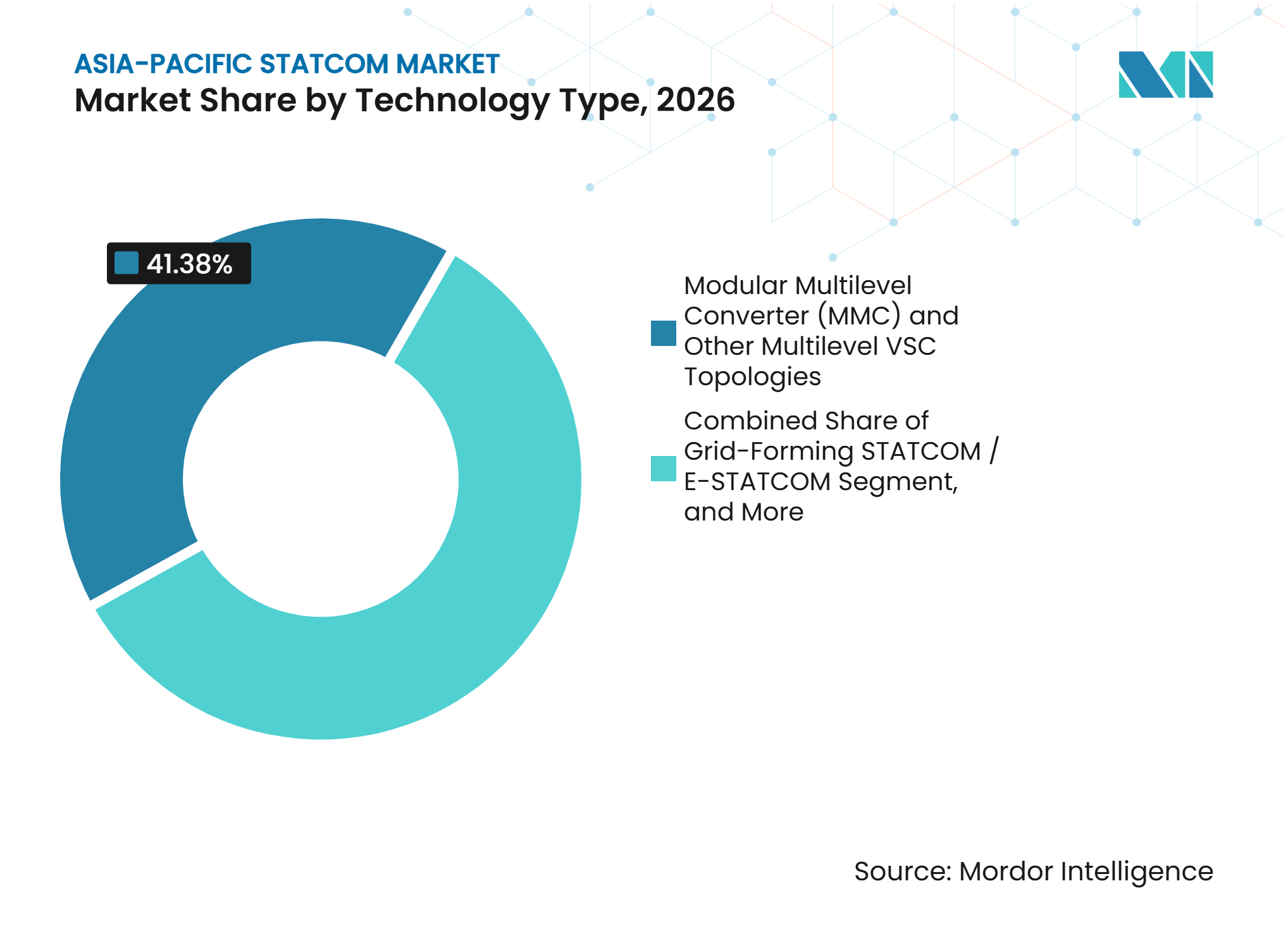
- By technology type, Modular Multilevel Converter and Other Multilevel VSC Topologies held 41.38% of the Asia-Pacific STATCOM market share in 2026, while Grid-Forming STATCOM and E-STATCOM are projected to expand at a 9.92% CAGR through 2032.
- By reactive power rating, Large-Scale Transmission STATCOM held 48.67% of the regional STATCOM segment in 2026, while Small-Scale Distribution and Industrial STATCOM is projected to expand at a 9.86% CAGR through 2032.
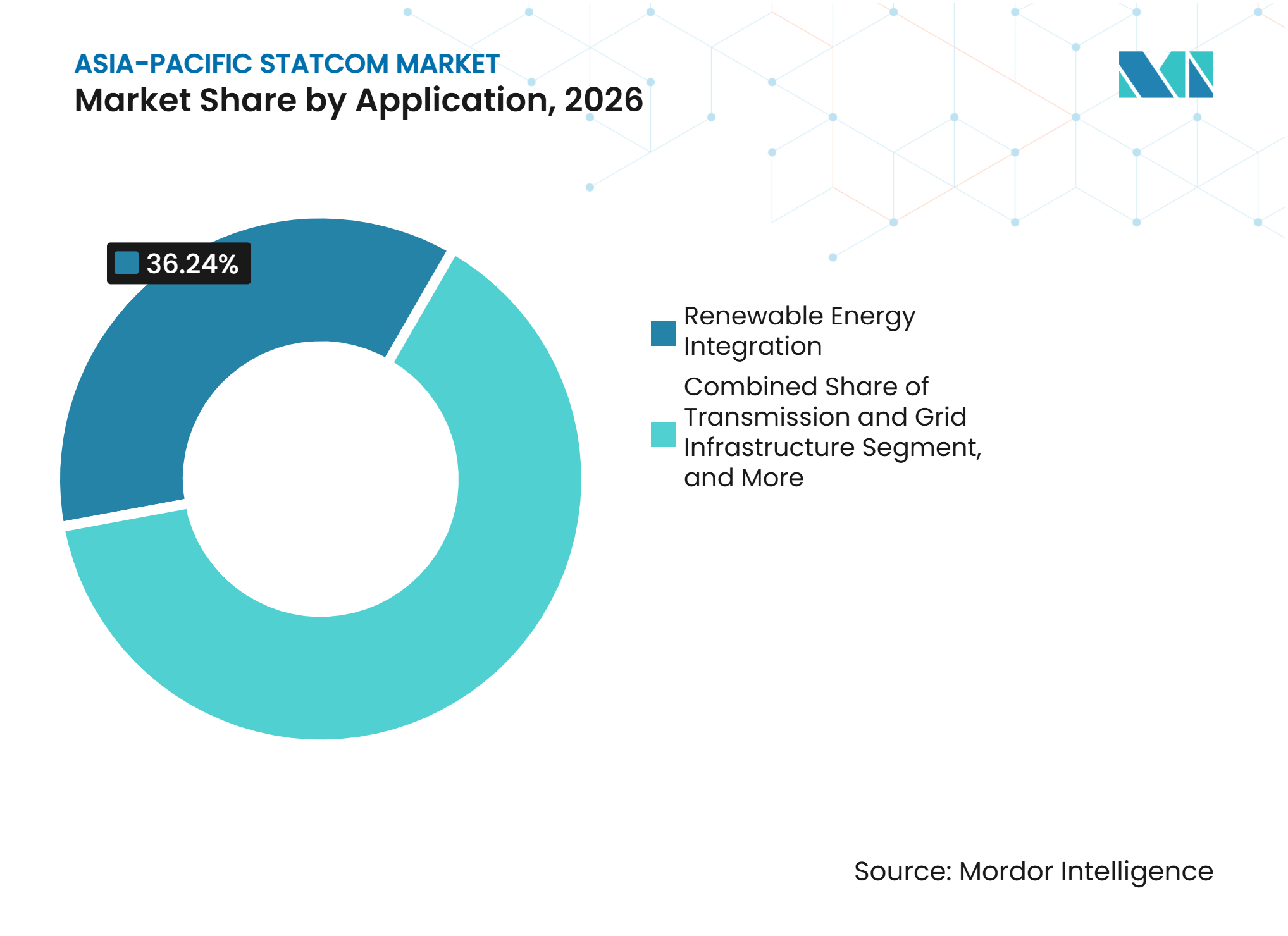
- By application, Renewable Energy Integration accounted for 36.24% of the regional STATCOM market in 2026, while Data Centers and Commercial Infrastructure is projected to expand at a 9.47% CAGR through 2032.
- By component, Power Electronic Converter Valves held 39.79% of the market share in 2026, while Control, Protection, and Monitoring Systems are projected to expand at a 9.64% CAGR through 2032.
- By geography, China held 42.13% of the regional STATCOM market in 2026, while India is projected to expand at a 9.83% CAGR through 2032.
Note: Market numbers in this report are based on Mordor Intelligence's proprietary estimation framework, which combines nine months of actuals with Q4 projections for base year 2026.
Market Trends and Insights
Drivers Impact Analysis of Asia-Pacific STATCOM Market*
| Driver | (~) % Impact on CAGR Forecast | Geographic Relevance | Impact Timeline |
|---|---|---|---|
| Renewable Energy Integration and Grid-Code Compliance | +3.2% | Global, with concentrated impact in China, India, and ASEAN | Short term (≤ 2 years) |
| Transmission Expansion and Long-Distance Power Transfer | +1.8% | China, India, and Rest of Asia-Pacific | Medium term (2-4 years) |
| Grid Modernization and Dynamic Voltage Support | +1.3% | APAC core, with early gains in Japan, South Korea, and Australia | Medium term (2-4 years) |
| Industrial Electrification and Power-Quality Requirements | +0.9% | China, India, South Korea, and Taiwan | Medium term (2-4 years) |
| High-Density Power Electronics at Renewable Pooling Substations | +0.5% | India’s northwestern renewable corridors and China’s Inner Mongolia | Long term (≥ 4 years) |
| Cross-Border Power Trading and Interconnection Stability | +0.3% | ASEAN, the China-Laos-Vietnam corridor, and Singapore | Long term (≥ 4 years) |
| Source: Mordor Intelligence | |||
Renewable Energy Integration and Grid-Code Compliance Are Rewriting Procurement Standards
India added more than 47 GW of solar capacity and 5.6 GW of wind capacity between May 2025 and May 2026, while transmission expansion lagged generation growth, creating more difficult operating conditions at renewable pooling points. The Asia-Pacific STATCOM market benefits when renewable plants need dynamic reactive current during voltage disturbances rather than conventional fixed compensation. India’s Central Electricity Regulatory Commission warned renewable projects in November 2025 that repeated failures to meet Low Voltage Ride-Through and High Voltage Ride-Through requirements could result in disconnection.[1] The Central Electricity Authority’s 2026 technical standards require power-quality meters and reactive-power control modes for qualifying renewable facilities, placing power-quality capability earlier in project design. These requirements make STATCOM equipment part of the grid-connection design rather than a later corrective investment. The resulting demand is strongest where transmission additions do not keep pace with the commissioning of wind and solar projects.
Transmission Expansion and Long-Distance Power Transfer Drive Utility-Scale Procurement
The Asia-Pacific STATCOM market is supported by high-voltage transmission projects that require voltage control at new converter stations and substation nodes. China’s State Grid issued its 12th UHV procurement tender in March 2025, covering 55 packages with bids totaling CNY 1.959 billion, equivalent to USD 268 million at the reported conversion rate. In India, Hitachi Energy and BHEL received the April 2025 award for the 950-km, 6,000-MW Bhadla-Fatehpur HVDC link, which requires reactive power compensation at both converter stations. The Northern Region scheme specifies 8 units rated at ±300 MVAr, giving a combined dynamic range of ±2,400 MVAr. This type of project makes dynamic compensation a standard element of transmission planning instead of an isolated grid-stability purchase. Longer transmission corridors also create recurring demand for equipment capable of maintaining voltage under changing power flows.
Grid Modernization and Dynamic Voltage Support Accelerate Technology Upgrade Cycles
South Korea finalized grid-forming inverter performance requirements in 2026 and will require the technology for centrally contracted battery storage from December 2027, with a total capacity of 540 MW. The Asia-Pacific STATCOM market is therefore moving toward equipment that can provide voltage regulation, synthetic inertia, and coordinated control with inverter-based resources. HD Hyundai Electric’s 2026 research agreement with KEPCO and LS Electric’s 10 MW-class grid-forming inverter verification show that Korean suppliers are developing transmission-grade grid-forming functions. Large data centers in Australia may also be required to remain connected during voltage disturbances, extending the use case beyond substations and renewable plants. IEC technical work on grid-forming inverter behavior is becoming an important reference point for interoperability expectations in procurement specifications. These changes favor suppliers that can demonstrate both control performance and converter capacity.
Industrial Electrification and Power-Quality Requirements Open Distribution-Tier Opportunities
Manufacturing electrification in China, South Korea, and Taiwan is increasing inverter-based load and raising concerns over harmonics and reactive power on distribution networks. India’s data center capacity reached an estimated 1.75 GW by mid-2026 and is projected to reach 6 GW by 2029, increasing the need for high-quality grid interconnection at large campuses. A 2025 study in IET Generation, Transmission and Distribution found that a 1,000 MW AI data center load reduced the modeled voltage-stability margin from 36.15% to 5.35% under normal operating conditions. The Asia-Pacific STATCOM market can address this need by providing fast, reactive support at the utility interface. IEEE P4200 is under development to set power-quality and reactive-power expectations for large data centers connected to utility networks. This creates an opportunity for distribution-scale systems where conventional capacitor banks cannot provide the same response speed.
Restraints Impact Analysis of Asia-Pacific STATCOM Market*
| Restraint | (~) % Impact on CAGR Forecast | Geographic Relevance | Impact Timeline |
|---|---|---|---|
| High Upfront Capital Cost and Long Procurement Cycles | -1.4% | Emerging Asia-Pacific markets and India’s private transmission developers | Short term (≤ 2 years) |
| Transformer, Semiconductor, and Project-Engineering Bottlenecks | -0.7% | Global supply chain, with acute pressure in India and Southeast Asia | Medium term (2-4 years) |
| Utility Bankability and Off-Taker Risk in Emerging Asia-Pacific Markets | -0.4% | Vietnam, Philippines, Bangladesh, and Rest of Asia-Pacific | Long term (≥ 4 years) |
| Substitution by SVCs, Synchronous Condensers, and Grid-Forming Storage | -0.3% | Japan, Australia, and markets with legacy rotating machinery ecosystems | Long term (≥ 4 years) |
| Source: Mordor Intelligence | |||
High Upfront Capital Cost and Long Procurement Cycles Compress Private Investment
A ±300 MVAr STATCOM system requires material investment in converter equipment, transformer bays, cooling infrastructure, controls, and civil works. The Asia-Pacific STATCOM market is affected when distribution licensees lack concessional finance or a clear regulatory route to recover these costs. India’s tariff-based competitive bidding and special-purpose vehicle delivery structure can extend the period from approval to commissioning to 24 months or longer. Several regional tariff frameworks still do not explicitly recover reactive-power compensation costs, slowing decision-making despite curtailment pressure. The World Bank’s USD 2.5 billion Multi-Phase Programmatic Approach supports energy-transition financing across East Asia and the Pacific. However, sovereign debt constraints and weaker utility balance sheets continue to constrain deployment in several Southeast Asian markets.
Supply Chain Limitations in Semiconductors and Engineering Talent Extend Project Lead Times
High-power IGBT modules and silicon carbide devices remain important supply constraints for utility-scale converter valves. Converter transformers rated at 400 kV and above have lead times of 24-36 months, limiting a utility’s ability to respond quickly to renewable integration deadlines. The Asia-Pacific STATCOM market also faces a shortage of engineers with experience commissioning MMC-based systems at 500 kV, particularly in Vietnam and Bangladesh. Trench Group signed framework agreements in May 2025 with GE Vernova, Hitachi Energy, and Siemens Energy for high-voltage components, signaling that buyers expect demand for specialized components to remain elevated into the mid-2030s. Indian manufacturers are investing in local transformer capacity, although the impact on supply is expected to be felt after 2028. These constraints can defer projects even when grid operators have already identified a technical need.
*Our forecasts treat driver/restraint impacts as directional, not additive. The impact forecasts reflect baseline growth, mix effects, and variable interactions.
Asia-Pacific STATCOM Market Segment Analysis
By Technology Type:
Grid-Forming Designs Extend the Role of Dynamic CompensationModular Multilevel Converter and Other Multilevel VSC Topologies held 41.38% of the regional STATCOM segment in 2026. Transmission operators favor these systems for their modular design, lower harmonic distortion, and ability to continue operating when individual modules are unavailable. Hyosung Heavy Industries presented its 1 GVar deployment at the Shin-Okcheon substation as a 2 × 500 MVAr modular configuration. The architecture uses module redundancy to reduce exposure to planned and unplanned outages at a large transmission site. This approach is suited to grids that need high reactive current while maintaining service availability. It also supports staged maintenance, as individual modules can be managed without taking the entire platform out of service.
Grid-Forming STATCOM and E-STATCOM are projected to grow at a 9.92% CAGR through 2032, the highest rate among technology types. South Korea’s planned grid-forming requirements provide a direct policy rationale for equipment that can help stabilize systems with greater inverter-based generation. NR Electric commissioned a grid-forming STATCOM at the Yuntian 500 kV substation in Hunan in May 2025, rated at 150 MVAr continuous capacity and 450 MVAr transient capacity.[2] Conventional VSC-based equipment remains relevant for established transmission requirements. Medium-voltage and distribution STATCOM systems are also gaining ground where renewable interconnection conditions require dynamic support. The technology mix shows that buyers are placing more value on system behavior during disturbances, not only nameplate reactive-power capacity.



By Reactive Power Rating:
Transmission Projects Lead While Distribution Demand BroadensLarge-Scale Transmission STATCOM held 48.67% of the regional STATCOM segment in 2026. China’s UHV backbone and India’s 765 kV renewable evacuation corridors need large ratings at converter and pooling substations. These sites face declining system strength as renewable capacity rises faster than transmission capacity. Rajasthan and Gujarat pooling stations are expected to face short-circuit ratios near or below the Central Electricity Authority threshold of 5 without dynamic compensation. The resulting need is concentrated at high-voltage nodes where a voltage event can affect a large area. Transmission projects therefore continue to set the largest individual equipment requirements.
Small-Scale Distribution and Industrial STATCOM is projected to grow at a 9.86% CAGR through 2032. Distribution utilities in India, Thailand, and Vietnam are managing voltage deviations tied to rooftop solar, electric-vehicle charging, and industrial load changes. Medium-scale systems support railway traction substations and industrial feeders where conventional capacitor banks are too slow. These systems can deliver a more practical capital profile than the largest transmission units. The Yuntian project also illustrates a design approach that emphasizes transient current capability besides nominal continuous rating. This may support more efficient sizing across rating categories as utilities focus on the conditions that occur during faults and fast voltage changes.
By Application:
Renewable Integration Remains Central as Commercial Demand RisesRenewable Energy Integration accounted for 36.24% of the regional STATCOM segment in 2026. China’s utility-scale wind and solar additions and India’s Green Energy Corridor continue to anchor demand in this application. The International Energy Agency expects Asia-Pacific renewable additions, excluding China, to exceed 840 GW during 2026-2031, more than twice the preceding period's additions. Each new renewable zone needs a dependable connection to the transmission infrastructure, which may not be fully reinforced at the time of commissioning. STATCOM equipment provides voltage control that supports generation delivery during changing output conditions. This keeps renewable interconnection the primary source of system volume over the forecast period.
Data Centers and Commercial Infrastructure are projected to grow at a 9.47% CAGR through 2032. AI-focused campuses in India, Japan, South Korea, and Singapore create high and rapidly changing loads at the grid interface. Their requirements are not limited to a reliable electricity supply, as voltage quality and disturbance response also influence facility design. Transmission and Grid Infrastructure remains the second-largest application and includes substation systems designed for N-2 contingency conditions and cross-border voltage support. Industrial and Manufacturing demand provides a stable base in Taiwan and South Korea. Railway Electrification and Other Applications are expanding in India and Southeast Asia, where unbalanced traction loads necessitate negative-sequence compensation alongside reactive-power support.

By Component:
Digital Controls Gain Value Alongside Converter HardwarePower Electronic Converter Valves held 39.79% of the regional STATCOM segment in 2026. IGBT valve stacks, associated cooling arrangements, and snubber circuits account for a large share of the total system bill of materials. Their availability directly affects project schedules because the valves perform the conversion function at the heart of a STATCOM system. Large systems also require converter transformers and reactors matched to the voltage rating and operating profile of each project. These components make domestic manufacturing capacity and long-term supplier relationships important in procurement decisions. Hardware remains the core cost center even as software capability becomes more significant.
Control, Protection, and Monitoring Systems is projected to grow at a 9.64% CAGR through 2032. Buyers are increasingly specifying predictive maintenance, cybersecurity measures, and remote interfaces alongside conventional protection and control functions. This increases the long-term value of digital systems beyond their initial equipment cost. Converter transformers and reactors remain under supply pressure, with 400 kV and 765 kV units often requiring more than 24 months of lead time. Hitachi Energy India announced INR 2,000 crore (USD 238.1 million), for a transformer factory in June 2026, while Siemens Energy India approved INR 2,060 crore (USD 245.2 million) for expanded large-transformer capacity in February 2026. Capacitors, harmonic filters, cooling equipment, and auxiliary systems present recurring maintenance opportunities for earlier installations. Service agreements that combine firmware updates, equipment analytics, and performance commitments are gaining importance.
Geography Analysis
China: UHV Development Supports the Largest Regional Position
China accounted for 42.13% of the Asia-Pacific STATCOM market share in 2026. Its UHV expansion links renewable-resource areas in Xinjiang, Inner Mongolia, and Yunnan with major eastern demand centers. State Grid’s March 2025 procurement covered 55 UHV packages and bids totaling CNY 1.959 billion (USD 268 million) at the reported conversion rate. The China-Laos 500 kV interconnection entered service in April 2026, increasing bidirectional exchange capacity from 50 MW to 1,500 MW.[3] Cross-border operation increases the value of fast voltage management at interconnection substations. NR Electric’s Yuntian grid-forming system demonstrates a domestic supplier capability at transmission scale. China’s standards, procurement structure, and established domestic supply base make it the main source of utility-scale volume in the Asia-Pacific STATCOM market.
India: Renewable Evacuation Drives the Fastest Projected Growth
India is projected to expand at a 9.83% CAGR through 2032, the fastest geographic rate in the Asia-Pacific STATCOM market. The National Electricity Plan calls for more than 50 STATCOM deployments, and Siemens Energy India has announced plans for 10 in 2025. Renewable capacity additions have outpaced transmission expansion, leaving some pooling stations in Rajasthan and Gujarat with lower system strength. The Northern Region Static and Dynamic Compensation scheme requires INR 4,378 crore (USD 521.2 million) and includes 8 units of ±300 MVAr at 6 substations. CERC enforcement of ride-through requirements and the Central Electricity Authority’s 2026 technical standards strengthen the regulatory influence behind this spending. Data center expansion adds another source of demand where large campuses require a stable grid interface. India therefore combines a large renewable pipeline with a growing need for power-quality equipment across both transmission and commercial connections.
Rest of Asia-Pacific: Grid-Forming Requirements and Cross-Border Systems Broaden Adoption
South Korea is investing KRW 73 trillion (USD 54.1 billion) to modernize the grid and will apply grid-forming requirements to centrally contracted battery storage from December 2027. Japan needs reactive-power absorption at shore-end substations because long offshore-wind cables can create capacitive reactive-power surpluses. Taiwan’s semiconductor facilities require high-speed response to voltage disturbances that can affect sensitive production processes. Thailand’s Electricity Generating Authority signed its July 2026 contract with Sinohydro for a STATCOM at Khlong Ngae Substation, scheduled for completion in 2028, to support renewable integration and future electricity trading with Malaysia. Vietnam’s revised Power Development Plan VIII and Indonesia’s Green Enabling Super Grid include renewable expansion that will require attention to voltage support. Cross-border interconnections and grid-forming requirements are making equipment flexibility more important in this mixed group of markets. These systems give the Asia-Pacific STATCOM market opportunities beyond the large UHV projects in China and renewable corridors in India.
Competitive Landscape
Market Concentration
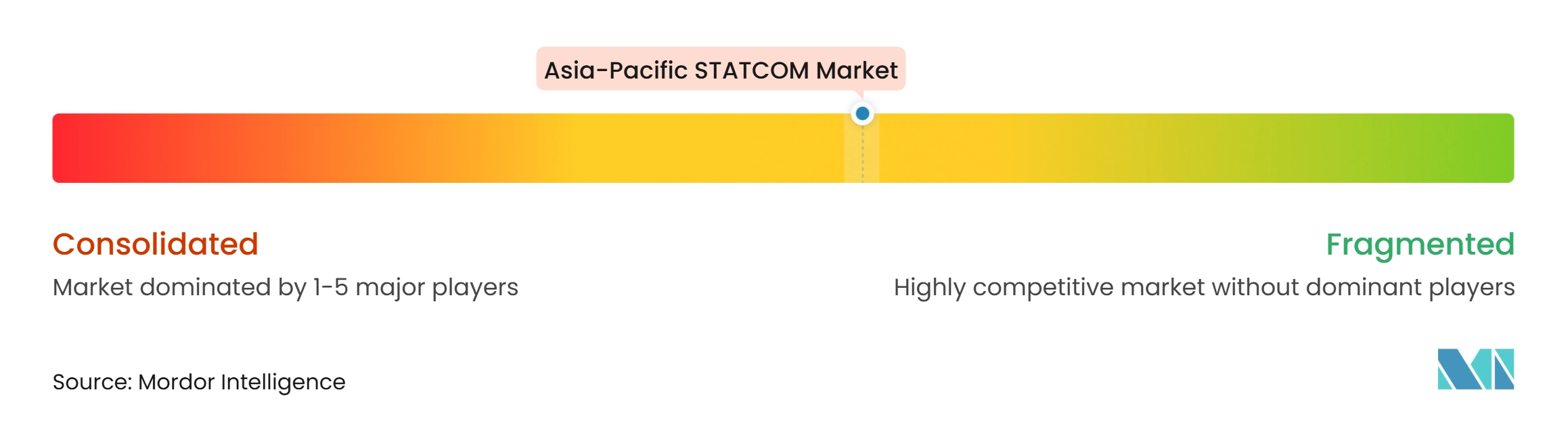
The Asia-Pacific STATCOM market is moderately concentrated in utility-scale transmission projects. Hitachi Energy, Siemens Energy, GE Vernova, Mitsubishi Electric, and Hyosung Heavy Industries compete for large-rating awards where operating experience, manufacturing capacity, and service capability matter. The distribution tier is more fragmented because it includes a broader set of regional vendors and smaller system integrators. Chinese suppliers, including NARI Technology, NR Electric, Sieyuan Electric, and Rongxin Power Electronic, have progressed beyond domestic projects and are competing in Southeast Asia. Their position is supported by price and delivery considerations. Global suppliers continue to hold a strong position where a buyer requires prior experience at the highest voltage levels.
Hyosung Heavy Industries differentiated its offering through the 1 GVar Shin-Okcheon deployment, structured as 2 × 500 MVAr modules with a hierarchical master controller. NR Electric’s May 2025 Yuntian commissioning demonstrated grid-forming operation with 150 MVAr continuous capability and 450 MVAr transient capability. Marubeni, Hyosung Heavy Industries, and Skeleton Technologies signed a memorandum of understanding in February 2026 to develop E-STATCOM systems that combine reactive power compensation with supercapacitor-based energy storage.[4] These actions show that suppliers are competing on control architecture, transient performance, and integration with storage. The Asia-Pacific STATCOM market also has an open position in grid-interface systems tailored to hyperscale data center campuses. Buyers currently combine converter equipment, harmonic filters, and controls from different suppliers rather than relying on one established specialist.
Component security and regulatory compliance are becoming important factors in bids. Trench Group’s framework agreements with GE Vernova, Hitachi Energy, and Siemens Energy extend toward the mid-2030s and help manufacturers secure high-voltage component supply. Suppliers are also moving toward long-term service arrangements that cover condition monitoring, firmware upgrades, and performance commitments. IEC equipment requirements and country-level grid codes influence qualification, especially the Central Electricity Authority standards in India and grid-forming requirements in South Korea. This makes technical documentation and evidence of compliance important alongside price. Local manufacturing investments can improve delivery confidence but will not remove the need for specialized imported semiconductor components in the near term. Competition is likely to remain strongest at the intersection of transmission-grade equipment, project execution, and control software.
Asia-Pacific STATCOM Industry Leaders
-
Hitachi Energy Ltd.
-
Siemens Energy AG
-
GE Vernova Inc.
-
Mitsubishi Electric Corporation
-
Hyosung Heavy Industries Corporation
- *Disclaimer: Major Players sorted in no particular order
Asia-Pacific STATCOM Market Companies Covered in this Report
- Hitachi Energy Ltd.
- Siemens Energy AG
- GE Vernova Inc.
- Mitsubishi Electric Corporation
- Hyosung Heavy Industries Corporation
- Toshiba Energy Systems & Solutions Corporation
- Fuji Electric Co., Ltd.
- NARI Technology Co., Ltd.
- NR Electric Co., Ltd.
- Sieyuan Electric Co., Ltd.
- Rongxin Power Electronic Co., Ltd.
- TBEA Co., Ltd.
- Sungrow Power Supply Co., Ltd.
- Ingeteam S.A.
- JEMA Energy, S.A.
- American Superconductor Corporation
- Nidec Corporation
- TMEIC Corporation
- ABB Ltd
Recent Industry Developments in Asia-Pacific STATCOM Market
- July 2026: EGAT signed a contract with Sinohydro (Thailand) Co., Ltd. for the installation of a STATCOM at Khlong Ngae Substation in Songkhla Province, with completion scheduled for 2028, to support grid stabilization for renewable energy integration and facilitate future cross-border electricity trading with Malaysia through the ASEAN Power Grid, marking Thailand’s formal entry into utility-scale STATCOM deployment.
- June 2026: Hitachi Energy India announced an INR 2,000 crore (USD 238.1 million) commitment to establish a new large power transformer factory in Karjan, Vadodara, with completion scheduled for FY28, addressing transformer supply bottlenecks that are constraining STATCOM project timelines in India.
- April 2026: China Southern Power Grid commissioned the China-Laos 500 kV interconnection, raising bidirectional power exchange capacity between the 2 countries from 50 MW to 1,500 MW and enabling 3 billion kWh of annual clean-energy transmission, demonstrating reactive-power compensation infrastructure requirements at cross-border interconnection substations.
- February 2026: Siemens Energy India approved INR 2,060 crore (USD 245.2 million) in investment to expand large power transformer manufacturing capacity by 30,000 MVA, with operations expected between 2030 and 2032.
Asia-Pacific STATCOM Market Report Scope
The Asia-Pacific STATCOM market comprises the sale and deployment of static synchronous compensators (STATCOMs), which are power electronic devices that regulate voltage and improve power quality and grid stability. Utilities and industrial users deploy STATCOM systems to provide reactive power compensation, support the integration of renewable energy, and enhance the performance of transmission and distribution networks across the Asia-Pacific region.
The Asia-Pacific STATCOM Market Report is Segmented by Technology Type (Modular Multilevel Converter (MMC) and Other Multilevel VSC Topologies, Conventional Voltage Source Converter (VSC)-Based STATCOM, Grid-Forming STATCOM / E-STATCOM, and Medium-Voltage and Distribution STATCOM), Reactive Power Rating (Large-Scale Transmission STATCOM, Medium-Scale STATCOM, and Small-Scale Distribution and Industrial STATCOM), Application (Transmission and Grid Infrastructure, Renewable Energy Integration, Industrial and Manufacturing, Data Centers and Commercial Infrastructure, and Railway Electrification and Other Applications), Component (Power Electronic Converter Valves, Converter Transformers and Reactors, Capacitors and Harmonic Filters, Control, Protection, and Monitoring Systems, and Cooling Systems and Auxiliary Components), and Geography (China, Japan, South Korea, Taiwan, India, and Rest of Asia-Pacific). The Market Forecasts are Provided in Terms of Value (USD).
Segmentation Overview
| Modular Multilevel Converter (MMC) and Other Multilevel VSC Topologies |
| Conventional Voltage Source Converter (VSC)-Based STATCOM |
| Grid-Forming STATCOM / E-STATCOM |
| Medium-Voltage and Distribution STATCOM |
| Large-Scale Transmission STATCOM |
| Medium-Scale STATCOM |
| Small-Scale Distribution and Industrial STATCOM |
| Transmission and Grid Infrastructure |
| Renewable Energy Integration |
| Industrial and Manufacturing |
| Data Centers and Commercial Infrastructure |
| Railway Electrification and Other Applications |
| Power Electronic Converter Valves |
| Converter Transformers and Reactors |
| Capacitors and Harmonic Filters |
| Control, Protection, and Monitoring Systems |
| Cooling Systems and Auxiliary Components |
| China |
| Japan |
| South Korea |
| Taiwan |
| India |
| Rest of Asia-Pacific |
| By Technology Type | Modular Multilevel Converter (MMC) and Other Multilevel VSC Topologies |
| Conventional Voltage Source Converter (VSC)-Based STATCOM | |
| Grid-Forming STATCOM / E-STATCOM | |
| Medium-Voltage and Distribution STATCOM | |
| By Reactive Power Rating | Large-Scale Transmission STATCOM |
| Medium-Scale STATCOM | |
| Small-Scale Distribution and Industrial STATCOM | |
| By Application | Transmission and Grid Infrastructure |
| Renewable Energy Integration | |
| Industrial and Manufacturing | |
| Data Centers and Commercial Infrastructure | |
| Railway Electrification and Other Applications | |
| By Component | Power Electronic Converter Valves |
| Converter Transformers and Reactors | |
| Capacitors and Harmonic Filters | |
| Control, Protection, and Monitoring Systems | |
| Cooling Systems and Auxiliary Components | |
| By Geography | China |
| Japan | |
| South Korea | |
| Taiwan | |
| India | |
| Rest of Asia-Pacific |
Key Questions Answered in the Report
What is the Asia-Pacific STATCOM market size?
The regional STATCOM sector is USD 0.88 billion in 2026 and is estimated to reach USD 1.48 billion by 2032, at an 8.82% CAGR from 2027 to 2032.
What is driving demand for STATCOM systems in Asia-Pacific?
Renewable-energy interconnection, long-distance transmission, stricter ride-through requirements, and data center power-quality needs are supporting demand.
Which technology holds the largest share of the Asia-Pacific STATCOM market?
Modular Multilevel Converter and Other Multilevel VSC Topologies lead with 41.38% share in 2026.
Which application is expected to grow fastest through 2032?
Data Centers and Commercial Infrastructure is projected to grow at a 9.47% CAGR through 2032.
Which country leads regional demand for STATCOM equipment?
China leads with a 42.13% share in 2026, supported by UHV transmission development and renewable integration.
Why are grid-forming STATCOM systems gaining attention?
They can combine fast reactive-power support with grid-forming functions needed in systems with a larger share of inverter-based resources.