
Asia-Pacific Semiconductor Logistics Market Size and Share
Market Overview
| Study Period | 2021 - 2032 |
|---|---|
| Forecast Data Period | 2027 - 2032 |
| Base Year Market Size (2026) | USD 16.18 Billion |
| Market Size (2027) | USD 18.72 Billion |
| Market Size (2032) | USD 29.30 Billion |
| Growth Rate (2027 - 2032) | 9.37 % |
| Market Concentration | Medium |
Major Players *Disclaimer: Major Players sorted in no particular order Image © Mordor Intelligence. Reuse requires attribution under CC BY 4.0. | |
Asia-Pacific Semiconductor Logistics Market Analysis by Mordor Intelligence
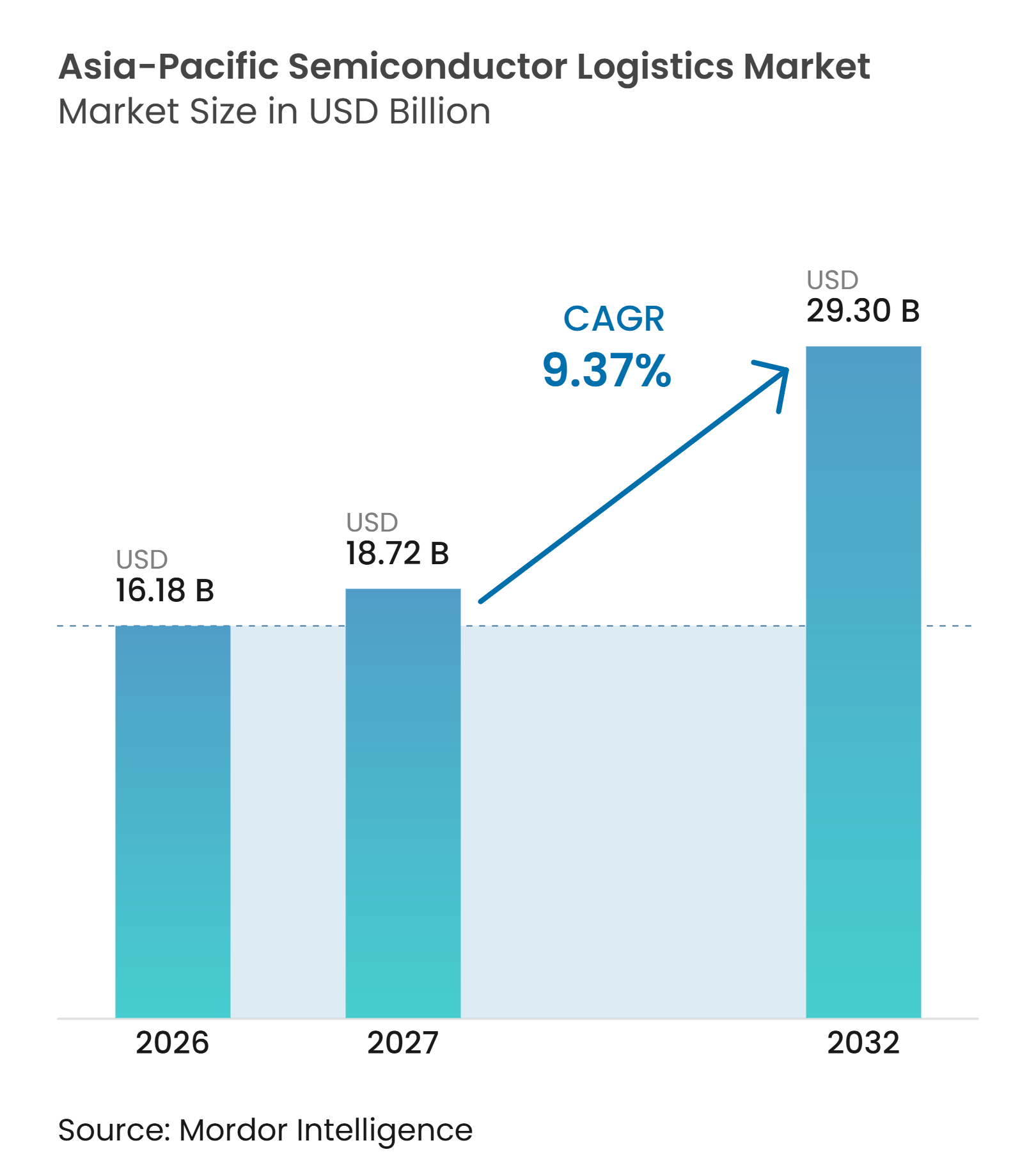
The Asia-Pacific semiconductor logistics market size was valued at USD 16.18 billion in 2026 and is estimated to grow from USD 18.72 billion in 2027 to reach USD 29.30 billion by 2032, at a CAGR of 9.37% during the forecast period (2027-2032).
Advanced-node capacity additions are increasing the need for controlled movement of wafer tools, chemicals, substrates, and finished devices across the region. The Asia-Pacific semiconductor logistics market is also supported by the concentration of fabrication, assembly, testing, design, and material suppliers in Taiwan, South Korea, Japan, China, India, and Southeast Asia. These networks require temperature control, electrostatic discharge protection, secure documentation, and cleanroom-compatible transport. New industrial programs in India and other regional markets are creating specialized demand before manufacturing sites reach full output. Providers that combine certified handling, digital shipment visibility, and facilities near fabs are better placed to serve these supply chains.
Key Report Takeaways
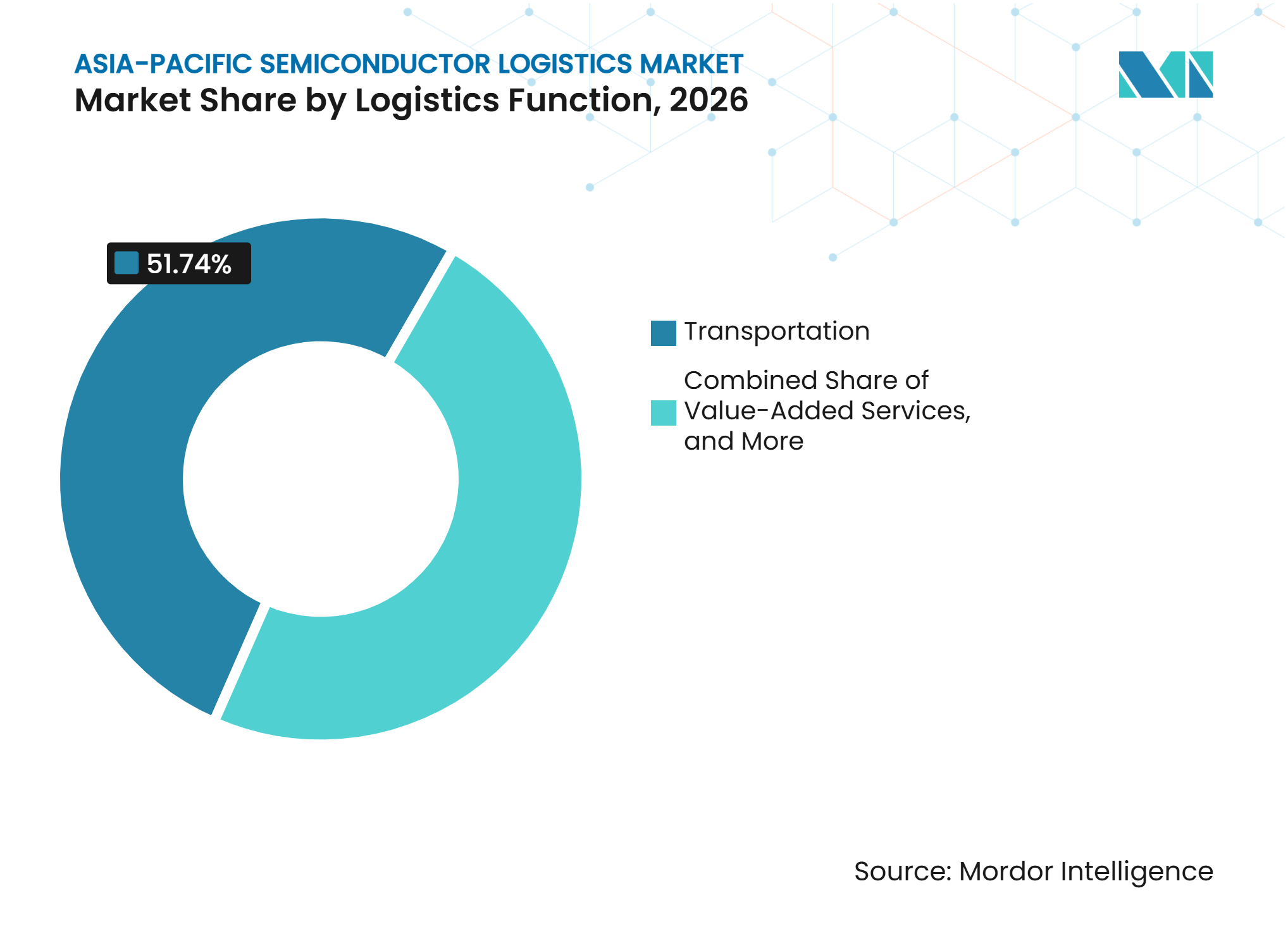
- By logistics function, transportation held 51.74% of the Asia-Pacific semiconductor logistics market share in 2026, while value-added services are forecast to register a 10.54% CAGR through 2032.
- By transportation mode, airways held 39.26% of the Asia-Pacific semiconductor logistics market size in 2026 and are forecast to register a 12.74% CAGR through 2032.
- By warehousing type, non-temperature-controlled warehousing held a 77.24% share in 2026, while temperature-controlled warehousing is forecast to register an 11.85% CAGR through 2032.
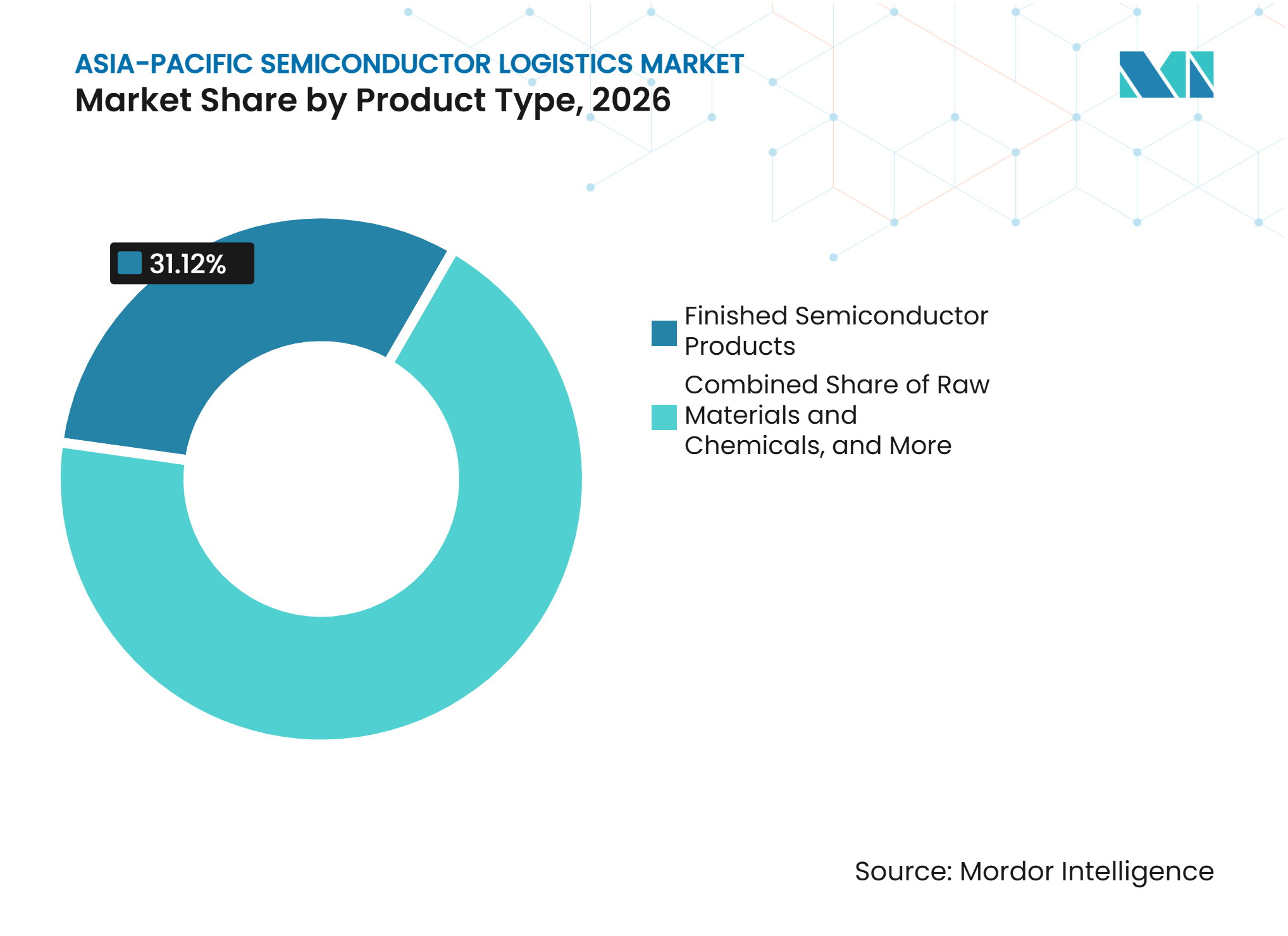
- By product type, finished semiconductor products held a 31.12% share in 2026, while other product types are forecast to register a 13.19% CAGR through 2032.
- By customer, IDMs held a 29.37% share in 2026, while foundries are forecast to register a 13.70% CAGR through 2032.
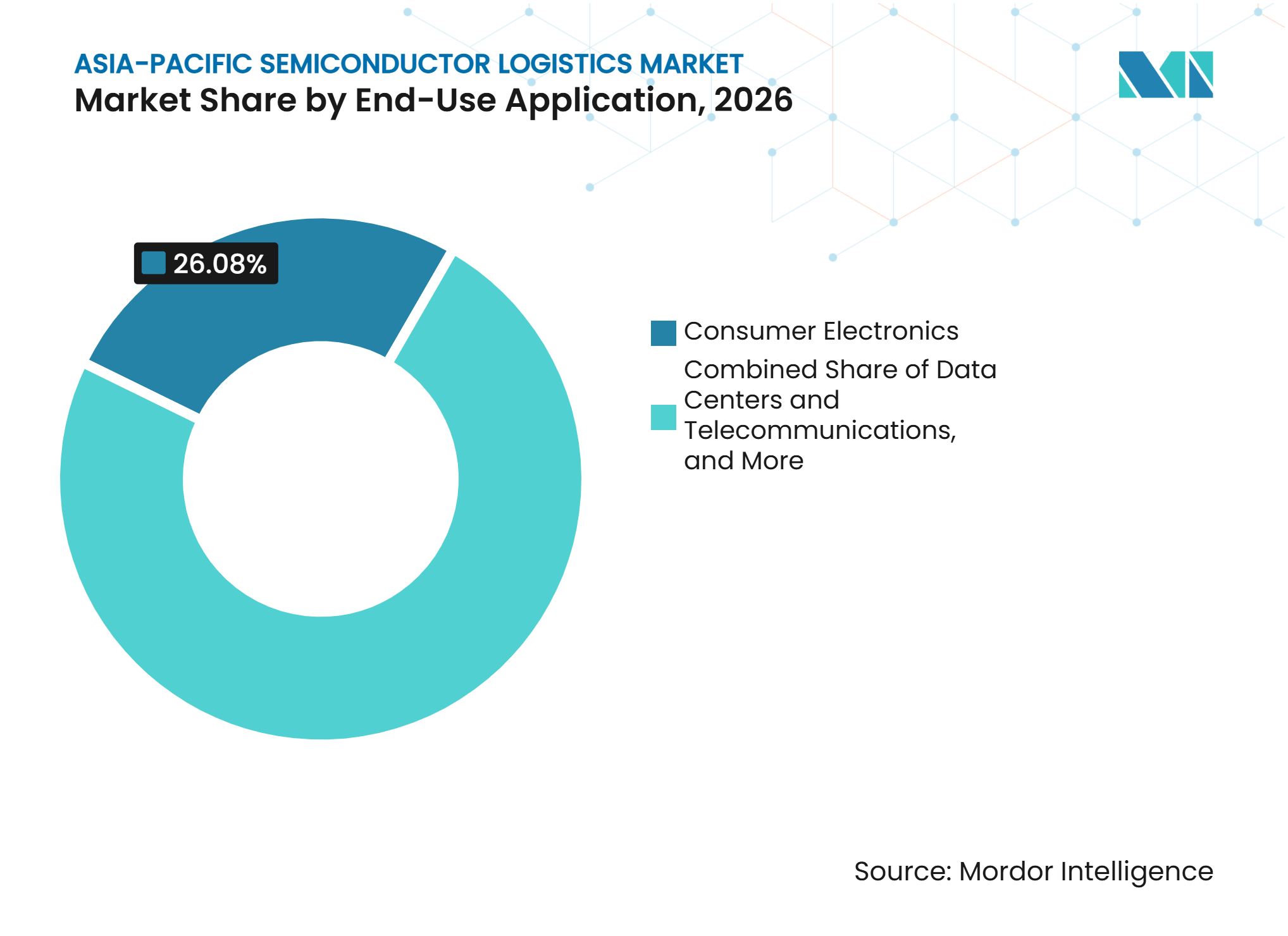
- By end-use application, consumer electronics held a 26.08% share in 2026, while data centers and telecommunications are forecast to register a 14.66% CAGR through 2032.
- By geography, China held a 32.61% share in 2026, while India is forecast to register a 14.94% CAGR through 2032.
Note: Market numbers in this report are based on Mordor Intelligence's proprietary estimation framework, which combines nine months of actuals with Q4 projections for base year 2026.
Market Trends and Insights
Drivers Impact Analysis of Asia-Pacific Semiconductor Logistics Market*
| Driver | (~) % Impact on CAGR Forecast | Geographic Relevance | Impact Timeline |
|---|---|---|---|
| AI-Enabled Routing, ETA Visibility, and Condition Monitoring | +2.5% | Taiwan, South Korea, Singapore, and Japan, with regional application | Medium term (2-4 years) |
| Expansion of Advanced-Node Fabs and OSAT Capacity | +2.1% | Taiwan, South Korea, Japan, India, and Southeast Asia | Long term (≥ 4 years) |
| Government Incentives for Trusted Semiconductor Supply Chains | +1.8% | India, South Korea, Japan, Singapore, and Vietnam | Medium term (2-4 years) |
| Wafer-Level Packaging and Advanced Packaging Outsourcing | +1.4% | Taiwan, South Korea, Malaysia, Vietnam, and the Philippines | Short term (≤ 2 years) |
| Near-Foundry Milk-Run and Just-in-Time Logistics | +1.0% | Taiwan, South Korea, Japan, India, and Southeast Asia | Medium term (2-4 years) |
| Temperature-Controlled Handling of EUV Chemicals | +0.7% | Taiwan, South Korea, Japan, and Singapore | Long term (≥ 4 years) |
| Source: Mordor Intelligence | |||
AI-Enabled Routing, ETA Visibility, and Condition Monitoring
AI-based routing, estimated arrival times, and condition monitoring are moving semiconductor transport toward earlier detection of shipment exceptions. The Asia-Pacific semiconductor logistics market needs these capabilities because wafer tools and sensitive materials may have limited tolerance for delays, shock, or temperature variation. Shipment data can help logistics teams intervene before an incident affects a production schedule. Semiconductor buyers are also increasingly able to connect logistics information with their manufacturing and inventory systems. This makes integrated sensor data, digital records, and reliable event reporting more relevant in partner qualification. The result is a higher value placed on providers that can manage freight while providing usable condition and location data.
Expansion of Advanced-Node Fabs and OSAT Capacity
New fabs and outsourced semiconductor assembly and test facilities are generating logistics work during construction and after production begins. Global 300 mm front-end fab equipment spending is estimated to be 32% higher by the end of 2026 than the prior year.[1] 18 fab construction projects began in 2025, including 15 projects for 300 mm facilities. Each project requires inbound movement of equipment, cleanroom systems, materials, and chemicals before it creates regular production shipments. This overlap gives the Asia-Pacific semiconductor logistics market a combination of project cargo demand and recurring operating demand. UMC unveiled its new Singapore fab expansion in April 2026, with up to USD 5 billion planned for 22 nm and 28 nm capacity, according to the Singapore Economic Development Board.
Government Incentives for Trusted Semiconductor Supply Chains
Government programs are adding specialized logistics requirements to national semiconductor investments. India approved Semicon 2.0 in July 2026 with an INR 127,500 crore (USD 14.19 billion) outlay, covering chip design, equipment and materials, research, advanced packaging, and talent development.[2] These programs favor traceable and compliant supply chains because project equipment and controlled materials need to meet formal security and handling conditions. The Asia-Pacific semiconductor logistics market, therefore, benefits when logistics suppliers establish domestic facilities, trained teams, and documentation controls before fab construction advances. Government-backed clusters also focus attention on utility, road, customs, and warehouse readiness around a manufacturing site. This supports providers that can offer secure movement and controlled storage within a defined industrial ecosystem.
Wafer-Level Packaging and Advanced Packaging Outsourcing
Advanced packaging outsourcing increases the number of transfers between foundries, packaging operations, and test facilities. Each transfer requires suitable packaging, electrostatic discharge controls, and condition records for the materials involved. The Asia-Pacific semiconductor logistics market is exposed to this change because Southeast Asia has an expanding role in assembly, testing, and packaging supply chains. Materials used in bonding, underfill, and encapsulation can also require controlled handling and dangerous goods documentation. As these activities span several countries, dedicated cross-border lanes are becoming more important. The operational requirement is no longer only fast transport but also consistent transfer conditions across every handoff.
Restraints Impact Analysis of Asia-Pacific Semiconductor Logistics Market*
| Restraint | (~) % Impact on CAGR Forecast | Geographic Relevance | Impact Timeline |
|---|---|---|---|
| Export-Control Licensing and Dual-Use Documentation Delays | -1.8% | APAC-wide, especially China-destined flows and advanced-equipment trade | Long term (≥ 4 years) |
| Jet-Fuel and Airfreight Surcharge Volatility | -1.3% | Taiwan, South Korea, Japan, Southeast Asia, and intercontinental air lanes | Medium term (2-4 years) |
| Limited Capacity for Clean-Room Trucks and Containers | -0.9% | Taiwan, South Korea, Japan, India, and Southeast Asia | Medium term (2-4 years) |
| Shortage of Certified Dangerous Goods and ESD Personnel | -0.6% | APAC-wide, especially India, Vietnam, and emerging fab locations | Long term (≥ 4 years) |
| Source: Mordor Intelligence | |||
Export-Control Licensing, Dual-Use Documentation, and Certified Personnel Gaps
Export licensing and dual-use documentation can delay the movement of advanced semiconductor equipment and sensitive components. These processes are particularly relevant for shipments that cross multiple jurisdictions or involve items subject to technical controls. The Asia-Pacific semiconductor logistics market needs to also address shortages of personnel trained in dangerous-goods procedures and electrostatic discharge handling. Emerging fab locations need to build this specialized workforce alongside transport and warehousing infrastructure. Compliance needs can increase lead times, inventory buffers, and administrative effort even when physical capacity is available.
Jet-Fuel Surcharge Volatility and Limited Clean-Room Transport Capacity
Airfreight is important for urgent semiconductor shipments, which makes fuel surcharges a material planning concern. IATA's Jet Fuel Price Monitor showed jet fuel prices at more than twice their year-earlier level in October 2026.[3] The United States Energy Information Administration reported a Gulf Coast kerosene-type jet fuel price of USD 3.501 per gallon on July 20, 2026.[4] Faster changes in fuel costs can shorten the validity of transport quotes and make budget planning harder. At the same time, cleanroom-ready trucks, containers, and trained handling teams remain limited in newer manufacturing clusters. This limits the ability of the Asia-Pacific semiconductor logistics market to shift sensitive cargo between modes when air transport costs rise.
*Our forecasts treat driver/restraint impacts as directional, not additive. The impact forecasts reflect baseline growth, mix effects, and variable interactions.
Asia-Pacific Semiconductor Logistics Market Segment Analysis
By Logistics Function:
Transportation Leads While Value-Added Services ExpandTransportation accounted for 51.74% of the Asia-Pacific semiconductor logistics market size in 2026. It serves inbound project cargo for new fabs and recurring shipments between fabrication, assembly, test, and distribution sites. High-value equipment requires carefully planned movement because vibration, contamination, and timing failures can disrupt installation. Chemical and materials shipments similarly require reliable schedules, specialized documentation, and controlled handling. New fabs create construction-related freight demand before their operating cycles create steady flows of wafers, parts, and finished devices. This creates demand across clusters at different stages of maturity. The largest transportation requirement also reflects the geography of the region. Inputs may cross borders before entering a fab, then move again to packaging and test operations before final distribution. Providers need to coordinate customs, security, carrier schedules, and consignee readiness across this sequence. That operating complexity gives transportation a central role even when an individual shipment is small.
Value-added services are forecast to record a 10.54% CAGR through 2032. These services include kitting, traceability, reverse logistics, and work performed inside or near customer facilities. A 2026 study found that 44% of semiconductor stakeholders selected faster international shipping as the leading logistics partner capability for the following 3 years. The Asia-Pacific semiconductor logistics industry is, therefore, moving beyond conventional transport toward services that support production continuity. Providers with certified networks can package transport, storage, and execution services into a single operating model. Regional specialists can still compete where proximity to a fab cluster supports responsive project and spot freight services. The Asia-Pacific semiconductor logistics market is consequently rewarding reliable execution as much as physical network coverage. Services that reduce a customer's internal coordination burden can become part of a longer-term operating relationship. This supports demand for partners that understand both production-site requirements and cross-border logistics controls.


By Transportation Mode:
Airways Leads Volume and GrowthAirways held 39.26% of the transportation-mode segment in 2026 and is forecast to register a 12.74% CAGR through 2032. Air transport is important for high-value chips, urgent equipment parts, advanced packaging inputs, and time-sensitive finished-device shipments. Its role reflects the value of avoiding production interruptions and meeting short delivery windows. The Asia-Pacific semiconductor logistics market size for air-linked movements is supported by dense regional manufacturing networks and global electronics export routes. Freight movement by air also supports smaller, frequent consignments that need reliable electrostatic discharge protection and shipment visibility.
Road transport remains essential for milk-run activity inside major fab clusters. Such movements need air-suspension vehicles, monitored cargo protection, and controlled transfers between facilities. Sea and inland waterways are better suited to bulk materials, construction cargo, and lower-urgency mature-node flows. Railways offer a possible lower-cost option for selected bulk materials on cross-border corridors. However, vibration management and cleanroom-container availability still restrict wider rail use for sensitive cargo. Logistics operators need to use multimodal planning without weakening handling standards for critical components. The choice of mode often changes during a shipment cycle as a fab moves from construction to steady operations. Construction may favor sea freight for large equipment, while replacement parts often require air transport. Road capability remains the link that connects ports and airports with highly controlled fab environments.
By Warehousing Type:
Temperature Control Gains Strategic ImportanceNon-temperature-controlled warehousing held 77.24% of the Asia-Pacific semiconductor logistics market share in 2026. Finished chips, packaging materials, and several mature-node inputs can be stored without active thermal management. These facilities still need electrostatic discharge controls, security procedures, and conditions suitable for sensitive electronics. Their locations near established clusters reflect long-term investment beside major fabs and supply-chain nodes. The larger installed base near Hsinchu, Pyeongtaek, and Greater Shanghai gives established hubs an infrastructure advantage. It also allows manufacturers to maintain inventory buffers for equipment, materials, and production components.
Temperature-controlled warehousing is forecast to expand at an 11.85% CAGR through 2032. EUV photoresists, specialty etchants, ultrapure gases, and other advanced materials may need closer thermal stability during storage and transport. The shift to 3 nm and smaller process technologies increases the importance of materials purity and consistency. This raises demand for facilities that can monitor and document storage conditions rather than simply provide floor space. The Asia-Pacific semiconductor logistics market is likely to value certified temperature-control capability more highly as advanced-node supply chains become larger. Controlled warehouse capacity also reduces the risk that material quality issues interrupt fab operations. It can also help customers maintain inventories closer to a production site without losing visibility over material condition. The warehouse is, therefore, becoming a quality-control extension of the transport network. This is particularly relevant where a material moves through multiple storage points before reaching a fab.
By Product Type:
Finished Semiconductor Products Remain CentralFinished semiconductor products held 31.12% of the product-type segment in 2026. Their high value relative to physical volume supports frequent, secure, and often air-based shipments from production hubs to device assembly and customer locations. These shipments require electrostatic discharge-safe packaging and dependable chain-of-custody records. Finished devices also move through wide distribution networks that link Asia-Pacific manufacturing sites with global electronics markets. This makes the category a significant source of recurring specialized freight demand. Its handling requirements favor logistics providers that can protect cargo integrity while meeting narrow delivery windows.
Other product types are forecast to register a 13.19% CAGR through 2032. This category is supported by specialty chemicals, advanced packaging substrates, EUV photoresists, and underfill compounds used in advanced production processes. Bare and processed wafers require vibration control and protective carriers because transit losses can be costly. Raw materials and chemicals need dangerous goods capabilities, bonded storage, and licensed consignors where applicable. Packaging materials create recurring movement between supplier sites and outsourced assembly and test facilities. These different requirements are leading providers to build more tailored services for each material flow. Separate operating procedures are needed for wafers, hazardous materials, finished devices, and high-volume packaging supplies. Providers can use documented processes to identify weak points before they affect a delivery. Consistent training makes these systems more effective across a large regional network. Product-specific planning also improves the use of costly certified transportation assets. It can reduce unnecessary steps when cargo needs different environmental conditions. Clear segregation procedures support safer movement of materials that require regulated controls. These capabilities become more important as advanced packaging introduces additional material categories. Providers need to maintain consistent records throughout the shipment life cycle.

By Customer:
Foundries Gain Demand While IDMs Retain ScaleIDMs held 29.37% of the customer segment in 2026. Their integrated operating models generate logistics needs throughout product development, manufacturing, assembly, testing, and distribution. They often require dedicated transport assets, certified handling, and support within manufacturing facilities. The Asia-Pacific semiconductor logistics market serves these customers through consistent processes that can span many internal sites. Their requirements can include equipment returns, spare-parts supply, and controlled movement of materials between production stages. This breadth gives integrated manufacturers a substantial and recurring logistics requirement.
Foundries are forecast to register a 13.70% CAGR through 2032. Demand for leading-edge capacity from AI chip designers and large data center operators is increasing the flow of wafers, tools, and materials around foundry ecosystems. Outsourced assembly and test providers also need more complex movement as advanced packaging creates additional controlled handoffs. Fabless companies concentrate demand around inbound wafers and outbound finished chips across multi-site supply chains. Equipment manufacturers need project and reverse logistics that can protect precision tools from contamination and vibration. Materials suppliers and design houses are adding further demand nodes as the regional ecosystem expands. Their needs make supply chains less linear because cargo can move among research sites, fabs, packaging operations, and customer locations. Each location may have different security rules, delivery windows, and material-handling requirements. Logistics planning needs to account for these site-specific procedures before a shipment is dispatched.
By End-Use Application:
Data Centers and Telecommunications Drive Faster GrowthConsumer electronics held 26.08% of the end-use application segment in 2026. Smartphones, wearables, and personal computers continue to create regular demand for finished-chip transport and packaging-material flows. India Electronics and Semiconductor Association indicated that consumer electronics represented 30% of India's semiconductor demand in 2026. This segment needs reliable movement across production cycles and distribution networks. It also supports the steady flow of lower-volume, high-value components between Asia-Pacific manufacturing and device assembly sites. The broad base of consumer-electronics activity helps maintain demand across several modes of transport.
Data centers and telecommunications are forecast to register a 14.66% CAGR through 2032. AI infrastructure is increasing the need for GPUs, high-bandwidth memory, advanced networking chips, and related equipment. More than 2,000 data centers are expected to be built globally between 2026 and 2035, with a significant share in Asia-Pacific markets. Automotive production also supports the movement of power semiconductors in China, Japan, and South Korea. Healthcare, aerospace, defense, and industrial automation add further specialized requirements, including controlled handling and secure documentation. These end uses diversify the Asia-Pacific semiconductor logistics market across several high-value cargo categories. Demand from different applications also reduces dependence on a single electronics cycle. It gives logistics providers a reason to develop capabilities that can support both large infrastructure customers and smaller specialized users. The same controlled handling network can serve several applications if its process design meets the strictest cargo requirements.
Geography Analysis
China held 32.61% of the Asia-Pacific semiconductor logistics market share in 2026. The country combines a large electronics assembly base with expanding domestic semiconductor manufacturing activity. Its fab clusters in Shanghai, Suzhou, Beijing, and Chengdu support demand for equipment, chemicals, materials, and finished-device logistics. Established bonded logistics parks and certified warehouses can reduce administrative friction for providers that already have local infrastructure. China's export-control environment also increases the importance of end-user documentation and compliant handling for advanced items. These conditions favor firms with established customs processes, electrostatic discharge-safe storage, and temperature-controlled capacity.
India is forecast to register a 14.94% CAGR through 2032. Semicon 2.0 was approved in July 2026 and added policy support for chip design, equipment and materials, new fabs, advanced packaging, research, and talent. NX Group signed a cooperation memorandum with India Semiconductor Mission in September 2026 to support semiconductor logistics infrastructure. Dedicated facilities around Dholera indicate that the initial logistics buildout is concentrating near Gujarat's semiconductor corridor. This development requires a coordinated buildout of warehousing, surface transport, customs procedures, and trained handling teams. It may also create opportunities for service providers that can operate near fab sites before supply chains become fully established. India therefore combines rapid demand growth with a significant need for specialized logistics capacity.
Taiwan's advanced manufacturing base creates frequent inbound equipment shipments and outbound finished-chip movements. South Korea's policy support for semiconductor clusters strengthens the case for logistics facilities with power, water, road, and waste-management readiness. Japan's developing semiconductor hubs are generating demand for storage and on-demand spares near newer manufacturing locations. DHL Supply Chain broke ground on a 14,500 m² semiconductor logistics center in Chitose, Hokkaido, in August 2025, with completion planned by the end of 2026. Southeast Asia is important to the Asia-Pacific semiconductor logistics market because Malaysia, Vietnam, Thailand, Singapore, and the Philippines support assembly, testing, packaging, and electronics production. Singapore also remains a key location for high-value semiconductor manufacturing and logistics services. UMC's Singapore expansion supports inbound demand for chemicals, substrates, and equipment. Australia and other Asia-Pacific markets contribute smaller but specialized flows from materials, design, and growing electronics-assembly activities. Across this group of markets, logistics requirements differ according to whether activity centers on leading-edge manufacturing, packaging, materials, or electronics assembly. This requires a network design that combines regional connections with local operating knowledge. Facilities near ports, airports, and industrial clusters remain relevant because they reduce the number of cargo transfers.
Competitive Landscape
Market Concentration
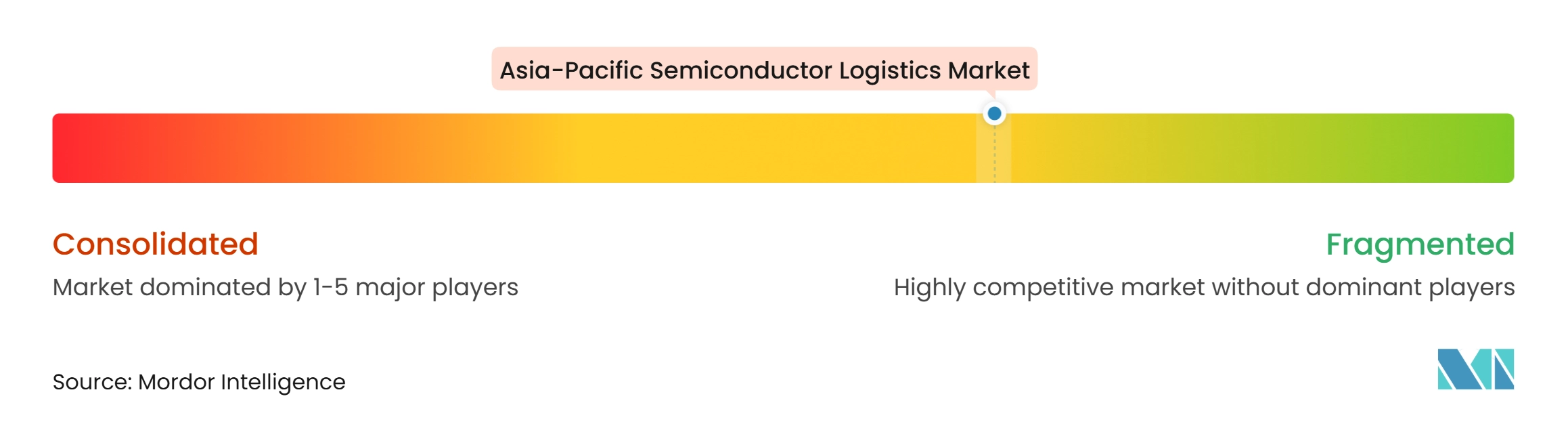
The Asia-Pacific semiconductor logistics market is moderately fragmented because it includes global integrated providers and regional specialists. Competition is stronger in highly specialized work, such as temperature-controlled chemical transport, oversized equipment movement, and cleanroom-compatible last-mile delivery. Customer qualification can take 6-12 months because it covers electrostatic discharge controls, information security, customs processes, and operating procedures. IATA Dangerous Goods Regulations and IEC 61340 electrostatic discharge standards are important compliance references for sensitive cargo operations. ISO 14001 environmental management systems and R2v3 recycling certification can also support procurement requirements where sustainability obligations apply. Providers need to combine certifications with operations near the fab, rather than treating compliance as a stand-alone service. Semiconductor customers need evidence that processes are consistently applied by drivers, warehouse teams, customs staff, and local subcontractors. This makes training, audits, and documented operating procedures essential to competitive delivery. It also raises the cost of entry for providers seeking to serve the most sensitive cargo.
Companies are investing in facilities and network capabilities that place specialized services close to semiconductor clusters. DHL Supply Chain's Chitose project was designed to provide inventory storage, in-plant logistics, and spare-parts delivery for Japan's next-generation semiconductor cluster. NX Group's September 2026 cooperation with India Semiconductor Mission showed how logistics providers were preparing for India's new manufacturing locations. Kuehne+Nagel also signed a lead logistics provider agreement with Evonik in 2026 for approximately 70,000 annual shipments across Asia-Pacific markets. These moves show a focus on regional scale, integrated control, and service consistency. Their facilities can support time-sensitive spares and production materials while reducing the distance to manufacturing sites. Cross-border services are also more useful when a provider can apply the same quality controls in each location. Investment in physical capacity therefore works best when linked to a standardized operating system.
Technology is an important basis for competition in the Asia-Pacific semiconductor logistics market, as predictive ETAs, shock and temperature monitoring, and automated customs documentation improve visibility for sensitive cargo. Controlled cross-border routes between Taiwan, Malaysia, and Vietnam, together with new Indian fab corridors, favor providers that establish certified capacity early and coordinate equipment imports, storage, scheduled transport, emergency shipments, and returns. Regional operators can compete through close fab access, carrier relationships, local facilities, and transit-time flexibility, while global providers can draw on multi-country networks and broader compliance systems. Digital reporting can make shipment status, documents, and cargo conditions easier to assess, but it does not replace electrostatic discharge, safety, security, and temperature-control capability. Customers assess reliability across the full-service chain, so local teams need contingency plans, direct coordination with manufacturing and procurement contacts, and alternatives such as pre-approved carriers or controlled buffer storage. The competitive model may, therefore, vary by location, as mature corridors may reward service quality and fast response while newer clusters require early infrastructure investment and qualified local execution.
Asia-Pacific Semiconductor Logistics Industry Leaders
-
DHL Group
-
Kuehne + Nagel
-
Nippon Express Holdings, Inc.
-
DSV A/S
-
Yusen Logistics Co., Ltd.
- *Disclaimer: Major Players sorted in no particular order
Asia-Pacific Semiconductor Logistics Market Companies Covered in this Report
- DHL Group
- Kuehne + Nagel
- Nippon Express Holdings, Inc.
- DSV A/S
- Yusen Logistics Co., Ltd.
- UPS Supply Chain Solutions
- FedEx Logistics
- CEVA Logistics
- Omni Logistics
- Dimerco Express Group
- NNR Global Logistics
- MOL Logistics
- AIT Worldwide Logistics
- Kintetsu World Express, Inc.
- Logistics Plus, Inc.
- CCS Express
- K Line Logistics, Ltd.
- Javelin Logistics Company, Inc.
- Three Way Logistics
- Sinotrans Limited
- Kerry Logistics Network Limited
- Expeditors International of Washington, Inc.
Recent Industry Developments in Asia-Pacific Semiconductor Logistics Market
- September 2026: NX Group (Nippon Express Holdings) formalized cooperation with India Semiconductor Mission, targeting USD 380 million in India revenue by FY 2028 and committing to a dedicated semiconductor logistics facility in Gujarat's Dholera Special Investment Region by 2027 to serve India's first wave of commercial chip manufacturing units.
- August 2026: DHL Supply Chain broke ground on a dedicated semiconductor logistics center in Chitose, Hokkaido, adjacent to Japan's next-generation semiconductor industrial cluster. The 14,500 m² multi-user facility provides inventory storage, in-plant logistics, and on-demand spare-parts delivery, with completion expected by the end of 2026.
- May 2026: Kuehne + Nagel signed a Lead Logistics Provider agreement with Evonik covering approximately 70,000 annual shipments across Mainland China, Taiwan, Singapore, South Korea, Japan, New Zealand, Australia, India, and Southeast Asia, standardizing digitized logistics processes and real-time visibility for specialty chemical flows that included semiconductor-related materials.
- April 2025: UMC officially unveiled its new greenfield fab in Singapore's Pasir Ris Wafer Fab Park, targeting volume production at an investment of up to USD 5 billion for 30,000 wafers per month of 22nm/28nm capacity, creating immediate inbound demand for chemical, substrate, and equipment logistics.
Asia-Pacific Semiconductor Logistics Market Report Scope
Segmentation Overview
| Transportation | Roadways |
| Railways | |
| Sea and Inland Waterways | |
| Airways | |
| Warehousing and Storage | Tempertaure-Controlled (Cold Chain) |
| Non-Temperature-Controlled (Non-Cold Chain) | |
| Value-Added Services |
| Raw Materials and Chemicals |
| Wafers, Bare and Processed |
| Packaging Materials |
| Finished Semiconductor Products |
| Other Product Types |
| Integrated Device Manufacturers (IDMs) |
| Foundries |
| Outsourced Semiconductor Assembly and Test (OSAT) Providers |
| Fabless Semiconductor Companies |
| Semiconductor Equipment Manufacturers |
| Others |
| Automotive |
| Consumer Electronics |
| Data Centers and Telecommunications |
| Industrial and Automation |
| Healthcare and Life Sciences |
| Aerospace and Defense |
| Other Applications |
| China |
| Taiwan |
| South Korea |
| Japan |
| India |
| Southeast Asia |
| Australia |
| Rest of Asia-Pacific |
| By Logistics Function | Transportation | Roadways |
| Railways | ||
| Sea and Inland Waterways | ||
| Airways | ||
| Warehousing and Storage | Tempertaure-Controlled (Cold Chain) | |
| Non-Temperature-Controlled (Non-Cold Chain) | ||
| Value-Added Services | ||
| By Product Type | Raw Materials and Chemicals | |
| Wafers, Bare and Processed | ||
| Packaging Materials | ||
| Finished Semiconductor Products | ||
| Other Product Types | ||
| By Customer | Integrated Device Manufacturers (IDMs) | |
| Foundries | ||
| Outsourced Semiconductor Assembly and Test (OSAT) Providers | ||
| Fabless Semiconductor Companies | ||
| Semiconductor Equipment Manufacturers | ||
| Others | ||
| By End-Use Application | Automotive | |
| Consumer Electronics | ||
| Data Centers and Telecommunications | ||
| Industrial and Automation | ||
| Healthcare and Life Sciences | ||
| Aerospace and Defense | ||
| Other Applications | ||
| By Geography | China | |
| Taiwan | ||
| South Korea | ||
| Japan | ||
| India | ||
| Southeast Asia | ||
| Australia | ||
| Rest of Asia-Pacific | ||
Key Questions Answered in the Report
What is the forecast for Asia-Pacific semiconductor logistics through 2032?
The sector is forecast to grow from USD 18.72 billion in 2027 to USD 29.30 billion by 2032, at a 9.37% CAGR.
Which logistics function accounts for the largest portion of semiconductor activity in Asia-Pacific?
Transportation leads with 51.74% in 2026, reflecting recurring cross-border freight and fab construction cargo.
Why is temperature-controlled warehousing becoming more important for semiconductor supply chains?
It is forecast to register an 11.85% CAGR because EUV photoresists, specialty etchants, and ultrapure materials need closer thermal stability.
Which mode of transport is growing fastest for semiconductor cargo in Asia-Pacific?
Airways lead the transport-mode segment with 39.26% in 2026 and a projected 12.74% CAGR through 2032.
What is driving India's semiconductor logistics demand?
Semicon 2.0, approved in July 2026, supports new capacity across design, materials, fabs, advanced packaging, research, and talent.
What compliance capabilities do semiconductor logistics providers need?
Providers need controlled handling, electrostatic discharge procedures, dangerous goods processes, traceability, and appropriate customs documentation.