
Asia-Pacific Semiconductor Demand In Data Center Market Size and Share
Market Overview
| Study Period | 2021 - 2032 |
|---|---|
| Forecast Data Period | 2027 - 2032 |
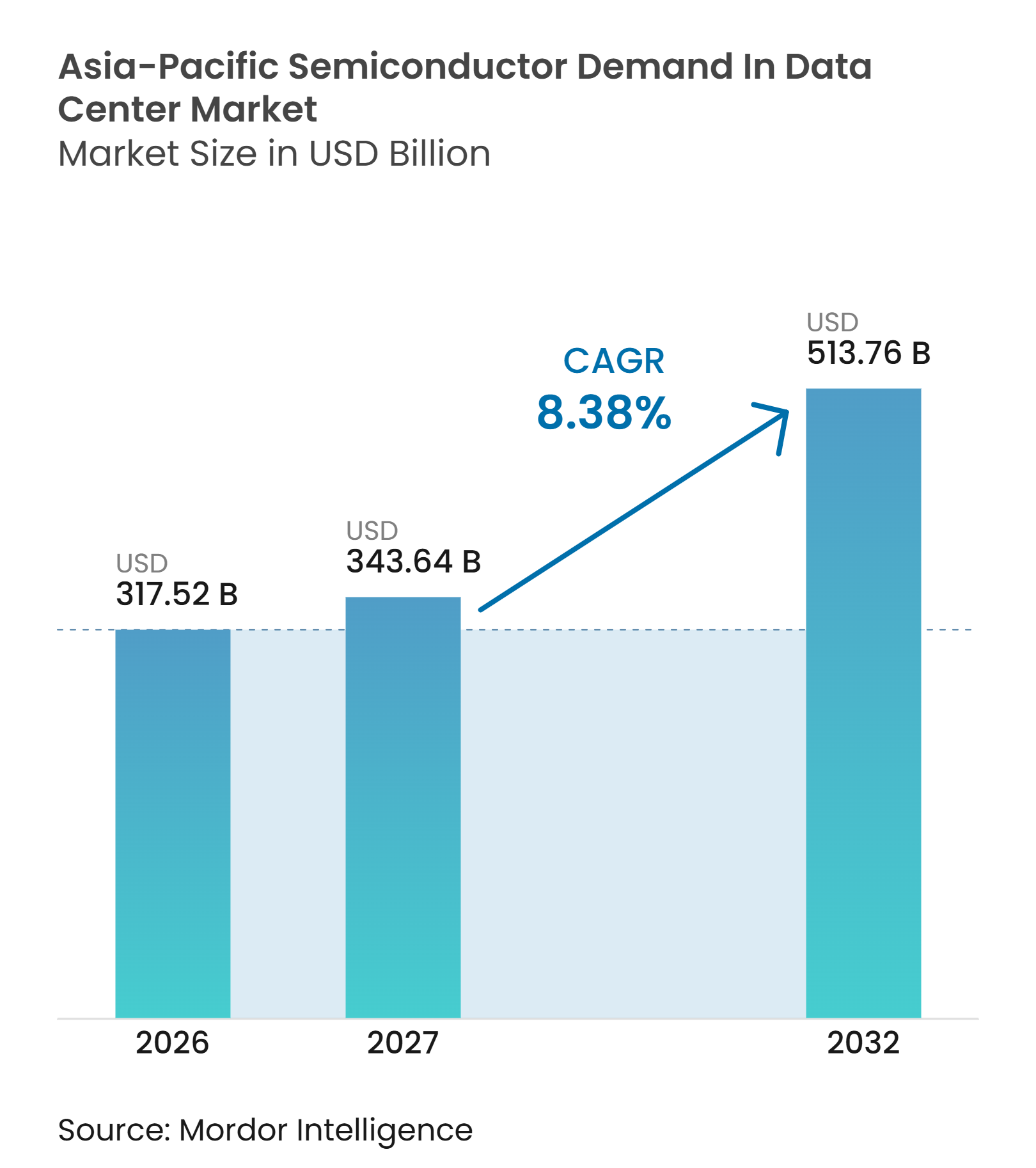
| Base Year Market Size (2026) | USD 317.52 Billion |
| Market Size (2027) | USD 343.64 Billion |
| Market Size (2032) | USD 513.76 Billion |
| Growth Rate (2027 - 2032) | 8.38 % |
| Market Concentration | High |
Major Players *Disclaimer: Major Players sorted in no particular order Image © Mordor Intelligence. Reuse requires attribution under CC BY 4.0. | |
Asia-Pacific Semiconductor Demand In Data Center Market Analysis by Mordor Intelligence
Asia-Pacific semiconductor demand in data center market size is expected to grow from USD 317.52 billion in 2026 and is forecast to reach USD 513.76 billion by 2032 at 8.38% CAGR over 2027-2032. The Asia-Pacific semiconductor demand in data center market is supported by investment in AI-ready facilities and by efforts to build more local chip supply chains. Demand is extending beyond AI accelerators because new systems also need processors, memory, networking components, power devices, and thermal controls. National AI programs and hyperscale investment are shifting procurement toward domestic capacity in several countries, especially where local sourcing is a policy priority. Power availability, grid connection timing, advanced packaging capacity, and HBM supply will determine how quickly committed projects become operating data centers. Competition is becoming more complex as global semiconductor leaders scale capacity while domestic chip suppliers build positions in government-backed deployments.
Key Report Takeaways
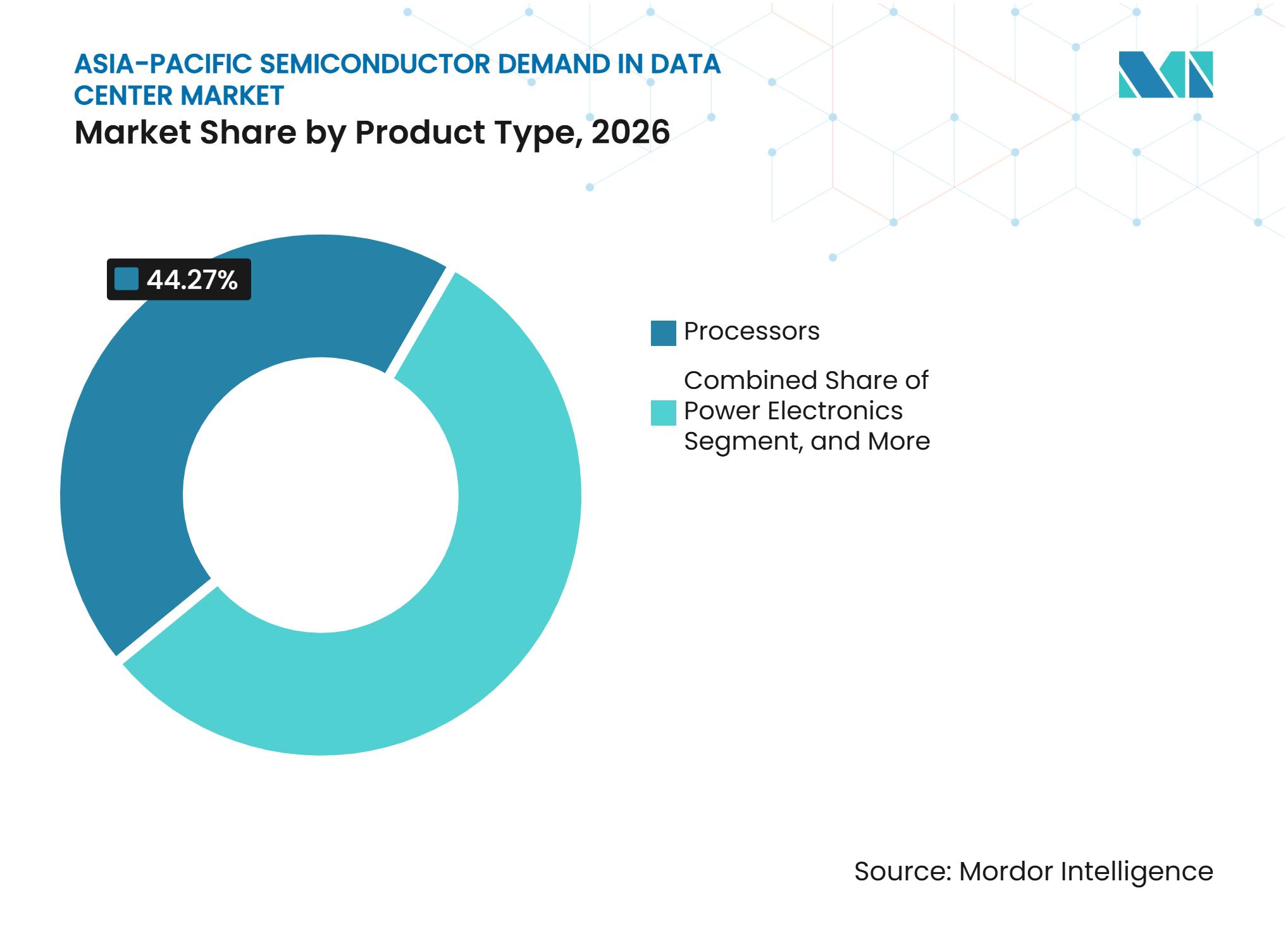
- By product type, processors held 44.27% revenue share in 2026, while memory type is projected to expand at a 9.24% CAGR through 2032.
- By application, IT equipment accounted for 77.69% revenue share in 2026, while server and rack power systems are projected to expand at a 9.29% CAGR through 2032.
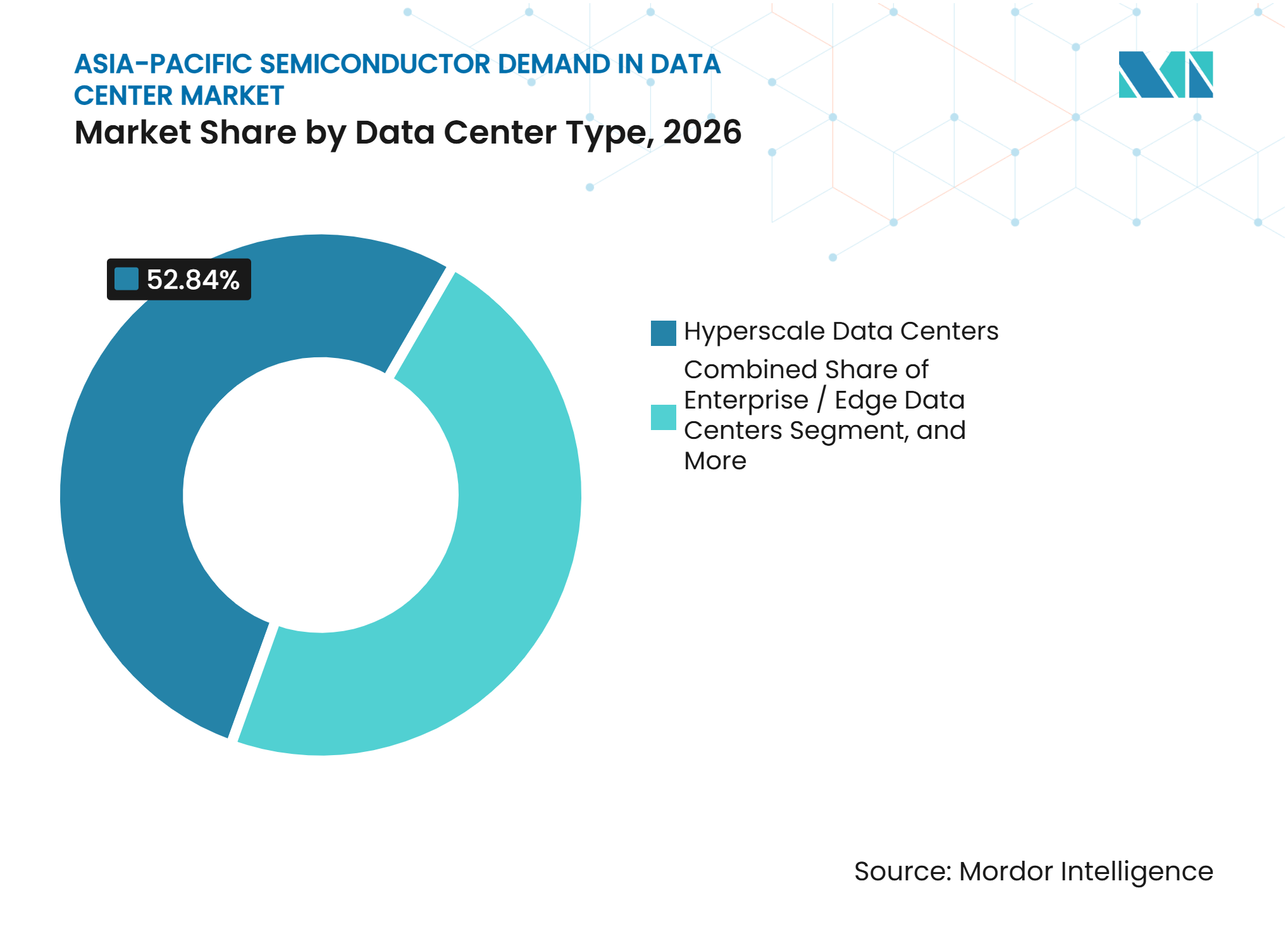
- By data center type, hyperscale data centers held 52.84% revenue share in 2026, while enterprise and edge data centers are projected to expand at a 9.36% CAGR through 2032.
- By geography, China held 43.38% revenue share in 2026, while India is projected to expand at a 9.18% CAGR through 2032.
Note: Market numbers in this report are based on Mordor Intelligence's proprietary estimation framework, which combines nine months of actuals with Q4 projections for base year 2026.
Market Trends and Insights
Drivers Impact Analysis of Asia-Pacific Semiconductor Demand In Data Center Market*
| Driver | (~) % Impact on CAGR Forecast | Geographic Relevance | Impact Timeline |
|---|---|---|---|
| AI Training and Inference Infrastructure Expansion | +2.5% | Global, with concentration in China, Japan, South Korea, and India | Short term (≤ 2 years) |
| Hyperscaler and Sovereign Cloud Investment | +1.8% | China, India, Japan, South Korea, and Taiwan | Medium term (2-4 years) |
| Rising Demand for High-Bandwidth Memory and Advanced Networking | +1.2% | South Korea, Taiwan, and global spillover | Short term (≤ 2 years) |
| Regional Semiconductor Supply Chain Localization | +0.8% | China, India, Japan, and South Korea | Long term (≥ 4 years) |
| Enterprise Digitalization Across Manufacturing, Retail, and Financial Services | +0.5% | China, India, Southeast Asia, and Japan | Medium term (2-4 years) |
| Domestic AI Chip Substitution in Mainland China | +0.4% | China, with early gains in Beijing, Shanghai, and Shenzhen | Medium term (2-4 years) |
| Source: Mordor Intelligence | |||
AI Training and Inference Infrastructure Expansion
AI spending is now supporting both large training clusters and distributed inference systems across the Asia-Pacific semiconductor demand in data center market. J.P. Morgan reported that 88% of surveyed Asia-Pacific respondents had incurred AI spending in the previous 12 months, and that the AI share of combined operating and capital expenditure is expected to rise from 4.5% to 5.8% in the following year. The shift increases demand for CPUs, GPUs, HBM, networking ASICs, and power semiconductors rather than for accelerators alone. Agentic workloads require more CPU capacity than GPUs for conventional training tasks, which changes the component mix purchased by hyperscalers. J.P. Morgan projects total server CPU shipments to rise from 26 million units in 2025 to 68 million units in 2028, with agentic AI CPU shipments growing at a 155% CAGR over that period. This broader equipment requirement strengthens the demand base for the Asia-Pacific semiconductor demand in data center market.
Hyperscaler and Sovereign Cloud Investment
Hyperscaler capital programs are raising the volume of semiconductor purchases needed for new facilities. Meta, Microsoft, Amazon, and Alphabet invested USD 380 billion in AI-capable data centers in 2025, and their spending was projected to reach USD 650 billion in 2026. Sovereign AI programs add a separate source of demand because their near-term objectives are often based on national computing capacity and technology control. India approved Semicon 2.0 in July 2026 with INR 127,500 crore (USD 13.4 billion) covering chip design, advanced packaging, fabrication, equipment, research and development, and talent.[1] Local sourcing provisions can create dependable demand for domestic semiconductor suppliers that would otherwise face a sharper price and performance disadvantage against global suppliers.
Rising Demand for High-Bandwidth Memory and Advanced Networking
HBM has become a capacity-constrained component for AI servers in the Asia-Pacific semiconductor demand in data center market. NVIDIA’s B200 uses 192 GB of HBM3E, while the Rubin platform is expected to move to HBM4, increasing bandwidth requirements for each generation. The supplied research indicates that memory makers may meet only 60% of global demand in 2026, despite capacity additions at Samsung and SK Hynix. TSMC’s CoWoS capacity was projected to reach 1.313 million wafers in 2026, while NVIDIA had reserved 800,000 to 850,000 wafers for the year. JEDEC HBM interface standards and IEC thermal-management requirements affect how memory and packaging advances are qualified for deployment. Packaging capacity therefore has as much influence on supply availability as the production of compute dies.
Regional Semiconductor Supply Chain Localization
Localization is redirecting semiconductor investment across the region and is creating demand that is less dependent on a single economic cycle. Samsung Electronics and SK Hynix committed KRW 800 trillion (USD 520 billion) to a semiconductor fabrication hub in South Korea for HBM and advanced DRAM production. TSMC announced investment exceeding USD 23 billion in a second Japanese facility focused on 3 nm production, strengthening Japan’s role in high-performance computing supply chains. These programs also require sensors, power electronics, and analog ICs used in fabrication, testing, and facility operations. South Korea also received USD 2 billion in semiconductor and AI investment pledges, including a commitment by Tokyo Electron for an equipment and materials plant. This investment pattern gives specialized suppliers more routes into the Asia-Pacific semiconductor demand in data center market.
Restraints Impact Analysis of Asia-Pacific Semiconductor Demand In Data Center Market*
| Restraint | (~) % Impact on CAGR Forecast | Geographic Relevance | Impact Timeline |
|---|---|---|---|
| Data Center Power and Grid Connection Constraints | -1.5% | Asia-Pacific, particularly India, Southeast Asia, and China’s eastern regions | Medium term (2-4 years) |
| Advanced Packaging and HBM Capacity Bottlenecks | -1.2% | South Korea, Taiwan, and global spillover | Short term (≤ 2 years) |
| Export Controls and Technology Access Restrictions | -0.9% | China, with spillover to Vietnam and Southeast Asia | Long term (≥ 4 years) |
| High Cost of AI Optimized Data Center Infrastructure | -0.7% | Global, with acute effects in emerging Asia-Pacific markets | Medium term (2-4 years) |
| Source: Mordor Intelligence | |||
Data Center Power and Grid Connection Constraints
Grid capacity is becoming an immediate operating constraint for the Asia-Pacific semiconductor demand in data center market. The supplied assessment indicated that electricity use in Asia-Pacific data centers could rise from less than 200 TWh in 2025 to more than 1,000 TWh by the mid-2030s. More than 32 GW of planned capacity across over 1,150 projects is increasing pressure on power networks. New connections increasingly carry requirements for battery storage and renewable power procurement. In India, capacity planned for Visakhapatnam, Mumbai, and Hyderabad could equal 80%, 60%, and 20% of each city’s current peak power demand by fiscal 2030. Delays in power delivery can postpone data center commissioning and delay the use of semiconductor orders already placed by operators.
Advanced Packaging and HBM Capacity Bottlenecks
Advanced packaging cannot yet keep pace with the growth in demand for AI systems. TSMC’s CoWoS supply-demand gap was estimated at 20% in 2026, even as monthly output was projected to rise from 70,000 wafers in 2025 to 130,000-140,000 wafers by the end of 2026. CoWoS-S is nearing reticle-size limits for large AI chips, which has encouraged customers to consider CoWoS-L and accept additional yield and cost risks. New memory manufacturing capacity from Samsung and SK Hynix was not expected to materially arrive before late 2027 or 2028. HBM production requires more cleanroom capacity per gigabyte than conventional DRAM, so the shift toward HBM also limits standard memory output. The resulting supply constraints can increase costs and delay the rollout of new AI infrastructure.
*Our forecasts treat driver/restraint impacts as directional, not additive. The impact forecasts reflect baseline growth, mix effects, and variable interactions.
Asia-Pacific Semiconductor Demand In Data Center Market Segment Analysis
By Product Type:
Processors Lead AI Infrastructure SpendingProcessors represented 44.27% of regional revenue in 2026, making them the largest product category. GPU-intensive training clusters are the leading source of processor revenue, but custom ASICs and networking logic are also increasing their role. Broadcom reported AI semiconductor revenue of USD 16.7 billion in fiscal third quarter 2026, up 221% year over year. Intel reported data center and AI revenue of USD 7.3 billion in third quarter 2026, up 78% year over year, as Xeon and EPYC deployments expanded across cloud and enterprise systems.[2] FPGAs, DPUs, SmartNICs, and network switches are being purchased as operators expand InfiniBand and Ethernet fabrics for accelerator clusters.
Memory type is projected to grow at a 9.24% CAGR through 2032, the highest rate among product categories in the Asia-Pacific semiconductor demand in data center market. SK Hynix cited an estimate that the global HBM market would reach USD 54.6 billion in 2026, up 58% year over year. The HBM3E-to-HBM4 transition and the planned Rubin platform are absorbing a larger share of memory capacity. Custom ASIC demand is also increasing HBM requirements, according to the supplied analysis. NAND flash demand is rising as AI systems require enterprise SSD capacity for model weights and retrieval-augmented generation workloads, while power electronics, analog ICs, and sensors become increasingly important, with each deployment requiring additional energy management and monitoring hardware.



By Application:
IT Equipment Remains the Largest Spending AreaIT equipment represented 77.69% of regional revenue in 2026. The category includes servers, storage systems, and networking hardware that receive the majority of investment in processors, memory, and logic ICs. Dell’Oro Group reported 182% year-over-year growth in worldwide revenue for semiconductors and components used in data center servers and storage during the second quarter of 2026. DRAM and storage drives were identified as major contributors to that growth. Inference systems increasingly require a different balance of memory bandwidth and compute capacity than training systems, broadening the equipment configurations used by operators.
Server and rack power systems are projected to grow at a 9.29% CAGR through 2032. Leading AI facilities are reaching or exceeding 100 kW per rack, thereby increasing semiconductor content per rack. Power-management ICs, GaN and SiC switching devices, and intelligent power modules are used to manage this higher electrical load. Battery backup, energy storage, facility power, cooling, thermal management, monitoring, and security systems require more power components, sensors, controller ICs, and embedded analytics. These requirements extend the Asia-Pacific semiconductor demand in data center industry beyond conventional server components.
By Data Center Type:
Hyperscale Facilities Lead, While Enterprise and Edge Systems ExpandHyperscale data centers accounted for 52.84% of revenue share in 2026. Their position is supported by large capital programs at the region’s leading cloud operators. China’s leading internet companies were expected to invest more than USD 70 billion in data center capacity in 2026, primarily through hyperscale facilities. In South Korea and Japan, colocation agreements also support expansion, and Actis reported that its Seoul hyperscale data center had been fully contracted since February 2024. Proprietary ASICs from Google and AWS are helping hyperscalers diversify their silicon purchases beyond merchant accelerators.
Enterprise and edge data centers are projected to expand at a 9.36% CAGR through 2032. Inference workloads are moving closer to users where operators need lower latency, data residency, and local processing capacity. IDC identified hyperscale power and permitting constraints, real-time needs, and rapid growth in edge data volumes as drivers for accelerator demand at the edge. Manufacturing, financial services, and retail organizations need embedded AI processors, rugged power modules, and industrial sensors that differ from the GPU-focused configuration common in hyperscale systems. Colocation providers offer dedicated capacity without the cost of a self-built facility and are adopting more liquid-cooling and power-management components as rack density rises, broadening Asia-Pacific semiconductor demand in the data center industry across centralized and distributed computing sites.

Geography Analysis
China: Domestic Sourcing Reshapes AI Infrastructure Procurement
China accounted for 43.38% of Asia-Pacific semiconductor demand in the data center market in 2026. The country is preparing a CNY 2 trillion (USD 295 billion) five-year plan for interconnected AI computing hubs that would require at least 80% of the technology to come from domestic suppliers. This rule creates a clearer path to deployment for domestic suppliers, such as Huawei Technologies, in state-funded facilities. China’s leading internet companies were expected to invest more than USD 70 billion in data center capacity in 2026, changing a procurement model that had previously directed a large share of hyperscaler spending to foreign chips. Export controls and domestic sourcing requirements will remain important compliance factors in data center investment and chip selection.
India: Capacity Growth Is Supported by Policy and Contracted Demand
India is projected to expand at a 9.18% CAGR through 2032. Installed data center capacity is expected to increase fivefold to 7.5 GW by fiscal 2030, supported by investment exceeding INR 300,000 crore (USD 35 billion) over the four fiscal years ending in March 2030. Nearly half of upcoming capacity was already committed under long-term contracts, providing greater visibility for equipment procurement. Semicon 2.0 covers chip design, fabrication, packaging, materials, equipment, research and development, and skills, and five of the 12 approved semiconductor units were in commercial production by September 2026. Data localization needs and enterprise AI adoption support local computing capacity, but grid connection timing in Visakhapatnam, Mumbai, and Hyderabad remains a central constraint.
Japan, South Korea, Taiwan, and Other Asia-Pacific Markets: Manufacturing and Capacity Buildout Continue
Japan, South Korea, Taiwan, and emerging Asia-Pacific locations combine manufacturing investment with data center capacity growth. TSMC’s investment of over USD 23 billion in a second Japanese 3 nm facility strengthens regional production of high-performance computing devices.[3] South Korea’s plan calls for KRW 550 trillion (USD 407 billion) in AI data centers by 2029 and an additional 10 GW of capacity by 2035, while Samsung Electronics and SK Hynix have committed KRW 800 trillion (USD 520 billion) to a new fabrication hub. Taiwan remains central to advanced fabrication and packaging, while Malaysia, Singapore, Thailand, Vietnam, and the Philippines are attracting projects that need available power and supportive compliance conditions.
Competitive Landscape
Market Concentration
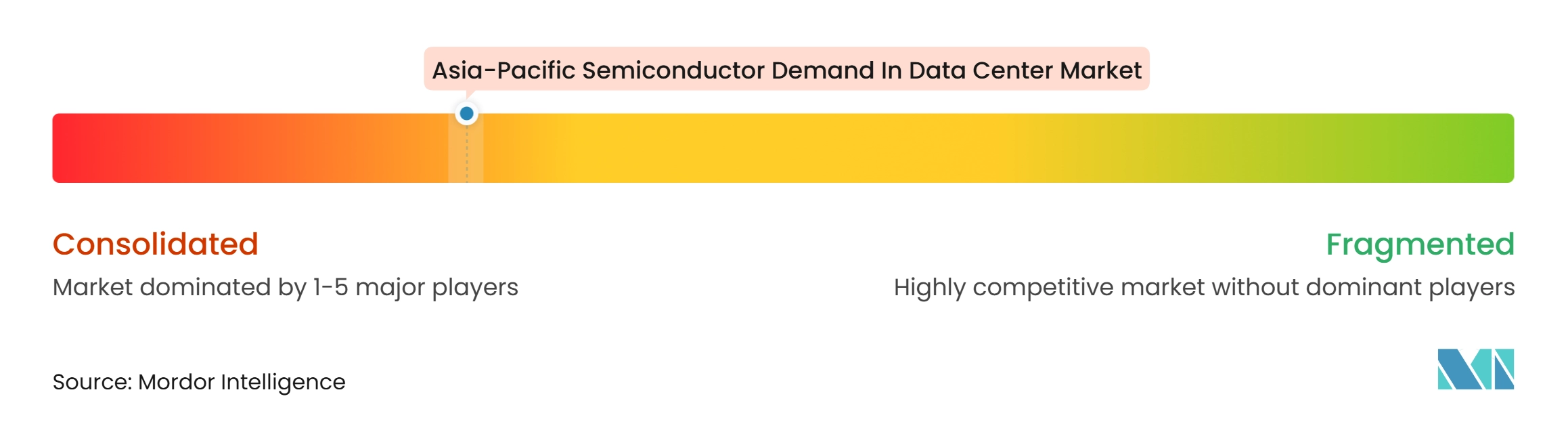
The Asia-Pacific semiconductor demand in the data center market has concentrated in AI accelerators, HBM, and advanced packaging, while power electronics, analog ICs, sensors, and packaging services remain more distributed. NVIDIA reported USD 89 billion in data center revenue for the fiscal second quarter of 2027, for the quarter ended July 26, 2026.[4] Broadcom’s AI semiconductor revenue reached USD 16.7 billion in fiscal third quarter 2026, up 221% year over year, confirming the growing role of custom ASICs and networking logic. Samsung Electronics, SK Hynix, and Micron accounted for 90.5% of global DRAM sales in the fourth quarter of 2025. TSMC’s CoWoS-L is expected to remain a major advanced packaging platform for AI chips through 2028.
Hyperscalers are driving Asia-Pacific semiconductor demand in the data center market through proprietary ASIC designs and close relationships with foundries. Arm architecture supports chips such as Alibaba’s Yitian 710 and AWS Graviton, giving cloud providers a route to tailor server processors to their workloads. TSMC disclosed that it was evaluating 3D DRAM production options at NVIDIA’s request, including a new memory facility or the conversion of an existing plant. The consideration reflects the persistent shortage of memory capacity and the strategic value of closer integration between foundry, packaging, and memory supply. The shift could intensify competition for established memory producers if it leads to new manufacturing capacity.
In China, Huawei’s Ascend portfolio is benefiting from requirements for domestic chips in state-funded projects. Cambricon Technologies, Iluvatar CoreX, and Phytium Technology are also gaining traction in domestic data center deployments, adding more suppliers to an area previously led by NVIDIA and AMD. TSMC expanded a key CoWoS front-end production step by working with outsourced semiconductor assembly and test partners, including ASE, as demand for packaging rose. SK Telecom, NTT, and Chunghwa Telecom also agreed to invest in a fund focused on AI data center infrastructure, AI semiconductors, optical communications, and AI software startups, underscoring that access to capacity, ecosystem partnerships, and local procurement channels matter alongside chip design performance.
Asia-Pacific Semiconductor Demand In Data Center Industry Leaders
-
NVIDIA Corporation
-
Advanced Micro Devices, Inc.
-
Intel Corporation
-
Broadcom Inc.
-
Marvell Technology, Inc.
- *Disclaimer: Major Players sorted in no particular order
Asia-Pacific Semiconductor Demand In Data Center Market Companies Covered in this Report
- NVIDIA Corporation
- Advanced Micro Devices, Inc.
- Intel Corporation
- Broadcom Inc.
- Marvell Technology, Inc.
- Arm Holdings plc
- Samsung Electronics Co., Ltd.
- SK hynix Inc.
- Micron Technology, Inc.
- Kioxia Holdings Corporation
- Taiwan Semiconductor Manufacturing Company Limited
- United Microelectronics Corporation
- GlobalFoundries Inc.
- Huawei Technologies Co., Ltd.
- Alibaba Group Holding Limited
- Google LLC
- Amazon.com, Inc.
- Microsoft Corporation
- IBM Corporation
Recent Industry Developments in Asia-Pacific Semiconductor Demand In Data Center Market
- November 2026: South Korea drew a record USD 2 billion in foreign investment pledges in semiconductors and AI at an annual trade forum, including commitments from Tokyo Electron for a semiconductor equipment and materials plant and UK-based Nscale for an AI data center in South Korea, reinforcing the country’s position as an integrated semiconductor and data center hub. The pledges covered both manufacturing inputs and digital infrastructure, which connects chip capacity with local computing demand.
- October 2026: TSMC expanded outsourcing of a key CoWoS front-end step, Chip-on-Wafer, to OSAT partners including ASE, as NVIDIA reserved 800,000 to 850,000 CoWoS wafers for 2026. The CoWoS supply-demand gap was estimated to remain at 20% through the year, sustaining advanced packaging as a binding market constraint. The use of OSAT partners reflects efforts to relieve a production constraint that affects chip deployment schedules.
- October 2026: TSMC’s CoWoS-L was expected to remain the mainstream advanced packaging solution for AI chips through 2028, with AWS and Microsoft expected to adopt CoWoS-L in 2027, expanding the advanced packaging customer base beyond NVIDIA and AMD.
- September 2026: Micron unveiled a 512 GB DDR5 DRAM module for AI and data center servers. The module doubled capacity relative to existing next-generation offerings while reducing power consumption by more than 60%, and AMD and Intel were validating it for next-generation server platforms with mass production targeted for the second half of 2027. The development addresses memory capacity and power requirements in denser server configurations.
Asia-Pacific Semiconductor Demand In Data Center Market Report Scope
The Asia-Pacific data center semiconductor demand market covers the demand for semiconductor components used in data center infrastructure across the Asia-Pacific region. These components include processors, memory chips, storage controllers, networking chips, graphics processing units, and other integrated circuits that support data processing, storage, connectivity, and cloud computing operations.
The Asia-Pacific Semiconductor Demand in Data Center Market Report is Segmented by Product Type (Processors [Central Processing Units (CPUs), Graphics Processing Units (GPUs), Microcontrollers (MCUs), and Digital Signal Processors (DSPs)], Logic ICs [Field Programmable Gate Arrays (FPGAs), DPUs/IPUs/SmartNICs, Network Switches and Server Rack Connectivity, Controller ICs, and Other Logic ICs], Memory Type [DRAM, High-Bandwidth Memory (HBM), NAND Flash, NOR Flash, and Other Memory Types], Power Electronics [Discrete Components {Rectifiers, Bipolar Transistors, MOSFETs, IGBTs, and Other Discrete Components}, Power Modules {Thyristor Modules, IGBT Modules, MOSFET Modules, and Intelligent Power Modules (IPMs)}, and Power ICs {PMICs (Multichannel), Switching Regulators (AC/DC and DC/DC, Isolated/Non-Isolated), Linear Regulators, Battery Management ICs, Gate Driver ICs, and Other Power ICs}], Analog ICs [Interface and Signal-Conditioning ICs, Signal-Conversion ICs, Application-Specific Analog ICs], Optoelectronics [Laser Transmitters, Photodetectors and Photodiodes, Optocouplers and Optical Isolators, Optical Switches, and Infrared Emitters and Detectors], and Sensors [Temperature Sensors, Pressure Sensors, Magnetic-Field and Hall-Effect Sensors, Current Sensors, Humidity Sensors, and Gas and Smoke Sensors]), Application (IT Equipment, Server and Rack Power Systems, Battery Backup and Energy Storage Systems, Facility Power Infrastructure, Cooling and Thermal Management Infrastructure, Data Center Monitoring and Automation, and Safety and Security Infrastructure), Data Center Type (Hyperscale Data Centers, Colocation Data Centers, and Enterprise/Edge Data Centers), and Geography (China, Japan, South Korea, Taiwan, India, and Rest of Asia-Pacific)
Segmentation Overview
| Processors | Central Processing Units (CPUs) | |
| Graphics Processing Units (GPUs) | ||
| Microcontrollers (MCUs) | ||
| Digital Signal Processors (DSPs) | ||
| Logic ICs | Field Programmable Gate Arrays (FPGAs) | |
| DPUs / IPUs / SmartNICs | ||
| Network Switches and Server Rack Connectivity | ||
| Controller ICs | ||
| Other Logic ICs | ||
| Memory Type | DRAM | |
| High-Bandwidth Memory (HBM) | ||
| NAND Flash | ||
| NOR Flash | ||
| Other Memory Types | ||
| Power Electronics | Discrete Components | Rectifiers |
| Bipolar Transistors | ||
| MOSFETs | ||
| IGBTs | ||
| Other Discrete Components | ||
| Power Modules | Thyristor Modules | |
| IGBT Modules | ||
| MOSFET Modules | ||
| Intelligent Power Modules (IPMs) | ||
| Power ICs | PMICs (Multichannel) | |
| Switching Regulators (AC/DC, DC/DC, Isolated/Non-Isolated) | ||
| Linear Regulators | ||
| Battery Management ICs | ||
| Gate Driver ICs | ||
| Other Power ICs | ||
| Analog ICs | Interface and Signal-Conditioning ICs | |
| Signal-Conversion ICs | ||
| Application-Specific Analog ICs | ||
| Optoelectronics | Laser Transmitters | |
| Photodetectors and Photodiodes | ||
| Optocouplers and Optical Isolators | ||
| Optical Switches | ||
| Infrared Emitters and Detectors | ||
| Sensors | Temperature Sensors | |
| Pressure Sensors | ||
| Magnetic-Field and Hall-Effect Sensors | ||
| Current Sensors | ||
| Humidity Sensors | ||
| Gas and Smoke Sensors | ||
| IT Equipment |
| Server and Rack Power Systems |
| Battery Backup and Energy Storage Systems |
| Facility Power Infrastructure |
| Cooling and Thermal Management Infrastructure |
| Data Center Monitoring and Automation |
| Safety and Security Infrastructure |
| Hyperscale Data Centers |
| Colocation Data Centers |
| Enterprise / Edge Data Centers |
| China |
| Japan |
| South Korea |
| Taiwan |
| India |
| Rest of Asia-Pacific |
| By Product Type | Processors | Central Processing Units (CPUs) | |
| Graphics Processing Units (GPUs) | |||
| Microcontrollers (MCUs) | |||
| Digital Signal Processors (DSPs) | |||
| Logic ICs | Field Programmable Gate Arrays (FPGAs) | ||
| DPUs / IPUs / SmartNICs | |||
| Network Switches and Server Rack Connectivity | |||
| Controller ICs | |||
| Other Logic ICs | |||
| Memory Type | DRAM | ||
| High-Bandwidth Memory (HBM) | |||
| NAND Flash | |||
| NOR Flash | |||
| Other Memory Types | |||
| Power Electronics | Discrete Components | Rectifiers | |
| Bipolar Transistors | |||
| MOSFETs | |||
| IGBTs | |||
| Other Discrete Components | |||
| Power Modules | Thyristor Modules | ||
| IGBT Modules | |||
| MOSFET Modules | |||
| Intelligent Power Modules (IPMs) | |||
| Power ICs | PMICs (Multichannel) | ||
| Switching Regulators (AC/DC, DC/DC, Isolated/Non-Isolated) | |||
| Linear Regulators | |||
| Battery Management ICs | |||
| Gate Driver ICs | |||
| Other Power ICs | |||
| Analog ICs | Interface and Signal-Conditioning ICs | ||
| Signal-Conversion ICs | |||
| Application-Specific Analog ICs | |||
| Optoelectronics | Laser Transmitters | ||
| Photodetectors and Photodiodes | |||
| Optocouplers and Optical Isolators | |||
| Optical Switches | |||
| Infrared Emitters and Detectors | |||
| Sensors | Temperature Sensors | ||
| Pressure Sensors | |||
| Magnetic-Field and Hall-Effect Sensors | |||
| Current Sensors | |||
| Humidity Sensors | |||
| Gas and Smoke Sensors | |||
| By Application | IT Equipment | ||
| Server and Rack Power Systems | |||
| Battery Backup and Energy Storage Systems | |||
| Facility Power Infrastructure | |||
| Cooling and Thermal Management Infrastructure | |||
| Data Center Monitoring and Automation | |||
| Safety and Security Infrastructure | |||
| By Data Center Type | Hyperscale Data Centers | ||
| Colocation Data Centers | |||
| Enterprise / Edge Data Centers | |||
| By Geography | China | ||
| Japan | |||
| South Korea | |||
| Taiwan | |||
| India | |||
| Rest of Asia-Pacific | |||
Key Questions Answered in the Report
What is the size of the Asia-Pacific semiconductor demand in data center market?
The Asia-Pacific semiconductor demand in data center market was USD 317.52 billion in 2026 and is forecast to reach USD 513.76 billion by 2032 at an 8.38% CAGR from 2027 to 2032. Growth is linked to AI-ready facility construction and broader semiconductor content per deployment.
Which product category has the largest share of data center semiconductor demand in Asia-Pacific?
Processors lead the product category with a 44.27% revenue share in 2026, supported by GPU-intensive training clusters and growing demand for CPUs, custom ASICs, network switches, DPUs, SmartNICs, and other logic components used in high-density AI systems.
Which application is expected to grow fastest in regional data center semiconductor demand?
Server and rack power systems are expected to expand at a 9.29% CAGR through 2032 as AI racks reach higher power densities and require more power-management components, switching devices, and intelligent power modules.
Why is HBM important for AI data center deployments?
HBM supports the bandwidth needs of AI accelerators, but supply remains constrained by memory fabrication and advanced packaging capacity. The transition toward HBM4 is increasing the need for qualified packaging and more cleanroom capacity.
Which country is expected to grow fastest in Asia-Pacific data center semiconductor demand?
India is projected to grow at a 9.18% CAGR through 2032, supported by new data center capacity, long-term contracts, semiconductor policy investment, and enterprise adoption of AI-enabled computing.
What is limiting the pace of AI data center expansion in Asia-Pacific?
Grid connection delays, power availability, advanced packaging limits, and HBM shortages can defer facility commissioning and semiconductor deployment. These constraints can affect projects even when operators have committed equipment procurement, secured sites, and contracted long-term capacity for their planned regional computing facilities and networks.