
Asia-Pacific Protective and Defense Technical Textile Market Size and Share
Market Overview
| Study Period | 2021 - 2032 |
|---|---|
| Forecast Data Period | 2027 - 2032 |
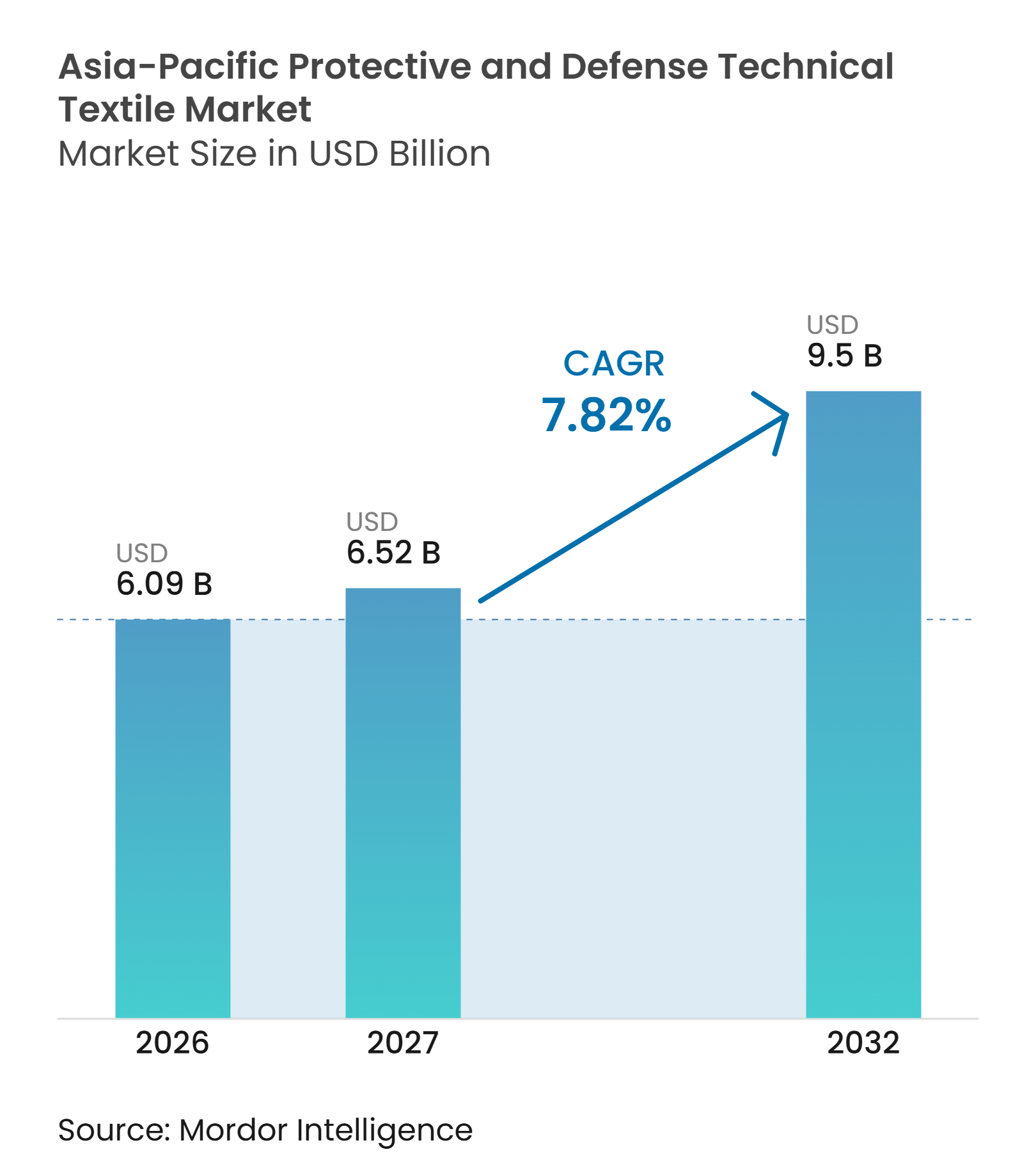
| Base Year Market Size (2026) | USD 6.09 Billion |
| Market Size (2027) | USD 6.52 Billion |
| Market Size (2032) | USD 9.5 Billion |
| Growth Rate (2027 - 2032) | 7.82 % |
| Market Concentration | Medium |
Major Players *Disclaimer: Major Players sorted in no particular order Image © Mordor Intelligence. Reuse requires attribution under CC BY 4.0. | |
Asia-Pacific Protective and Defense Technical Textile Market Analysis by Mordor Intelligence
The Asia-Pacific Protective And Defense Technical Textile Market size is expected to increase from USD 6.09 billion in 2026 to USD 6.52 billion in 2027 and reach USD 9.5 billion by 2032, growing at a CAGR of 7.82% over 2027-2032.
The Asia-Pacific protective and defense technical textile market is supported by higher defense procurement and tighter safety requirements in hazardous civilian work. Military expenditure in Asia and Oceania reached USD 681 billion in 2025, rising 8.1% from the prior year, which supports demand for certified protective systems across armed forces. Updated requirements, including China’s GB 20097-2025 standard effective in September 2026, require suppliers to reassess existing protective-garment lines. The Asia-Pacific protective and defense technical textile market also benefits when new vehicles, specialist units, and medical teams require protection against ballistic, thermal, chemical, biological, and radiological risks at the same time. These combined specifications increase textile content per wearer and create opportunities for suppliers that can qualify materials across several standards.
Key Report Takeaways
- By product type, flame, heat, and arc protective textiles held 26.5% of Asia-Pacific protective and defense technical textile market share in 2026, while ballistic, fragmentation, and penetration-resistant textiles are forecast to grow at a 9.5% CAGR through 2032.
- By material type, aramid fibers held 27.5% of Asia-Pacific protective and defense technical textile market size in 2026, while UHMWPE is forecast to grow at a 9.8% CAGR through 2032.
- By end-use application, defense and armed forces held 30.5% of regional revenue in 2026 and is forecast to grow at a 9.2% CAGR through 2032.
- By geography, China held 38.0% of regional revenue in 2026, while India is forecast to grow at a 9.5% CAGR through 2032.
Note: Market numbers in this report are based on Mordor Intelligence's proprietary estimation framework, which combines nine months of actuals with Q4 projections for base year 2026.
Market Trends and Insights
Drivers Impact Analysis of Asia-Pacific Protective and Defense Technical Textile Market*
| Driver | (~) % Impact on CAGR Forecast | Geographic Relevance | Impact Timeline |
|---|---|---|---|
| Defense Modernization and Indigenous Procurement | +2.0% | China, India, Japan, South Korea, Taiwan, Australia | Medium term (2-4 years) |
| Growth of High-Risk Manufacturing and Infrastructure | +1.5% | China, India, Southeast Asia | Short term (≤ 2 years) |
| Demand for Lightweight Multi-Threat Protection | +1.2% | APAC core markets and ASEAN | Medium term (2-4 years) |
| Regionalization of Technical-Textile Supply Chains | +0.8% | China, India, South Korea, and ASEAN | Long term (≥ 4 years) |
| Expansion of CBRN, Thermal, and Contamination-Control Requirements | +0.6% | China, India, Japan, Australia, Southeast Asia | Medium term (2-4 years) |
| Digitized Soldier Systems and Smart Protective Textiles | +0.4% | India, South Korea, China, Japan | Long term (≥ 4 years) |
| Source: Mordor Intelligence | |||
Defense Modernization and Indigenous Procurement
The Asia-Pacific protective and defense technical textile market draws its strongest support from defense modernization and domestic procurement rules. Japan allocated JPY 8,809.3 billion (USD 56.4 billion) to defense-related expenditure for FY2026, while its material expenses increased 4.8% from the prior year.[1] India’s 2026 defense capital outlay stands at USD 28.6 billion, and 75% is directed to domestic suppliers under updated procurement rules.[2] Taiwan increased defense spending to USD 18.2 billion in 2025, while South Korea allocated USD 47.8 billion to defense, supporting demand for flame-resistant uniforms and ballistic panels. Domestic-content requirements expand the role of qualified local fiber producers because overseas primes face offset obligations. STANAG protocols, national procurement rules, and ISO 11612 requirements shape which suppliers can turn procurement plans into contracted textile volumes.
High-Risk Manufacturing, Infrastructure, and Protection Requirements
The Asia-Pacific protective and defense technical textile market has a civilian demand base in construction, electrical utilities, chemical processing, and manufacturing. ASEAN economies require USD 7.1 trillion in infrastructure investment through 2040, equivalent to annual deployment of USD 476 billion, according to the Asian Development Bank.[3] These projects increase the number of workers who need high-visibility, cut-resistant, flame-resistant, and arc-rated clothing. Infrastructure activity also raises demand for protective equipment in rail, logistics, power transmission, and industrial maintenance. Military CBRN readiness programs in Japan, India, and Australia add demand for chemical and biological protective systems. The EU CBRN Project 113 provides specialized equipment and standardized training across 8 Southeast Asian countries through 2028, supporting more structured procurement practices.
Demand for lightweight multi-threat protection
The Asia-Pacific protective and defense technical textile market is moving toward systems that combine ballistic, thermal, and chemical protection without adding excessive weight. The Philippine Department of Science and Technology is developing tactical vests below 1 kilogram and plates between 550 grams and 2,100 grams that target Level III performance. India’s DRDO and IIT Delhi have developed smart body armor weighing 1.8 kilograms with conductive-ink biometric sensors. UHMWPE benefits from a density advantage over aramid, at 0.97 g/cm³ compared with 1.44 g/cm³, in weight-constrained armor programs. Korea Precision Materials Industry began domestic commercial production of a lighter and more heat-resistant unidirectional ballistic fabric in 2025. This direction brings materials engineering, wearability, and sensor integration into the same purchasing decision.
Regionalization of technical-textile supply chains
The Asia-Pacific protective and defense technical textile market is also shaped by export controls, geopolitical risk, and local-content clauses that favor regional production. Kolon Industries has annual para-aramid capacity of 15,300 tons and is targeting full plant utilization while investing KRW 100 billion (USD 69.4 million) in para-aramid capital expenditure. Taekwang Industrial is expanding its Ulsan capacity from 1,500 tons to 5,500 tons annually. In China, HengHui Safety is progressing from an initial 3,000-ton UHMWPE capacity toward 12,000 tons, with full capacity release targeted by the end of 2026. Additional regional output can reduce import exposure for military and industrial programs. It can also make high-performance textiles more accessible for procurement agencies that previously faced limited safety-equipment budgets.
Restraints Impact Analysis of Asia-Pacific Protective and Defense Technical Textile Market*
| Restraint | (~) % Impact on CAGR Forecast | Geographic Relevance | Impact Timeline |
|---|---|---|---|
| Fragmented Standards and Qualification Regimes | -0.8% | Asia-Pacific wide | Long term (≥ 4 years) |
| High Capital Intensity and Long Approval Cycles | -0.6% | Asia-Pacific wide | Medium term (2-4 years) |
| Imported Specialty Chemistry and Fiber Exposure | -0.5% | India, Southeast Asia, Rest of Asia-Pacific | Medium term (2-4 years) |
| Price Pressure from Non-Certified and Low-Cost Suppliers | -0.3% | Southeast Asia and South Asia | Short term (≤ 2 years) |
| Source: Mordor Intelligence | |||
Fragmented Standards and Qualification Regimes
The Asia-Pacific protective and defense technical textile market faces different qualification routes across major jurisdictions. China uses mandatory GB standards, including GB 24539-2025 for chemical protective clothing and GB 20097-2025 for general garment requirements. South Korea applies KCs marking through KOSHA-accredited bodies, while Japan uses JIS T 8115:2015 and JIS Mark certification under Ministry of Health, Labour and Welfare oversight. Australia and New Zealand mainly reference EN and ISO standards. ISO 13688:2013 and its 2021 amendment serve as a reference point for China’s GB 20097-2025 standard. Suppliers operating in 6 or more jurisdictions can face separate testing, documentation, renewal, and product-introduction timelines of 2 to 4 years.
High capital intensity and long approval cycles
Defense-grade aramid and UHMWPE systems require costly production assets and long military approval cycles. Para-aramid polymerization requires proprietary wet-spinning lines, while ballistic composite qualification can take 24 to 36 months before an initial contract is awarded. India’s Ordnance Factory Medak procurement document requires at least 50% domestic content for armored personnel carrier ballistic protection and 70% at full production. This supports localization but reveals the limited upstream fiber capability in some developing markets. Smaller manufacturers may defer cross-border entry because certification and development expenses arrive before contract revenue. Where compliance enforcement is uneven, lower-priced non-certified products can also pressure qualified suppliers.
*Our forecasts treat driver/restraint impacts as directional, not additive. The impact forecasts reflect baseline growth, mix effects, and variable interactions.
Asia-Pacific Protective and Defense Technical Textile Market Segment Analysis
By Product Type:
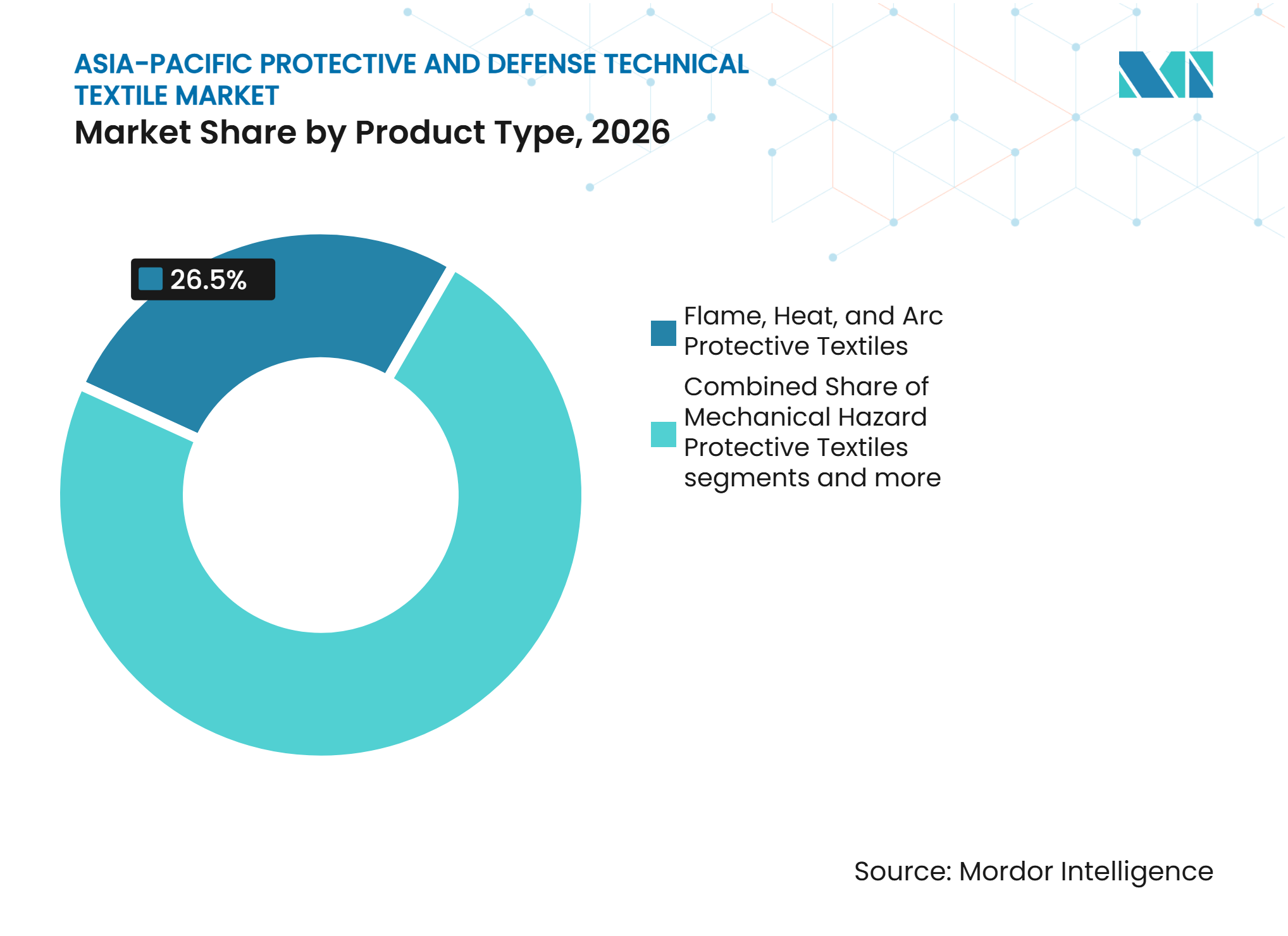
Ballistic Protection Gains as Flame Textiles Anchor BaseFlame, heat, and arc protective textiles held 26.5% of regional revenue in 2026. Demand comes from oil, gas, chemical processing, firefighting, and expanding power infrastructure across the region. Arc-rated textiles have a larger role as utilities strengthen worker safety requirements and expand transmission assets. The Asian Development Bank projects USD 3.6 trillion in electricity investment across Asia and the Pacific through 2040. This industrial base gives the Asia-Pacific protective and defense technical textile market recurring demand beyond defense contracts.
Ballistic, fragmentation, and penetration-resistant textiles are expected to record a 9.5% CAGR through 2032. Japan’s platform procurement and India’s body-armor development support demand for these products. Chemical, biological, and CBRN protective textiles form the third-largest product category and are supported by programs in Japan, India, and Australia. Mechanical hazard and high-visibility textiles serve automotive assembly, electronics fabrication, construction, rail, and logistics operations in Southeast Asia. Signature-management, extreme-cold, antistatic, electromagnetic-shielding, and electrostatic-dissipative products serve specialized military deployments and semiconductor production.



By Material Type:
Aramid Anchors the Market, UHMWPE Leads GrowthAramid fibers held 27.5% of regional revenue in 2026. They remain important in flame-resistant garments, flight suits, and high-temperature industrial clothing. Their high-temperature performance is significant where UHMWPE’s lower melt point limits its suitability. UHMWPE is projected to advance at a 9.8% CAGR through 2032 because it can lower the weight of ballistic panels, helmets, and vehicle liners. This material split allows the Asia-Pacific protective and defense technical textile market to serve both high-temperature and weight-constrained applications.
HengHui safety’s capacity expansion toward 12,000 tons reflects efforts to reduce domestic material costs and import dependence. Regenerated cellulosic and flame-resistant viscose fibers are used in inherently flame-resistant base layers under aramid outer shells, particularly in tropical settings where moisture management affects wearability. Modacrylic and flame-resistant acrylic fibers serve cost-sensitive industrial users in ASEAN markets with earlier compliance maturity. Polyester and polyamide provide structural substrates for high-visibility and mechanical-hazard garments, while glass, carbon, and inorganic fibers are used in hard armor and vehicle protection. Procurement criteria increasingly favor high-tenacity synthetic systems where lifecycle cost and protection durability are decisive.
By End-Use Application:
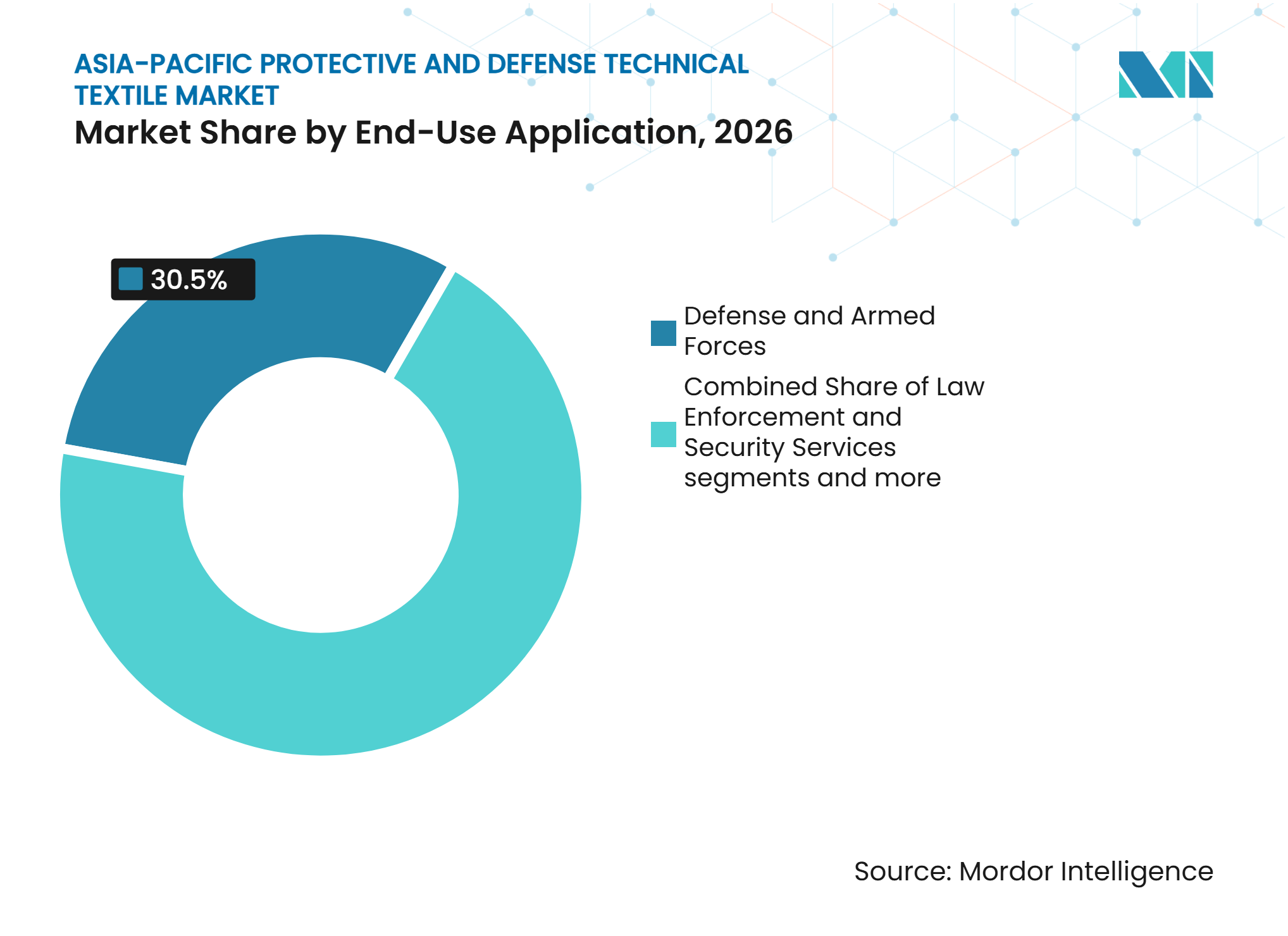
Defense Dominates, Industrial Segments Broaden the BaseDefense and armed forces held 30.5% of the Asia-Pacific protective and defense technical textile market size in 2026 and is forecast to grow at a 9.2% CAGR through 2032. This combination reflects modernization needs across large standing forces in the region. China, India, Japan, South Korea, Taiwan, and Australia accounted for more than USD 550 billion in defense expenditure during 2025. Ground-force and special-operations requirements include ballistic panels, flame-resistant combat uniforms, CBRN suits, and signature-management fabrics. Law Enforcement and Security Services form the second-largest institutional buyer group, and multiyear agreements can provide stable demand for ballistic-vest and cut-resistant textile suppliers.
Firefighting and emergency response is another major end-use area. Project 113 is equipping and training 8 Southeast Asian countries through 2028, which supports specialized CBRN clothing and equipment. Oil, gas, petrochemicals, and chemical processing require recurring flame-resistant workwear and chemical-barrier programs, particularly in Malaysia, Indonesia, Australia, and India. Manufacturing and industrial processing covers metalworking, automotive production, and general fabrication, while Construction, Mining, and Infrastructure require high-visibility, impact-resistant, and arc-flash garments. This broader buyer base reduces reliance on a single public procurement cycle in the Asia-Pacific protective and defense technical textile market.

Geography Analysis
China
China accounted for 38.0% of Asia-Pacific protective and defense technical textile market share in 2026. Its position reflects USD 336 billion in defense expenditure in 2025, a 7.4% increase and the 31st consecutive annual increase. China also has a large concentration of chemical processing, steel, and manufacturing sites that require certified protective clothing. Its 7% defense budget increase for 2026 supports procurement of ballistic panels, camouflage textiles, and nuclear, biological, and chemical protective suits. China’s Ministry of Emergency Management released draft mandatory standards for smart safety helmets and smart heating protective clothing in June 2026.
India
India is forecast to grow at a 9.5% CAGR from 2027 to 2032, the strongest rate among the geographic segments, supported by rising defense modernization spending, indigenous manufacturing initiatives, and increasing investment in advanced protective equipment. Military spending reached USD 92.1 billion in 2025, representing a real-terms increase of 8.9%. The 2026 defense capital outlay directs 75% of funding to domestic suppliers, strengthening opportunities for local manufacturers of ballistic protection systems, combat uniforms, and advanced technical textiles. DRDO’s collaboration with IIT Delhi on smart body armor demonstrates that demand is extending beyond conventional procurement toward domestic research, material innovation, and technology-driven product development. Additionally, the government's emphasis on reducing dependence on imported defense equipment is encouraging investment in high-performance fibers, lightweight ballistic composites, and next-generation soldier protection systems. These initiatives are expected to strengthen India's domestic supply chain and create opportunities for technical textile manufacturers serving the military and defense sectors.
Japan, South Korea, Taiwan, Australia, Indonesia, and Other ASEAN Markets
Japan spent USD 62.2 billion on defense in 2025, with spending rising 9.7% and FY2026 material expenditure increasing 4.8%. South Korea’s domestic para-aramid capacity supports military and industrial demand, while Taiwan tendered USD 73 million for ballistic protective fiber in 2025. Australia extended a C-CBRNE asset-management contract valued at AUD 42 million (USD 28.1 million) through 2030, covering 132 asset types and 65,000 pieces of force-protection equipment. Indonesia and other ASEAN countries are receiving specialized CBRN equipment and training through the EU program. These activities encourage more consistent specifications and support future certified-protection procurement.
Competitive Landscape
Market Concentration
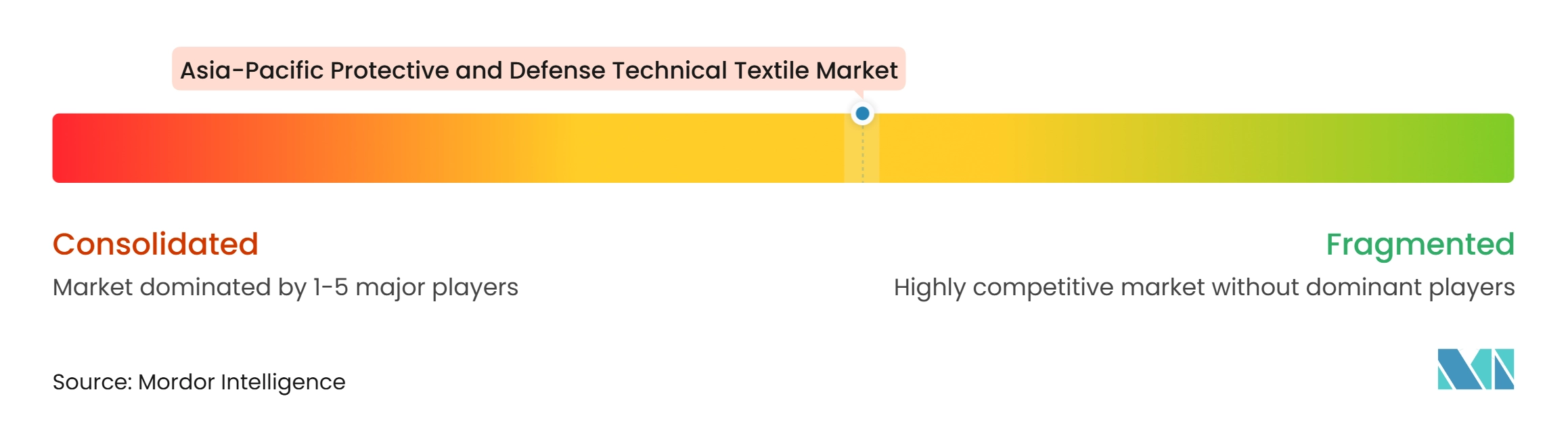
The Asia-Pacific protective and defense technical textile market exhibits a medium level of market concentration. A small group of qualified suppliers serves the certified material tier, while armor assembly and garment conversion are fragmented across national manufacturers. Entry barriers are tied to material science, ballistic testing, and qualification under STANAG and NATO AQAP requirements. DuPont introduced Tyvek APX in November 2025 as its most breathable Tyvek fabric for chemical-protective garments. This move addresses demand for garments that combine comfort with compliance in hot and demanding work settings.
Freudenberg agreed in December 2025 to acquire the remaining 25% of Japan Vilene Company for EUR 100 million (USD 117.6 million), giving it full ownership of the Japanese nonwovens producer. MKU secured a multi-year contract for more than 200,000 advanced ballistic helmets for an Asian military in 2025. BASF and LEMON signed an agreement in October 2025 to develop Freeflex-based, PFAS-free, fully recyclable thermoplastic polyurethane fiber solutions for functional apparel. These moves show activity in nonwovens consolidation, locally qualified armor, and PFAS-free material development.
The Asia-Pacific protective and defense technical textile market retains room for firms that can combine protective performance, moisture management, and digital sensing. These capabilities are important where users need longer wear times without reducing compliance. Regional production expansion can also change purchasing choices by improving material availability. Qualified regional converters can compete for contracts where governments value domestic content and local support. The result is a market with concentration in core fibers but a wider group of converters and armor assemblers.
Asia-Pacific Protective and Defense Technical Textile Industry Leaders
-
3M Company
-
Ansell Limited
-
Arclin, Inc.
-
Australian Defence Apparel Pty Ltd
-
BAE Systems plc
- *Disclaimer: Major Players sorted in no particular order
Asia-Pacific Protective and Defense Technical Textile Market Companies Covered in this Report
- 3M Company
- Ansell Limited
- Arclin, Inc.
- Australian Defence Apparel Pty Ltd
- BAE Systems plc
- DuPont de Nemours, Inc.
- Gentex Corporation
- Honeywell International Inc.
- Innovative Tech Tex Pvt. Ltd.
- KOLON INDUSTRIES, INC.
- MALLCOM INDIA LIMITED
- MKU Limited
- MSA Safety Incorporated
- Point Blank Enterprises, Inc.
- Revision Military Ltd.
- Rheinmetall AG
- Sioen Industries NV
- Sinofibra Advanced Materials Co., Ltd.
- Teijin Limited
- TenCate Protective Fabrics
- Toray Industries, Inc.
- W. L. Gore and Associates, Inc.
Recent Industry Developments in Asia-Pacific Protective and Defense Technical Textile Market
- June 2026: China’s Ministry of Emergency Management released draft mandatory national standards for smart PPE, covering smart safety helmets and smart heating protective clothing, open for public comment through August 2026.
- February 2026: Teijin Frontier acquired 100% of Toray’s China airbag-fabric subsidiary, Toray Auto Interior (Changsha), as Toray consolidated its airbag business in Thailand.
- December 2025: Freudenberg SE agreed to acquire the remaining 25% stake in Japan Vilene Company from Toray Industries for EUR 100 million (USD 117.6 million), becoming the sole owner of Japan’s nonwovens manufacturer across 15 production sites.
- October 2025: Korea Precision Materials Industry began domestic commercial production of unidirectional ballistic fabric from aramid and carbon fiber, targeting South Korean military body-armor programs.
Asia-Pacific Protective and Defense Technical Textile Market Report Scope
The Asia-Pacific Protective and Defense Technical Textile Market Report is Segmented by Product Type (Flame, Heat, and Arc Protective Textiles, Mechanical Hazard Protective Textiles, and more), by Material Type (Aramid Fibers, Polyamide, and more), by End-Use Application (Utilities and Electrical Services, and more), and by Geography (China, India, and more). The Market Forecasts are Provided in Terms of Value (USD).
Segmentation Overview
| Flame, Heat, and Arc Protective Textiles | Flame-Resistant and Flash Fire Protective Textiles |
| Firefighter Protective Textiles | |
| Arc-Rated Protective Textiles | |
| Welding and Molten Metal Protective Textiles | |
| Textile Fire Blankets, Welding Curtains, and Thermal Safety Barriers | |
| Ballistic, Fragmentation, and Penetration-Resistant Textiles | Ballistic Protection Fabrics and Laminates |
| Textile-Based Soft Body Armor Components and Panels | |
| Others (Textile Reinforcement for Ballistic Helmets/Hard Armor Systems, Blast-Related Protective Textile Components, etc.) | |
| Chemical, Biological, and CBRN Protective Textiles | Chemical Protective Fabrics and Clothing |
| Biological and Particulate Barrier Protective Textiles | |
| CBRN Protective Textiles and Clothing | |
| Mechanical Hazard Protective Textiles | Cut- and Slash-Resistant Textiles |
| Puncture- and Needle-Resistant Textiles | |
| Abrasion- and Impact-Resistant Textile Components | |
| Other Mechanical Hazard Protective Textiles | |
| High-Visibility and Reflective Protective Textiles | Fluorescent High-Visibility Fabrics and Apparel |
| Retroreflective Textile Materials | |
| Combined High-Visibility Protective Textile Products | |
| Extreme-Cold and Adverse-Weather Protective Textiles | |
| Defense Signature-Management and Specialized Survivability Textiles | |
| Other Protective Technical Textiles (Antistatic and Electrostatic-Dissipative, Electromagnetic Shielding Protective, etc.) |
| Aramid Fibers |
| Ultra-High-Molecular-Weight Polyethylene |
| Cotton and Other Natural Cellulosic Fibers |
| Regenerated Cellulosic and Flame-Resistant Viscose Fibers |
| Modacrylic and Other Flame-Resistant Acrylic Fibers |
| Polyester |
| Polyamide |
| Glass, Carbon, and Other Inorganic Fibers |
| Other High-Performance Synthetic Fibers (PBI, PBO, Heat-Resistant Fibers, etc.) |
| Defense and Armed Forces | |
| Law Enforcement and Security Services | |
| Firefighting and Emergency Response | Firefighting Services |
| Hazmat and Disaster Response Services | |
| Oil, Gas, Petrochemicals, and Chemical Processing | |
| Utilities and Electrical Services | |
| Manufacturing and Industrial Processing | Metalworking, Fabrication, and Heavy Manufacturing |
| Automotive and General Manufacturing | |
| Other Industrial Processing | |
| Construction, Mining, and Infrastructure | |
| Transportation, Warehousing, and Logistics Operations | |
| Other Occupational and Institutional End Users |
| China |
| India |
| Japan |
| South Korea |
| Taiwan |
| Australia |
| Indonesia |
| Rest of Asia-Pacific |
| By Product Type | Flame, Heat, and Arc Protective Textiles | Flame-Resistant and Flash Fire Protective Textiles |
| Firefighter Protective Textiles | ||
| Arc-Rated Protective Textiles | ||
| Welding and Molten Metal Protective Textiles | ||
| Textile Fire Blankets, Welding Curtains, and Thermal Safety Barriers | ||
| Ballistic, Fragmentation, and Penetration-Resistant Textiles | Ballistic Protection Fabrics and Laminates | |
| Textile-Based Soft Body Armor Components and Panels | ||
| Others (Textile Reinforcement for Ballistic Helmets/Hard Armor Systems, Blast-Related Protective Textile Components, etc.) | ||
| Chemical, Biological, and CBRN Protective Textiles | Chemical Protective Fabrics and Clothing | |
| Biological and Particulate Barrier Protective Textiles | ||
| CBRN Protective Textiles and Clothing | ||
| Mechanical Hazard Protective Textiles | Cut- and Slash-Resistant Textiles | |
| Puncture- and Needle-Resistant Textiles | ||
| Abrasion- and Impact-Resistant Textile Components | ||
| Other Mechanical Hazard Protective Textiles | ||
| High-Visibility and Reflective Protective Textiles | Fluorescent High-Visibility Fabrics and Apparel | |
| Retroreflective Textile Materials | ||
| Combined High-Visibility Protective Textile Products | ||
| Extreme-Cold and Adverse-Weather Protective Textiles | ||
| Defense Signature-Management and Specialized Survivability Textiles | ||
| Other Protective Technical Textiles (Antistatic and Electrostatic-Dissipative, Electromagnetic Shielding Protective, etc.) | ||
| By Material Type | Aramid Fibers | |
| Ultra-High-Molecular-Weight Polyethylene | ||
| Cotton and Other Natural Cellulosic Fibers | ||
| Regenerated Cellulosic and Flame-Resistant Viscose Fibers | ||
| Modacrylic and Other Flame-Resistant Acrylic Fibers | ||
| Polyester | ||
| Polyamide | ||
| Glass, Carbon, and Other Inorganic Fibers | ||
| Other High-Performance Synthetic Fibers (PBI, PBO, Heat-Resistant Fibers, etc.) | ||
| By End-Use Application | Defense and Armed Forces | |
| Law Enforcement and Security Services | ||
| Firefighting and Emergency Response | Firefighting Services | |
| Hazmat and Disaster Response Services | ||
| Oil, Gas, Petrochemicals, and Chemical Processing | ||
| Utilities and Electrical Services | ||
| Manufacturing and Industrial Processing | Metalworking, Fabrication, and Heavy Manufacturing | |
| Automotive and General Manufacturing | ||
| Other Industrial Processing | ||
| Construction, Mining, and Infrastructure | ||
| Transportation, Warehousing, and Logistics Operations | ||
| Other Occupational and Institutional End Users | ||
| By Geography | China | |
| India | ||
| Japan | ||
| South Korea | ||
| Taiwan | ||
| Australia | ||
| Indonesia | ||
| Rest of Asia-Pacific | ||
Key Questions Answered in the Report
What is the projected size of the Asia-Pacific protective and defense technical textile market by 2032?
The Asia-Pacific protective and defense technical textile market is projected to reach USD 9.50 billion by 2032, rising at a 7.82% CAGR from 2027 to 2032.
Which product category leads regional demand?
Flame, heat, and arc protective textiles lead with 26.5% of regional revenue in 2026 within the Asia-Pacific protective and defense technical textile market.
Which material is forecast to grow fastest through 2032?
UHMWPE is forecast to grow at a 9.8% CAGR in the Asia-Pacific protective and defense technical textile market because it is suited to lightweight ballistic panels, helmets, and vehicle liners.
Why is India expected to grow faster than other regional segments?
India is forecast to grow at a 9.5% CAGR, supported by higher defense spending, a USD 28.6 billion capital outlay, and domestic procurement rules in the Asia-Pacific protective and defense technical textile market.
What is the largest end-use application for protective and defense technical textiles?
Defense and armed forces is the largest end-use application with 30.5% of revenue in 2026 and is forecast to grow at a 9.2% CAGR in the Asia-Pacific protective and defense technical textile market.
What limits wider regional adoption of certified protective textiles?
Differing qualification systems, capital-intensive fiber production, approval cycles of 24 to 36 months, import exposure, and low-cost non-certified products limit the Asia-Pacific protective and defense technical textile market.