
Asia-Pacific Pre-Engineered Buildings Construction Market Size and Share
Market Overview
| Study Period | 2021 - 2032 |
|---|---|
| Forecast Data Period | 2027 - 2032 |
| Base Year Market Size (2026) | USD 16.12 Billion |
| Market Size (2027) | USD 18.02 Billion |
| Market Size (2032) | USD 31.67 Billion |
| Growth Rate (2027 - 2032) | 11.94 % |
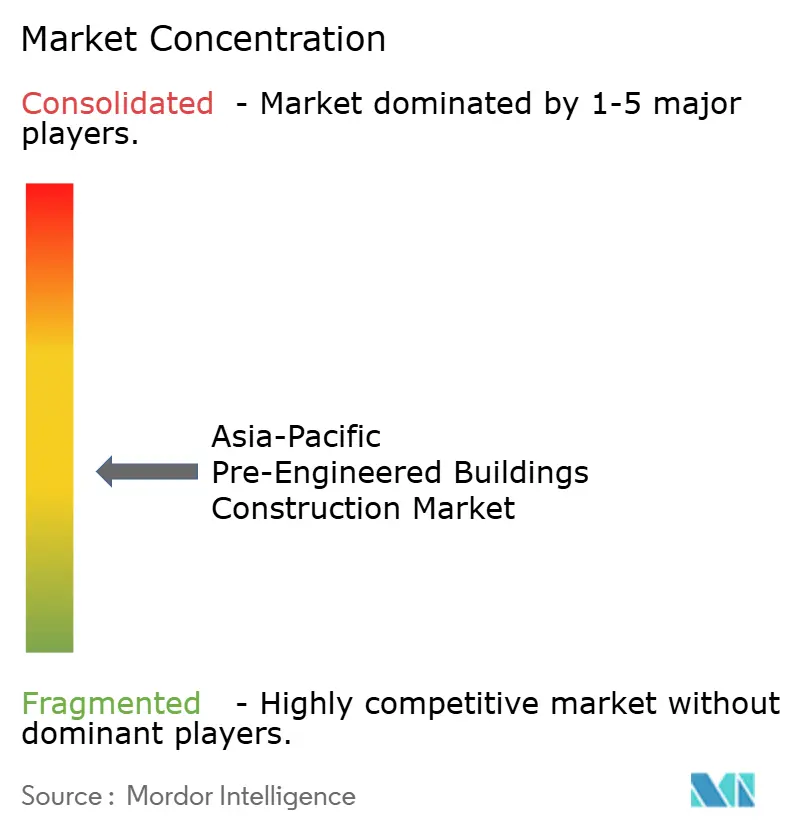
| Market Concentration | Medium |
Major Players *Disclaimer: Major Players sorted in no particular order Image © Mordor Intelligence. Reuse requires attribution under CC BY 4.0. | |
Asia-Pacific Pre-Engineered Buildings Construction Market Analysis by Mordor Intelligence
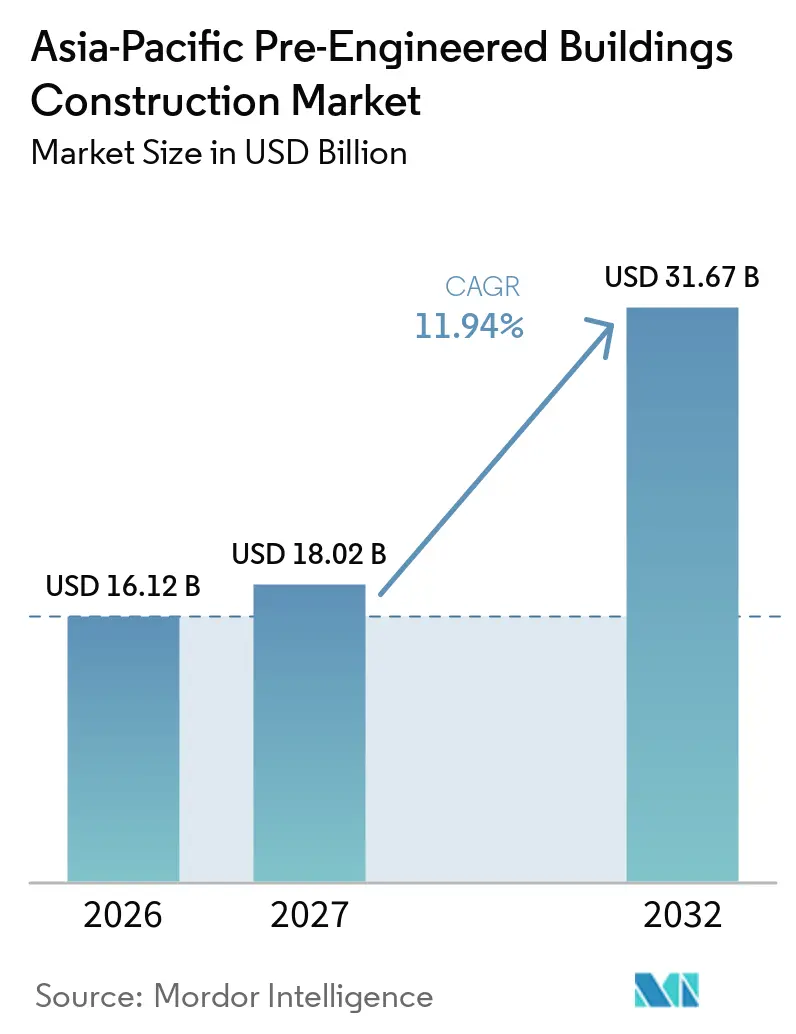
The Asia-Pacific pre-engineered buildings construction market size is expected to increase from USD 16.12 billion in 2026 to USD 18.02 billion in 2027 and reach USD 31.67 billion by 2032, growing at a CAGR of 11.94% over 2027-2032. Demand is supported by manufacturers that need facilities quickly in India, Vietnam, Indonesia, Thailand, Malaysia, and other production centers, where construction timing can affect the launch of new production lines, tenant commitments, and distribution operations. Electronics plants, semiconductor facilities, battery plants, distribution centers, and data centers require large spans, reliable schedules, and more controlled construction quality, especially when structural work must be coordinated with specialized equipment, internal utilities, safety systems, and later interior installation. Factory-made steel systems can meet these needs while reducing work at the project site and giving owners a more defined sequence for engineering, fabrication, transport, erection, and interior fit-out, with fewer handoffs between separate contractors. The Asia-Pacific pre-engineered buildings construction market also benefits when industrial park developers add worker housing, storage, service facilities, and logistics support around new plants, creating several building requirements within one connected development area. Competition increasingly depends on design capability, certified erection, local code compliance, material sourcing, and the ability to manage a project from early engineering through installation rather than fabrication volume alone.
Key Report Takeaways
- By structure, single-story buildings held 70% of the Asia-Pacific pre-engineered buildings construction market share in 2026, while multi-story buildings are forecast to grow at a 12.2% CAGR through 2032.
- By product type, panelized and componentized systems held 36% of the Asia-Pacific pre-engineered buildings construction market size in 2026, while modular buildings are forecast to grow at a 13% CAGR through 2032.
- By application, industrial buildings held 60% of the regional total in 2026, while commercial buildings are forecast to grow at a 12% CAGR through 2032.
- By country, China held 32% of the regional total in 2026, while India is forecast to grow at a 12.8% CAGR through 2032.
Note: Market numbers in this report are based on Mordor Intelligence's proprietary estimation framework, which combines nine months of actuals with Q4 projections for base year 2026.
Asia-Pacific Pre-Engineered Buildings Construction Market Trends and Insights
Drivers Impact Analysis*
| Drivers | (~) % Impact on CAGR Forecast | Geographic Relevance | Impact Timeline |
|---|---|---|---|
| China-Plus-One Manufacturing Relocation and Electronics-Capacity Expansion | +3.2% | Vietnam, India, Indonesia, Thailand, Malaysia | Short term (≤ 2 years) |
| Cross-Border E-Commerce, Port-Led Logistics, and Urban Fulfillment Infrastructure | +2.5% | India, China, Vietnam, Indonesia, Australia | Short term (≤ 2 years) |
| Mass Urban Housing, Worker Accommodation, and Rapid-Build Construction | +2.1% | India, China, Indonesia, Philippines | Medium term (2–4 years) |
| Semiconductor, Battery, and Hyperscale Data-Center Facility Development | +1.8% | India, South Korea, Malaysia, Japan | Medium term (2–4 years) |
| National Infrastructure Corridors, Industrial Parks, and Smart-City Programs | +1.4% | India, China, Indonesia | Long term (≥ 4 years) |
| Source: Mordor Intelligence | |||
China-Plus-One Manufacturing Relocation and Electronics-Capacity Expansion
The structural reorientation of global electronics and consumer manufacturing supply chains away from sole dependence on China is the most immediate demand accelerant for the Asia-Pacific pre-engineered buildings market. Vietnam attracted more than USD 25 billion of realized foreign direct investment (FDI) in 2025, the majority in manufacturing. Companies, including Apple suppliers Foxconn, Goertek, and Luxshare Precision, extended Vietnam manufacturing footprints in Bac Ninh, per Business Times 2025 reporting, creating clustered demand for standardized steel factory structures. Less visible is that Malaysia and India are absorbing semiconductor and electronics assembly investment that requires cleanroom-compatible pre-engineered buildings (PEB) with higher value than basic factory sheds, compounding order book quality, not just volume. Per Reuters in September 2026, the China-plus-one dynamic continues to channel investment into India, Indonesia, and Vietnam despite tariff recalibration, sustaining PEB demand across multiple Asia-Pacific markets simultaneously.
Cross-Border E-Commerce, Port-Led Logistics, and Urban Fulfillment Infrastructure
Port-adjacent logistics infrastructure is scaling across Asia-Pacific, driven by the Regional Comprehensive Economic Partnership (RCEP) Agreement implementation, cross-border e-commerce volume growth, and automated fulfillment center specifications that demand pre-engineered steel for column-free spans and high eave clearance. A.P. Moller - Maersk opened a 1.1 million square foot fully automated distribution center in Singapore in March 2026, serving Asia-Pacific B2B and B2C e-commerce fulfillment at an institutional scale[1]. Frasers Property Vietnam broke ground in 2025 on SPX Express's 170,000 square meter two-story cross-dock logistics facility, targeting 7 million parcels daily, deploying multi-story pre-engineered building systems to maximize leasable area on a constrained footprint. The LŌ-GOI Yen Phong LEED Gold two-story industrial complex, completed in Bac Ninh, Vietnam, in 2025, further illustrates how two-story fulfillment formats are pulling multi-story pre-engineered building adoption forward faster than single-country dynamics suggest. For pre-engineered building vendors, this represents a structural shift toward higher-value, engineering-intensive designs where design-build capability, not just fabrication volume, determines contract awards.
Mass Urban Housing, Worker Accommodation, and Rapid-Build Construction
Rapid urbanization across Asia-Pacific's emerging economies is generating demand for worker accommodation, dormitory housing, and prefabricated residential modules that conventional concrete construction cannot deliver within industrial park development timelines. Modular and panelized pre-engineered building systems, light-gauge steel framing with sandwich insulated panels, are displacing site-cast concrete where speed and relocation flexibility are priorities. Industrial Park developers in Vietnam and Indonesia are building permanent worker accommodation campuses adjacent to factory zones, creating a non-industrial PEB demand stream that follows manufacturing FDI with a 12–18 month lag. India's National Building Code (NBC) 2025 amendments, effective July 2027, mandate green material preferences, including Electric Arc Furnace (EAF) steel for government-aided projects, accelerating demand for environmentally certified PEB systems in institutional housing.
Semiconductor, Battery, and Hyperscale Data-Center Facility Development
Semiconductor fabs, battery giga factories, and hyperscale data centers are now among the largest single-project consumers of pre-engineered buildings' structural steel in Asia-Pacific, an underappreciated shift because these facilities are classified under industrial application rather than recognized as a distinct demand stream. Interarch Building Products Limited executed PEB contracts for Micron's semiconductor fab in Sanand, Gujarat, Tata Electronics' Assam facility, and the Agratas gigafactory, per the company's investor disclosures, reorienting its product mix toward heavy-gauge, high-specification steel systems. Brightray Veridian Pte. Ltd. signed a Prefabricated Module Sales Framework Agreement in September 2026 for a 40 Megawatt (MW) AI data center in Macao using a Fully Prefabricated Data center (FPD) solution, with delivery targeted for Q3 2027, per its United States Securities and Exchange Commission (SEC) filing. Hyperscale operators facing AI-driven demand surges prioritize schedule predictability over cost minimization, and a dynamic PEB vendor delivers this through factory-fabricated delivery guarantees. Interarch's inauguration of a dedicated heavy structural steel plant in Attivaram, Andhra Pradesh, in September 2026, specifically targeting data center and semiconductor demand, confirms this sub-sector is mature enough to justify dedicated manufacturing infrastructure.
Restraints Impact Analysis*
| Restraints | (~) % Impact on CAGR Forecast | Geographic Relevance | Impact Timeline |
|---|---|---|---|
| Imported Steel, Coking-Coal, and Freight-Cost Volatility | -1.8% | India, Vietnam, Indonesia, Australia | Short term (≤ 2 years) |
| Fragmented Provincial Approval, Fire Certification, and Code-Enforcement Practices | -1.2% | China, India, Vietnam, Indonesia | Medium term (2–4 years) |
| Limited Certified Erector Capacity in Tier-2 and Tier-3 Industrial Corridors | -0.8% | India, Indonesia, Vietnam, Philippines | Medium term (2–4 years) |
| Typhoon, Monsoon, Earthquake, and Tropical-Corrosion Design Requirements | -0.5% | Southeast Asia, Japan, Taiwan, Philippines | Long term (≥ 4 years) |
| Source: Mordor Intelligence | |||
Imported Steel, Coking-Coal, and Freight-Cost Volatility
Steel price volatility is the most disruptive near-term constraint on Asia-Pacific pre-engineered buildings (PEB) project economics, with hot-rolled coil (HRC) and plate pricing in 2026 responding to iron ore supply shifts, trade policy regimes, and ocean freight dynamics driven by port congestion, per PEB Steel's 2026 cost guidance. Structural steel plate prices stabilized in mid-2026 following a volatile Q2, but quote validity windows of only 7–30 days force procurement decisions under uncertainty. Fleming Construction Group reported in mid-2026 that nonresidential construction costs rose approximately 2.4% in May 2026, accumulating to nearly 10% annually, compressing developer margins across the region. Oversized structural steel components for Asia-Pacific cross-border projects carry specialized freight costs, adding 5–8% to delivered project cost, even when mill prices are flat, a dynamic disproportionately affecting smaller Tier-2 corridor developers lacking escalation contract protections.
Fragmented Provincial Approval, Fire Certification, and Code-Enforcement Practices
Inconsistent regulatory enforcement across Asia-Pacific jurisdictions adds 15–30% to project timeline estimates for developers operating across multiple countries or provinces. India's Bureau of Indian Standards (BIS) governs PEB structural design through IS 800 (General Construction in Steel) and IS 875 (load codes). IS 1893 (seismic design), but field evidence from 2025 reveals that unorganized players frequently deploy foreign code combinations producing structurally non-compliant hybrids, an exposure that organized listed players exploit as competitive differentiation. Vietnam governs steel construction design through TCVN 5575:2024 and TCVN 9386 seismic standards, which must align with international codes on cross-border procurement projects. India's NBC 2025 amendments, effective July 2027, introduce a dual-code planning environment requiring alignment with both NBC 2016 and NBC 2025, adding design cost and approval uncertainty. BIS withdrew the IS 1893:2025 revision in March 2026 over concerns of 10–15% cost escalation in seismic Zones V and VI, per MetalTree India, illustrating how code revision without adequate industry consultation introduces transient project planning risk.
*Our forecasts treat driver/restraint impacts as directional, not additive. The impact forecasts reflect baseline growth, mix effects, and variable interactions.
Segment Analysis
By Structure: Single-Story Buildings Retain the Largest Installed Base
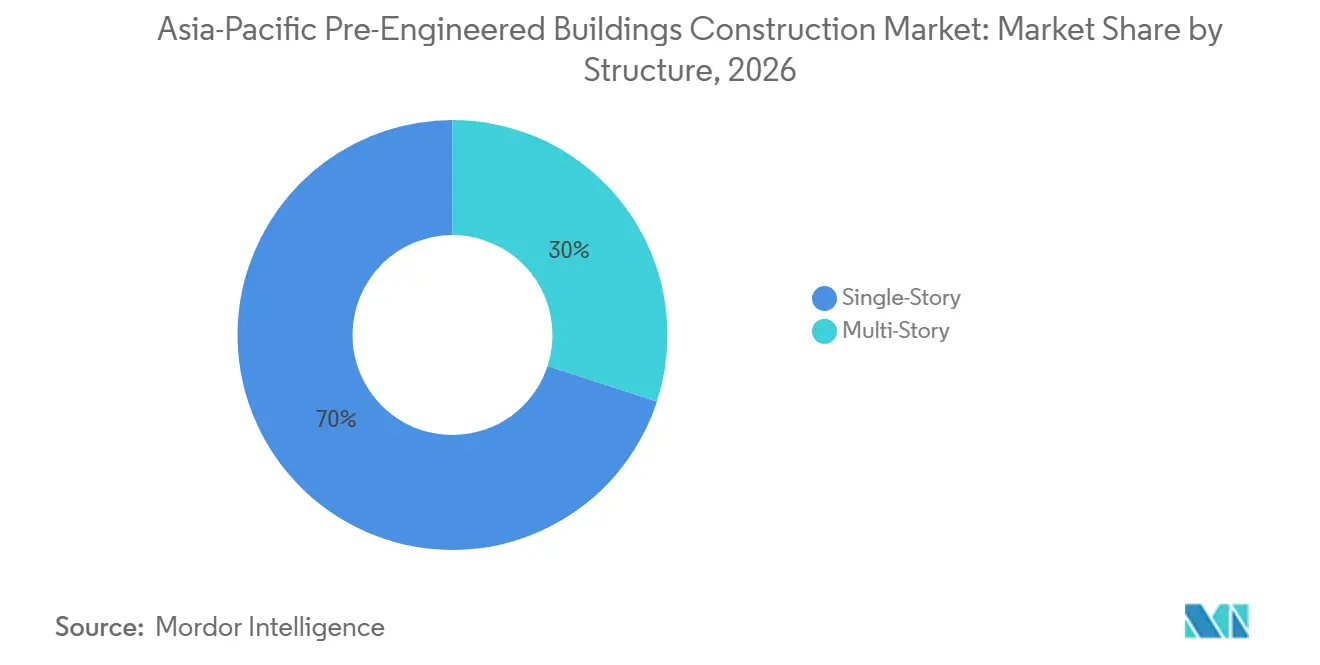
Single-story buildings held 70% of the regional total in 2026, making them the leading structural format in the Asia-Pacific pre-engineered buildings construction market. They are widely used for industrial sheds, logistics buildings, processing facilities, and distribution centers. Their design is familiar to contractors and is easier to integrate with loading yards, forklifts, and ground-level material handling. Single-story formats also suit sites with available land in industrial parks and port-linked corridors. The structure can accommodate long, clear spans for storage, assembly, and production lines. This helps developers preserve flexible floor layouts as tenant requirements change.
Multi-story buildings are forecast to grow at a 12.2% CAGR through 2032 as industrial land becomes less available in dense urban areas. The LŌ-GOI Yen Phong complex in Bac Ninh, completed in 2025, was presented by Coteccons as northern Vietnam’s first LEED Gold two-story industrial and logistics complex[2]. It covers more than 139,000 square meters and has 12.5-meter floor heights, illustrating the scale that a multi-level logistics format can reach. These projects require more detailed structural design, vertical circulation planning, and fire coordination than standard one-level facilities. The Asia-Pacific pre-engineered buildings construction industry can gain from this shift when suppliers build stronger multi-story engineering and erection capabilities.

By Product Type: Panelized Systems Lead While Modular Buildings Expand Fastest
Panelized and componentized systems held 36% of the regional total in 2026, giving them the leading position by product type. The systems can be adapted for industrial sheds, insulated envelopes, storage buildings, and support facilities. Their components can be selected to match project requirements for thermal performance, corrosion protection, and building dimensions. This flexibility supports use across both major urban markets and lower-cost industrial corridors. Panelized systems also allow owners to balance standardization with modifications for individual tenants. Their broad use keeps them important for the Asia-Pacific pre-engineered buildings construction market.
Modular buildings are forecast to grow at a 13% CAGR through 2032, led by demand for predictable delivery and controlled factory work. Brightray Veridian’s disclosed Macao project uses a fully prefabricated data center format for a 40 MW artificial intelligence facility. Modular systems are relevant where operators want to add capacity in defined stages instead of building a full site at once. They are also suited to accommodation, technical rooms, and other buildings requiring repeatable internal layouts. Other prefabricated formats serve transport, energy, airport, and institutional projects.
By Application: Industrial Buildings Lead as Commercial Projects Grow
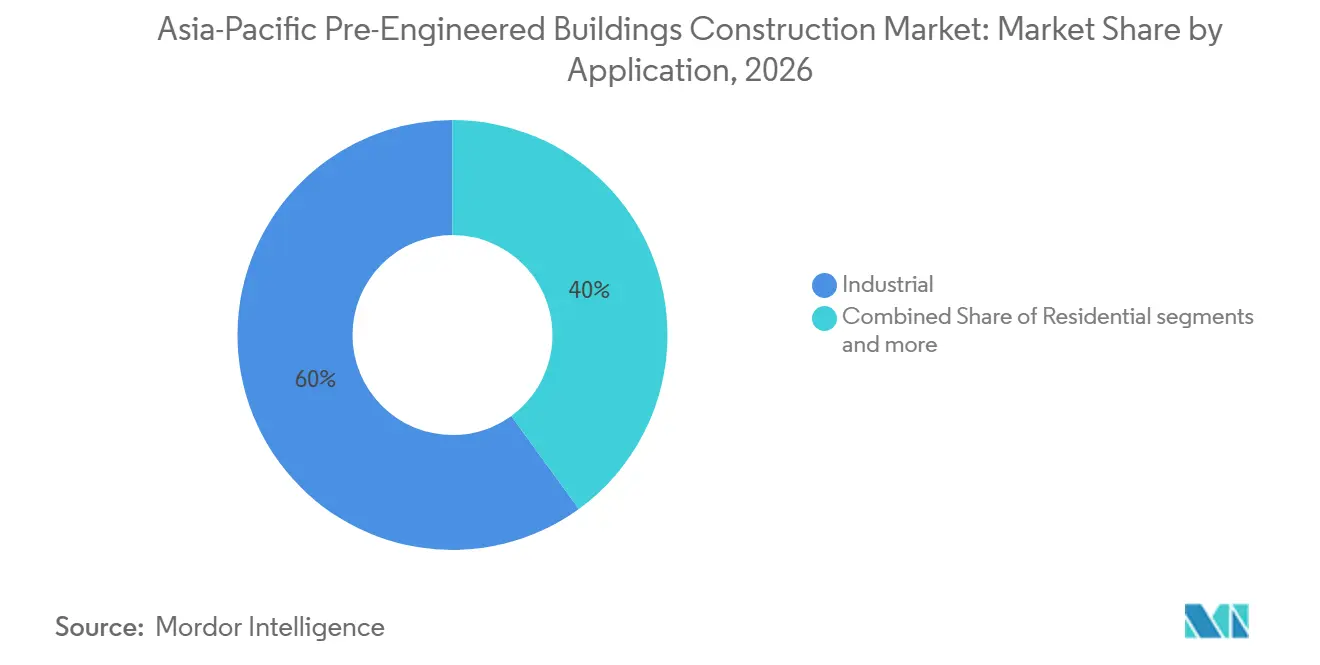
Industrial buildings held 60% of the regional total in 2026 and remain the main application for pre-engineered structures. The category includes manufacturing sheds, warehouses, technology facilities, battery plants, and data center shells. Industrial owners value construction methods that reduce site work and keep project schedules more predictable. Interarch’s reported focus on data centers, semiconductor plants, and battery facilities shows how industrial demand is moving toward more specialized projects. These applications can require greater steel intensity and closer coordination with equipment installation. The largest application, therefore, includes both standard industrial buildings and more complex facilities.
Commercial buildings are forecast to grow at a 12% CAGR through 2032 as retail, showrooms, service offices, and fulfillment space expand around industrial areas. Commercial owners can use steel structures for open interior layouts and shorter construction periods. Logistics hubs also generate demand for offices, maintenance buildings, and tenant facilities that sit beside warehouses. This broadens the opportunity for suppliers that can manage several building types on one site. The Asia-Pacific pre-engineered buildings construction market needs design teams that can address façade, insulation, fire, and tenant requirements as commercial projects become more varied. The commercial segment is likely to reward suppliers that combine standard components with local design support.
Geography Analysis
China held 32% of the regional total in 2026, supported by its large manufacturing base, industrial park network, and broad steel supply chain. Its scale gives domestic fabricators an established customer base across industrial, logistics, and commercial construction. China’s steel exports also influence material availability and price competition in other regional markets. Japan and South Korea remain established markets for manufacturing, cold-chain logistics, and technology facilities that require high engineering standards. Australia has demand from mining-related buildings, agriculture, storage, and commercial construction. The Asia-Pacific pre-engineered buildings construction market includes these mature countries because they provide steady demand for higher-specification systems.
India is forecast to grow at a 12.8% CAGR through 2032, making it the fastest-growing country in the regional forecast. Manufacturing investment in electronics, semiconductors, pharmaceuticals, and logistics is supporting demand for factory and warehouse buildings. Kirby Building Systems broke ground on its fourth Indian manufacturing facility in Tamil Nadu in September 2026. The company stated that the site will add 100,000 MT of annual capacity and raise Kirby India’s total capacity to 400,000 MT[3]. This investment indicates that suppliers expect sustained demand from southern India and export-oriented projects.
Vietnam, Indonesia, Thailand, and Malaysia benefit from manufacturing diversification and growing logistics requirements. Vietnam has an active demand for ready-built factories, sorting facilities, and industrial projects near expanding supply chains. Indonesia offers a growing manufacturing base, although site infrastructure and delivery capability differ widely among locations. Malaysia has opportunities linked to technology manufacturing and related industrial support facilities. Singapore remains important for high-value logistics and automated distribution infrastructure, as illustrated by Maersk’s World Gateway II development. These countries make regional delivery networks and local code knowledge essential for suppliers serving the Asia-Pacific pre-engineered buildings construction market.
Competitive Landscape
The Asia-Pacific pre-engineered buildings construction market is moderately fragmented, with domestic producers, regional specialists, and multinational steel companies serving different applications. Competition is shaped by fabrication capacity, engineering depth, local relationships, and the ability to provide erection support. India-based suppliers are expanding capacity to serve the country’s industrial construction pipeline. Kirby’s Tamil Nadu facility is expected to begin commercial operations in mid-2027 and will support southern Indian and export demand. Interarch has also reported investment in capacity focused on data center and semiconductor projects.
Technology facilities, logistics projects, and multi-story structures raise the importance of integrated design and construction services. ATAD differentiates through work across industrial and public infrastructure applications, including the Vietnam Exhibition Fair Center project. The company’s project profile shows that engineering capability can support contracts beyond conventional factory buildings. Suppliers that serve data centers and semiconductor sites must meet closer requirements for interfaces, schedules, and structural performance. This favors companies with in-house detailing, quality systems, and trained installation teams. A shortage of certified erectors in smaller industrial corridors gives integrated suppliers an opportunity to distinguish themselves from basic fabricators.
Steel supply relationships also affect competition. Tata Steel completed the acquisition of the remaining equity stake in Tata Steel Colors Private Limited, formerly Tata BlueScope Steel Private Limited, in April 2026. The transaction places the coated steel business within Tata Steel’s ownership structure and can influence material availability for steel building products in India. BlueScope also acknowledged media speculation concerning a potential bid in December 2025.
Asia-Pacific Pre-Engineered Buildings Construction Industry Leaders
-
Kirby Building Systems
-
BlueScope Steel Limited
-
Everest Industries Limited
-
Interarch Building Products Limited
-
Pennar Industries Limited
- *Disclaimer: Major Players sorted in no particular order
Recent Industry Developments
- September 2026: Kirby Building Systems & Structures India Pvt. Ltd., a subsidiary of Alghanim Industries, broke ground on a new manufacturing facility in Manapparai, Tamil Nadu. The facility is planned across approximately 33.2 acres, with an annual production capacity of 100,000 metric tons (MT) and commercial operations expected to begin in mid-2027. The expansion will increase Kirby India's total manufacturing capacity from 300,000 MT to 400,000 MT, strengthening its ability to serve Southern India and export markets.
- September 2026: Brightray Veridian Pte. Ltd. entered into a framework agreement for a 40-megawatt (MW) artificial intelligence (AI) data center campus in Macao, incorporating a fully prefabricated data center (FPD) solution. Delivery is targeted for the third quarter of 2027, according to the company's filing with the United States Securities and Exchange Commission (SEC). The project highlights the application of prefabricated construction in data center infrastructure.
- April 2026: Tata Steel Limited completed the acquisition of the remaining equity interest in Tata Steel Colors Private Limited, formerly Tata BlueScope Steel Pvt. Ltd., from BlueScope Steel Asia Holdings Pty Ltd., making the entity an indirect wholly owned subsidiary. The transaction strengthens Tata Steel's position in the coated steel and pre-engineered building (PEB) supply chain across the Asia-Pacific (APAC) region.
Asia-Pacific Pre-Engineered Buildings Construction Market Report Scope
| Single-Story |
| Multi-Story |
| Modular Buildings |
| Panelized and Componentized Systems |
| Other Prefabricated Building Types |
| Residential |
| Commercial |
| Industrial |
| Institutional |
| Others |
| China |
| India |
| Japan |
| South Korea |
| Australia |
| Indonesia |
| Rest of Asia-Pacific |
| By Structure | Single-Story |
| Multi-Story | |
| By Product Type | Modular Buildings |
| Panelized and Componentized Systems | |
| Other Prefabricated Building Types | |
| By Application | Residential |
| Commercial | |
| Industrial | |
| Institutional | |
| Others | |
| By Country | China |
| India | |
| Japan | |
| South Korea | |
| Australia | |
| Indonesia | |
| Rest of Asia-Pacific |
Key Questions Answered in the Report
What is driving demand for pre-engineered buildings in Asia-Pacific?
Manufacturing diversification, logistics investment, data center construction, and industrial park development support demand. These needs favor suppliers that can deliver clear-span buildings, controlled fabrication, reliable schedules, and installation support across several countries.
How large is the Asia-Pacific pre-engineered buildings construction market?
The market is projected to grow from USD 18.02 billion in 2027 to USD 31.67 billion by 2032 at a 11.94% CAGR. Growth is linked to factory buildings, logistics facilities, technology-related projects, and supporting development in industrial parks.
Which building structure leads regional demand?
Single-story buildings lead with 70% of the regional total in 2026 because they fit factory, warehouse, processing, and ground-level logistics uses. Their layouts also support large spans and flexible material handling arrangements for industrial occupiers.
Which pre-engineered building product type is growing fastest?
Modular buildings are forecast to grow at a 13% CAGR through 2032, supported by data center and rapid-deployment applications. Operators use modular formats when they need predictable delivery, repeatable layouts, phased capacity additions, and more factory-controlled work.
Which country is expected to grow fastest through 2032?
India is expected to grow at a 12.8% CAGR through 2032, supported by industrial and logistics construction. Kirbys capacity expansion in Tamil Nadu shows that leading suppliers are positioning for sustained demand from manufacturing projects and export-oriented facilities.
What constrains pre-engineered building projects in the Asia-Pacific?
Steel and freight cost changes, local approvals, fire requirements, varied codes, and a limited certified erector base can delay projects or raise costs. Weather, seismic, corrosion, and transport requirements can also add engineering work before fabrication begins and require closer coordination among designers, fabricators, transport providers, contractors, developers, and approving authorities during design, procurement, delivery, installation, inspection, and final project handover.