
Asia-Pacific Packaging Technical Textile Market Size and Share
Market Overview
| Study Period | 2021 - 2032 |
|---|---|
| Forecast Data Period | 2027 - 2032 |
| Base Year Market Size (2026) | USD 9.88 Billion |
| Market Size (2027) | USD 10.37 Billion |
| Market Size (2032) | USD 13.56 Billion |
| Growth Rate (2027 - 2032) | 5.51 % |
| Market Concentration | Low |
Major Players *Disclaimer: Major Players sorted in no particular order Image © Mordor Intelligence. Reuse requires attribution under CC BY 4.0. | |
Asia-Pacific Packaging Technical Textile Market Analysis by Mordor Intelligence
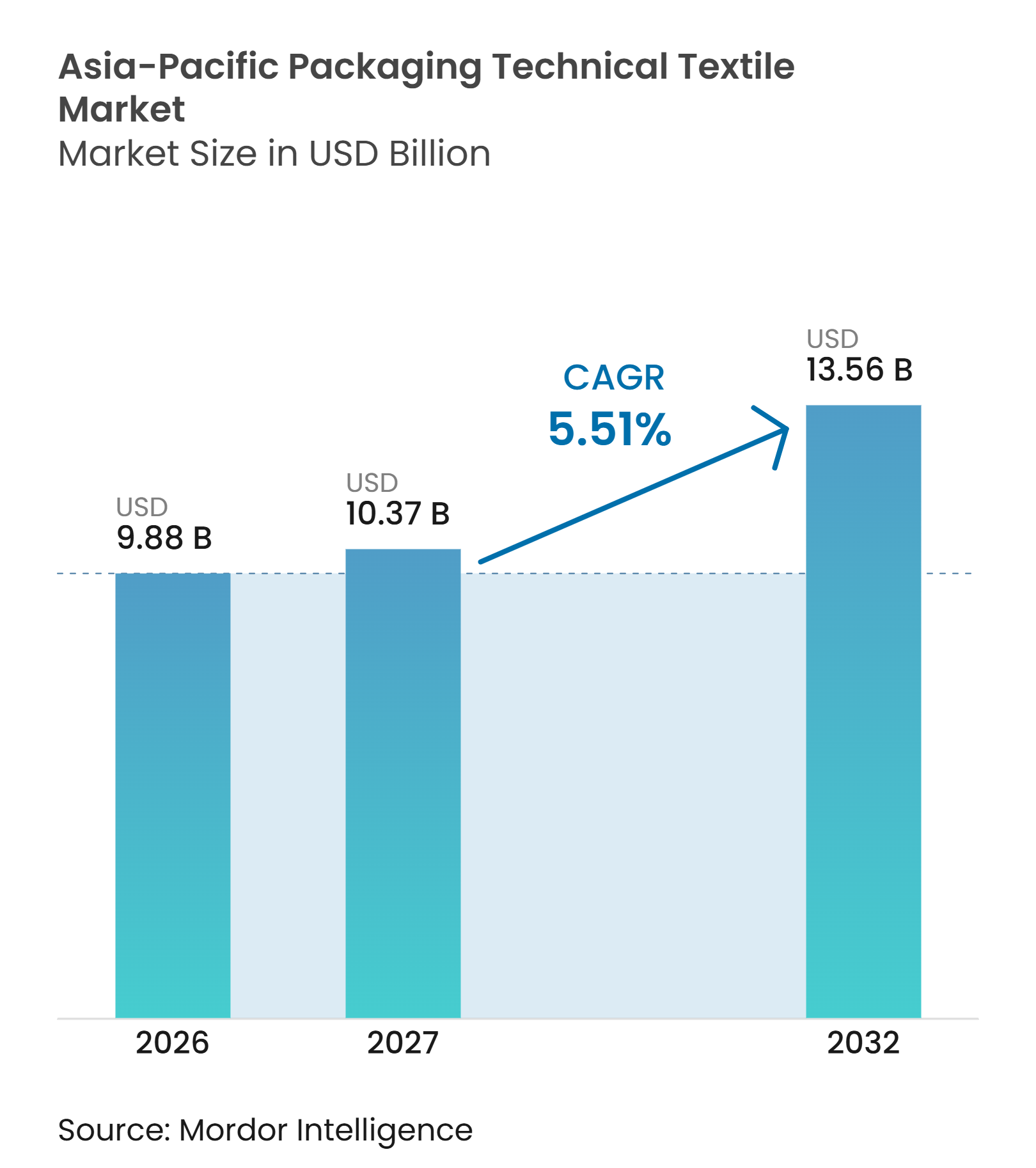
The Asia-Pacific Packaging Technical Textile Market size is projected to be USD 9.88 billion in 2026, USD 10.37 billion in 2027, and reach USD 13.56 billion by 2032, growing at a CAGR of 5.51% from 2027 to 2032.
The Asia-Pacific Packaging Technical Textile Market benefits from the region’s large manufacturing base and its role in industrial and agricultural exports. Demand centers on polypropylene woven sacks, flexible intermediate bulk containers, jute bags, mesh produce bags, and specialty nonwovens. Industrial users are moving toward larger containers that work with automated filling, discharge, and conveying systems. Food, chemical, and pharmaceutical buyers are also placing greater value on packaging that meets formal safety and traceability requirements. This shift favors converters with tested materials, clean production environments, and reliable supply networks.
Key Report Takeaways
- By product type, woven polyolefin sacks and bags held 34.0% of the Asia-Pacific packaging technical textile market share in 2026, while flexible intermediate bulk containers (FIBCs) are projected to be the fastest-growing product category, registering a 7.2% CAGR through 2032.
- By material type, polypropylene accounted for 54.0% of the Asia-Pacific packaging technical textile market size in 2026, while regenerated cellulosic fibers are projected to be the fastest-growing material category, registering a 7.8% CAGR through 2032.
- By end-use application, agriculture and fresh produce packaging represented 27.0% of the Asia-Pacific packaging technical textile market share in 2026, while pharmaceuticals and healthcare products are projected to be the fastest-growing end-use application, registering a 7.4% CAGR through 2032.
- By geography, China accounted for 30% of the market size in 2026, while India is projected to be the fastest-growing market, registering a 7.2% CAGR through 2032.
Note: Market numbers in this report are based on Mordor Intelligence's proprietary estimation framework, which combines nine months of actuals with Q4 projections for base year 2026.
Market Trends and Insights
Drivers Impact Analysis of Asia-Pacific Packaging Technical Textile Market*
| Driver | (~) % Impact on CAGR Forecast | Geographic Relevance | Impact Timeline |
|---|---|---|---|
| Industrialization and Bulk-Export Growth | +2.1% | APAC-wide, with core demand in India, China, Vietnam, and Indonesia | Medium term (2-4 years) |
| Shift from Small Sacks to FIBCs and Mechanized Handling | +1.8% | China, India, and Southeast Asia | Medium term (2-4 years) |
| Food, Agrochemical, and Pharmaceutical Grade Qualification | +1.2% | India, China, South Korea, Japan, and global export flows | Long term (≥ 4 years) |
| China-Plus-One Packaging Manufacturing Diversification | +1.0% | Vietnam, Bangladesh, Indonesia, and Thailand | Short term (≤ 2 years) |
| Circular and Recycled-Content Packaging Requirements | +0.8% | Japan, South Korea, Australia, and Southeast Asia | Long term (≥ 4 years) |
| Track-and-Trace Requirements for Bulk Shipments | +0.5% | APAC-wide, with advanced adoption in China, Japan, and South Korea | Medium term (2-4 years) |
| Source: Mordor Intelligence | |||
Industrialization and Bulk-Export Growth
Industrial expansion across South and Southeast Asia is increasing demand for containers that can move raw materials and finished goods in larger loads. India’s Production Linked Incentive scheme has approved applications across 14 strategic sectors, with cumulative actual investment above INR 2.58 lakh crore (USD 27.60 billion) as of June 2026. Chemicals, pharmaceuticals, food processing, and other supported activities require dependable sacks and bulk containers for internal and external logistics. The Asia-Pacific packaging technical textile market therefore benefits when industrial sites add processing capacity and increase regular material flows. Export baskets are also moving toward semi-processed and finished products, which need more controlled packaging than basic commodity sacks. Certified food-grade and UN-approved containers can lift converter revenue because they require stronger quality controls and command higher unit values.[1]
Shift from Small Sacks to FIBCs and Mechanized Handling
Automated filling and emptying systems are increasing the use of FIBCs across chemical, mineral, food, and pharmaceutical facilities. These systems are designed for larger loads and do not work as efficiently with conventional small-format sacks. Emmbi Industries reported FY2025-26 export sales of INR 341.60 crore (USD 36.63 million), up 27.26% year on year, with automation-compatible FIBCs included in its product offer. Form-stable baffle bags and related designs support stable conveying, racking, and handling. Once a receiving plant adopts FIBC discharge equipment, connected processors often need compatible systems to keep material moving efficiently. This equipment linkage supports continued FIBC adoption across industrial supply chains in the Asia-Pacific packaging technical textile market.
Food, Agrochemical, and Pharmaceutical Grade Qualification
Food and pharmaceutical packaging rules are making formal qualification a basic requirement for more bulk packaging suppliers. India’s packaging regulations, amended on March 28, 2025, reinforce migration limits for plastics used in direct food contact. China’s pharmaceutical packaging materials annex took effect on January 1, 2026, requiring quality systems, supplier audits, and documented change control for manufacturers. ISO 22002-4:2025 sets food safety prerequisite program requirements for packaging manufacturing facilities. These rules raise the cost of market entry for basic converters without testing, cleanroom, or documentation capabilities. They also strengthen the position of established suppliers serving food, agrochemical, and pharmaceutical customers across the Asia-Pacific packaging technical textile market.
China-Plus-One Packaging Manufacturing Diversification
Manufacturing diversification is creating new demand locations for packaging technical textiles in Vietnam, Thailand, Indonesia, Bangladesh, and Malaysia. New production plants need woven sacks, FIBCs, and specialty packaging for inbound materials and outbound shipments. During the first half of 2025, Penang recorded RM 1.85 billion (USD 0.27 million) in approved manufacturing investment from China-based companies. The relocation of factories also creates a period when local packaging supply is still developing. Import demand from established suppliers in India and China can therefore remain high while local converter networks form. This pattern broadens the geographic opportunity for the Asia-Pacific packaging technical textile market without immediately displacing existing exporters.
Restraints Impact Analysis of Asia-Pacific Packaging Technical Textile Market*
| Restraint | (~) % Impact on CAGR Forecast | Geographic Relevance | Impact Timeline |
|---|---|---|---|
| Polypropylene Resin and Energy-Cost Volatility | -0.8% | Southeast Asia and South Asia, especially import-dependent markets | Short term (≤ 2 years) |
| Fragmented Collection and Recycling Infrastructure | -0.7% | ASEAN, especially Indonesia, Vietnam, and the Philippines | Long term (≥ 4 years) |
| Cross-Border Testing and Food-Contact Compliance Costs | -0.4% | APAC-wide, especially India, China, and South Korea | Medium term (2-4 years) |
| Substitution by Silos, Rigid IBCs, and Paper-Based Packaging | -0.4% | Japan and Australia, with emerging use in South Korea and China | Long term (≥ 4 years) |
| Source: Mordor Intelligence | |||
Polypropylene Resin and Energy-Cost Volatility
Polypropylene resin remains the main input for woven sacks and FIBCs, leaving converters exposed to feedstock and energy price changes. The OECD identifies commodity polymer cost volatility as a persistent challenge for packaging converters in import-dependent ASEAN economies. Southeast Asian producers can face margin pressure when resin costs rise faster than the prices they can charge customers. Customers in agriculture and chemicals can also reduce purchases when their own input costs increase. This creates pressure on both volume and profitability for smaller converters. The Asia-Pacific packaging technical textile market is most exposed where local polymer supply is limited, and converters depend heavily on imported resin.[2]
Fragmented Collection and Recycling Infrastructure
Recycled-content and recovery requirements are advancing faster than collection and recycling capacity in many ASEAN markets. Vietnam’s Decree 110/2026/ND-CP requires producers and importers to recycle a specified share of several packaging materials or make a financial contribution to the Vietnam Environment Protection Fund. The Philippines requires large enterprises to recover or offset 60% of their plastic packaging footprint by December 2026 and 70% in 2027 under Republic Act No. 11898. The OECD found that Japan and South Korea had established packaging EPR systems, while several ASEAN markets remained in earlier stages of implementation. Producers may therefore face higher compliance costs without consistent access to verified recycled feedstock. This can slow investment decisions for converters serving the Asia-Pacific packaging technical textile market.
*Our forecasts treat driver/restraint impacts as directional, not additive. The impact forecasts reflect baseline growth, mix effects, and variable interactions.
Asia-Pacific Packaging Technical Textile Market Segment Analysis
By Product Type:
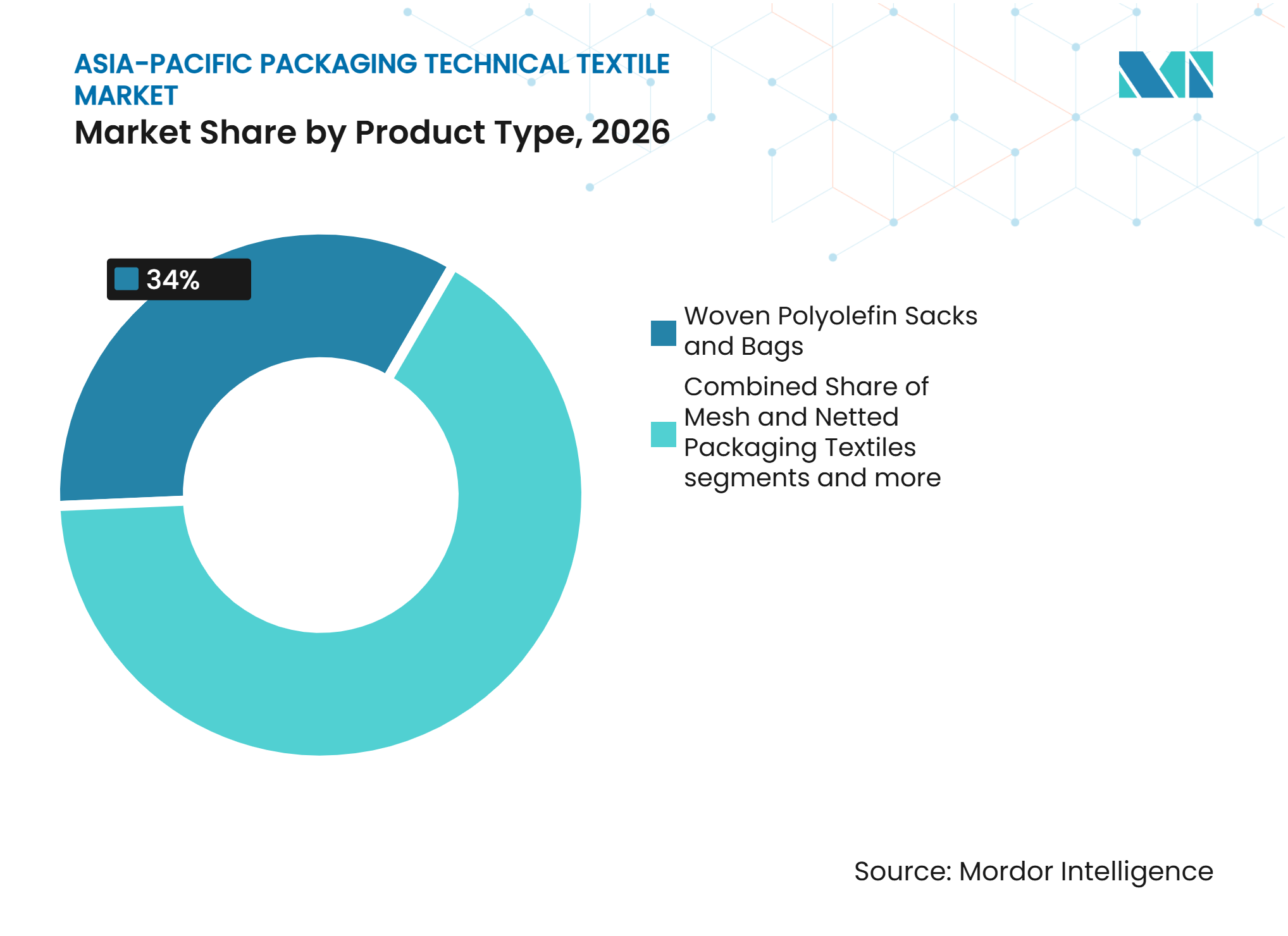
Woven Sacks Retain Scale While FIBCs ExpandWoven polyolefin sacks and bags accounted for 34.0% of the Asia-Pacific packaging technical textile market share in 2026. Their use in grain, cement, fertilizer, sugar, and industrial minerals keeps demand broad across major commodity flows. This product type remains useful for buyers that need an economical, familiar, and widely available package. Food-grade rice bags in India and Vietnam and cement bags in China and Indonesia reflect this range of use. Existing procurement systems and filling lines also support continued demand for woven sacks. The large installed base limits the pace at which alternatives can replace them.
FIBCs are the fastest-growing product category, registering a 7.2% CAGR through 2032 as industrial users shift toward mechanized bulk handling. Chemical, pharmaceutical, and food processors use these containers for powders, granules, and pellets that need controlled movement in larger loads. Designs include form-stable baffle bags, ventilated produce bags, and Type C and Type D containers for sensitive chemical applications. Rishi FIBC Japan began commercial sales of the Fusion Bag in November 2026, a stitch-free FIBC that uses heat-fusion bonding and reduces contamination risks in product-contact areas. Jute and natural-fiber packaging retain policy support in India and Bangladesh, while mesh bags serve growing fresh produce requirements. Nonwoven and transit-protection products also support e-commerce and specialized logistics needs within the Asia-Pacific packaging technical textile market.



By Material Type:
Polypropylene Supports the Main Production BasePolypropylene represented 54.0% of the Asia-Pacific packaging technical textile market size in 2026, totaling USD 5.3352 billion. Its strength, chemical resistance, low cost, and ease of processing make it the standard input for many woven sacks and FIBCs. China, India, and Southeast Asia have established production systems for polypropylene raffia and related grades. These systems support tape extrusion, circular weaving, lamination, and conversion at scale. Polypropylene is also used in spunbond nonwovens and other specialty packaging formats. Its extensive installed base gives buyers reliable material availability across the region.
Regenerated cellulosic fibers are the fastest-growing material category, registering a 7.8% CAGR through 2032 because buyers are seeking natural-fiber options for food and fresh produce packaging. Food-contact sustainability requirements and retail interest in alternatives to synthetic sacks support this direction. Polyester remains relevant in wrapping and transit-protection products that need UV resistance and dimensional stability. Polyethylene is used in moisture-sensitive agricultural products, including sacks that need internal barriers for seed and fertilizer. Jute and cotton retain roles in mandated or specialty uses, while polyamide serves higher-load products such as Type D FIBCs and lifting components. Procurement is increasingly favoring mono-material polypropylene structures that are easier to recover within the Asia-Pacific packaging technical textile market.
By End-Use Application:
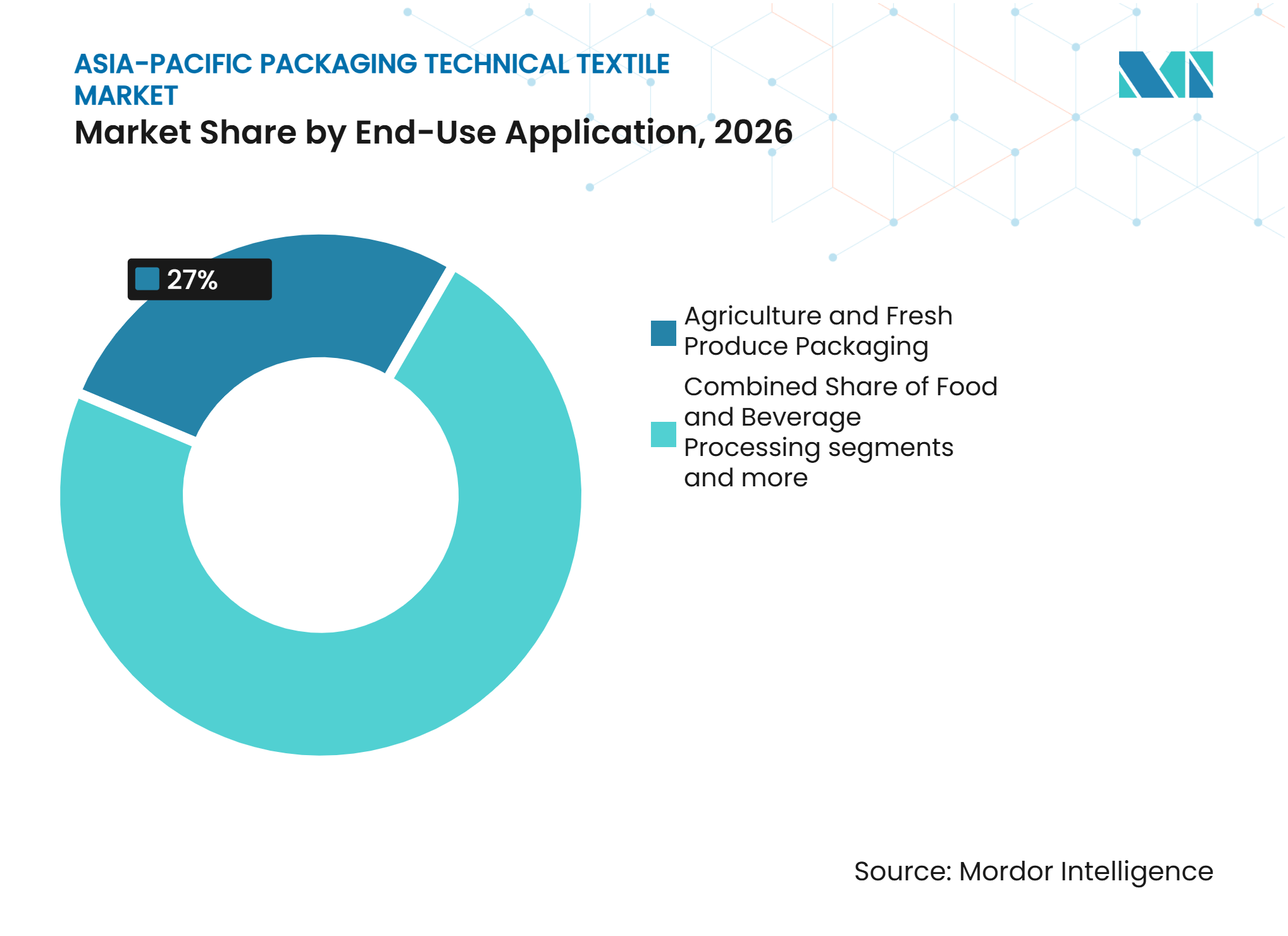
Agriculture Remains the Largest Demand CenterAgriculture and fresh produce packaging held 27.0% of the Asia-Pacific packaging technical textile market share in 2026, equivalent to USD 2.6676 billion. Rice, wheat, sugar, fertilizer, and horticultural supply chains require high volumes of woven sacks and mesh packaging. India, Bangladesh, Vietnam, Thailand, and Indonesia provide large agricultural demand bases. Public procurement for fertilizer and food grains can add stability to ordering volumes in these markets. Leno-woven and ventilated bags are increasingly used for fruits and vegetables that need airflow. Modern retail supply chains in China, South Korea, Japan, and Australia are strengthening demand for packaging that supports freshness and product visibility.
Pharmaceuticals and healthcare products are the fastest-growing end-use application, registering a 7.4% CAGR through 2032. India and China are expanding pharmaceutical manufacturing and raising requirements for packaging material quality. China’s pharmaceutical packaging materials annex directs manufacturers toward stronger quality management practices and certified suppliers. Food and beverage processing is another large customer group, especially for grains, flour, sugar, and animal feed. Chemicals, petrochemicals, fertilizers, construction materials, and minerals maintain stable demand for specialized bulk containers. Retail and e-commerce demand supports nonwoven bags and printed woven carriers, particularly in India and China.

Geography Analysis
China
China held 30.0% of the Asia-Pacific packaging technical textile market share in 2026, totaling USD 2.964 billion. It combines a large domestic base for woven polyolefin packaging with an important export role across South and Southeast Asia. Production clusters in Guangdong, Shandong, and Jiangsu support circular weaving, BOPP lamination, and high-definition printing. Producers are moving toward food-grade and pharmaceutical-grade FIBCs, anti-static designs, and laminated woven bags with higher-value printing. South Korea’s Ministry of Food and Drug Safety updated food-contact standards in March 2026, which affects suppliers of polypropylene woven food bags in China and India. The regulatory influence encourages exporters to improve material testing and documentation. Commodity sack overcapacity is still putting pressure on pricing and pushing many manufacturers toward application-specific products.
India
India is the fastest-growing geography, with a projected CAGR of 7.20% from 2027 to 2032. The country combines a major FIBC export role with increasing domestic demand for food-grade and pharmaceutical-grade bulk packaging. India recorded a technical textile trade surplus of INR 3,420.20 crore in FY2025-26, while technical textile exports reached INR 29,217.60 crore (USD 3.12 billion). FIBC bags, slings, ropes, gauze, and wipes accounted for around 60% of technical textile export value from April to October 2025. FSSAI packaging rules and production-linked industrial investment support higher demand for qualified woven packaging. India’s packaging producers can use food safety controls, cleanroom capability, and export certification to serve more demanding customers. Bangladesh continues to supply jute packaging into regional commodity flows, which sustains cross-border natural-fiber trade.
Remaining Asia-Pacific Markets
Japan and South Korea are high-value markets where food-contact compliance, automation compatibility, and sustainability documentation are central buying requirements. GS1 standards support traceability in food distribution, including product identification and data sharing across supply chains. Vietnam is adding production and domestic demand through industrial development in its northern corridors. Thailand benefits from agribusiness exports, while Indonesia and Bangladesh combine cost-competitive production with substantial agricultural demand. Australia has premium requirements and strong sustainability scrutiny, while Taiwan supports the region through machinery and specialty yarn capabilities. Malaysia’s objective to recycle 100% of plastic packaging by 2030 adds a policy signal for regional materials selection. These markets create varied opportunities for technical textile suppliers that can meet local compliance and customer specifications.[3]
Competitive Landscape
Market Concentration
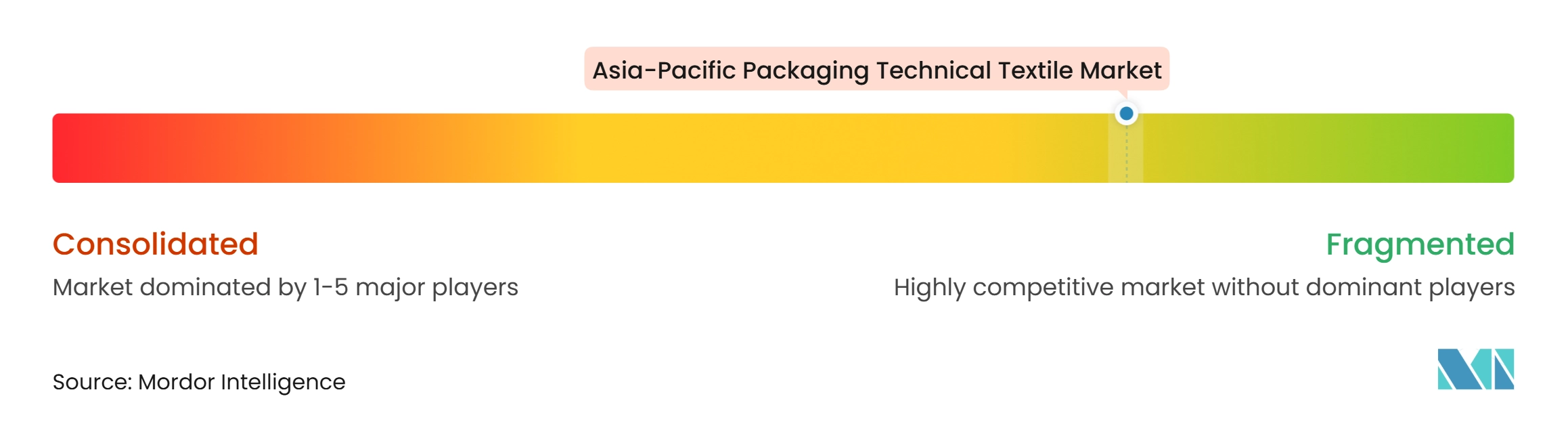
The Asia-Pacific packaging technical textile market is fragmented because no single producer holds a majority of regional output. Commodity sack manufacturing has relatively accessible entry requirements, while food-grade, pharmaceutical-grade, and hazardous-material packaging requires stronger process controls. China and Southeast Asian commodity suppliers compete on scale, price, and proximity to local customers. India-based exporters can differentiate through cleanroom production, certification, and established customer qualification programs. This creates clear separation between high-volume commodity products and premium technical containers. Competition is therefore strongest where suppliers offer similar basic polypropylene packaging products.
The largest regional opportunity is not uniform across product groups. Basic sacks continue to serve high-volume agricultural and construction uses. Suppliers that add controlled conversion, stronger liners, traceability, or electrostatic protection can address applications where product failure has higher customer costs. This supports product differentiation within an otherwise price-sensitive supplier base. It also helps explain why the same market includes small local converters and globally qualified exporters.
Emmbi Industries has focused on recycled-content bulk packaging through its Reclaim brand. The company stated that its certified recycled-content FIBCs use 20% post-consumer and post-industrial polymer waste within its disclosed raw material strategy. It also reported export sales of INR 341.60 crore for FY2025-26, supported by automation-compatible FIBC variants. Rishi FIBC Japan’s Fusion Bag uses seamless heat-fusion bonding to remove conventional sewing holes in product-contact areas. These product choices address needs in food, chemical, and pharmaceutical logistics. They also show how suppliers can compete through performance and compliance rather than only on price. The company’s approach links recycled material use with products intended for demanding bulk applications. This can help buyers respond to procurement requirements that increasingly consider recoverability and recycled content. It also shows the commercial value of maintaining product performance while changing the raw material mix.
Asia-Pacific Packaging Technical Textile Industry Leaders
-
LC Packaging International BV
-
Emmbi Industries Limited
-
Jumbo Bag Limited
-
Taihua Group
-
Berry Global Group, Inc.
- *Disclaimer: Major Players sorted in no particular order
Asia-Pacific Packaging Technical Textile Market Companies Covered in this Report
- LC Packaging International BV
- Emmbi Industries Limited
- Jumbo Bag Limited
- Taihua Group
- Berry Global Group, Inc.
- Greif, Inc.
- Conitex Sonoco
- Rishi FIBC Solutions Private Limited
- Umasree Texplast Private Limited
- Packem Umasree Private Limited
- Shankar Packaging Limited
- Global-Pak, Inc.
- Bulk Lift International, LLC
- Halsted Corporation
- Intertape Polymer Group Inc.
- Commercial Syn Bags Limited
- Innoweave Packaging Solutions Private Limited
- Lohia Corp Limited
- Asia Polysacks Company Limited
- Oji Interpack Co., Ltd.
- United Bags, Inc.
- Plastene Group
- Mewar Polytex Limited
Recent Industry Developments in Asia-Pacific Packaging Technical Textile Market
- November 2026: Rishi FIBC Japan commenced commercial sales of the Fusion Bag, a seamless, stitch-free FIBC employing AmeriGlobe’s patented heat-fusion bonding technology, targeting food, chemical, resin, and pharmaceutical powder applications in Japan. The product eliminates sewing holes and needle-fragment contamination risk in product-contact zones, addressing food and pharmaceutical packaging quality concerns. Its heat-fusion construction replaces conventional stitching in the contact area. The launch reflects buyer attention to contamination control in pharmaceutical and food material handling.
- May 2026: Emmbi Industries Limited announced through an NSE and BSE filing that its Reclaim brand of eco-friendly bulk packaging uses approximately 20% of raw materials from post-consumer and post-industrial polymer waste. The company presented this product line as certified recycled-content bulk packaging for export customers. The disclosure accompanied FY2025-26 standalone revenue of INR 530.52 crore, up 11.97% year on year. The development shows how recycled-content requirements are becoming relevant even for industrial bulk containers.
- April 2025: Amcor Plc completed the acquisition of Berry Global Group, Inc. in an all-stock transaction, creating a combined entity with approximately 77,000 employees and more than 400 manufacturing facilities across over 40 countries. The transaction brought two major flexible and specialty packaging businesses together. It may affect the competitive environment for premium packaging applications in Asia-Pacific. The combined network has a broad manufacturing footprint across global packaging markets.
Asia-Pacific Packaging Technical Textile Market Report Scope
The Asia-Pacific Packaging Technical Textile Market Report is Segmented by Product Type (Flexible Intermediate Bulk Containers (FIBCs), Woven Polyolefin Sacks and Bags, and More), by Material Type ( Polypropylene and More), by End-Use Application (Agriculture and Fresh Produce Packaging and More), and by Geography (China, India, and More). The Report Offers Market Size and Forecasts in Value (USD) for all the Above Segments.
Segmentation Overview
| Flexible Intermediate Bulk Containers (FIBCs) | Conventional Bulk FIBCs |
| Form-Stable and Baffle FIBCs | |
| Ventilated FIBCs | |
| Other Specialized FIBCs | |
| Woven Polyolefin Sacks and Bags | |
| Jute and Other Natural-Fiber Packaging Textiles | Jute Sacking and Finished Packaging Bags |
| Others (Hessian, Burlap, Natural-Fiber Packaging Cloth, Speciality Packaging) | |
| Mesh and Netted Packaging Textiles | Leno Woven Packaging Bags |
| Raschel Knitted Packaging Bags | |
| Tubular Knitted Packaging Nets and Sleeves | |
| Other Textile Mesh Packaging Products | |
| Wrapping and Transit-Protection Textiles | Industrial Bale and Goods Wrapping Fabrics |
| Textile Packaging Covers and Protective Wraps | |
| Textile-Based Container Liners and Cargo Protection Fabrics | |
| Textile Pallet Netwrap and Load-Securing Materials | |
| Textile Packaging Sleeves, Padding, and Dunnage | |
| Nonwoven and Specialty Textile Packaging Products (Shopping and Carrying Bags, Protective Packaging Bags and Pouches, etc.) |
| Polypropylene |
| Polyethylene |
| Polyester |
| Jute |
| Cotton and Other Natural Fibers |
| Regenerated Cellulosic Fibers |
| Polyamide and Other Specialty Synthetic Fibers |
| Other Materials |
| Agriculture and Fresh Produce Packaging | Fresh Fruits and Vegetables |
| Seeds and Other Agricultural Commodities | |
| Food and Beverage Processing | Food Grains, Flour, and Sugar |
| Processed Food and Food Ingredients | |
| Animal Feed and Pet Food | |
| Beverage Ingredients and Infusion Products | |
| Chemicals, Petrochemicals, and Fertilizers | |
| Construction Materials, Minerals, and Mining | |
| Pharmaceuticals and Healthcare Products | |
| Retail, E-Commerce, and Consumer Goods | |
| Other Industrial Products and Materials |
| China |
| India |
| Japan |
| South Korea |
| Taiwan |
| Indonesia |
| Vietnam |
| Thailand |
| Bangladesh |
| Australia |
| Rest of Asia-Pacific |
| By Product Type | Flexible Intermediate Bulk Containers (FIBCs) | Conventional Bulk FIBCs |
| Form-Stable and Baffle FIBCs | ||
| Ventilated FIBCs | ||
| Other Specialized FIBCs | ||
| Woven Polyolefin Sacks and Bags | ||
| Jute and Other Natural-Fiber Packaging Textiles | Jute Sacking and Finished Packaging Bags | |
| Others (Hessian, Burlap, Natural-Fiber Packaging Cloth, Speciality Packaging) | ||
| Mesh and Netted Packaging Textiles | Leno Woven Packaging Bags | |
| Raschel Knitted Packaging Bags | ||
| Tubular Knitted Packaging Nets and Sleeves | ||
| Other Textile Mesh Packaging Products | ||
| Wrapping and Transit-Protection Textiles | Industrial Bale and Goods Wrapping Fabrics | |
| Textile Packaging Covers and Protective Wraps | ||
| Textile-Based Container Liners and Cargo Protection Fabrics | ||
| Textile Pallet Netwrap and Load-Securing Materials | ||
| Textile Packaging Sleeves, Padding, and Dunnage | ||
| Nonwoven and Specialty Textile Packaging Products (Shopping and Carrying Bags, Protective Packaging Bags and Pouches, etc.) | ||
| By Material Type | Polypropylene | |
| Polyethylene | ||
| Polyester | ||
| Jute | ||
| Cotton and Other Natural Fibers | ||
| Regenerated Cellulosic Fibers | ||
| Polyamide and Other Specialty Synthetic Fibers | ||
| Other Materials | ||
| By End-Use Application | Agriculture and Fresh Produce Packaging | Fresh Fruits and Vegetables |
| Seeds and Other Agricultural Commodities | ||
| Food and Beverage Processing | Food Grains, Flour, and Sugar | |
| Processed Food and Food Ingredients | ||
| Animal Feed and Pet Food | ||
| Beverage Ingredients and Infusion Products | ||
| Chemicals, Petrochemicals, and Fertilizers | ||
| Construction Materials, Minerals, and Mining | ||
| Pharmaceuticals and Healthcare Products | ||
| Retail, E-Commerce, and Consumer Goods | ||
| Other Industrial Products and Materials | ||
| By Geography | China | |
| India | ||
| Japan | ||
| South Korea | ||
| Taiwan | ||
| Indonesia | ||
| Vietnam | ||
| Thailand | ||
| Bangladesh | ||
| Australia | ||
| Rest of Asia-Pacific | ||
Key Questions Answered in the Report
What is the projected value of the Asia-Pacific packaging technical textile sector by 2032?
It is projected to reach USD 13.56 billion by 2032, from USD 10.37 billion in 2027, at a 5.51% CAGR.
Which packaging technical textile product has the largest regional share?
Woven polyolefin sacks and bags lead product demand with a 34.0% share in 2026, valued at USD 3.3592 billion.
Why are FIBCs growing faster than other packaging textile products?
Automated filling, discharge, and handling systems in chemical, food, and pharmaceutical facilities are supporting FIBC adoption.
Which material is most widely used in Asia-Pacific packaging technical textiles?
Polypropylene holds a 54.0% share in 2026, valued at USD 5.3352 billion, because it combines strength, chemical resistance, and processability.
Which end-use application has the greatest demand for packaging technical textiles?
Agriculture and fresh produce packaging leads with a 27.0% share in 2026, equivalent to USD 2.6676 billion.
Which country is growing fastest in Asia-Pacific packaging technical textiles?
India is the fastest-growing geography, with a projected CAGR of 7.20% from 2027 to 2032.