
Market Overview
| Study Period | 2019 - 2031 |
|---|---|
| Forecast Data Period | 2026 - 2031 |
| Base Year Market Size (2025) | USD 1.82 Billion |
| Market Size (2026) | USD 1.92 Billion |
| Market Size (2031) | USD 2.47 Billion |
| Growth Rate (2026 - 2031) | 5.16 % |
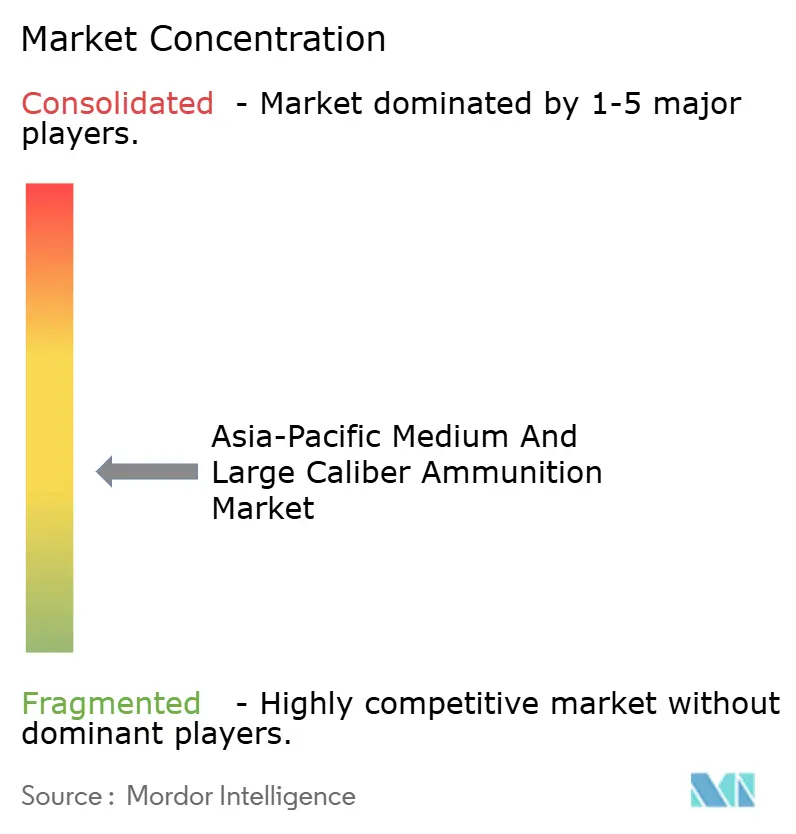
| Market Concentration | Medium |
Major Players *Disclaimer: Major Players sorted in no particular order Image © Mordor Intelligence. Reuse requires attribution under CC BY 4.0. | |
Asia-Pacific Medium and Large Caliber Ammunition Market Analysis by Mordor Intelligence
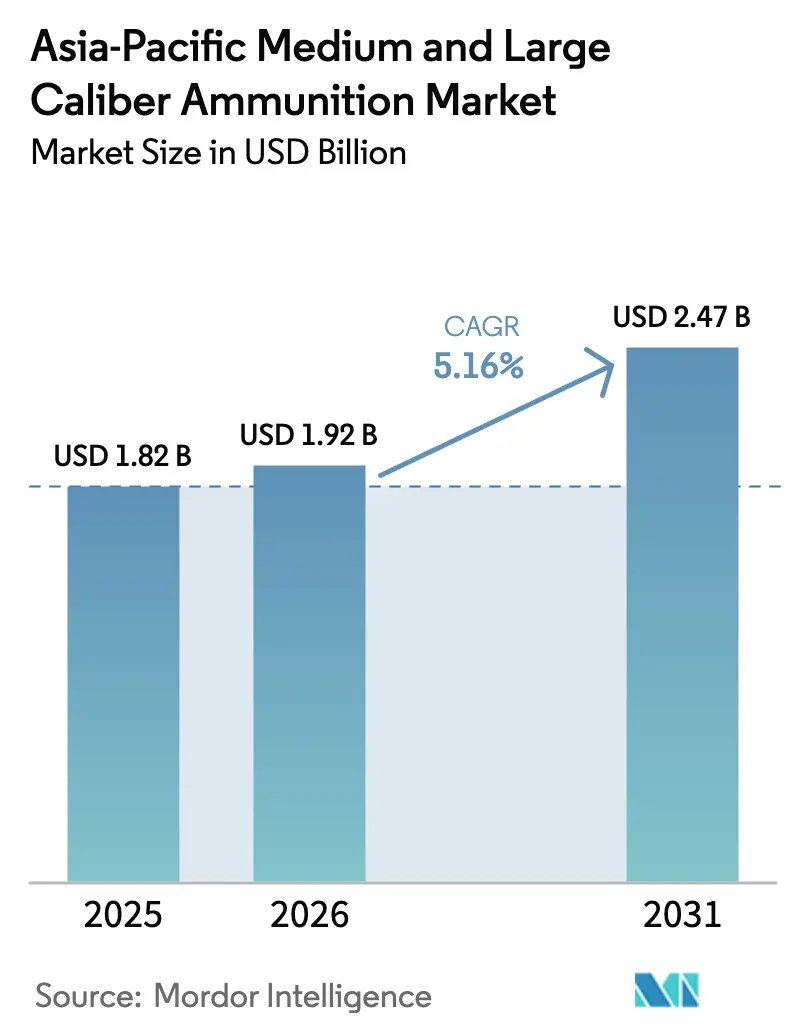
The Asia-Pacific medium and large caliber ammunition market size is expected to grow from USD 1.82 billion in 2025 to USD 1.92 billion in 2026 and is forecasted to reach USD 2.47 billion by 2031 at a 5.16% CAGR over 2026-2031. This growth is driven by rearmament programs in countries such as Japan, Taiwan, India, and Australia, alongside initiatives to enhance domestic production capabilities, which reduce lead times and dependence on Foreign Military Sales (FMS) pipelines. Factors such as rapid naval modernization, the integration of AI-enabled fire-control systems, and insights from ammunition shortages in Ukraine are further boosting demand, particularly for 155mm artillery and 127mm naval rounds. However, rising copper and brass prices are increasing unit costs, while emerging investments in directed-energy systems pose a potential long-term challenge to substitution.
Key Report Takeaways
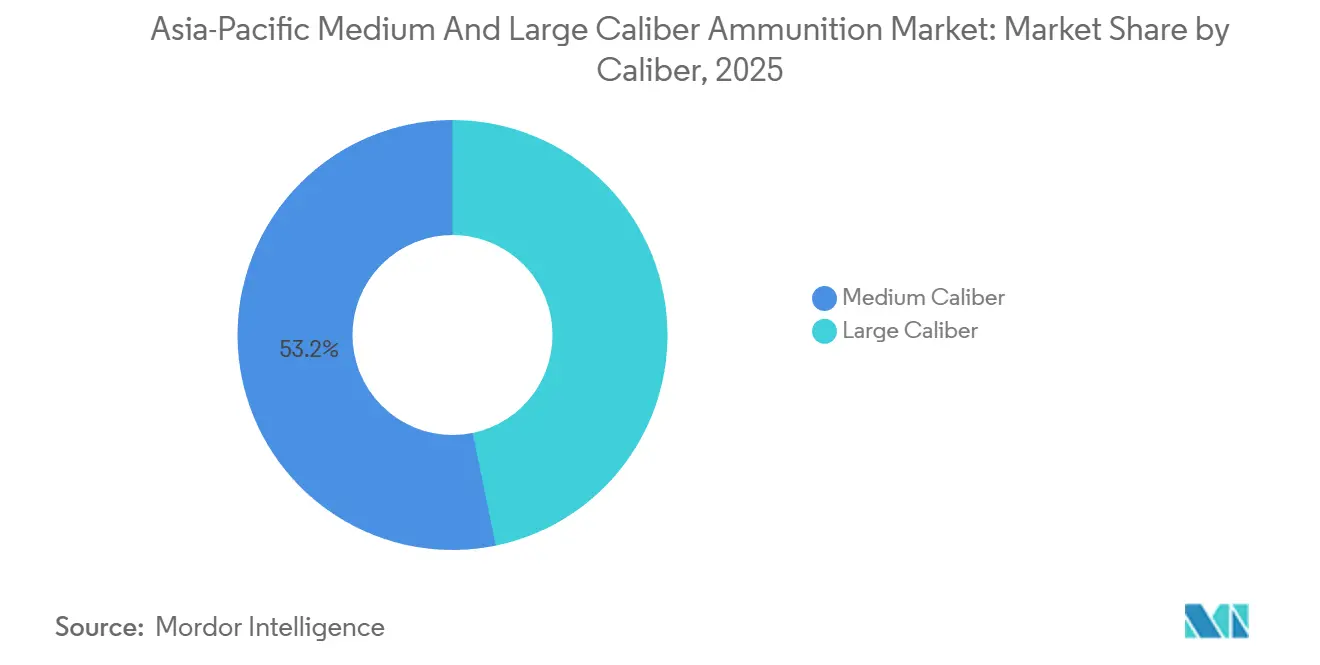
- By caliber, medium caliber led with 53.23% of the Asia-Pacific medium and large caliber ammunition market share in 2025, while large caliber is forecast to grow at a 6.55% CAGR through 2031.
- By product, artillery shells and mortars accounted for 38.95% of the Asia-Pacific medium and large caliber ammunition market in 2025; aerial bombs and grenades are projected to expand at a 6.04% CAGR through 2031.
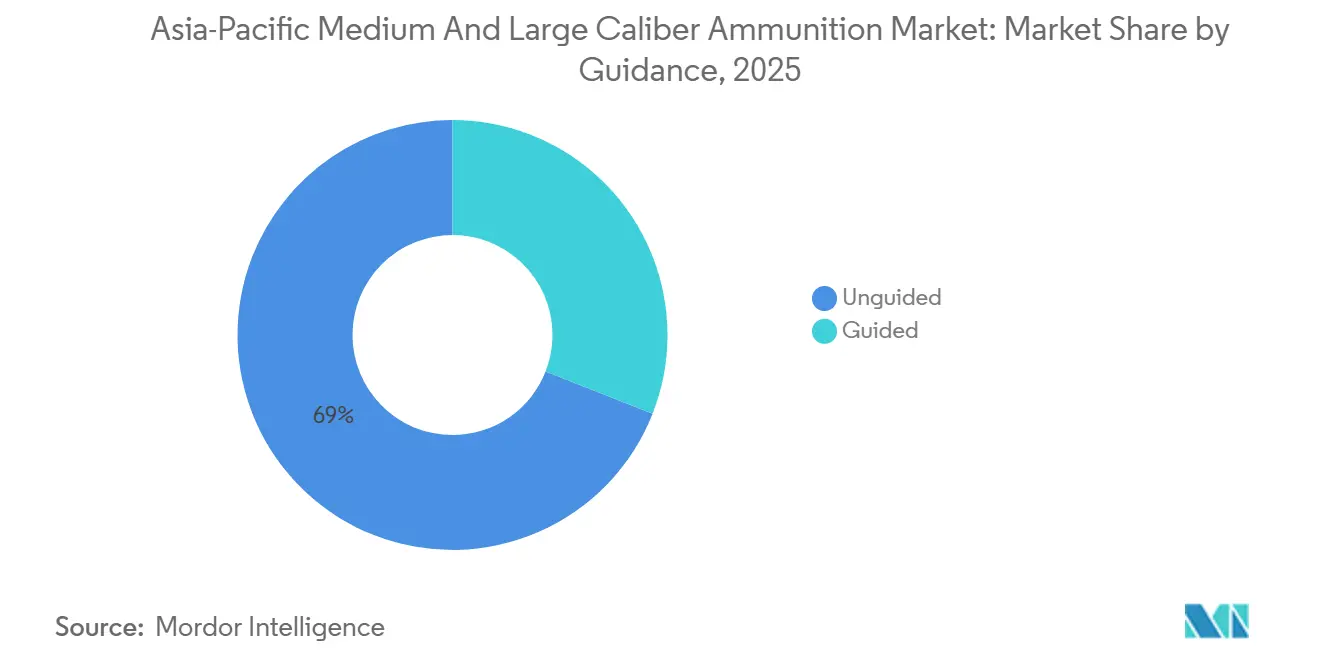
- By guidance, unguided rounds captured a 69.04% share in 2025, whereas guided munitions are forecast to grow at a 7.85% CAGR through 2031.
- By end-user, the military segment held an 86.95% share in 2025, while the law enforcement segment is projected to grow at a 6.01% CAGR through 2031.
- By platform, land systems represented 56.93% of 2025 revenue, yet airborne platforms are forecast to grow at a 6.58% CAGR through 2031.
- By geography, China accounted for 33.49% of regional spending in 2025, while India is projected to grow at a 6.49% CAGR through 2031.
Note: Market size and forecast figures in this report are generated using Mordor Intelligence’s proprietary estimation framework, updated with the latest available data and insights as of January 2026.
Market Trends and Insights
Drivers Impact Analysis of Asia-Pacific Medium and Large Caliber Ammunition Market*
| Driver | (%) Impact on CAGR Forecast | Geographic Relevance | Impact Timeline |
|---|---|---|---|
| 2026+ rearmament cycles across Indo-Pacific defense forces | +1.20% | Japan, South Korea, Taiwan, Philippines, Australia | Medium term (2-4 years) |
| Surge in indigenous production and export hubs | +1.00% | India, South Korea, Australia, with export spill-over to Middle East and Southeast Asia | Long term (≥ 4 years) |
| Rapid naval modernization driving 76-127mm and 155mm naval rounds | +0.70% | China, India, Japan, South Korea, Australia | Medium term (2-4 years) |
| AI-enabled fire-control systems unlock demand for “Smart” shells | +0.60% | Global, with early adoption in India, South Korea, Japan | Long term (≥ 4 years) |
| Stockpile replenishment after Ukraine conflict lessons | +0.50% | Global, particularly Japan, South Korea, Australia | Short term (≤ 2 years) |
| Niche requirement for counter-UAV air-burst ammunition | +0.30% | India, South Korea, Taiwan, Southeast Asia | Medium term (2-4 years) |
| Source: Mordor Intelligence | |||
2026+ Re-Armament Cycles Across Indo-Pacific Defence Forces
Tokyo's record USD 58 billion fiscal-2025 defense budget includes ammunition purchases equivalent to the combined total of the previous three years. This scale compels suppliers to secure copper and propellant contracts two years in advance to mitigate spot-market volatility. Taiwan's USD 11.1 billion FMS letter incorporates surge clauses that allow for quarterly call-offs, which enhance flexibility but complicate production scheduling for US prime contractors. South Korea increased its 155mm war-reserve target by 125,000 rounds for 2025, converting Poongsan's optional capacity expansion into committed throughput. The Philippines, an early-cycle participant, introduced 40% local-content requirements for ATMOS howitzer ammunition, prompting Israeli prime Elbit to collaborate with the government-owned Government Arsenal for filling operations. Across these nations, procurement activity is concentrated in 2026-2028, driving overtime shifts and forging-press utilization above 95% capacity. Post-2028, replenishment declines, but sustainment orders maintain baseline activity. This multi-year visibility supports a stable 1.2-point increase in the CAGR of the Asia-Pacific medium and large caliber ammunition market.
Surge in Indigenous Production and Export Hubs
India's Munitions India Limited (MIL) operates six hot-strip rolling lines for 155mm shell bodies and introduced automated ultrasonic flaw detection in 2025, resulting in a 30% reduction in rejection rates. Kalyani's NATO-grade exports demonstrated compliance with rigorous STANAG 4110 lot-acceptance standards, leading Poland to submit a follow-up inquiry for 25,000 rounds. South Korea's Poongsan doubled brass-case production and vertically integrated extrusion press maintenance to minimize downtime, a strategic response to elevated LME copper volatility. Australia's Thales-operated Benalla plant secured green power from a nearby solar farm, mitigating carbon-pricing penalties and reinforcing Canberra's industrial-sovereignty objectives. Collectively, these hubs reduce shipping times and ITAR-related risks, contributing a 1-point structural gain to the growth trajectory of the Asia-Pacific medium and large caliber ammunition market.
Rapid Naval Modernisation Driving 76-127mm and 155mm Rounds
Japan's Mogami-class frigates utilize 127mm Vulcano guided rounds, enabling land-attack missions traditionally reserved for cruise missiles. This shift alters fleet operational concepts and increases budgets for precision-guided munitions (PGMs). South Korea's KDX-III Batch II destroyers integrate 127mm guns with advanced fire-control radars, enhancing hit probability at ranges up to 100 km. Australia's Hunter-class project achieved 400-ton fuel savings by adopting lighter-weight 127mm rounds, driving recurring orders for low-drag base-bleed variants. China's Type 055 destroyers employ 130mm extended-range shells with base-bleed and rocket-assist options, sustaining domestic demand and supporting export variants for Pakistan. The Indian Navy, traditionally reliant on 76mm systems, is preparing a Request for Information (RFI) for 127mm systems to align with long-range surface-fire doctrines. This naval modernization is expected to contribute a 0.7-point increase to the Asia-Pacific medium and large caliber ammunition market CAGR through 2031.
AI-Enabled Fire-Control Systems Unlock Demand for “Smart” Shells
India's DRDO utilizes a digital twin of its 155mm projectile to simulate in-bore stress and external ballistics across 40,000 iterations, thereby reducing development time by eight months and enabling the production of sub-USD 10,000 smart shells. South Korea's K9 upgrade packages include on-weapon GPS antennae and encrypted Mil-GPS receivers, enabling course-correcting fuzes in flight and improving first-round effectiveness while reducing logistical demands. Japan's Ground Self-Defense Force (GSDF) integrates machine-learning algorithms in fire-direction centers to analyze weather, drone imagery, and historical dispersion data, dynamically selecting between unguided and guided shots for cost efficiency. Australia's Army is studying AI models to recommend the most cost-effective round mix for mission success, potentially saving USD 35 million in ammunition life-cycle costs over five years. These advancements compress the sensor-to-shooter loop from minutes to seconds, encouraging procurement of higher-cost smart shells while reducing overall quantities, resulting in a 0.6-point boost to market growth.
Restraints Impact Analysis of Asia-Pacific Medium and Large Caliber Ammunition Market*
| Restraint | (%) Impact on CAGR Forecast | Geographic Relevance | Impact Timeline |
|---|---|---|---|
| Tight ITAR-like export controls within Quad and EU | -0.40% | Global, with acute impact on US FMS recipients (Taiwan, Japan, Philippines) | Short term (≤ 2 years) |
| Persistent copper/brass cost inflation | -0.30% | Global, particularly affecting India, South Korea, Australia producers | Medium term (2-4 years) |
| Emerging directed-energy alternatives | -0.20% | US, Japan, South Korea, Australia | Long term (≥ 4 years) |
| Environmental push for lead-free formulations | -0.20% | Australia, Japan, South Korea, with EU-driven compliance spill-over | Medium term (2-4 years) |
| Source: Mordor Intelligence | |||
Tight ITAR-Like Export Controls Within Quad and EU
Australian project officers report an average wait of 270 days for US export licenses for forging dies used in 155mm shell production, necessitating interim reliance on legacy tooling. Taiwan's dependence on FMS has delayed shell deliveries, prompting discussions with India and South Korea for alternative supply chains. Japan eased its export regulations in 2025 but remains constrained by the ITAR for US-origin guidance kits, which delays the co-production of Excalibur rounds by at least 12 months. These export control challenges collectively reduce near-term CAGR by 0.4 points but simultaneously drive indigenous investments that offset the impact in the long term.
Persistent Copper/Brass Cost Inflation
Copper prices averaged USD 9,200 per ton in 2025, a 18% increase from 2023, significantly inflating the cost of brass cartridge cases, which constitute up to 40% of the total cost of a round.[1] Poongsan's margins declined by three points despite a nine-month forward-hedge program, highlighting the challenges of managing metal inflation. MIL renegotiated with India's Ministry of Defence to include an escalation clause tied to LME prices, passing through an 8% cost increase on 155mm shells. Australia's Benalla plant faced a 10% cost overrun, leading to a five-year copper supply agreement with BHP's Olympic Dam mine. Sustained input cost inflation reduces medium-term CAGR by 0.3 points, straining discretionary modernization budgets.
*Our forecasts treat driver/restraint impacts as directional, not additive. The impact forecasts reflect baseline growth, mix effects, and variable interactions.
Asia-Pacific Medium and Large Caliber Ammunition Market Segment Analysis
By Caliber:
Firepower Shift Toward Heavy TubesLarge caliber rounds accounted for 46.77% of 2025 revenue and are projected to grow at a 6.55% CAGR, potentially reaching parity with medium caliber by 2030. For instance, India’s ATAGS and Dhanush howitzers consume approximately 70,000 155mm shells annually during training, with guided upgrades significantly increasing the value per round.[2] Additionally, Australia’s plan to deploy 75 M1A2 SEPv3 tanks necessitates an annual demand of around 18,000 120mm rounds, which were previously imported but will soon be produced domestically. This shift highlights the growing importance of local production capabilities in meeting the increasing demand for heavy-caliber ammunition.
Medium-caliber ammunition, ranging from 20mm to 57mm, supports infantry fighting vehicles, attack helicopters, and CIWS mounts. In 2025, the Directorate of Ordnance (Coordination & Services) supplied 2 million rounds of 30mm ammunition for the BMP-2 fleet, accounting for 12% of its annual ammunition revenue. However, the growing importance of networked fires and guided kits is driving the value of large-caliber ammunition, underscoring that future revenue splits will prioritize lethality over sheer volume in the Asia-Pacific medium- and large-caliber ammunition market. The shift toward guided and networked systems underscores the evolving nature of modern warfare and its impact on ammunition demand.
By Product:
Programmable Munitions Garner AttentionArtillery shells and mortars accounted for 38.95% of total sales in 2025, with the Asia-Pacific medium and large caliber ammunition market for this category expected to grow steadily as military doctrines emphasize sustained fires. South Korea exported 800,000 155mm shells tied to K9 packages in 2025, demonstrating a production capacity capable of scaling up to meet NATO replenishment orders. This steady growth in artillery shells and mortars reflects the increasing reliance on sustained firepower in modern military strategies, particularly in regions with heightened geopolitical tensions.
Aerial bombs and grenades, though smaller in scale, are projected to achieve the fastest growth at a 6.04% CAGR. Taiwan’s deployment of 40mm programmable grenades at forward island garrisons highlights how niche counter-UAV requirements can evolve into significant procurement volumes. Additionally, India’s adoption of Rheinmetall’s AHEAD fuze in 35mm rounds establishes a recurring aftermarket for canister reloads, demonstrating how technology transfer fosters supplier dependency. Recoilless rifle ammunition, such as Saab’s Carl Gustaf 84mm rounds delivered to Australia, further diversifies revenue streams and provides a flexible procurement option unaffected by artillery barrel life cycles. These developments underscore the increasing significance of technological advancements and diversified product offerings in shaping the Asia-Pacific medium and large caliber ammunition market.
By Guidance:
Precision’s Premium Gains MomentumUnguided ammunition remains cost-effective for area denial, maintaining a 69.04% market share in 2025. However, the introduction of sub-USD 10,000 Indian smart shells may reduce price sensitivity and attract mid-tier users in Indonesia and Vietnam. This shift is gradually steering the Asia-Pacific medium and large caliber ammunition market toward guided munitions, although traditional high-volume ammunition will continue to play a significant role. The balance between cost-effectiveness and precision will continue to be a key factor influencing procurement decisions in the region.
Guided rounds are expected to grow at a 7.85% CAGR. For example, Japan’s purchase of 1,000 Excalibur shells in 2025 amounted to USD 120 million, equivalent to the value of 150,000 unguided M795 rounds. This significant investment in guided rounds highlights the premium placed on precision and efficiency in modern military operations.
By End-User:
Military Demand Dominates but Para-Military Budgets GrowMilitary organizations accounted for 86.95% of 2025 expenditure, supported by five-year capital budgets that shield procurement from short-term fiscal fluctuations. This stability in military spending ensures a consistent demand for ammunition, even during periods of economic uncertainty.
Law enforcement, with a forecasted 6.01% CAGR, is achieving incremental growth through United Nations peacekeeping reimbursements. These funds enable paramilitary units in countries like India and Thailand to enhance their firepower. For instance, India’s Central Reserve Police Force (CRPF) procured 12.7mm and 30mm rounds for armored vehicles in Kashmir, sustaining local production facilities during periods of reduced military orders. This parallel demand base enhances the resilience of the Asia-Pacific medium and large caliber ammunition market during cyclical downturns in defense spending. The growing role of paramilitary forces in maintaining internal security and participating in peacekeeping missions further underscores their importance as a key end-user segment.
By Platform:
Airborne Arms Race IntensifiesLand platforms led the market, accounting for 56.93% of the 2025 revenue, driven by the need for artillery and tank resupply. For example, India’s Dhanush regiment allocates 180 live rounds per gun annually for training and operations. This consistent demand from land platforms highlights their critical role in sustaining the overall ammunition market.
Airborne platforms are expected to grow at a 6.58% CAGR as countries such as Australia, Japan, and India induct the AH-64E Apache helicopters, each equipped with a 30mm cannon that fires 300 rounds per sortie. Additionally, the increasing deployment of UCAVs, such as Wing Loong II and Bayraktar TB2, across Southeast Asia is boosting demand for lightweight 12.7mm belts and single-use 20mm pods. This trend is driving the Asia-Pacific medium and large caliber ammunition market toward sustained, sortie-driven replenishment cycles. The growing emphasis on airborne platforms reflects their strategic importance in modern military operations, particularly in regions with complex security challenges.
Geography Analysis
China Medium and Large Caliber Ammunition Market
China accounted for 33.49% of 2025 revenue, benefiting from Norinco's vertically integrated supply chains, which helped maintain low per-unit costs.[3] The country mitigated exposure to copper price fluctuations by utilizing its state reserves. While domestic R&D in guidance technology lags behind Western advancements, Beijing compensates by mass-producing unguided rounds, which are widely distributed to partner markets such as Pakistan and Myanmar. Additionally, the PLA Navy's 130mm extended-range shell program has driven demand for proprietary propellant blends, further strengthening domestic feedstock controls.
India Medium and Large Caliber Ammunition Market
India is expected to achieve a 6.49% CAGR, the highest in the Asia-Pacific medium and large caliber ammunition market. This growth is supported by USD 1 billion in military orders and private-sector expansion initiatives. The DRDO's smart-shell program aims to address precision gaps while reducing dependency on US and European vendors, thereby curbing foreign currency outflows. Export credibility has improved following Kalyani's NATO sale, positioning India to fill supply gaps as traditional suppliers face ITAR-related restrictions.
APAC Medium and Large Caliber Ammunition Market
Japan, South Korea, and Australia collectively contributed approximately 40% of regional revenue in 2025. Japan's cabinet-level focus on munitions stock transparency has accelerated delivery timelines. South Korea's Hanwha has established overseas production lines to mitigate currency risks and streamline logistics. Meanwhile, Australia's GWEO umbrella programs promote local manufacturing, aligning with its defense sovereignty objectives and potentially enabling exports to Pacific Island nations under security assistance agreements.
The rest of the Asia-Pacific region, including Thailand, Vietnam, Indonesia, and the Philippines, recorded mid-single-digit growth. Thailand's army is transitioning from legacy 105mm howitzers to M777s and ATMOS units, increasing demand for large-caliber ammunition. Vietnam continues to rely on Russian stockpiles but is exploring Indian and Korean suppliers for diversification. Indonesia's 15% increase in its ammunition budget supports purchases of 155mm and 30mm rounds for territorial defense. The Philippines utilizes US Foreign Military Financing to place rolling orders for 40mm grenades, ensuring smoother cash flow and reducing delivery risks.
Regulatory Landscape
Across Asia-Pacific, medium and large caliber ammunition manufacturing and trade are shaped by layered safety, packaging, and export-control regimes that affect lead times and permissible technology transfer, particularly for guided fuzes and US-origin subsystems. In Australia, the Defence and Strategic Goods List (DSGL) 2024 and the Explosives Regulations 2024 operate alongside Defence Explosive Ordnance Publication 101 to govern controlled goods, handling, storage, and movement of ammunition and related production tooling. The DEF(AUST)1000C ADF Packaging Standard further anchors compliance expectations for ammunition supplied to the ADF.
In India, policy continues to emphasize self-reliance and export enablement under the Defence Production and Export Promotion Policy (DPEPP) 2020, while quality and commonality are reinforced through the Directorate of Standardisation via Joint Services Specifications and the Single Integrated Standardisation Programme. Exports of munitions remain subject to prior authorization for items under the SCOMET list, which affects how Indian producers structure technology collaboration, documentation, and end-user controls when supplying medium and large caliber ammunition to overseas customers.
Value Chain Analysis
The value chain runs from upstream inputs like copper and brass for cases and driving bands, steel for bodies, and energetics such as propellants and explosives, to midstream conversion steps including forging or rolling of shell bodies, machining, heat treatment, filling, fuzing, and lot acceptance. Downstream logistics move finished rounds to military depots and into platform OEM-linked sustainment channels. Input-price volatility is increasingly visible as a constraint, with brass and copper exposure pushing producers toward longer offtake and hedging arrangements, and toward localization of primers and propellants where national policy supports it.
Supply chain bottlenecks are most apparent in the guided segment, where seekers, GPS-related components, and other controlled subassemblies increase reliance on external suppliers and export licensing. Industrial programs across the region are addressing these constraints through domestic capacity and automation. Australia has anchored GWEO Enterprise funding (AUD 21 billion) and selected Thales as the preferred tenderer for a new 155mm forging capability at Benalla, while Lockheed Martin Australia opened a government-owned facility at Port Wakefield for GMLRS rockets and launch pod containers (December 2025), expanding regional munitions manufacturing capacity. India is also pushing toward ammunition self-reliance through investments in energetics and components, while Taiwan's limited domestic 155mm shell output keeps external supply lines strategically important.
Competitive Landscape
The Asia-Pacific medium and large caliber ammunition market is moderately fragmented, with competitive dynamics evolving steadily. Western companies continue to dominate the premium guided ammunition segment. For instance, BAE Systems manages the Excalibur program, Rheinmetall holds intellectual property for AHEAD programmable fuzes, and Thales specializes in base-bleed technology for 127mm naval rounds. Meanwhile, regional players are expanding their capabilities. MIL has introduced a new automated filling line capable of processing 5,000 shells daily, matching the production capacity of Western manufacturers. Hanwha's Australian joint venture is positioned to serve both domestic and export markets. At the same time, Poongsan leverages its surplus brass-case production to offer competitive pricing during periods of copper price volatility.
Key strategic efforts in the market focus on vertical integration and localization of intellectual property (IP). For example, Kalyani has licensed bottom-bore welding technology from German toolmaker KUKA, enabling the production of seamless shell bodies and reducing machine time by 18%. Poongsan has secured a 10-year copper ore offtake agreement with Rio Tinto, mitigating price fluctuation risks. Additionally, Thales' Benalla plant has transitioned to renewable energy sources to address potential carbon audits linked to export tenders. On the technological front, India's DRDO and Rheinmetall partnership has established local teams for fuze-logic development, enhancing upstream value capture.
The combined market share of the top five players is estimated at 50-55%, maintaining a balance in supply power. Buyers retain the ability to source from multiple suppliers, avoiding dependency on a single provider. However, incumbents continue to defend their market positions through faster certification processes and robust guided-round portfolios.
Asia-Pacific Medium and Large Caliber Ammunition Industry Leaders
-
BAE Systems plc
-
Munitions India Limited
-
Hanwha Corporation
-
Rheinmetall Denel Munition (Pty) Ltd. (Rheinmetall AG)
-
Thales Group
- *Disclaimer: Major Players sorted in no particular order
Asia-Pacific Medium and Large Caliber Ammunition Market Companies Covered in this Report
- Munitions India Limited
- Kalyani Strategic Systems Ltd. (Bharat Forge Limited)
- Poongsan Co., Ltd.
- Rheinmetall Denel Munition (Pty) Ltd. (Rheinmetall AG)
- Saab AB
- Rostec
- Bharat Electronics Ltd.
- Hanwha Corporation
- Singapore Technologies Engineering Ltd.
- General Dynamics Corporation
- KNDS N.V.
- Directorate of Ordnance (Coordination & Services)
- Thales Group
- Nammo AS
- BAE Systems plc
Read Analysis of Asia-Pacific Medium and Large Caliber Ammunition Companies
Market Opportunities and Future Outlook
Large-caliber artillery localization is opening room for new forging, machining, and filling capacity, and for domestically qualified supply of M795-class 155mm projectiles and compatible components. A clear signal is Australia awarding Rheinmetall Nioa Munitions a contract (AUD 72 million, June 2026) to establish 155mm M795 artillery projectile production at Maryborough, complementing earlier steps toward a domestic forging capability at Benalla. Together, these moves support opportunities for regionalized supply chains across steel inputs, forging, machining, energetics, and packaging, which can shorten replenishment cycles.
Guided and programmable munitions add a parallel opportunity in integration, test, and certification, particularly where national programs pair local production with foreign technology. Examples include Taiwan's Ministry of National Defense signing a joint heavy-caliber ammunition production agreement with the US (NT$910 million, April 2026) covering shells 105mm or larger, and India progressing private-sector investments in energetics and ammunition manufacturing such as Bharat Forge breaking ground on a large campus in Andhra Pradesh (May 2026). These actions support demand for local qualification infrastructure, including lot acceptance, non-destructive inspection, and quality systems aligned to export requirements, as well as for vertically integrated energetics supply that reduces dependence on imported propellants and primers.
Recent Industry Developments in Asia-Pacific Medium and Large Caliber Ammunition Market
- April 2026: Hanwha Aerospace halted its review of a potential acquisition of Poongsan Corporation's ammunition division after exploring vertical integration across platforms and ammunition. The move pointed to how major regional primes assess control over brass-case and ammunition output to support bundled platform exports and recurring resupply programs.
- February 2025: Munitions India Limited formalized a contract with Indias Ministry of Defence for procurement of High Explosive Pre-Fragmented (HEPF) Mk-1 (Enhanced) rockets for the PINAKA MLRS under a larger procurement package. The order reinforced domestic demand visibility for energetics and warhead-filling capacity and supported scale-up of Indian ammunition production lines tied to artillery and rocket forces.
- February 2024: Munitions India Limited signed a USD 225 million artillery ammunition supply agreement with Nadrah Company for Saudi Arabia during World Defence Show 2024. The export deal highlighted cross-border demand pull for Asia-based ammunition suppliers and increased the focus on meeting international quality and compliance requirements for large-caliber lots.
Asia-Pacific Medium and Large Caliber Ammunition Market Report Scope and Research Methodology
Market Definition and Coverage
This market covers the value of medium and large caliber ammunition supplied for defense and select paramilitary users across Asia-Pacific, including items such as projectiles, shells, cartridges, and related charges typically used by land, naval, and air platforms.
Scope exclusions: We exclude small caliber rounds, civilian sporting ammunition, and standalone weapons or launch systems that are procured separately from ammunition.
Segments Covered in This Report
- By Caliber
- Medium Caliber
- Large Caliber
- By Product
- Rounds
- Artillery Shells and Mortars
- Aerial Bombs and Grenades
- By Guidance
- Guided
- Unguided
- By End-User
- Military
- Law Enforcement
- By Platform
- Land
- Naval
- Airborne
- By Geography
- China
- Japan
- India
- South Korea
- Australia
- Rest of Asia-Pacific
Data Sources, Market Sizing, and Validation
Desk Research
Desk research was used to set the market boundary, build the country demand map, and anchor the model with public defense indicators before interviews began. We relied on official and non-paywalled sources such as Stockholm International Peace Research Institute defense spending series, UN Comtrade trade statistics for relevant HS codes, government budget documents and defense ministry procurement releases, and parliamentary or audit reports where procurement totals are published.
To convert activity signals into value, the work was supported with sources like customs and port authority publications, standards and technical references for caliber classes, and peer reviewed defense economics papers that explain procurement cycles and stock replacement behavior. Company annual reports, investor presentations, and reputable press coverage were reviewed to confirm delivery timelines and contract announcements, and a paid subscription for company financials and a defense focused contract and tender database was used selectively to cross-check large awards. The sources named above are illustrative only, and many other public datasets and documents were also used for data collection, validation, and clarification.
Primary Interviews and Surveys
Primary work focused on validating demand drivers and price movement by caliber class, and then stress-testing assumptions country by country with people close to procurement and production planning. We spoke with a mix of ammunition producers, component suppliers, integrators, and defense procurement and maintenance stakeholders across APAC so the final model reflects how orders, deliveries, and replenishment typically happen in practice.
Distribution of primary research fieldwork respondents
| Company type | Respondent position |
|---|---|
| Top tier: 31% | CXOs: 17% |
| Mid tier: 50% | Functional/Unit leaders: 41% |
| Smaller Players: 19% | Managers: 42% |
Market-Sizing & Forecasting
Market sizing starts with a top-down build where country defense procurement signals are reconstructed into an ammunition demand pool, and then filtered to medium and large caliber categories based on platform mix and doctrine-level consumption patterns. Once the country totals are formed, we check them using selective bottom-up approximations, such as sampling contract values, applying typical splits by caliber families, and using price per round or price per shell ranges discussed in interviews.
Key inputs used in the model include defense budget allocations tied to munitions and sustainment, announced procurement and replenishment programs, artillery and armored vehicle modernization pace, training intensity indicators that influence consumption, and import or export movements that show supply availability. Because contract timing can be lumpy, gaps were handled by distributing deliveries across realistic production and acceptance windows, and then reconciling those runs with observed award announcements. For forecasting, scenario analysis was used to reflect different procurement pacing outcomes, and the final path was chosen after aligning with expert views on production capacity, inventory replacement needs, and expected price progression.
Data Validation & Update Cycle
We validate the model through stepwise cross-checks, starting with country level consistency checks against budget direction, procurement news flow, and trade signals, and then moving to a second pass that reviews outliers by caliber and platform linkages. When a country result looks unusual, the assumptions are revisited, and respondents are re-contacted to confirm whether the variance is due to a one-time award, a delayed delivery, or a change in pricing.
Before sign-off, the dataset is reviewed by another analyst to confirm arithmetic integrity, unit consistency, and alignment of growth drivers with the narrative. Reports are refreshed annually, with interim updates triggered by material events such as major contract awards, conflict-driven replenishment surges, or policy shifts that affect importability or local production. Right before delivery, we run a final update pass so clients receive the most current view available.
Mordor Intelligence's Asia Pacific Medium and Large Caliber Ammunition Market Estimate Compared With Other Published Estimates
Published market values for medium and large caliber ammunition in Asia-Pacific can look far apart, even when they appear to cover similar years, because the scope and timing choices are not always consistent. The biggest differences usually come from what is counted as ammunition versus adjacent defense spending, how contract years are mapped to delivery years, and how prices are converted into USD.
In this study, the refresh cadence and the currency timing are treated as core controls, and ASP ranges are re-checked against recent contract language and delivery mix before the final number is locked, which is also why Mordor Intelligence may not line up with figures that carry older FX points or blended pricing across guided and unguided rounds.
Benchmark comparison
| Source | Market Size | Gaps in Research Methodology |
|---|---|---|
| Mordor Intelligence | USD 1.82 B (2025) | |
| Trade Journal A | USD 0.46 B (2022) | Uses a narrower window and often reflects disclosed deals and shipments, which can understate countries where procurement is budgeted but not publicly itemized, and it may not normalize contract timing into delivery-year value. |
| Industry Brief B | USD 0.69 B (2023) | Focuses on large caliber only, which omits medium caliber cannons and related ammunition demand tied to IFVs and aircraft guns, and the USD conversion can vary depending on the month and exchange rate used. |
The spread in the table is mainly explained by boundary choices (large caliber only versus medium plus large) and by how contract disclosure and currency conversion are handled across years. By keeping the value build traceable to procurement signals, platform-linked demand, and refreshed price checks, our estimate stays easier to reproduce and to explain during planning discussions.
Key Questions Answered in the Report
What is the forecast value for the Asia-Pacific medium and large caliber ammunition market in 2031?
The Asia-Pacific medium and large caliber ammunition market size is expected to grow from USD 1.82 billion in 2025 to USD 1.92 billion in 2026 and is forecasted to reach USD 2.47 billion by 2031 at a 5.16% CAGR over 2026-2031.
Which caliber category is accelerating fastest in Asia-Pacific?
Large caliber ammunition, fueled by 155 mm howitzer and 120 mm tank rounds, is expected to post a 6.55% CAGR through 2031.
Why are Asian militaries investing in guided 155 mm shells?
AI-enabled fire-control systems reduce rounds-per-target, making precision rounds economically viable despite high unit pricing.
How do ITAR restrictions influence regional supply chains?
Lengthy license approvals delay deliveries up to 18 months, prompting India, South Korea, and Australia to expand indigenous capacity.
Which country is the fastest-growing buyer of medium and large caliber ammunition?
India, supported by Atmanirbhar Bharat policies and new export wins, is forecasted at a 6.49% CAGR.
Are lasers a near-term threat to ammunition demand?
Directed-energy systems are entering niche roles like drone defense, but they only trim long-term growth by about 0.2 percentage points.