
Asia-Pacific Mechanical Presses Market Size and Share
Market Overview
| Study Period | 2021 - 2032 |
|---|---|
| Forecast Data Period | 2027 - 2032 |
| Base Year Market Size (2025) | USD 3.02 Billion |
| Market Size (2027) | USD 3.19 Billion |
| Market Size (2032) | USD 4.05 Billion |
| Growth Rate (2027 - 2032) | 4.89 % |
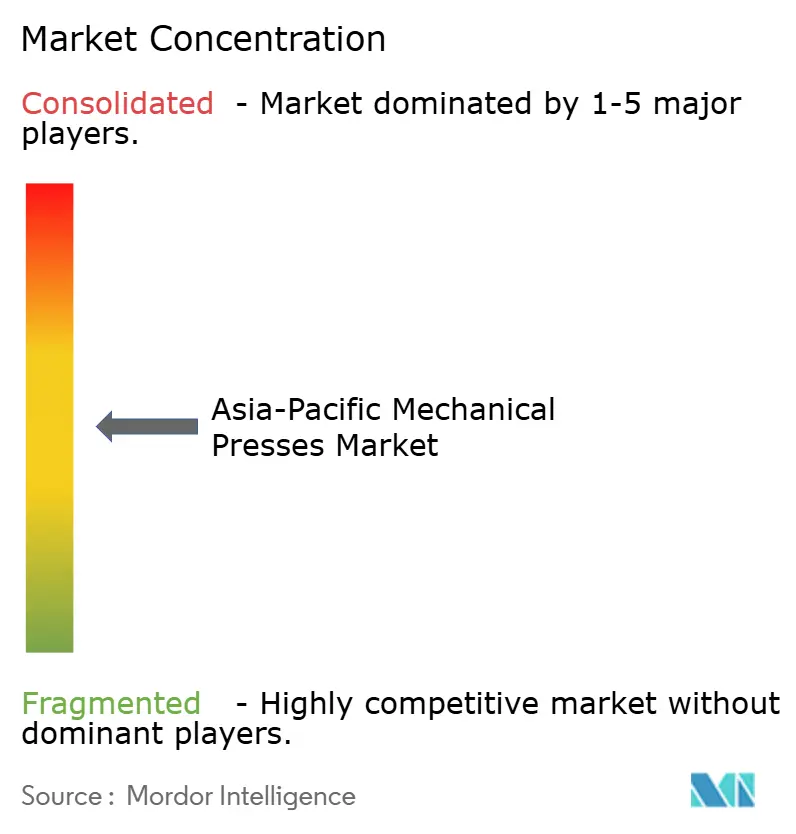
| Market Concentration | Medium |
Major Players *Disclaimer: Major Players sorted in no particular order Image © Mordor Intelligence. Reuse requires attribution under CC BY 4.0. | |
Asia-Pacific Mechanical Presses Market Analysis by Mordor Intelligence
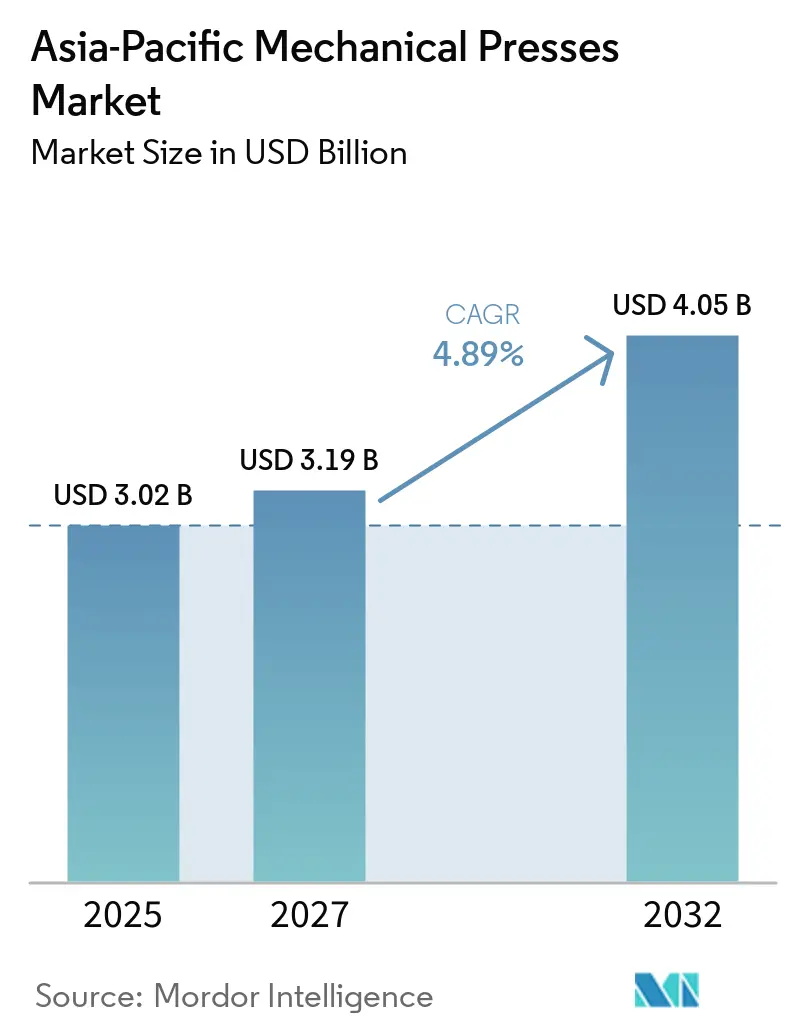
The Asia-Pacific Mechanical Presses Market size is projected to expand from USD 3.02 billion in 2026 and USD 3.19 billion in 2027 to USD 4.05 billion by 2032, registering a CAGR of 4.89% between 2027 and 2032.
The Asia-Pacific Mechanical Presses Market is supported by new EV and battery plants in China, India, and Southeast Asia, which require press lines for enclosures, motor housings, and underbody reinforcements. These investments add demand for formed parts alongside conventional body-panel production. Replacement and retrofit activity also supports the Asia-Pacific Mechanical Presses Market because many installed presses in China, Japan, and South Korea are aging. Manufacturers are responding through larger press lines, automation, local service capacity, and equipment designed for demanding applications. Giga casting reduces demand for selected large body structures, but it does not replace the need for motor-core, battery enclosure, connector, and busbar forming.
Key Report Takeaways
- By frame or structural configuration, straight-side/h-frame held 42.5% of the Asia-Pacific mechanical presses market share in 2026, while C-frame/gap-frame is forecast to grow at a 5.4% CAGR through 2032.
- By press force or capacity, the 101-500 ton range accounted for 37.8% of the Asia-Pacific mechanical presses market size in 2026, while the 501-1,000 ton range is projected to grow at a 6.2% CAGR through 2032.
- By application or process, blanking and punching held a 31.6% share in 2026, while high-speed and precision stamping is expected to expand at a 6.2% CAGR through 2032.
- By end-use industry, automotive and transportation accounted for a 35.9% share in 2026, while electrical and electronics is forecast to grow at a 6.4% CAGR through 2032.
- By geography, China held a 47.2% share in 2026, while India is projected to expand at a 6.7% CAGR through 2032.
Note: Market numbers in this report are based on Mordor Intelligence's proprietary estimation framework, which combines nine months of actuals with Q4 projections for base year 2026.
Asia-Pacific Mechanical Presses Market Trends and Insights
Drivers Impact Analysis*
| Driver | (~) % Impact on CAGR Forecast | Geographic Relevance | Impact Timeline |
|---|---|---|---|
| Automotive and Electric Vehicle Manufacturing Capacity Expansion | +1.2% | China, Indonesia, Thailand, and India | Short term (≤ 2 years) |
| Battery Enclosure, Motor-Core and Electrical Component Stamping | +1.0% | China, South Korea, Japan, India, and Thailand | Short term (≤ 2 years) |
| Manufacturing Regionalization Across India and Southeast Asia | +0.8% | India, Vietnam, Thailand, Indonesia, and Malaysia | Medium term (2-4 years) |
| Automation and Precision Requirements in High-Volume Forming | +0.7% | China, Japan, South Korea, and Taiwan | Medium term (2-4 years) |
| Retrofit Demand from Aging Mechanical Press Installations | +0.5% | China, Japan, and South Korea | Long term (≥ 4 years) |
| Localization of Press Manufacturing and Aftermarket Support | +0.3% | India, China, and Vietnam | Medium term (2-4 years) |
| Source: Mordor Intelligence | |||
Automotive and Electric Vehicle Manufacturing Capacity Expansion
New vehicle capacity is creating demand for press lines and related tooling across the Asia-Pacific mechanical presses market. Toyota, Honda, and Suzuki had committed more than USD 11 billion to expand automotive manufacturing in India by November 2025, and Toyota planned to increase its capacity to more than 1 million vehicles in the country. VinFast inaugurated its Subang, Indonesia, plant in December 2025 with a USD 1 billion commitment and initial annual capacity of 50,000 vehicles, scalable to 350,000 vehicles. Kia also established its future purpose-built vehicle production hub in Korea, including facilities planned for 100,000 and 150,000 annual units. These projects require body, structural, and chassis parts from press shops, which extends demand beyond final assembly plants. The Asia-Pacific mechanical presses market, therefore, benefits when OEM programs lead suppliers to add local stamping operations.
Battery Enclosure, Motor-Core, and Electrical Component Stamping
Battery cases, motor laminations, busbar terminals, and power-electronics housings broaden the range of stamped parts required for electric vehicles. AIDA introduced the DPH Former in 2025 for rectangular battery cases, showing that battery forming is becoming a dedicated equipment application. Motor-core production needs high-speed progressive presses and close stack control, which increases the value placed on precision, tooling stability, and monitoring. India had approved 82 applicants under the automobile and auto-component PLI scheme by November 2025, with a cumulative investment of INR 35,657 crore (USD 4.0 billion), through September 2025.[1] The program requires at least 50% domestic value addition for incentives, creating a reason to establish domestic component production. This pattern supports demand in the Asia-Pacific mechanical presses market because electrical and battery-related components need forming capacity close to vehicle and component plants.
Manufacturing Regionalization Across India and Southeast Asia
Manufacturing investment is shifting toward a wider group of Asian production locations, including India, Vietnam, Thailand, Malaysia, and Indonesia. Manufacturing investment supports new electronics, automotive, and energy-equipment supply chains across these locations. Honda plans to export Zero series electric vehicles from India to Japan and other Asian countries from 2027, which would link Indian component production to export supply chains. New plants need local fixtures, tools, and stamped parts, even when the original vehicle design comes from elsewhere. Local-content rules and domestic-value-addition requirements also reduce the case for importing stamped parts from an established production hub. The Asia-Pacific mechanical presses market gains from this change because presses are part of the factory investment needed to localize metal component production.
Automation and Precision Requirements in High-Volume Forming
Press lines are increasingly purchased as connected production systems that include feeders, transfer equipment, force monitoring, and maintenance tools. China’s 2025-2026 machinery work plan calls for digital transformation and intelligent upgrading across the sector, with machinery revenue targeted to exceed CNY 10 trillion (USD 1.42 trillion).[2] ANDRITZ Schuler reported that its Triton transfer presses for SUV structural components include Metris Smart Monitoring for die-level force, vibration, and temperature monitoring. High-speed stamping for motors and connectors requires steady process control because tooling can be costly and sensitive to process variation. Buyers also need equipment that can fit into automated material handling and factory data systems. This makes integrated technical support an important part of competition in the Asia-Pacific mechanical presses market.
Restraints Impact Analysis*
| Restraint | (~) % Impact on CAGR Forecast | Geographic Relevance | Impact Timeline |
|---|---|---|---|
| High Initial Investment and Long Payback Periods | -1.2% | Asia-Pacific, with higher relevance in India, Indonesia, and Vietnam | Medium term (2-4 years) |
| Skilled Tool-and-Die and Maintenance Labor Shortages | -0.8% | Asia-Pacific, with higher relevance in India, Indonesia, and Vietnam | Medium term (2-4 years) |
| Gigacasting and Alternative Forming Technologies Reducing Selected Stamping Demand | -0.6% | China, Japan, South Korea | Long term (≥ 4 years) |
| Limited Retrofit Standardization Across Legacy Presses | -0.4% | China, India, Japan, Taiwan | Medium term (2-4 years) |
| Source: Mordor Intelligence | |||
High Initial Investment and Long Payback Periods
Large mechanical press lines require spending on the machine, automation, tooling, installation, and commissioning. Payback periods can extend from 3 to 7 years under the utilization condition, which can constrain decisions by small and mid-sized suppliers. China’s machinery work plan identified insufficient domestic demand and irrational price competition as challenges facing equipment investment. India’s PLI Scheme for the Automobile and Auto Component Industry (PLI-Auto) was approved on September 23, 2021, with a budgetary outlay of INR 25,938 crore (USD 2,886.85 million) to strengthen domestic manufacturing capabilities for Advanced Automotive Technology (AAT) products. As of March 31, 2026, approved applicants had reported INR 44,326 crore (USD 4,933.4 million) in investment, exceeding the INR 42,500 crore (USD 4,730.17 billion) target investment set for March 31, 2027. While the scheme supports domestic capacity expansion, manufacturers may still face upfront cash-flow requirements because investments must be made before the associated incentives are realized. The Asia-Pacific mechanical presses industry also faces extended replacement cycles, as well-maintained presses can typically remain operational for 20–30 years, potentially limiting recurring replacement demand.
Skilled Tool-and-Die and Maintenance Labor Shortages
Press production depends on die designers, toolmakers, maintenance technicians, and specialists in clutch and brake systems. The International Labour Organization projected employment growth of 1.7% in Asia and the Pacific in 2025. It noted that manufacturing accounts for nearly half of the 55 million regional jobs linked to the United States trade and supply chains.[3] Indonesia reported more than 42,000 workers across its mold-and-dies base, alongside an Indonesia-Japan training initiative in 2025. The ILO also identified the need for employer-linked occupational mapping as Thailand’s automotive workforce adapts to electric vehicle production. Automation can reduce some labor needs, but it does not remove the need for people who can set up, maintain, and improve the equipment. These shortages can limit the productivity benefit from retrofits and automated press systems.
*Our forecasts treat driver/restraint impacts as directional, not additive. The impact forecasts reflect baseline growth, mix effects, and variable interactions.
Segment Analysis
By Frame / Structural Configuration: Straight-Side Presses Lead Automotive Forming and C-Frame Equipment Expands in Flexible Lines
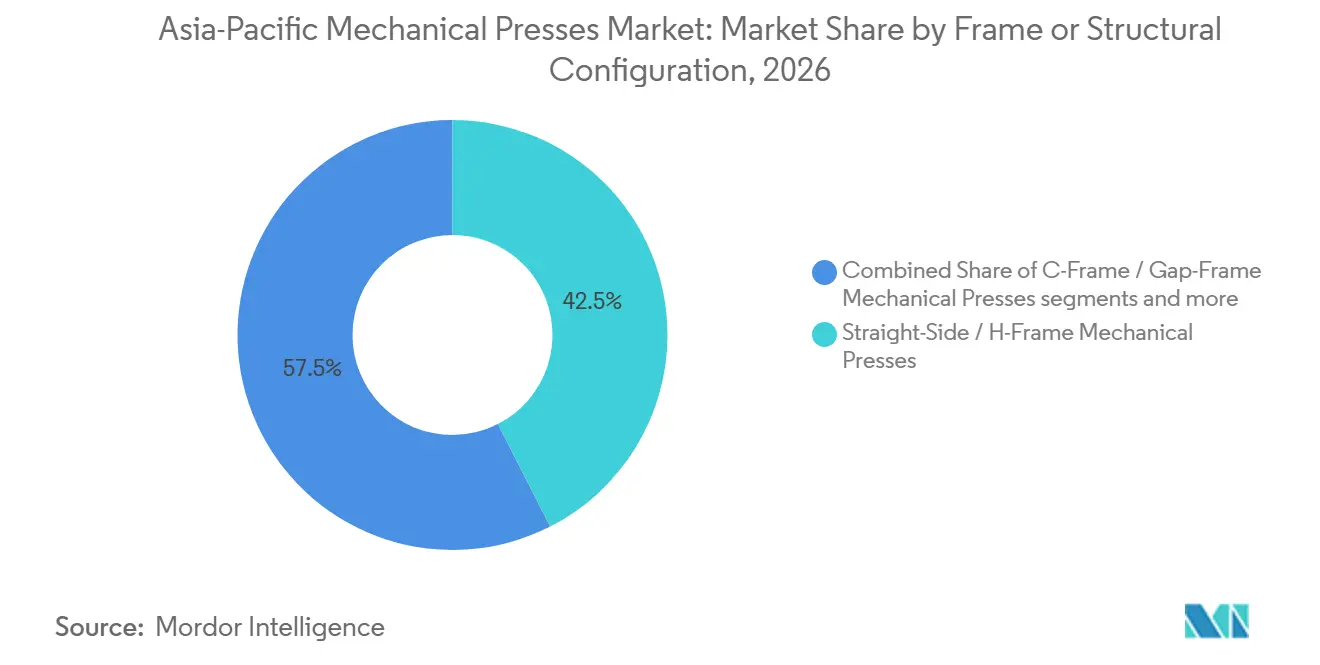
Straight-Side/H-Frame presses held 42.5% share in 2026, supported by their use in automotive body panels and structural components. Their rigid frame and consistent slide movement suit tandem and transfer systems that produce doors, hoods, and body sides. This installed base is strongest in China, Japan, and South Korea, where large body shops need repeatable output at scale. The Asia-Pacific mechanical presses market continues to rely on this frame type for applications that need strength, controlled alignment, and high output. Safety expectations also affect configuration decisions because guarding, enclosures, and control interfaces vary by machine design. Procurement teams, therefore, assess both production needs and safety requirements before choosing a frame.
C-Frame/Gap-Frame presses are projected to grow at a 5.4% CAGR through 2032. These machines offer easier access and lower cost for blanking, punching, and shallow-forming work. They fit the needs of smaller lines that are growing in India and Southeast Asia’s Tier-2 stamping clusters. Solid or monoblock presses serve more specialized precision uses in Taiwan, Japan, and South Korea, including connectors and electronics parts. Link-motion designs also draw interest where producers need less tool impact while forming high-strength steel or aluminum. The Asia-Pacific mechanical presses industry, therefore, includes both large body-shop equipment and smaller machines that support flexible production.

By Press Force / Capacity: Mid-Range Equipment Anchors Demand While Higher Capacity Builds
The 101-500 ton category captured 37.8% of 2026 demand, making it the largest press-force range in the Asia-Pacific mechanical presses market. It covers much of the region’s automotive body-component work, appliance panels, electrical enclosures, and general sheet-metal forming. This category also suits automated configurations, which help suppliers scale output while controlling material handling. Chinese manufacturers such as Jiangsu Yangli, JIER, and Yadon compete strongly in this range through lower prices and shorter delivery times. The segment is important because it serves broad production needs rather than a single narrow application. It also provides an entry point for manufacturers adding their first automated press line.
The 501-1,000 ton category is forecast to grow at a 6.2% CAGR through 2032 as battery housings and hot-stamped steel parts require greater press force. Higher-capacity requirements are linked to battery enclosures and structural parts, which need controlled forming and stronger frames. The 1,001-2,000 ton and above 2,000 ton ranges remain tied to large automotive body lines and are supplied by a narrower set of manufacturers. Toyota’s planned expansion in Maharashtra illustrates the kind of vehicle program that can require larger transfer press infrastructure. The up-to-100 ton range remains relevant for connectors, small hardware, and appliance components, where high-speed machines are replacing older flywheel presses.
By Application / Process: Blanking Leads Current Use While High-Speed Stamping Gains Importance
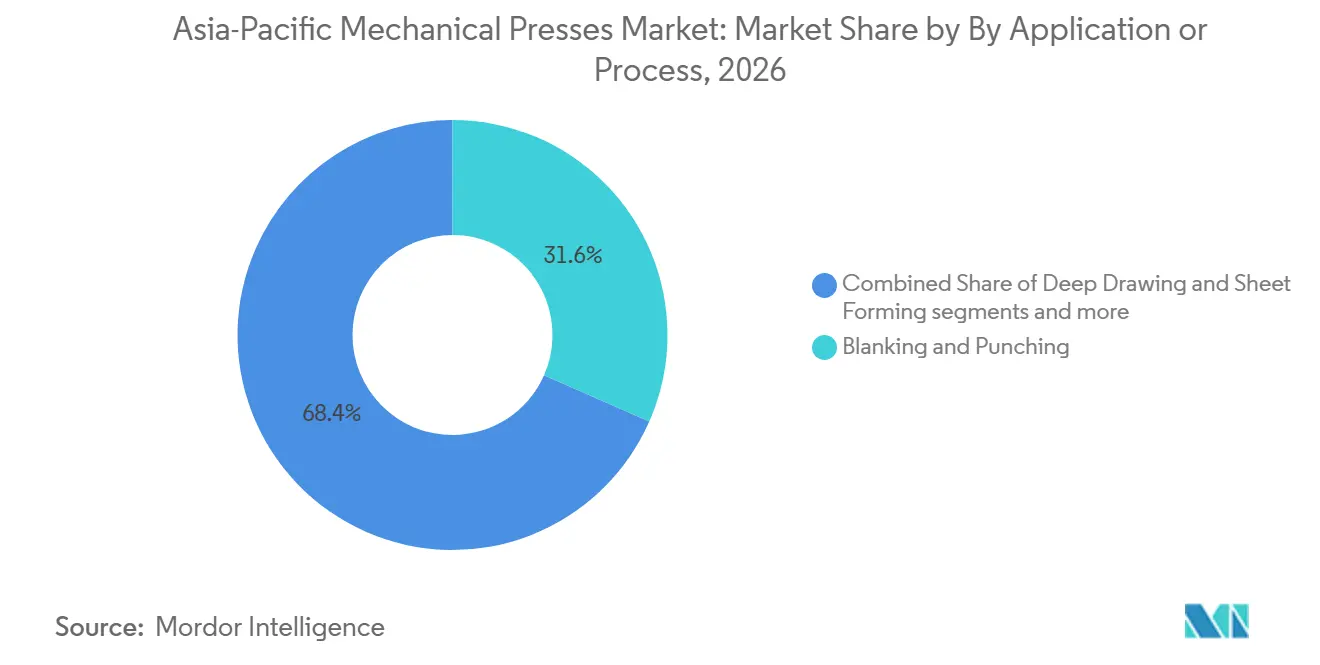
Blanking and Punching held a 31.6% share in 2026, making it the largest application process in the Asia-Pacific mechanical presses market. The process is used for automotive blanks, perforated metal products, and appliance panels. It remains widely used because high-volume flat-blank separation is a central task in metal component manufacturing. Deep drawing and sheet forming provide a second major use base for quarter panels, appliance shells, and battery enclosures. Fine blanking remains a smaller but growing use area for precision gears and valve discs. Coining and embossing continue to support decorative hardware and precision fasteners in China, Taiwan, and South Korea.
High-Speed and Precision Stamping is forecast to grow at a 6.2% CAGR through 2032. Motor laminations, connectors, and bipolar plates are driving demand for repeatable, tight-tolerance forming at higher stroke rates. SEYI demonstrated a high-rigidity 160-ton servo press for metallic bipolar plate flow-channel forming at MF-TOKYO 2025. The equipment was designed for thin plates where high structural stiffness and close dimensional control are needed. Other applications include emerging processes for composite and bi-material assemblies, though these remain pre-commercial at scale. The Asia-Pacific mechanical presses market is therefore moving toward a broader mix of high-volume and precision forming applications.
By End-Use Industry: Automotive Remains the Largest Customer While Electronics Grows Faster
Automotive and Transportation accounted for a 35.9% share in 2026. Body, structural, chassis, and powertrain parts create the largest sustained use of mechanical presses across the region. Automotive production is also connected to a wide network of Tier-1 and Tier-2 suppliers that operate their own press lines. New vehicle facilities in India, Indonesia, Thailand, and South Korea can therefore create demand beyond the main assembly plant. The Asia-Pacific mechanical presses market remains closely tied to investment cycles in vehicle manufacturing and supplier localization. Battery cases and electric vehicle structural parts add further work to existing automotive stamping programs.
Electrical and Electronics are forecast to grow at a 6.4% CAGR through 2032. EV motor laminations, power semiconductor lead frames, and grid equipment components support this growth. Appliance and consumer durable production also sustains press use in China, South Korea, and Thailand, especially for tight-tolerance exterior panels. Industrial machinery creates an internal demand loop because new factories need equipment that uses stamped housing, frames, and covers. Aerospace and defense applications are concentrated in Japan, South Korea, and India, and often involve specialized aluminum and titanium forming. Energy and power demand are gaining relevance through transformer laminations and wind-turbine components.
Geography Analysis
China’s 47.2% share in 2026 made it the largest national contributor to regional demand. The scale comes from vehicle production, electrical equipment, appliances, and precision industrial parts, all of which use stamped components. Electric vehicle investment adds battery housings, motor laminations, and power electronics, catering to existing automotive demand. China’s 2025-2026 machinery plan places digital transformation, intelligent upgrading, and equipment renewal among sector priorities. This policy direction favors equipment that can deliver connected monitoring and modern controls. Taiwan adds a specialized base for connector, lead-frame, and semiconductor-packaging stamping. South Korea supports high-value demand through Hyundai and Kia vehicle programs and a wider battery supply chain.
India is the fastest-growing country at a 6.7% CAGR through 2032. Toyota, Honda, and Suzuki had committed more than USD 11 billion to Indian manufacturing expansion by November 2025. This spending supports local body, structural, and component suppliers that need press capacity. Japan continues to support a technically advanced installed base through precision lamination and connector stamping. Japanese press manufacturers and distributors also use the country as an important regional service base.
Indonesia, Thailand, and Vietnam are building production capabilities beyond basic assembly. VinFast’s December 2025 Subang plant includes integrated body welding and pressing, which can support local stamping and tooling requirements. Chang’an began production at its Rayong facility in Thailand in May 2025, adding a new electric-vehicle manufacturing base in Southeast Asia. Malaysia contributes through electronics manufacturing and new electric-vehicle assembly activity. The Philippines, Bangladesh, and Australia represent a dispersed set of additional equipment opportunities. These markets are smaller than China or India, but together they broaden the regional base for the Asia-Pacific mechanical presses market.
Competitive Landscape
The Asia-Pacific mechanical presses market exhibits a medium level of market concentration. ANDRITZ Schuler, AIDA Engineering, BRUDERER, and Komatsu are positioned strongly in high-tonnage and precision applications. Jiangsu Yangli, JIER, Hefei Metalforming, Yadon Machinery, and Nantong Guosheng compete in China through price, delivery speed, and domestic support. The largest global suppliers have an advantage where customers need large transfer lines, high-precision equipment, and certified safety controls. Chinese suppliers are more competitive in the 100-800-ton range, where local service and price are important. This structure gives buyers a choice between application depth and a locally supported cost position.
ANDRITZ renamed Schuler Group companies as ANDRITZ Schuler in March 2025. The move presented the business as an integrated provider of forming and handling technology rather than a stand-alone press supplier. ANDRITZ Schuler also secured a fourth 1,600-ton mechanical transfer press order from Metalúrgica Nakayone for SUV structural parts, with its Metris Smart Monitoring system included in the solution. AIDA’s DPH Former for rectangular battery cases shows a different strategy that focuses on dedicated equipment for battery applications. These actions show that leading companies are seeking to compete through line integration, monitoring, and application-specific equipment.
Local after-sales support has become an important competitive factor in the Asia-Pacific mechanical presses market. Buyers with older equipment need spare parts, retrofit support, and technical help without long delivery delays. Affordable servo-mechanical retrofit packages are a contested area because customers want connectivity and energy monitoring without replacing an entire press line. JIER completed factory acceptance of a 1,600-ton transfer press for a Turkish automotive Tier-1 supplier in 2025, while Yangli demonstrated an automotive body-panel transfer line for an OEM customer. Standards for electrical safety, hydraulic safety, and press protection create an additional barrier for suppliers that lack proven safety-control platforms. Competition is therefore based on machine capability, service reach, process knowledge, and the ability to meet local compliance needs.
Asia-Pacific Mechanical Presses Industry Leaders
-
AIDA ENGINEERING, LTD.
-
Komatsu Ltd.
-
Jiangsu Yangli Group Co., Ltd.
-
JIER Machine-Tool Group Co., Ltd.
-
AMADA CO., LTD.
- *Disclaimer: Major Players sorted in no particular order
Recent Industry Developments
- July 2025: ANDRITZ Schuler delivers 6,500-ton forging press to Maxiforja with Kinetic Energy Recovering System. The GLK 6500 forging press, which reduces power demand by up to 40% versus conventional presses of equivalent size through KERS technology, entered operation at Maxiforja’s facility.
- June 2025: AIDA Engineering launches DPH Former for rectangular battery cases. AIDA unveiled its DPH-80-30 dedicated former for rectangular storage battery cases, designed for EV and stationary energy-storage applications. The product subsequently received the 68th Annual Ten Greatest New Products Award from Japan’s Nikkan Kogyo Shimbun, validating the technology’s commercial significance for the battery-forming segment.
- May 2025: Chang’an Automobile launches Rayong, Thailand factory. Chang’an’s first international NEV manufacturing base in Rayong began production in May 2025, commissioning new press and body-shop infrastructure and positioning Thailand as a Southeast Asian EV export hub. The investment directly expands mechanical press utilization in a market that previously had limited NEV-dedicated stamping capacity.
- May 2025: ANDRITZ renames Schuler Group to ANDRITZ Schuler. More than a decade after acquiring Schuler, ANDRITZ formalized the integration by renaming all Schuler Group companies with the ANDRITZ prefix, positioning the combined entity as an integrated forming and handling technology provider. The rebranding reflects strategic intent to cross-sell forming lines, automation systems, and battery-manufacturing equipment as bundled solutions.
Asia-Pacific Mechanical Presses Market Report Scope
The Asia-Pacific Mechanical Presses Market is Segmented by Frame Configuration (C-Frame Mechanical Presses, Straight-Side Mechanical Presses, and More), by Press Force (101–500 Tons, and More), by Application (Blanking and Punching, Fine Blanking, and More), by End-Use Industry (Electrical and Electronics, Energy and Power, and More), by Geography (China, Japan, and More). The Market Forecasts are Provided in Terms of Value (USD).
| C-Frame / Gap-Frame Mechanical Presses |
| Straight-Side / H-Frame Mechanical Presses |
| Solid / Monoblock Frame Mechanical Presses |
| Other Mechanical Press Configurations |
| Up to 100 Tons |
| 101–500 Tons |
| 501–1,000 Tons |
| 1,001–2,000 Tons |
| Above 2,000 Tons |
| Blanking and Punching |
| Deep Drawing and Sheet Forming |
| Coining and Embossing |
| Fine Blanking |
| High-Speed and Precision Stamping |
| Other Mechanical Press Applications |
| Automotive and Transportation |
| Electrical and Electronics |
| Appliances and Consumer Durables |
| Industrial Machinery and Equipment |
| Metal Products and General Manufacturing |
| Aerospace and Defense |
| Construction and Heavy Equipment |
| Energy and Power |
| Other End-Use Industries |
| China |
| Japan |
| India |
| South Korea |
| Taiwan |
| Indonesia |
| Thailand |
| Vietnam |
| Rest of Asia-Pacific |
| By Frame / Structural Configuration | C-Frame / Gap-Frame Mechanical Presses |
| Straight-Side / H-Frame Mechanical Presses | |
| Solid / Monoblock Frame Mechanical Presses | |
| Other Mechanical Press Configurations | |
| By Press Force / Capacity | Up to 100 Tons |
| 101–500 Tons | |
| 501–1,000 Tons | |
| 1,001–2,000 Tons | |
| Above 2,000 Tons | |
| By Application / Process | Blanking and Punching |
| Deep Drawing and Sheet Forming | |
| Coining and Embossing | |
| Fine Blanking | |
| High-Speed and Precision Stamping | |
| Other Mechanical Press Applications | |
| By End-Use Industry | Automotive and Transportation |
| Electrical and Electronics | |
| Appliances and Consumer Durables | |
| Industrial Machinery and Equipment | |
| Metal Products and General Manufacturing | |
| Aerospace and Defense | |
| Construction and Heavy Equipment | |
| Energy and Power | |
| Other End-Use Industries | |
| By Geography | China |
| Japan | |
| India | |
| South Korea | |
| Taiwan | |
| Indonesia | |
| Thailand | |
| Vietnam | |
| Rest of Asia-Pacific |
Key Questions Answered in the Report
What is the forecast growth rate for mechanical presses in the Asia-Pacific?
The sector is projected to grow at a 4.89% CAGR from 2027 to 2032, reaching USD 4.05 billion by 2032. New vehicle plants, electrical equipment production, local supplier investment, and greater use of connected press lines support this outlook.
Which country has the greatest regional demand for mechanical presses?
China leads with 47.2% share in 2026, supported by vehicle, appliance, electrical equipment, and industrial component production. Battery enclosures, motor laminations, and power-electronics components add newer sources of demand to its existing automotive stamping base.
Which country is expected to grow fastest through 2032?
India is forecast to expand at a 6.7% CAGR through 2032 as vehicle and component manufacturing capacity increases. The PLI program, automotive investment, and a growing local supplier network support demand for body, chassis, battery, and electrical component forming.
Which press capacity range has the largest share?
The 101–500-ton range accounts for 37.8% share in 2026 because it serves automotive, appliance, electrical, and general sheet-metal applications. It is also a common starting point for automated press configurations and a major area of competition for Chinese equipment suppliers.
Which end-use sector uses the most mechanical presses?
Automotive and transportation lead with 35.9% share in 2026, driven by body, structural, chassis, and powertrain component forming. New EV models also require battery cases and related structural parts, expanding the range of stamped components used by vehicle supply chains.
Why are battery and electronics applications important for press suppliers?
Battery cases, motor laminations, power-electronics housings, and connectors require specialized forming, high speed, and close process control. These requirements favor equipment with monitoring, tooling stability, accurate material handling, and service support for precision operations.