
Asia-Pacific Magnetic Drive Pumps Market Size and Share
Market Overview
| Study Period | 2022 - 2032 |
|---|---|
| Forecast Data Period | 2027 - 2032 |
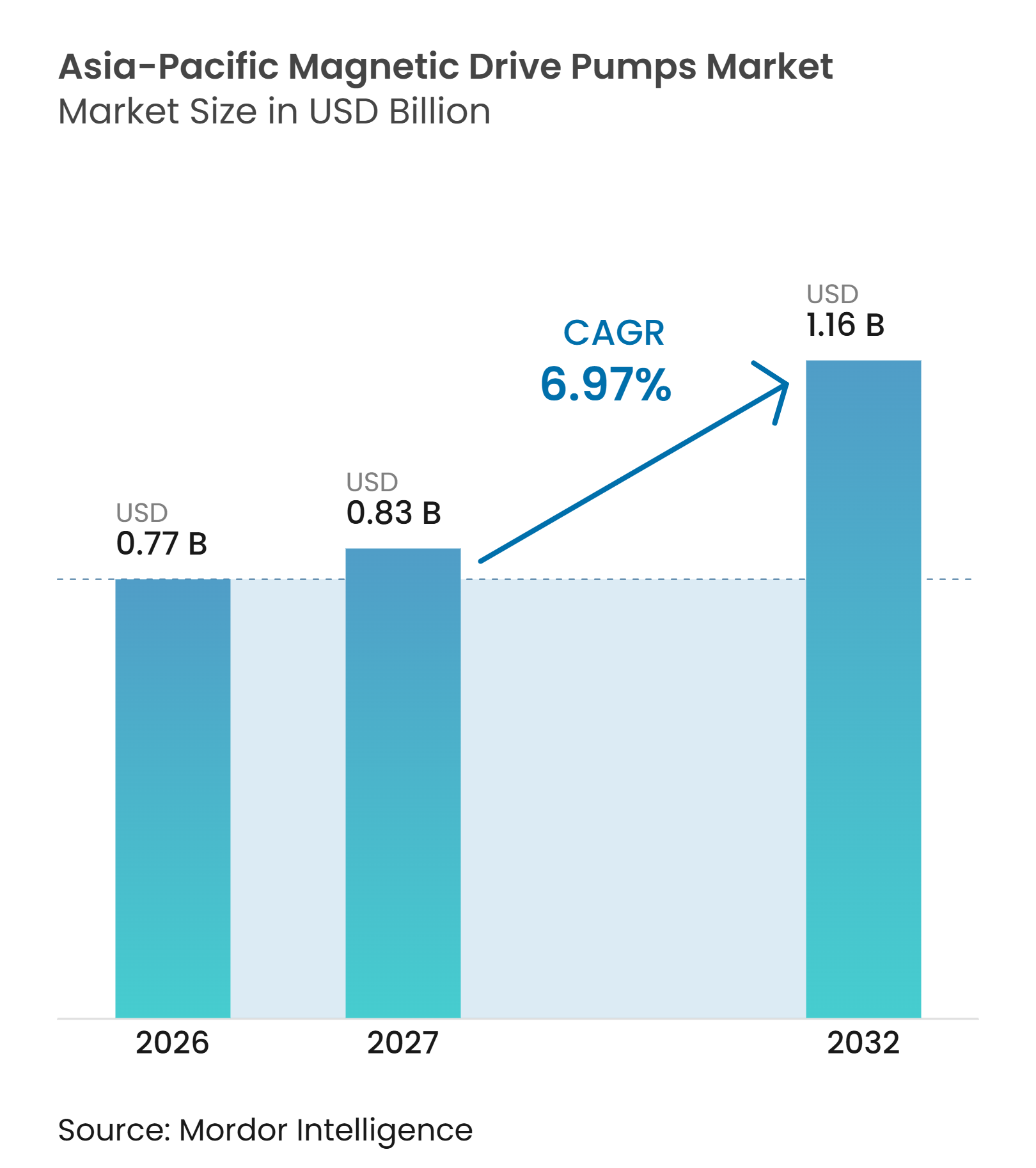
| Base Year Market Size (2026) | USD 0.77 Billion |
| Market Size (2027) | USD 0.83 Billion |
| Market Size (2032) | USD 1.16 Billion |
| Growth Rate (2027 - 2032) | 6.97 % |
| Market Concentration | Medium |
Major Players *Disclaimer: Major Players sorted in no particular order Image © Mordor Intelligence. Reuse requires attribution under CC BY 4.0. | |
Asia-Pacific Magnetic Drive Pumps Market Analysis by Mordor Intelligence
The Asia-Pacific Magnetic Drive Pumps Market size is expected to grow from USD 0.77 billion in 2026 to USD 0.83 billion in 2027 and is forecast to reach USD 1.16 billion by 2032 at 6.97% CAGR over 2027-2032. Demand is rising as chemical, semiconductor, pharmaceutical, and clean-energy facilities prioritize leak-free handling for corrosive, toxic, and flammable fluids. Tighter emissions controls in China are shifting purchases from routine seal replacement toward sealless pump retrofits, which can remove a recurring compliance point at the plant level. Semiconductor investment and pharmaceutical localization are widening demand for high-purity fluid systems in China and India, while battery and hydrogen projects create newer chemical-handling duties. Suppliers are responding through secondary containment, larger-flow models, localized production, and monitoring features that support plant documentation. The Asia-Pacific Magnetic Drive Pumps Market therefore combines compliance-led replacement demand with capacity-led equipment demand, although price premiums, material availability, and lengthy qualification processes continue to limit adoption in selected sectors.
Key Report Takeaways
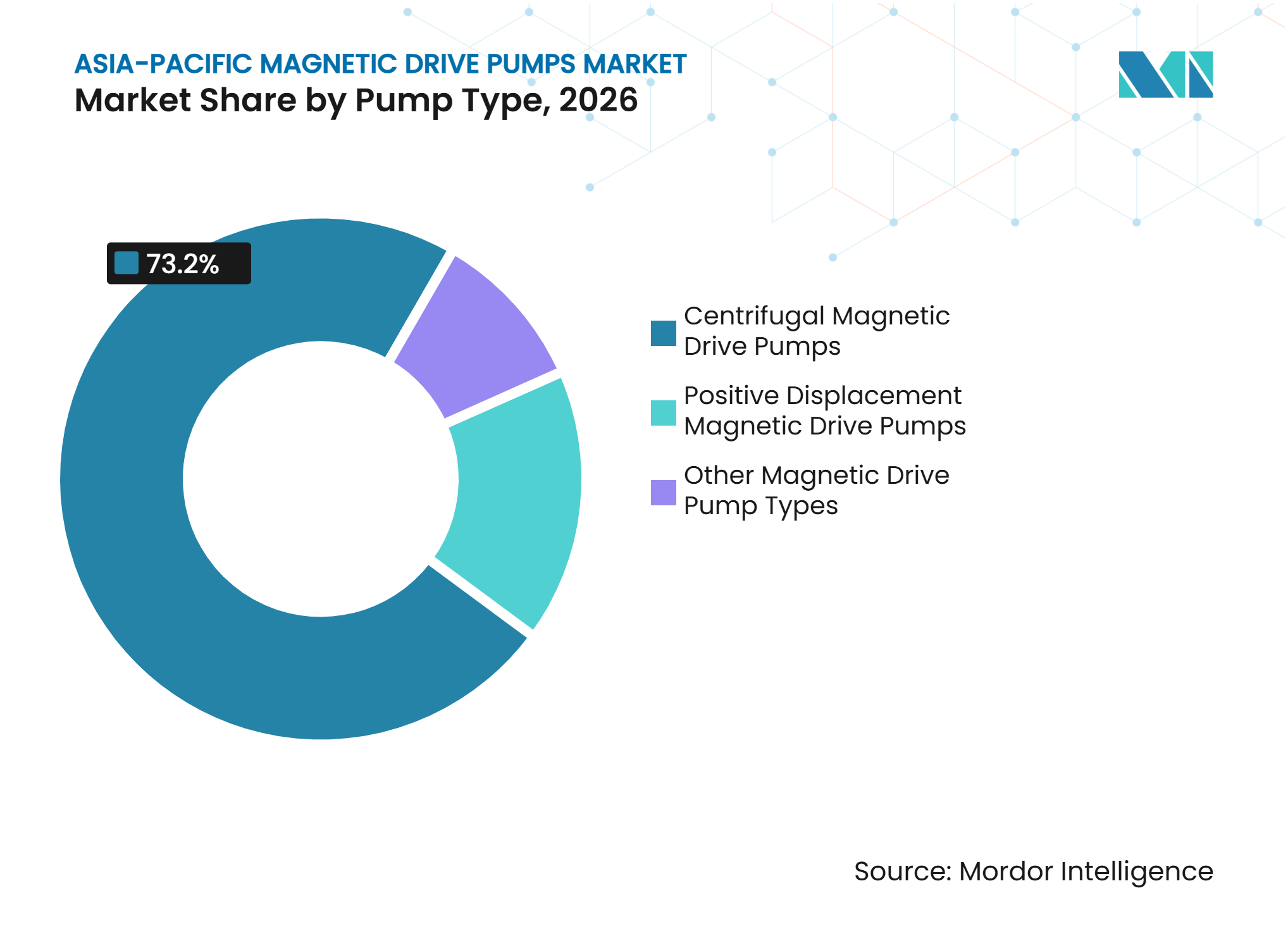
- By pump type, centrifugal magnetic drive pumps held 73.2% of the Asia-Pacific Magnetic Drive Pumps Market share in 2026, while positive displacement magnetic drive pumps are projected to grow at a 7.6% CAGR through 2032.
- By flow rate, the up to 80 m³/hr segment accounted for 38.7% of regional revenue in 2026, while the 201-500 m³/hr segment is forecast to expand at a 7.9% CAGR through 2032.
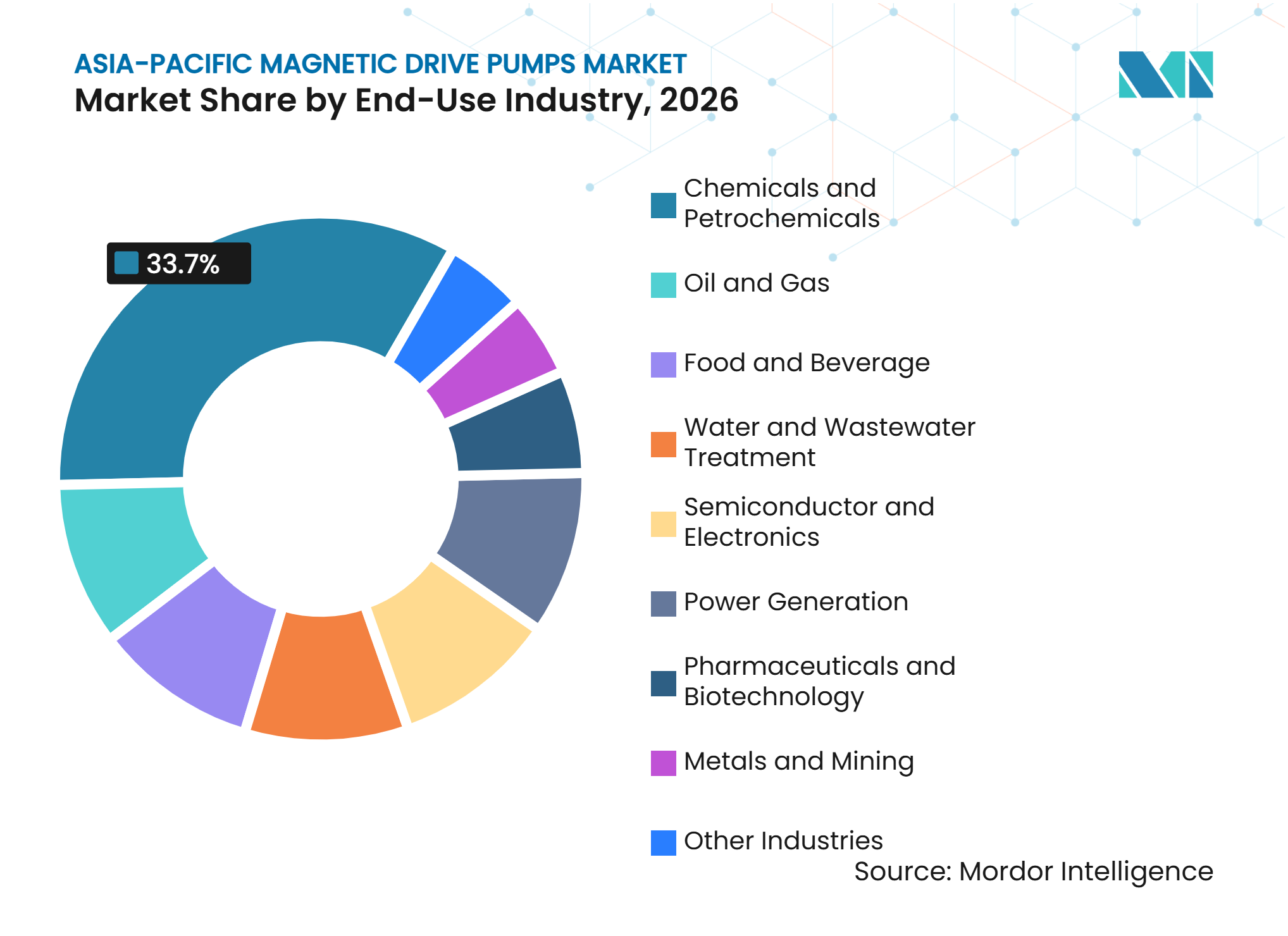
- By end-use industry, chemicals and petrochemicals captured 33.7% of the Asia-Pacific Magnetic Drive Pumps Market size in 2026, while semiconductors and electronics are expected to advance at a 9.2% CAGR through 2032.
- By geography, China held 37.5% of the Asia-Pacific Magnetic Drive Pumps Market share in 2026, while India is forecast to grow at a 7.5% CAGR through 2032.
Note: Market numbers in this report are based on Mordor Intelligence's proprietary estimation framework, which combines nine months of actuals with Q4 projections for base year 2026.
Market Trends and Insights
Drivers Impact Analysis of Asia-Pacific Magnetic Drive Pumps Market*
| Driver | (~) % Impact on CAGR Forecast | Geographic Relevance | Impact Timeline |
|---|---|---|---|
| Leak-Free Handling for Hazardous Fluids | +1.8% | Global, with Asia-Pacific focus in China, India, South Korea, and Japan | Long term (≥ 4 years) |
| Manufacturing Capacity Expansion | +1.5% | China, India, South Korea, Vietnam, and Indonesia | Medium term (2-4 years) |
| Stricter Emissions and Safety Requirements | +1.2% | China, India, and South Korea | Medium term (2-4 years) |
| Battery, Hydrogen, and Advanced-Materials Growth | +0.8% | China, South Korea, Japan, Australia, and Vietnam | Long term (≥ 4 years) |
| Smart Monitoring and Predictive Maintenance | +0.5% | Core Asia-Pacific markets and Southeast Asia | Medium term (2-4 years) |
| Localized Replacement for High-Purity Duties | +0.4% | Japan, South Korea, Australia, and India | Short term (≤ 2 years) |
| Source: Mordor Intelligence | |||
Leak-Free Design as a Process-Safety Non-Negotiable
The Asia-Pacific Magnetic Drive Pumps Market benefits from the growing need to contain hazardous process fluids without mechanical seals. Shanghai’s DB31/1640-2025 standard became effective in March 2026 and established volatile organic compounds (VOC) leakage detection and repair requirements for refining, petrochemical, and synthetic-resin facilities. The standard includes a leakage threshold of 200 µmol/mol for pumps, compressors, and valves, increasing attention to individual equipment points.[1] Ningbo’s leak detection and repair (LDAR) guidance also placed chemical facilities under quarterly inspection requirements from February 2025.[2] These requirements make a sealless upgrade a capital decision that can reduce repeated seal-related documentation and maintenance exposure. Flowserve introduced the INNOMAG TB-MAG Dual Drive in March 2025 with secondary hermetic containment, showing that suppliers are targeting services where a primary containment failure could become a reportable event.[3]
Semiconductor and Pharmaceutical Capacity Adding a Structurally New Demand Layer
The Asia-Pacific Magnetic Drive Pumps Market is gaining a broader base in semiconductor and pharmaceutical production. SEMI expected global fab equipment investment to reach USD 110 billion in 2025, with China, Japan, South Korea, and Southeast Asia contributing to investment activity.[4] These facilities require high-purity pumps for etchants, cleaning acids, solvents, and other wet-process chemicals. India had approved 10 semiconductor manufacturing and packaging projects with USD 2 million (INR 1.60 lakh crore) in investment by August 2025. The country’s Production Linked Incentive (PLI) program had also generated USD 275.5 million (INR 26,123 crore) in domestic Active Pharmaceutical Ingredient (API) and drug-intermediate sales by September 2025. As specialty chemical suppliers build local capability for fabs, their equipment needs extend the Asia-Pacific Magnetic Drive Pumps Market beyond basic chemical-process use.
Stricter Fugitive-Emission Rules Driving Qualification-Based Replacement
The Asia-Pacific Magnetic Drive Pumps Market is also shaped by purchasing criteria that now place greater weight on documented emissions performance. China’s Ministry of Industry and Information Technology included equipment that reduces pollutant leakage in its 2025 recommendations for major environmental protection technology equipment. This creates an advantage for suppliers that can substantiate sealless designs and quality systems during project qualification. Compliance specifications passed through Engineering, Procurement, and Construction (EPC) contracts can reduce the scope for lower-cost substitution once a certified design is selected. Smart monitoring and predictive-maintenance functions reinforce this direction because they can support equipment records and planned maintenance. Localized replacement demand is most evident in mature high-purity and high-temperature applications, where the installed base already has defined operating requirements. The Asia-Pacific Magnetic Drive Pumps Market consequently depends not only on new projects but also on qualification-based replacement decisions in existing plants.
Battery, Hydrogen, and Advanced-Materials Manufacturing Opening New Pump Duty Classes
The Asia-Pacific Magnetic Drive Pumps Market is entering applications associated with hydrogen, battery materials, and advanced manufacturing. The International Energy Agency reported in 2025 that China accounted for most global electrolyzer projects reaching final investment decision. Alkaline and Proton Exchange Membrane (PEM) electrolyzers need corrosion-resistant equipment for electrolyte circulation, deionized water, and chemical dosing. APEC identified China, Japan, Australia, and South Korea among the active locations for green-hydrogen roadmaps and projects. Battery plants create a related requirement for controlled handling of electrolytes and additives. Sundyne’s May 2025 ANSIMAG KF438F launch named battery manufacturing among its intended applications, indicating product development for these duties. The longer operating life of hydrogen and battery assets supports continued demand once early equipment specifications are established.
Restraints Impact Analysis of Asia-Pacific Magnetic Drive Pumps Market*
| Restraint | (~) % Impact on CAGR Forecast | Geographic Relevance | Impact Timeline |
|---|---|---|---|
| High Initial Cost Versus Sealed Pumps | -0.8% | Vietnam, Thailand, Indonesia, and India’s cost-sensitive segments | Medium term (2-4 years) |
| Limited Flow and Pressure Envelope | -0.4% | Global, with emphasis on large oil and gas and power-generation services | Long term (≥ 4 years) |
| Rare-Earth Magnet Price and Supply Volatility | -0.5% | Global, with exposure in Japan, South Korea, and India | Medium term (2-4 years) |
| Long Qualification Cycles for Critical Service | -0.3% | India, Southeast Asia, and Australia | Medium term (2-4 years) |
| Source: Mordor Intelligence | |||
High Capital Outlay Relative to Sealed Alternatives
Magnetic drive units typically cost 1.5 to 2.5 times more than comparable mechanically sealed centrifugal pumps. This difference remains material for smaller chemical producers in Vietnam, Thailand, and Indonesia, where purchase decisions often prioritize initial price. Mechanical-seal replacement can appear acceptable where labor and energy costs do not materially change lifecycle economics. Adoption becomes more compelling when regulations require tighter containment or when a process handles fluids such as fuming nitric acid or cyanide-based electroplating solutions. Service coverage and spare-parts logistics outside major industrial centers can add to the buyer’s total cost. Rare-earth magnet price volatility further affects the cost and availability of coupling-magnet components. Long qualification cycles can delay revenue realization by 2 to 4 years in pharmaceutical, chemical, and nuclear services across the Asia-Pacific Magnetic Drive Pumps Market, particularly where users require extensive site and material validation.
Operational Boundaries in High-Flow and High-Pressure Services
The containment shell in magnetic drive equipment faces eddy-current heating and mechanical-load constraints in demanding services. These constraints limit operating windows at high pressure, high temperature, and high solids concentration. Many applications above 40 bar or above 500 m³/hr continue to favor canned motor pumps or mechanically sealed API 610 equipment. This narrows the addressable base in large oil and gas and power-generation applications. Suppliers have developed API 685-compliant designs, but their use does not remove the limits in every extreme duty. Carbon-fiber-reinforced containment shells can reduce eddy-current losses and gradually extend the performance range. The Asia-Pacific Magnetic Drive Pumps Market therefore remains strongest in duties with moderate pressure and flow requirements, even as material improvements broaden selected applications.
*Our forecasts treat driver/restraint impacts as directional, not additive. The impact forecasts reflect baseline growth, mix effects, and variable interactions.
Asia-Pacific Magnetic Drive Pumps Market Segment Analysis
By Pump Type:
Centrifugal Dominance Offset by High-Precision Positive Displacement GrowthCentrifugal magnetic drive pumps held 73.2% of regional revenue in 2026. Their scale reflects broad use in chemical transfer, semiconductor wet-bench recirculation, and water-treatment duties. They fit the moderate-pressure and medium-flow requirements common in chemical and pharmaceutical plants. Compatibility with established piping dimensions can also simplify replacement projects. ITT’s Goulds portfolio addresses process-pump configurations relevant to these operating conditions. Iwaki’s MDW-F process pump can deliver up to 5,000 L/min and 98 m of head, demonstrating the expansion of centrifugal magnetic drive designs into larger industrial duties. This established installed base gives centrifugal designs an advantage in the Asia-Pacific Magnetic Drive Pumps Market where users need familiar operating characteristics and retrofit flexibility.
Positive displacement magnetic drive pumps are forecast to expand at a 7.6% CAGR through 2032. Their value lies in dosing and metering applications where accuracy is more important than large volumetric capacity. Gear and lobe designs are increasingly relevant to battery electrolyte filling, hydrogen additives, and high-potency pharmaceutical Active Pharmaceutical Ingredient (API) transfer. The premium is easier to justify where controlled flow and leak-free operation are essential to the process. Iwaki introduced its GM-09 magnetic gear pump in 2025 for low-flow, pulse-free chemical injection. Other magnetic drive configurations include vortex and regenerative turbine designs used in specialized thermal circulation. Yuanxin’s range covers high and low temperatures for semiconductor precision-temperature applications. These specialized products remain smaller in volume but serve applications where conventional centrifugal equipment is less suited in the Asia-Pacific Magnetic Drive Pumps Market.



By Flow Rate:
Small-Bore Installed Base and Growing Large-Project DemandThe up to 80 m³/hr range accounted for 38.7% of the Asia-Pacific Magnetic Drive Pumps Market size in 2026. General chemical plants, pharmaceutical production, and water-treatment dosing create a large installed base of distributed process points. These applications often use multiple lower-capacity pumps rather than a single large transfer unit. The category is highly competitive because both international specialists and domestic producers can address standard chemical duties. Semiconductor wet benches and pharmaceutical batching also favor smaller bore sizes. This installed base provides replacement demand even when new industrial construction slows. Suppliers that combine competitive pricing with timely after-sales support are well placed in this portion of the Asia-Pacific Magnetic Drive Pumps Market.
The 201-500 m³/hr range is forecast to grow at a 7.9% CAGR through 2032. New chemical complexes in Shandong, Zhejiang, and Jiangsu support demand for higher-capacity circulation and transfer units. Petrochemical projects in India also contribute to larger-flow requirements. Fluoropolymer-lined and stainless-steel centrifugal designs are moving into some mid-scale duties that previously used sealed pumps. The 81-200 m³/hr band serves bulk chemical transfer, cooling-water circulation, and larger food-grade processing lines. The above 500 m³/hr range remains the smallest and faces direct competition from canned motor designs. Nikkiso’s canned motor pump range reaches 1,000 m³/hr and operates from -130°C to +450°C, illustrating the competing option in demanding large-bore services. Compliance documentation therefore becomes more important for the Asia-Pacific Magnetic Drive Pumps Market as flow requirements rise and project risk increases.
By End-Use Industry:
Chemicals Remain the Base While Semiconductor Demand AcceleratesChemicals and petrochemicals accounted for 33.7% of regional revenue in 2026. The sector reflects an established base across China, India, South Korea, and Vietnam. Current demand is increasingly tied to specification upgrades rather than only to the number of new units. Quarterly Leak Detection and Repair (LDAR) expectations in Ningbo make pump-level containment and inspection relevant to chemical and petrochemical operators. These rules can lead operators to replace lower-grade sealed equipment with certified sealless designs. Large-scale chemical and refining plants also create demand for the 201-500 m³/hr range. This combination of replacement and capacity spending keeps chemicals and petrochemicals central to the Asia-Pacific Magnetic Drive Pumps Market.
Semiconductors and electronics are projected to grow at a 9.2% CAGR through 2032. The category uses high-purity chemical systems for cleaning, etching, and solvent management. SEMI expected 18 new semiconductor fabs to begin construction in 2025, including activity in key Asia-Pacific locations. Each additional wet-processing step requires dedicated circulation and chemical delivery equipment. Pharmaceuticals and biotechnology provide a smaller premium application because cleaning validation and material traceability are important. Oil and gas maintain demand in Australia and Malaysia, although high-pressure applications often select canned motor alternatives. Food and beverages, water and wastewater, power generation, metals and mining provide additional demand in the Asia-Pacific Magnetic Drive Pumps Market through urbanization, safety requirements, hydrogen co-firing, and electrolytic refining.

Geography Analysis
China
China held 37.5% of regional revenue in 2026. Its concentrated chemical, refining, and semiconductor base is operating alongside stricter equipment-level emissions accountability under Shanghai’s DB31/1640-2025 standard and Ningbo’s leak detection and repair (LDAR) guidance. These compliance factors support retrofit demand, while China’s leading semiconductor equipment spending position adds a second demand source. Domestic suppliers compete through cost and local supply, while multinational suppliers focus on Good Manufacturing Practice (GMP) and semiconductor-grade services. Sulzer reported pricing pressure from refinery and chemical overcapacity during 2025, showing that the Asia-Pacific Magnetic Drive Pumps Market can have strong unit demand alongside tighter margins.
India
India is forecast to record a 7.5% CAGR through 2032, the fastest rate among regional segments. Approved semiconductor projects and a planned USD 5.27 million (INR 500 crore) electronic specialty gas hub in Dholera are building demand for ultra-high-purity process infrastructure. Pharmaceutical and specialty chemical capacity provide additional openings for sealless equipment. Flowserve received United States authorization in September 2025 to manufacture safety-critical pumps for Indian civil nuclear reactors at Coimbatore. Domestic manufacturers compete on price and delivery for standard duties, while KSB adds near-local capacity for higher-specification projects.
Japan, South Korea, and Southeast Asia
Japan’s demand is led by replacement cycles and technology refinement, supported by Ebara, Iwaki, and Teikoku relationships with semiconductor equipment makers. Teikoku became Teikoku Corporation in April 2026 after exiting electronics components, while pumps remained its core business. South Korea’s demand is linked to semiconductor and electric-vehicle battery supply chains, with SEMI Korea identifying continued investment in equipment and materials. Vietnam, Thailand, and Indonesia are earlier-stage adopters as battery-material relocation and export-oriented chemical manufacturing generate local demand, a focus reflected in Yuanxin’s 2025 Bangkok exhibition.
Competitive Landscape
Market Concentration
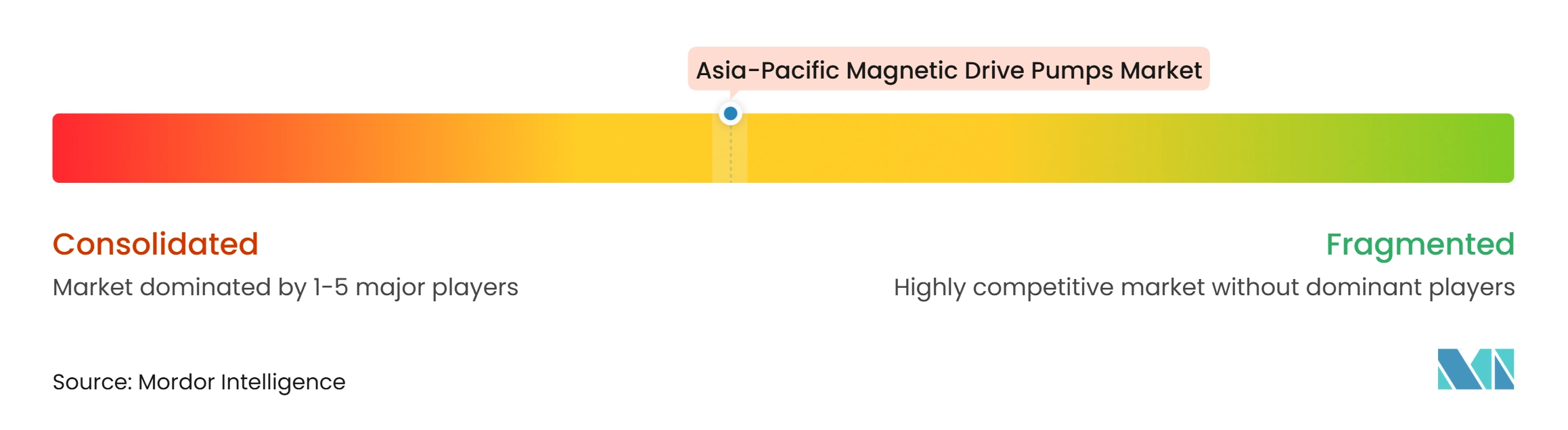
The Asia-Pacific Magnetic Drive Pumps Market is moderately concentrated. Japanese specialists Ebara, Iwaki, and Teikoku retain premium positions in high-purity and high-temperature applications through semiconductor relationships and application expertise. Flowserve and ITT compete through standards compliance and large-project channels. Nikkiso provides a competing seamless option for selected semiconductor cooling applications. Chinese producers have cost and local-supply advantages in standard chemical duties, but many face qualification barriers in pharmaceutical Good Manufacturing Practice (GMP) and advanced semiconductor services.
Honeywell completed its USD 2.16 billion acquisition of Sundyne in June 2025, placing ANSIMAG and HMD/Kontro lines within its Energy and Sustainability Solutions portfolio. The combined offer can link pump selection with automation, digital monitoring, and emissions-management needs. Flowserve introduced the INNOMAG TB-MAG Dual Drive in 2025 with secondary hermetic containment for safety-critical chemical and hydrocarbon duties. Iwaki expanded its range with the MDW-F large-flow process pump and direct-drive products during 2025. These actions make safety architecture, monitoring, and operating range central competitive considerations.
KSB invested USD 16.8 million (EUR 15 million) in its Shanghai facility during 2025 to expand chemical-pump manufacturing. Local production supports China project delivery, while openings remain in integrated monitoring, India-made fluoropolymer-lined units, and hydrogen-qualified equipment. Regional manufacturers can strengthen their position by meeting certification and service requirements. Long qualification cycles continue to favor established suppliers in critical chemical and pharmaceutical duties.
Asia-Pacific Magnetic Drive Pumps Industry Leaders
-
Iwaki Co., Ltd.
-
Ebara Corporation
-
Teikoku Electric Mfg. Co., Ltd.
-
Kirloskar Brothers Limited
-
Nikkiso Eiko Co., Ltd.
- *Disclaimer: Major Players sorted in no particular order
Asia-Pacific Magnetic Drive Pumps Market Companies Covered in this Report
- Caster Pumps (India) Pvt. Ltd.
- Ebara Corporation
- Flowserve Corporation
- Gen Creative Engineers Limited
- Grosvenor Worldwide Private Limited
- ITT Inc.
- Iwaki Co., Ltd.
- Kirloskar Brothers Limited
- KSB SE & Co. KGaA
- Kweng Magnadyne Private Limited
- Leakless (India) Engineering
- Nikkiso Eiko Co., Ltd.
- Shandong Shuanglun Co., Ltd.
- Shanghai Fuxin Pump Valve Co., Ltd.
- Shanghai Junquan Pump Industry Co., Ltd.
- Shanghai Kaiquan Pump (Group) Co., Ltd.
- Sulzer Ltd
- Sundyne LLC
- Teikoku Electric Mfg. Co., Ltd.
- Yuanxin Pump (Suzhou) Technology Co., Ltd.
Recent Industry Developments in Asia-Pacific Magnetic Drive Pumps Market
- August 2026: Zhejiang Yida Pump Industry introduced an expanded portfolio of corrosion-resistant magnetic drive pumps, comprising MP mini magnetic pumps, MPH threaded-connection magnetic pumps, and heavy-duty CQF flange-type magnetic pumps. The new range is designed for chemical, pharmaceutical, lithium battery, and industrial wastewater applications.
- September 2025: Yuanxin Pump exhibited its CMP Series Chemical Magnetic Drive Centrifugal Pumps and MAP Series high- and low-temperature magnetic drive pumps at SEMI Shenzhen 2025 for semiconductor thermal-control and chemical-circulation equipment makers.
- June 2025: Honeywell completed the acquisition of Sundyne from Warburg Pincus for USD 2.16 billion, integrating Sundyne’s ANSIMAG and HMD/Kontro sealless magnetic drive pump lines into Honeywell’s Energy and Sustainability Solutions portfolio. The deal is expected to accelerate digital monitoring integration with sealless pumps in chemical and hydrocarbon processing, reshaping bundle-selling dynamics across Asia-Pacific end-user markets.
- March 2025: Flowserve launched the INNOMAG TB-MAG Dual Drive, described as the first magnetic drive pump with true secondary hermetic containment. The product addresses chemical and hydrocarbon services where an existing sealless design lacked independent secondary isolation.
Asia-Pacific Magnetic Drive Pumps Market Report Scope
A magnetic drive pump (or mag-drive pump) is a sealless industrial pump that uses a magnetic field to transmit torque from the motor to the impeller. Unlike traditional mechanical shaft seals, which can wear out and leak, a magnetic drive pump isolates the fluid completely inside a hermetically sealed hydraulic chamber.
The Asia-Pacific magnetic drive pumps market is segmented into pump type, flow rate, end-use industry, and geography. By pump type, the market is segmented into centrifugal magnetic drive pumps, positive displacement magnetic drive pumps, and other magnetic drive pump types. By flow rate, the market is divided into up to 80 m³/hr, 81–200 m³/hr, 201–500 m³/hr, and above 500 m³/hr. By end-use industry, the market is segmented into chemicals and petrochemicals, pharmaceuticals and biotechnology, oil and gas, food and beverage, water and wastewater treatment, semiconductor and electronics, power generation, metals and mining, and other industries. The report also covers the market size and forecasts for the Asia-Pacific magnetic drive pumps market across 8 key countries. For each segment, the market sizing and forecasts have been provided on the basis of value (USD).
Segmentation Overview
| Centrifugal Magnetic Drive Pumps |
| Positive Displacement Magnetic Drive Pumps |
| Other Magnetic Drive Pump Types |
| Up to 80 m³/hr |
| 81–200 m³/hr |
| 201–500 m³/hr |
| Above 500 m³/hr |
| Chemicals and Petrochemicals |
| Pharmaceuticals and Biotechnology |
| Oil and Gas |
| Food and Beverage |
| Water and Wastewater Treatment |
| Semiconductor and Electronics |
| Power Generation |
| Metals and Mining |
| Other Industries |
| China |
| India |
| Japan |
| South Korea |
| Australia |
| Indonesia |
| Vietnam |
| Thailand |
| Rest of Asia-Pacific |
| By Pump Type | Centrifugal Magnetic Drive Pumps |
| Positive Displacement Magnetic Drive Pumps | |
| Other Magnetic Drive Pump Types | |
| By Flow Rate | Up to 80 m³/hr |
| 81–200 m³/hr | |
| 201–500 m³/hr | |
| Above 500 m³/hr | |
| By End-Use Industry | Chemicals and Petrochemicals |
| Pharmaceuticals and Biotechnology | |
| Oil and Gas | |
| Food and Beverage | |
| Water and Wastewater Treatment | |
| Semiconductor and Electronics | |
| Power Generation | |
| Metals and Mining | |
| Other Industries | |
| By Geography | China |
| India | |
| Japan | |
| South Korea | |
| Australia | |
| Indonesia | |
| Vietnam | |
| Thailand | |
| Rest of Asia-Pacific |
Key Questions Answered in the Report
What is the projected value of Asia-Pacific magnetic drive pumps by 2032?
The sector is forecast to reach USD 1.16 billion by 2032, expanding at a 6.97% CAGR from 2027.
Which pump type has the largest share in Asia-Pacific magnetic drive pumps?
Centrifugal magnetic drive pumps lead with a 73.2% share in 2026 because they fit many chemical, semiconductor, and water-treatment duties.
Which end-use application is growing fastest for magnetic drive pumps in Asia-Pacific?
Semiconductor and electronics is projected to grow at a 9.2% CAGR through 2032, supported by new fab construction and wet-process chemical systems.
Why are Chinese facilities adopting sealless pumps?
VOC leak detection and repair requirements in places such as Shanghai and Ningbo are increasing focus on equipment-level containment and compliance records.
Why is India the fastest-growing Asia-Pacific geography?
India's 7.5% forecast CAGR reflects semiconductor projects, pharmaceutical production, specialty chemicals, and emerging nuclear-pump manufacturing capability.
What limits wider use of magnetic drive pumps?
Higher initial cost, rare-earth magnet availability, long qualification cycles, and operating limits in extreme high-flow or high-pressure duties remain constraints.