
Asia-Pacific LTPS LCD Module In Automotive Market Size and Share
Market Overview
| Study Period | 2021 - 2032 |
|---|---|
| Forecast Data Period | 2027 - 2032 |
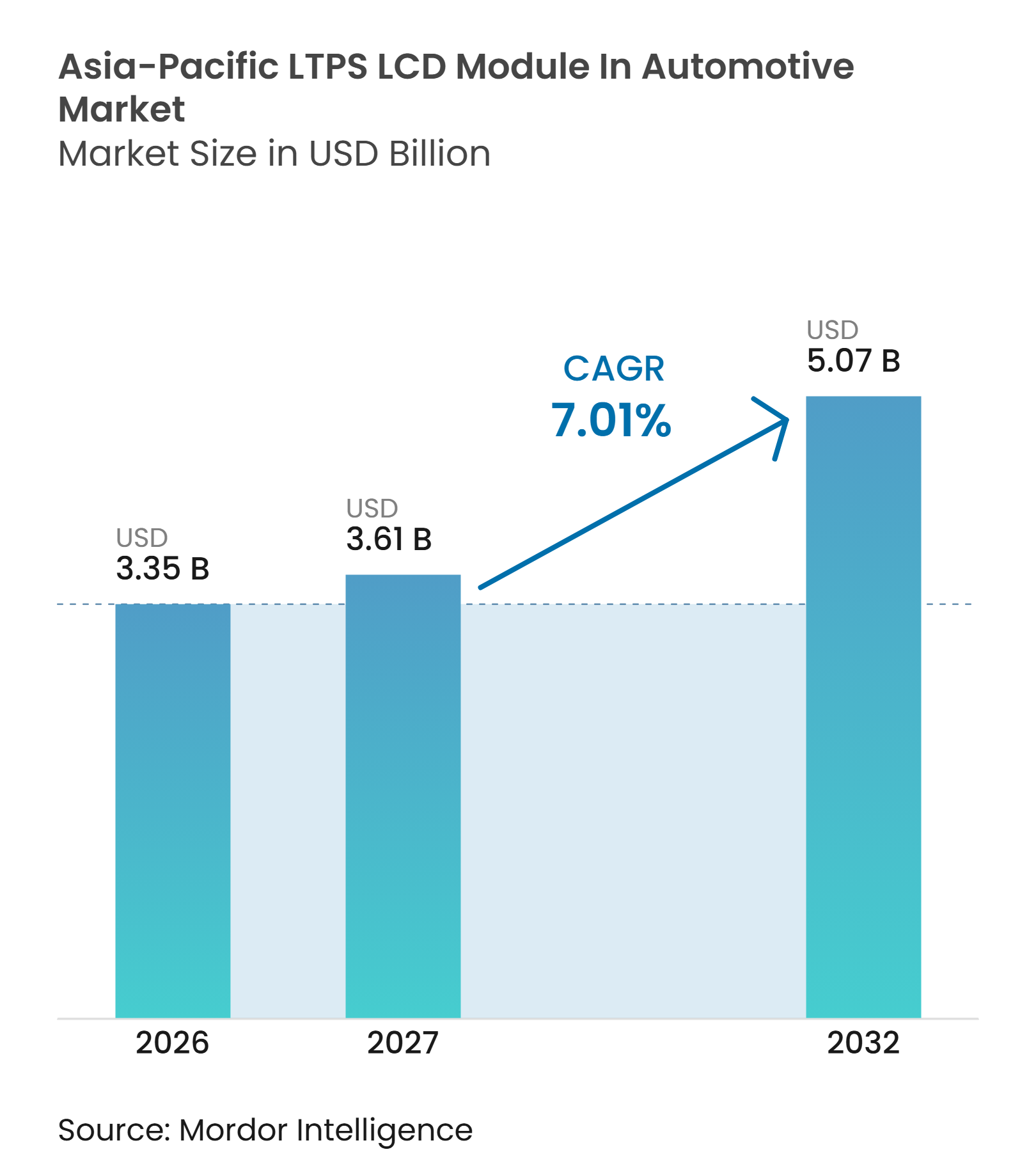
| Base Year Market Size (2026) | USD 3.35 Billion |
| Market Size (2027) | USD 3.61 Billion |
| Market Size (2032) | USD 5.07 Billion |
| Growth Rate (2027 - 2032) | 7.01 % |
| Market Concentration | Medium |
Major Players *Disclaimer: Major Players sorted in no particular order Image © Mordor Intelligence. Reuse requires attribution under CC BY 4.0. | |
Asia-Pacific LTPS LCD Module In Automotive Market Analysis by Mordor Intelligence
The Asia-Pacific LTPS LCD Module (LCM) in Automotive Market size is valued at USD 3.35 billion in 2026 and is forecast to reach USD 5.07 billion by 2032 at a CAGR of 7.01% from 2027 to 2032. The Asia-Pacific LTPS LCD Module (LCM) in Automotive Market is benefiting from the replacement of conventional amorphous silicon LCD panels with LTPS backplanes that support higher resolution, brightness, and touch integration. Software-defined vehicle designs are also raising expectations for center screens and driver information displays. Vehicle makers are using larger screens to differentiate electric models, while suppliers are moving capacity released by smartphone display production into automotive programs. The result is a wider use of LTPS modules across passenger vehicles, although long validation cycles and a concentrated supply base remain important constraints.
Key Report Takeaways
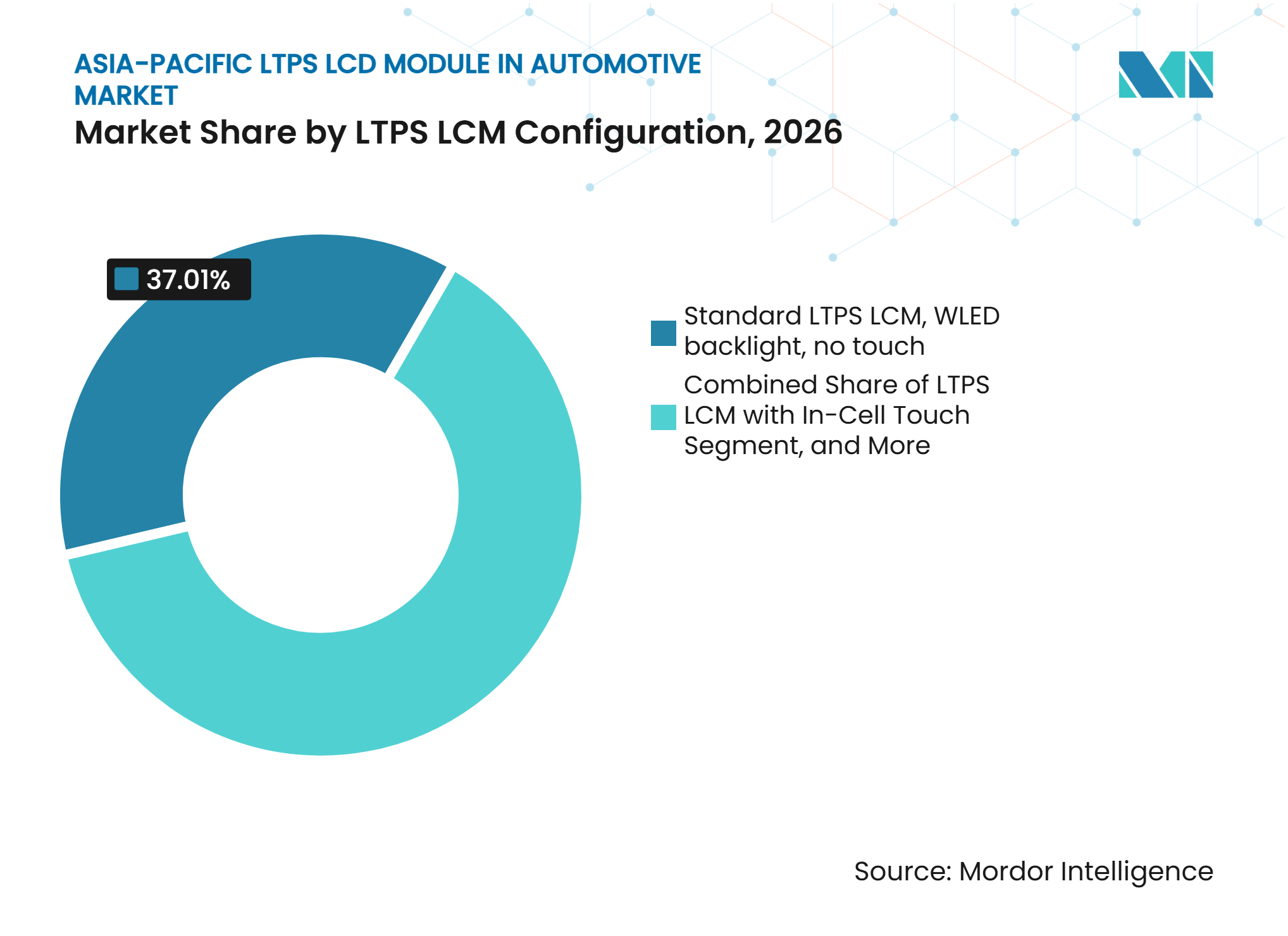
- By LTPS LCM configuration, Standard LTPS LCM with WLED Backlight and No Touch held 37.01% of the Asia-Pacific LTPS LCD Module (LCM) in Automotive Market share in 2026, while LTPS LCM with Mini-LED Backlight and In-Cell Touch is projected to expand at an 8.82% CAGR through 2032.
- By application, Center Stack and Infotainment Displays accounted for 45.97% of the Asia-Pacific LTPS LCD Module (LCM) in Automotive Market size in 2026, while Pillar-to-Pillar Center Console Displays are projected to expand at an 8.74% CAGR through 2032.
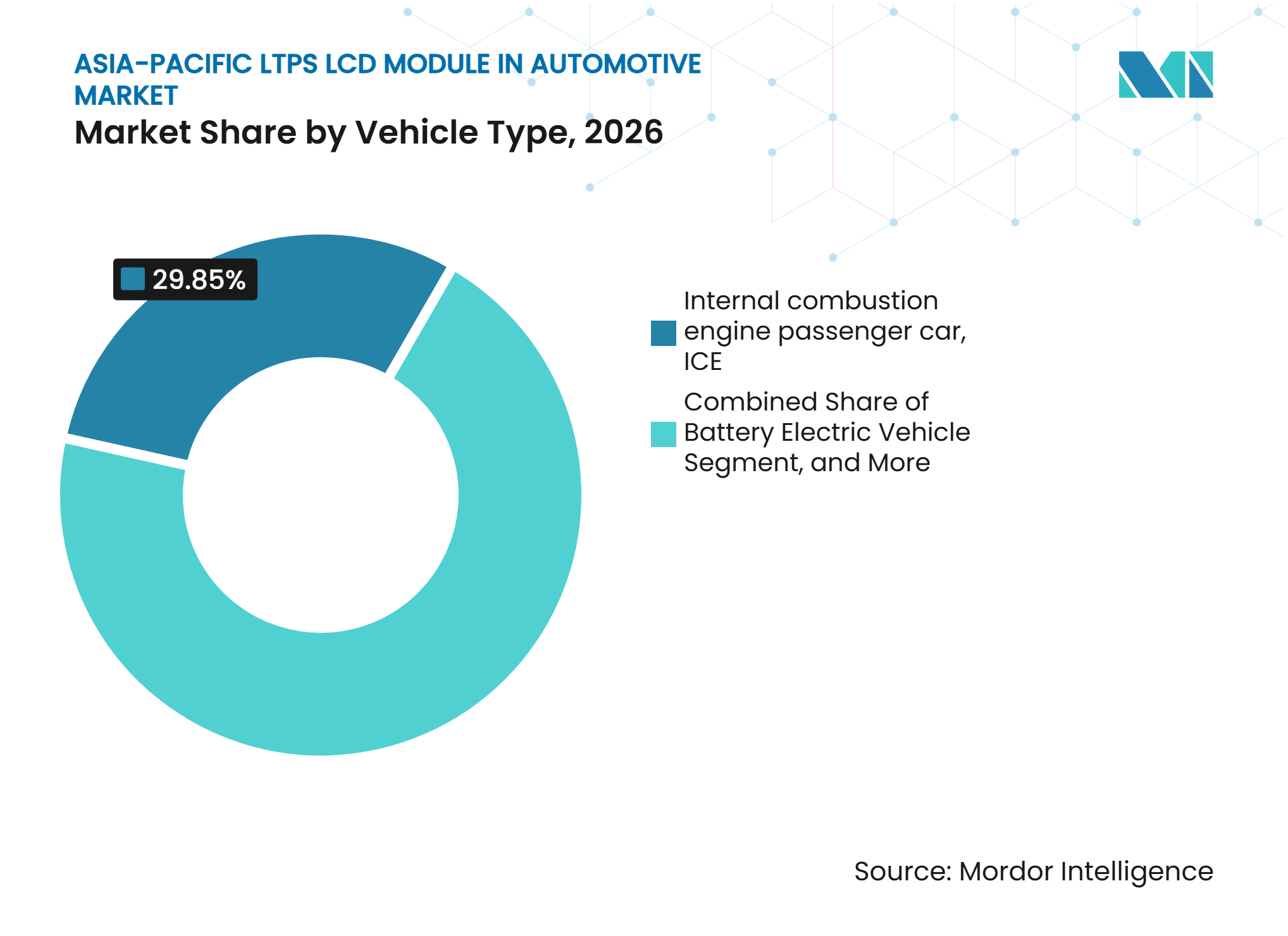
- By vehicle type, ICE Passenger Cars accounted for 29.85% of regional sales in 2026, while BEVs are projected to expand at an 8.78% CAGR through 2032.
- By bonding process, Film on Glass bonding held 60.81% of regional demand in 2026, while Chip on Glass bonding is projected to expand at an 8.85% CAGR through 2032.
- By geography, China held 53.13% of regional demand in 2026 and is projected to expand at an 8.67% CAGR through 2032.
Note: Market numbers in this report are based on Mordor Intelligence's proprietary estimation framework, which combines nine months of actuals with Q4 projections for base year 2026.
Market Trends and Insights
Drivers Impact Analysis of Asia-Pacific LTPS LCD Module In Automotive Market*
| Driver | (~) % Impact on CAGR Forecast | Geographic Relevance | Impact Timeline |
|---|---|---|---|
| Rising Adoption of High-Resolution Smart Cockpits | +1.8% | China core, South Korea and Japan, with spillover to Taiwan | Short term (≤ 2 years) |
| Growing Electric Vehicle Display Content | +1.6% | China core, South Korea and Japan | Medium term (2-4 years) |
| Demand for High-Brightness Displays in Advanced Driver Assistance Systems | +1.3% | Global, with early traction in China and Japan | Long term (≥ 4 years) |
| Expansion of Pillar-to-Pillar and Passenger Displays | +1.0% | China early leader, with spillover to South Korea and Taiwan | Medium term (2-4 years) |
| In-Cell Touch Integration and Slimmer Module Designs | +0.7% | China and Taiwan core | Short term (≤ 2 years) |
| Automotive Qualification of LTPS Lines Repurposed From Mobile Display Production | +0.5% | China, South Korea, and Taiwan | Short term (≤ 2 years) |
| Source: Mordor Intelligence | |||
Rising Adoption of High-Resolution Smart Cockpits
LTPS backplanes support the shift toward larger automotive cockpit screens because they preserve pixel density at sizes where conventional a-Si panels can lose visible detail. This capability matters for the 10-inch to 15-inch screen range that is becoming common in new vehicle programs. LG Display demonstrated a 47.8-inch LTPS LCD with Switchable Privacy Mode at K-Display 2025 for front passenger display applications.[1] Larger standard displays can raise LTPS module content per vehicle during each model refresh. China Ministry of Industry and Information Technology guidance and Euro NCAP assessments can influence the placement of screen functions and physical controls. These requirements shape cockpit layouts but do not remove demand for high-resolution display modules in the Asia-Pacific LTPS LCD Module (LCM) in Automotive Market.
Growing Electric Vehicle Display Content
BEVs generally provide more uninterrupted dashboard area than ICE vehicles because their layouts do not require the same transmission tunnel and engine-related controls. Vehicle makers can use that space for wider center screens, passenger displays, and integrated driver interfaces. This layout supports 30-inch to 50-inch display formats in premium programs, where high brightness and resolution are important. LTPS panels are suitable for these applications because the backplane can support demanding luminance and pixel requirements. BEV displays also show charging status, energy flow, driving range, and navigation data, which increases the value of responsive driver interfaces. The Asia-Pacific LTPS LCD Module (LCM) in Automotive Market therefore benefits when electric lineups receive more screen content than comparable ICE models.
Demand for High-Brightness Displays in Advanced Driver Assistance Systems
Advanced driver assistance systems are raising brightness requirements for camera monitoring, augmented-reality head-up displays, and warning interfaces. These applications can require sustained luminance of 1,000 nits or more in direct sunlight. Tianma presented an 11.98-inch LTPS panoramic head-up display module with peak brightness of 12,000 nits at CES 2026.[2] Mini-LED local dimming can help LTPS modules combine high brightness with contrast control. Research on local dimming identifies zone partitioning as a practical approach to controlling halo effects in vehicle displays.[3] As safety functions become more prominent in vehicle interfaces, high-brightness modules can become a larger part of the Asia-Pacific LTPS LCD Module (LCM) in Automotive Market.
Expansion of Pillar-to-Pillar and Passenger Displays
Pillar-to-pillar formats are moving from concept vehicles toward production programs in parts of Asia-Pacific. LCD remains more accessible than OLED for very large display surfaces outside luxury vehicle programs. Valeo announced in July 2025 that a Chinese OEM selected its panoramic pillar-to-pillar head-up display, with production planned from 2026. LG Display also showed a 57-inch pillar-to-pillar LCD at K-Display 2025. In-cell touch helps these designs reduce thickness because it removes a separate touch overlay. This makes curved glass and slim dashboard integration more feasible for the Asia-Pacific LTPS LCD Module (LCM) in Automotive Market.
Restraints Impact Analysis of Asia-Pacific LTPS LCD Module In Automotive Market*
| Restraint | (~) % Impact on CAGR Forecast | Geographic Relevance | Impact Timeline |
|---|---|---|---|
| High Qualification and Validation Costs for Automotive Programs | -1.5% | Global | Long term (≥ 4 years) |
| Intense Price Competition From China-Based Panel Makers | -1.2% | Asia-Pacific core, with Japan and South Korea most affected | Medium term (2-4 years) |
| Limited Geographic Diversification of Mature LTPS Capacity | -0.8% | Non-China Asia-Pacific, including Japan, South Korea, and Taiwan | Long term (≥ 4 years) |
| Thermal, Optical, and Reliability Trade-Offs in Large Mini-LED Modules | -0.5% | Global | Medium term (2-4 years) |
| Source: Mordor Intelligence | |||
High Qualification and Validation Costs for Automotive Programs
A new LTPS LCM supplier can face an 18-month to 36-month qualification path before entering an automotive program. The process includes functional safety, component testing, and quality management expectations under ISO 26262, AEC-Q100, and IATF 16949. A change in substrate generation, backlight design, or process flow may require further validation. These costs are particularly difficult for suppliers adapting consumer electronics lines for automotive use. The burden can reduce margins on standard module programs even when the supplier has adequate technical capability. It can also favor established suppliers with automotive engineering teams and recognized quality systems.
Intense Price Competition From China-Based Panel Makers
Chinese panel makers benefit from large LTPS production capacity, policy support, and integrated supply chains. Their scale places pressure on average selling prices for standard and mid-tier module configurations. Japanese, South Korean, and Taiwanese suppliers are responding by focusing on in-cell touch, Mini-LED backlights, and privacy functions. Those features provide a clearer route to differentiation than commodity WLED products. TCL CSOT has identified LTPS LCD as a mainstream technology in its automotive display roadmap, reflecting its relevance for cockpit applications. This competitive pressure can divide the Asia-Pacific LTPS LCD Module (LCM) in Automotive Market between China-led volume supply and premium programs served by specialized producers.
*Our forecasts treat driver/restraint impacts as directional, not additive. The impact forecasts reflect baseline growth, mix effects, and variable interactions.
Asia-Pacific LTPS LCD Module In Automotive Market Segment Analysis
By LTPS LCM Configuration:
Mini-LED Integration Redefines Module PerformanceStandard LTPS LCM with WLED Backlight and No Touch held 37.01% of regional sales in 2026. The configuration fits established dashboard platforms and has a broad supply base in China, Taiwan, and Japan. It is also familiar to vehicle makers seeking faster qualification and lower sourcing risk. LTPS LCM with In-Cell Touch and WLED Backlight remains important where manufacturers want touchscreen-focused human-machine interfaces without the cost of Mini-LED backlighting. LTPS LCM with Mini-LED Backlight and No Touch serves applications where brightness above 1,000 nits matters more than touch functionality. These uses include augmented-reality head-up displays and large instrument clusters. The present configuration mix therefore favors reliable and proven designs for high-volume vehicle programs. Automotive buyers select this option when service history, supply continuity, and assembly familiarity outweigh the need for a premium optical specification. The WLED backlight also provides a known cost structure for programs that must work across several vehicle trims. Suppliers can offer the same basic panel with different cover glass, control electronics, and mechanical packages. That flexibility allows a common architecture to serve multiple dashboard designs. The approach is particularly useful when manufacturers need dependable availability during long production runs. It also gives module integrators a stable base from which to offer upgraded touch and backlight options.
LTPS LCM with Mini-LED Backlight and In-Cell Touch is projected to expand at an 8.82% CAGR through 2032. The configuration combines the brightness and contrast benefits of Mini-LED with a thinner interface created by in-cell touch. This combination is relevant to premium BEVs that use large displays as a visible product feature. It is also relevant to suppliers moving Mini-LED engineering from consumer applications into automotive-grade modules. Full-array local dimming can provide high brightness, high contrast, and lower Mura in vehicle displays. These performance attributes support a cost-performance position against OLED in some mid-range vehicle programs. The Asia-Pacific LTPS LCD Module (LCM) industry is likely to see Mini-LED and in-cell touch used together more often as display requirements rise. The configuration also gives automakers a way to carry a consistent visual interface from a flagship model into a higher-volume vehicle. A supplier can retain the LTPS panel while adjusting screen size, brightness targets, cover glass, and mechanical housing. This supports a common development path across several vehicle grades. It also reduces the need to qualify a completely different display architecture for every dashboard program. Vehicle makers are likely to value that flexibility when model cycles require similar user interfaces across electric and combustion vehicles. The design can pair central touch controls with separate driver information displays without changing the basic panel technology. Mini-LED backlighting is particularly relevant where a large screen must remain readable under varied ambient light. Local dimming can help preserve dark areas of the image while bright elements remain visible. The benefit is most apparent in cockpit layouts that combine navigation, media, vehicle settings, and camera views on one surface. In-cell touch removes a discrete touch layer from the module stack. Removing that layer can lower thickness and simplify curved display assemblies. It can also reduce reflections that affect a user’s view of the display. These features are useful in passenger displays, where privacy modes and high image quality can be part of a premium specification. They are also useful in driver displays that need a direct and responsive touch surface.
Module suppliers must still balance these features against the thermal demands of high-brightness operation. Mini-LED designs require careful control of heat from the backlight and driver electronics. They also require a reliable local dimming approach to avoid visible halo effects around bright objects. Automotive programs add further requirements for vibration, temperature cycling, and long service life. This makes the move from a consumer Mini-LED design to an automotive module more demanding. Suppliers that have already established automotive validation processes are therefore better placed to bring the configuration into production. The higher specification can support better pricing than a standard WLED module. It can also create a clearer distinction between modules aimed at premium vehicles and those aimed at volume segments. For manufacturers, the choice depends on whether display performance is central to the vehicle’s product position. For premium BEVs, it often is. For lower-priced models, a standard LTPS design may remain more practical. The two configurations can therefore coexist over the forecast period rather than replacing one another quickly.
The broader supply picture also supports this mixed outcome. LTPS capacity that was once directed to smartphones can be redirected toward automotive modules as handset makers use more AMOLED panels. This may reduce the need for entirely new LTPS capacity in some production locations. It can also increase competition among suppliers seeking automotive programs. Existing production equipment offers an advantage only when a line can meet the quality and validation expectations of vehicle makers. A module supplier must combine panel capability with bonding, backlight, touch, and mechanical integration expertise. That requirement favors companies that can work closely with OEM engineering teams. It also increases the value of partnerships with established Tier 1 cockpit suppliers. Standard WLED modules benefit from the availability of mature assembly methods. Mini-LED modules benefit from stronger differentiation where brightness and contrast are visible to the end user. The configuration split is therefore shaped by both technology needs and procurement practices.
For the Asia-Pacific LTPS LCD Module (LCM) in Automotive Market, this pattern creates a gradual upgrade path instead of a single technology break. Standard LTPS modules can serve programs that require reliable sourcing and known cost structures. In-cell touch can be added when a vehicle moves to a screen-led control interface. Mini-LED can be added when the program requires more brightness or visual contrast. Combining Mini-LED and in-cell touch then addresses the needs of larger and thinner premium displays. Each step can be assessed against the vehicle’s intended price point and cockpit design. This gives OEMs flexibility as display content becomes more important in vehicle design. It also gives suppliers several ways to participate without relying on one configuration alone. The fastest configuration is likely to benefit from the strongest demand in electric and premium vehicle programs. The largest configuration is likely to remain tied to broad production volumes and established assembly processes.



By Application:
Infotainment Leads as Pillar Displays ScaleCenter Stack and Infotainment Displays commanded 45.97% of the Asia-Pacific LTPS LCD Module (LCM) in Automotive Market size in 2026. Large central touchscreens are now common in new passenger vehicle launches, supporting this leading position. Instrument clusters provide a stable second source of demand because manufacturers still require dedicated driver-facing information displays. Rear-seat entertainment and passenger screens add LTPS content beyond the primary driver interface. Chinese brands are introducing co-pilot privacy displays and rear-seat screens in mid-priced BEV lineups. These additional screens increase display content per vehicle. The wide adoption of central interfaces keeps infotainment central to the Asia-Pacific LTPS LCD Module (LCM) in Automotive Market.
Pillar-to-Pillar Center Console Displays are projected to expand at an 8.74% CAGR through 2032. The format uses continuous screen surfaces across the dashboard and is appearing in a wider range of Chinese and South Korean vehicle programs. Adoption has proceeded faster in China than in Japan and South Korea because dashboard integration and program approval cycles are often shorter. LTPS is suited to these products because it can support in-cell touch and detailed displays within slim modules. The Society for Information Display has noted the role of LTPS and integrated touch in automotive display and human-machine interface development. As the format reaches more volume models, it can reduce the relative pace of growth for center-stack-only designs. Passenger displays can also become a more meaningful source of module demand.
By Vehicle Type:
EVs Accelerate Premium Display AdoptionICE Passenger Cars held 29.85% of regional demand in 2026. Their scale reflects continuing vehicle volume in markets where electric vehicle adoption remains uneven. Manufacturers are increasingly applying a common LTPS backplane across ICE and electric models to simplify cockpit component sourcing. This approach lets ICE vehicles receive higher specification displays that were first developed for BEV programs. HEV and PHEV models form an intermediate segment with display content between BEVs and ICE vehicles. Light commercial vehicles are also adopting LTPS modules for telematics, fatigue monitoring, navigation, and fleet information. These applications keep demand broader than a single vehicle powertrain category.
BEVs are projected to expand at an 8.78% CAGR through 2032, the fastest rate among vehicle types. Electric models often require more complex driver interfaces for energy management, charging information, over-the-air update notices, and route planning. Their cockpit layouts also make room for wider and more integrated displays. LTPS supports those interfaces with the resolution and touch integration needed for primary driver-facing screens. Integrated touch is especially useful in center stack interfaces that combine navigation and vehicle controls. BEV programs can therefore move more quickly toward Mini-LED and in-cell touch configurations. The Asia-Pacific LTPS LCD Module (LCM) industry gains from this higher display content without relying only on vehicle unit volume.

By Bonding Process:
COG Gains Ground in Slim Module DesignsFilm on Glass bonding held 60.81% of regional demand in 2026. The process remains established in module assembly lines and works well with flexible printed circuit connections. That flexibility helps integration teams manage curved and non-rectangular display layouts in center stack and pillar-to-pillar programs. FOG also has a broad supplier base and a relatively lower rework risk. These practical advantages support its continued use in large-area module configurations. Existing production equipment further strengthens its position in standard automotive programs. The Asia-Pacific LTPS LCD Module (LCM) market retains FOG as its principal bonding method while cockpit architectures remain diverse.
Chip on Glass bonding is projected to expand at an 8.85% CAGR through 2032. COG removes the intermediate flexible printed circuit step by placing driver integrated circuits directly on the glass substrate. This reduces module depth and supports low-profile designs used in BEV cockpit layouts. It can also support tighter curvature requirements where FOG connections are harder to accommodate. The process requires higher initial investment and more careful thermal management at the glass substrate. These requirements limit adoption in simpler WLED modules. COG is likely to gain share more quickly in Mini-LED configurations, where compact architecture and local dimming control add value.
Geography Analysis
China
China held 53.13% of regional demand in 2026 and is projected to expand at an 8.67% CAGR through 2032. BOE Technology Group, TCL China Star Optoelectronics, Tianma Microelectronics, and Truly International Holdings support a domestic supply base covering standard, in-cell touch, and Mini-LED products. Chinese new-energy vehicle brands are deploying multi-screen cockpit designs that increase LTPS content per vehicle. Panoramic head-up display applications are also becoming more relevant to domestic vehicle programs. The Ministry of Industry and Information Technology influences intelligent cockpit safety expectations and provides a clearer compliance setting for display integration. China’s scale combines panel manufacturing with rapid cockpit design adoption. This combination gives the Asia-Pacific LTPS LCD Module (LCM) in Automotive Market a strong production and demand center.
South Korea
South Korea’s contribution rests on the LTPS processing and automotive engineering capabilities of LG Display and Samsung Display. LG Display presented automotive LTPS LCD products ranging from center stack modules to a 47.8-inch LCD with Switchable Privacy Mode. The country’s LTPS lines are generally older and offer limited room for major capacity expansion. Producers therefore have stronger reasons to focus on quality, system integration, and direct design-in work with OEMs. Hyundai Mobis also links domestic display suppliers with cockpit system demand from Hyundai and Kia. This industrial relationship supports premium modules rather than a volume-led supply model. South Korea remains important to the Asia-Pacific LTPS LCD Module (LCM) in Automotive Market because its suppliers can address high-specification global programs.
Japan, Taiwan, and the Rest of Asia-Pacific
Japan is reducing commodity LTPS capacity as Japan Display consolidates automotive production at its Ishikawa Multi-Fab facility following the March 2026 closure of its Mobara line. The company is shifting toward specialized digital mirror and dual-view display products, while Sharp maintains a secondary automotive display presence. Taiwan contributes through AUO and Innolux, whose roles extend from panels toward module and cockpit system integration. Mini-LED automotive programs give Taiwanese suppliers a route to higher-value products, while their customer relationships extend to European and United States OEMs. In the rest of Asia-Pacific, including Southeast Asia and India, demand is still developing rather than serving as a major regional production base. Japanese and South Korean OEM assembly operations and interest in digitally equipped passenger vehicles support this demand. These mixed geographies give the Asia-Pacific LTPS LCD Module (LCM) industry alternative design and integration capabilities, although they do not yet match China’s manufacturing scale.
Competitive Landscape
Market Concentration
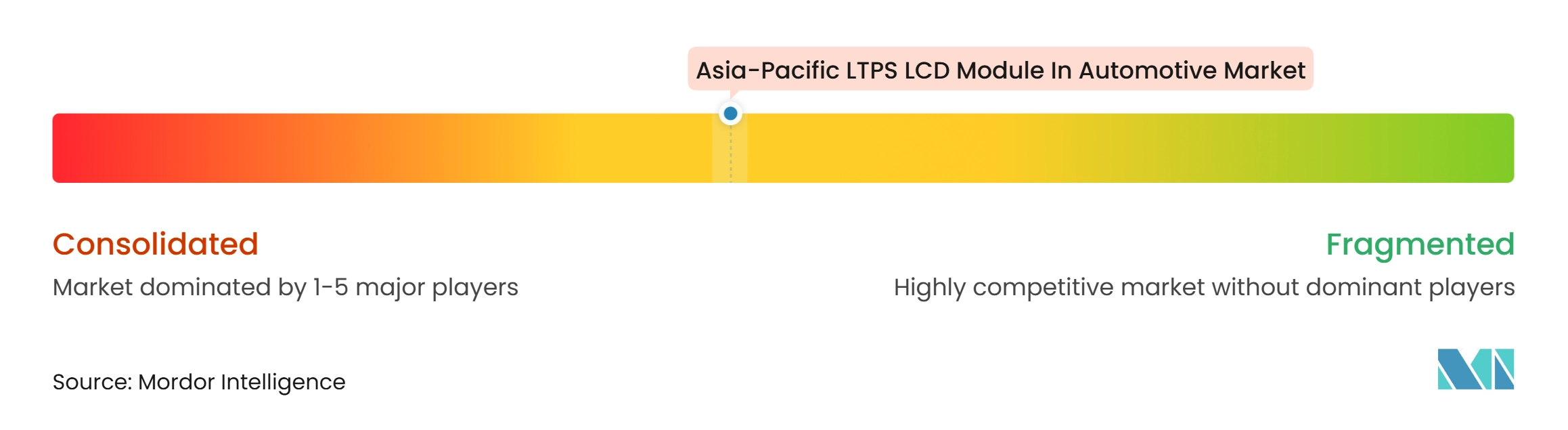
The Asia-Pacific LTPS LCD Module (LCM) in Automotive Market is moderately consolidated at the panel level and more fragmented at the module integration level. No single company controls both LTPS processing and downstream cockpit human-machine interface delivery across all programs. BOE Technology Group has a strong volume position in Chinese automotive display supply through LTPS and a-Si LCD offerings. Its BOEVX unit has identified display work with BMW, Volkswagen, and Hyundai, including a 44.8-inch pillar-to-pillar project for a Chinese automaker. AUO, Innolux, Tianma, and BOE are extending their roles into module and cockpit integration. This shift places pressure on established Tier 1 suppliers such as Continental, Visteon, and DENSO. Qualified non-China suppliers can still receive a sourcing premium from OEMs seeking greater resilience.
Tianma is developing a system-level position through its Smart Cockpit 7.0 concept, which combines multiple display technologies in a single cockpit offering. LG Display has also disclosed a direct automotive display supply relationship with a global premium vehicle maker, bypassing the usual Tier 1 channel in that program. Valeo’s selected panoramic head-up display program in China offers a further example of a Tier 1 supplier extending large-screen cockpit capability into series production. High-brightness Mini-LED local dimming and in-cell touch are becoming more influential in OEM design decisions. LG Display’s Switchable Privacy Mode supports passenger display use cases in large cockpit screens. These capabilities help suppliers compete on module performance rather than price alone.
Panel suppliers and Tier 1 integrators are increasingly converging around cockpit display procurement. Panel makers can offer closer technical control where screens, touch layers, backlights, and module packaging must work together. Traditional integrators retain relevance through vehicle-level engineering and software-defined vehicle capabilities. The competitive balance varies by program, with Chinese suppliers strongest in high-volume domestic models and Korean, Japanese, and Taiwanese suppliers more exposed to premium or specialized designs. The closure of mature capacity in Japan makes supply diversification a larger commercial issue for some buyers. Larger OEMs are likely to work with fewer suppliers that can meet automotive qualification, optical performance, and integration requirements. Market concentration score: 5 out of 10, because the record supports moderate panel-level concentration but does not provide a combined top-five share sufficient to indicate a more concentrated structure.
Asia-Pacific LTPS LCD Module In Automotive Industry Leaders
-
BOE Technology Group Co., Ltd.
-
Tianma Microelectronics Co., Ltd.
-
AUO Corporation
-
Japan Display Inc.
-
LG Display Co., Ltd.
- *Disclaimer: Major Players sorted in no particular order
Asia-Pacific LTPS LCD Module In Automotive Market Companies Covered in this Report
- LG Display Co., Ltd.
- Samsung Display Co., Ltd.
- BOE Technology Group Co., Ltd.
- Tianma Microelectronics Co., Ltd.
- AUO Corporation
- Innolux Corporation
- Japan Display Inc.
- TCL China Star Optoelectronics Technology Co., Ltd.
- Sharp Corporation
- Truly International Holdings Limited
- Visionox Technology Inc.
- HKC Corporation Limited
- EverDisplay Optronics (Shanghai) Co., Ltd.
- Continental AG
- DENSO CORPORATION
- Robert Bosch GmbH
- Visteon Corporation
- Panasonic Automotive Systems Co., Ltd.
- Hyundai Mobis Co., Ltd.
- Marelli Holdings Co., Ltd.
Recent Industry Developments in Asia-Pacific LTPS LCD Module In Automotive Market
- August 2026: Japan Display Inc. completed the sale of its Tottori factory to Yahata Toei Estate, with a projected gain of JPY 500 million (USD 3.4 million). Following the March 2026 closure of its Mobara LTPS panel line, the transaction consolidated JDI’s automotive LTPS production at its Ishikawa Multi-Fab facility and removed non-China production capacity from the regional supply pool.
- May 2026: Tianma Microelectronics presented an automotive display portfolio spanning LTPS LCD, AMOLED, and Micro-LED technologies at SID Display Week 2026 in Los Angeles. The company emphasized high-brightness and wide-color-gamut products for intelligent cockpit architectures.
- February 2026: LG Display set out an AI-connected automotive display strategy that combines LTPS LCD for high-resolution center stack and instrument cluster displays with Oxide LCD for ultra-large screen formats.
- January 2026: Tianma presented the IRIS head-up display system at CES 2026 in Las Vegas. The system used a 12,000-nit LTPS LCD panel for panoramic head-up display applications, with module thickness below 15 mm and an 82% NTSC color gamut.
Asia-Pacific LTPS LCD Module In Automotive Market Report Scope
The Asia-Pacific LTPS LCD Module (LCM) in Automotive Market encompasses the development, manufacturing, and supply of automotive-grade display modules using Low-Temperature Polycrystalline Silicon (LTPS) technology. These modules deliver high-resolution visuals, enhanced display performance, and power efficiency for advanced vehicle interfaces. Market growth is driven by increasing vehicle digitalization, adoption of sophisticated cockpit systems, and demand for high-quality automotive displays.
The Asia-Pacific LTPS LCD Module (LCM) in Automotive Market Report is Segmented by LTPS LCM Configuration (Standard LTPS LCM (WLED Backlight, No Touch), LTPS LCM with In-Cell Touch (WLED Backlight), LTPS LCM with Mini-LED Backlight (No Touch), and LTPS LCM with Mini-LED Backlight and In-Cell Touch), Application (Center Stack/Infotainment, Instrument Cluster, Pillar-to-Pillar Center Console, and Rear Seat Entertainment and Passenger Screen), Vehicle Type (Battery Electric Vehicle (BEV), Hybrid / Plug-in Hybrid Electric Vehicle (HEV/PHEV), Internal Combustion Engine Passenger Car (ICE), and Light Commercial Vehicle (LCV)), Bonding Process (Film on Glass (FOG), and Chip on Glass (COG)), and Geography (China, Japan, South Korea, Taiwan, and Rest of Asia-Pacific). The Market Forecasts are Provided in Terms of Value (USD).
Segmentation Overview
| Standard LTPS LCM (WLED Backlight, No Touch) |
| LTPS LCM with In-Cell Touch (WLED Backlight) |
| LTPS LCM with Mini-LED Backlight (No Touch) |
| LTPS LCM with Mini-LED Backlight and In-Cell Touch |
| Center Stack / Infotainment |
| Instrument Cluster |
| Pillar-to-Pillar Center Console |
| Rear Seat Entertainment and Passenger Screen |
| Battery Electric Vehicle (BEV) |
| Hybrid / Plug-in Hybrid Electric Vehicle (HEV/PHEV) |
| Internal Combustion Engine Passenger Car (ICE) |
| Light Commercial Vehicle (LCV) |
| Film on Glass (FOG) |
| Chip on Glass (COG) |
| China |
| Japan |
| South Korea |
| Taiwan |
| Rest of Asia-Pacific |
| By LTPS LCM Configuration | Standard LTPS LCM (WLED Backlight, No Touch) |
| LTPS LCM with In-Cell Touch (WLED Backlight) | |
| LTPS LCM with Mini-LED Backlight (No Touch) | |
| LTPS LCM with Mini-LED Backlight and In-Cell Touch | |
| By Application | Center Stack / Infotainment |
| Instrument Cluster | |
| Pillar-to-Pillar Center Console | |
| Rear Seat Entertainment and Passenger Screen | |
| By Vehicle Type | Battery Electric Vehicle (BEV) |
| Hybrid / Plug-in Hybrid Electric Vehicle (HEV/PHEV) | |
| Internal Combustion Engine Passenger Car (ICE) | |
| Light Commercial Vehicle (LCV) | |
| By Bonding Process | Film on Glass (FOG) |
| Chip on Glass (COG) | |
| By Geography | China |
| Japan | |
| South Korea | |
| Taiwan | |
| Rest of Asia-Pacific |
Key Questions Answered in the Report
What is the size of the Asia-Pacific LTPS LCD Module (LCM) in Automotive Market?
The Asia-Pacific LTPS LCD Module (LCM) in Automotive Market is valued at USD 3.35 billion in 2026 and is forecast to reach USD 5.07 billion by 2032, at a 7.01% CAGR from 2027 to 2032.
What is driving automotive LTPS LCD module demand in Asia-Pacific?
Larger smart cockpits, wider BEV displays, higher brightness needs for advanced driver assistance systems, and pillar-to-pillar screen designs are supporting demand.
Which automotive LTPS LCD module configuration is expanding fastest?
LTPS LCM with Mini-LED Backlight and In-Cell Touch is projected to expand at an 8.82% CAGR through 2032.
Which application uses the largest share of automotive LTPS LCD modules?
Center Stack and Infotainment Displays held 45.97% share in 2026, supported by widespread use of central touchscreens in new passenger vehicles.
Why is China important for automotive LTPS LCD modules?
China held 53.13% share in 2026 and is projected to expand at an 8.67% CAGR through 2032, supported by domestic panel production and multi-screen vehicle cockpits.
What bonding process is gaining traction in automotive LTPS LCD modules?
Chip on Glass bonding is projected to expand at an 8.85% CAGR through 2032 because it supports thinner modules and tighter cockpit packaging.