
Asia-Pacific Industrial Technical Textile Market Size and Share
Market Overview
| Study Period | 2021 - 2032 |
|---|---|
| Forecast Data Period | 2027 - 2032 |
| Base Year Market Size (2026) | USD 26.35 Billion |
| Market Size (2027) | USD 27.67 Billion |
| Market Size (2032) | USD 36.17 Billion |
| Growth Rate (2027 - 2032) | 5.50 % |
| Market Concentration | Medium |
Major Players *Disclaimer: Major Players sorted in no particular order Image © Mordor Intelligence. Reuse requires attribution under CC BY 4.0. | |
Asia-Pacific Industrial Technical Textile Market Analysis by Mordor Intelligence
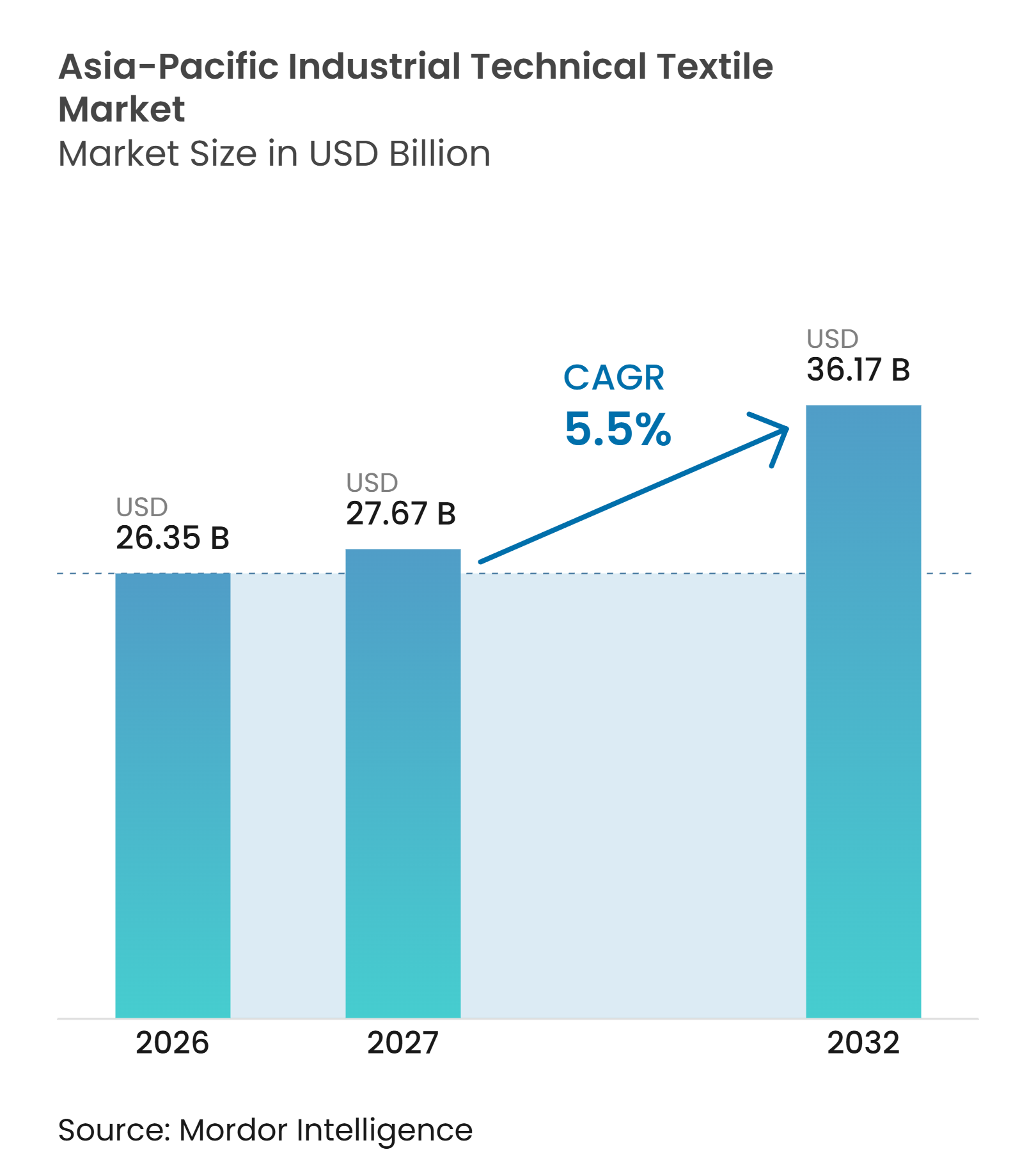
The Asia-Pacific Industrial Technical Textile Market size is expected to grow from USD 26.35 billion in 2026 to USD 27.67 billion in 2027 and is forecast to reach USD 36.17 billion by 2032 at 5.5% CAGR over 2027-2032.
The Asia-Pacific industrial technical textile market is supported by demand from automotive electrification, infrastructure construction, healthcare capacity, process filtration, and industrial manufacturing. Product specifications are shifting toward nonwovens, composite reinforcement, thermal barriers, and other materials that can meet higher performance requirements. China remains the largest production and consumption base, while India is expected to grow faster because policy support, infrastructure investment, and manufacturing relocation are occurring at the same time. Established suppliers are strengthening procurement, engineering, and traceability capabilities, while newer producers face input-cost exposure and long approval cycles. Opportunities in the Asia-Pacific industrial technical textile market depend on supplying qualified materials rather than competing only on volume.
Key Report Takeaways
- By product type, industrial filtration and separation textiles held 27.0% of the Asia-Pacific industrial technical textile market share in 2026, while industrial composite reinforcement textiles are forecast to grow at a 7.0% CAGR through 2032.
- By material type, polyester accounted for 35.0% of the Asia-Pacific industrial technical textile market share in 2026, while high-performance synthetic fibers are projected to expand at a 6.8% CAGR through 2032.
- By end-use application, industrial machinery and material handling held a 23.5% share in 2026, while electrical, electronics, and battery manufacturing is forecast to grow at an 8.0% CAGR through 2032.
- By geography, China held 43.0% of the Asia-Pacific industrial technical textile market size in 2026, while India is forecast to expand at an 8.5% CAGR through 2032.
Note: Market numbers in this report are based on Mordor Intelligence's proprietary estimation framework, which combines nine months of actuals with Q4 projections for base year 2026.
Market Trends and Insights
Drivers Impact Analysis of Asia-Pacific Industrial Technical Textile Market*
| Driver | (~) % Impact on CAGR Forecast | Geographic Relevance | Impact Timeline |
|---|---|---|---|
| Automotive Lightweighting and EV Thermal-Acoustic Systems | +1.4% | China, Japan, South Korea, India, Thailand | Short term (≤ 2 years) |
| Infrastructure, Geotechnical and Climate-Resilience Investment | +1.2% | India, Vietnam, Indonesia, Thailand, China | Medium term (2-4 years) |
| Industrial Automation, Smart Manufacturing and High-Performance Textile Integration | +0.9% | China, India, Southeast Asia | Short term (≤ 2 years) |
| China-Plus-One Manufacturing Diversification | +0.7% | Vietnam, India, Indonesia, Thailand | Medium term (2-4 years) |
| Government-Backed Technical-Textile Substitution and R&D | +0.5% | India, China, Japan, South Korea | Long term (≥ 4 years) |
| Digital Traceability and Recycled-Fiber Qualification | +0.3% | Global, with early adoption in China and Japan | Long term (≥ 4 years) |
| Source: Mordor Intelligence | |||
Automotive Lightweighting and EV Thermal-Acoustic Systems
Battery-electric vehicles require material systems beyond conventional interior trim. A battery-electric vehicle uses 10-15 kg of nonwoven fabric, compared with 8-12 kg in a comparable internal-combustion vehicle, for insulation barriers, electromagnetic shielding, acoustic layers, and thermal protection. Asia-Pacific produced 48-50 million light vehicles in 2025, including more than 26 million units in China, which gives material suppliers a broad regional platform. Carbon-fiber composite reinforcement can reduce battery-housing weight by more than 35% compared with steel. Japan’s Ministry of Economy, Trade and Industry approved financial support of up to JPY 3 billion (USD 19.2 million), for Toray’s BOPP xEV automotive capacitor film line at Nasu Plant. These investments support the Asia-Pacific industrial technical textile market because thermal, acoustic, electrical, and reinforcement requirements are becoming more important within automotive supply chains.
Infrastructure, Geotechnical and Climate-Resilience Investment
Infrastructure investment is increasing demand for geotextiles, geomembranes, and reinforcement fabrics in South and Southeast Asia. India’s National Infrastructure Pipeline targets INR 111 trillion (USD 1.23 trillion) in investment, and geosynthetics are used in road embankments, rail ballast separation, and riverbank erosion control. The Asian Development Bank issued a September 2025 procurement notice for geotextile bags and fabric sheets for flood-prone districts in Assam under its Climate Resilient Brahmaputra project.[1] Regional manufacturing investment indicates that suppliers are building local capacity rather than serving the region solely through imports. This pattern strengthens specification adoption and creates a deeper local base for the Asia-Pacific industrial technical textile market.
Industrial Automation, Smart Manufacturing and High-Performance Textile Integration
Industrial automation is increasing demand for technical textiles that can operate reliably in continuous manufacturing environments. Automated production lines use conveyor reinforcements, filtration media, precision meshes, insulation fabrics, and protective materials that must withstand heat, abrasion, chemical exposure, and repeated mechanical stress. Smart manufacturing systems also require consistent material performance, which raises the value of traceable, tested, and application-specific textile components. This supports the Asia-Pacific industrial technical textile market as manufacturers upgrade equipment across automotive, electronics, chemicals, food processing, and material-handling operations. High-performance fibers such as aramid, PTFE, PEEK, and polyimide are becoming more relevant where standard polyester or polypropylene cannot meet demanding operating conditions. Suppliers with testing capability, product traceability, and close technical support are better positioned to serve automated facilities with strict qualification requirements.
China-Plus-One Manufacturing Diversification
Manufacturing diversification is changing where industrial textile inputs are made and supplied. India’s PLI Scheme for Textiles includes 74 selected companies that project INR 28,711 crore (USD 3.2 billion) of investment through FY2029-30 in artificial fibers and technical textile categories.[2] Vietnam and Indonesia are attracting final assembly activity, while India is building upstream specialty-fiber and technical-textile capacity. This creates demand for reinforcement fabrics, filtration media, insulation textiles, and other intermediate products across regional supply chains. Japan and South Korea retain important capabilities in high-performance materials, while India can serve domestic and intra-ASEAN demand. Government-backed substitution programs and research support in India, China, Japan, and South Korea reinforce this transition. Digital traceability and recycled-fiber qualification are also becoming relevant where customers need verified material histories.
Restraints Impact Analysis of Asia-Pacific Industrial Technical Textile Market*
| Restraint | (~) % Impact on CAGR Forecast | Geographic Relevance | Impact Timeline |
|---|---|---|---|
| Volatile Polymer, Energy and Specialty-Fiber Input Costs | -1.2% | Global, with China, India, and Southeast Asia | Short term (≤ 2 years) |
| High Qualification Costs and Long Customer Approvals | -0.8% | Global, with the highest exposure in Japan, South Korea, and China | Medium term (2-4 years) |
| Carbon-Compliance and Zero-Liquid-Discharge Capital Expenditure | -0.6% | China, with emerging exposure in India | Medium term (2-4 years) |
| Process-Engineering, Testing and Skilled-Operator Gaps | -0.4% | India, Indonesia, Vietnam, and Thailand | Long term (≥ 4 years) |
| Source: Mordor Intelligence | |||
Volatile Polymer, Energy and Specialty-Fiber Input Costs
Feedstock and energy costs can reduce margins for regional manufacturers, particularly producers that use polypropylene, polyester, or other inputs purchased at spot prices. This exposure is most difficult for suppliers of standard belting, nonwoven, and filtration products where customer contracts may not allow rapid cost recovery. SRF reported 7% revenue growth in its Technical Textiles Business in FY25, while EBITDA declined 8.5%, reflecting raw-material pressure and low-cost import competition in belting fabrics. Aramid and carbon-fiber precursor costs are less tied to commodity polymer cycles but remain exposed to concentrated supply chains. Integrated suppliers can reduce part of this exposure through procurement scale and fiber-to-fabric operations. Smaller ASEAN manufacturers remain more exposed when they serve price-sensitive local customers.
High Qualification Costs and Long Customer Approvals
Technical qualification slows revenue conversion for new producers and new product grades. Tire cord, conveyor reinforcement, and filtration products for pharmaceutical and food uses require tensile, thermal, and chemical-resistance testing against customer specifications. These approval processes can extend for 12-24 months before commercial volumes begin. SRF’s belting-fabric expansion was commissioned in Q4 FY25, but commercial ramp-up depended on sequential customer plant qualification. India’s National Technical Textiles Mission included INR 204 crore (USD 22.7 million) for laboratory and testing upgrades at IITs and NITs, which addresses part of the local capability gap. However, local facilities do not always replace OEM-specific certification or approved third-party testing, especially where global vehicle and process-equipment producers set the requirement.
*Our forecasts treat driver/restraint impacts as directional, not additive. The impact forecasts reflect baseline growth, mix effects, and variable interactions.
Asia-Pacific Industrial Technical Textile Market Segment Analysis
By Product Type:
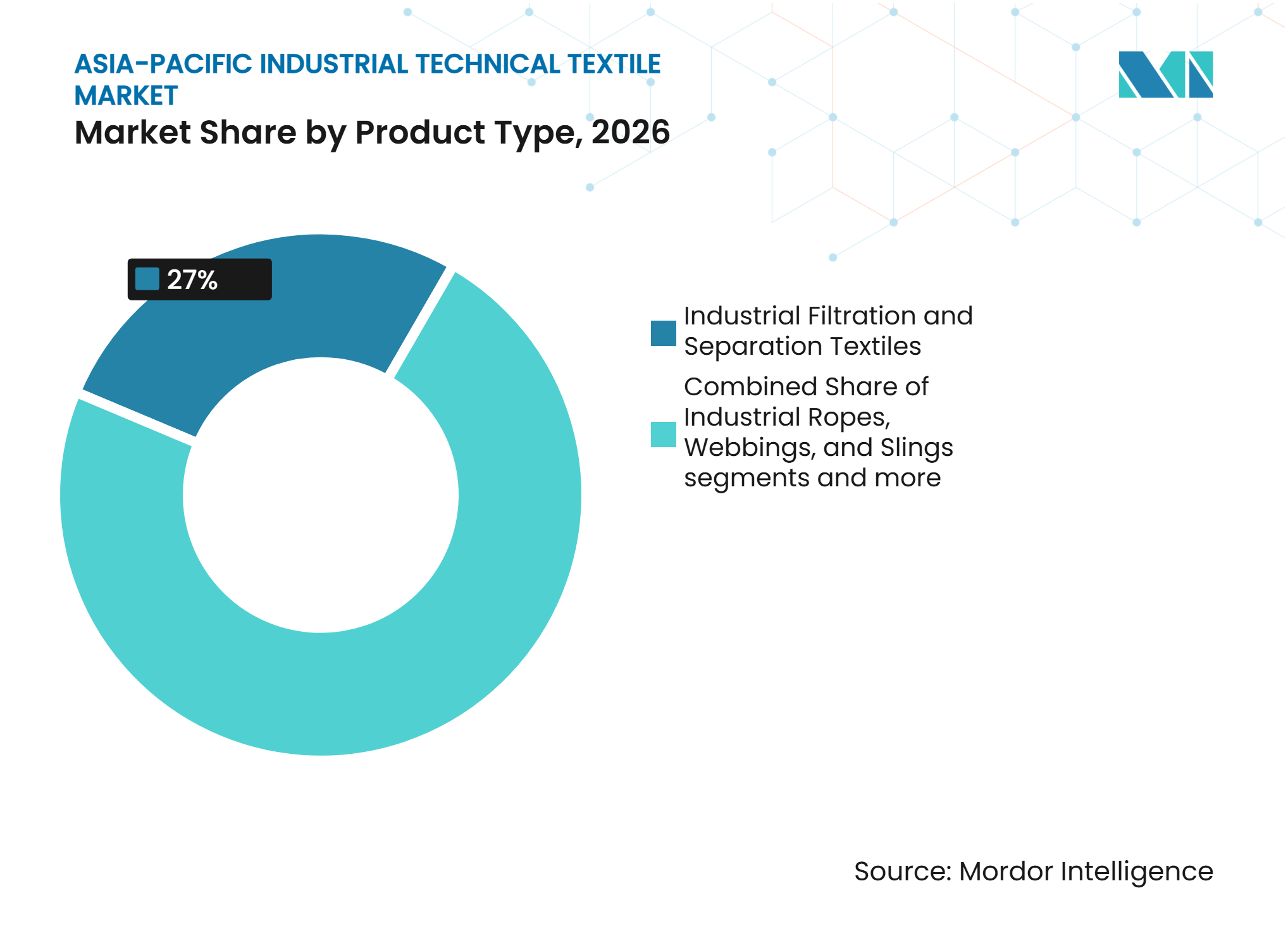
Filtration Leads While Composite Reinforcement Expands FasterIndustrial filtration and separation textiles accounted for 27% of the Asia-Pacific industrial technical textile market size in 2026. The segment serves cement, chemical, pharmaceutical, food-processing, and other plants that require continuous process filtration. Needle-punched and woven polyester or polyimide media are central to industrial gas and dust control in major manufacturing clusters. China’s GB-series air-quality requirements and India’s Quality Control Orders for technical textiles reinforce the need for materials that meet defined performance specifications. The category benefits from a wide installed base of industrial equipment and recurring replacement needs. It also has higher entry requirements where applications require documented particle capture, chemical resistance, or temperature performance.
Industrial composite reinforcement textiles are forecast to grow at a 7% CAGR through 2032. The Asia-Pacific industrial technical textile market supports this expansion through demand for EV battery structures, aerospace laminates, and civil reinforcement. Composite materials can address weight, thermal management, and structural requirements that standard textiles cannot meet. Carbon-fiber use in battery housings highlights the movement toward stronger and lighter assemblies. Paper-machine clothing remains relevant in Japan, South Korea, and China, although digital printing has pressured some forming-fabric volumes in Japan. Belting and flexible reinforcement fabrics face price pressure, while ropes, webbings, and slings continue to serve offshore energy, port handling, and maritime infrastructure applications.



By Material Type:
Polyester Remains the Core Material While Specialty Fibers Gain GroundPolyester held 35% of the Asia-Pacific industrial technical textile market share in 2026. Its role across filtration, belting, tire cord, and process fabrics reflects a usable balance of cost and performance. Polyamide remains important in tire cord and high-tenacity rope applications. Polypropylene and polyethylene are used in geotextiles and medical nonwovens. However, producers of these materials are more exposed to commodity input movements. Glass fiber supports pipe reinforcement, chemical filtration, and thermal insulation. The material mix therefore continues to include high-volume fibers alongside specialized materials.
High-performance synthetic fibers are expected to expand at a 6.8% CAGR through 2032. Aramid, PPS, PTFE, PEEK, and polyimide support applications where thermal stability, chemical resistance, or electrical performance are more important than low material cost. The Asia-Pacific industrial technical textile market size for such specialized applications is supported by EV thermal management, chemical-process filtration, and high-frequency electronic insulation. Toray Advanced Materials Korea completed capacity expansion at Gumi Plant 4 to reach 8,000 tons per year of carbon-fiber capacity in H2 2025. Teijin Frontier also expanded high-tenacity recycled polyester filament yarn capacity in Thailand by 620 tons per year, showing that recycled content is becoming a competitive factor in industrial yarn. Traceability requirements add a further qualification consideration for advanced materials.
By End-Use Application:
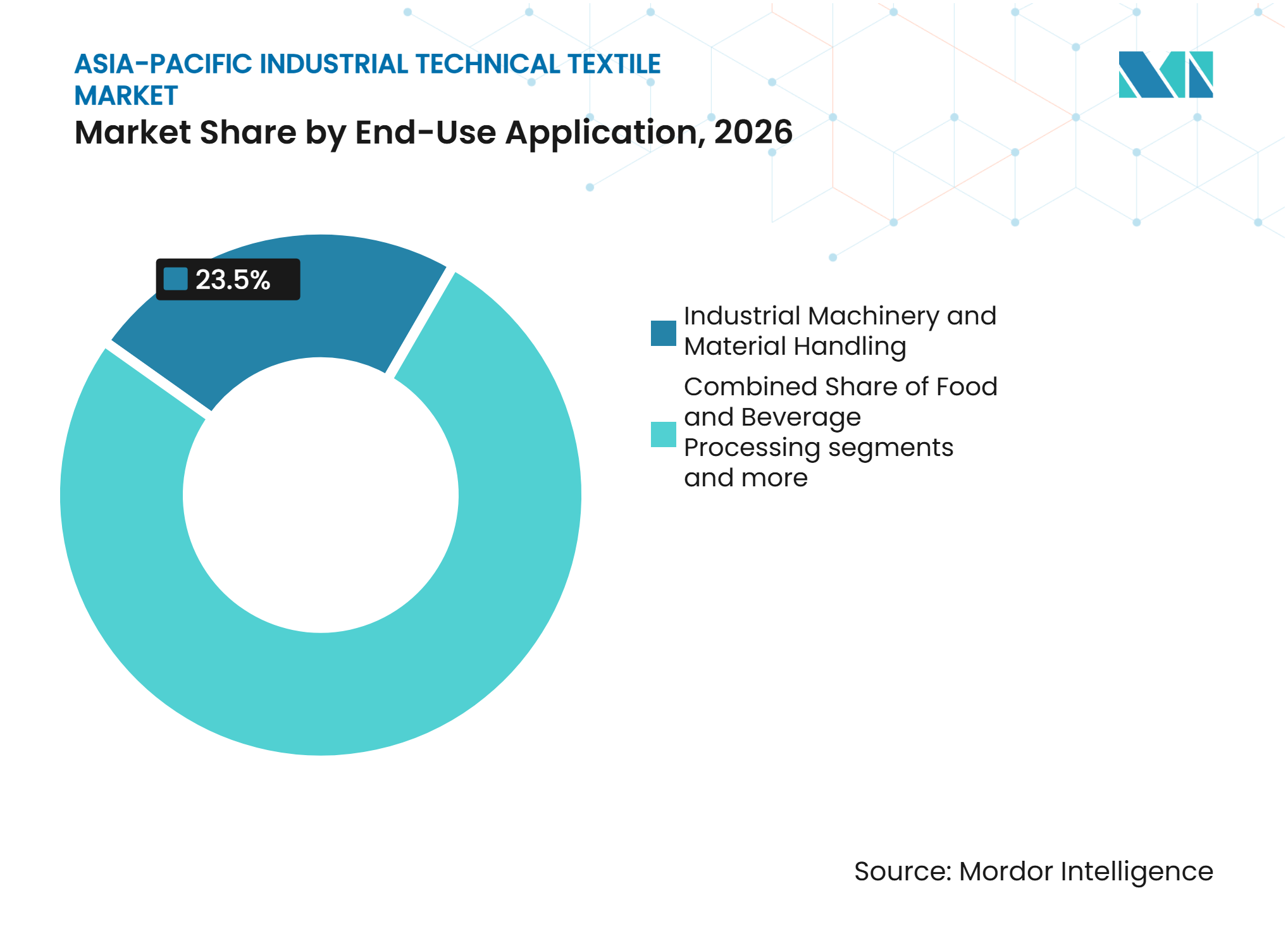
Machinery Holds the Largest Base While Battery Manufacturing Grows FastestIndustrial machinery and material handling held 23.5% of the Asia-Pacific industrial technical textile market share in 2026. Demand comes from conveyor-belt reinforcement, industrial hoses, pneumatic conveying, and process filtration across regional manufacturing. Mining in Australia and Indonesia, cement production in China and India, and vehicle assembly across several Asian countries sustain this demand base. The sector relies on durable materials that can withstand abrasion, tension, heat, and chemical exposure. Pulp, paper, and nonwoven production also supports technically demanding uses of paper-machine clothing. Mining, metals, cement, and mineral processing add stable demand for high-performance filter bags.
Electrical, electronics, and battery manufacturing is forecast to grow at an 8% CAGR through 2032. Lithium-ion cell production requires separator backing fabrics, thermal-barrier materials, module packaging textiles, and cleanroom process fabrics. These applications are linked to capacity additions in Japan, South Korea, and India’s battery corridor. Chemical and pharmaceutical manufacturing creates related demand for PTFE and PPS filter media and validated process systems. Food and beverage processing in Southeast Asia adds demand for hygienic textiles as food-safety requirements strengthen. Textile manufacturing and industrial printing add demand for precision mesh, press-pad fabrics, and specialized process materials.

Geography Analysis
China
China held 43% of the Asia-Pacific industrial technical textile market share in 2026, based on its concentration of automotive, paper, chemical, construction, and filtration activity. The country is shifting from commodity filtration and belting products toward composite reinforcement and thermal-management materials as EV production becomes more important. China produced more than 26 million light vehicles in 2025, and electric platforms require an additional 2-4 kg of nonwoven and composite materials per vehicle. China’s environmental requirements increase investment needs for water treatment, emissions control, and energy efficiency. Producers in Jiangsu and Guangdong face pressure to invest in zero-liquid-discharge systems and related upgrades. Suppliers that respond early can improve their position with multinational customers that evaluate Scope 3 supply-chain performance. This makes compliance capability a commercial factor as well as a regulatory requirement.
India
India is forecast to expand at an 8.5% CAGR through 2032. The Asia-Pacific industrial technical textile market size in India benefits from aligned support for research, capacity, and commercialization. The National Technical Textiles Mission has INR 1,480 crore (USD 164.7 million) through March 2026; the PLI Textiles program has INR 10,683 crore (USD 1.2 billion) through FY2029-30; and Tex-RAMPS has INR 305 crore (USD 33.9 million) over 6 years from FY2025-26. Infrastructure investment and climate-resilience procurement are creating direct demand for geotextiles and geomembranes. The September 2025 ADB procurement notice for the Brahmaputra project illustrates this connection.[3] Spunweb’s capacity increase shows that nonwoven capacity is expanding locally. India also has an opportunity to supply neighboring manufacturing locations as more upstream capability is developed.
Japan, South Korea, and Southeast Asia
Japan and South Korea retain a technology position in carbon fiber, high-tenacity polyamide, and specialty nonwovens. METI included carbon fiber among 15 strategic technologies subject to enhanced export-control reporting under the Economic Security Promotion Act in 2025. This policy environment supports domestic advanced-material capacity and reinforces the regional role of high-performance composite suppliers. South Korea’s Gumi National Industrial Complex is receiving KRW 500 billion (USD 347.0 million) in investment commitments for advanced carbon and aramid fiber capacity. Thailand is building a role in specialty nonwovens and recycled industrial yarn, as illustrated by Teijin Frontier’s Pathumthani expansion. Vietnam, Indonesia, the Philippines, and other Southeast Asian markets are increasing industrial capacity, but some continue to rely on imported technical-textile inputs. Taiwan’s electronics cluster supports demand for precision woven fabrics and specialty insulation, while Australia remains a significant user of geosynthetics in mining and civil engineering.
Competitive Landscape
Market Concentration
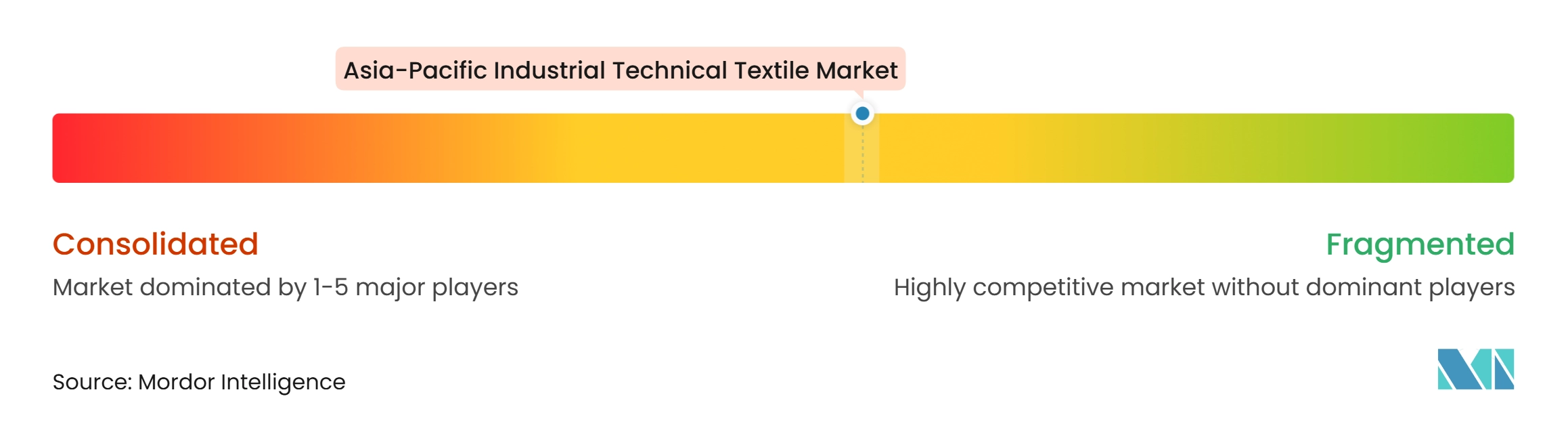
The Asia-Pacific industrial technical textile market exhibits a medium level of market concentration. Japanese and Korean groups have advantages in high-performance composites, specialty fibers, and paper-machine clothing, while Indian suppliers are active in tire cord, belting, and geosynthetics. Competitive conditions differ by product category. Carbon-fiber reinforcement and paper-machine clothing have fewer globally integrated suppliers, while filtration and geotextiles include many regional specialists. This structure means that scale is useful, but application engineering and qualification capability can be equally important. Suppliers are seeking to control more of the value chain from fiber procurement through fabric conversion and testing.
Asahi Kasei and Teijin agreed in December 2025 to integrate Asahi Kasei Advance and Teijin Frontier, effective October 1, 2026, with Teijin holding 80% and Asahi Kasei holding 20% of the surviving entity. The transaction combines procurement, high-performance fiber production, and industrial-material distribution. Teijin Frontier expanded recycled polyester filament yarn capacity by 620 tons per year in Thailand for tire cord, rubber-product reinforcement, and seat-belt applications. Toray Advanced Materials Korea expanded carbon-fiber capacity at Gumi Plant 4 to 8,000 tons per year. These actions reflect a focus on security of supply, higher-value materials, and regional production capability.
Traceability and quality certification are becoming points of competitive separation. ISO 9001- and ISO 13485-qualified components in ASEAN chemical and pharmaceutical applications, where local availability remains limited. Garware Technical Fibres Limited reported 101 patents filed and operations in more than 75 countries, illustrating the intellectual-property intensity of specialized ropes and cordage. Large R&D commitments and advanced testing capabilities can make it easier for established suppliers to meet customer requirements. Smaller companies can participate through local conversion, targeted specialty products, and partnerships, but long qualification periods remain a constraint.
Asia-Pacific Industrial Technical Textile Industry Leaders
-
Toray Industries, Inc.
-
Asahi Kasei Corporation
-
Teijin Limited
-
Toyobo Co., Ltd.
-
Mitsubishi Chemical Group Corporation
- *Disclaimer: Major Players sorted in no particular order
Asia-Pacific Industrial Technical Textile Market Companies Covered in this Report
- Toray Industries, Inc.
- Asahi Kasei Corporation
- Teijin Limited
- Toyobo Co., Ltd.
- Mitsubishi Chemical Group Corporation
- Mitsui Chemicals, Inc.
- Hyosung TNC Corporation
- Indorama Ventures Public Company Limited
- SRF Limited
- Arvind Limited
- Vardhman Textiles Limited
- Garware Technical Fibres Limited
- Strata Geosystems and Affiliates
- Freudenberg Performance Materials
- Ahlstrom Oyj
- Berry Global, Inc.
- DuPont de Nemours, Inc.
- 3M Company
- HUESKER Group
- Sioen Industries NV
- Fibertex Nonwovens A/S
- Kuraray Co., Ltd.
Recent Industry Developments in Asia-Pacific Industrial Technical Textile Market
- June 2026: Toray Advanced Materials Korea completed the expansion of its Meta-Aramid Fiber Unit 2 at its Gumi Plant 1 in South Korea. The additional unit provides an annual production capacity of 3,000 tons, increasing the company's total meta-aramid capacity to 5,400 tons. The expansion supports demand from power infrastructure, electric mobility, defense, and industrial safety applications.
- January 2026: SAERTEX announced the establishment of a new carbon fabric production facility in Pinghu, China, with production scheduled to begin in March 2026. The facility will manufacture carbon non-crimp fabrics for wind energy, automotive, and aerospace applications, strengthening the company's regional supply capabilities for lightweight composite materials.
- December 2025: Asahi Kasei and Teijin Limited agreed to an absorption-type merger between Asahi Kasei Advance Corp. and Teijin Frontier Co., effective October 1, 2026. The surviving entity, Teijin Frontier, with Teijin holding 80% and Asahi Kasei holding 20%, will combine global procurement, high-performance fiber manufacturing, and industrial materials distribution.
- November 2025: Teijin Frontier commenced capacity expansion at Teijin Polyester Thailand Limited in Pathumthani, adding 620 tons per year of high-tenacity recycled polyester filament yarn for tire cord, rubber-product reinforcement, and seat-belt applications.
Asia-Pacific Industrial Technical Textile Market Report Scope
The Asia-Pacific Industrial Technical Textile Market Report is Segmented by Product Type (Industrial Filtration and Separation Textiles, and More), by Material Type (Polyester, Polyamide, and More), by End-Use Application (Pulp, Paper, and Nonwoven Manufacturing, Chemical and Pharmaceutical Manufacturing, and More), and by Geography (China, Japan, and More). The Market Forecasts are Provided in Terms of Value (USD).
Segmentation Overview
| Industrial Filtration and Separation Textiles | Industrial Gas and Dust Filtration Textiles |
| Industrial Liquid Filtration Textiles | |
| Industrial Screening and Sieving Fabrics | |
| Paper-Machine Clothing and Specialty Process Textiles | Paper-Machine Forming Fabrics |
| Paper-Machine Press Felts and Fabrics | |
| Paper-Machine Dryer Fabrics | |
| Paper-Machine Shoe Press Belt Textiles | |
| Nonwoven Production and Specialty Process Fabrics | |
| Textile Processing and Finishing Fabrics | |
| Industrial Belting, Conveying, and Flexible Reinforcement Textiles | Textile Conveyor Belt Fabrics and Reinforcements |
| Industrial Drive and Power Transmission Belt Textiles | |
| Industrial Hose and Flexible Duct Textile Reinforcements | |
| Pneumatic Conveying and Fluidization Fabrics | |
| Industrial Ropes, Webbings, and Slings | Industrial Fiber Ropes and Cordage |
| Industrial Textile Webbings | |
| Textile Lifting Slings | |
| Industrial Composite Reinforcement Textiles | Woven Industrial Reinforcement Fabrics |
| Multiaxial and Non-Crimp Reinforcement Fabrics | |
| Other Engineered Composite Textile Reinforcements | |
| Industrial Thermal, Insulation, and Sealing Textiles | High-Temperature Industrial Fabrics |
| Others (Thermal Insulation Textile, Expansion Joint and Flexible Barrier Fabrics, etc.) | |
| Electrical and Electronic Industrial Textile Components | |
| Industrial Surface Processing, Printing, and Cleaning Textiles |
| Polyester |
| Polyamide |
| Polypropylene |
| Polyethylene and High-Performance Polyolefins |
| Glass Fibers |
| Carbon Fibers |
| Other High-Performance Synthetic Fibers (Aramid, PPS, PTFE, PEEK, Polyimide Fibers, etc.) |
| Other Materials (Other Inorganic and Mineral Fibers, Natural and Regenerated Cellulosic Fibers) |
| Pulp, Paper, and Nonwoven Manufacturing |
| Chemical and Pharmaceutical Manufacturing |
| Food and Beverage Processing |
| Mining, Metals, Cement, and Mineral Processing |
| Industrial Machinery and Material Handling |
| Electrical, Electronics, and Battery Manufacturing |
| Energy, Power, and Utilities |
| Textile Manufacturing and Industrial Printing |
| Other Industrial End-Use Industries |
| China |
| Japan |
| India |
| South Korea |
| Taiwan |
| Australia |
| Indonesia |
| Vietnam |
| Thailand |
| Rest of Asia-Pacific |
| By Product Type | Industrial Filtration and Separation Textiles | Industrial Gas and Dust Filtration Textiles |
| Industrial Liquid Filtration Textiles | ||
| Industrial Screening and Sieving Fabrics | ||
| Paper-Machine Clothing and Specialty Process Textiles | Paper-Machine Forming Fabrics | |
| Paper-Machine Press Felts and Fabrics | ||
| Paper-Machine Dryer Fabrics | ||
| Paper-Machine Shoe Press Belt Textiles | ||
| Nonwoven Production and Specialty Process Fabrics | ||
| Textile Processing and Finishing Fabrics | ||
| Industrial Belting, Conveying, and Flexible Reinforcement Textiles | Textile Conveyor Belt Fabrics and Reinforcements | |
| Industrial Drive and Power Transmission Belt Textiles | ||
| Industrial Hose and Flexible Duct Textile Reinforcements | ||
| Pneumatic Conveying and Fluidization Fabrics | ||
| Industrial Ropes, Webbings, and Slings | Industrial Fiber Ropes and Cordage | |
| Industrial Textile Webbings | ||
| Textile Lifting Slings | ||
| Industrial Composite Reinforcement Textiles | Woven Industrial Reinforcement Fabrics | |
| Multiaxial and Non-Crimp Reinforcement Fabrics | ||
| Other Engineered Composite Textile Reinforcements | ||
| Industrial Thermal, Insulation, and Sealing Textiles | High-Temperature Industrial Fabrics | |
| Others (Thermal Insulation Textile, Expansion Joint and Flexible Barrier Fabrics, etc.) | ||
| Electrical and Electronic Industrial Textile Components | ||
| Industrial Surface Processing, Printing, and Cleaning Textiles | ||
| By Material Type | Polyester | |
| Polyamide | ||
| Polypropylene | ||
| Polyethylene and High-Performance Polyolefins | ||
| Glass Fibers | ||
| Carbon Fibers | ||
| Other High-Performance Synthetic Fibers (Aramid, PPS, PTFE, PEEK, Polyimide Fibers, etc.) | ||
| Other Materials (Other Inorganic and Mineral Fibers, Natural and Regenerated Cellulosic Fibers) | ||
| By End-Use Application | Pulp, Paper, and Nonwoven Manufacturing | |
| Chemical and Pharmaceutical Manufacturing | ||
| Food and Beverage Processing | ||
| Mining, Metals, Cement, and Mineral Processing | ||
| Industrial Machinery and Material Handling | ||
| Electrical, Electronics, and Battery Manufacturing | ||
| Energy, Power, and Utilities | ||
| Textile Manufacturing and Industrial Printing | ||
| Other Industrial End-Use Industries | ||
| By Geography | China | |
| Japan | ||
| India | ||
| South Korea | ||
| Taiwan | ||
| Australia | ||
| Indonesia | ||
| Vietnam | ||
| Thailand | ||
| Rest of Asia-Pacific | ||
Key Questions Answered in the Report
What is the expected growth rate of Asia-Pacific industrial technical textiles?
The sector is forecast to grow at a 5.5% CAGR from 2027 to 2032, reaching USD 36.17 billion by 2032 from USD 26.35 billion in 2026. Demand comes from industrial filtration, vehicle electrification, infrastructure construction, healthcare capacity, and manufacturing applications.
Which product type has the largest share in Asia-Pacific industrial technical textiles?
Industrial filtration and separation textiles lead with a 27% share in 2026. Cement, chemical, pharmaceutical, food-processing, and other plants use these textiles for ongoing process filtration and dust control. Environmental requirements in China and India support demand for filter media that can demonstrate appropriate material performance.
Which material is growing fastest in Asia-Pacific industrial technical textiles?
High-performance synthetic fibers are forecast to grow at a 6.8% CAGR through 2032. Aramid, PPS, PTFE, PEEK, and polyimide are used where high heat resistance, chemical resistance, or electrical performance is required. Key demand areas include EV thermal management, chemical-process filtration, and high-frequency electronic insulation.
Why is India growing faster than the regional average?
India is projected to grow at an 8.5% CAGR because technical-textile programs, infrastructure investment, geosynthetics procurement, and manufacturing capacity are expanding together. The NTTM, PLI Textiles program, and Tex-RAMPS provide support across research, capacity creation, and commercialization. Flood-management and transport projects also create direct requirements for geotextiles and related materials.
How are electric vehicles affecting industrial technical textile demand?
Electric vehicles increase demand for nonwovens, thermal barriers, acoustic materials, electrical insulation, and composite reinforcement for battery systems. The supplied data indicate that battery-electric vehicles use 10-15 kg of nonwoven fabric, compared with 8-12 kg in comparable internal-combustion vehicles. This additional content supports material demand across several technical applications, including battery insulation, electromagnetic shielding, acoustic dampening, thermal-protection layers, and structural composite components used across regional vehicle platforms and supply chains.
What are the main barriers facing technical textile producers in Asia-Pacific?
Key barriers include volatile input costs, long customer qualification periods, environmental compliance investment, and gaps in testing and skilled operations. Product approval can take 12-24 months in demanding automotive, food, and pharmaceutical applications. Smaller producers are especially exposed when they cannot recover input costs or access customer-approved testing facilities.