
Asia-Pacific Industrial Asset Inspection Services Market Size and Share
Market Overview
| Study Period | 2021 - 2032 |
|---|---|
| Forecast Data Period | 2027 - 2032 |
| Base Year Market Size (2026) | USD 14.56 Billion |
| Market Size (2027) | USD 15.58 Billion |
| Market Size (2032) | USD 22.89 Billion |
| Growth Rate (2027 - 2032) | 8.00 % |
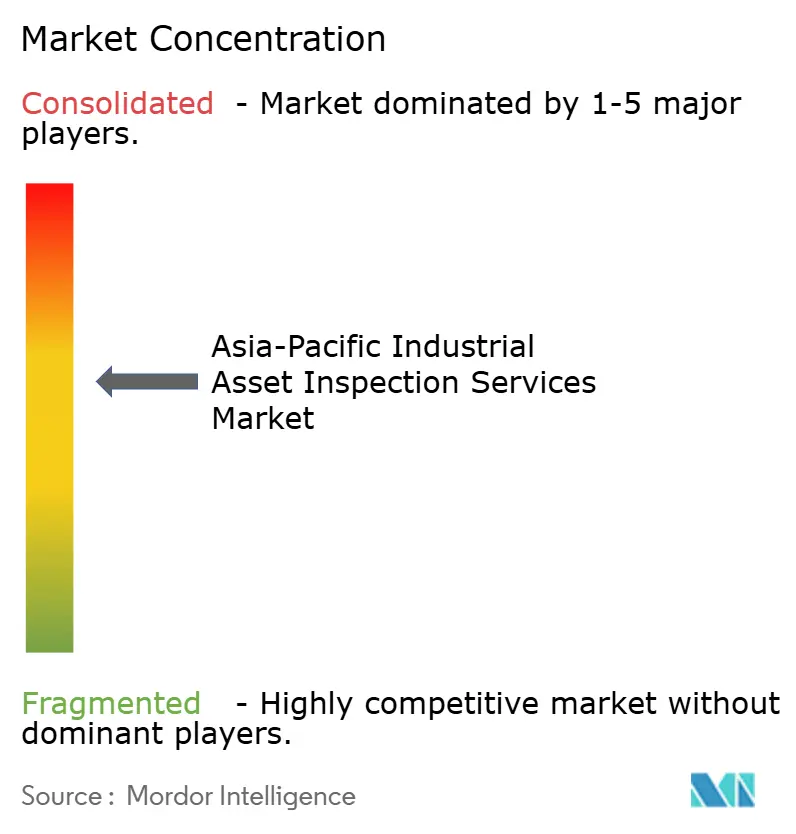
| Market Concentration | Medium |
Major Players *Disclaimer: Major Players sorted in no particular order Image © Mordor Intelligence. Reuse requires attribution under CC BY 4.0. | |
Asia-Pacific Industrial Asset Inspection Services Market Analysis by Mordor Intelligence
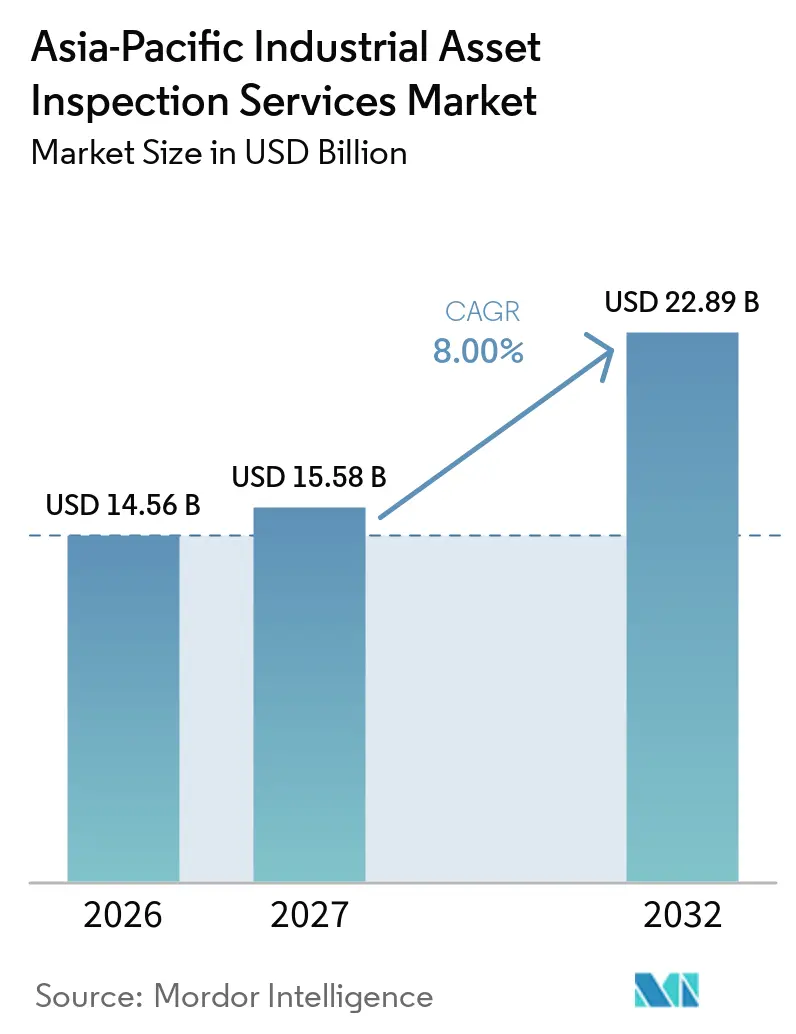
The Asia-Pacific Industrial Asset Inspection Services Market size is projected to expand from USD 14.56 billion in 2026 and USD 15.58 billion in 2027 to USD 22.89 billion by 2032, registering a CAGR of 8% between 2027 and 2032.
Capital spending on energy, process industries, transport infrastructure, and power systems is expanding the installed base that requires inspection before commissioning and throughout operation. The Asia-Pacific industrial asset inspection services market benefits because a new asset creates recurring work in corrosion monitoring, structural assessment, equipment testing, and integrity verification. Risk-based inspection rules are also moving buyers toward continuous asset integrity programs rather than isolated calendar-based checks. This favors providers that can combine accredited field work, digital reporting, and long-term maintenance support. Competition remains moderately concentrated, while shortages of certified technicians and the high cost of advanced equipment limit the pace at which smaller providers can expand.
Key Report Takeaways
- By asset type, pipelines and piping systems held 24% of the Asia-Pacific industrial asset inspection services market share in 2026, while electrical and power equipment is forecast to expand at a 9.5% CAGR through 2032.
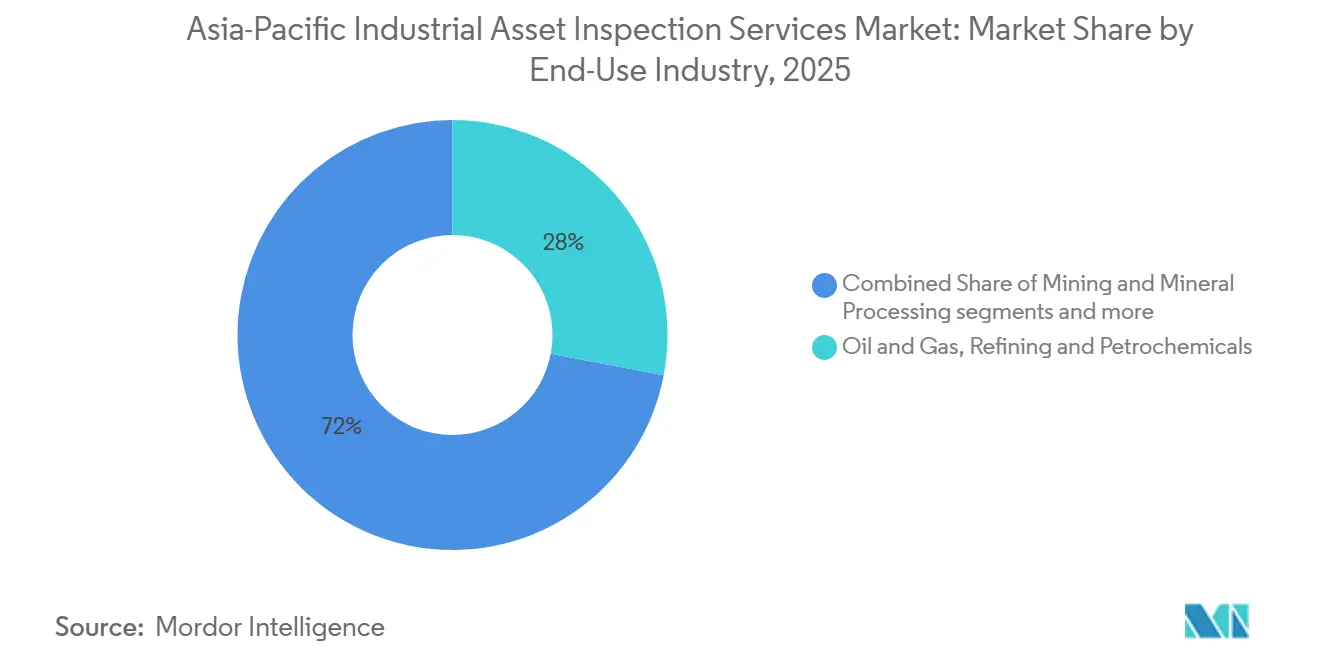
- By end-use industry, oil and gas, refining and petrochemicals held 28% of the Asia-Pacific industrial asset inspection services market size in 2026, while power generation, renewable energy and electrical utilities are forecast to expand at a 10% CAGR through 2032.
- By geography, China held a 32% revenue share in 2026, while India is forecast to expand at a 10% CAGR through 2032.
Note: Market size and forecast figures in this report are generated using Mordor Intelligence’s proprietary estimation framework, updated with the latest available data and insights as of January 2026.
Asia-Pacific Industrial Asset Inspection Services Market Trends and Insights
Drivers Impact Analysis*
| Driver | (~) % Impact on CAGR Forecast | Geographic Relevance | Impact Timeline |
|---|---|---|---|
| Accelerating Industrial Infrastructure and Energy Investment | +2.5% | China, India, Southeast Asia | Medium term (2-4 years) |
| Stricter Safety, Quality, and Regulatory Compliance Requirements | +1.8% | China, India, Malaysia, Australia, Singapore | Short term (≤ 2 years) |
| Expansion of Outsourced Inspection and Risk-Based Maintenance | +1.2% | Asia-Pacific, ASEAN, South Korea | Medium term (2-4 years) |
| Industry 4.0, AI, and Automated Inspection Adoption | +0.9% | China, Japan, South Korea, ASEAN | Long term (≥ 4 years) |
| Cross-Border Manufacturing and Supplier-Quality Complexity | +0.7% | Vietnam, Thailand, Indonesia, China | Short term (≤ 2 years) |
| Remote Inspection for Hazardous, Offshore, and Hard-to-Reach Assets | +0.5% | Australia, Southeast Asia, China | Medium term (2-4 years) |
| Source: Mordor Intelligence | |||
Accelerating Industrial Infrastructure and Energy Investment
Energy and industrial capital programs remain the main source of new inspection demand across the region. Global energy investment is expected to reach USD 3.3 trillion in 2025, and China is the largest national investor in this cycle.[1] Southeast Asia’s clean energy investment reached USD 47 billion in 2025, compared with USD 30 billion in 2015. New wind farms, solar facilities, substations, pipelines, LNG trains, and industrial plants create work before start-up and during operation. The Asia-Pacific industrial asset inspection services market therefore gains from the volume of assets entering regulated inspection cycles after commissioning. China also began construction on nearly 100 gigawatts of coal-fired capacity in 2024, adding to the inspection base alongside renewable and grid investment.
Stricter Safety, Quality, and Regulatory Compliance Requirements
For the Asia-Pacific industrial asset inspection services market, regulatory changes are raising the minimum level of asset integrity work required from industrial owners. Malaysia’s Special Scheme of Inspection Regulations 2025 were launched by PETRONAS and the Department of Occupational Safety and Health in August 2025. The rules replace the earlier 2014 risk-based inspection framework with a broader approach to asset integrity and safety management. This change supports continuous assessment of high-risk equipment rather than relying only on fixed inspection dates. The Asia-Pacific industrial asset inspection services market has a more stable compliance base when inspection is linked to certification and operating approval. Australia’s revised Model Work Health and Safety Regulations also maintain equipment validation and safety obligations for major hazard facilities.[2]
Expansion of Outsourced Inspection and Risk-Based Maintenance
Asset owners are increasingly using third-party specialists for inspection, condition monitoring, and compliance documentation. Malaysia’s regulatory framework places risk-based inspection at the center of the statutory system for covered industrial assets. Providers with recognized methods and multidisciplinary teams are better able to meet this requirement than narrow, single-service contractors. Baker Hughes received a 90-month agreement from bp in August 2025 for turbomachinery services at the Tangguh LNG facility in Indonesia. The contract covers inspection, spare parts, and field engineering for equipment across three LNG trains. Such arrangements move procurement toward longer service relationships and strengthen demand for providers that can take responsibility for technical delivery and reporting. The Asia-Pacific industrial asset inspection services market is shifting away from day-rate work toward integrated asset integrity contracts.
Industry 4.0, AI, and Automated Inspection Adoption
Digital methods are becoming more relevant where customers need faster interpretation, traceable records, and better coverage of complex assets. South Korea awarded a New Excellent Technology certification in June 2025 to an automated industrial diagnostic solution developed by SK Innovation and Deep AI. The solution applies artificial intelligence to heat exchanger inspection and was reported to deliver diagnostic accuracy above 95%. It was also reported to reduce interpretation time by 98% compared with manual analysis. Rockwell Automation found that 41% of the Asia-Pacific industrial organizations plan to accelerate automation adoption to address workforce shortages and skills gaps. The Asia-Pacific industrial asset inspection services market will favor companies that can pair certified personnel with automated data capture, defect classification, and usable digital reports.
Restraints Impact Analysis*
| Restraint | (~) % Impact on CAGR Forecast | Geographic Relevance | Impact Timeline |
|---|---|---|---|
| Shortage of Certified Level II and Level III Inspection Personnel | -1.2% | India, Southeast Asia, emerging Asia-Pacific markets | Short term (≤ 2 years) |
| High Cost of Advanced Inspection Equipment and Digital Integration | -0.8% | Asia-Pacific, especially smaller operators and emerging economies | Medium term (2-4 years) |
| Fragmented Accreditation and National Inspection Standards | -0.6% | Asia-Pacific, ASEAN, South Asia cross-border contracts | Long term (≥ 4 years) |
| Cybersecurity and Evidence-Chain Risk in Connected Inspection | -0.4% | China, South Korea, Australia, Singapore | Medium term (2-4 years) |
| Source: Mordor Intelligence | |||
Shortage of Certified Level II and Level III Inspection Personnel
The supply of qualified personnel limits the ability of providers to meet demand across expanding industrial asset portfolios. The American Society for Nondestructive Testing reported that there are nearly 150,000 certified NDT professionals worldwide and fewer than 1,200 senior Level III trainers.[3] The same work states that 47% of certified technicians require further skill bridging after formal qualification. It also links skill gaps to 15%-20% of delays in inspection-dependent projects. Regional training is expanding through programs aligned with ISO 9712, but the pace remains uneven across emerging markets. The Asia-Pacific industrial asset inspection services market faces a capacity constraint when operators need qualified people faster than training systems can produce them.
High Cost of Advanced Inspection Equipment and Digital Integration
Advanced methods require more capital than conventional visual or manual inspection tools. Phased-array ultrasonic testing, digital radiography, full-matrix capture, eddy current arrays, and artificial intelligence software require equipment, data systems, training, and validation. The ASNT found that more than 70% of NDT learners prefer hybrid training that combines digital learning with structured equipment practice. Smaller providers may find it difficult to finance these capabilities at the same pace as global testing, inspection, and certification companies. Fragmented national accreditation requirements can add cost when providers work across several Asia-Pacific countries. Connected tools also create cybersecurity and evidence-chain risks, which require secure data management and reliable inspection records. The Asia-Pacific industrial asset inspection services market may become more concentrated in advanced methods because large providers can spread these costs across broader contract portfolios.
*Our forecasts treat driver/restraint impacts as directional, not additive. The impact forecasts reflect baseline growth, mix effects, and variable interactions.
Segment Analysis
By Asset Type: Pipelines Lead Inspection Demand While Power Equipment Expands Fastest
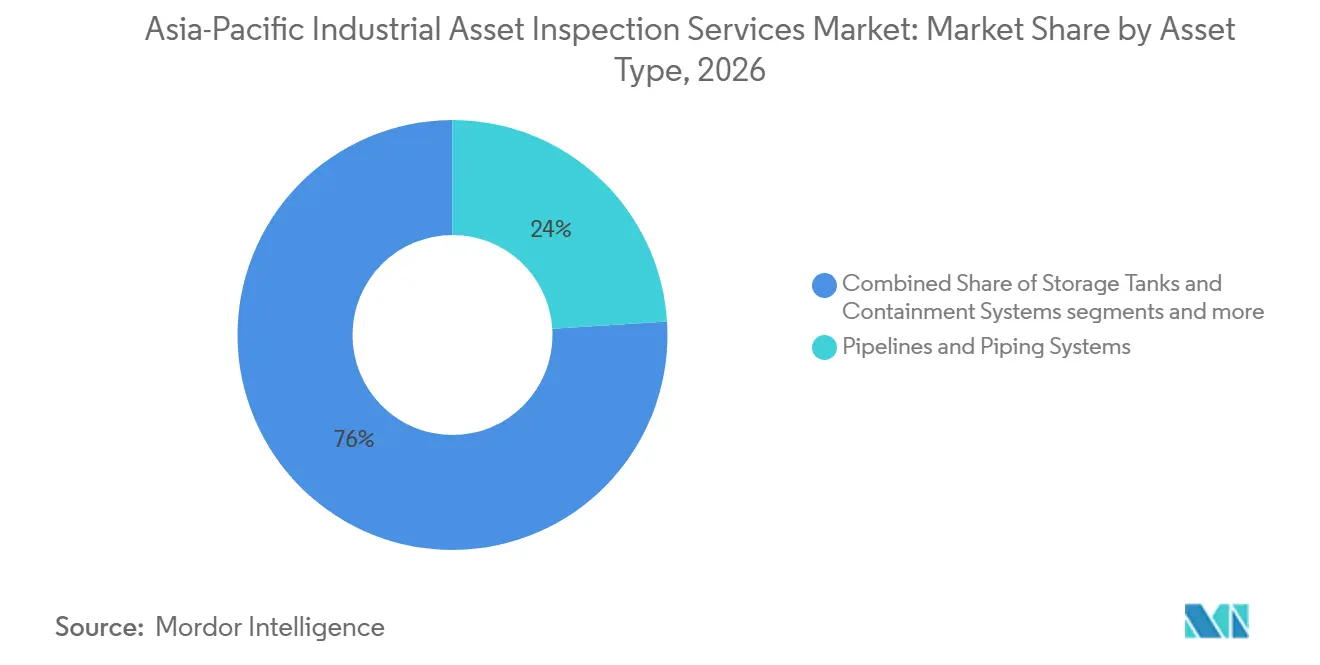
Pipelines and piping systems accounted for 24% of the Asia-Pacific industrial asset inspection services market share in 2026, reflecting the region’s large oil, gas, water, chemical, and industrial pipeline networks. Operators require corrosion monitoring, intelligent pigging, integrity assessment, and risk-based planning across these systems because pressure equipment and pipeline safety frameworks support recurring inspection requirements. Pressure vessels, boilers, and heat exchangers also generate material demand across refining, petrochemicals, power generation, and heavy manufacturing, where safety verification is essential. Storage tanks and containment systems require inspection as refineries and chemical operators address containment and environmental obligations, while rotating and mechanical equipment adds work through pumps, compressors, turbines, and related systems.
Electrical and power equipment is projected to grow at a 9.5% CAGR from 2027 to 2032, making it the fastest-growing asset type in the Asia-Pacific industrial asset inspection services market. Grid modernization, renewable commissioning, and higher electricity demand raise inspection needs for substations, transformers, switchgear, generation equipment, and related fixed infrastructure. South Korea’s 2025 certification of an AI-based diagnostic solution indicates the growing role of automated analysis in complex equipment. Industrial structures and fixed installations are gaining attention as offshore platforms, structural steel, and industrial towers operate beyond original design periods. At the same time, furnaces, refractory systems, instrumentation, and other specialized assets can command higher value where expertise or difficult access is required.

By End-Use Industry: Oil and Gas Holds the Largest Share While Utilities Lead Growth
Oil and gas, refining, and petrochemicals accounted for 28% of the Asia-Pacific industrial asset inspection services market share in 2026. This end-use group has a large installed base of refineries, LNG facilities, pipelines, offshore assets, and chemical processing equipment. It requires regular checks of pressure systems, storage facilities, rotating equipment, structural elements, and electrical systems. Baker Hughes’ 90-month Tangguh LNG agreement shows the scale and duration of technical service commitments in the segment. Chemical manufacturing and mining and mineral processing require recurring inspection of process equipment, industrial structures, and support systems.
Power generation, renewable energy, and electrical utilities are projected to expand at a 10% CAGR through 2032. Wind projects, solar facilities, transmission systems, conventional plants, and nuclear assets all need pre-commissioning verification and in-service integrity checks. Water and wastewater utilities add work as aging municipal infrastructure requires condition assessment in India and China. Food and beverage processing, pharmaceuticals, and bioprocessing are recurring niches because hygiene, pressure equipment, and contamination controls are material. Transportation, logistics, and port operations require maintenance assessment of terminals, storage areas, handling systems, and supporting structures.
Geography Analysis
China held a 32% revenue share in 2026, supported by a large installed base of refineries, LNG facilities, pipelines, thermal plants, nuclear assets, and renewable infrastructure. New coal capacity, grid expansion, and renewable projects increase requirements across mechanical, structural, and electrical inspection. Japan and South Korea support premium work in petrochemicals, semiconductors, nuclear power, and advanced electrical infrastructure, with South Korea also serving as an early setting for AI-enabled inspection methods.
India is projected to grow at a 10% CAGR from 2027 to 2032, supported by infrastructure investment, renewable capacity, and growing safety and certification requirements. Its pipeline, refining, power, transport, and manufacturing programs support demand across several asset categories. Taiwan requires specialized assurance for semiconductor and advanced electronics infrastructure, while Australia’s offshore oil and gas, LNG, mining, and industrial facilities sustain demand from domestic and multinational providers.
Malaysia’s risk-based inspection regulations, Indonesia’s LNG development, and manufacturing growth in Vietnam and Thailand support ASEAN demand. Malaysia’s 2025 rules formalize asset integrity requirements, while its nondestructive testing base supports local delivery despite skills and equipment constraints. Pakistan, Bangladesh, Sri Lanka, and frontier Pacific economies contribute less in the current market scenario but offer potential as formal compliance systems develop.
Competitive Landscape
The Asia-Pacific industrial asset inspection services market exhibits a medium level of market concentration. They compete through accredited teams, long-term agreements, regional coverage, and advanced methods such as phased-array ultrasonic testing, robotics, drone work, digital radiography, and asset integrity reporting. Smaller firms can compete through specialist expertise, local certifications, faster field response, and lower operating costs, particularly in India and Southeast Asia.
SGS expanded remote inspection capability through its September 2025 acquisition of Fulcrum Robotics in Australia, adding aerial, marine, and terrestrial drone inspection services. Bureau Veritas expanded in cybersecurity, nuclear, and transition services through acquisitions announced in July 2025, broadening its service base and raising the capability threshold for smaller specialists. Baker Hughes strengthened its presence in Indonesia with a long-term LNG services agreement, highlighting the value of technology, long-duration contracts, and local delivery capacity.
MISTRAS Group and Evident Corporation compete through specialized inspection technology, field analytics, and advanced equipment. DNV and Lloyd’s Register retain advantages in offshore and marine applications because of their classification and assurance roles. Applus+ received a 2025 contract in China for Petrobras FPSO projects P-84 and P-85 across facilities in China, Singapore, Malaysia, and Indonesia, showing the value of multi-country, multi-discipline FPSO capability. Providers without accreditation, specialist methods, or a regional footprint may be limited to localized and less complex scopes.
Asia-Pacific Industrial Asset Inspection Services Industry Leaders
-
Bureau Veritas SA
-
Intertek Group plc
-
Applus Services SA
-
TÜV Rheinland AG
-
SGS
- *Disclaimer: Major Players sorted in no particular order
Recent Industry Developments
- March 2026: The International Organization for Standardization (ISO) is expected to publish ISO/IEC 17020:2026, revising the requirements for inspection bodies and updating provisions related to impartiality, personnel competence, risk-based thinking, and data and information control. The revised standard will introduce changes that accredited inspection providers across Asia-Pacific must address as national accreditation bodies implement transition arrangements. These changes will increase the importance of standardized procedures and compliance with accreditation requirements.
- August 2025: Malaysia’s DOSH and PETRONAS formally launched the Occupational Safety and Health Special Scheme of Inspection Regulations 2025, replacing the 2014 Factories and Machinery RBI Regulations. The revised framework embeds systematic risk-based inspection into asset certification processes, raising compliance obligations for industrial asset owners across Malaysia’s oil, gas, petrochemical, and manufacturing sectors.
- July 2025: Baker Hughes and PETRONAS entered into a memorandum of understanding to explore technology partnerships and local supply chain development supporting Asia-Pacific energy expansion, including plans for a full aeroderivative gas turbine module repair and inspection facility in Malaysia.
- July 2025: Bureau Veritas announced acquisitions of Institute For Cyber Risk in Denmark, nuclear services firm Dornier Hinneburg in Germany, and sustainability consulting firm EcoPlus in South Korea, extending its inspection portfolio across cybersecurity, nuclear, and transition services.
Asia-Pacific Industrial Asset Inspection Services Market Report Scope
The Asia-Pacific Industrial Asset Inspection Services Market Report is Segmented by Asset Type (Pipelines and Piping Systems, Pressure Vessels, Boilers and Heat Exchangers, and More), by End-Use Industry (Oil and Gas, Refining and Petrochemicals, Mining and Mineral Processing, Water and Wastewater Utilities, and More), and by Geography (China, Japan, India, and More). The Market Forecasts are Provided in Terms of Value (USD).
| Pipelines and Piping Systems | Oil, Gas and Industrial Transmission Pipelines |
| Process Piping and Industrial Utility Piping | |
| Offshore Pipelines, Risers and Flowlines | |
| Pressure Vessels, Boilers and Heat Exchangers | Pressure Vessels and Process Reactors |
| Industrial Boilers and Steam Systems | |
| Heat Exchangers and Pressurized Thermal Equipment | |
| Storage Tanks and Containment Systems | Aboveground and Underground Industrial Storage Tanks |
| Industrial Containment and Bulk Storage Systems | |
| Rotating and Mechanical Equipment | Pumps, Compressors and Industrial Turbines |
| Conveyors, Drives and Fixed Production Machinery | |
| Other Installed Mechanical Equipment | |
| Electrical and Power Equipment | Transformers, Switchgear and Power Distribution Equipment |
| Generators and Electrical Installations | |
| Power Transmission and Electrical Utility Assets | |
| Industrial Structures and Fixed Installations | Industrial Structural Steel and Equipment Supports |
| Offshore Platforms and Fixed Energy Installations | |
| Industrial Towers, Stacks and Supporting Structures | |
| Other Fixed Industrial Assets | Process Furnaces and Refractory Systems |
| Industrial Instrumentation and Control Installations | |
| Other Specialized Installed Industrial Assets |
| Oil and Gas, Refining and Petrochemicals |
| Power Generation, Renewable Energy and Electrical Utilities |
| Chemical Manufacturing (Excluding Petrochemicals) |
| Metals and Other Industrial Manufacturing |
| Mining and Mineral Processing |
| Water and Wastewater Utilities |
| Food and Beverage Processing |
| Pharmaceuticals and Bioprocessing |
| Transportation, Logistics and Port Operations |
| Other Industrial End Users |
| China |
| Japan |
| India |
| South Korea |
| Taiwan |
| Australia |
| ASEAN Region |
| Rest of Asia-Pacific |
| By Asset Type | Pipelines and Piping Systems | Oil, Gas and Industrial Transmission Pipelines |
| Process Piping and Industrial Utility Piping | ||
| Offshore Pipelines, Risers and Flowlines | ||
| Pressure Vessels, Boilers and Heat Exchangers | Pressure Vessels and Process Reactors | |
| Industrial Boilers and Steam Systems | ||
| Heat Exchangers and Pressurized Thermal Equipment | ||
| Storage Tanks and Containment Systems | Aboveground and Underground Industrial Storage Tanks | |
| Industrial Containment and Bulk Storage Systems | ||
| Rotating and Mechanical Equipment | Pumps, Compressors and Industrial Turbines | |
| Conveyors, Drives and Fixed Production Machinery | ||
| Other Installed Mechanical Equipment | ||
| Electrical and Power Equipment | Transformers, Switchgear and Power Distribution Equipment | |
| Generators and Electrical Installations | ||
| Power Transmission and Electrical Utility Assets | ||
| Industrial Structures and Fixed Installations | Industrial Structural Steel and Equipment Supports | |
| Offshore Platforms and Fixed Energy Installations | ||
| Industrial Towers, Stacks and Supporting Structures | ||
| Other Fixed Industrial Assets | Process Furnaces and Refractory Systems | |
| Industrial Instrumentation and Control Installations | ||
| Other Specialized Installed Industrial Assets | ||
| By End-Use Industry | Oil and Gas, Refining and Petrochemicals | |
| Power Generation, Renewable Energy and Electrical Utilities | ||
| Chemical Manufacturing (Excluding Petrochemicals) | ||
| Metals and Other Industrial Manufacturing | ||
| Mining and Mineral Processing | ||
| Water and Wastewater Utilities | ||
| Food and Beverage Processing | ||
| Pharmaceuticals and Bioprocessing | ||
| Transportation, Logistics and Port Operations | ||
| Other Industrial End Users | ||
| By Geography | China | |
| Japan | ||
| India | ||
| South Korea | ||
| Taiwan | ||
| Australia | ||
| ASEAN Region | ||
| Rest of Asia-Pacific | ||
Key Questions Answered in the Report
What is the size of the Asia-Pacific industrial asset inspection services sector?
The Asia-Pacific industrial asset inspection services market size is USD 14.6 billion in 2026 and is forecast to reach USD 22.9 billion by 2032 at an 8.00% CAGR. Growth is tied to a rising installed base of energy, grid, process, transport, and industrial assets that need checks before commissioning and throughout operation.
Which asset category holds the largest share in Asia-Pacific industrial asset inspection services?
Pipelines and piping systems hold the largest share at 24% in 2026 because the region has extensive energy, water, chemical, and industrial pipeline networks. These systems require corrosion monitoring, integrity assessment, and risk-based planning over their operating life.
Which end-use application is growing fastest for industrial asset inspection services in Asia-Pacific?
Power generation, renewable energy, and electrical utilities is projected to grow at a 10% CAGR through 2032. Grid modernization, renewable commissioning, and rising electricity demand increase the need to verify substations, transformers, switchgear, generation equipment, and supporting infrastructure.
Which country leads Asia-Pacific demand for industrial asset inspection services?
China leads with a 32% share in 2026, supported by its large installed base of refining, pipeline, power, nuclear, and renewable assets. Its ongoing power and industrial additions require mechanical, structural, and electrical inspection coverage.
Why are risk-based inspection programs important for industrial operators?
Risk-based programs focus resources on equipment condition and potential consequences rather than using fixed dates alone. They support ongoing asset integrity management, compliance documentation, and more targeted deployment of qualified inspection teams.
What limits the expansion of industrial asset inspection capacity in Asia-Pacific?
A shortage of certified Level II and Level III personnel, advanced equipment costs, fragmented standards, and connected-system security risks can constrain service capacity. These factors are most challenging for smaller providers seeking to serve multi-country contracts.