
Asia-Pacific IC Design Services Market Size and Share
Market Overview
| Study Period | 2021 - 2032 |
|---|---|
| Forecast Data Period | 2027 - 2032 |
| Base Year Market Size (2026) | USD 5.01 Billion |
| Market Size (2027) | USD 5.89 Billion |
| Market Size (2031) | USD 9.36 Billion |
| Growth Rate (2027 - 2032) | 9.71 % |
| Market Concentration | Medium |
Major Players *Disclaimer: Major Players sorted in no particular order Image © Mordor Intelligence. Reuse requires attribution under CC BY 4.0. | |
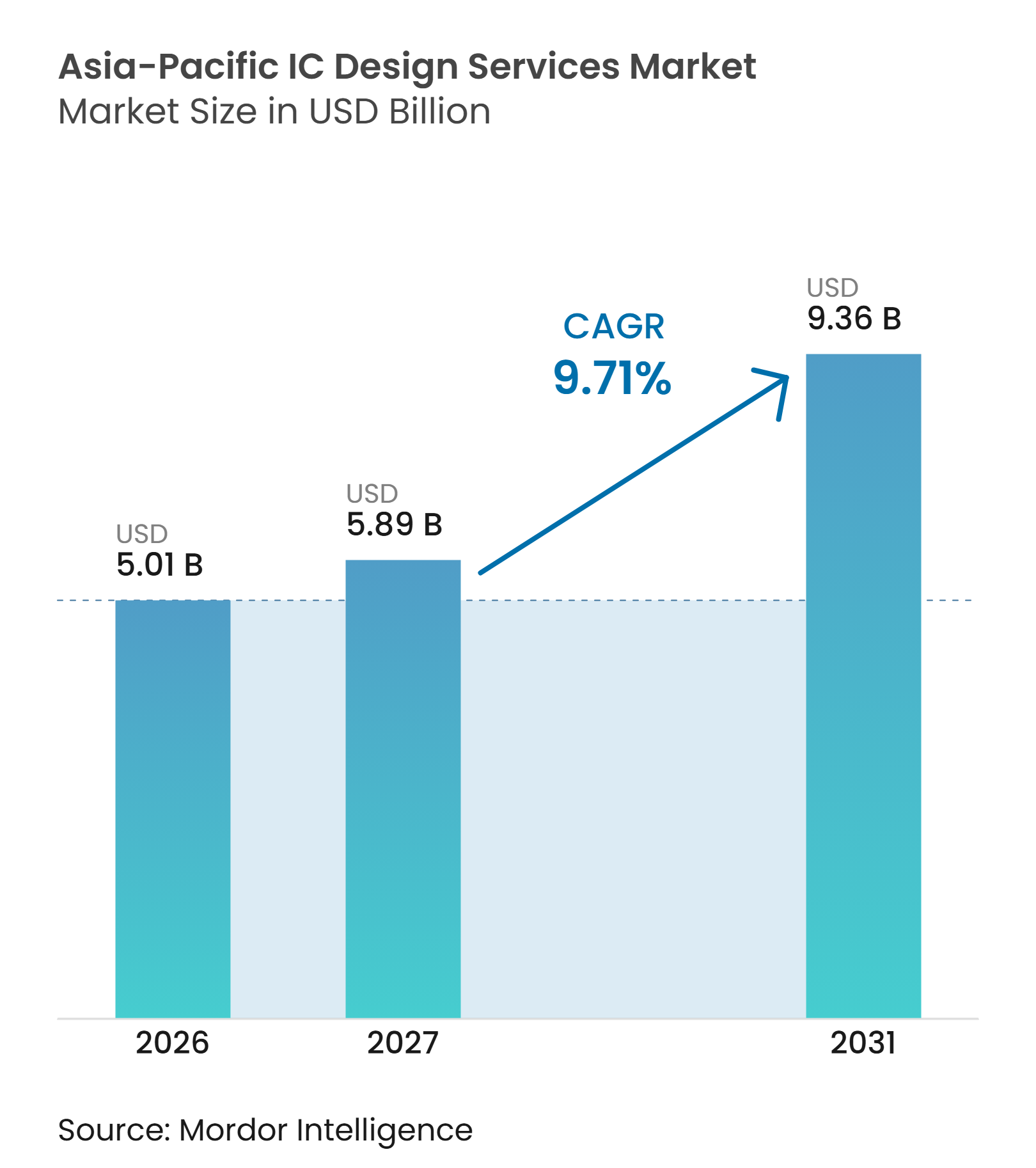
Asia-Pacific IC Design Services Market Analysis by Mordor Intelligence
The Asia-Pacific IC Design Services market size was valued at USD 5.01 billion in 2026 and estimated to expand from USD 5.89 billion in 2027 to reach USD 9.36 billion by 2032, at a CAGR of 9.71% during the forecast period (2027-2032). The Asia-Pacific IC Design Services market is supported by a larger pipeline of custom silicon programs as fabless companies work more closely with foundries and packaging partners. Demand for AI inference chips is making verification, systems integration, and advanced packaging more important within client engagements. Government programs in China, India, South Korea, and Japan are adding funded domestic design activity alongside private-sector demand. Competition is moving beyond layout work toward full ASIC delivery, which favors providers that can connect architecture, implementation, verification, and packaging. Trade restrictions and a shortage of specialized engineers may limit cross-border work and delay delivery on complex programs.
Key Report Takeaways
- By service type, Digital IC Design Services held 29.27% of the Asia-Pacific IC Design Services market share in 2026, while Design Verification Services is projected to expand at an 11.11% CAGR through 2032.
- By end-user application, Consumer Electronics held 31.07% of the Asia-Pacific IC Design Services market share in 2026, while AI, HPC and Data Centers is projected to expand at an 11.19% CAGR through 2032.
- By design complexity, Mature Nodes (8nm-28nm) accounted for 46.83% of the Asia-Pacific IC Design Services market size in 2026, while Advanced Nodes (≤7nm) is projected to expand at a 10.32% CAGR through 2032.
- By geography, China held 34.18% of the Asia-Pacific IC Design Services market share in 2026, while India is projected to expand at a 10.82% CAGR through 2032.
Note: Market numbers in this report are based on Mordor Intelligence's proprietary estimation framework, which combines nine months of actuals with Q4 projections for base year 2026.
Market Trends and Insights
Drivers Impact Analysis of Asia-Pacific IC Design Services Market*
| Driver | (~) % Impact on CAGR Forecast | Geographic Relevance | Impact Timeline |
|---|---|---|---|
| AI Accelerators, Custom ASICs, and HPC Chip Demand | +2.5% | Global, with Asia-Pacific core in Taiwan, China, and South Korea | Short term (≤ 2 years) |
| Strong Fabless, Foundry, and IDM Ecosystem | +2.0% | Taiwan, China, and South Korea | Medium term (2-4 years) |
| Government-Backed Semiconductor Self-Sufficiency Programs | +1.7% | China, India, South Korea, and Japan | Long term (≥ 4 years) |
| Smartphone, Consumer Electronics, and Communication Semiconductor Demand | +1.3% | China, South Korea, and Taiwan | Short term (≤ 2 years) |
| Automotive and Industrial Semiconductor Development | +0.8% | China, Japan, South Korea, and India | Medium term (2-4 years) |
| Advanced Packaging and Chiplet Architecture Adoption | +0.6% | Taiwan and South Korea | Medium term (2-4 years) |
| Source: Mordor Intelligence | |||
AI Accelerators, Custom ASICs, and HPC Chip Demand Power Design Services
Hyperscale cloud operators are increasingly developing custom silicon rather than relying solely on standard GPUs. This change directs more complex work toward the Asia-Pacific IC Design Services market because inference workloads place a high value on energy efficiency and application-specific performance. ASIC programs require expertise in architecture definition, verification, physical implementation, and packaging, which increases the value of individual engagements. Taiwan-based providers have adopted shift-left development practices that allow software validation to begin 12 to 18 months before tape-out, helping teams address first-pass risk at advanced nodes. This earlier verification work requires simulation and emulation capabilities that are not needed for routine implementation projects. Companies that can deliver architecture through advanced packaging are better placed to serve high-value AI and HPC programs.
Strong Fabless, Foundry, and IDM Ecosystem Underpins Structural Growth
Taiwan, South Korea, and China combine design companies, foundries, IP suppliers, and packaging resources within closely linked semiconductor ecosystems. This proximity can support faster design-process co-optimization than a supply chain spread across distant locations. The Taiwan Semiconductor Manufacturing Company Design Center Alliance includes more than 30 member companies across logic design, custom layout, and turnkey ASIC work.[1] The alliance gives emerging fabless customers access to providers that understand foundry requirements and design flows. Integrated device manufacturers also outsource selected design tasks when internal engineering capacity is constrained. This outsourcing can give specialized providers recurring work even when demand from a single end market is uneven.
Government-Backed Semiconductor Self-Sufficiency Programs Accelerate Regional Demand
Government support is creating domestic design projects that may not have reached commercial scale as quickly without public funding. India approved Semicon 2.0 in July 2026 with an INR 127,500 crore (USD 15.2 billion) outlay, including chip design, machinery, materials, fabs, advanced packaging, research, and talent development. India’s Design Linked Incentive program has supported 24 chip-design projects and trained more than 100,000 engineers. China’s 15th Five-Year Plan targets semiconductor sales above CNY 2.4 trillion (USD 359 billion), domestic process capability below 22nm, and progress at 3-5nm nodes by 2030. South Korea committed KRW 33 trillion (USD 23.25 billion) for semiconductor support in 2025, while Japan pledged USD 67 billion over 5 years for semiconductor and AI investment. These commitments can create a steadier base of design activity across the Asia-Pacific IC Design Services market.
Smartphone, Consumer Electronics, and Communication Semiconductor Demand Provides Baseline Volume
Consumer electronics provides a large volume base for design providers serving smartphones, wearables, smart televisions, and connected devices. The shift toward on-device AI inference adds neural processing units to application processors and increases verification and mixed-signal integration requirements. 5G modem updates and Wi-Fi 7 chipsets also maintain design work at mid-range process nodes. Consumer Electronics held 31.07% of the Asia-Pacific IC Design Services market in 2026, showing the continued importance of established regional engineering capacity. This demand supports recurring programs in the Asia-Pacific IC Design Services market even as AI and automotive applications attract greater strategic attention. It also gives mid-tier providers a volume stream while they build capabilities in newer technology areas.
Restraints Impact Analysis of Asia-Pacific IC Design Services Market*
| Restraint | (~) % Impact on CAGR Forecast | Geographic Relevance | Impact Timeline |
|---|---|---|---|
| Geopolitical Tensions and Semiconductor Trade Restrictions | -1.6% | Global, with direct impact on China-Taiwan-US design flows | Medium term (2-4 years) |
| Shortage of Specialized Semiconductor Design Engineers | -1.0% | Asia-Pacific-wide, most acute in India, Vietnam, and Singapore | Long term (≥ 4 years) |
| Intense Competition and Pricing Pressure | -0.6% | Taiwan, China, and South Korea | Short term (≤ 2 years) |
| Uneven Development of Regional Semiconductor Design Ecosystems | -0.4% | India, Vietnam, and Rest of Asia-Pacific | Long term (≥ 4 years) |
| Source: Mordor Intelligence | |||
Geopolitical Tensions and Semiconductor Trade Restrictions Constrain Cross-Border Design Flows
Export controls on advanced semiconductor technologies are changing how design firms source EDA tools, process design kits, and selected IP. The US Bureau of Industry and Security revised its license review policy for advanced computing commodities going to China and Macau in January 2026. These controls can limit access to the most mature international design tools and process ecosystems for projects that target leading-edge nodes. Chinese fabless customers may face higher non-recurring engineering costs and more schedule risk when domestic alternatives lack equivalent depth or process maturity. Uncertainty over future technology-transfer rules may also reduce joint design projects between Chinese firms and overseas partners. Providers that serve both Western hyperscalers and China-based original design manufacturers may face harder choices about how to organize engineering teams and customer work.
Shortage of Specialized Semiconductor Design Engineers Limits Service Delivery Capacity
The shortage of experienced engineers is a constraint, as advanced-node and 3DIC programs need specialized skills across architecture, verification, physical design, and packaging. India may face a shortage of 250,000-300,000 qualified semiconductor professionals by 2027, as demand for ASIC verification exceeds the available workforce. Singapore has added semiconductor engineering roles to its Shortage Occupation List, and Vietnam reported 7,000 IC design engineers in August 2025.[2] Limited access to these specialists can extend schedules on multiyear projects and weaken revenue realization despite strong client demand. The constraint is strongest where emerging ecosystems are expanding faster than their local training and hiring capacity can keep pace. Employers also compete for engineers who can connect design methods with packaging, testing, and software validation, not merely execute a defined block.
*Our forecasts treat driver/restraint impacts as directional, not additive. The impact forecasts reflect baseline growth, mix effects, and variable interactions.
Asia-Pacific IC Design Services Market Segment Analysis
By Service Type:
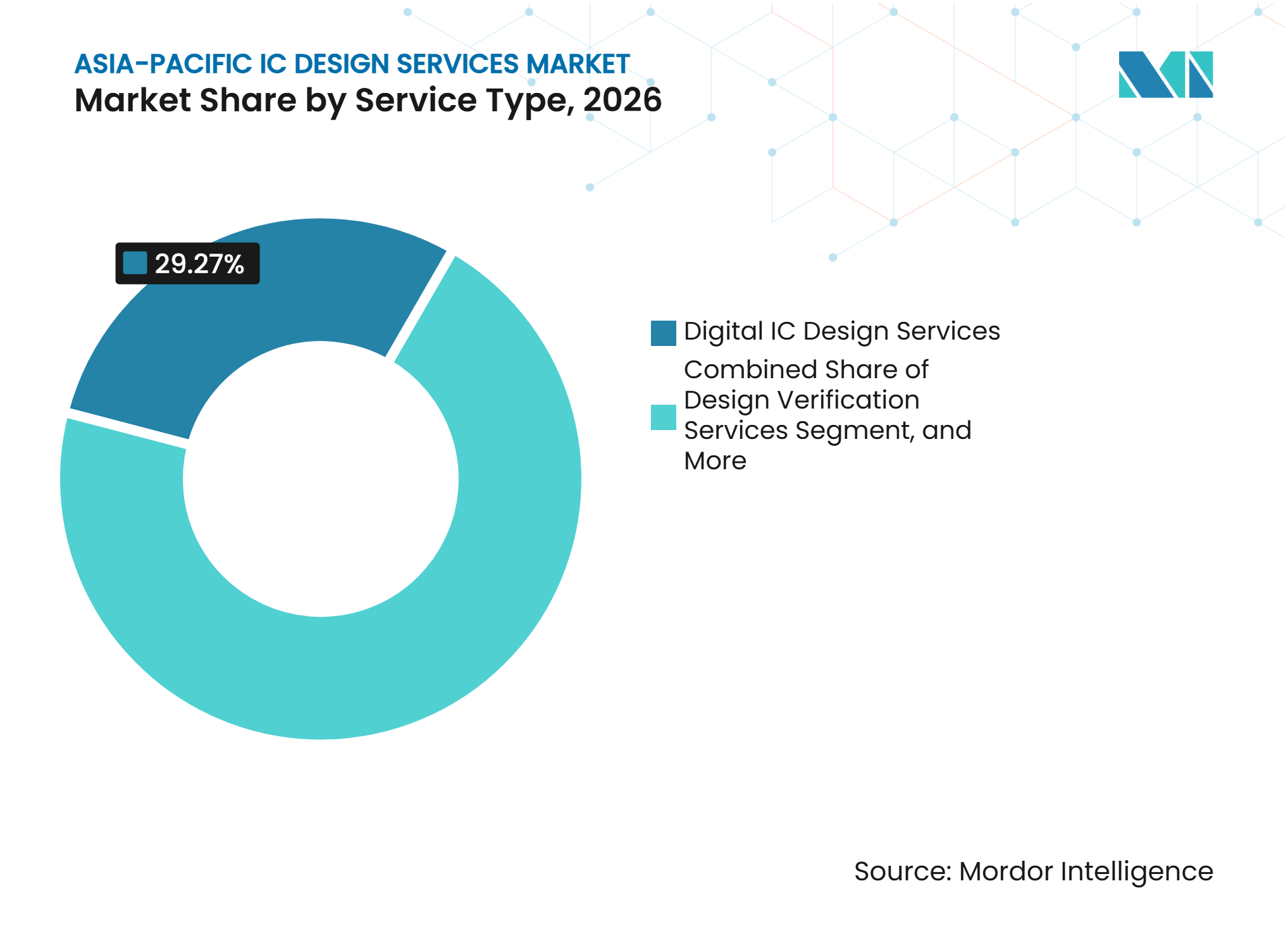
Verification Demand Outpaces Legacy Design CategoriesDigital IC Design Services held 29.27% of the Asia-Pacific IC Design Services market share in 2026, supported by custom logic across consumer, communications, and AI subsystems. Design Verification Services is projected to record an 11.11% CAGR from 2027 to 2032. Advanced-node designs have lower tolerance for first-pass errors, which increases the value of pre-silicon verification. AI chiplet integration adds testing needs because teams must validate interfaces before tape-out. Faraday reported that advanced-node NRE accounted for 49% of total NRE revenue in 2025, indicating a shift toward higher-complexity client work.
Analog Mixed-Signal IC Design Services and Physical Design and Layout Services remain important for specialized implementation work. Analog and mixed-signal demand benefits from electric-vehicle power electronics and industrial sensors. These projects can have longer qualification cycles than many digital programs. IP Development and Design Support Services are gaining importance as semiconductor companies seek reusable subsystem IP. This change can favor providers that maintain and update IP rather than relying solely on one-time licensing.



By End-User Application:
Consumer Volume Sustains Revenue While AI Resets Complexity ExpectationsConsumer Electronics accounted for 31.07% of the Asia-Pacific IC Design Services market size in 2026, reflecting the region’s role in smartphone, wearable, smart television, and Internet of Things chip design. AI, HPC, and Data Centers are projected to expand at an 11.19% CAGR from 2027 to 2032. Hyperscalers are seeking custom ASICs that fit their performance, energy, and workload requirements. Alchip reported that its 3DIC platform can deliver 3-5 times higher interconnect density and 30-40% lower energy per bit for AI and HPC applications. These requirements reward providers that can integrate logic, memory, package design, and thermal planning.
Automotive is becoming a more important source of high-reliability design programs. Volkswagen Group China announced its first self-designed system-on-chip through the CARIZON joint venture with Horizon Robotics in November 2025, targeting 500-700 TOPS for intelligent driving systems. Industrial, defense and aerospace, medical and healthcare, and telecom and networking applications support longer product cycles. These customers need stringent qualification, durable supply commitments, and specialized analog or mixed-signal capabilities. Their programs help smooth dependence on consumer refresh cycles.
By Design Complexity:
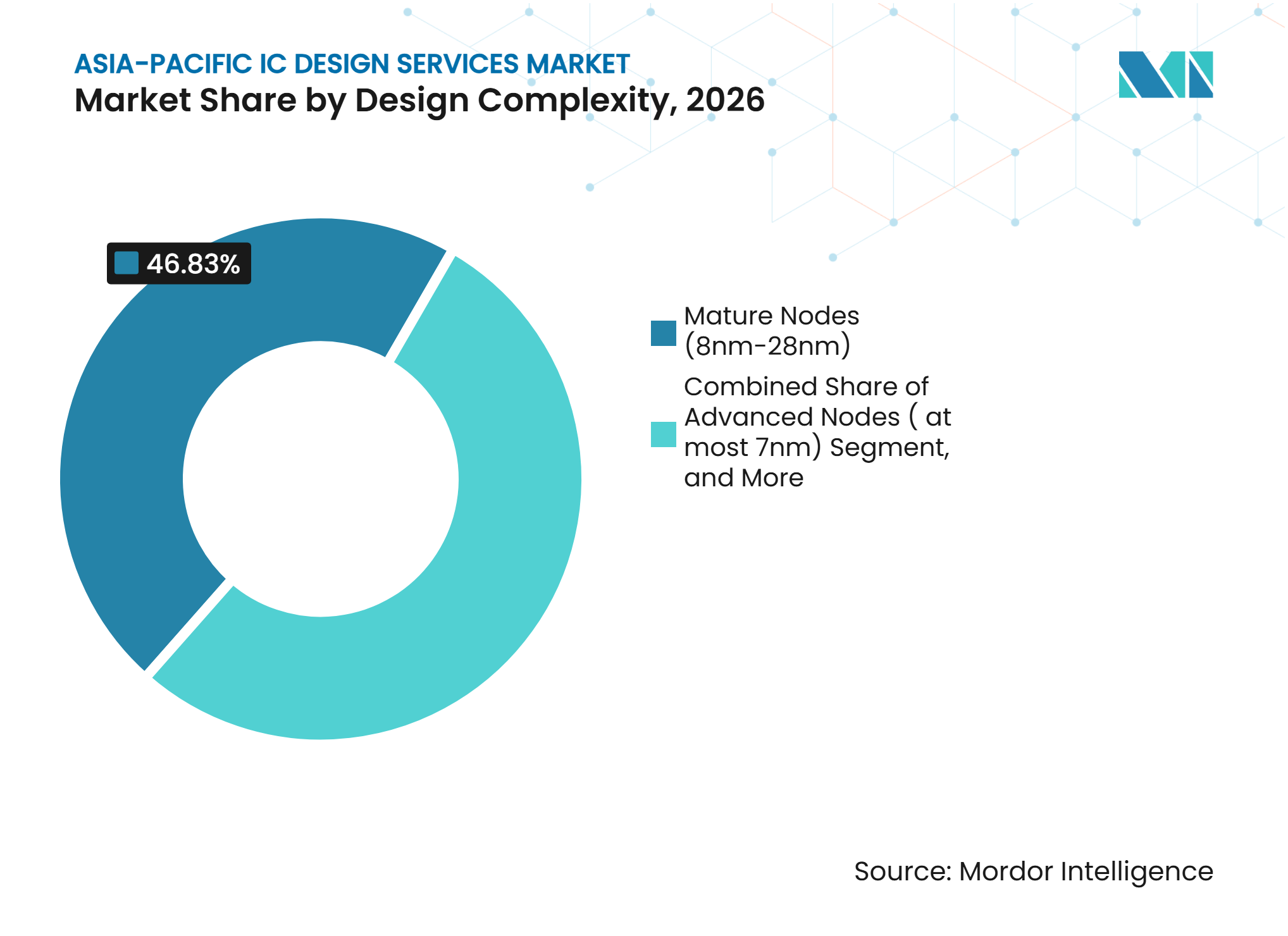
Mature Nodes Anchor Revenue While Advanced Nodes Redefine Competitive HierarchyMature Nodes (8nm-28nm) held 46.83% of the Asia-Pacific IC Design Services market share in 2026. This process range supports automotive electronics, industrial controls, Internet of Things connectivity chiplets, power management ICs, and display drivers. The broad base of applications helps sustain demand when leading-edge capacity receives most of the public attention. Advanced Nodes (≤7nm) are projected to register a 10.32% CAGR from 2027 to 2032. AI accelerator ASICs, high-performance networking chips, and advanced smartphone processors are key applications for these leading processes.
Advanced-node work favors providers with established tape-out histories, packaging experience, and foundry co-engineering relationships. SEMIFIVE announced a KRW 18 billion contract, equivalent to USD 12.5 million at the supplied conversion rate, for an AI NPU on Samsung Foundry’s SF4X 4nm process in March 2026. Such programs require strong capabilities in power, thermal, interconnect, and verification. Legacy Nodes (Above 28nm) remain useful for high-voltage analog and power devices. Fully depreciated capacity and established customer relationships support continued demand in these applications.

Geography Analysis
China: Regional Design Capacity Anchored by Scale and Policy
China held 34.18% of the Asia-Pacific IC Design Services market share in 2026. The country’s position is supported by fabless design houses, government procurement priorities, and a growing foundry base. The 15th Five-Year Plan targets semiconductor sales above CNY 2.4 trillion, annual output of 600 billion chips, and domestic process capability below 22nm by 2030. VeriSilicon’s AI-ISP custom chip entered mass production in customer smartphones in June 2025
India: Policy-Driven Ecosystem Generating Asia-Pacific’s Fastest Design Growth
India is projected to record a 10.82% CAGR from 2027 to 2032. It has a large engineering base and a stronger policy framework for chip design, manufacturing, packaging, research, and skills. India hosts nearly 20% of the global semiconductor chip design workforce and more than 120 semiconductor company R&D centers. The Design Linked Incentive scheme had enabled 16 tape-outs, 6 fabricated ASICs, and more than 140 reusable IP cores through supported startups by early 2026. MosChip delivered a custom SoC to ISRO’s Space Applications Centre in January 2026 for India’s satellite navigation program.
Taiwan, South Korea, Japan, and Rest of Asia-Pacific: Different Paths to Capability
Taiwan remains the region’s technical anchor because providers work close to TSMC and advanced packaging platforms such as CoWoS, SoIC, and 2.5D interposers. South Korea uses Samsung Foundry capacity to compete for AI design services, and SEMIFIVE opened a Tokyo subsidiary in December 2025. Japan’s USD 67 billion commitment supports Rapidus’s 2nm program and design work, complementing its analog and compound semiconductor IP capabilities. Vietnam and Singapore are building service capacity for overflow demand. Vietnam had 7,000 IC design engineers in August 2025.
Competitive Landscape
Market Concentration
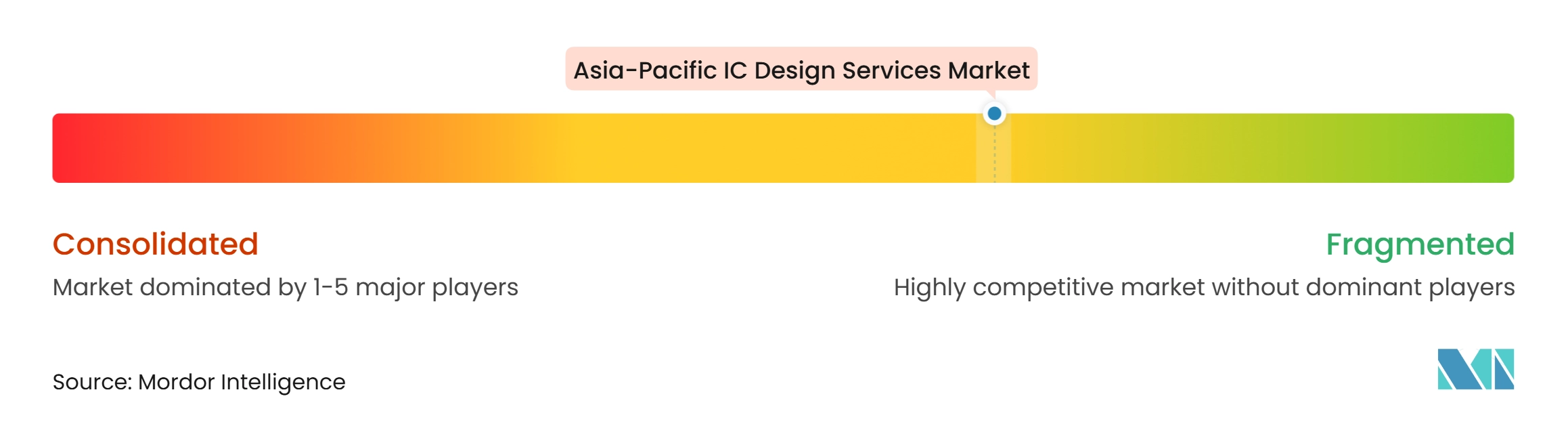
The Asia-Pacific IC Design Services market is moderately fragmented. Advanced-node specialists in Taiwan and South Korea compete for AI and HPC ASIC programs, while a wider group serves automotive, consumer, and industrial clients. Large fabless firms are entering the ASIC services market, increasing pricing pressure. Providers are responding with proprietary IP, packaging expertise, and deeper relationships with foundries. Global Unichip’s November 2025 work with VSORA on the Jotunn8 AI inference processor combined 5nm ASIC services with HBM3E and 2.5D packaging.
Alchip expanded its design capacity in June 2025 through a Vietnam Design Center and a larger Japan Design Center. The move added engineering capacity for 3nm and advanced packaging programs. HCLTech and Dolphin Semiconductor announced a partnership in December 2025 to combine low-power IP with silicon design workflows.[3] These moves show how companies are extending services through hiring, packaging specialization, and IP partnerships. India-based providers are also moving beyond cost-focused mid-node work toward turnkey ASIC capabilities.
Chiplet disaggregation services can help smaller fabless firms leverage advanced-node functions without adopting a monolithic program. AI-enabled EDA and verification automation may reduce repetitive work for mid-tier projects. Automotive-grade IC design is another opportunity in India and Southeast Asia as electric-vehicle development creates local demand for qualified designs. The wide difference in technical depth, client mix, and foundry access supports a moderately fragmented competitive structure.
Asia-Pacific IC Design Services Industry Leaders
-
Global Unichip Corporation
-
Alchip Technologies, Ltd.
-
Faraday Technology Corporation
-
VeriSilicon Microelectronics
-
SEMIFIVE Inc.
- *Disclaimer: Major Players sorted in no particular order
Asia-Pacific IC Design Services Market Companies Covered in this Report
- Global Unichip Corporation
- Alchip Technologies, Ltd.
- Faraday Technology Corporation
- VeriSilicon Microelectronics (Shanghai) Co., Ltd.
- SEMIFIVE Co., Ltd.
- CoAsia SEMI Co., Ltd.
- Sondrel Limited
- EnSilica plc
- Racyics GmbH
- ICsense NV
- eInfochips Private Limited
- HCL Technologies Limited
- L&T Technology Services Limited
- MosChip Technologies Limited
- Tessolve Semiconductor Private Limited
- Oppstar Berhad
- ASICLAND Co., Ltd.
- GAONCHIPS Co., Ltd.
- BlackPepper Technologies Pvt. Ltd.
- NSW Inc.
Recent Industry Developments in Asia-Pacific IC Design Services Market
- October 2026: MosChip Technologies announced the initial bring-up results of VIDYUT100 silicon, an indigenous three-phase smart energy meter IC, at SEMICON India 2026. The chip directly targets India’s smart city metering infrastructure, replacing imported IC solutions with a domestically designed alternative under the Atmanirbhar Bharat initiative.
- July 2026: The Government of India approved Semicon 2.0 with an outlay of INR 127,500 crore (USD 15.2 billion), explicitly adding chip design, machines and materials, research, and talent as pillars alongside fabs and advanced packaging, aiming to build a complete chip value chain within India.
- April 2026: Alchip Technologies announced its 3DIC ASIC design services platform targeting AI and HPC customers, delivering 3-5 times higher interconnect density, 30-40% less energy per bit, and latency reductions of up to 35%, integrating TSMC CoWoS and SoIC-X advanced packaging technologies.
- March 2026: SEMIFIVE signed a KRW 18 billion (USD 12.5 million) turnkey ASIC design contract for a next-generation AI NPU on Samsung Foundry’s SF4X 4nm process, its second consecutive advanced-node AI chip contract with the same customer. The win signals SEMIFIVE’s growing credibility as a full-lifecycle AI ASIC partner in South Korea’s design service industry.
Asia-Pacific IC Design Services Market Report Scope
The Asia-Pacific IC Design Services Market includes revenue generated by companies that offer outsourced and specialized integrated circuit (IC) design, development, verification, and engineering support services to semiconductor companies, fabless companies, IDMs, OEMs, and system developers. The market covers analog IC design, digital IC design, analog mixed-signal (AMS) design, physical design and layout, design verification, IP development, and other IC design support services for a range of semiconductor applications. These services facilitate the development of application-specific integrated circuits (ASICs), system-on-chips (SoCs), application-specific standard products (ASSPs), and other customized semiconductor solutions.
The Asia-Pacific IC Design Services Market Report is Segmented by Service Type (Analog IC Design Services, Digital IC Design Services, Analog Mixed-Signal (AMS) IC Design Services, Physical Design and Layout Services, Design Verification Services, IP Development and Design Support Services, and Other Service Types), End-User Application (Automotive, AI, HPC, and Data Centers, Consumer Electronics, Industrial, Defense and Aerospace, Medical and Healthcare, Telecom and Networking, and Other End-User Applications), Design Complexity (Advanced Nodes (≤7nm), Mature Nodes (8nm-28nm), and Legacy Nodes (Above 28nm)), and Geography (China, Taiwan, South Korea, Japan, India, and Rest of Asia-Pacific). The Market Forecasts are Provided in Terms of Value (USD).
Segmentation Overview
| Analog IC Design Services |
| Digital IC Design Services |
| Analog Mixed-Signal (AMS) IC Design Services |
| Physical Design and Layout Services |
| Design Verification Services |
| IP Development and Design Support Services |
| Other Service Types |
| Automotive |
| AI, HPC, and Data Centers |
| Consumer Electronics |
| Industrial |
| Defense and Aerospace |
| Medical and Healthcare |
| Telecom and Networking |
| Other End-User Applications |
| Advanced Nodes (≤7nm) |
| Mature Nodes (8nm-28nm) |
| Legacy Nodes (Above 28nm) |
| China |
| Taiwan |
| South Korea |
| Japan |
| India |
| Rest of Asia Pacific |
| By Service Type | Analog IC Design Services |
| Digital IC Design Services | |
| Analog Mixed-Signal (AMS) IC Design Services | |
| Physical Design and Layout Services | |
| Design Verification Services | |
| IP Development and Design Support Services | |
| Other Service Types | |
| By End-User Application | Automotive |
| AI, HPC, and Data Centers | |
| Consumer Electronics | |
| Industrial | |
| Defense and Aerospace | |
| Medical and Healthcare | |
| Telecom and Networking | |
| Other End-User Applications | |
| By Design Complexity | Advanced Nodes (≤7nm) |
| Mature Nodes (8nm-28nm) | |
| Legacy Nodes (Above 28nm) | |
| By Country | China |
| Taiwan | |
| South Korea | |
| Japan | |
| India | |
| Rest of Asia Pacific |
Key Questions Answered in the Report
What is the Asia-Pacific IC Design Services market size?
The Asia-Pacific IC Design Services market size is estimated at USD 5.89 billion in 2027 and is forecast to reach USD 9.36 billion by 2032 at a 9.71% CAGR, supported by custom silicon, verification, and advanced packaging demand across the region.
Which service type holds the largest share in Asia-Pacific IC design services?
Digital IC Design Services holds the largest service-type share at 29.27% in 2026.
Which application is projected to expand fastest in Asia-Pacific IC design services?
AI, HPC and Data Centers is projected to expand at an 11.19% CAGR from 2027 to 2032.
Why is design verification becoming more important for IC design providers?
Advanced-node and chiplet projects require more pre-silicon testing to reduce tape-out risk and validate complex interfaces.
Which country leads Asia-Pacific IC design services?
China leads with a 34.18% share in 2026, supported by fabless capacity, public programs, and an expanding foundry ecosystem.
Why is India becoming important for IC design services?
India is projected to expand at a 10.82% CAGR through 2032, supported by engineering talent, Semicon 2.0, and the Design Linked Incentive scheme, which support design projects, tape-outs, IP development, and domestic semiconductor capability.