
Asia-Pacific Geotextiles and Civil Engineering Technical Textile Market Size and Share
Market Overview
| Study Period | 2021 - 2032 |
|---|---|
| Forecast Data Period | 2027 - 2032 |
| Base Year Market Size (2026) | USD 1.51 Billion |
| Market Size (2027) | USD 1.61 Billion |
| Market Size (2032) | USD 2.21 Billion |
| Growth Rate (2027 - 2032) | 6.54 % |
| Market Concentration | Medium |
Major Players *Disclaimer: Major Players sorted in no particular order Image © Mordor Intelligence. Reuse requires attribution under CC BY 4.0. | |
Asia-Pacific Geotextiles and Civil Engineering Technical Textile Market Analysis by Mordor Intelligence
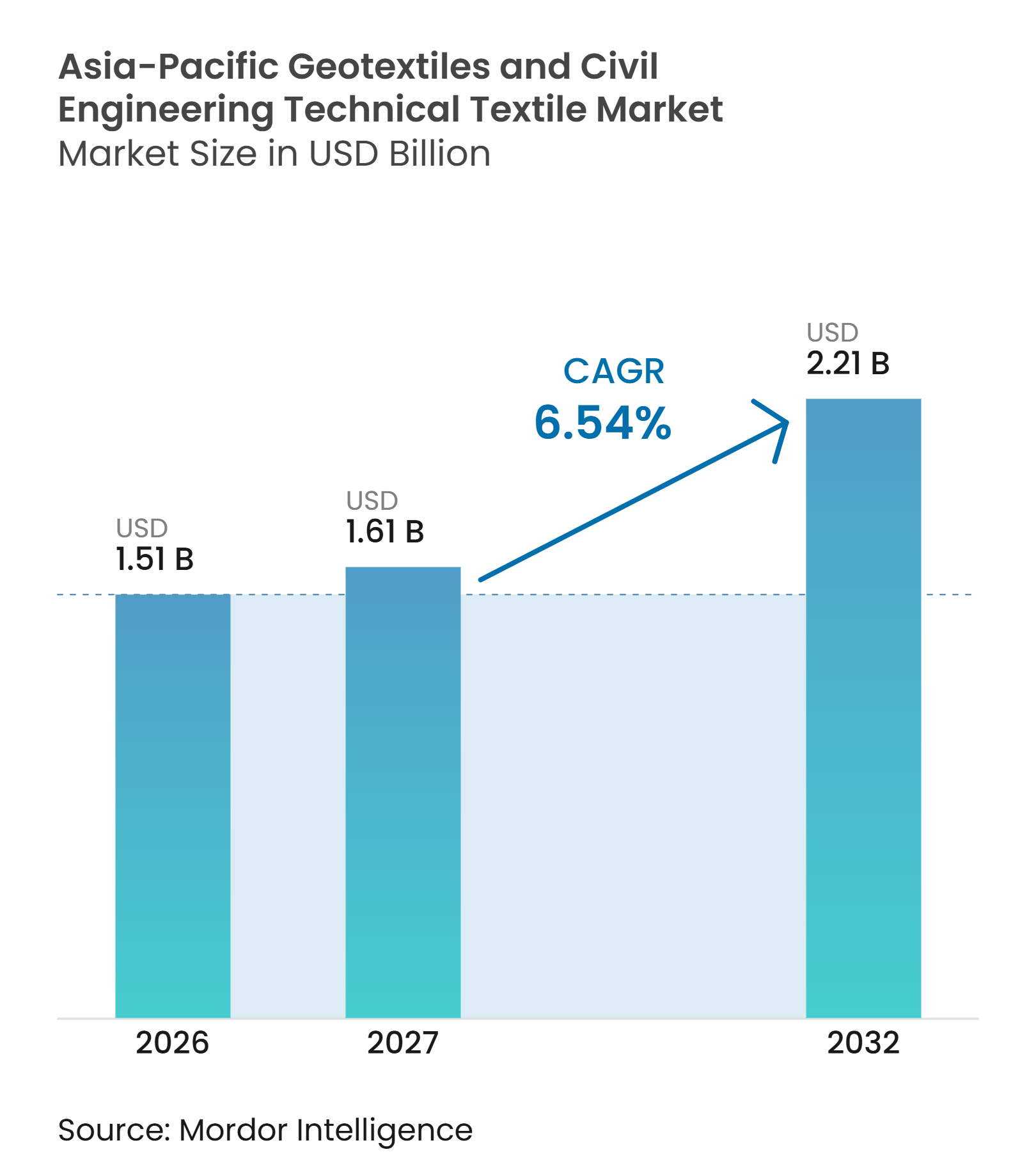
The Asia-Pacific Geotextiles And Civil Engineering Technical Textile Market size was valued at USD 1.51 billion in 2026 and is estimated to grow from USD 1.61 billion in 2027 to reach USD 2.21 billion by 2032, at a CAGR of 6.54% during the forecast period (2027-2032).
The Asia Pacific geotextiles and civil engineering technical textile market benefits from sustained road, rail, landfill, and water-management construction across the region. Low- and middle-income economies in Asia and the Pacific require USD 2.6 trillion in annual transport investment from 2025 to 2035, including USD 1.14 trillion for roads, which supports recurring demand for separation, filtration, drainage, and reinforcement materials. Infrastructure owners are also placing greater weight on flood resilience and waste containment, which expands the use of engineered geosynthetic systems rather than single-function materials. Regional suppliers can benefit from local manufacturing and testing capacity, while cross-border suppliers face differing national standards and procurement requirements. Feedstock exposure, product end-of-life requirements, and contractor installation quality remain important constraints for the Asia Pacific geotextiles and civil engineering technical textile market.
Key Report Takeaways
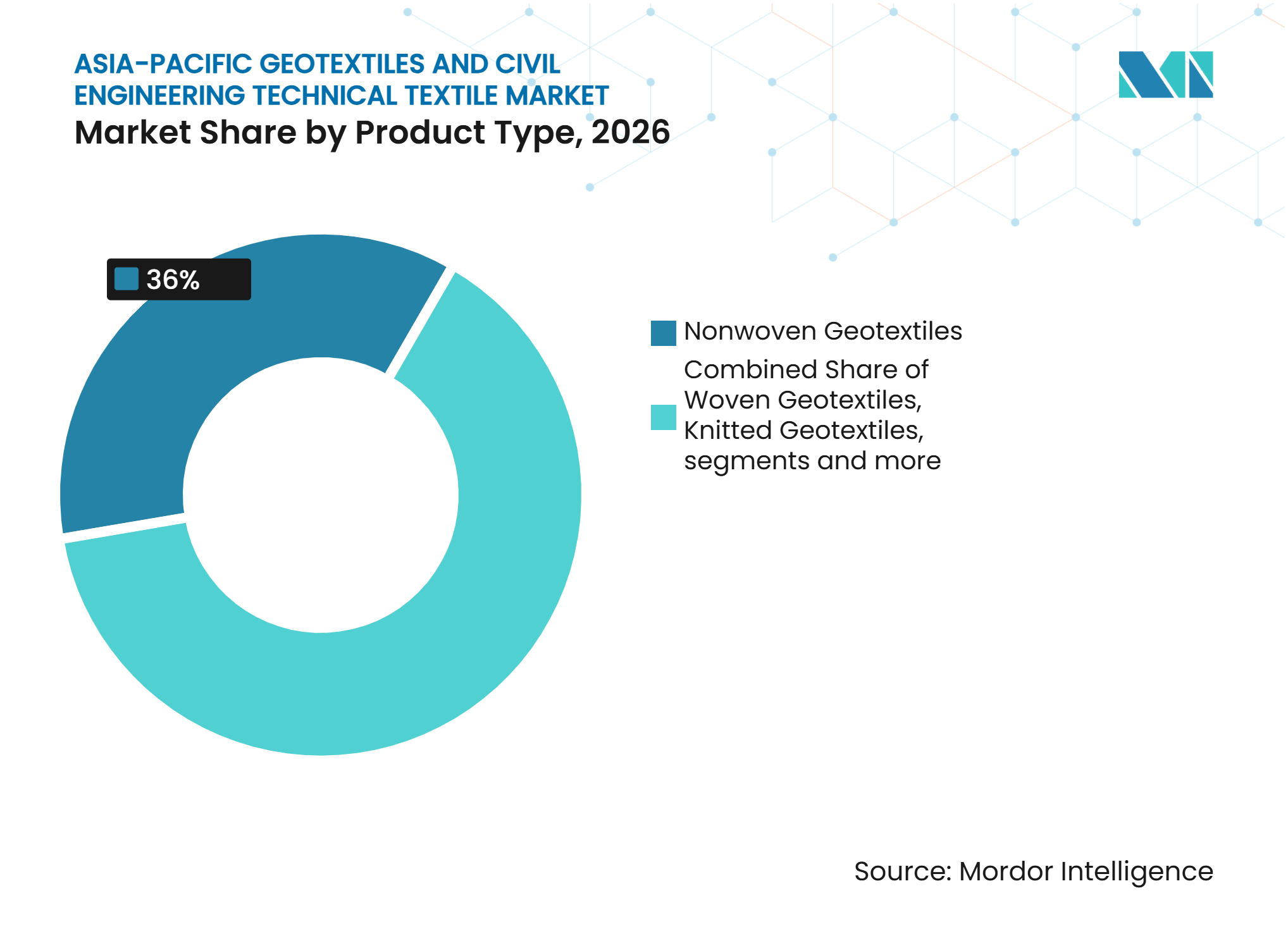
- By product type, nonwoven geotextiles held 36% of the Asia Pacific geotextiles and civil engineering technical textile market share in 2026, while textile-based geogrids recorded the highest projected CAGR at 8% through 2032.
- By material type, polypropylene held 40% of the Asia Pacific geotextiles and civil engineering technical textile market share in 2026, while natural fibers recorded the highest projected CAGR at 8.2% through 2032.
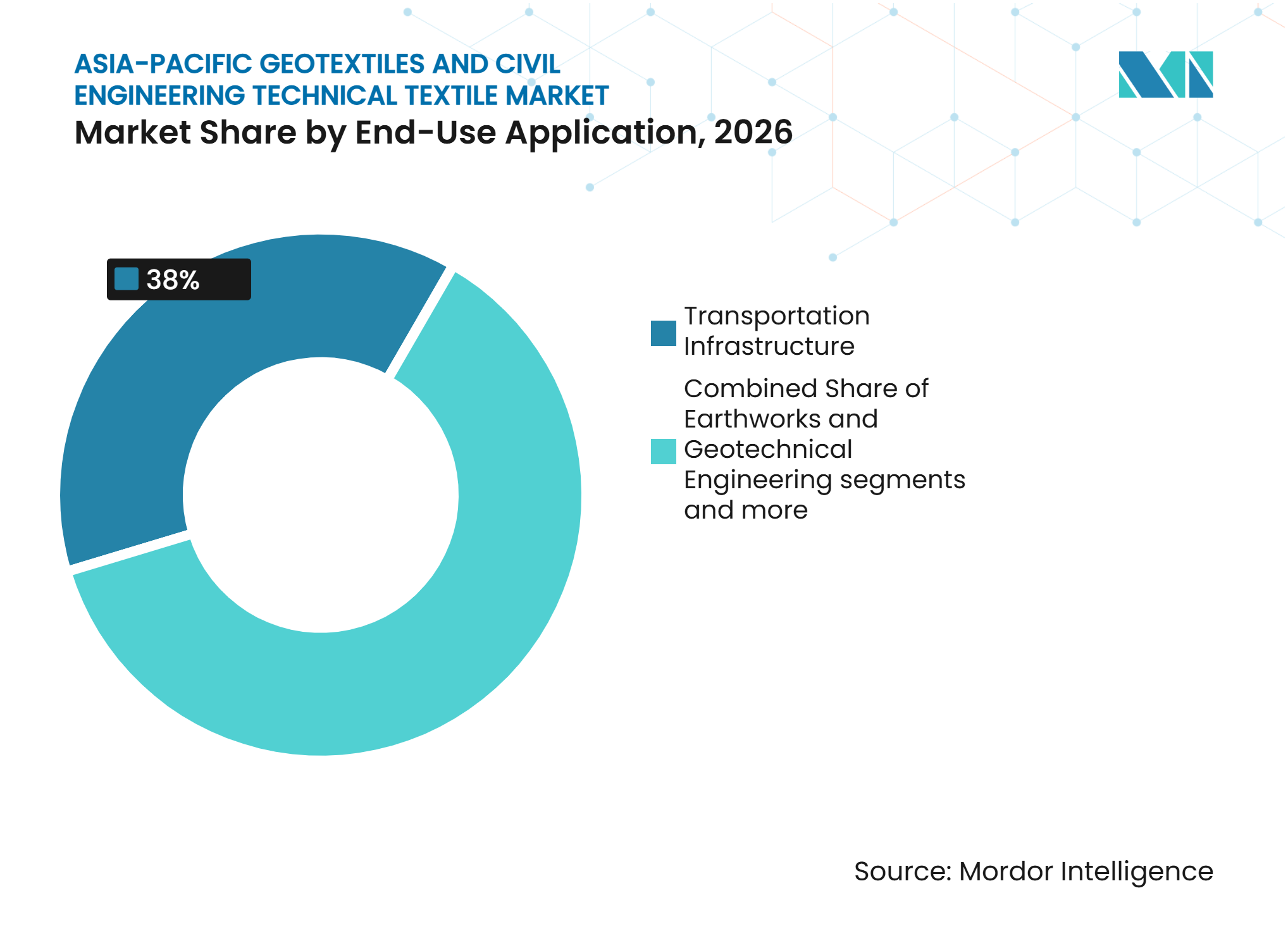
- By end-use application, transportation infrastructure accounted for 38% of the Asia Pacific geotextiles and civil engineering technical textile market size in 2026, while mining and energy infrastructure recorded the highest projected CAGR at 7.8% through 2032.
- By geography, China held a 34% share in 2026, while India recorded the highest projected CAGR at 8.5% through 2032.
Note: Market numbers in this report are based on Mordor Intelligence's proprietary estimation framework, which combines nine months of actuals with Q4 projections for base year 2026.
Market Trends and Insights
Drivers Impact Analysis of Asia-Pacific Geotextiles and Civil Engineering Technical Textile Market*
| Driver | (~) % Impact on CAGR Forecast | Geographic Relevance | Impact Timeline |
|---|---|---|---|
| Transport Infrastructure Expansion | +1.4% | Asia-Pacific wide, highest concentration in China, India, and Southeast Asia | Long term (≥ 4 years) |
| Road and Highway Construction in Emerging Asian Economies | +1.2% | India, Vietnam, Indonesia, Thailand, Philippines | Medium term (2-4 years) |
| Environmental Protection and Waste-Containment Requirements | +1% | China, India, Vietnam, Indonesia | Medium term (2-4 years) |
| Climate-Resilient Infrastructure and Disaster Mitigation | +0.9% | APAC-wide, especially South and Southeast Asia | Long term (≥ 4 years) |
| Urbanization and Real Estate-Led Earthworks Demand | +0.7% | India, Indonesia, Vietnam, Philippines | Medium term (2-4 years) |
| Procurement Preference for Integrated Multifunctional Geosynthetic Systems | +0.5% | Australia, Japan, South Korea, China | Long term (≥ 4 years) |
| Source: Mordor Intelligence | |||
Transport Infrastructure Expansion
Transport infrastructure expansion remains a durable demand base for the Asia-Pacific geotextiles and civil engineering technical textile market. The Asian Transport Observatory projects USD 1.14 trillion of annual road investment across Asia-Pacific low- and middle-income economies between 2025 and 2035.[1] Road and rail embankments use geotextiles for subgrade stabilization, filtration, drainage, and material separation. The same outlook expects vehicle numbers to increase 3% annually while road networks increase 1.4% annually, sustaining the need for new capacity and upgrades. Thailand committed THB 136.49 billion (USD 4.3 billion) to 223 infrastructure projects in its 2025 program across roads, rail, ports, and airports.[2] This pipeline supports demand across both high-volume standard products and higher-specification drainage and reinforcement systems.
Road and Highway Construction in Emerging Asian Economies
India’s road program remains an important national driver for the Asia Pacific geotextiles and civil engineering technical textile market. The Union Budget for 2025-26 allocated INR 1,16,292 crore (USD 12.9 billion) for roads and bridges, 5% above the revised 2024-25 estimate. The government also announced an INR 11 lakh crore (USD 122.43 billion) plan to build 17,000 km of high-speed expressways by 2033, with 40% already under construction.[3] Soft soils and high-rainfall areas require reinforcement, drainage, and separation layers beneath pavement structures. Vietnam, Indonesia, Thailand, and the Philippines also maintain expressway and connectivity programs, which reduce reliance on one country. These projects favor suppliers able to meet local specifications and deliver consistent materials near construction sites.
Environmental Protection and Waste-Containment Requirements
Waste-containment rules are making geotextile systems a prescribed engineering component in more projects. China’s GB 16889-2024 landfill standard requires single or double artificial composite liner systems and specifies HDPE geomembranes with a minimum thickness of 2.0 mm. Protective and drainage geotextiles support these liner systems and help prevent damage during installation and operation. Vietnam issued QCVN 96:2025/BNNMT for solid-waste landfill systems, creating a related compliance route for containment products. India’s standards body reviewed geotextile standards in 2025, supporting the use of formal technical specifications in procurement. These requirements reduce substitution risk because system performance is tied to documented design and compliance needs.
Climate-Resilient Infrastructure and Disaster Mitigation
Climate adaptation is adding drainage and reinforcement requirements to civil works across the Asia-Pacific geotextiles and civil engineering technical textile market. The Asia-Pacific Centre for Technology Transfer identifies resilient infrastructure as a key regional requirement in response to climate-related physical risks. Research published in 2025 found that embankments reinforced with geocomposite layers remained stable for up to 18 hours longer during 100-year rainfall events than unreinforced structures. Another 2025 study found that gabion and geosynthetic reinforced soil walls delayed bridge-abutment backfill collapse during flood events. The Asian Development Bank has also addressed disaster-resilient infrastructure through its multilateral development bank support work. As resilience criteria enter project design, drainage composites and reinforced soil structures can gain importance alongside conventional road materials.
Restraints Impact Analysis of Asia-Pacific Geotextiles and Civil Engineering Technical Textile Market*
| Restraint | (~) % Impact on CAGR Forecast | Geographic Relevance | Impact Timeline |
|---|---|---|---|
| Petrochemical Feedstock Price Volatility | -1.1% | Global, amplified in import-dependent Southeast Asia | Short term (≤ 2 years) |
| Absence of Harmonized Geosynthetics Testing and Procurement Standards Across APAC | -0.8% | Asia-Pacific wide, especially Southeast Asia and South Asia cross-border supply | Long term (≥ 4 years) |
| Installation Damage and Contractor Quality Variability | -0.6% | India, Vietnam, Indonesia | Medium term (2-4 years) |
| Synthetic Polymer End-of-Life and Disposal Concerns | -0.4% | Japan, Australia, South Korea | Long term (≥ 4 years) |
| Source: Mordor Intelligence | |||
Petrochemical Feedstock Price Volatility
Polypropylene represents 40% of material demand in the Asia Pacific geotextiles and civil engineering technical textile market in 2026, leaving manufacturers exposed to propylene, naphtha, and crude-oil price movements. Fixed-price civil contracts can prevent manufacturers from passing sudden resin-cost increases to project owners. This issue is stronger in import-dependent Southeast Asian markets because currency movements affect the cost of imported polymer as well as the underlying commodity price. Smaller producers generally have less scope to absorb volatility through purchasing scale or contract structures. The OECD notes that supply-chain cost pressures remain relevant to infrastructure delivery and investment conditions. Suppliers may respond through disciplined pricing, shorter validity periods, and a more balanced material portfolio.
Absence of Harmonized Geosynthetics Testing and Procurement Standards Across Asia Pacific Jurisdictions
Different testing frameworks raise the cost and time needed to serve multiple national markets. India uses its BIS standards, China uses GB and GB/T standards, Japan uses JIS standards, and ISO/TC 221 standards are adopted to differing degrees across Southeast Asia. India reconfirmed specifications for geogrids used in flexible pavements, reinforced soil slopes, and related applications in 2025. China’s GB/T 45366-2025 introduced requirements for determining vertical permeability under load. ISO 10319:2024 introduced wet-specimen tensile testing procedures that are not fully replicated in every national framework. Retesting and documentation requirements can narrow the effective supplier base, particularly for smaller companies without multi-standard laboratory capability.
*Our forecasts treat driver/restraint impacts as directional, not additive. The impact forecasts reflect baseline growth, mix effects, and variable interactions.
Asia-Pacific Geotextiles and Civil Engineering Technical Textile Market Segment Analysis
By Product Type:
Nonwoven Fabric Dominates and Geogrids Emerge as Fastest-GrowingNonwoven Geotextiles held 36% of the Asia Pacific geotextiles and civil engineering technical textile market share in 2026. Their performance across separation, filtration, drainage, and protection supports large road, railway, and embankment programs. India, Vietnam, and Indonesia sustain demand through national and rural highway construction, urban infrastructure expansion, and drainage improvement projects. Their ability to separate soil layers, control fines migration, and improve aggregate stability makes them suitable for applications involving variable soil conditions and heavy rainfall. Woven Geotextiles address higher-load applications, including embankment reinforcement, retaining structures, and soft-soil stabilization, where high tensile strength is essential. Knitted Geotextiles serve narrower reinforcement applications, particularly where flexibility and specialized structural performance are required. Growing emphasis on pavement durability and reduced maintenance requirements is expected to support demand for these products across infrastructure projects.
Textile-Based Geogrids are projected to grow at an 8% CAGR through 2032, the highest rate among product categories in the Asia Pacific geotextiles and civil engineering technical textile market. Their use in reinforced aggregate layers can improve load distribution, reduce pavement thickness requirements, and limit maintenance needs over the infrastructure lifecycle. These benefits are relevant to highway widening, industrial corridors, logistics infrastructure, and road construction over weak subgrades. Geotextile Containers, including geotubes, support coastal reclamation, shoreline protection, erosion control, and river-training work in Vietnam, Thailand, and Indonesia. Their use can reduce dependence on conventional hard-engineering structures in selected coastal protection projects. Geocomposites combine filtration and drainage functions to improve water management in embankments, retaining walls, tunnels, and landfills.



By Material Type:
Polypropylene Leads and Natural Fibers Accelerate on Sustainability DemandPolypropylene accounted for 40% of the Asia Pacific geotextiles and civil engineering technical textile market size by material type in 2026. Its low density, moisture resistance, chemical stability, and processing compatibility support large-scale production of geotextiles for road construction, drainage, filtration, and soil separation. South and Southeast Asian producers benefit from regional resin supply and established manufacturing capacity, supporting cost-effective production for infrastructure projects. Polypropylene products are particularly suitable for applications requiring resistance to moisture and many soil-borne chemicals, although their long-term performance depends on exposure conditions and stabilization against ultraviolet degradation. Polyester serves reinforcement applications requiring higher stiffness, dimensional stability, and lower creep deformation under sustained loads.
Natural Fibers, including coir and jute, are forecast to grow at an 8.2% CAGR through 2032. They are used in temporary erosion control, revegetation support, and vegetated slope stabilization where biodegradability is preferred over permanent polymer solutions. Their fibrous structures help reduce surface runoff velocity, retain soil particles, and support vegetation establishment while natural degradation occurs. India benefits from established coir and jute production industries, providing a domestic raw-material base for erosion-control products and selected road-construction applications. The Bureau of Indian Standards (BIS) maintains specifications for jute geotextiles used in road construction and erosion control, supporting standardized product selection and application. However, natural-fiber products generally have a shorter service life than synthetic alternatives and are most suitable where vegetation or other permanent stabilization measures can assume the protective function over time. Polyamide and other specialty fibers serve demanding mining and industrial applications requiring specific combinations of mechanical strength, abrasion resistance, and durability.
By End-Use Application:
Transportation Stays Dominant, and Mining Emerges as a High-Growth SegmentTransportation infrastructure held 38% of the Asia Pacific geotextiles and civil engineering technical textile market share in 2026. The segment includes roads, railways, airports, and airfields, where geotextiles improve soil separation, drainage, load distribution, and pavement stability. India’s expressway buildout, China’s connectivity projects, and Thailand’s transport corridors sustain demand for geosynthetic materials across new construction and infrastructure upgrades. Rail projects in India, Indonesia, and Vietnam require track-bed stabilization, drainage, and settlement management, particularly where weak soils and heavy monsoon rainfall affect infrastructure performance. Geotextiles and geogrids can help distribute loads, limit the migration of fine soil particles, and improve the durability of railway subgrades. Airport runways, taxiways, and access roads also create demand for reinforcement and separation materials that support heavy traffic loads and reduce premature pavement deterioration.
Mining and energy infrastructure is forecast to grow at a 7.8% CAGR through 2032. Heap-leach pads, tailings facilities, and mine-waste containment systems require geomembranes, drainage composites, and protective nonwovens to manage seepage, protect containment layers, and maintain drainage performance. Australia, Indonesia, and India provide the region’s strongest mining-related demand base, supported by mineral extraction, critical-mineral supply chains, and associated energy infrastructure. Geosynthetics are also used in haul roads, access routes, erosion-control systems, and water-management facilities at remote mining sites, where conventional construction materials can be costly to transport. Geofabrics Australasia emphasizes that tailings-facility testing should reflect site-specific mine-effluent chemistry and thermal conditions, highlighting the importance of material compatibility and long-term durability. Environmental and Waste Containment demand is supported by China’s landfill standards and Vietnam’s 2025 environmental regulation, which reinforce the importance of controlled waste management and pollution prevention.

Geography Analysis
China held 34% of the Asia Pacific geotextiles and civil engineering technical textile market share in 2026. Its position reflects large domestic consumption, extensive manufacturing capacity, and a broad base of transport and municipal engineering projects. The Ministry of Transport recorded USD 550.5 billion in transportation fixed-asset investment during 2025. In the first quarter of 2026, China completed USD 48.1 billion in major transport investments across 1,845 projects. Landfill regulations add demand for containment and drainage systems, creating a separate procurement route beyond transport construction.
India is projected to grow at an 8.5% CAGR through 2032, the fastest rate in the Asia Pacific geotextiles and civil engineering technical textile market. Transport construction, water management, urban infrastructure, and land development support its demand profile across public and private projects. The road program creates demand for subgrade reinforcement and drainage, especially in soft soils and high-rainfall terrain. Vietnam combines expressway development with landfill compliance under QCVN 96:2025/BNNMT. Indonesia adds toll-road construction and mining-related containment demand, which broadens the opportunity for standard and engineered products.
Japan, South Korea, and Taiwan are specification-led markets for high-performance stabilization and urban geotechnical products. Australia is smaller by volume but significant in value because mining applications require specialized tailings and containment solutions. Bangladesh, Myanmar, Sri Lanka, Nepal, and Pacific Island states form an emerging demand pool. Road-connectivity and flood-mitigation programs can embed geotextile requirements in procurement, particularly where multilateral development finance supports project preparation. Suppliers need to balance local distribution, project economics, contractor education, and dependable access to project-specific technical support.
Competitive Landscape
Market Concentration
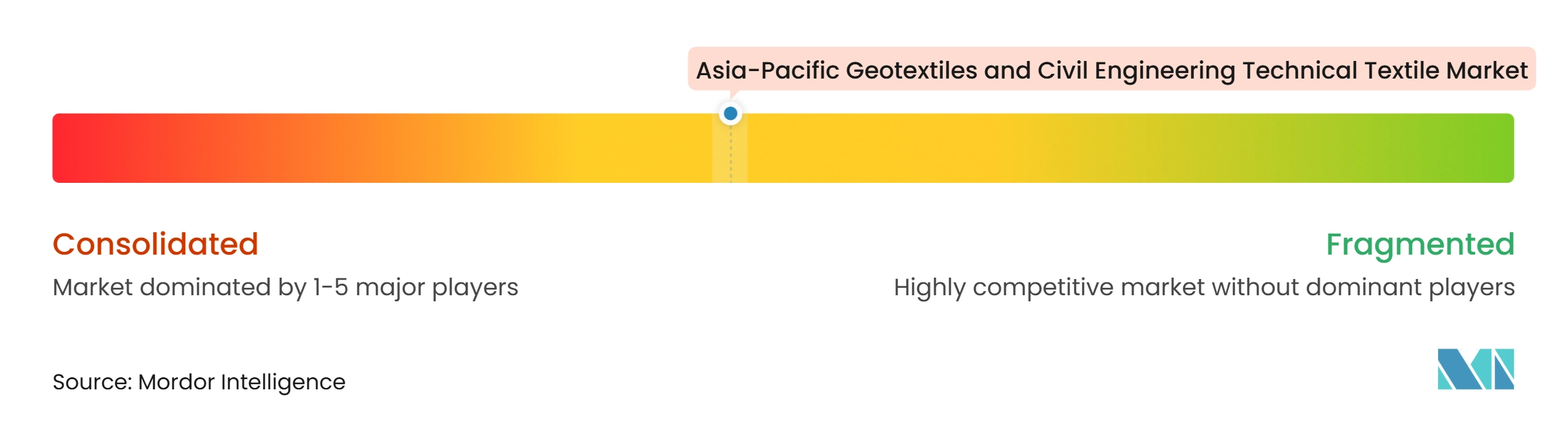
The Asia Pacific geotextiles and civil engineering technical textile market exhibits a medium level of market concentration. Global manufacturers compete alongside regional producers in China, India, and Southeast Asia. Solmax operates facilities in China, Thailand, and Malaysia. Its Performance Materials platform brought together TenCate Geosynthetics and Propex in June 2025. Solmax appointed Yujing Liu as Managing Director for Asia Pacific in July 2026.
Acquisitions are helping major suppliers add manufacturing capacity, testing capability, and design expertise. Strata Geosystems acquired Venus Interlinings in India in February 2026, entering the nonwoven segment. Officine Maccaferri acquired Ovattificio Alpino in September 2026, adding specialized nonwoven geotextile and technical-felt manufacturing. These actions show that differentiated reinforcement, drainage, and nonwoven products are important paths beyond commodity competition in technically demanding project applications. Local production remains important for secondary and rural road projects where transport costs affect project economics.
Sensor integration within geotextile layers remains underdeveloped across the region. These systems can track settlement, pore pressure, and seepage in earthworks. Bio-based and recycled-polymer formulations may gain relevance where lifecycle criteria affect qualification. Larger groups can use testing infrastructure and broad portfolios for complex specifications. Regional producers can compete through local service, cost discipline, schedule responsiveness, and familiarity with national construction practices.
Asia-Pacific Geotextiles and Civil Engineering Technical Textile Industry Leaders
-
Solmax
-
Strata Geosystems
-
TechFab India Industries Ltd.
-
HUESKER Synthetic GmbH
-
NAUE GmbH & Co. KG
- *Disclaimer: Major Players sorted in no particular order
Asia-Pacific Geotextiles and Civil Engineering Technical Textile Market Companies Covered in this Report
- Solmax
- Strata Geosystems
- TechFab India Industries Ltd.
- HUESKER Synthetic GmbH
- NAUE GmbH & Co. KG
- Officine Maccaferri S.p.A.
- Fibertex Nonwovens A/S
- Freudenberg Performance Materials
- Thrace Group
- Geofabrics Australasia Pty Ltd
- AGRU America, Inc.
- SKAPS Industries
- ACE Geosynthetics
- United Geosynthetics
- Asahi Kasei Advance Corporation
- CeTeau
- PT Tetrasa Geosinindo
- PT. Urban Plastik Indonesia
- Yixing Shenzhou Earth Working Material Co., Ltd.
- Dezhou Minghao Geotechnical Material Co., Ltd.
- Geofantex Geosynthetics
- Global Synthetics
- WIL-KEY INTERNATIONAL SDN BHD
Recent Industry Developments in Asia-Pacific Geotextiles and Civil Engineering Technical Textile Market
- July 2026: Solmax appointed Yujing Liu as Managing Director, Asia Pacific. The dedicated senior leadership appointment reflects the company’s strategic focus on Asia-Pacific as a core growth region within its globally integrated geosynthetics business.
- June 2026: Geoquest, a VINCI Construction subsidiary, signed an agreement to acquire the geosynthetics division of Grupo TDM. The transaction was completed in September 2026 and expands Geoquest’s portfolio to include waterproofing geomembranes and geocells for the mining sector.
- February 2026: Strata Geosystems acquired Venus Interlinings in Jaipur, India, a manufacturer of advanced nonwoven geotextiles. The transaction marked Strata’s entry into the nonwoven segment and added manufacturing capacity and technical expertise to its vertically integrated geosynthetics capabilities.
Asia-Pacific Geotextiles and Civil Engineering Technical Textile Market Report Scope
The Asia-Pacific Geotextiles and Civil Engineering Technical Textile Market Report is Segmented by Product Type (Woven Geotextiles, Nonwoven Geotextiles, and More), by Material Type (Polypropylene (PP), Polyester (PET), and More), by End-Use Application (Transportation Infrastructure, Earthworks and Geotechnical Engineering, and More), and by Geography (China, and More). The Market Forecasts are Provided in Terms of Value (USD).
Segmentation Overview
| Woven Geotextiles |
| Nonwoven Geotextiles |
| Knitted Geotextiles |
| Textile-Based Geogrids |
| Geotextile-Based Geocomposites |
| Geotextile Containers and Fabricated Products |
| Textile-Based Erosion Control Products |
| Other Civil Engineering Technical Textiles |
| Polypropylene (PP) |
| Polyester (PET) |
| Polyethylene (PE) |
| Polyamide (Nylon) |
| Natural Fibers (Coir, Jute. Other Natural Fibers) |
| Other Specialty Fibers and Materials |
| Transportation Infrastructure | Roads and Highways |
| Railways | |
| Airports and Airfield Infrastructure | |
| Earthworks and Geotechnical Engineering | |
| Water and Coastal Infrastructure (Including dams and water management infrastructure) | |
| Environmental and Waste Containment (landfills, waste containment, etc.) | |
| Mining and Energy Infrastructure | |
| Other Civil Engineering Applications |
| China |
| Japan |
| India |
| South Korea |
| Taiwan |
| Australia |
| Indonesia |
| Vietnam |
| Rest of Asia-Pacific |
| By Product Type | Woven Geotextiles | |
| Nonwoven Geotextiles | ||
| Knitted Geotextiles | ||
| Textile-Based Geogrids | ||
| Geotextile-Based Geocomposites | ||
| Geotextile Containers and Fabricated Products | ||
| Textile-Based Erosion Control Products | ||
| Other Civil Engineering Technical Textiles | ||
| By Material Type | Polypropylene (PP) | |
| Polyester (PET) | ||
| Polyethylene (PE) | ||
| Polyamide (Nylon) | ||
| Natural Fibers (Coir, Jute. Other Natural Fibers) | ||
| Other Specialty Fibers and Materials | ||
| By End-Use Application | Transportation Infrastructure | Roads and Highways |
| Railways | ||
| Airports and Airfield Infrastructure | ||
| Earthworks and Geotechnical Engineering | ||
| Water and Coastal Infrastructure (Including dams and water management infrastructure) | ||
| Environmental and Waste Containment (landfills, waste containment, etc.) | ||
| Mining and Energy Infrastructure | ||
| Other Civil Engineering Applications | ||
| By Geography | China | |
| Japan | ||
| India | ||
| South Korea | ||
| Taiwan | ||
| Australia | ||
| Indonesia | ||
| Vietnam | ||
| Rest of Asia-Pacific | ||
Key Questions Answered in the Report
What is the projected value of Asia Pacific geotextiles and civil engineering technical textiles by 2032?
The sector is projected to reach USD 2.21 billion by 2032, expanding at a 6.54% CAGR from 2027. Transport investment supports the outlook because geotextiles are used for reinforcement, separation, filtration, and drainage in road, rail, airport, coastal, and embankment construction.
Which product category leads demand in Asia Pacific geotextiles?
Nonwoven geotextiles lead with a 36% share in 2026 because they serve separation, filtration, drainage, and protection uses. They are widely specified for road, embankment, and earthworks projects where a versatile material is needed at a practical cost and consistent installation performance is important.
Which material has the largest share in civil engineering technical textiles?
Polypropylene holds a 40% share in 2026, supported by its processing compatibility, moisture resistance, and wide regional supply base. It is a common choice for high-volume products manufactured by established regional producers and supplied into infrastructure programs.
Which application has the greatest demand for geotextiles in Asia Pacific?
Transportation infrastructure leads with a 38% share in 2026, supported by highway, rail, airport, and embankment projects. These uses require separation, reinforcement, filtration, and drainage products through construction and maintenance, including in difficult ground and wet-site conditions.
Which country is expected to grow fastest through 2032?
India is forecast to record the fastest growth at an 8.5% CAGR, supported by road, urban, and water-management construction. Its national expressway program and formal geotextile specifications support demand for reinforcement and drainage materials in public works.
What factors constrain geotextile suppliers in the region?
Resin-price volatility, fragmented testing standards, inconsistent installation quality, and polymer end-of-life requirements can pressure suppliers and project delivery. Firms that maintain technical support, localized supply, and multi-standard testing capabilities are better placed to manage these constraints.