
Asia-Pacific Food Grade Carbon Dioxide Market Size and Share
Market Overview
| Study Period | 2021 - 2031 |
|---|---|
| Forecast Data Period | 2026 - 2031 |
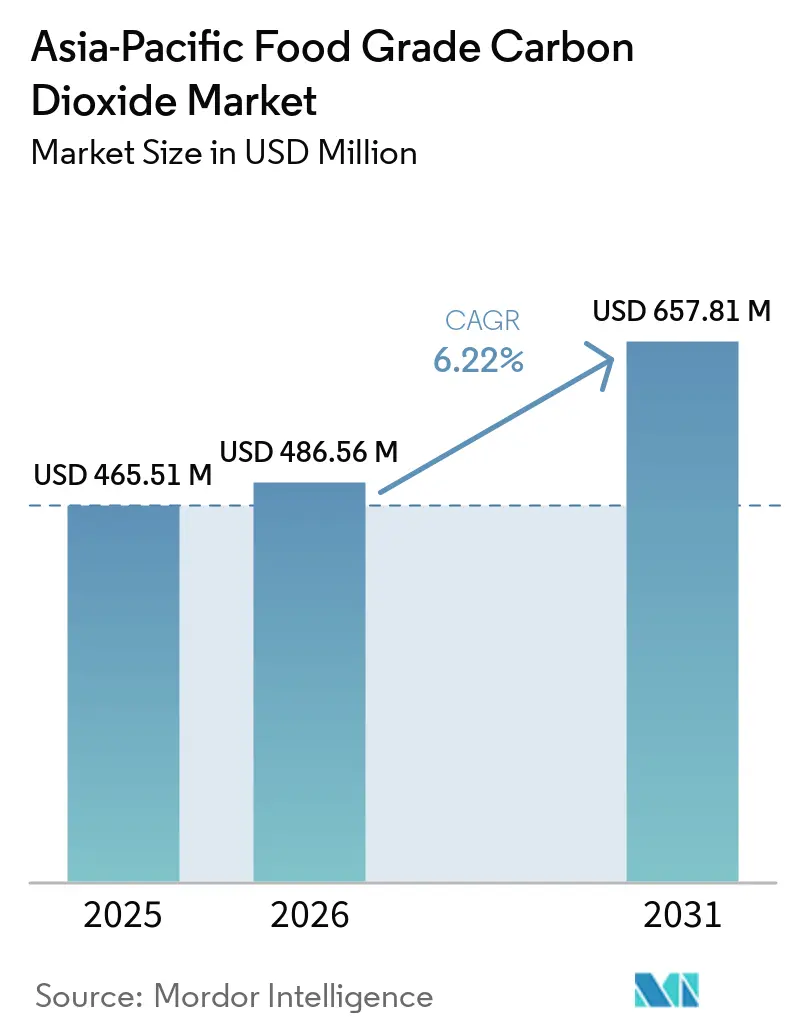
| Base Year Market Size (2025) | USD 465.51 Million |
| Market Size (2026) | USD 486.56 Million |
| Market Size (2031) | USD 657.81 Million |
| Growth Rate (2026 - 2031) | 6.22 % |
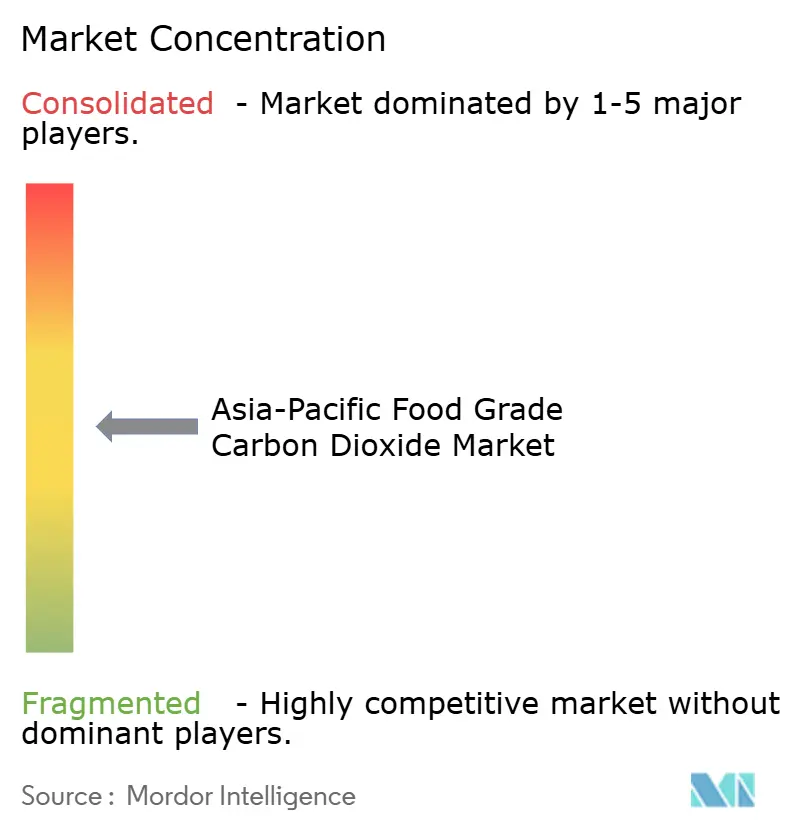
| Market Concentration | Medium |
Major Players *Disclaimer: Major Players sorted in no particular order Image © Mordor Intelligence. Reuse requires attribution under CC BY 4.0. | |
Asia-Pacific Food Grade Carbon Dioxide Market Analysis by Mordor Intelligence
The Asia-pacific food grade carbon dioxide market size is expected to grow from USD 465.51 million in 2025 to USD 486.56 million in 2026 and is forecast to reach USD 657.81 million by 2031 at 6.22% CAGR over 2026-2031. The market is supported by beverage carbonation, modified atmosphere packaging, and cold-chain operations for food and pharmaceutical products. Beverage production continues to add demand because manufacturers in developing cities are building capacity and need consistent food-grade gas supply. Modified atmosphere packaging requires controlled carbon dioxide concentrations, which raises the value of certified supply for processors. Dry ice also supports food exports and temperature-controlled distribution, linking the Asia-Pacific food-grade carbon dioxide market to wider cold-chain investment. Supply remains exposed to production interruptions at ammonia and ethanol facilities, so local recovery and storage capacity will remain important for suppliers and food processors.
Key Report Takeaways
- By source, ammonia recovery held 35.14% of the Asia-Pacific food-grade carbon dioxide market share in 2025, while ethanol recovery is forecast to grow at a 7.37% CAGR through 2031.
- By form, liquid carbon dioxide held 77.27% of the Asia-Pacific food-grade carbon dioxide market share in 2025, while solid carbon dioxide, or dry ice, is forecast to grow at a 7.61% CAGR through 2031.
- By end-use industry, beverages held 42.11% of regional demand in 2025, while meat and poultry processing is forecast to grow at a 7.81% CAGR through 2031.
- By geography, China held 37.51% of regional demand in 2025, while India is forecast to grow at a 7.51% CAGR through 2031.
Note: Market size and forecast figures in this report are generated using Mordor Intelligence’s proprietary estimation framework, updated with the latest available data and insights as of January 2026.
Market Trends and Insights
Drivers Impact Analysis of Asia-Pacific Food Grade Carbon Dioxide Market*
| Driver | (~) % Impact on CAGR Forecast | Geographic Relevance | Impact Timeline |
|---|---|---|---|
| Growth in carbonated beverage consumption | +1.8% | China, India | Medium term (2-4 years) |
| Expansion of food processing and preservation | +1.2% | India, Southeast Asia, China | Long term (≥ 4 years) |
| Increasing adoption of modified atmosphere packaging (MAP) | +0.8% | Japan, South Korea, China, Australia | Medium term (2-4 years) |
| Rising demand for meat and poultry processing | +0.7% | India, Vietnam, Australia | Long term (≥ 4 years) |
| Expansion of frozen and chilled food production | +0.5% | China, Japan, South Korea | Medium term (2-4 years) |
| Growth in packaged dairy and frozen products | +0.4% | India, China, New Zealand | Long term (≥ 4 years) |
| Source: Mordor Intelligence | |||
Growth in carbonated beverage consumption
Carbonated beverages remain the main source of food-grade carbon dioxide demand across the region. China reported a 6.1% year-on-year increase in production of liquor, beverages, and refined tea in June 2026, indicating continued manufacturing activity in a large beverage base[1]. The Asia-Pacific food-grade carbon dioxide market benefits when beverage plants add bottling and carbonation capacity in developing urban centers. Sparkling water, flavored carbonated drinks, and sugar-free products require reliable carbonation control. That requirement favors suppliers that can deliver consistent purity and dependable bulk volumes. It also makes long-term supply arrangements more relevant for large beverage producers than occasional spot purchases. The same operating requirements place value on local storage, scheduled tanker deliveries, and supplier quality documentation.
Expansion of food processing and preservation
Food processing is widening the use of carbon dioxide beyond beverage manufacturing. India’s Ministry of Food Processing Industries identified a substantial need for cold-chain infrastructure investment between 2025 and 2047, particularly for the handling of meat and dairy products[2]. Pre-cooling, tunnel freezing, and temperature-controlled storage can require liquid carbon dioxide or dry ice. The Asia-Pacific food-grade carbon dioxide market therefore gains from the shift toward refrigerated and packaged food. This demand is strongest where processors are extending distribution distances and shelf life. Supply providers that pair gas delivery with storage and handling support are better placed to serve these applications. Their role becomes more important when processors move from local sales toward longer distribution routes that require consistent temperature management. This also links gas demand to investments in refrigerated warehouses, transport, and food handling equipment.
Increasing adoption of modified atmosphere packaging (MAP)
Modified atmosphere packaging uses controlled gas mixtures to slow microbial growth and protect product quality. Carbon dioxide is a specification-sensitive input because packaging systems must use the appropriate concentration for the food product. Japan, South Korea, China, and Australia provide important markets where food exports and premium packaged foods support adoption. The Asia-Pacific food-grade carbon dioxide market benefits as processors seek consistent gas quality for packaged meat, seafood, bakery products, and produce. Common quality requirements can reduce duplicate supplier checks for companies operating across several countries. This makes certification, traceability, and reliable packaging-grade supply important competitive factors. Suppliers also need to work with processors on the gas specifications required for different food categories and packaging formats. This requires a closer working relationship than basic commodity supply, especially where shelf-life performance is closely monitored.
Rising demand for meat and poultry processing
Food-grade carbon dioxide supports modified atmosphere packaging and controlled-atmosphere operations in modern processing facilities. India’s food safety authority lists carbon dioxide, identified as INS 290, as a compliant processing aid for raw meat and poultry applications under its March 2024 direction[3]. The Asia-Pacific food-grade carbon dioxide market is linked to the expansion of export-oriented processing because those facilities need documented food-safety practices. Poultry capacity additions also create recurring demand for packaging and cold-chain gases. India, Vietnam, and Australia are relevant because each combines protein production with export and cold-chain requirements. Growth in these locations can require suppliers to coordinate food-safety documentation with regular processing and packaging deliveries.
Restraints Impact Analysis of Asia-Pacific Food Grade Carbon Dioxide Market*
| Restraint | (~) % Impact on CAGR Forecast | Geographic Relevance | Impact Timeline |
|---|---|---|---|
| Regional imbalances in food-grade CO₂ availability | -0.7% | Southeast Asia, South Asia | Short term (≤ 2 years) |
| High investment requirements for storage and distribution infrastructure | -0.5% | Asia-core | Short term (≤ 2 years) |
| Energy-price volatility affecting CO₂ production economics | -0.4% | India, Indonesia, Vietnam | Medium term (2-4 years) |
| Stringent food-grade purity and certification requirements | -0.3% | India, Pakistan | Medium term (2-4 years) |
| Source: Mordor Intelligence | |||
Regional imbalances in food-grade CO₂ availability
Food-grade carbon dioxide supply does not always match the location of food-processing demand. Large recovery sites are concentrated around ammonia and ethanol facilities in India, China, and Thailand. Indonesia, Malaysia, Vietnam, and northeastern India can face limited nearby purification, storage, and distribution capacity. The Asia-Pacific food-grade carbon dioxide market can therefore operate differently for coastal processors and inland processors. Plants located near liquid carbon dioxide terminals can use longer-term supply arrangements. Processors farther from those networks face a greater risk of seasonal supply tightening during peak beverage demand. The distance between recovery sites and customers can also increase delivery costs and reduce the flexibility of smaller processors.
High investment requirements for storage and distribution infrastructure
Liquid carbon dioxide distribution requires insulated tanks, specialized tanker fleets, vaporization equipment, and trained operating support. These requirements can delay capacity growth in India, Indonesia, Vietnam, and other developing food-processing markets. PVCFC commissioned a food-grade carbon dioxide extraction facility at its Ca Mau Fertilizer Plant in February 2026, showing that dedicated recovery capacity requires a material upfront investment. The Asia-Pacific food-grade carbon dioxide market can face supply limitations while projects move from investment decisions to commercial operation. Smaller regional suppliers may find it difficult to fund infrastructure before securing long-term customer commitments. These conditions strengthen the position of companies with established logistics networks and customer contracts. Long project timelines can leave demand ahead of local capacity when food-processing investment moves faster than gas infrastructure development.
*Our forecasts treat driver/restraint impacts as directional, not additive. The impact forecasts reflect baseline growth, mix effects, and variable interactions.
Asia-Pacific Food Grade Carbon Dioxide Market Segment Analysis
By Source:
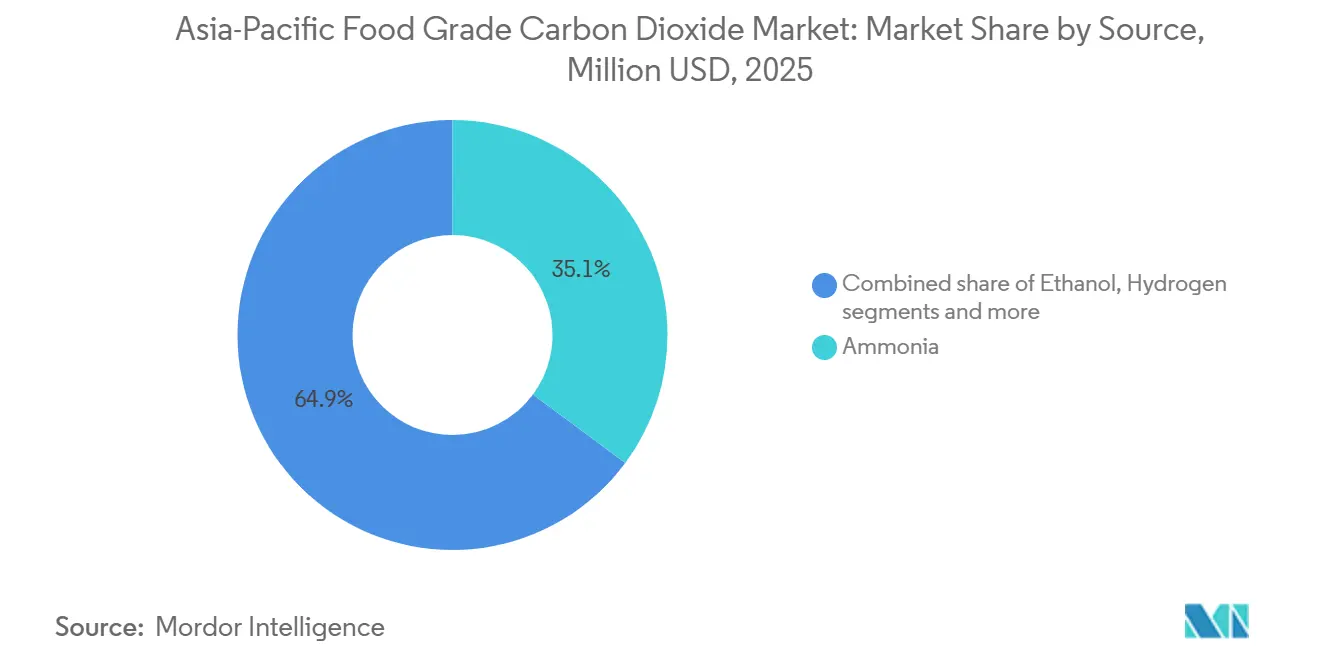
Ammonia Remains the Leading Supply Route While Ethanol Gains ImportanceAmmonia-plant recovery held 35.14% of regional supply in 2025. Fertilizer complexes in India, China, and Vietnam generate concentrated carbon dioxide streams that can be recovered and purified for food applications. This route benefits from the scale of existing ammonia and urea production. It can also expose food-gas supply to changes in fertilizer output, natural gas costs, or plant maintenance schedules. Hydrogen production, natural gas processing, and other industrial sources serve more localized supply positions. These alternatives often support one large beverage, food, or meat processor through captive arrangements or long-term commercial contracts. Their contribution depends on local feedstock availability, purification capability, and the customer’s food-grade quality requirements.
Ethanol recovery is projected to grow at a 7.37% CAGR through 2031 within the Asia-Pacific food-grade carbon dioxide market. Fermentation creates a high-concentration carbon dioxide stream that can be purified for food and beverage use. India’s ethanol blending program and Thailand’s biofuel expansion are increasing distillation capacity across the region. A 100-KLPD ethanol plant can recover 13,000 to 15,000 tonnes of carbon dioxide each year from fermentation exhaust. Nippon Sanso Thailand and Thai Special Gas launched Green CO2 Co., Ltd. in 2026 to purify carbon dioxide from BBGI’s ethanol process in Chachoengsao Province for food, beverage, and industrial supply.

By Form:
Liquid Carbon Dioxide Supports Bulk Demand While Dry Ice Grows FasterLiquid carbon dioxide accounted for 77.27% of the Asia-Pacific food-grade carbon dioxide market size by form in 2025. Its leading position reflects the needs of large beverage bottlers and food-gas users that rely on bulk deliveries. Cryogenic tanker networks support regular supply to carbonation lines and modified atmosphere packaging systems. Large protein processors also use liquid product where delivery consistency and volume are important. Gas-form carbon dioxide serves smaller food businesses, including bakeries, dairy plants, and food-service operators. Japan, South Korea, and Australia have distributed demand that supports cylinder and microbulk supply alongside bulk liquid distribution.
Solid carbon dioxide, commonly called dry ice, is forecast to grow at a 7.61% CAGR through 2031. It supports cold-chain applications for meat, seafood, frozen food, fresh-food deliveries, and pharmaceutical products. China consumed 160,000 tonnes of dry ice in 2025, while India consumed 95,000 tonnes. Local dry ice recovery can reduce the transport burden that limits centralized distribution. The Asia-Pacific food-grade carbon dioxide market can benefit from small-scale recovery models near distilleries and food-processing sites. These models are most relevant where fermentation emissions are available and local demand needs reliable temperature control.
By End-Use Industry:
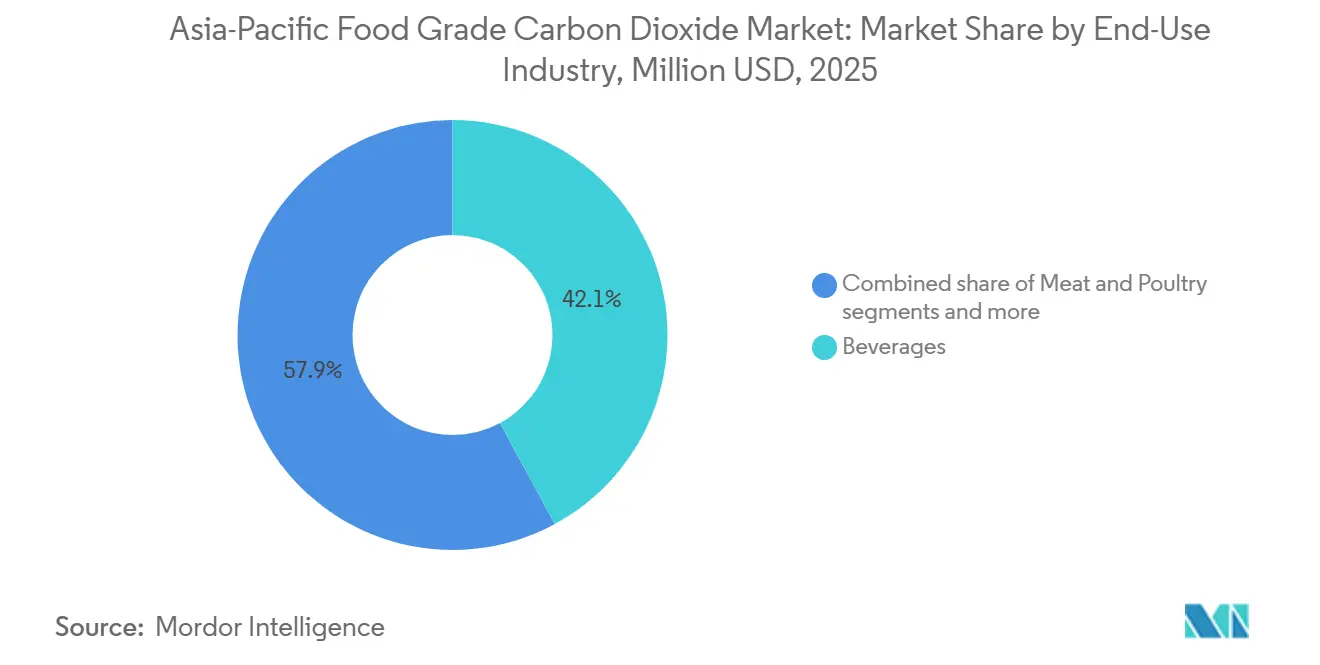
Beverages Hold the Largest Position While Meat and Poultry Processing Leads GrowthBeverages held 42.11% of the Asia-Pacific food-grade carbon dioxide market size in 2025. Cola, sparkling water, energy drinks, beer, and other carbonated products rely on consistent food-grade carbon dioxide supply. Beverage applications require close control of purity and contaminants, which makes this end-use segment a quality benchmark for suppliers. Dairy and frozen foods, fruits and vegetables, and bakery and confectionery use carbon dioxide in packaging or freezing-related applications. These end uses benefit from the same cold-chain buildout that supports the broader food sector. Their carbon dioxide use per unit of output is generally lower than in large-scale beverage production.
Meat and poultry processing is projected to grow at a 7.81% CAGR through 2031. Export-oriented processors use carbon dioxide in controlled-atmosphere activities and modified atmosphere packaging for retail-ready products. Food processors must maintain records that support food-safety and processing-aid compliance. The Asia-Pacific food-grade carbon dioxide industry benefits when protein exporters improve shelf-life management and cold-chain performance. India’s food-processing and cold-chain investment needs show the scale of infrastructure required to serve this demand. This segment creates an opportunity for suppliers that can combine certified supply with reliable delivery to processing sites.
Geography Analysis
Northeast Asia and Australia Food Grade Carbon Dioxide Market
China held 37.51% of regional demand in 2025. Its position reflects a large beverage manufacturing base and established industrial-gas infrastructure. China reported a 6.1% year-on-year rise in the production of liquor, beverages, and refined tea in June 2026. Domestic suppliers serve inland food-processing clusters through bulk liquid and pipeline arrangements. China’s food-grade purity requirements favor suppliers that can meet formal specifications. Japan, South Korea, and Australia form a high-specification group where premium food exports and food-safety practices sustain demand for consistent high-purity product. These markets reward suppliers that can demonstrate stable product quality and dependable service for sensitive food applications.
India Food Grade Carbon Dioxide Market
India is forecast to record the highest country CAGR at 7.51% through 2031. The Asia-Pacific food-grade carbon dioxide market in India is supported by meat and poultry exports, packaged food consumption, and growth in ethanol distillation. These demand and supply factors develop together, but recovery infrastructure must keep pace with new processing capacity. Gujarat has concentrated recovery from fertilizer production, while new ethanol capacity can add biogenic recovery opportunities. The Food Safety and Standards Authority of India’s March 2024 direction provides a clear compliance basis for carbon dioxide use in raw meat and poultry processing. Cold storage capacity remains below the level identified as necessary for India’s food-processing needs.
ASEAN, Australia and New Zealand Food Grade Carbon Dioxide Market
Southeast Asia includes Indonesia, Malaysia, Vietnam, and Thailand, and each country has different infrastructure and sourcing conditions. PVCFC began commercial food-grade liquid carbon dioxide production at its Ca Mau Fertilizer Plant in February 2026 and distributed its first 75-tonne batch through Messer Vietnam. The project shows how fertilizer-based recovery can support food processing where industrial infrastructure develops before food-gas demand. Australia and New Zealand remain smaller by volume but set an important high-purity supply standard. Air Liquide announced a planned biogenic carbon dioxide facility at Bomaderry in New South Wales using wheat-fermentation emissions from Shoalhaven Starches.
Competitive Landscape
The Asia-Pacific food-grade carbon dioxide market is moderately concentrated. Linde plc, Air Liquide S.A., Air Products and Chemicals, Taiyo Nippon Sanso Corporation, and Messer SE & Co. KGaA are positioned in high-specification and export-aligned food-processing applications. National specialists also compete in domestic and regional markets where distribution coverage is essential. Linde has established cryogenic distribution networks for food applications in Australia and Japan. Air Liquide supports integrated supply across ASEAN and China. Its acquisition of Hangzhou Best added industrial and specialty gas capacity in East China.
Yingde Gases Group serves food-processing clusters in China through bulk liquid and pipeline supply arrangements. The company started production at a gas supply project in Zhejiang Province in September 2024, expanding liquid-product supply capacity and pipeline coverage in the industrial park. Sicgil India operates dry ice capacity across multiple locations and serves both food cold-chain and pharmaceutical distribution. The Asia-Pacific food-grade carbon dioxide market offers room for regional suppliers serving mid-sized processors that do not meet the volume needs of bulk supply contracts. Microbulk delivery and certification support can be valuable in this part of the customer base.
New competitive pressure can come from fertilizer, ethanol, and other industrial operators with captive carbon dioxide streams. PVCFC entered food-grade liquid carbon dioxide supply in 2026 by recovering gas from urea production. Nippon Sanso Thailand and Thai Special Gas created Green CO2 Co., Ltd. to convert ethanol-fermentation carbon dioxide into commercial supply. Mitsubishi Electric, ITRI, and Taiwan Tobacco & Liquor Corporation began testing carbon dioxide capture and reuse at the Jhunan Brewery in August 2025. These projects show that on-site recovery could reduce dependence on merchant supply for some large users. ISO 22000 certification remains a baseline expectation for suppliers serving formal food-processing contracts.
Asia-Pacific Food Grade Carbon Dioxide Industry Leaders
-
Linde plc
-
Air Liquide S.A.
-
Air Products and Chemicals, Inc.
-
TAIYO NIPPON SANSO CORPORATION
-
Messer SE & Co. KGaA
- *Disclaimer: Major Players sorted in no particular order
Asia-Pacific Food Grade Carbon Dioxide Market Companies Covered in this Report
- Linde plc
- Air Liquide S.A.
- Air Products and Chemicals, Inc.
- TAIYO NIPPON SANSO CORPORATION
- Messer SE & Co. KGaA
- Sicgil India Limited
- Ellenbarrie Industrial Gases Limited
- IFB Agro Industries Limited
- WKS Industrial Gas Pte Ltd.
- Southern Gas Limited
- Yingde Gases Group Company Limited
- Hangzhou Hangyang Co., Ltd.
- Sichuan Tianyi Science and Technology Co., Ltd.
- Shandong Shouguang Juneng Golden Corn Co., Ltd.
- Jiangsu Huachang Chemical Co., Ltd.
- Guangdong Huate Gas Co., Ltd.
- Zhejiang Juhua Co., Ltd.
- India Glycols Limited
- PT Samator Indo Gas Tbk
- Air Water, Inc.
Recent Industry Developments in Asia-Pacific Food Grade Carbon Dioxide Market
- May 2026: Nippon Sanso (Thailand) and Thai Special Gas commenced its commercial operations through Green CO2 Co., Ltd., a joint venture that processes carbon dioxide from ethanol fermentation at BBGI Public Company in Chachoengsao Province into liquid carbon dioxide for food, beverage, and industrial applications. The venture is seeking Carbon Footprint of Product certification for beverage manufacturers across eastern Thailand and the broader ASEAN corridor.
- February 2026: PVCFC began operations at its food-grade carbon dioxide production project at the Ca Mau Fertilizer Plant and delivered its first commercial 75-ton batch of ISBT-standard liquid carbon dioxide on February 4, 2026. The project captures carbon dioxide from urea production, operates at a capacity of 50 tons per day, and has appointed Messer Vietnam as its offtake and distribution partner.
- August 2025: Mitsubishi Electric Corporation entered into a collaboration agreement with the Industrial Technology Research Institute and Taiwan Tobacco & Liquor Corporation’s Jhunan Brewery to evaluate the capture and purification of carbon dioxide from a gas boiler for reuse in beer production.
Asia-Pacific Food Grade Carbon Dioxide Market Report Scope
Food-grade carbon dioxide (CO₂) is carbon dioxide that meets specified purity and safety standards for use in food and beverage applications. The market is segmented into source, form, end-use industry and country. Based on source the market is segmented into ammonia, ethanol, hydrogen, natural gas processing and other sources. Based on form, the market is segmented into liquid, gas, solid/ice. Based on end-use industry, the market is segmented into beverages, meat and poultry, dairy and frozen foods, fruits and vegetables, bakery and confectionery and other food industries. Based on country, the market is segmented into China, Japan, India, South Korea, Australia , New Zealand, Indonesia, Malaysia, Vietnam and Rest of Asia-Pacific. For each segment, the market sizing and forecasting have been done in value terms (USD million).
Segmentation Overview
| Ammonia |
| Ethanol |
| Hydrogen |
| Natural Gas Processing |
| Other Sources |
| Liquid |
| Gas |
| Solid/Dry Ice |
| Beverages |
| Meat & Poultry |
| Dairy & Frozen Foods |
| Fruits & Vegetables |
| Bakery & Confectionery |
| Other Food Industries |
| China |
| Japan |
| India |
| South Korea |
| Australia |
| New Zealand |
| Indonesia |
| Malaysia |
| Vietnam |
| Rest of Asia-Pacific |
| By Source | Ammonia |
| Ethanol | |
| Hydrogen | |
| Natural Gas Processing | |
| Other Sources | |
| By Form | Liquid |
| Gas | |
| Solid/Dry Ice | |
| By End-use Industry | Beverages |
| Meat & Poultry | |
| Dairy & Frozen Foods | |
| Fruits & Vegetables | |
| Bakery & Confectionery | |
| Other Food Industries | |
| By Country | China |
| Japan | |
| India | |
| South Korea | |
| Australia | |
| New Zealand | |
| Indonesia | |
| Malaysia | |
| Vietnam | |
| Rest of Asia-Pacific |
Key Questions Answered in the Report
What is driving demand for food-grade carbon dioxide in Asia-Pacific?
Beverage carbonation, modified atmosphere packaging, meat and poultry processing, and cold-chain operations support demand across the region. These applications require either regular bulk supply or dry ice availability close to food-processing and distribution sites.
Which source supplies the largest share of food-grade carbon dioxide?
Ammonia-plant recovery held 35.14% of supply by source in 2025, supported by fertilizer complexes in India, China, and Vietnam.
Why is ethanol-based recovery becoming more important?
Ethanol fermentation provides a concentrated carbon dioxide stream, and ethanol capacity expansion in India and Thailand supports new recovery projects. Certification and purification remain necessary before the recovered gas can enter formal food-contact supply chains.
Which carbon dioxide form is growing the fastest?
Solid carbon dioxide, or dry ice, is forecast to grow at a 7.61% CAGR through 2031, supported by food and pharmaceutical cold chains. It is relevant for frozen-food exports, fresh-food delivery, and temperature-controlled transport.
Which end-use application is expanding fastest?
Meat and poultry processing is forecast to grow at a 7.81% CAGR through 2031, supported by export processing and packaging requirements.