
Asia Pacific Electric Three-Wheeler Market Size and Share
Market Overview
| Study Period | 2020 - 2032 |
|---|---|
| Base Year Market Size (2026) | USD 6.15 Billion |
| Market Size (2027) | USD 6.79 Billion |
| Market Size (2032) | USD 11.15 Billion |
| Growth Rate (2027 - 2032) | 10.43 % |
| Fastest Growing Market | Philippines |
| Largest Market | India |
Major Players *Disclaimer: Major Players sorted in no particular order Image © Mordor Intelligence. Reuse requires attribution under CC BY 4.0. | |
Asia Pacific Electric Three-Wheeler Market Analysis by Mordor Intelligence
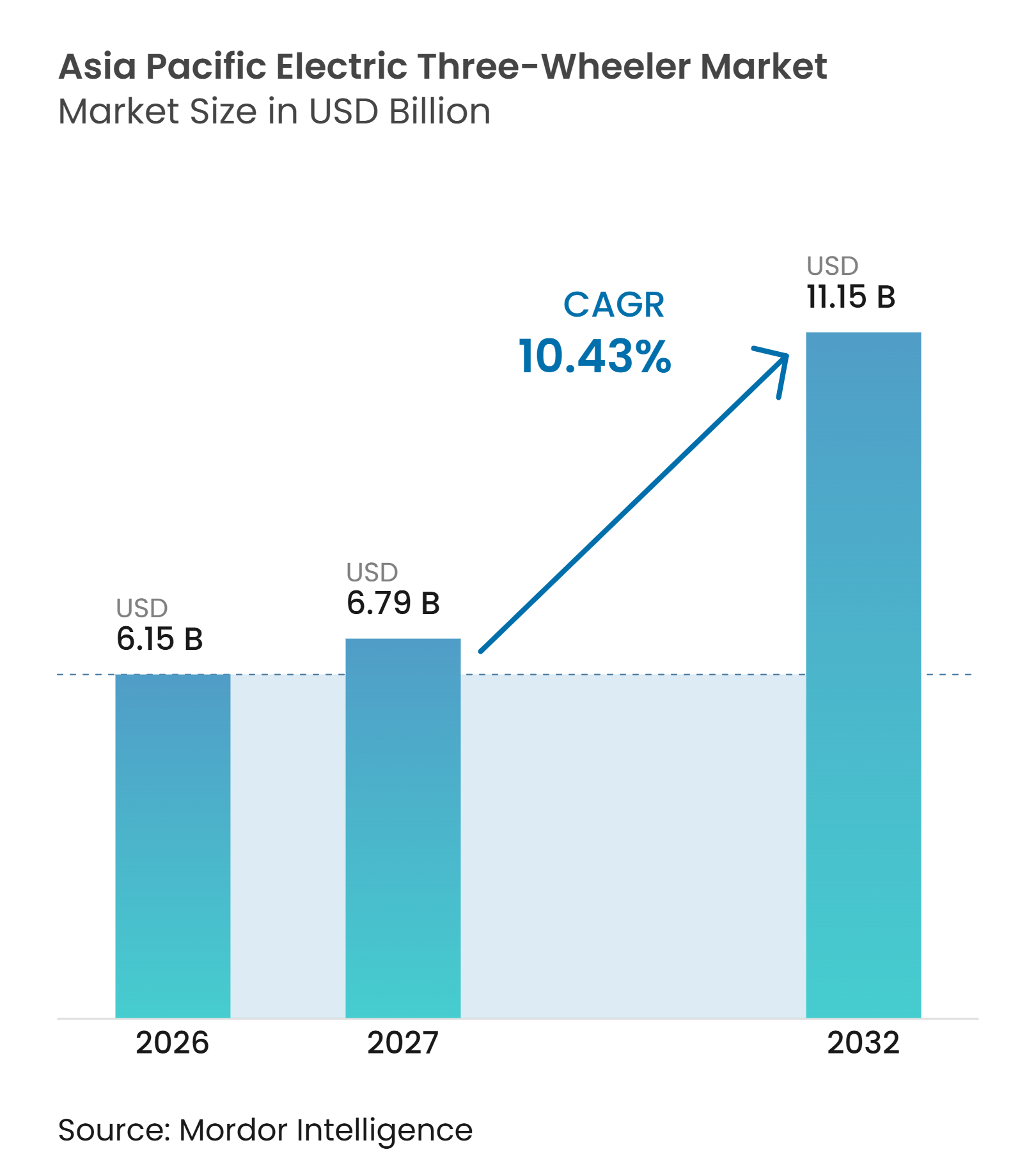
The Asia Pacific electric three-wheeler market size was valued at USD 6.15 billion in 2026 and is expected to grow from USD 6.79 billion in 2027 to USD 11.15 billion by 2032, at a CAGR of 10.43% during 2027-2032. The Asia Pacific electric three-wheeler market is supported by dense urban travel patterns, owner-operators seeking lower daily operating costs, and demand for short-distance freight services. Electric models accounted for more than one-quarter of the roughly 4.5 million three-wheelers sold worldwide in 2025, and India and China together represented about 91% of global electric three-wheeler sales. India and China remain the primary sources of regional volume, although their roles differ because India is expanding commercial adoption while China is a key source of vehicles and components. The Asia Pacific electric three-wheeler market also has room to grow as battery swapping, higher-capacity packs, and formally registered commercial vehicles address longer operating hours. Supply resilience is becoming more important because rare-earth magnet restrictions showed the exposure of regional manufacturers to concentrated component supply.
Key Report Takeaways
- By vehicle type, passenger carriers held a 72.13% share in 2026, while load carriers are projected to grow at a 13.20% CAGR through 2032.
- By battery type, lithium-ion held a 67.27% share in 2026 and is projected to grow at a 15.27% CAGR through 2032.
- By motor power, the 1,000 to 1,500 W segment held a 51.36% share in 2026 and is projected to grow at an 8.46% CAGR through 2032.
- By battery capacity, the 3 to 6 kWh segment held a 46.28% share in 2026, while the more than 6 kWh segment is projected to grow at a 13.58% CAGR through 2032.
- By charging, plug-in charging held an 84.17% share in 2026, while battery swapping is projected to grow at a 24.38% CAGR through 2032.
- By end use, fleet and shared mobility held a 35.42% share in 2026, while last-mile logistics is projected to grow at a 15.63% CAGR through 2032.
- By country, India held a 60.24% share in 2026, while the Philippines is projected to grow at a 16.80% CAGR through 2032.
Note: Market numbers in this report are based on Mordor Intelligence's proprietary estimation framework, which combines nine months of actuals with Q4 projections for base year 2026.
Market Trends and Insights
Drivers Impact Analysis of Asia Pacific Electric Three-Wheeler Market*
| Driver | (~) % Impact on CAGR Forecast | Geographic Relevance | Impact Timeline |
|---|---|---|---|
| Fuel-Cost Savings and Lower Total Cost of Ownership | +2.3% | Asia-Pacific, strongest in India and Bangladesh | Short term (≤ 2 years) |
| Government Incentives and Electrification Targets | +2.1% | India, Philippines, Thailand | Medium term (2–4 years) |
| Urban Last-Mile Passenger and Cargo Demand | +2.0% | India, China, Vietnam, Indonesia | Medium term (2–4 years) |
| Lithium-ion Battery Performance and Falling Pack Costs | +1.6% | Asia-Pacific, sharpest cost advantage in China | Medium term (2–4 years) |
| Battery Swapping for Higher Fleet Utilization | +1.2% | India, with spillover to Southeast Asia | Medium term (2–4 years) |
| Rare-Earth Magnet and Component Localization for Regional Supply Resilience | +0.9% | India, with secondary Asia-Pacific OEM influence | Long term (≥ 4 years) |
| Source: Mordor Intelligence | |||
Fuel-Cost Savings and Lower Total Cost of Ownership
The Asia Pacific electric three-wheeler market benefits when daily energy expenses are lower than fuel spending for comparable conventional vehicles. Charging an electric three-wheeler in the Philippines costs a fraction of the daily fuel bill of a gasoline tricycle, which can shorten the payback period for owner-operators. India recorded 159,235 L5-category electric three-wheeler sales in FY2025, up 57% year over year, under policy support that reduced barriers to commercial adoption[1]. Lower running costs matter most to owner-drivers because their daily earnings depend directly on vehicle availability and route income. They also improve the case for fleet operators that can schedule charging and monitor energy use across many vehicles. The resulting savings make higher-quality vehicles more attainable even where access to formal credit remains limited.
Government Incentives and Electrification Targets
Public programs continue to influence the Asia Pacific electric three-wheeler market by reducing initial purchase costs and encouraging formal commercial registration. India’s PM E-DRIVE program allocated support for about 316,000 electric three-wheelers, and its L5 target of 288,000 units was met in December 2025, when incentives for that category closed. Support for e-rickshaws and e-carts continues through March 31, 2028, at revised rates. Thailand’s EV3.5 program and the Philippines’ Electric Vehicle Industry Development Act extend similar policy direction into Southeast Asia. India has also tightened traction-motor localization rules for electric trucks and buses under PM E-DRIVE, effective September 2026, which signals rising policy weight on domestic component partnerships across electric vehicle categories. These measures can favor manufacturers that meet local production and compliance requirements over import-only suppliers.
Urban Last-Mile Passenger and Cargo Demand
The Asia Pacific electric three-wheeler market is gaining from passenger and freight trips that are short, frequent, and concentrated in crowded urban areas. Global electric three-wheeler sales exceeded 1.2 million units in 2025, even as total three-wheeler sales fell 16%[2]. This movement is strongest where delivery platforms need vehicles that can make repeated journeys through narrow streets and dense neighborhoods. Fleet cargo buyers are increasingly assessing uptime, service support, and vehicle operating cost rather than only the purchase price. Bangladesh illustrates the scale of passenger use, with about 4 million electric three-wheelers in operation, most of them unregistered. This demand supports both established passenger formats and newer cargo models designed for platform-led delivery work.
Lithium-ion Battery Performance and Falling Pack Costs
Lithium-ion batteries strengthen the Asia Pacific electric three-wheeler market because they support longer operating ranges and reduce lifetime energy-system costs. The International Energy Agency reported that global battery manufacturing capacity reached 3 TWh in 2024 and could triple by 2030. Greater cell supply can reduce pressure on pack availability even when raw-material prices move unpredictably. Bangladesh has a large lead-acid installed base, with about 4 million operational electric three-wheelers, which creates a substantial future replacement opportunity. Pure Earth estimates that 80% of used lead-acid batteries in Bangladesh are recycled at informal sites, and a national survey found elevated blood lead levels in about 38% of children under five. Those environmental and health concerns add urgency to a move toward sealed battery technologies. Chinese manufacturers maintain a structural cost advantage through their scale in cell sourcing and vehicle production.
Restraints Impact Analysis of Asia Pacific Electric Three-Wheeler Market*
| Restraint | (~) % Impact on CAGR Forecast | Geographic Relevance | Impact Timeline |
|---|---|---|---|
| Inadequate Charging and Swapping Coverage Outside Dense Urban Corridors | -1.3% | India, Bangladesh, Philippines | Short term (≤ 2 years) |
| High Upfront Cost and Constrained Small-Operator Finance | -1.1% | India, Bangladesh, Vietnam, Nepal | Medium term (2–4 years) |
| Informal Low-Speed Vehicle Regulation and Uneven Safety Enforcement | -0.8% | Bangladesh, Philippines, Vietnam | Long term (≥ 4 years) |
| Lead-Acid Battery End-of-Life and Recycling Externalities | -0.6% | Bangladesh and India’s informal sector | Medium term (2–4 years) |
| Source: Mordor Intelligence | |||
Inadequate Charging and Swapping Coverage Outside Dense Urban Corridors
The Asia Pacific electric three-wheeler market faces a practical infrastructure constraint outside major cities. India is projected to need more than 26,000 battery-swapping kiosks by the end of FY2026, while the India Battery Swapping Association counted about 2,600 swapping kiosks in April 2025, mainly in Delhi. The Philippines had about 912 charging stations in early 2025, and much of this network remained concentrated in Metro Manila. Operators in provincial and semi-urban locations may therefore lack dependable charging access for commercial routes. A hub-and-spoke approach could extend swapping from metropolitan logistics terminals to secondary corridors. However, grid connections, land permissions, and working capital remain necessary before stations can serve these locations. The gap limits adoption precisely where many new owner-operators and freight users are located.
High Upfront Cost and Constrained Small-Operator Finance
Purchase price and finance access remain material barriers for small operators across the Asia Pacific electric three-wheeler market. In the Philippines, an electric three-wheeler costs considerably more than a conventional tricycle, despite a meaningful operating-cost advantage over its working life. Lenders face difficulty underwriting borrowers with irregular or undocumented income, particularly when a subsidy is no longer available to support the transaction. In India, the exhaustion of PM E-DRIVE support for L5 vehicles in December 2025 affected financing processes built around that incentive. Fleet leasing and cash-flow-based underwriting can address this issue, but these models remain limited outside India’s larger urban centers.
*Our forecasts treat driver/restraint impacts as directional, not additive. The impact forecasts reflect baseline growth, mix effects, and variable interactions.
Asia Pacific Electric Three-Wheeler Market Segment Analysis
By Vehicle Type:
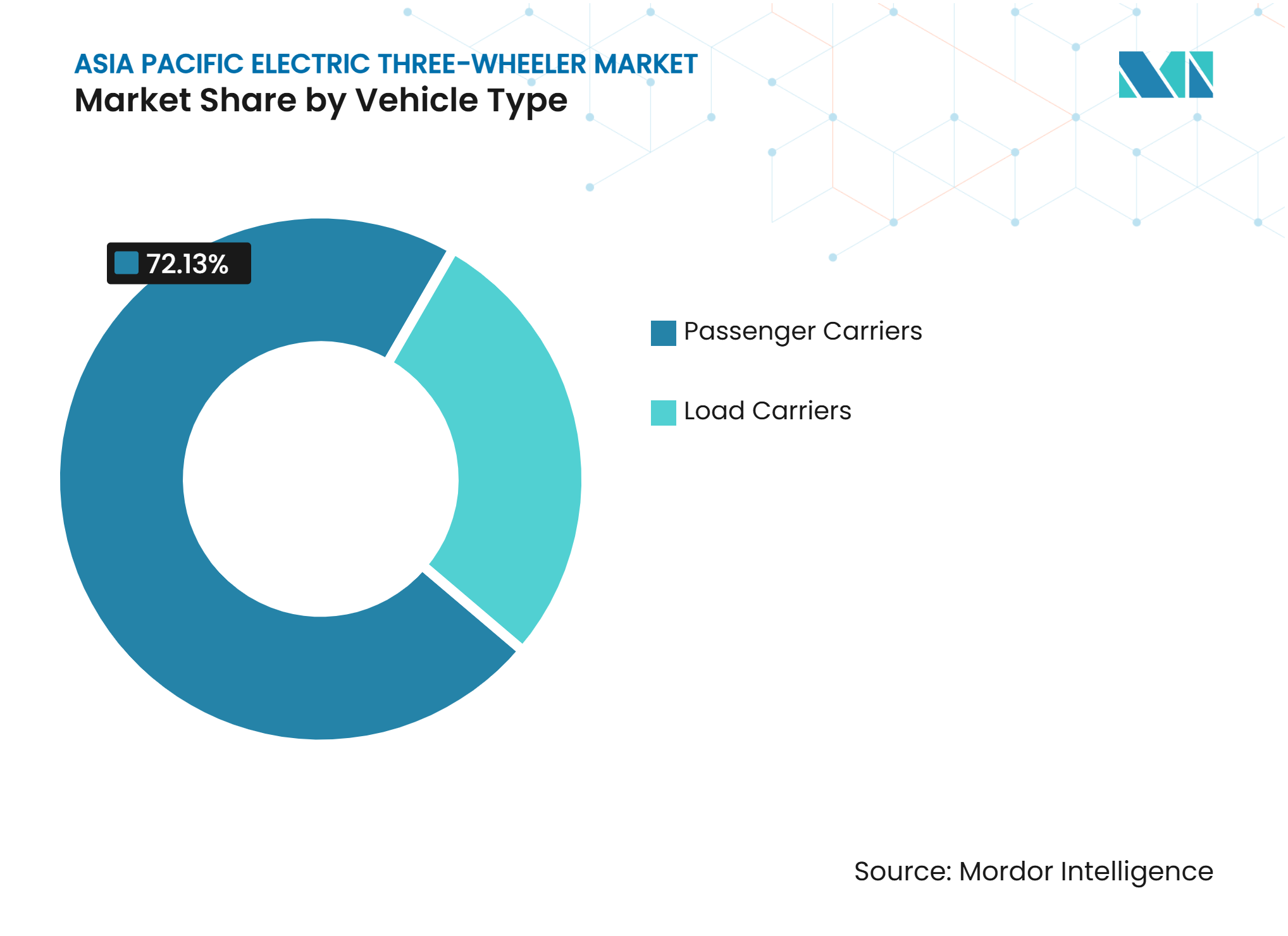
Cargo Demand Reshaping a Passenger-Led MarketPassenger carriers accounted for 72.13% of the Asia Pacific electric three-wheeler market share in 2026, reflecting the continuing role of e-rickshaws in South and Southeast Asian passenger transport. This category benefits from familiar vehicle formats, established local repair capacity, and predictable demand on short urban routes. In India, electric three-wheeler retail reached 830,819 units in FY2026, with Mahindra Last Mile Mobility selling 101,905 units, Bajaj Auto selling 89,604 units, and TVS Motor selling 27,831 units. Passenger operations are often run by individual owner-drivers, so simple maintenance and overnight charging remain important purchase factors. Existing service networks help established brands retain a role in this part of the Asia Pacific electric three-wheeler industry.
Load carriers are forecast to grow at a 13.20% CAGR through 2032 within the Asia Pacific electric three-wheeler market. Their expansion follows rapid growth in urban delivery requirements, where operators need compact vehicles with useful payload and lower energy costs. Cargo fleets also operate for longer periods, increasing interest in battery management, route planning, and service guarantees. Leading OEMs are adding dedicated cargo products, such as the C90 cargo series in Bajaj Auto’s WEGO range launched in India in April 2026. This pattern may gradually reduce the relative weight of passenger vehicles, although passenger e-rickshaws remain deeply embedded in regional transport systems. The cargo category is expected to remain dependent on charging access and vehicle reliability because a missed delivery cycle directly affects fleet income.


By Battery Type:
Lithium-Ion Consolidating Across Price PointsLithium-ion batteries held 67.27% of the Asia Pacific electric three-wheeler market share in 2026 and are projected to grow at a 15.27% CAGR through 2032. Their position reflects demand for better range, repeated-charge performance, and commercial operating flexibility. The Asia Pacific electric three-wheeler industry is also moving toward lithium-ion systems because fleet operators can spread their higher initial cost over greater vehicle use. The International Energy Agency noted that battery manufacturing capacity could expand sharply through 2030, which can support continued cell availability. A larger supply base gives vehicle manufacturers more options in designing standardized packs and higher-capacity vehicles.
Lead-acid batteries continue to have a large installed base in Bangladesh because they carry lower purchase costs. The country’s roughly 4 million operational electric three-wheelers are primarily lead-acid vehicles. Informal recycling and documented health concerns make the transition away from this chemistry more pressing. Sodium-ion products remain at an early stage but are being evaluated by regional manufacturers as a lower-cost alternative chemistry. These alternatives may offer manufacturers another option if lithium input costs become more volatile. For now, the installed supplier base and commercial performance of lithium-ion systems keep them in the strongest position.
By Motor Power:
Mid-Range Configuration Anchors Commercial OperationsThe 1,000–1,500 W category represented 51.36% of the Asia Pacific electric three-wheeler market share in 2026 and is expected to expand at an 8.46% CAGR through 2032. This configuration balances torque requirements for loaded urban operation with eligibility under many regional vehicle rules. It is suited to vehicles that must carry passengers or goods while maintaining reasonable energy consumption. Manufacturers can use this middle range across several applications, which supports production scale and service familiarity. Its concurrent share and growth position suggests that demand is not moving solely toward entry-level or high-power models.
Vehicles below 1,000 W are common in low-speed family e-trikes in Bangladesh and the Philippines. Regulatory treatment is changing in these markets because formal registration and highway access favor higher-power configurations. The Philippines’ restriction on e-trikes on major Metro Manila roads took effect on January 2, 2026, redirecting some buyers toward registered commercial vehicles. Higher-power vehicles above 1,500 W are also becoming more relevant for long-range passenger and high-payload cargo uses. Bajaj Auto’s WEGO P9018 claimed a certified range of 296 km when the WEGO range was launched in India in April 2026. Motor efficiency and controller improvements can reduce the distinction between power bands over time, but their effect will depend on local vehicle regulations.
By Battery Capacity:
High-Capacity Packs Unlocking New Use CasesThe 3–6 kWh band held 46.28% of the Asia Pacific electric three-wheeler market share in 2026. This capacity fits the 70–100 km daily cycle described for many e-rickshaw operations in India and Bangladesh. It also benefits from supply chains and swapping networks organized around relatively standardized pack dimensions. For individual operators, this balance can meet daily route needs without imposing the cost of a larger energy system. The segment therefore remains central to established passenger services.
The more than 6 kWh segment is forecast to grow at a 13.58% CAGR through 2032 in the Asia Pacific electric three-wheeler market. Higher-capacity packs are useful for cargo operators, extended routes, and fleet buyers seeking longer duty cycles. The Philippines’ move toward registered commercial formats also supports vehicles that need more energy capacity than informal low-speed models. CATL and Gotion High-Tech are improving cell energy density, which can increase energy availability within a similar pack size. This development supports greater payload flexibility while helping operators limit charging interruptions. Lower-capacity vehicles will remain relevant in lower-cost and lower-speed applications, but their regulatory and commercial options are narrowing in some markets.
By Charging:
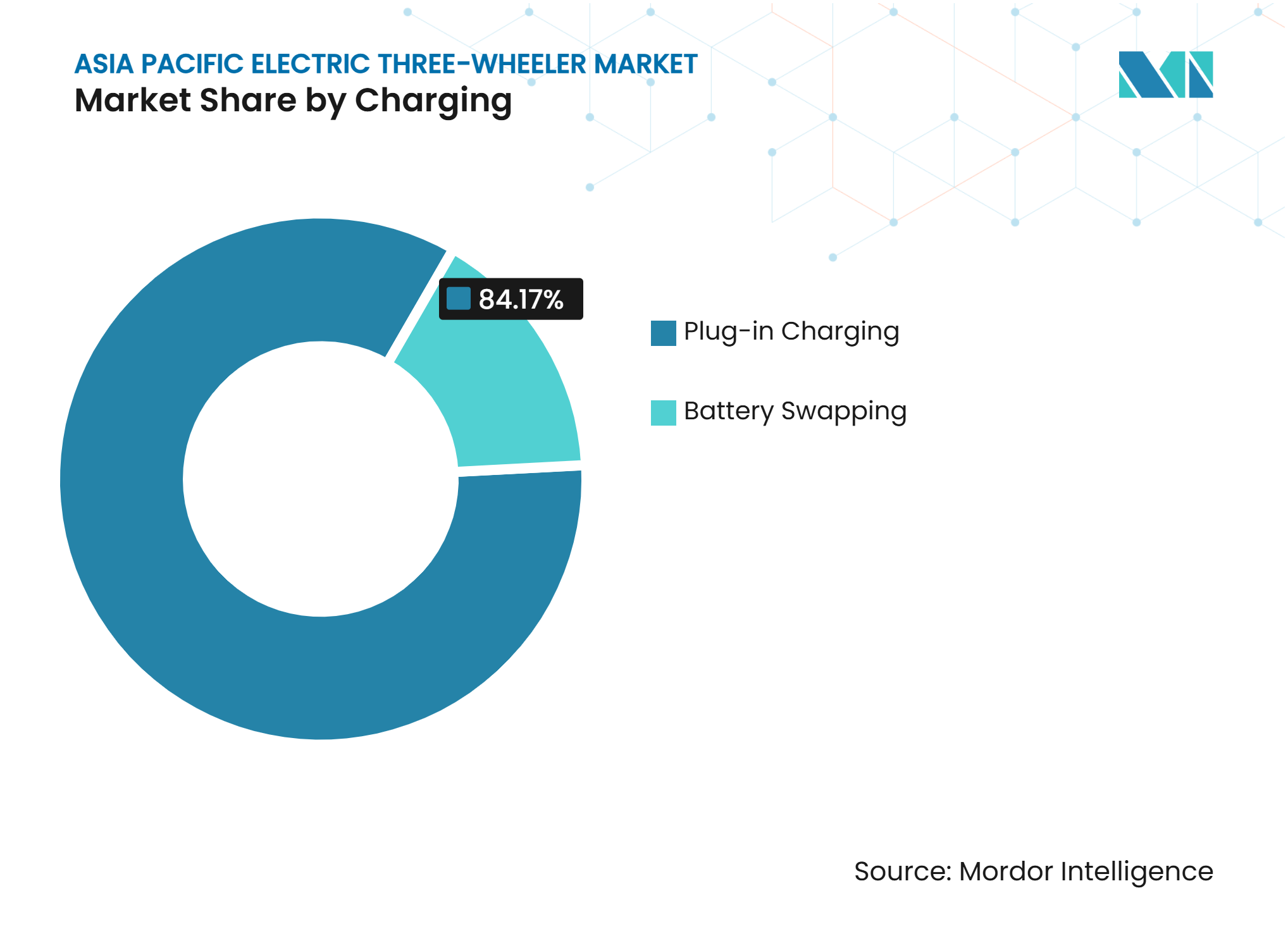
Battery Swapping Redefining Fleet EconomicsPlug-in charging accounted for 84.17% of the Asia Pacific electric three-wheeler market share in 2026. Its lead is based on the large number of individually owned vehicles that charge overnight at home or at fixed vehicle stands. This method requires little dedicated infrastructure beyond a safe electricity connection. It remains well suited to owner-drivers with predictable routes and enough idle time between shifts. The installed base of this charging method makes it difficult for any alternative to replace it quickly.
Battery swapping is forecast to grow at a 24.38% CAGR through 2032, the highest charging-mode growth rate in the Asia Pacific electric three-wheeler market. A rapid battery exchange can avoid the income loss associated with extended plug-in charging during a working shift. SUN Mobility operates more than 900 battery-swapping stations and received backing from Helios Climate and PIDG in July 2025, mainly to build a battery-swapping network in Africa while also supporting e-mobility supply chains in Southeast Asia. The model is most compelling for fleets that need high daily vehicle utilization. Interoperability remains a limiting issue because operators gain the greatest benefit when packs work across several vehicle brands. Government guidelines exist in India, but wider OEM alignment remains incomplete.

By End Use:
Fleet Scaling Fastest in Platform-Driven MarketsFleet and shared mobility held 35.42% of the Asia Pacific electric three-wheeler market share in 2026. Aggregated demand platforms can buy vehicles in volume, manage energy at central depots, and use vehicles on defined routes. This structure can deliver higher utilization than an individually operated vehicle. Fixed-route services, including metro feeders, shared autos, and corporate shuttles, are particularly suited to planned charging or swapping. Fleet purchasing also increases the importance of reliability, finance, and service arrangements in supplier selection.
Last-mile logistics is expected to grow at a 15.63% CAGR through 2032. E-commerce fulfillment density in urban Asia is making dedicated electric cargo vehicles more viable than motorcycle-only courier models for some routes. In India, 561,154 low-speed L3 e-rickshaws were registered in FY2026, while high-speed L5 electric autos rose 65% to 262,683 units. L3 growth slowed to 4%, while the faster rise of L5 vehicles points to a buyer shift toward higher-value registered models. Agricultural transport, utility services, and municipal use remain early-stage uses in Indonesia and Vietnam. These applications could widen demand if procurement and operating models become more established.
Geography Analysis
India: Market Anchor with Deepening Commercial Penetration
India held 60.24% of the Asia Pacific electric three-wheeler market share in 2026. The country sold 801,431 electric three-wheelers in 2025, about 67% of global electric three-wheeler sales, before FY2026 retail sales surpassed 830,000 units. Mahindra Last Mile Mobility reached 101,905 units in FY2026, becoming the first commercial vehicle manufacturer to sell more than 100,000 electric vehicles in a fiscal year. High-speed L5 electric autos rose 65% in FY2026, compared with 4% growth for low-speed e-rickshaws, indicating demand for higher-performance registered vehicles. India’s regulatory influence extends from PM E-DRIVE support to localization requirements for traction motors. The Union Cabinet also approved an INR 72.8 billion scheme, equivalent to USD 866 million, for 6,000 MTPA of domestic sintered rare-earth permanent magnet capacity. This plan responds to component exposure after China’s 2025 export controls. Bajaj Auto’s nearly 200,000 electric two- and three-wheeler units in the July–September 2026 quarter, achieved despite supply constraints, suggest that supply capacity, rather than market saturation, is the nearer constraint.
Philippines: Commercial Formats Superseding the Informal Fleet
The Philippines is forecast to grow at a 16.80% CAGR through 2032, the fastest rate among the covered geographies in the Asia Pacific electric three-wheeler market. Electric vehicle registrations reached about 40,000 in January–September 2025, well above the 24,286 recorded in all of 2024, and more than 67,000 electrified vehicles were registered in January–August 2026. The January 2026 restriction on e-trikes on major Metro Manila roads is restructuring demand toward registered commercial models. Tricycle operators and drivers associations are moving toward registered vehicles, which are priced well above unregistered family variants. Compliance with the Electric Vehicle Industry Development Act also supports a clearer policy structure for commercial electrification. The cost gap remains important because electric three-wheelers cost considerably more than conventional tricycles, even though operating savings can repay that difference over time. Chinese exports into Southeast Asia are helping to lower purchase prices, while local charging infrastructure is still largely centered on Metro Manila. The change from informal family vehicles to registered passenger and cargo platforms gives manufacturers a path to serve more formal fleet demand.
Divergent Paths Across Remaining Markets
China is primarily an upstream catalyst for the Asia Pacific electric three-wheeler market, while Bangladesh is a major future conversion opportunity and Vietnam is an emerging demand center. Fengxian County, which accounts for more than 60% of China’s electric tricycle market, exports to more than 130 countries and regions, and Southeast Asia is an important destination for Chinese electric tricycle exports. Bangladesh’s estimated 4 million operational electric three-wheelers remain mainly lead-acid vehicles, creating a large potential transition toward lithium-ion products. Vietnam’s electric motorbike sales nearly doubled year over year to about 209,000 units in the first half of 2025, supported by VinFast and rising fuel costs. Indonesia, Thailand, Nepal, and Sri Lanka remain at an earlier stage of electric three-wheeler adoption. These markets are likely to depend on affordable imports, local policy support, and charging access before reaching broader commercial scale.
Competitive Landscape
Market Concentration
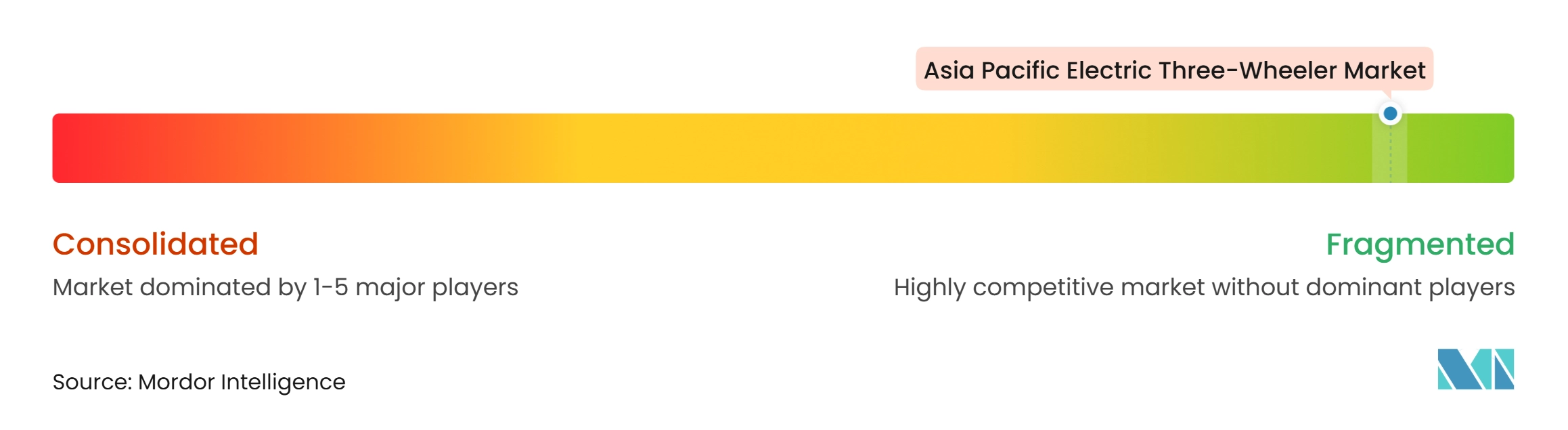
The Asia Pacific electric three-wheeler market is fragmented at the original equipment manufacturer level but has concentrated component supply. More than 680 manufacturers competed in India in FY2026, and the top six held 36% of retail sales. This structure means established firms have advantages from dealer coverage, financing links, and compliance capability rather than decisive control of the market. Chinese battery-cell suppliers have an outsized role because their prices shape the production-cost floor across the region. YC Electric, Saera Electric Auto, and Dilli Electric Auto remained among the six largest sellers in FY2026, although each recorded lower retail volumes as buyers shifted toward higher-speed L5 models. The Asia Pacific electric three-wheeler market therefore remains open to new entrants, but service depth and component access are increasingly important.
Bajaj Auto sold nearly 200,000 electric two- and three-wheelers in the July–September 2026 quarter, with its electric business contributing about one-third of domestic revenue. Mahindra Last Mile Mobility said in April 2026 that it had become the first commercial vehicle manufacturer to sell more than 100,000 electric vehicles in a single fiscal year. SUN Mobility is expanding its battery-swapping business beyond India with support from Helios Climate and PIDG. These moves show that competition now includes capacity, energy services, and fleet support, not only vehicle design. Firms that connect these elements can create recurring relationships with commercial customers.
The Asia Pacific electric three-wheeler market has an opening in interoperable battery swapping and in formalizing Bangladesh’s large electric fleet. Standardized packs could allow energy-service companies to build more recurring revenue, but OEM alignment remains incomplete. Indian manufacturers are responding with telematics, fleet-management tools, and battery-health certification to compete on lifecycle value. Chinese manufacturers continue to set export price benchmarks, led by the Fengxian County cluster, which exports to more than 130 countries and regions. Bangladesh could become a major procurement opportunity if fleet formalization and lithium-chemistry adoption gain policy backing.
Asia Pacific Electric Three-Wheeler Industry Leaders
-
Mahindra & Mahindra Ltd.
-
Bajaj Auto Ltd.
-
YC Electric Vehicle Pvt. Ltd.
-
Saera Electric Auto Pvt. Ltd.
-
Dilli Electric Auto Pvt. Ltd.
- *Disclaimer: Major Players sorted in no particular order
Asia Pacific Electric Three-Wheeler Market Companies Covered in this Report
- Mahindra & Mahindra Ltd.
- Bajaj Auto Ltd.
- Piaggio & C. S.p.A.
- Kinetic Engineering Ltd.
- Euler Motors Pvt. Ltd.
- Omega Seiki Pvt. Ltd.
- Altigreen Propulsion Labs Pvt. Ltd.
- Atul Auto Ltd.
- TVS Motor Company Ltd.
- TI Clean Mobility Pvt. Ltd.
- YC Electric Vehicle Pvt. Ltd.
- Saera Electric Auto Pvt. Ltd.
- Lohia Auto Industries
- Terra Motors Corporation
- Chongqing Zongshen Vehicle Group Co., Ltd.
- Jiangsu Jinpeng Group Co., Ltd.
- Jiangsu Kingbon Vehicle Co., Ltd.
- Dilli Electric Auto Pvt. Ltd.
- Etrio Automotive Pvt. Ltd.
- Greaves Cotton Limited
- Huaihai Holding Group Co., Ltd.
- Yadea Technology Group Co., Ltd.
Recent Industry Developments in Asia Pacific Electric Three-Wheeler Market
- September 2026: Bajaj Auto Philippines introduced the WEGO P5009 electric three-wheeler in the Philippines with a 9.2 kWh battery, a claimed range of up to 212 km, and an introductory price of PHP 329,888.
- April 2026: Bajaj Auto launched its WEGO electric three-wheeler range in India, comprising passenger and cargo models with a maximum certified range of 296 km and prices starting at INR 311,000.
- April 2026: Mahindra Last Mile Mobility reported FY2026 sales of more than 100,000 electric vehicles, remaining India’s largest electric commercial vehicle maker for a fourth consecutive year.
- March 2026: India’s Ministry of Heavy Industries revised the PM E-DRIVE scheme, extending incentives for e-rickshaws and e-carts to March 31, 2028.
- February 2026: Mahindra Last Mile Mobility launched the UDO electric passenger three-wheeler at an introductory price of INR 358,999.
Asia Pacific Electric Three-Wheeler Market Report Scope
The Asia Pacific electric three-wheeler market is segmented by vehicle type, battery type, motor power, battery capacity, charging, end use, and country. By vehicle type, the market is segmented into passenger carriers (e-rickshaw and e-auto) and load carriers (cargo and delivery). By battery type, the market is segmented into lead-acid, lithium-ion (LFP and NMC), and other battery types. By motor power, the market is segmented into less than 1,000 W, 1,000 to 1,500 W, and more than 1,500 W. By battery capacity, the market is segmented into less than 3 kWh, 3 to 6 kWh, and more than 6 kWh. By charging, the market is segmented into plug-in charging and battery swapping. By end use, the market is segmented into personal/owner-driver, fleet and shared mobility, last-mile logistics, and other end uses. By country, the market is segmented into India, China, Bangladesh, Indonesia, the Philippines, Thailand, Vietnam, Nepal, Sri Lanka, and the rest of Asia-Pacific. The market sizes and forecasts are provided in terms of value (USD) and volume (units) for all the above segments.
Segmentation Overview
| Passenger Carriers |
| Load Carriers |
| Lead-Acid |
| Lithium-ion |
| Other Battery Types |
| Less than 1,000 W |
| 1,000 to 1,500 W |
| More than 1,500 W |
| Less than 3 kWh |
| 3 to 6 kWh |
| More than 6 kWh |
| Plug-in Charging |
| Battery Swapping |
| Personal/Owner-Driver |
| Fleet and Shared Mobility |
| Last-Mile Logistics |
| Other End Uses |
| India |
| China |
| Bangladesh |
| Indonesia |
| Philippines |
| Thailand |
| Vietnam |
| Nepal |
| Sri Lanka |
| Rest of Asia-Pacific |
| By Vehicle Type | Passenger Carriers |
| Load Carriers | |
| By Battery Type | Lead-Acid |
| Lithium-ion | |
| Other Battery Types | |
| By Motor Power | Less than 1,000 W |
| 1,000 to 1,500 W | |
| More than 1,500 W | |
| By Battery Capacity | Less than 3 kWh |
| 3 to 6 kWh | |
| More than 6 kWh | |
| By Charging | Plug-in Charging |
| Battery Swapping | |
| By End Use | Personal/Owner-Driver |
| Fleet and Shared Mobility | |
| Last-Mile Logistics | |
| Other End Uses | |
| By Country | India |
| China | |
| Bangladesh | |
| Indonesia | |
| Philippines | |
| Thailand | |
| Vietnam | |
| Nepal | |
| Sri Lanka | |
| Rest of Asia-Pacific |
Key Questions Answered in the Report
What is the expected value of the Asia Pacific electric three-wheeler market by 2032?
The Asia Pacific electric three-wheeler market is forecast to reach USD 11.15 billion by 2032, rising from USD 6.79 billion in 2027 at a 10.43% CAGR.
Which vehicle type leads electric three-wheeler demand in Asia Pacific?
Passenger carriers led with a 72.13% share in 2026, supported by established e-rickshaw use across South and Southeast Asia.
Why are lithium-ion batteries gaining ground in electric three-wheelers?
Lithium-ion held a 67.27% share in 2026 and is projected to grow at a 15.27% CAGR because it can support longer range and higher commercial use.
What limits adoption of electric three-wheelers outside major cities?
Limited charging and swapping infrastructure, high upfront cost, uneven regulation, and restricted operator finance remain key barriers.