
Asia-Pacific Data Center Water Management Market Size and Share
Market Overview
| Study Period | 2021 - 2032 |
|---|---|
| Forecast Data Period | 2027 - 2032 |
| Base Year Market Size (2026) | USD 0.76 Billion |
| Market Size (2027) | USD 0.84 Billion |
| Market Size (2032) | USD 1.42 Billion |
| Growth Rate (2027 - 2032) | 11.07 % |
| Market Concentration | Medium |
Major Players *Disclaimer: Major Players sorted in no particular order Image © Mordor Intelligence. Reuse requires attribution under CC BY 4.0. | |
Asia-Pacific Data Center Water Management Market Analysis by Mordor Intelligence
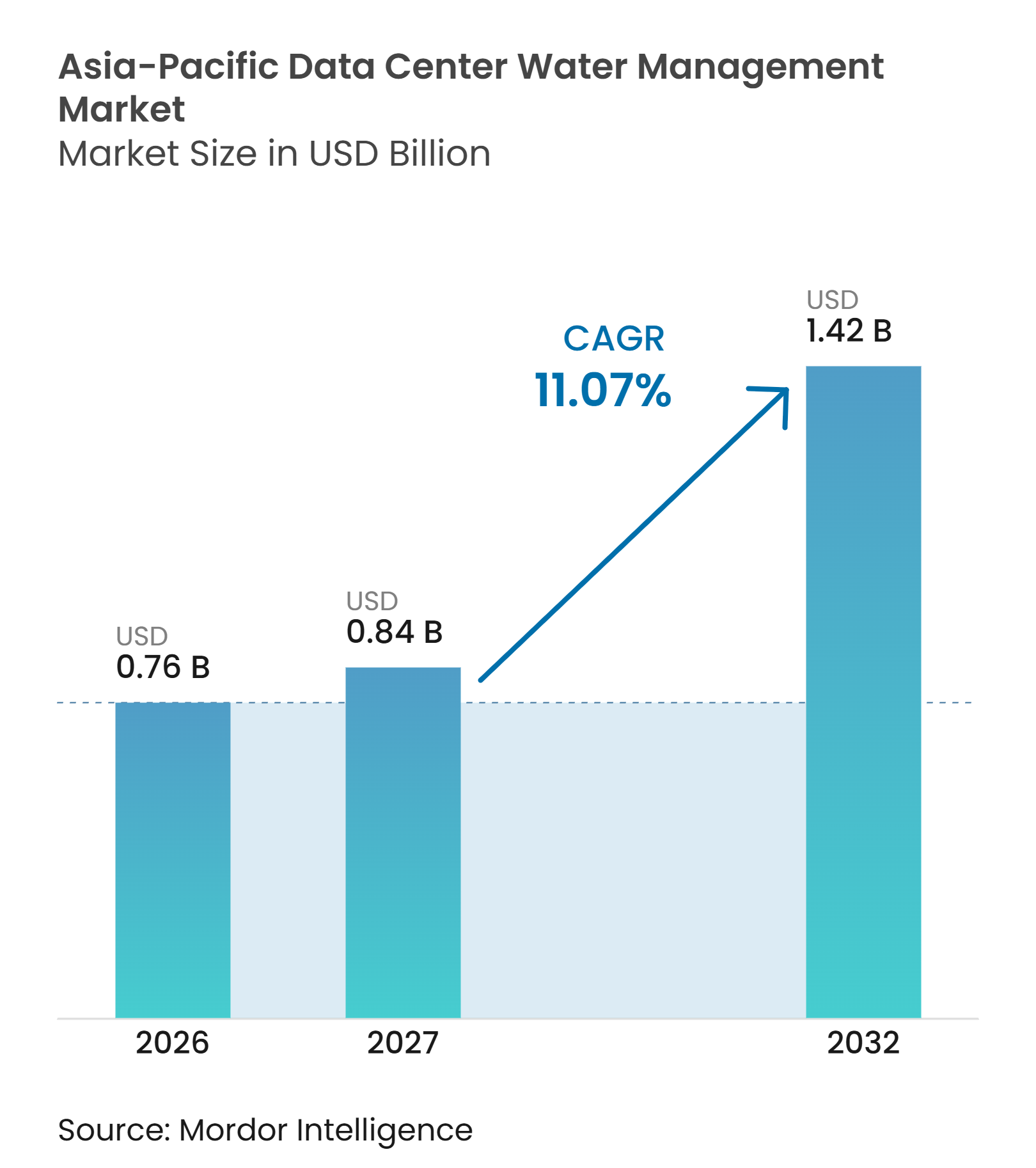
The Asia-Pacific data center water management market is valued at USD 0.76 billion in 2026 and is forecast to reach USD 1.42 billion by 2032, expanding at a CAGR of 11.07% during 2027-2032. Rising rack densities are changing cooling design requirements across the region, particularly as air cooling becomes less viable beyond 50 kW per rack. The Asia-Pacific data center water management market is therefore moving from basic cooling-water treatment toward closed-loop systems, recycling equipment, and continuous monitoring. Water availability is becoming part of site selection and permitting decisions alongside power access, especially in Malaysia, Singapore, Australia, Thailand, China, and India. Providers are responding with outcome-based contracts that combine treatment chemicals, digital monitoring, equipment, and managed services. This approach gives operators a way to address water-quality risks while keeping high-density cooling systems available.
Key Report Takeaways
- By solution type, water treatment and quality monitoring systems held 24.68% of the Asia-Pacific data center water management market share in 2026, while water recycling and reuse management systems are projected to expand at an 11.44% CAGR through 2032.
- By water management application, cooling system water management accounted for 38.26% of the Asia-Pacific data center water management market share in 2026, while water consumption reporting and optimization is projected to expand at an 11.56% CAGR through 2032.
- By deployment model, on-premises systems held 40.98% share in 2026, while integrated and hybrid systems are projected to expand at an 11.38% CAGR through 2032.
- By service type, managed water management services held 40.28% share in 2026 and are projected to expand at an 11.77% CAGR through 2032.
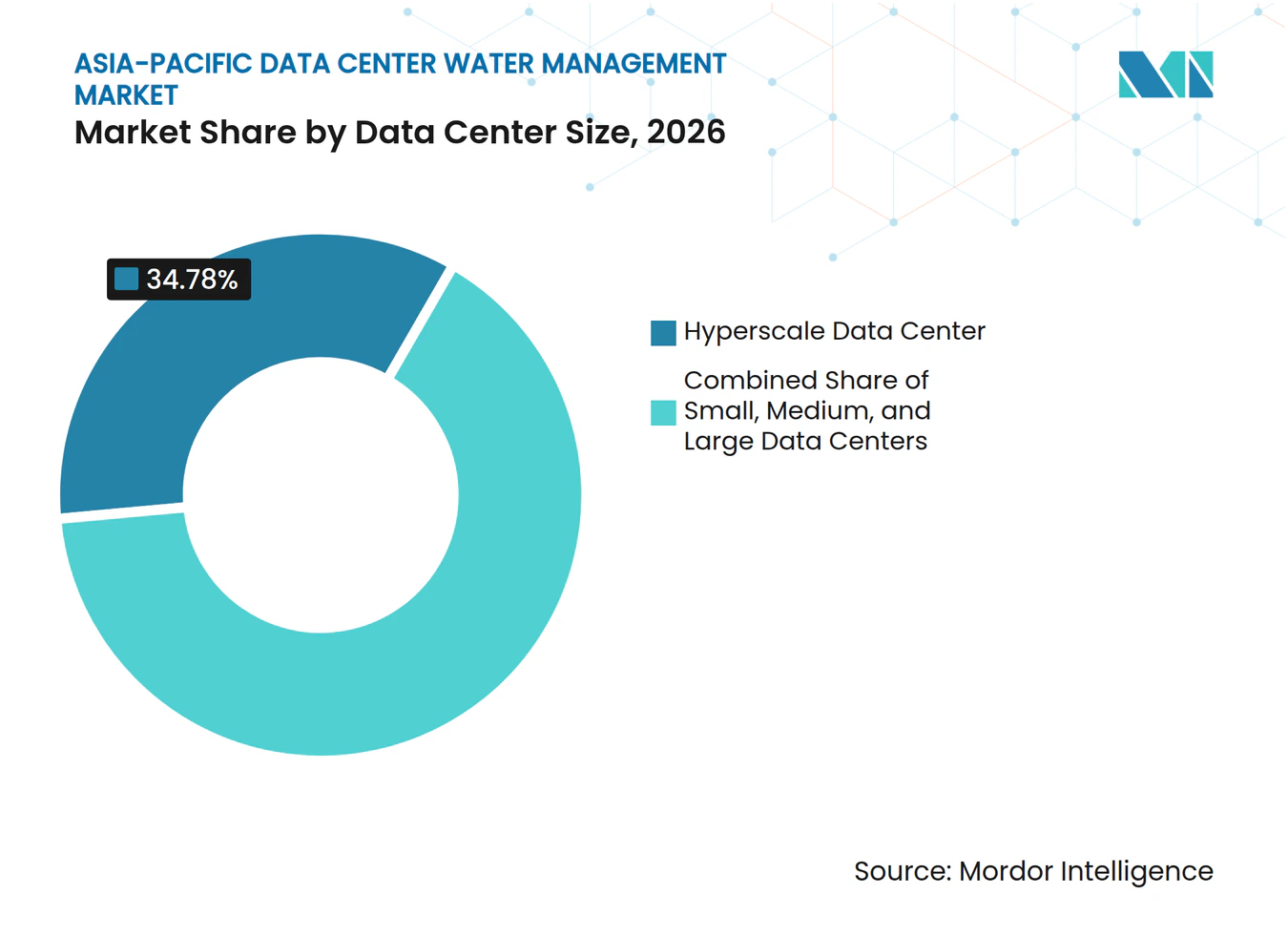
- By data center size, hyperscale data centers held 34.78% share in 2026 and are projected to expand at an 11.68% CAGR through 2032.
- By data center type, colocation data centers held 32.88% share in 2026, while cloud service providers are projected to expand at an 11.49% CAGR through 2032.
- By geography, China held 38.16% share in 2026, while India is projected to expand at an 11.68% CAGR through 2032.
Note: Market numbers in this report are based on Mordor Intelligence's proprietary estimation framework, which combines nine months of actuals with Q4 projections for base year 2026.
Market Trends and Insights
Drivers Impact Analysis of Asia-Pacific Data Center Water Management Market*
| Driver | (~) % Impact on CAGR Forecast | Geographic Relevance | Impact Timeline |
|---|---|---|---|
| Accelerating AI and High-Performance Computing Rack Density | +3.2% | Global, concentrated in China, Japan, India, Malaysia, and Singapore | Short term (≤ 2 years) |
| Expansion of Hyperscale and Colocation Capacity Across Asia-Pacific | +2.8% | Asia-Pacific-wide, strongest in Malaysia, India, Indonesia, and Thailand | Short term (≤ 2 years) |
| Tightening Water-Use Effectiveness and Sustainability Disclosure Requirements | +1.9% | Singapore, China, Malaysia, Japan, and South Korea | Medium term (2-4 years) |
| Rising Freshwater Competition in Data Center Hubs | +1.4% | India, China, South Korea, Australia, and Malaysia | Medium term (2-4 years) |
| Green Financing Linked to Water-Performance Targets | +0.8% | Asia-Pacific-wide, strongest in Malaysia, Australia, and Singapore | Medium term (2-4 years) |
| Water-as-a-Service Models Lowering Retrofit and Expansion Barriers | +0.5% | Asia-Pacific-wide, with early adoption in Singapore, Malaysia, and South Korea | Long term (≥ 4 years) |
| Source: Mordor Intelligence | |||
Accelerating AI and High-Performance Computing Rack Density
The Asia-Pacific data center water management market is benefiting from the move away from conventional low-density server rooms toward AI clusters with much higher thermal loads. Racks moved from 6-10 kW in the early 2010s to AI configurations that can exceed 120 kW per rack. Air cooling becomes thermally impractical beyond 50 kW per rack, so operators increasingly require liquid cooling and associated water treatment. China made water-use effectiveness a compliance consideration when GB/T 32910.6-2025 took effect on December 1, 2025. Japan also demonstrated a commercial closed-loop approach when Preferred Networks, IIJ, and JAIST launched the AImod modular facility in April 2026 with near-zero water-use effectiveness.[1]
Water quality is as important as water availability in direct-to-chip cooling circuits. Scale, corrosion, and biological contamination can affect the performance and reliability of high-value computing equipment. This changes procurement because operators need sensors, treatment programs, and service support rather than a single cooling component. The Asia-Pacific data center water management market consequently gains from both new construction and upgrades to operating facilities. Ecolab introduced its direct-to-chip liquid-cooling monitoring program in Southeast Asia during 2025, making continuous pH, temperature, and flow monitoring available for high-density installations.[2]
Expansion of Hyperscale and Colocation Capacity Across Asia-Pacific
The Asia-Pacific data center water management market is supported by large hyperscale campuses and colocation facilities that must commission water infrastructure with their computing capacity. These sites need treatment, distribution, recycling, monitoring, and discharge controls before they can run high-density workloads. Johor has become an important example because operators requested 136 million liters per day of alternative water supply as of June 2025. The scale of those requests shows that water supply planning has become a development requirement rather than a later operating decision. AirTrunk and Johor Special Water announced a recycled-water supply scheme for the JHB1 and JHB2 campuses in April 2025.[3]
Capacity additions are spreading beyond established hubs into Bangkok, Greater Jakarta, and other locations where specialist water-engineering resources are limited. This favors managed service models because many operators cannot build large in-house water chemistry teams at the same pace as capacity. The Asia-Pacific data center water management market also benefits from multi-source supply designs that combine potable water, treated effluent, and rainwater where available. These designs require tighter control because each source can have different chemical characteristics. Digital Edge announced a USD 4.5 billion investment in a 500 MW AI-ready campus in Bekasi during January 2026, including direct-to-chip liquid cooling and integrated recycled-water systems.
Tightening Water-Use Effectiveness and Sustainability Disclosure Requirements
Water reporting requirements are shifting investment from voluntary programs toward measurable operating controls. Singapore requires water efficiency management planning and metering at important usage points for large data centers. Malaysia's sustainable development guideline specifies water-use effectiveness targets for hyperscale facilities and calls for ongoing reporting. The International Telecommunication Union released Recommendation ITU-T L.1510 in October 2025 to establish environmental performance indicators for digital infrastructure.
Common reporting frameworks allow customers, regulators, and financiers to compare facility performance more directly. This makes reliable metering and auditable data important to the Asia-Pacific data center water management market. China revised its data center design standards for public consultation in January 2026, adding requirements related to resource utilization and water-saving systems. South Korea also considered legislation during 2026 that would require water-use effectiveness disclosure for large facilities. These changes encourage operators to acquire systems that connect measurements to compliance reporting. They also raise the value of providers that can combine equipment, data management, and operating expertise.
Rising Freshwater Competition in Data Center Hubs
Freshwater competition can delay projects, limit capacity, or require a different cooling design. A 2025 study reported that 73% of Indian data center facilities experience water gaps for at least 1 month each year. The same research found that 33% face gaps for 9 or more months annually. These pressures are important in Mumbai, Hyderabad, and Chennai, where cooling needs overlap with municipal demand.
China faces a similar issue because much of its computing capacity operates in water-scarce areas. A 2025 Applied Energy study found that 72% of China's computing capacity is in severely water-scarce regions. It also estimated that Chinese data centers used 15.7 billion m³ of water in its reference year. The Asia-Pacific data center water management market gains a strong operating case for onsite recycling and non-potable sourcing where municipal supply is constrained.
Restraints Impact Analysis of Asia-Pacific Data Center Water Management Market*
| Restraint | (~) % Impact on CAGR Forecast | Geographic Relevance | Impact Timeline |
|---|---|---|---|
| Freshwater Scarcity and Competing Municipal Demand | -2.1% | India, water-scarce parts of China, Malaysia, South Korea, and Australia | Short term (≤ 2 years) |
| High Upfront Cost and Retrofit Complexity | -1.6% | Asia-Pacific-wide, with greatest relevance in Japan and Singapore | Medium term (2-4 years) |
| Coastal TDS and Pretreatment Burden | -0.9% | Singapore, coastal China, Mumbai, Chennai, and Japan | Medium term (2-4 years) |
| Fragmented Metering and Groundwater Governance | -0.6% | Indonesia, India, Malaysia, Vietnam, and Rest of Asia-Pacific | Long term (≥ 4 years) |
| Source: Mordor Intelligence | |||
Freshwater Scarcity and Competing Municipal Demand
Water scarcity remains a direct constraint for the Asia-Pacific data center water management market because it can affect approvals, operating continuity, and community acceptance. High water stress exposes facilities in China, India, Australia, Malaysia, and South Korea to potential supply interruptions. The issue is more difficult where public water statistics do not distinguish data center demand from broader commercial usage. Operators must then establish their own credible data trail before agreeing new supply arrangements. Water reuse schemes can reduce the burden, but they depend on suitable treatment capacity and reliable wastewater sources. Bridge Data Centres described its Johor reclamation effort as a model for applying effluent water in data center cooling.
A constrained water environment can also raise project costs through additional treatment, storage, and permitting requirements. The commercial response is increasingly based on recycled supply, water recycling equipment, and agreements with public utilities. This supports the long-term need for solutions but may slow individual projects in the near term. The Asia-Pacific data center water management market must therefore address both the physical availability of water and the quality required by cooling equipment. Operators that secure non-potable supply can reduce their exposure to local potable-water constraints. Smaller operators may find these arrangements harder to obtain at the needed scale.
High Upfront Cost and Retrofit Complexity
Modern water management equipment can require substantial engineering work at facilities built for lower rack densities. Older cooling towers, piping, and control systems may not support direct-to-chip cooling or highly automated treatment without changes to the wider plant. This increases the cost and duration of retrofit work in mature hubs such as Japan and Singapore. Fast AI accelerator refresh cycles can compound the problem because cooling needs may change before a planned upgrade is fully recovered. The Asia-Pacific data center water management market has a clear reason to use performance-based contracts where those contracts can reduce initial capital demands.
Reverse osmosis can lower water-use effectiveness in sites with difficult water chemistry, but deployment still requires capital and technical planning. The approach can reduce water demand where source quality creates a higher treatment burden. This example shows the potential value of advanced treatment, though the operating context may differ across Asia-Pacific facilities. Water-as-a-Service models may help operators manage retrofit complexity through external expertise and contractual performance commitments. New installations can also be designed around treatment equipment from the outset. Operators still need to assess their water source and cooling configuration before selecting a system.
*Our forecasts treat driver/restraint impacts as directional, not additive. The impact forecasts reflect baseline growth, mix effects, and variable interactions.
Asia-Pacific Data Center Water Management Market Segment Analysis
By Solution Type:
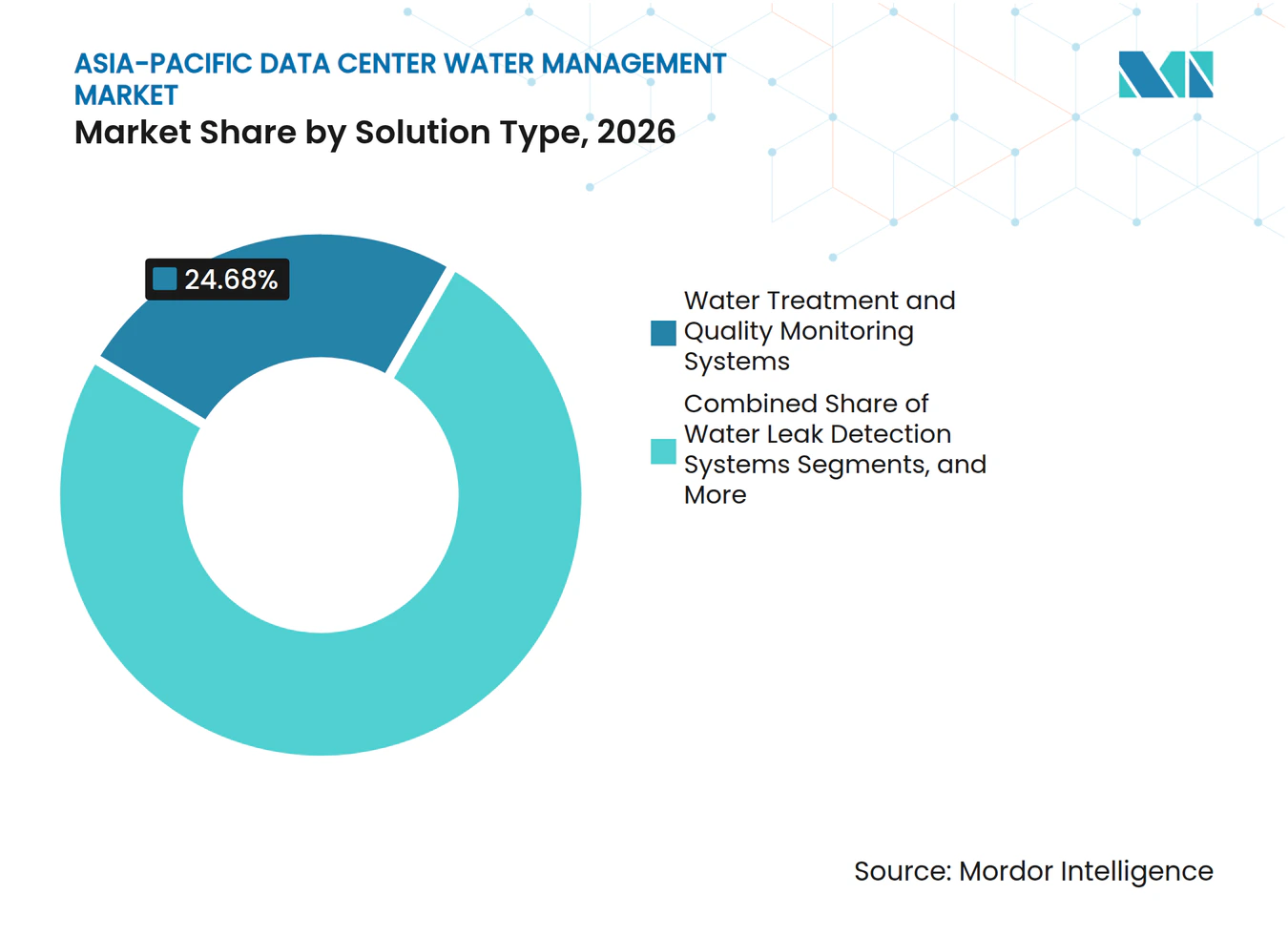
Recycling Systems Lead the Forecast Growth HorizonWater treatment and quality monitoring systems held 24.68% of regional revenue in 2026. Their leading position reflects the basic need to control scale, corrosion, and biological contamination in cooling towers and liquid-cooling circuits. Water recycling and reuse management systems are projected to expand at an 11.44% CAGR through 2032. These systems reduce potable-water intake and support water-use effectiveness objectives in water-constrained locations. Gradiant reported data center contracts in the Indo-Pacific region during May 2025 using zero-liquid-discharge technology that can recover up to 99% of process water onsite.
Water management software and analytics are gaining importance as facilities move from isolated equipment purchases toward connected systems. Operators need consolidated data to monitor water quality, verify consumption, and prepare disclosures. Monitoring and metering equipment provides the sensor layer needed for those activities. Leak detection systems can also reduce avoidable losses in large campuses with extensive distribution networks. The Asia-Pacific data center water management industry is moving toward integrated solution packages because water source, quality, usage, and discharge affect each other. Water usage optimization and control systems also become more important when direct-to-chip cooling requires real-time management of flow, temperature, and pressure at the rack level.



By Water Management Application:
Cooling Dominates, Reporting Drives GrowthCooling system water management commanded 38.26% of the Asia-Pacific data center water management market size in 2026. Evaporative cooling towers and direct-to-chip liquid-cooling loops account for much of a typical facility's onsite water use. Water consumption reporting and optimization is projected to expand at an 11.56% CAGR through 2032. This activity gains priority as disclosure requirements make reliable water-use data a management and compliance need. AWS Singapore reported an average water-use effectiveness of 1.57 L/kWh in 2025 through a recycling system that reduced cooling-tower discharge by up to 70%.
Water supply and distribution management is becoming more complex as operators use combinations of potable water, reclaimed water, and rainwater. Each source may require a different treatment approach before it enters a shared cooling system. Wastewater management and water recycling applications gain relevance as campuses seek to use the same resource more than once. Leak prevention and detection remain important because losses can be significant across large distribution networks. The Asia-Pacific data center water management market is also supported by higher expectations for reporting accuracy from customers and regulators. This reinforces investment in systems that measure consumption at a facility, cooling-loop, or equipment level.
By Deployment Model:
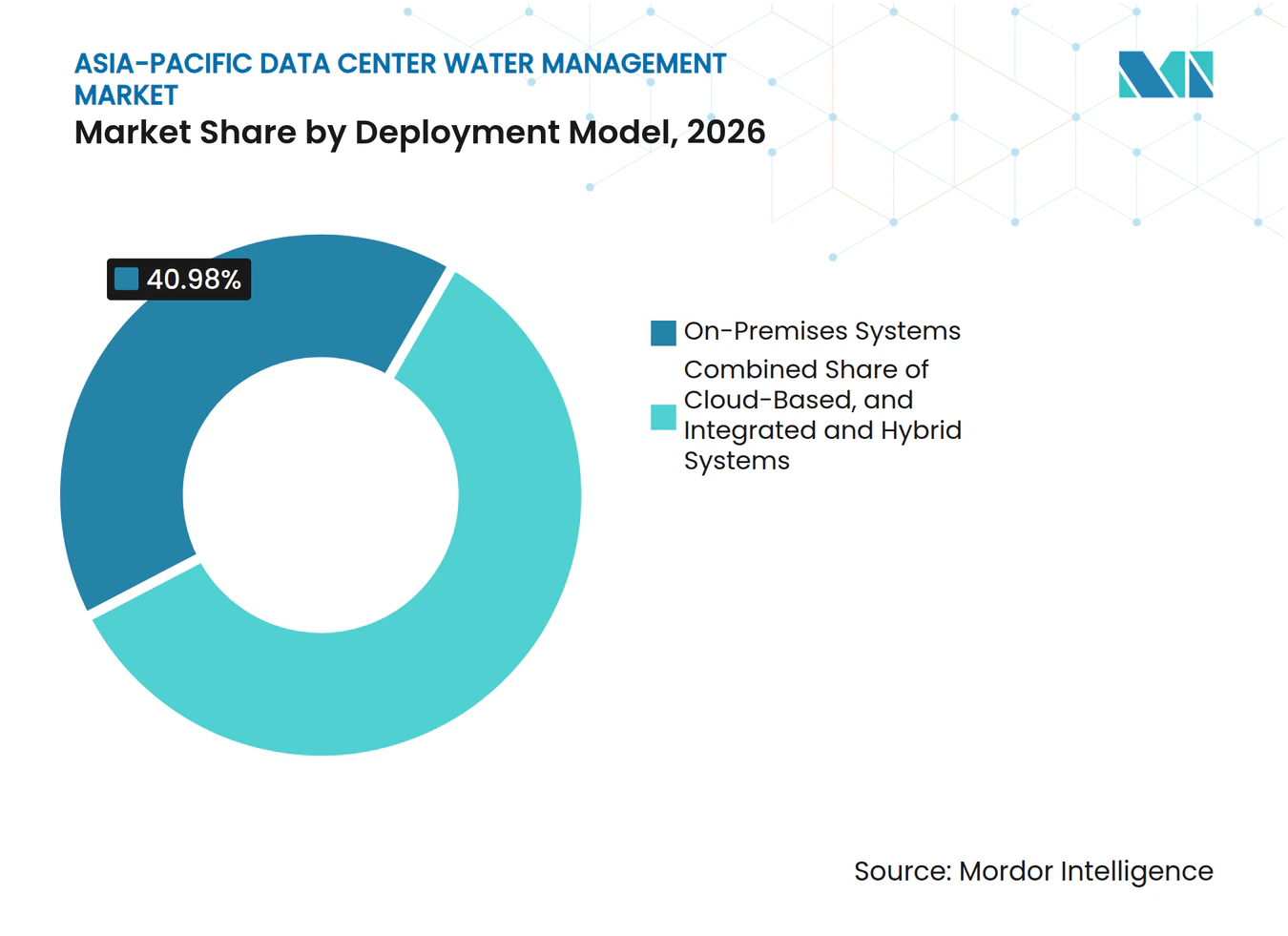
Hybrid Systems Fastest Growing as Complexity RisesOn-premises systems held 40.98% of regional revenue in 2026. Reverse-osmosis units, chemical dosing equipment, cooling controls, and physical treatment assets need to operate at or near the facility. Integrated and hybrid systems are projected to expand at an 11.38% CAGR through 2032. They combine local control with cloud-based analytics, which is useful for sites with complex water systems and multiple reporting requirements. Partnerships between water specialists and public utilities can support connected management platforms for semiconductor and AI data center operations.
On-premises supervisory control and data acquisition systems can deliver immediate readings from field sensors. However, operators also need longer-term analysis for optimizing chemistry, identifying trends, and preparing compliance reports. Cloud platforms offer those capabilities, but they depend on a reliable connection to physical instruments. Hybrid architecture addresses this divide by retaining local control while using remote software for optimization and documentation. The Asia-Pacific data center water management market benefits when providers can keep operating data secure and available across these layers. Cloud-based systems are especially relevant to managed service models, where specialists need access to dashboards without being present at every facility.

By Service Type:
Managed Services Lead and Grow Fastest as Expertise Outsourcing RisesManaged water management services held 40.28% share of the Asia-Pacific data center water management market size in 2026 and are projected to expand at an 11.77% CAGR through 2032. This combination shows that many operators favor ongoing performance support over owning every element of the water program. Managed services can combine chemical treatment, monitoring, maintenance, reporting, and corrective action under a single agreement. Ecolab introduced its Cooling as a Service program in November 2025, combining 3D TRASAR Technology for direct-to-chip cooling with smart coolant distribution units. The model reduces the need for every operator to maintain a large internal water chemistry team.
System installation and integration services remain necessary as Asia-Pacific capacity is built and existing sites are upgraded. Each project may need site-specific engineering because water source, cooling configuration, and local requirements can differ. Water auditing and efficiency consulting can identify the metering, treatment, and recycling equipment needed before a larger upgrade begins. Monitoring and maintenance provide recurring work because cooling-water chemistry must be adjusted continuously. The Asia-Pacific data center water management industry gains durability from this service requirement because performance depends on sustained operation, not only initial equipment delivery. Outsourced expertise is especially valuable to operators expanding across several markets with different water regulations and supply conditions.
By Data Center Size:
Hyperscale Investment Anchors the MarketHyperscale data centers held 34.78% of regional revenue in 2026 and are projected to expand at an 11.68% CAGR through 2032. Their scale makes water treatment and recycling economics more favorable because a single campus may require water volumes comparable to a mid-size municipal utility. Large facilities also have more complex cooling loads, multiple water sources, and stricter customer expectations. Veolia stated that it aims to exceed EUR 1 billion in annual data center and microelectronics revenue by 2030, equivalent to USD 1.17 billion, as it expands its clean-technology activities. The company launched an integrated platform in April 2026 that targeted a 75% smaller water footprint for new campuses.
Large data centers present an important retrofit opportunity because many were designed before current water-use effectiveness expectations took shape. These facilities can require new treatment systems, control equipment, and meters as computing equipment changes. Small and medium sites usually use simpler chemical dosing and basic metering arrangements. Their investment decisions can be more sensitive to equipment cost and in-house technical capability. Still, reporting requirements are gradually bringing these facilities into formal water management programs. The Asia-Pacific data center water management market can serve this group with modular equipment and managed services that reduce the need for extensive local engineering resources.
By Data Center Type:
Colocation Sets the Benchmark, Cloud Service Providers AccelerateColocation data centers held 32.88% of regional revenue in 2026. They are concentrated in regulated hubs such as Singapore, Hong Kong, Tokyo, and Sydney, where tenants increasingly ask for water stewardship data during procurement. Cloud service providers are projected to expand at an 11.49% CAGR through 2032. These operators are investing in closed-loop and reclaimed-water systems as their regional capacity expands. AWS stated that it reached 75% progress toward its water-positive 2030 target by the end of 2025 and operates 26 global facilities using 100% reclaimed water.
Colocation providers use transparent water performance to differentiate their facilities with enterprise and hyperscale customers. Enterprise and edge facilities are increasing water management investment more gradually because their cooling systems are usually smaller. Government and institutional facilities remain the smallest revenue category, although national digital-sovereignty programs can include sustainability requirements. The Asia-Pacific data center water management market has a broad customer base, but larger shared and cloud-oriented facilities will continue to shape solution specifications. Their requirements often set the performance benchmark for other facility types.
Geography Analysis
China
China held 38.16% of regional revenue in 2026. Its position reflects a large installed data center base and a regulatory environment that increasingly connects building design with resource efficiency. The GB/T 32910.6-2025 standard took effect on December 1, 2025, while revised design standards released for consultation in January 2026 added a water resource utilization chapter. Eastern facilities can face saline groundwater and high total dissolved solids, creating a need for pretreatment. Western hubs can face temperature extremes and limited water infrastructure, increasing the value of recirculation and recycling. A 2026 scientific study found that moving computing west reduced operational water intensity in only 27 of 48 project comparisons under its central assumptions.
India
India is projected to expand at an 11.68% CAGR through 2032, making it the fastest-growing geography in the Asia-Pacific data center water management market. Mumbai, Hyderabad, Chennai, and Bengaluru are the main centers of water management spending because they combine substantial data center activity with water constraints. India’s data center water consumption is projected to increase from 150 billion liters in 2025 to 358 billion liters by 2030. AWS stated that its operating facilities in India do not use potable water for cooling and that new sites use air-cooled chillers and recycled urban wastewater. Japan is also a technically advanced market, where closed-loop cooling, water metering, and reporting are becoming more visible in facility design.
Singapore, Malaysia, South Korea, Australia and Rest of Asia-Pacific
Singapore has the region's most established water efficiency framework for large data centers, and SS 715:2025 provides a liquid-cooling specification for tropical operating conditions. Malaysia's Johor has become a major test location for reclaimed-water supply at hyperscale scale. AirTrunk obtained RM9.5 billion in financing for JHB2 during July 2026, equivalent to USD 2.325 billion, with water-efficient cooling and water-use effectiveness indicators linked to environmental commitments. South Korea is assessing disclosure requirements while its planned AI capacity increases demand for treatment and reuse systems. Indonesia provides a replication model through the GIIC plant in West Java, where AWS works with partners to treat 8,000 m³ of effluent per day for industrial cooling. Australia and other Asia-Pacific markets remain relevant where water risk, new capacity, and sustainability-linked financing converge.
Competitive Landscape
Market Concentration
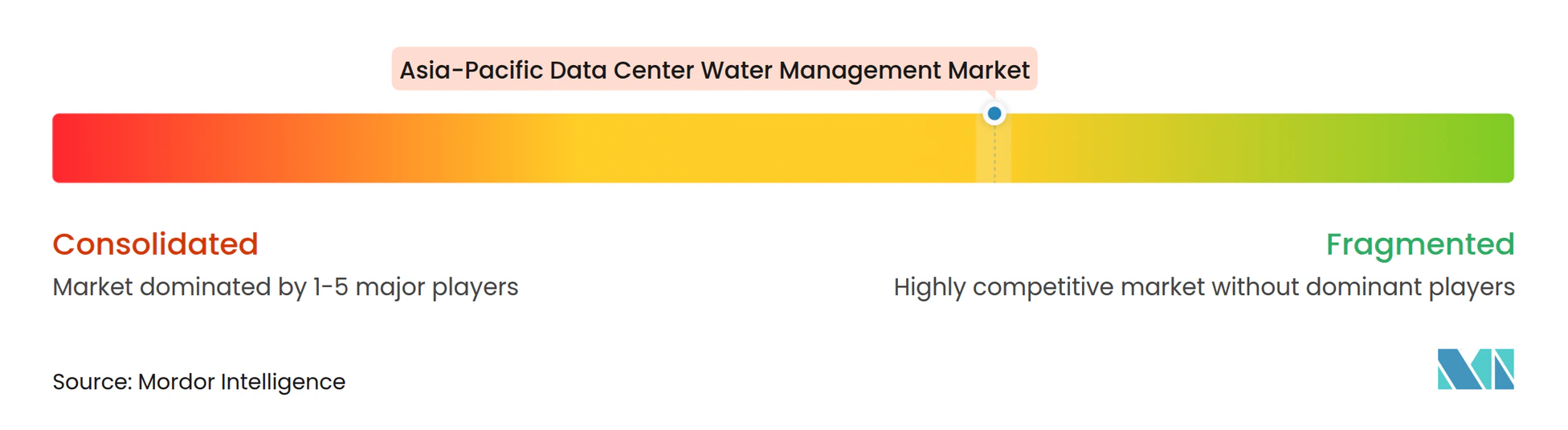
The Asia-Pacific data center water management market is moderately fragmented between water technology providers and operators that procure or co-develop their infrastructure. Ecolab, Veolia Water Technologies, Kurita Water Industries, Xylem, SUEZ, Solenis, Hydroleap, ProMinent, Hach, and Milton Roy provide treatment, dosing, monitoring, or management services. Operators including AWS, Microsoft, Google, Digital Realty, Equinix, STT GDC, NTT DATA, Princeton Digital Group, AirTrunk, NEXTDC, Alibaba Cloud, Tencent Cloud, and CtrlS act as buyers and development partners. Ecolab agreed in December 2025 to acquire Ovivo's electronics business unit for USD 1.8 billion, adding ultra-pure water capabilities for semiconductor and direct-to-chip cooling applications. This move broadens Ecolab's coverage from water pretreatment to coolant health monitoring.
Veolia Water Technologies launched an integrated carbon-neutral data center platform during April 2026. The platform targets a 75% smaller water footprint and 95% waste recycling capability for new data center projects. Hydroleap presents a regional specialist model because its electrochemical technology supported lower cooling-tower discharge in AWS Singapore. The Asia-Pacific data center water management market remains open to specialized companies where they can document site-specific improvements in water-use effectiveness. Established providers retain an advantage in complex treatment systems, global service coverage, and performance contracting. Regional firms can compete through local execution, utility relationships, and customized treatment approaches.
At the operator level, non-potable supply arrangements increasingly create a durable advantage. AirTrunk reported that 55% of its total water use came from recycled supply during FY25, while its Singapore site uses reclaimed water and its Johor campuses are shifting toward treated effluent supply. AWS has secured reclaimed-water arrangements in Singapore, Malaysia, Indonesia, and Hong Kong, which can reduce its exposure to potable supply constraints. The Asia-Pacific data center water management market also has opportunity in analytics, auditing, and managed services for operators that are scaling faster than their internal water expertise. Competition is likely to depend on verifiable operating outcomes, utility coordination, and the ability to support compliance reporting across several jurisdictions.
Asia-Pacific Data Center Water Management Industry Leaders
-
Ecolab Inc.
-
Veolia Water Technologies
-
Kurita Water Industries Ltd.
-
Xylem Inc.
-
SUEZ
- *Disclaimer: Major Players sorted in no particular order
Asia-Pacific Data Center Water Management Market Companies Covered in this Report
- Veolia Water Technologies
- Ecolab Inc.
- Kurita Water Industries Ltd.
- Xylem Inc.
- SUEZ
- Solenis LLC
- Hydroflux Epco Pty Ltd
- Suntar International Pte. Ltd.
- Hydroleap Pte. Ltd.
- ProMinent GmbH
- Hach Company
- Milton Roy Company
- Amazon Web Services, Inc.
- Microsoft Corporation
- Google LLC
- Digital Realty Trust, Inc.
- Equinix, Inc.
- STT GDC Pte. Ltd.
- NTT DATA Corporation
- Princeton Digital Group
- AirTrunk
- NEXTDC Limited
- Alibaba Cloud
- Tencent Cloud
- CtrlS Datacenters Ltd.
Recent Industry Developments in Asia-Pacific Data Center Water Management Market
- October 2026: STTGDC, a global colocation data center provider, secured a USD 590 million green loan facility to support the fit-out and operation of its Tokyo data center campus, STTGDC TYO1 and STTGDC TYO2. The campus will offer 70.8 MW of IT capacity.
- April 2026: Veolia Water Technologies launched a new integrated carbon-neutral data center platform promising a 75% smaller water footprint and 95% waste recycling capability, with an explicit target of exceeding EUR 1 billion (USD 1.17 billion) in annual revenue from data centers and microelectronics by 2030, marking a strategic reorientation toward integrated water-energy-carbon management.
- January 2026: Digital Edge announced a USD 4.5 billion investment to build a 500 MW AI-ready hyperscale campus (CGK Campus) in Bekasi, Indonesia, featuring direct-to-chip liquid cooling and integrated recycled water systems, with Phase 1 delivery scheduled through Q2 2027.
- December 2025: Ecolab completed the USD 1.8 billion cash acquisition of Ovivo’s electronics business unit, adding ultrapure water treatment capabilities for semiconductor and direct-to-chip cooling applications. The acquisition expanded Ecolab’s coverage of the data center cooling water value chain in Asia-Pacific and globally.
Asia-Pacific Data Center Water Management Market Report Scope
The Asia-Pacific Data Center Water Management Market comprises technologies and services that help data center operators monitor, manage, conserve, and optimize water use across facility operations. It focuses on improving water efficiency, reducing wastage, supporting sustainable cooling practices, ensuring water quality, and meeting environmental compliance requirements. The market enables organizations to enhance operational resilience, lower resource consumption, and achieve sustainability goals through advanced monitoring, automation, analytics, and water conservation strategies, supporting the growing demand for environmentally responsible and resource-efficient digital infrastructure.
The Asia-Pacific Data Center Water Management Market Report is Segmented by Solution Type (Water Monitoring and Metering Systems, Water Leak Detection Systems, Water Usage Optimization and Control Systems,Water Recycling and Reuse Management Systems,Water Treatment and Quality Monitoring Systems, and Water Management Software and Analytics), Water Management Application (Cooling System Water Management, Water Supply and Distribution Management, Wastewater Management, Water Recycling and Reuse, Leak Prevention and Detection, and Water Consumption Reporting and Optimization), Deployment Model (On-Premises Systems, Cloud-Based Systems, and Integrated and Hybrid Systems), Service Type (System Installation and Integration, Monitoring and Maintenance, Water Auditing and Efficiency Consulting, and Managed Water Management Services), Data Center Size (Small, Medium, Large, and Hyperscale), Data Center Type (Colocation, Cloud Service Providers (CSPs), Enterprise and Edge, and Government and Institutional Data Centers), and Geography (China, India, Japan, Australia, Singapore, South Korea, Malaysia, Indonesia, and Rest of Asia-Pacific). The Market Forecasts are Provided in Terms of Value (USD).
Segmentation Overview
| Water Monitoring and Metering Systems |
| Water Leak Detection Systems |
| Water Usage Optimization and Control Systems |
| Water Recycling and Reuse Management Systems |
| Water Treatment and Quality Monitoring Systems |
| Water Management Software and Analytics |
| Cooling System Water Management |
| Water Supply and Distribution Management |
| Wastewater Management |
| Water Recycling and Reuse |
| Leak Prevention and Detection |
| Water Consumption Reporting and Optimization |
| On-Premises Systems |
| Cloud-Based Systems |
| Integrated and Hybrid Systems |
| System Installation and Integration |
| Monitoring and Maintenance |
| Water Auditing and Efficiency Consulting |
| Managed Water Management Services |
| Small |
| Medium |
| Large |
| Hyperscale |
| Colocation |
| Cloud Service Providers (CSPs) |
| Enterprise and Edge |
| Government and Institutional Data Centers |
| China |
| India |
| Japan |
| Australia |
| Singapore |
| South Korea |
| Malaysia |
| Indonesia |
| Rest of Asia-Pacific |
| By Solution Type | Water Monitoring and Metering Systems |
| Water Leak Detection Systems | |
| Water Usage Optimization and Control Systems | |
| Water Recycling and Reuse Management Systems | |
| Water Treatment and Quality Monitoring Systems | |
| Water Management Software and Analytics | |
| By Water Management Application | Cooling System Water Management |
| Water Supply and Distribution Management | |
| Wastewater Management | |
| Water Recycling and Reuse | |
| Leak Prevention and Detection | |
| Water Consumption Reporting and Optimization | |
| By Deployment Model | On-Premises Systems |
| Cloud-Based Systems | |
| Integrated and Hybrid Systems | |
| By Service Type | System Installation and Integration |
| Monitoring and Maintenance | |
| Water Auditing and Efficiency Consulting | |
| Managed Water Management Services | |
| By Data Center Size | Small |
| Medium | |
| Large | |
| Hyperscale | |
| By Data Center Type | Colocation |
| Cloud Service Providers (CSPs) | |
| Enterprise and Edge | |
| Government and Institutional Data Centers | |
| By Asia-Pacific | China |
| India | |
| Japan | |
| Australia | |
| Singapore | |
| South Korea | |
| Malaysia | |
| Indonesia | |
| Rest of Asia-Pacific |
Key Questions Answered in the Report
What is the size of the Asia-Pacific data center water management market?
The Asia-Pacific data center water management market is valued at USD 0.76 billion in 2026 and is forecast to reach USD 1.42 billion by 2032 at an 11.07% CAGR.
What is driving water management spending at data centers?
Higher AI rack densities, liquid cooling, water-use effectiveness requirements, and water supply constraints are increasing demand for treatment, recycling, monitoring, and managed services.
Which solution type is expected to expand fastest through 2032?
Water recycling and reuse management systems are projected to expand at an 11.44% CAGR through 2032.
Which application holds the largest share of spending?
Cooling system water management holds the largest application share at 38.26% in 2026 because cooling equipment accounts for much of onsite water use.
Which country has the largest regional share?
China holds the largest regional share at 38.16% in 2026, supported by its large installed data center base and water-efficiency requirements.
Which country is expected to expand fastest?
India is projected to expand at an 11.68% CAGR through 2032 as capacity grows in Mumbai, Hyderabad, Chennai, and Bengaluru.