
Asia-Pacific Data Center Video Surveillance Market Size and Share
Market Overview
| Study Period | 2021 - 2032 |
|---|---|
| Forecast Data Period | 2027 - 2032 |
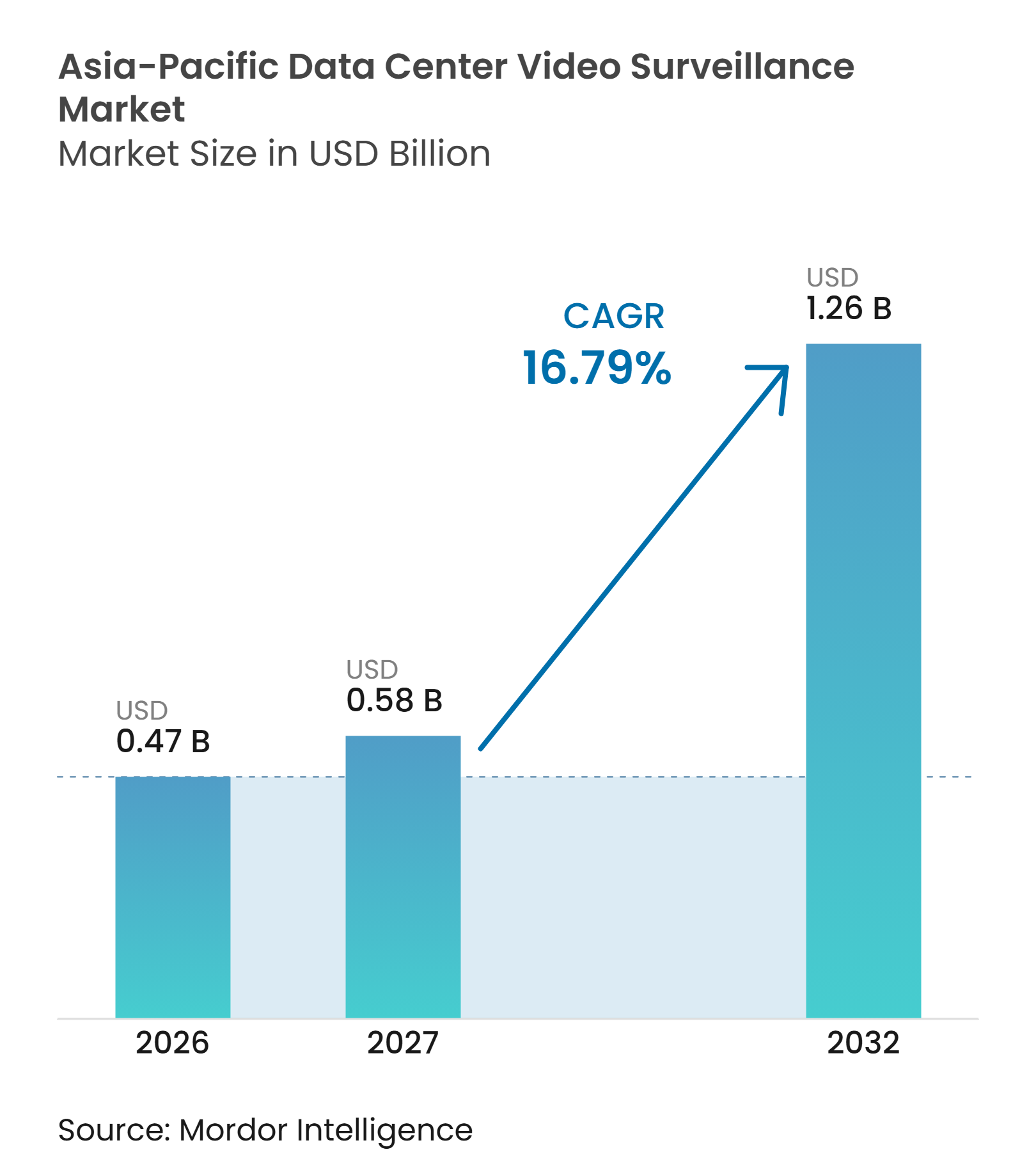
| Base Year Market Size (2026) | USD 0.47 Billion |
| Market Size (2027) | USD 0.58 Billion |
| Market Size (2032) | USD 1.26 Billion |
| Growth Rate (2027 - 2032) | 16.79 % |
| Market Concentration | Medium |
Major Players *Disclaimer: Major Players sorted in no particular order Image © Mordor Intelligence. Reuse requires attribution under CC BY 4.0. | |
Asia-Pacific Data Center Video Surveillance Market Analysis by Mordor Intelligence
The Asia-Pacific data center video surveillance market size is projected to expand from USD 0.47 billion in 2026 to USD 1.26 billion by 2032, registering a CAGR of 16.79% between 2027 and 2032. New data center campuses are increasing demand for cameras, recording systems, and analytics from the earliest design stages. Operators are placing greater value on systems that combine security monitoring with operational oversight in high-density facilities. AI workloads are increasing the importance of continuous monitoring in data halls, cooling areas, and electrical rooms. Data localization rules also favor platforms that can keep recordings, access logs, and evidence trails under local control. The Asia-Pacific data center video surveillance market is therefore shifting from isolated camera deployments toward connected security systems that support compliance, remote oversight, and incident response.
Key Report Takeaways
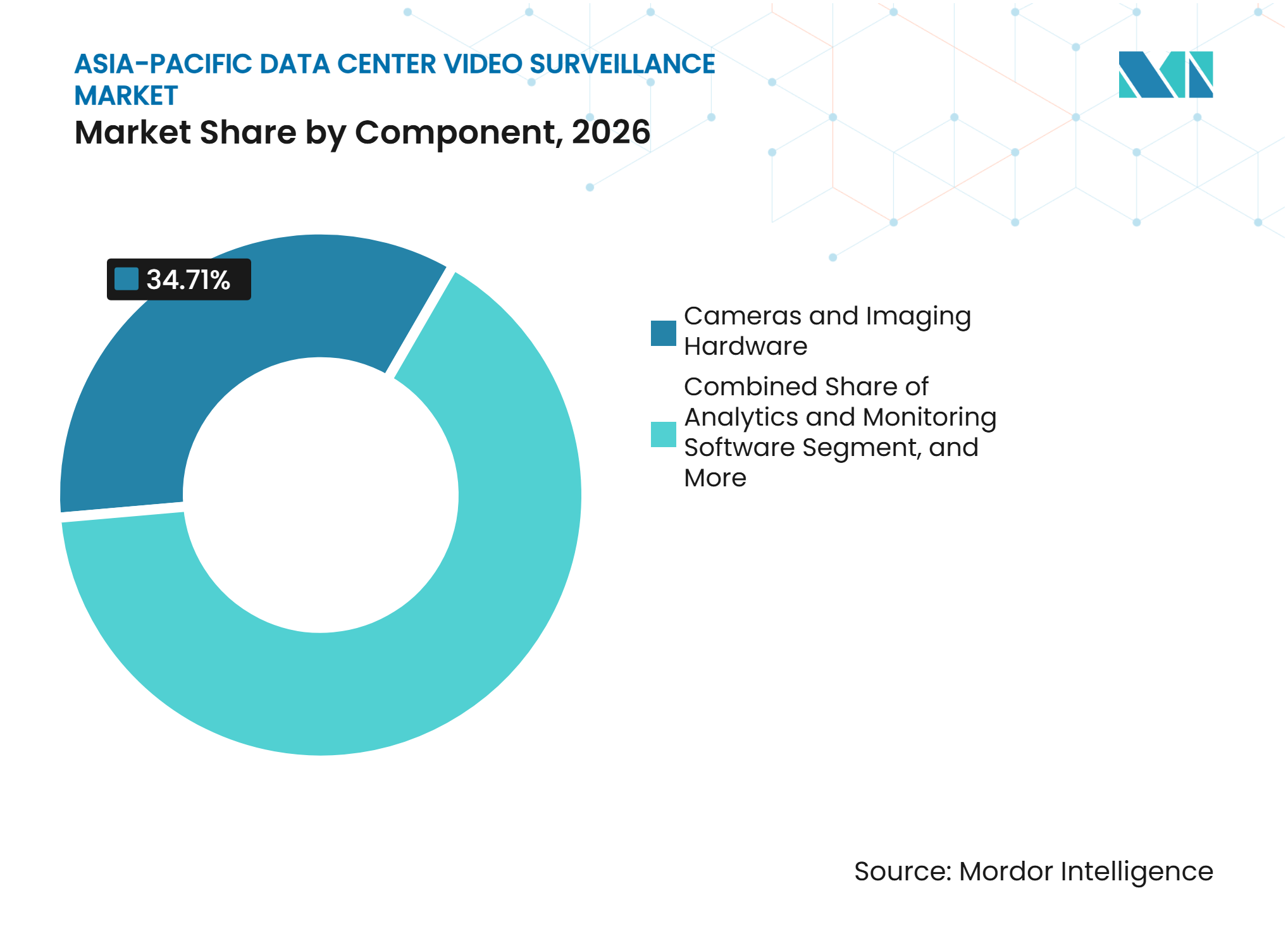
- By component, cameras and imaging hardware held 34.71% of the Asia-Pacific data center video surveillance market revenue in 2026, while analytics and monitoring software is projected to expand at a 17.26% CAGR through 2032.
- By camera type, fixed cameras held 63.28% of the segment in 2026, while PTZ cameras are projected to expand at an 18.92% CAGR through 2032.
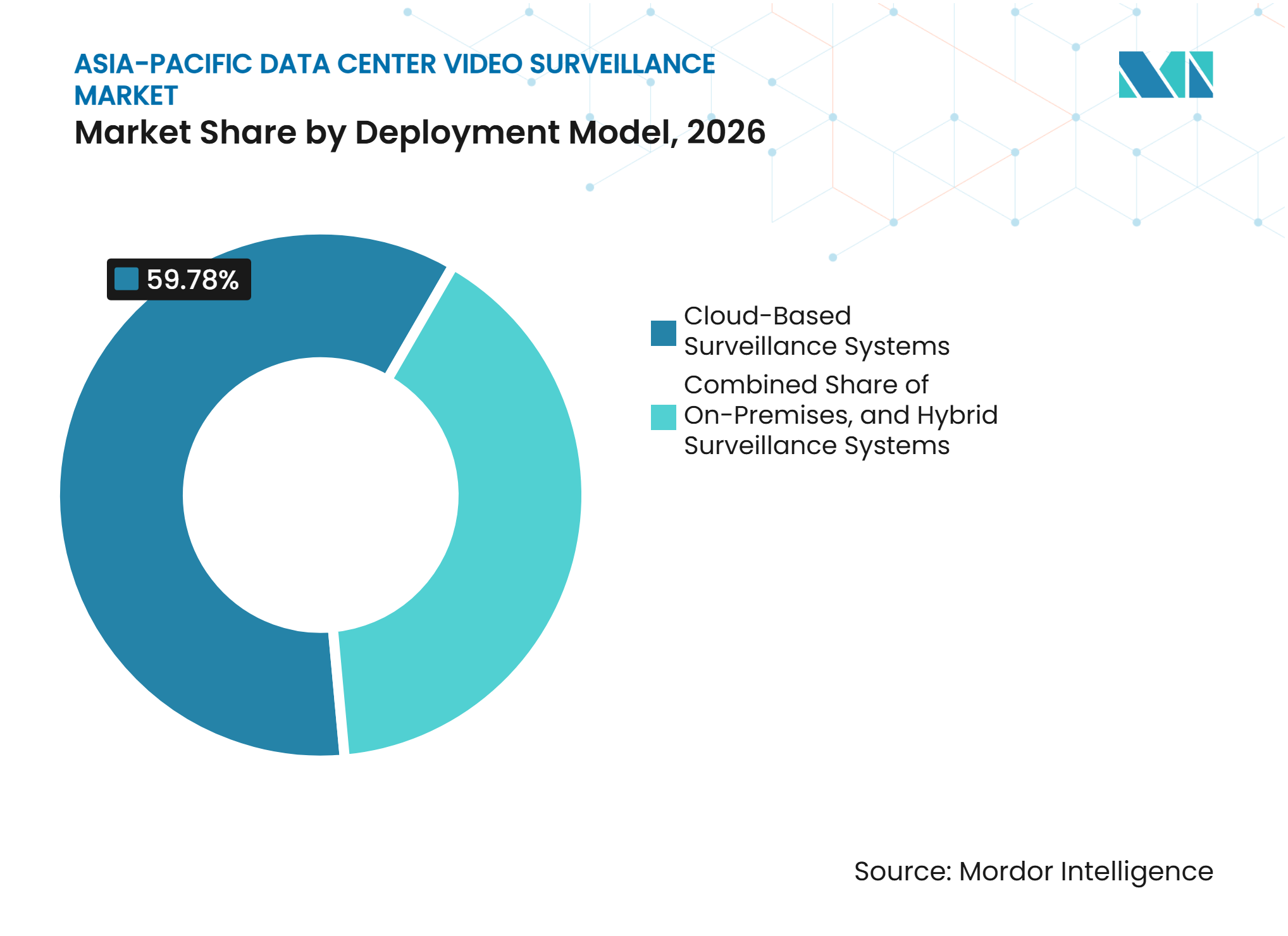
- By deployment model, cloud-based systems accounted for 59.78% of the Asia-Pacific data center video surveillance market segment in 2026 and are projected to expand at a 17.39% CAGR through 2032.
- By application, perimeter and external area monitoring accounted for 26.54% of the Asia-Pacific data center video surveillance market size in 2026, while electrical and mechanical room monitoring is projected to expand at a 19.59% CAGR through 2032.
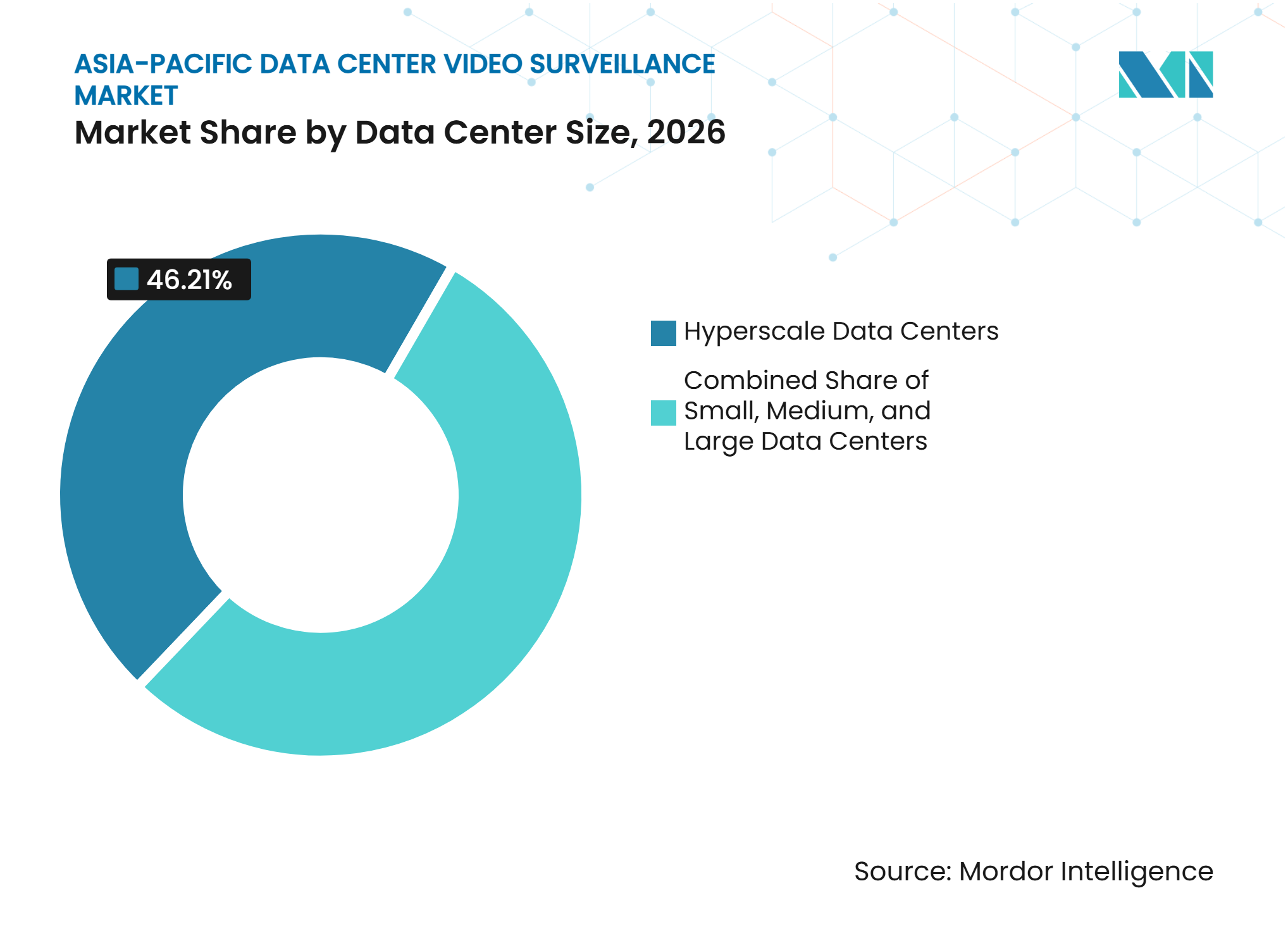
- By data center size, hyperscale facilities held 46.21% of the segment in 2026 and are projected to expand at an 18.27% CAGR through 2032.
- By data center type, colocation facilities held 36.64% of the segment in 2026, while cloud service providers are projected to expand at a 17.38% CAGR through 2032.
- By geography, China accounted for 36.23% of the Asia-Pacific data center video surveillance market revenue in 2026, while India is projected to expand at a 19.86% CAGR through 2032.
Note: Market numbers in this report are based on Mordor Intelligence's proprietary estimation framework, which combines nine months of actuals with Q4 projections for base year 2026.
Market Trends and Insights
Drivers Impact Analysis of Asia-Pacific Data Center Video Surveillance Market*
| Driver | (~) % Impact on CAGR Forecast | Geographic Relevance | Impact Timeline |
|---|---|---|---|
| Hyperscale and Colocation Buildout | +4.2% | Asia-Pacific, with concentration in China, India, Malaysia, Indonesia, and Thailand | Short term (≤ 2 years) |
| AI Workloads Increasing Security-Critical Data Hall Density | +3.8% | Global, with the highest relevance in China, Singapore, and Japan | Medium term (2-4 years) |
| Data Sovereignty and Localization Requirements | +2.9% | China and India, with spillover to Singapore, Indonesia, and Vietnam | Medium term (2-4 years) |
| Physical-Cyber Convergence | +2.1% | Japan, Singapore, South Korea, and Australia | Medium term (2-4 years) |
| Multi-Tenant Colocation Auditability Needs | +1.5% | Singapore, Hong Kong, and Tokyo | Long term (≥ 4 years) |
| Edge AI for Remote Facilities | +1.2% | Southeast Asia, India, and secondary Asia-Pacific locations | Long term (≥ 4 years) |
| Source: Mordor Intelligence | |||
Hyperscale And Colocation Buildout Across China, India, And Southeast Asia
The Asia-Pacific data center video surveillance market benefits directly from the construction of new data halls and colocation campuses. Greenfield facilities require perimeter, entrance, data hall, delivery-area, and equipment-room coverage before operations begin. This approach makes surveillance part of core facility design rather than a later fit-out decision. Larger sites also require more cameras, wider video retention capacity, and centralized management across multiple buildings. The demand effect is strongest in markets adding large campuses, including China, India, Malaysia, Indonesia, and Thailand. This construction cycle gives suppliers an opportunity to secure design specifications early and support the customer through installation, integration, and maintenance.
AI Workloads Increasing Security-Critical Data Hall Density
AI infrastructure is concentrating more electrical and cooling equipment within each data hall. High-density GPU environments require monitoring for unauthorized access, heat conditions, cooling integrity, and equipment activity. Video analytics can serve as an early operational signal when it is connected to thermal, access, and facilities data. Hanwha Vision stated that its AI-based camera approach can reduce bandwidth use by up to 80% while supporting anomaly detection. The Open Data Center Committee published ODCC202506003 in September 2025 for cloud-edge combined intelligent video monitoring in data centers.[1] These requirements are moving the Asia-Pacific data center video surveillance market toward camera systems that provide operational visibility as well as security coverage.
Data Sovereignty And Localization Requirements Expanding Local Monitoring
Data protection rules are changing how operators select video platforms and manage recorded footage. China's Administrative Regulation on Network Data Security took effect in January 2025 and established security duties for network data processing.[2] India published draft Digital Personal Data Protection Rules in January 2025, setting out obligations for data fiduciaries.[3] Data center operators must be able to document retention, access, and incident-handling practices for video evidence. This need supports local recording, controlled access, and verified audit trails. It also raises the value of hybrid architectures that keep recordings within a site or jurisdiction while allowing centralized administration.
Physical-Cyber Convergence Requiring Correlated Video And Access Events
Data center security teams increasingly need video events to connect with access-control records and cyber alerts. A badge anomaly can be investigated faster when the security team can review its matching video event. Axis Communications has described the value of integrated layers that connect perimeter monitoring, data center areas, and individual rack zones. This approach supports more consistent evidence collection across multi-site operations. It also helps operators meet tenant expectations for traceable physical-security processes. The Asia-Pacific data center video surveillance market is gaining from demand for video management systems that can connect with access control, building management systems, and security information platforms.
Restraints Impact Analysis of Asia-Pacific Data Center Video Surveillance Market*
| Restraint | (~) % Impact on CAGR Forecast | Geographic Relevance | Impact Timeline |
|---|---|---|---|
| High Retrofit Cost in Live Data Halls | -2.8% | Asia-Pacific, especially Singapore, Tokyo, and Hong Kong | Short term (≤ 2 years) |
| Privacy, Facial Recognition, and Cross-Border Data Restrictions | -2.1% | China, India, South Korea, and ASEAN jurisdictions | Medium term (2-4 years) |
| Interoperability Friction Across Legacy Systems | -1.6% | Japan and mixed-equipment enterprise and edge deployments | Long term (≥ 4 years) |
| Power, Cooling, and Cybersecurity Burden of Video Retention | -1.4% | Singapore, Hong Kong, and other energy-constrained markets | Long term (≥ 4 years) |
| Source: Mordor Intelligence | |||
High Retrofit Cost In Live, Always-On Data Halls
Live data centers cannot treat camera replacement as a simple equipment change. Installation work must fit change-control processes and avoid disruption to customer operations. Multi-tenant facilities may also need consent or coordination before work occurs in shared access, power, and corridor areas. Thermal monitoring projects can require specialist oversight when equipment is near live electrical systems or cooling infrastructure. These conditions raise project cost and can lengthen installation schedules compared with greenfield sites. The restraint affects mature colocation centers most strongly because they must update existing systems while preserving service continuity.
Privacy, Facial-Recognition, And Cross-Border Data Restrictions
Biometric rules, product certification, and cross-border data requirements can limit the use of advanced camera functions. India introduced government laboratory testing requirements for internet-connected cameras in April 2025, increasing product qualification needs for suppliers. The rules can extend procurement cycles when approved products are not immediately available. Operators with sites in multiple jurisdictions must account for differing rules on face recognition, video retention, data residency, and cybersecurity certification. These issues make it harder to use one standard platform across all regional locations. Suppliers that provide transparent security documentation and locally suitable deployment options can reduce this procurement barrier.
*Our forecasts treat driver/restraint impacts as directional, not additive. The impact forecasts reflect baseline growth, mix effects, and variable interactions.
Asia-Pacific Data Center Video Surveillance Market Segment Analysis
By Component:
Analytics Software Expands Alongside Hardware's Revenue LeadCameras and imaging hardware held 34.71% of the Asia-Pacific data center video surveillance market share in 2026. Fixed dome, fisheye, low-light, and specialist cameras form the physical base of a surveillance deployment. Their role in covering corridors, access points, equipment rooms, and perimeters keeps hardware spending high at the start of a new project. Hardware also remains necessary when operators expand coverage across a larger facility footprint. Analytics and monitoring software is projected to expand at a 17.26% CAGR through 2032. Operators are directing more budget toward software that can identify events and convert video feeds into usable alerts.
Video management software and storage systems sit between the camera network and the operator's response process. Video management software is moving toward cloud-delivered subscriptions in facilities that need centrally managed fleets. Services are also important because integrators must connect cameras with building systems, access control, and enterprise security processes. Hikvision released HikCentral Professional v3.0 in April 2025 with capacity for 20,000 video channels on one server and clustering support for up to 55,000 devices. Edge AI can reduce the processing burden on central servers by handling some analysis at the camera. This shift gives software, integration, and recurring support a larger role in the Asia-Pacific data center video surveillance market. It also changes vendor selection because operators need dependable support for updates, interoperability testing, video retention settings, and incident-response workflows after installation.



By Camera Type:
Fixed Cameras Anchor Coverage While PTZ Supports Large PerimetersFixed cameras accounted for 63.28% of the camera-type segment in 2026. They provide continuous coverage for corridors, entrance points, data halls, and other stable viewing zones. Their lower unit cost supports dense grid coverage where operators need a clear audit record. Fixed devices are therefore central to compliance-led monitoring in both new and established facilities. PTZ cameras are projected to expand at an 18.92% CAGR through 2032. Their ability to pan, tilt, and zoom supports wide perimeter coverage at large campuses.
PTZ systems can reduce the need for several fixed positions in open outdoor areas. They are useful where security teams must investigate movement across a campus boundary or service road. Axis Communications introduced the AXIS Q6411-LE Bispectral PTZ Camera in September 2025, combining thermal detection and visual verification with FIPS 140-3 Level 3 cybersecurity. Thermal cameras address equipment-room and perimeter use cases where visibility may be poor. Hanwha Vision introduced a QVGA AI Thermal Surveillance Camera in September 2025 with a noise equivalent temperature difference below 20 mK. Multi-sensor devices are widening the role of individual camera units by combining visible, thermal, and AI capabilities. This design can simplify deployment planning when operators need to cover changing outdoor conditions, restricted utility areas, and large physical boundaries with fewer separate systems.
By Deployment Model:
Cloud-Based Systems Lead While Hybrid Addresses Local RequirementsCloud-based systems held 59.78% of the deployment-model segment in 2026. The same segment is projected to expand at a 17.39% CAGR through 2032. Centralized camera management is valuable for operators with facilities across several countries and cities. Cloud platforms can simplify software updates, model deployment, user administration, and evidence searches. They also reduce the need for each site to maintain a large local video-management server environment. The Asia-Pacific data center video surveillance market therefore benefits from cloud systems that provide common policies across distributed operations.
Cloud-based surveillance does not eliminate the need for local controls. Enterprise, edge, and regulated facilities may retain on-site recording because of residency rules, latency needs, or existing infrastructure. Hybrid designs keep recordings within the facility while allowing centralized analytics and management functions. This arrangement gives operators a way to use cloud functionality without moving all sensitive video data across borders. Verkada introduced its AI-Powered Unified Timeline in September 2025, which uses cloud-managed cameras to reconstruct people and vehicle movement across a property. Hybrid deployment is likely to remain important where local data control is a key buying requirement. It also provides a practical transition path for operators that need to improve analytics without replacing established recording and storage systems immediately.

By Application:
Perimeter Monitoring Leads While Equipment Rooms Advance FasterPerimeter and external area monitoring held 26.54% of application revenue in 2026. Large campuses require coverage of fences, gates, roads, loading areas, and boundary zones. The camera count required for these areas rises with each new hyperscale or colocation campus. Perimeter systems also support investigation of unauthorized movement before it reaches the building. Electrical and mechanical room monitoring is projected to expand at a 19.59% CAGR through 2032. This use case is gaining importance as higher-density computing increases heat, power, and cooling risks.
Thermal and AI-enabled cameras can support both security and facilities teams in electrical and mechanical spaces. They can help identify unusual heat patterns, coolant-related issues, or access activity in restricted areas. Entrance and access-point monitoring remains essential because data centers require controlled movement through high-security zones. Loading-bay monitoring addresses risks related to deliveries and temporary contractor access. Remote site monitoring is also becoming more relevant in secondary locations with limited local security staffing. Event-based recording and prioritized alerts can lower storage demand while helping personnel focus on unusual activity. These capabilities improve the business case for monitoring systems when the same camera deployment supports safety, facilities operations, physical security, and post-incident review.
By Data Center Size:
Hyperscale Facilities Set Surveillance StandardsHyperscale facilities held 46.21% of the data-center-size segment in 2026. They are projected to expand at an 18.27% CAGR through 2032. A single hyperscale campus can require surveillance across multiple buildings, access points, internal halls, utility spaces, and surrounding land. This scale supports dedicated security design, integrated video management, and long-term maintenance arrangements. Large operators also set specifications that influence how other data center tiers approach surveillance procurement. The Asia-Pacific data center video surveillance market size for hyperscale facilities is supported by the need for comprehensive security coverage at large sites.
Large data centers often follow architectures proven by hyperscale operators after those configurations have been tested at scale. Small and medium facilities have different budget, staffing, and integration constraints. Subscription-based camera platforms can give these operators access to analytics without requiring large up-front server investment. Modular systems may also allow a smaller site to add devices as capacity expands. India is adding digital infrastructure in Tier-2 and Tier-3 cities, which increases the relevance of flexible monitoring systems. The opportunity is strongest for suppliers that can combine manageable pricing with installation and ongoing technical support. Smaller operators also need straightforward evidence retrieval, remote health checks, and practical escalation procedures because they may not maintain a dedicated on-site security team.
By Data Center Type:
Colocation Spending Leads While CSPs Expand FasterColocation facilities held 36.64% of the data-center-type segment in 2026. Their surveillance requirements are high because several tenants share parts of the same physical infrastructure. Operators must document access events in corridors, delivery zones, and other common areas. Video records help establish chain of custody and support tenant audits. Johnson Controls introduced C-CURE IQ 3.2 in March 2026 with integrated video management and structured incident workflows. This capability reflects colocation demand for a common process that connects access and video information.
Cloud service providers are projected to expand at a 17.38% CAGR through 2032. These operators are increasing their regional presence and need security systems that can work across distributed facilities. AI-enabled cameras with edge inference can continue basic detection functions during a network disruption. Enterprise and edge facilities are smaller but may offer a strong fit for managed surveillance services. Remote edge locations need monitoring with little on-site intervention and clear escalation processes. The Asia-Pacific data center video surveillance industry can therefore support both large integrated deployments and simpler service-led offerings for smaller facilities. Suppliers that can standardize configuration, support remote troubleshooting, and maintain auditable evidence records have a clear fit with these operating models.
Geography Analysis
China and Japan
China accounted for 36.23% of regional revenue in 2026, giving it the largest Asia-Pacific data center video surveillance market share. Its data center base and domestic surveillance supply chain support extensive deployment activity. The ODCC published its cloud-edge combined intelligent video monitoring standard for data centers in September 2025. The standard supports the use of intelligent video monitoring within data center environments. China Unicom Jiangxi's 2026 security renovation procurement specified nationally certified cameras with onboard cryptographic modules, illustrating the relevance of domestic compliance requirements. Japan is the second-largest regional market, supported by established data center operations and strong physical-security expectations. Japanese buyers also place importance on reliable audit trails, defined operating procedures, and surveillance systems that work alongside established physical-security controls.
India
India is projected to expand at a 19.86% CAGR through 2032, the fastest rate among country markets. Local data-protection obligations and camera-testing requirements influence vendor qualification and deployment choices. India's draft Digital Personal Data Protection Rules were published in January 2025. The country also introduced mandatory testing requirements for internet-connected camera products in April 2025. These requirements increase the importance of local support, certification evidence, and deployment planning. Singapore remains a regional reference market where multinational operators can test systems before using similar designs elsewhere. Its importance comes from its role as a regional operating hub, where customers can compare technology, security processes, and integration practices before larger deployments.
Malaysia, Indonesia, Thailand, Vietnam, Australia and South Korea
Malaysia, Indonesia, Thailand, and Vietnam are adding large data center sites that require perimeter and campus monitoring. Digital Edge announced a USD 4.5 billion AI-ready campus in Bekasi in January 2026, with a 500 MW initial target and a 1 GW ceiling. Australia and South Korea are more mature markets with complex compliance needs. South Korea's planned replacement of 3,663 Chinese-manufactured cameras at Korea Electric Power Corporation facilities indicates stronger attention to approved security equipment. Across the region, the Asia-Pacific data center video surveillance market depends on each country's mix of construction activity, local rules, technology requirements, and buyer preferences. This diversity limits a single regional product approach and increases the value of suppliers that can adapt retention, hosting, product-certification, and maintenance practices to local needs.
Competitive Landscape
Market Concentration
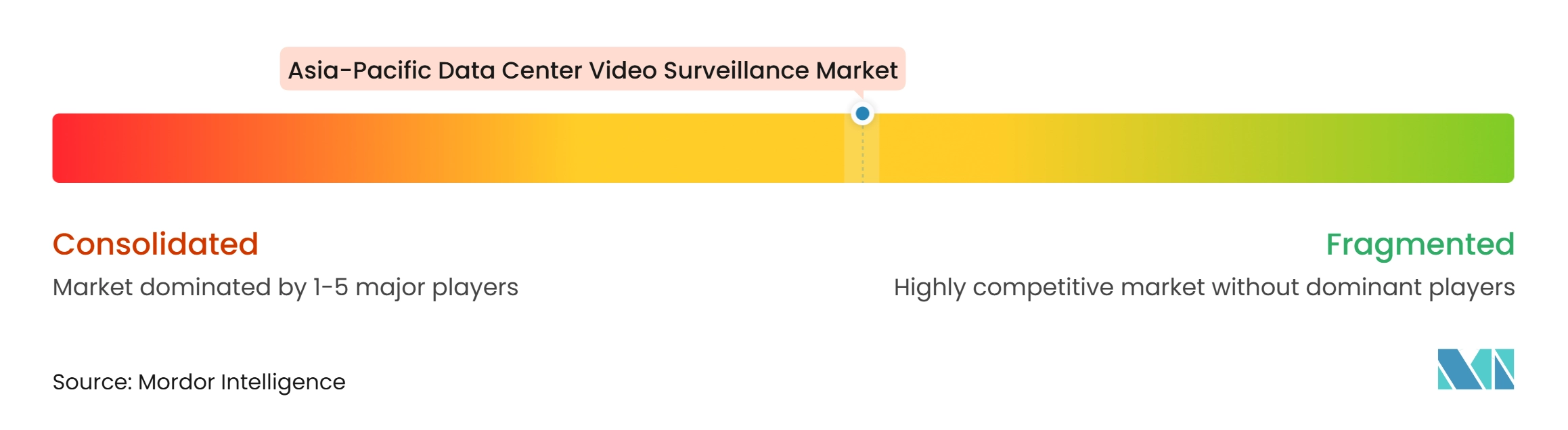
The Asia-Pacific data center video surveillance market is moderately fragmented. Hikvision and Dahua have large revenue positions by volume because of broad distribution and competitive pricing. Axis Communications, Hanwha Vision, Bosch Building Technologies, and Motorola Solutions through Avigilon compete on analytics, cybersecurity credentials, and suitability for projects with procurement restrictions. Genetec and Milestone Systems provide open video management platforms that can integrate feeds from several hardware suppliers. Verkada and Eagle Eye Networks use cloud-based subscription models that reduce the initial cost of a deployment. The competitive outcome often depends on whether a buyer prioritizes camera pricing, regulatory compliance, open integration, or centralized cloud management. This range of approaches means buyers commonly separate camera selection, video-platform selection, integration work, and long-term support rather than sourcing every element from one provider.
Product assurance is becoming more important in procurement decisions. FIPS-certified cryptographic modules, NDAA compliance, and third-party audit readiness can determine whether a supplier is allowed to bid for regulated work. Axis Communications positioned its September 2025 PTZ product around thermal detection, visual verification, and FIPS 140-3 Level 3 certification. Hanwha Vision introduced its thermal AI camera platform in September 2025 for perimeter and critical-infrastructure use. Hikvision expanded the scale of its HikCentral Professional platform in April 2025 to support large device clusters. These moves show that product strategy is increasingly tied to AI processing, integration capacity, and verification requirements. They also show why supplier documentation, software support commitments, and product testing are as relevant as camera specifications in critical-facility tenders.
The Asia-Pacific data center video surveillance market also has opportunities in integrated operations platforms, managed services for small and medium edge sites, and locally suitable systems for sovereign cloud and government-adjacent facilities. Secom announced the acquisition of AVTEL in July 2025 to extend its data center security capabilities across international markets. Suppliers must manage the growing dependence of AI camera features on edge computing components and software ecosystems. Buyers are likely to favor vendors that can document data handling, maintain compatibility with existing systems, and provide reliable regional service. Competition will remain active because no single provider offers the lowest cost, the broadest interoperability, and the strongest compliance fit across every Asia-Pacific jurisdiction. The most effective vendors will align a credible compliance position with local service capacity and a technology roadmap that does not force customers into unnecessary system replacement.
Asia-Pacific Data Center Video Surveillance Industry Leaders
-
Hangzhou Hikvision Digital Technology Co., Ltd.
-
Dahua Technology Co., Ltd.
-
Axis Communications AB
-
Hanwha Vision Co., Ltd.
-
Robert Bosch GmbH
- *Disclaimer: Major Players sorted in no particular order
Asia-Pacific Data Center Video Surveillance Market Companies Covered in this Report
- Hangzhou Hikvision Digital Technology Co., Ltd.
- Dahua Technology Co., Ltd.
- Axis Communications AB
- Hanwha Vision Co., Ltd.
- Robert Bosch GmbH
- Honeywell International Inc.
- Johnson Controls International plc
- Schneider Electric SE
- Convergint Technologies LLC
- Securitas Technology AB
- ASSA ABLOY AB
- Cisco Systems, Inc.
- ABB Ltd.
- Genetec Inc.
- Milestone Systems A/S
- Motorola Solutions, Inc.
- Canon Inc.
- NVIDIA Corporation
- Verkada Inc.
- Eagle Eye Networks, Inc.
Recent Industry Developments in Asia-Pacific Data Center Video Surveillance Market
- October 2026: Shanghai Qingpu Cloud Lake Data Center initiated procurement for video surveillance equipment for its smart campus construction project, reflecting continued investment in AI-enabled surveillance infrastructure within Chinese data center developments.
- August 2026: Deng-X (Japan) received a contract to supply 66 security cameras for server security at a major Indonesian bank, marking the company's first step in developing AI-powered security camera business in Southeast Asia.
- March 2026: Johnson Controls introduced C-CURE IQ 3.2 at ISC West 2026, integrating video management and structured incident workflows directly into its enterprise security platform for critical infrastructure operators, including data centers. The update also added Illustra multi-sensor cameras and extended interoperability with Kantech EntraPass 9.10 and exacqVision 26.0.
- October 2025: Hikvision and InfraX, a subsidiary of Digital DEWA (Dubai), signed a Memorandum of Understanding to co-develop AI- and machine learning-based camera solutions and explore new application segments across critical infrastructure, including data centers.
Asia-Pacific Data Center Video Surveillance Market Report Scope
The Asia-Pacific Data Center Video Surveillance Market encompasses technologies and services that enable visual security, monitoring, and surveillance of data center facilities. It includes solutions designed to enhance physical security, detect unauthorized activities, support incident response, and provide real-time operational visibility across critical infrastructure environments. The market is driven by increasing concerns over facility protection, asset security, business continuity, and the growing adoption of intelligent surveillance systems with advanced monitoring and analytics capabilities.
The Asia-Pacific Data Center Video Surveillance Market is Segmented by Component (Cameras and Imaging Hardware, Video Management Software, Storage and Recording Hardware, Analytics and Monitoring Software, and Installation, Integration, and Support Services), Camera Type (Fixed Cameras, Pan-Tilt-Zoom Cameras, Thermal Cameras, and Specialized Low-Light and Infrared Cameras), Deployment (On-Premise Surveillance Systems, Cloud-Based Surveillance Systems, and Hybrid Surveillance Systems), Application (Perimeter and External Area Monitoring, Entrance and Access Point Monitoring, Data Hall and Internal Corridor Monitoring, Electrical and Mechanical Room Monitoring, Loading Bay and Delivery Area Monitoring, and Remote Site and Campus Monitoring), Size (Small, Medium, Large, Hyperscale), Data Center Type (Colocation, Cloud Service Provider(CSPs), Enterprise / Edge, and Edge Data Centers), and Country (China, Japan, India, Singapore, and Rest of Asia-Pacific). The Market Forecasts are Provided in Terms of Value (USD).
Segmentation Overview
| Cameras and Imaging Hardware |
| Video Management Software |
| Storage and Recording Hardware |
| Analytics and Monitoring Software |
| Installation, Integration, and Support Services |
| Fixed Cameras |
| Pan-Tilt-Zoom Cameras |
| Thermal Cameras |
| Specialized Low-Light and Infrared Cameras |
| On-Premise Surveillance Systems |
| Cloud-Based Surveillance Systems |
| Hybrid Surveillance Systems |
| Perimeter and External Area Monitoring |
| Entrance and Access Point Monitoring |
| Data Hall and Internal Corridor Monitoring |
| Electrical and Mechanical Room Monitoring |
| Loading Bay and Delivery Area Monitoring |
| Remote Site and Campus Monitoring |
| Small |
| Medium |
| Large |
| Hyperscale |
| Colocation |
| Cloud Service Provider(CSPs) |
| Enterprise / Edge |
| Edge Data Centers |
| China |
| Japan |
| India |
| Singapore |
| Rest of Asia-Pacific |
| By Component | Cameras and Imaging Hardware |
| Video Management Software | |
| Storage and Recording Hardware | |
| Analytics and Monitoring Software | |
| Installation, Integration, and Support Services | |
| By Camera Type | Fixed Cameras |
| Pan-Tilt-Zoom Cameras | |
| Thermal Cameras | |
| Specialized Low-Light and Infrared Cameras | |
| By Deployment Model | On-Premise Surveillance Systems |
| Cloud-Based Surveillance Systems | |
| Hybrid Surveillance Systems | |
| By Application | Perimeter and External Area Monitoring |
| Entrance and Access Point Monitoring | |
| Data Hall and Internal Corridor Monitoring | |
| Electrical and Mechanical Room Monitoring | |
| Loading Bay and Delivery Area Monitoring | |
| Remote Site and Campus Monitoring | |
| By Data Center Size | Small |
| Medium | |
| Large | |
| Hyperscale | |
| By Data Center Type | Colocation |
| Cloud Service Provider(CSPs) | |
| Enterprise / Edge | |
| Edge Data Centers | |
| By Country | China |
| Japan | |
| India | |
| Singapore | |
| Rest of Asia-Pacific |
Key Questions Answered in the Report
What is the size of the Asia-Pacific data center video surveillance market?
The Asia-Pacific data center video surveillance market is valued at USD 0.47 billion in 2026 and is forecast to reach USD 1.26 billion by 2032, at a 16.79% CAGR from 2027 to 2032. These figures cover cameras, video management software, storage, analytics, services, and related surveillance systems used within regional data center facilities.
What is driving demand for video surveillance in Asia-Pacific data centers?
The Asia-Pacific data center video surveillance market benefits from new hyperscale and colocation construction, AI-related operational needs, local data requirements, and connected access-video security workflows. Buyers also need auditable coverage of perimeters, access areas, delivery zones, data halls, electrical rooms, and cooling infrastructure.
Which component leads data center video surveillance spending in Asia-Pacific?
Cameras and imaging hardware lead with 34.71% of revenue in 2026, while analytics and monitoring software is projected to expand at a 17.26% CAGR through 2032. Hardware provides physical coverage, while software helps operators identify events, manage recordings, and coordinate response procedures.
Which camera type is expanding fastest in Asia-Pacific data centers?
PTZ cameras are projected to expand at an 18.92% CAGR through 2032 because they support broad coverage of large campus perimeters. Their movement and zoom functions allow security teams to investigate changing conditions over outdoor areas and service roads.
Why are cloud-based surveillance systems important for data center operators?
Cloud-based systems held 59.78% of the deployment segment in 2026 and allow multi-site operators to manage updates, alerts, and investigations through a central interface. Hybrid systems remain relevant when operators need local recording, data-residency control, or lower dependency on remote connectivity.
Which country is expected to expand fastest through 2032?
India is projected to expand at a 19.86% CAGR through 2032, supported by data center development and locally managed security requirements. Product-testing rules and data protection obligations also increase the importance of qualified suppliers, deployment evidence, and accessible local support.