
Asia-Pacific Data Center Sustainable Cooling Market Size and Share
Market Overview
| Study Period | 2021 - 2032 |
|---|---|
| Forecast Data Period | 2027 - 2032 |
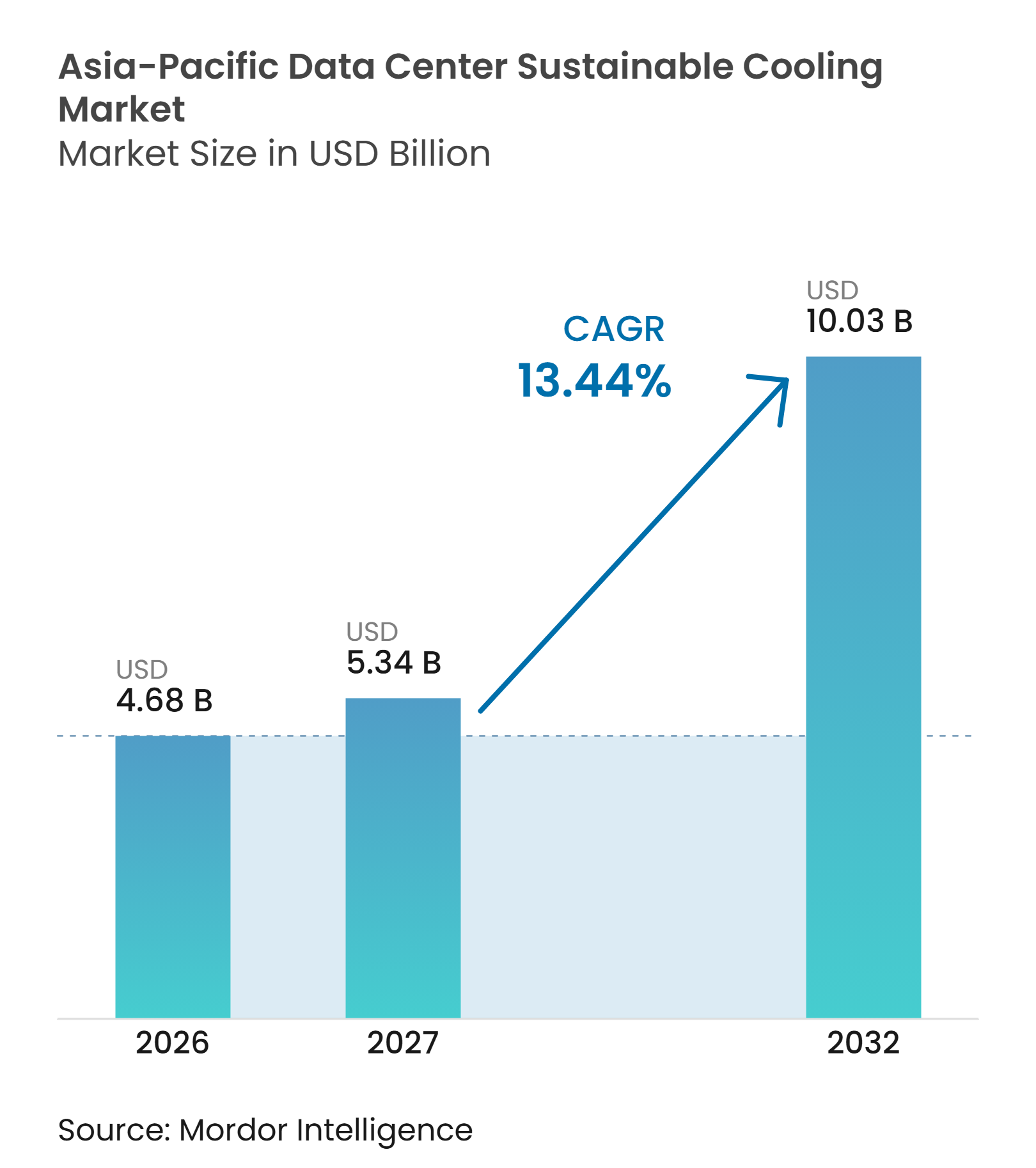
| Base Year Market Size (2026) | USD 4.68 Billion |
| Market Size (2027) | USD 5.34 Billion |
| Market Size (2032) | USD 10.03 Billion |
| Growth Rate (2027 - 2032) | 13.44 % |
| Market Concentration | Medium |
Major Players *Disclaimer: Major Players sorted in no particular order Image © Mordor Intelligence. Reuse requires attribution under CC BY 4.0. | |
Asia-Pacific Data Center Sustainable Cooling Market Analysis by Mordor Intelligence
The Asia-Pacific data center sustainable cooling market size was valued at USD 4.68 billion in 2026 and is estimated to grow from USD 5.34 billion in 2027 to reach USD 10.03 billion by 2032, at a CAGR of 13.44% during the forecast period (2027-2032). Higher rack densities from artificial intelligence and high-performance computing are changing cooling requirements across the region. New facilities increasingly need systems that can manage sustained thermal loads that conventional air systems cannot handle economically. Capacity additions in cloud, colocation, and hyperscale facilities are widening the addressable base for cooling equipment and controls. Energy and water targets are making efficiency a design requirement rather than a discretionary improvement. Vendors that combine liquid cooling, heat rejection, controls, and service capability are better placed to support complex deployments across the Asia-Pacific data center sustainable cooling market.
Key Report Takeaways
- By cooling technology, air-based cooling held 45.94% of the Asia-Pacific data center sustainable cooling market share in 2026, while direct-to-chip liquid cooling is projected to expand at a 13.57% CAGR through 2032.
- By heat-rejection technology, air-cooled systems accounted for 32.27% of the market in 2026, while hybrid heat-rejection systems are projected to expand at a 13.68% CAGR through 2032.
- By cooling system component, chillers held 20.94% of the market in 2026 in the Asia-Pacific data center sustainable cooling market, while cooling distribution units are projected to expand at a 13.84% CAGR through 2032.
- By sustainability approach, energy-efficient cooling accounted for 41.44% of the market in 2026, while integrated cooling optimization and controls are projected to expand at a 13.76% CAGR through 2032.
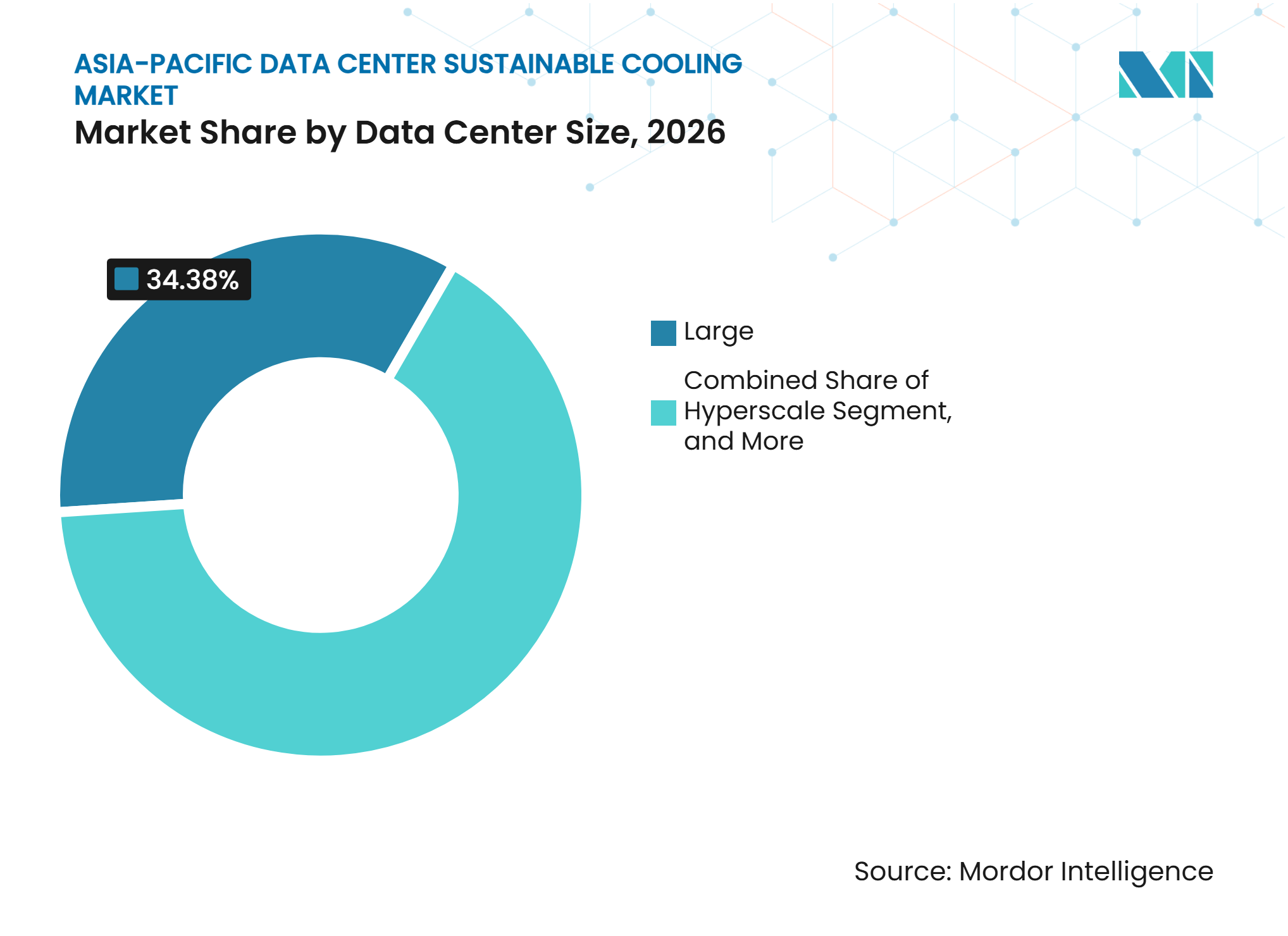
- By data center size, large data centers held 34.38% of the market in 2026, while hyperscale facilities are projected to expand at a 13.69% CAGR through 2032.
- By data center type, cloud service providers held 38.03% of the market in 2026 and are projected to grow at the fastest rate through 2032.
- By geography, China held 34.62% of the market in 2026, while India is projected to expand at a 13.94% CAGR through 2032.
Note: Market numbers in this report are based on Mordor Intelligence's proprietary estimation framework, which combines nine months of actuals with Q4 projections for base year 2026.
Market Trends and Insights
Drivers Impact Analysis of Asia-Pacific Data Center Sustainable Cooling Market*
| Driver | (~) % Impact on CAGR Forecast | Geographic Relevance | Impact Timeline |
|---|---|---|---|
| AI and High-Performance Computing Rack Power Densification | +3.5% | China, India, Japan, Singapore, and South Korea | Short term (≤ 2 years) |
| Hyperscale, Cloud, and Colocation Capacity Expansion | +2.8% | Asia-Pacific, led by Malaysia, India, Japan, and South Korea | Short term (≤ 2 years) |
| PUE, WUE, and Low-Carbon Data Center Requirements | +2.2% | China, Singapore, Malaysia, Japan, Australia, Indonesia, and India | Medium term (2-4 years) |
| Growth of Edge Computing and 5G-Enabled Distributed Infrastructure | +1.4% | India, Indonesia, South Korea, Malaysia, and Rest of Asia-Pacific | Medium term (2-4 years) |
| Water-Stress-Driven Shift to Closed-Loop and Low-Water Cooling | +1.0% | India, Indonesia, Malaysia, Singapore, and Australia | Medium term (2-4 years) |
| Liquid-Cooling-Ready Local Manufacturing and Supply Ecosystems | +0.7% | Malaysia, China, India, and Japan | Long term (≥ 4 years) |
| Source: Mordor Intelligence | |||
AI and High-Performance Computing Rack Power Densification
Artificial intelligence inference workloads generally require 20-40 kW per rack, while training configurations can exceed 100 kW per rack.[1] Older halls designed for loads below 30 kW per rack need substantial cooling changes before they can host dense AI systems. Princeton Digital Group’s TY1 campus in Greater Tokyo supports densities above 140 kW per rack and received NVIDIA DGX-Ready Data Center certification for liquid cooling. AI clusters also tend to operate near their thermal peak for extended periods, leaving less of the part-load relief that legacy cooling systems relied on. ST Telemedia Global Data Centres stated that its Bangkok direct-to-chip deployment supports at least 150 kW per rack and can reduce cooling energy use by 20-30% against air-cooled configurations. This requirement favors CDUs, cold plates, leak detection, and controls that can manage stable, high-density thermal conditions.
Hyperscale, Cloud, and Colocation Capacity Expansion
The Asia-Pacific data center sustainable cooling market is supported by the expanding construction pipeline for cloud, colocation, and hyperscale capacity. Facilities designed for AI workloads need equipment sized for much higher rack density than previous builds. This moves cooling decisions earlier in project design and increases the value of vendors that can coordinate facility and rack-level systems. Liquid-cooling-ready colocation can also offer a differentiated service to tenants that cannot operate their own thermal systems. That service model creates demand for CDUs, coolant distribution, monitoring, and field support rather than only standalone equipment. The result is a broader revenue opportunity across equipment, integration, and lifecycle services.
PUE, WUE, and Low-Carbon Data Center Requirements
PUE and WUE requirements are narrowing the range of viable designs for new data centers in key Asia-Pacific locations. China’s guidelines require new large and hyperscale facilities to achieve PUE below 1.25, while national hub nodes are capped at 1.2 and green procurement standards set a WUE ceiling of 2.5 L/kWh.[2] Malaysia’s sustainable development guideline recommends a design WUE of 2.2 m³/MWh or lower and connects incentive eligibility to PUE and WUE requirements. Singapore tightened its Green Mark criteria in March 2025, setting a PUE threshold of 1.46 at 25% IT load for Gold Plus status. The ASEAN Guide for Sustainable Data Center Development also places water management and WUE alignment within regional development expectations. AISO/IEC 30134-2 and ISO/IEC 30134-9 provide common PUE and WUE measurement frameworks that support these efficiency requirements.
Growth of Edge Computing and 5G-Enabled Distributed Infrastructure
5G network density is creating demand for compact cooling at distributed edge sites. India’s mobile data consumption reached 31 GB per user in 2025, an increase of 12.7% from the prior year. This supports the commercial case for processing data closer to users rather than moving all traffic to centralized locations. An IEEE Access study found that workload-aware thermal management can reduce peak temperature by 12% and cooling energy use by 20-30% at distributed sites in tropical conditions.[3] Edge applications need sealed, low-maintenance systems that can work in constrained outdoor or industrial settings. This creates room for cooling specialists with equipment designed for smaller, distributed installations.
Restraints Impact Analysis of Asia-Pacific Data Center Sustainable Cooling Market*
| Restraint | (~) % Impact on CAGR Forecast | Geographic Relevance | Impact Timeline |
|---|---|---|---|
| High Upfront Cost and Retrofit Complexity | -1.8% | Asia-Pacific, especially Japan, Australia, and Greater Seoul | Short term (≤ 2 years) |
| Shortage of HVAC, Liquid-Cooling, and Commissioning Skills | -1.2% | Asia-Pacific, especially Southeast Asia, India, and Indonesia | Medium term (2-4 years) |
| Fluid Compatibility, Warranty, and Certification Uncertainty | -0.9% | Asia-Pacific, especially Japan and South Korea | Medium term (2-4 years) |
| Water, Power, and Environmental Approval Constraints in High-Growth Hubs | -0.7% | Johor, Mumbai, Chennai, Jakarta, and Singapore | Medium term (2-4 years) |
| Source: Mordor Intelligence | |||
High Upfront Cost and Retrofit Complexity
Full direct-to-chip conversion at an existing site entails high per-MW costs for IT load, while greenfield liquid-cooling builds require even higher per-MW investment. Legacy facilities often need piping, manifolds, CDUs, leak detection, and commissioning in addition to cooling hardware. Raised-floor congestion, ceiling restrictions, and structural loading constraints can make conversion difficult. Operators must also maintain uptime commitments while upgrades are underway. This usually requires phased work rather than a single facility-wide conversion. The cost and disruption keep adoption most accessible to large and hyperscale operators with stronger capital capacity.
Shortage of HVAC, Liquid-Cooling, and Commissioning Skills
Liquid cooling brings together mechanical engineering, fluid management, IT operations, and control systems. These capabilities have often been managed separately, and the available workforce has not scaled at the same pace as regional construction. The shortage is more visible in Southeast Asia and India, where new capacity is being added quickly. It can increase outsourced commissioning costs and slow the rollout of more complex projects. Vendors are responding with training and certification programs, but the shortfall continues to affect deployment schedules. Factory-tested modular systems are therefore valuable because they reduce the technical work required at the site.
*Our forecasts treat driver/restraint impacts as directional, not additive. The impact forecasts reflect baseline growth, mix effects, and variable interactions.
Asia-Pacific Data Center Sustainable Cooling Market Segment Analysis
By Cooling Technology:
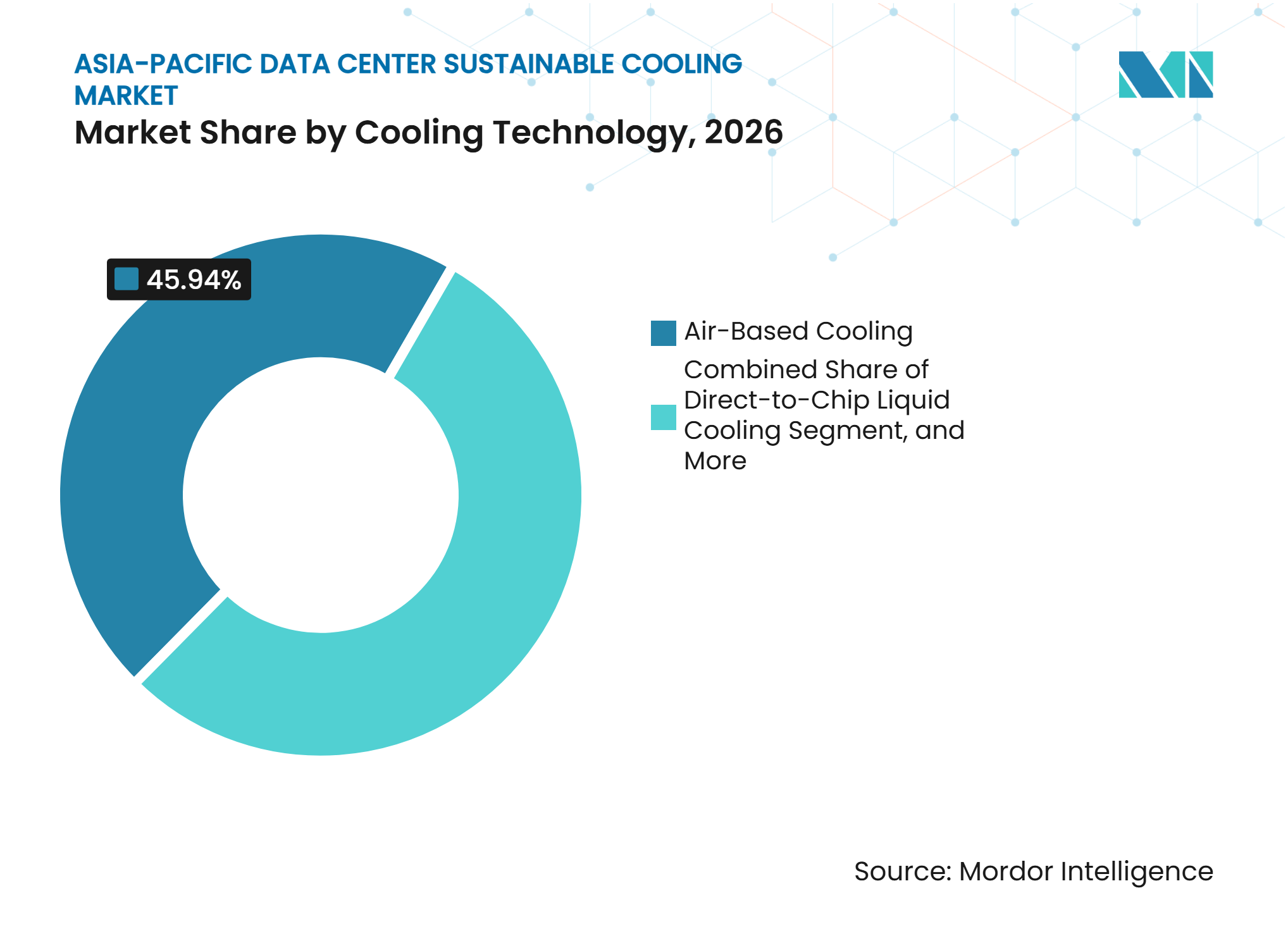
Air-Based Systems Remain Established as Liquid Cooling AdvancesAir-based cooling held 45.94% of the Asia-Pacific data center sustainable cooling market share in 2026, supported by the large installed base of CRAC and CRAH equipment in enterprise and mid-tier colocation facilities. Its position reflects existing infrastructure and lower entry costs for medium-density applications. The segment is likely to lose relative weight as new AI-focused campuses adopt liquid cooling at the design stage. Direct-to-chip liquid cooling is projected to expand at a 13.57% CAGR through 2032. It is being adopted for GPU clusters with rack loads of 70 kW and above. The technology supports a direct path for removing heat from high-density processors. It also requires a more integrated approach to distribution, controls, and service.
Immersion cooling has a smaller revenue base, but it is moving toward broader commercial use. Castrol’s regional industry discussion identified fluid leakage, implementation time, and maintenance as important barriers for single-phase immersion systems. Rear-door heat exchangers can provide a practical intermediate option for sites managing 30-50 kW racks. They work with existing air-side designs while increasing the thermal capacity available near the rack. Evaporative, adiabatic, and free-cooling systems also remain relevant in markets with favorable ambient conditions. Australia and Japan can use more free-cooling hours in suitable locations, which can reduce mechanical refrigeration demand. These technologies will continue to coexist because site climate, water availability, building layout, and rack density differ across the region.



By Heat Rejection Technology:
Hybrid Systems Support Flexible Efficiency ManagementAir-cooled systems accounted for 32.27% of the Asia-Pacific data center sustainable cooling market in 2026. Their installed position reflects compatibility with established air-side infrastructure and lower direct water use. Hybrid heat rejection systems are projected to expand at a 13.68% CAGR through 2032. These systems combine dry cooling, adiabatic operation, and chilled-water circuits. The combination lets operators adjust operating modes according to ambient conditions and workload. It also helps sites manage the PUE and WUE trade-off under changing weather and resource conditions. This flexibility is especially important in tropical locations where both power use and water use are closely monitored.
Closed-loop and hybrid designs can reduce freshwater intake by 50-70% compared with conventional evaporative systems. Water-cooled and evaporative designs remain useful where warm-water loops and climate conditions support efficient operation. Dry coolers are gaining relevance in locations facing tighter water constraints. The mix of liquid cooling for dense AI racks and ambient air cooling for lower-density equipment supports the use of multiple heat rejection methods at the same facility. This reduces the likelihood that a single technology will meet every use case. The Asia-Pacific data center sustainable cooling industry will therefore need designs that can be configured around local water conditions, climate, and workload mix.
By Cooling System Component:
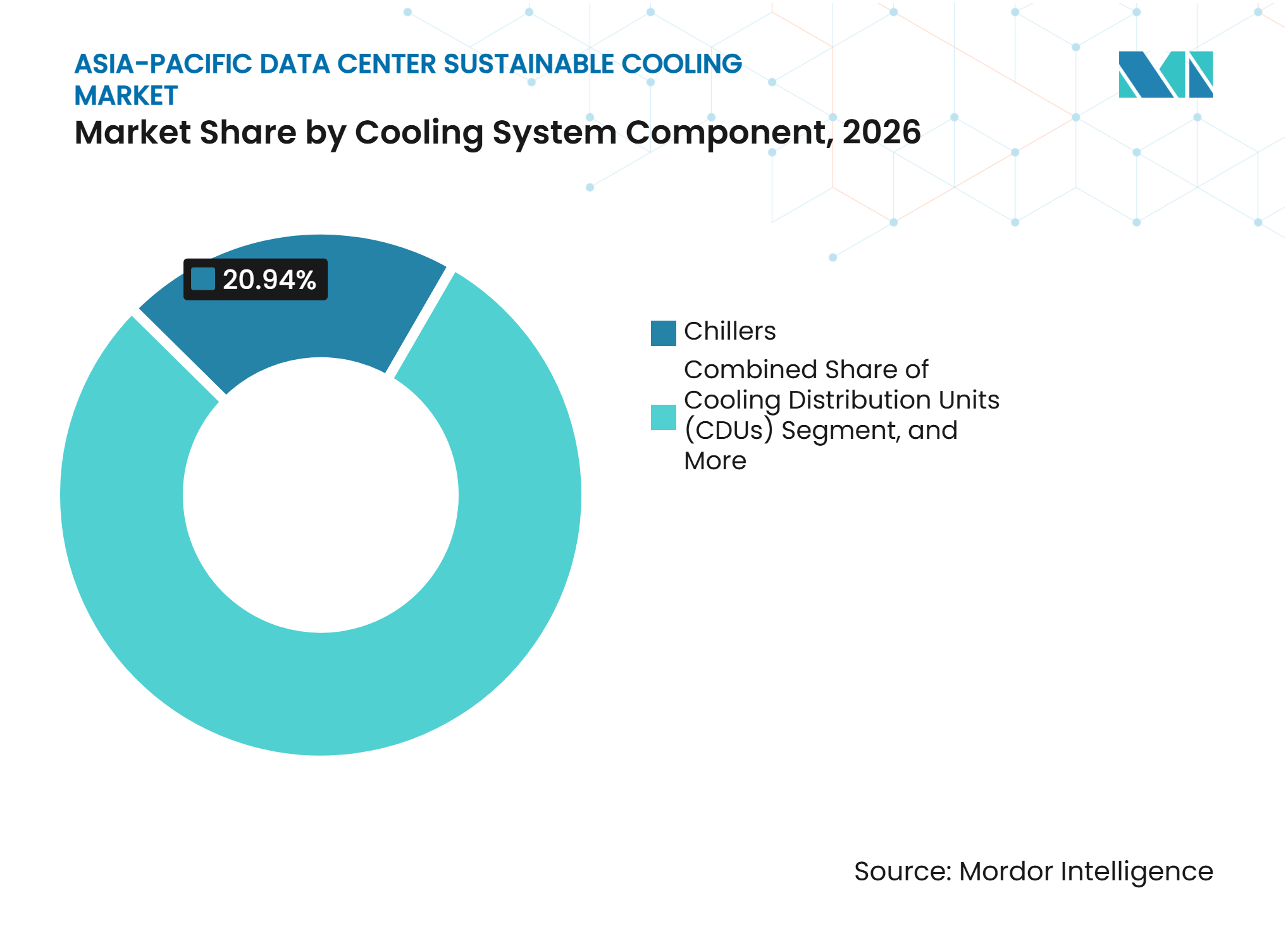
CDUs Gain Importance as Liquid Systems ExpandChillers held 20.94% of the Asia-Pacific data center sustainable cooling market in 2026. They remain important because they supply chilled water to legacy air systems and the primary loops used by liquid-cooling designs. Cooling distribution units are projected to expand at a 13.84% CAGR through 2032. A direct-to-chip system requires a CDU to separate facility water from the rack-level circuit and manage the hydraulic connection. This makes the CDU a core part of most direct liquid-cooling designs. Demand for the component rises with the number of high-density deployments rather than only with overall facility capacity. It also raises the value of suppliers that can provide commissioning support and controls integration.
Vertiv’s 2026 production and testing investments show that manufacturers are preparing for greater demand for high-density cooling equipment. Cooling towers and heat exchangers remain central to water-cooled and evaporative configurations. Pumps and fluid distribution equipment are becoming more important as operators manage tighter flow and temperature requirements in primary and secondary circuits. Companies with water and pumping expertise can compete on reliability and fluid management. Cooling controls also have a larger role because they identify thermal anomalies and make better use of free-cooling periods. The component mix is moving from stand-alone equipment toward connected thermal systems that depend on hardware and control software working together.

By Sustainability Approach:
Energy Efficiency Holds the Largest Position as Controls AccelerateEnergy-efficient cooling accounted for 41.44% of the Asia-Pacific data center sustainable cooling market in 2026. This reflects the installed base of chiller optimization, variable-speed drives, and hot-aisle containment projects. Integrated cooling optimization and controls are projected to expand at a 13.76% CAGR through 2032. These systems adjust cooling output in response to live compute loads instead of relying only on fixed operating points. This is useful for facilities where workload changes quickly and energy use must be managed closely. It also improves the return on investment from liquid cooling and heat rejection equipment. The approach gives operators better visibility into system performance and potential thermal risks.
Water-efficient cooling is also becoming a separate procurement focus in locations where freshwater use is scrutinized. Low-global-warming-potential refrigerant options are gaining relevance as the phasedown of high-GWP hydrofluorocarbons affects equipment selection. Heat recovery remains limited in Asia-Pacific but has potential in Japan and South Korea, where district heating and industrial heat users may provide demand for recovered heat. These approaches do not replace energy-efficiency measures. They extend the sustainability decision beyond electricity consumption to water, refrigerants, and heat reuse. The Asia-Pacific data center sustainable cooling market therefore requires vendors to show how equipment performs across several environmental measures.
By Data Center Size:
Hyperscale Facilities Drive the Fastest Demand IncreaseLarge data centers held 34.38% of the Asia-Pacific data center sustainable cooling market size in 2026. Their installed base includes cloud and colocation campuses that are undergoing density upgrades and cooling renewal programs. Hyperscale data centers are projected to expand at a 13.69% CAGR through 2032. These campuses are increasingly designed with liquid cooling, CDU manifolds, and on-site testing capability from the beginning. This changes the equipment scope because high-density cooling is included as a core project element. Hyperscale operators can also use liquid-cooling readiness to attract AI tenants that need high rack density from the first day of operations. Their purchasing decisions shape standards for suppliers across the region.
Medium-sized data centers often serve enterprises moving workloads from on-premises facilities. They are more likely to add modern chilled-water systems and isolated AI-ready zones than pursue a full liquid conversion. Small sites typically focus on precision cooling upgrades and energy efficiency improvements. Their cooling decisions are driven more by PUE compliance and operating costs than by extreme density. This creates a broad set of demand profiles across the Asia-Pacific data center sustainable cooling market. Suppliers need scalable products that fit large campuses, retrofit projects, and smaller deployments. A portfolio that supports each size category can reduce reliance on a narrow group of hyperscale projects.
By Data Center Type:
Cloud Service Providers Set Requirements for New CapacityCloud service providers held 38.03% of the Asia-Pacific data center sustainable cooling market in 2026. They are also the fastest-growing data center type through 2032. Their sustainability commitments and AI service expansion create strict internal requirements for cooling equipment. Large cloud projects may require low WUE, direct-to-chip cooling, and integrated controls at the same time. These specifications influence equipment selection across the supply chain. Vendors that can meet the full requirements gain an advantage in long-term procurement cycles. The segment’s size and rate of expansion make it the central source of demand for advanced cooling systems.
Colocation providers are becoming more active participants in thermal management rather than passive space providers. Some are offering liquid-cooling-as-a-service that includes CDUs, cold-water distribution, and monitoring. This can appeal to enterprise customers that lack in-house liquid-cooling teams. Enterprise and edge facilities continue to use efficient chillers, free-cooling economizers, and thermal controls. They often avoid the cost of comprehensive liquid conversion when rack densities remain moderate. These sites provide ongoing demand for established air-based and chilled-water products. The mix of cloud, colocation, enterprise, and edge demand makes the Asia-Pacific data center sustainable cooling industry less dependent on any single operating model.
Geography Analysis
China
China held 34.62% of the regional cooling market in 2026, making it the largest national market. The country’s large AI computing clusters and policy-backed data center hubs support demand for higher-performance cooling systems. The East Data, West Computing strategy directs capacity toward energy-rich western provinces and shapes facility planning. China requires new large and hyperscale facilities to meet PUE below 1.25, while national hub nodes have a 1.2 cap. Green procurement standards also set a WUE ceiling of 2.5 L/kWh. The China Electronics Energy Conservation Technology Association issued T/DZJN 386-2025 for AI data center cooling in January 2025. The standard supports liquid cooling for high-density environments and provides a framework for cooling load factors and WUE. Domestic suppliers are also building liquid-cooling equipment capacity, which strengthens local supply options and raises competitive pressure for foreign vendors.
India
India is projected to expand at a 13.94% CAGR through 2032 in the Asia-Pacific data center sustainable cooling market, the fastest rate among the geographies covered. Hyperscale investment is broadening beyond Mumbai into Chennai, Hyderabad, and Delhi NCR. Google is developing a 1 GW AI data center campus in Visakhapatnam, while AWS has planned a 473 MW campus in Navi Mumbai. India’s scale makes it a key location for cooling equipment procurement, local service capability, and product development. Daikin announced plans in June 2026 for a research and development base in India focused on large-scale air conditioning and data center cooling. Submer also signed a memorandum of understanding with Madhya Pradesh to develop up to 1 GW of liquid-cooled AI data centers. Water use, power availability, and approval processes will influence the system mix used at these sites. Closed-loop designs and equipment that reduce field commissioning complexity can be well suited to the country’s fast construction cycle.
Southeast Asia, Japan, Australia, and South Korea
Malaysia’s Johor capacity increase has made the state an important cooling equipment destination, while Singapore’s tighter Green Mark requirements support liquid-side free cooling and high-efficiency chiller use. Vertiv’s Senai manufacturing investment supports shorter equipment supply routes for Southeast Asian projects. Japan’s policy direction favors better PUE performance and capacity outside Tokyo and Osaka, where climate conditions can provide more free-cooling hours. Australia also benefits from conditions that support adiabatic and evaporative cooling in suitable areas. South Korea is a technology development center for immersion cooling, supported by its electronics and semiconductor ecosystem. LG Electronics, SK Enmove, and Green Revolution Cooling signed a 2025 memorandum to develop liquid immersion cooling for AI data centers. Indonesia represents a developing demand center as data center construction expands around Jakarta. Across these geographies, ISO/IEC efficiency measures and local environmental approvals will continue to affect technology choice.
Competitive Landscape
Market Concentration
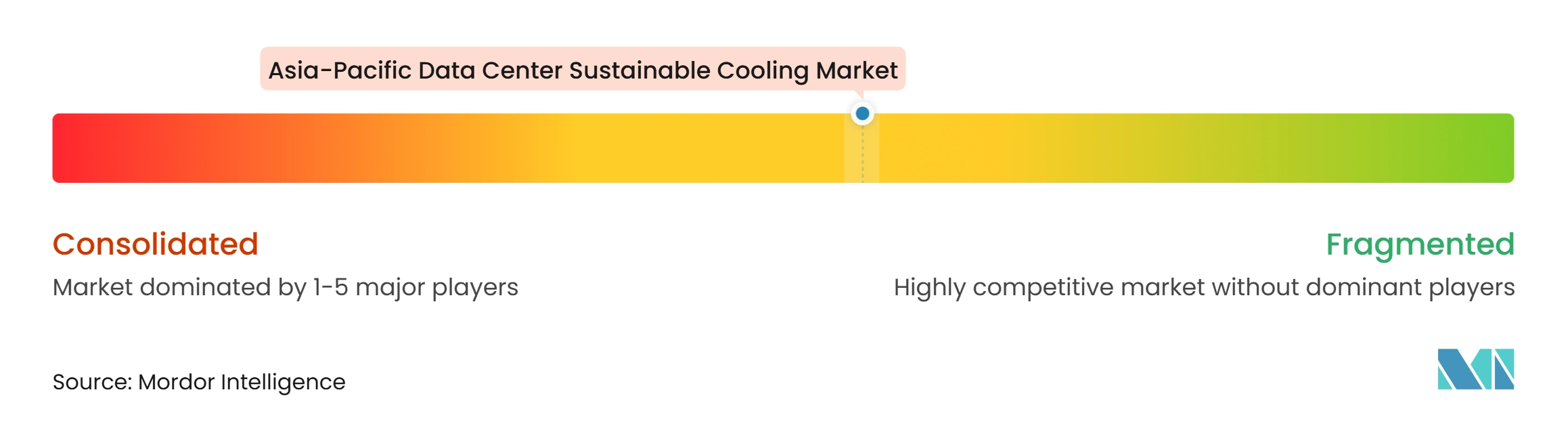
The Asia-Pacific data center sustainable cooling market is moderately fragmented across individual technologies, but portfolio consolidation is increasing. Established equipment providers are adding liquid cooling capability so that they can offer complete thermal systems. Schneider Electric completed a controlling 75% investment in Motivair in February 2025. It later introduced an integrated portfolio that includes CDUs, rear-door heat exchangers, cold plates, chillers, and technology cooling system loops. This approach reduces integration work for data center operators sourcing multiple elements of a cooling system. Trane Technologies completed its acquisition of LiquidStack in March 2026, adding direct-to-chip distribution and immersion cooling to its portfolio. The transaction strengthened its position across heat rejection and precision cooling. Patent activity in manifold systems and immersion fluid design also indicates that application engineering is becoming more important as deployments move beyond pilots.
Ecolab closed its acquisition of CoolIT Systems in July 2026 for USD 4.75 billion. The acquisition brings coolant chemistry, water treatment, fluid management, and liquid cooling equipment into a broader offering. CoolIT’s sales had increased by more than 100% year to date at the time of closing. Vertiv is increasing manufacturing and testing capacity for AI-ready cooling systems, reflecting the need for reliable supply and validation for high-density applications. These moves show that the leading companies are competing through combined equipment portfolios, deployment support, and lifecycle service capability. The competitive focus is shifting from individual products to the ability to manage the whole thermal chain. This favors companies that can coordinate hardware, controls, fluids, and local service resources.
Open opportunities remain in factory-integrated modules for edge and smaller data centers. These sites need equipment that can operate in outdoor and industrial conditions, yet much supplier investment remains directed at hyperscale facilities. Delta Electronics and Mitsubishi Electric combine precision air cooling with expanding liquid cooling portfolios across the region. Grundfos and Xylem can apply pumping and fluid distribution expertise to primary cooling loops and coolant management. Munters retains a relevant position in adiabatic and evaporative cooling applications, especially where climate supports extended free cooling. Regional manufacturers in China, South Korea, and Taiwan also benefit from proximity to domestic supply chains and local customer needs. Their presence reinforces the need for established suppliers to pair broad portfolios with responsive engineering, reliable local service, and equipment configured for regional site conditions.
Asia-Pacific Data Center Sustainable Cooling Industry Leaders
-
Schneider Electric SE
-
Vertiv Group Corp.
-
Johnson Controls International plc
-
STULZ GmbH
-
Rittal GmbH & Co. KG
- *Disclaimer: Major Players sorted in no particular order
Asia-Pacific Data Center Sustainable Cooling Market Companies Covered in this Report
- Schneider Electric SE
- Vertiv Group Corp.
- Johnson Controls International plc
- STULZ GmbH
- Rittal GmbH & Co. KG
- Mitsubishi Electric Corporation
- Huawei Digital Power Technologies Co., Ltd.
- Daikin Industries, Ltd.
- Delta Electronics, Inc.
- Munters AB
- Trane Technologies plc
- CoolIT Systems, Inc.
- Submer Technologies, S.L.
- Iceotope Technologies Ltd.
- Green Revolution Cooling, Inc.
- Alfa Laval AB
- Grundfos Holding A/S
- Xylem Inc.
- NTT Facilities, Inc.
- Fujitsu Limited
Recent Industry Developments in Asia-Pacific Data Center Sustainable Cooling Market
- October 2026: Vertiv completed India's first high-density direct-to-chip liquid-cooling deployment at CLDC Mumbai 01 in Navi Mumbai. The installation uses Vertiv's Secondary Fluid Network (SFN) system to support 30 MW of AI workloads. The project also involved development of local manufacturing capabilities for customized cooling-loop skids, strengthening India's supply capabilities for high-density data-center cooling.
- July 2026: Vertiv announced investments at its Tognana campus near Padua, Italy, expected to double chiller production capacity by the end of 2026 and establish a large-scale integrated testing laboratory for validating chiller and liquid cooling system performance under high-density conditions. Laboratory completion is planned for early 2027.
- July 2026: Ecolab closed its acquisition of CoolIT Systems for USD 4.75 billion on July 2, 2026. CoolIT’s year-to-date sales had increased by more than 100% before closing, driven by AI data center direct-to-chip liquid cooling demand, and the company was projected to generate USD 550 million in sales over the 12 months following the announcement.
- May 2026: Daikin Holdings Singapore and Delta Electronics signed an MoU to jointly develop next-generation Coolant Distribution Unit (CDU) solutions for AI and HPC data centers across ASEAN and Oceania. The partnership combines Daikin's facility-level cooling expertise with Delta's server-side liquid-cooling technologies, targeting rack power densities from 100 kW to 3,000 kW.
Asia-Pacific Data Center Sustainable Cooling Market Report Scope
The Asia-Pacific Data Center Sustainable Cooling Market refers to the regional market for energy-efficient, low-carbon, and water-conscious cooling technologies, systems, and services designed to manage thermal loads in data centers across Asia-Pacific while minimizing environmental impact, covering liquid cooling (direct-to-chip, immersion, rear-door heat exchangers), free/air-side economization, evaporative and adiabatic cooling, low-GWP refrigerant chillers, waste-heat recovery, AI-driven thermal optimization, and water-efficient closed-loop systems.
The Asia-Pacific Data Center Sustainable Cooling Market Report is Segmented by Cooling Technology (Air-Based Cooling, Direct-to-Chip Liquid Cooling, Immersion Cooling, Rear-Door Heat Exchangers, Evaporative and Adiabatic Cooling, Free Cooling and Economizer Systems, and Other Sustainable Cooling Technologies), Heat Rejection Technology (Air-Cooled Systems, Water-Cooled Systems, Evaporative Heat Rejection, Dry Coolers, and Hybrid Heat Rejection Systems), Cooling System Component (Cooling Distribution Units (CDUs), Chillers, Cooling Towers, Heat Exchangers, Pumps and Fluid Distribution Systems, Fans and Air Handling Equipment, and Cooling Controls and Monitoring Systems), Sustainability Approach (Energy-Efficient Cooling, Water-Efficient Cooling, Low-Global-Warming-Potential Refrigerant Solutions, Heat Recovery-Enabled Cooling, and Integrated Cooling Optimization and Controls), Data Center Size (Small, Medium, Large, and Hyperscale), Data Center Type (Colocation, Cloud Service Providers (CSPs), and Enterprise and Edge), and Geography (China, India, Japan, Australia, Singapore, South Korea, Malaysia, Indonesia, and Rest of Asia-Pacific). The Market Forecasts Are Provided in Terms of Value (USD).
Segmentation Overview
| Air-Based Cooling |
| Direct-to-Chip Liquid Cooling |
| Immersion Cooling |
| Rear-Door Heat Exchangers |
| Evaporative and Adiabatic Cooling |
| Free Cooling and Economizer Systems |
| Other Sustainable Cooling Technologies |
| Air-Cooled Systems |
| Water-Cooled Systems |
| Evaporative Heat Rejection |
| Dry Coolers |
| Hybrid Heat Rejection Systems |
| Cooling Distribution Units (CDUs) |
| Chillers |
| Cooling Towers |
| Heat Exchangers |
| Pumps and Fluid Distribution Systems |
| Fans and Air Handling Equipment |
| Cooling Controls and Monitoring Systems |
| Energy-Efficient Cooling |
| Water-Efficient Cooling |
| Low-Global-Warming-Potential Refrigerant Solutions |
| Heat Recovery-Enabled Cooling |
| Integrated Cooling Optimization and Controls |
| Small |
| Medium |
| Large |
| Hyperscale |
| Colocation |
| Cloud Service Providers (CSPs) |
| Enterprise and Edge |
| China |
| India |
| Japan |
| Australia |
| Singapore |
| South Korea |
| Malaysia |
| Indonesia |
| Rest of Asia-Pacific |
| By Cooling Technology | Air-Based Cooling |
| Direct-to-Chip Liquid Cooling | |
| Immersion Cooling | |
| Rear-Door Heat Exchangers | |
| Evaporative and Adiabatic Cooling | |
| Free Cooling and Economizer Systems | |
| Other Sustainable Cooling Technologies | |
| By Heat Rejection Technology | Air-Cooled Systems |
| Water-Cooled Systems | |
| Evaporative Heat Rejection | |
| Dry Coolers | |
| Hybrid Heat Rejection Systems | |
| By Cooling System Component | Cooling Distribution Units (CDUs) |
| Chillers | |
| Cooling Towers | |
| Heat Exchangers | |
| Pumps and Fluid Distribution Systems | |
| Fans and Air Handling Equipment | |
| Cooling Controls and Monitoring Systems | |
| By Sustainability Approach | Energy-Efficient Cooling |
| Water-Efficient Cooling | |
| Low-Global-Warming-Potential Refrigerant Solutions | |
| Heat Recovery-Enabled Cooling | |
| Integrated Cooling Optimization and Controls | |
| By Data Center Size | Small |
| Medium | |
| Large | |
| Hyperscale | |
| By Data Center Type | Colocation |
| Cloud Service Providers (CSPs) | |
| Enterprise and Edge | |
| By Geography | China |
| India | |
| Japan | |
| Australia | |
| Singapore | |
| South Korea | |
| Malaysia | |
| Indonesia | |
| Rest of Asia-Pacific |
Key Questions Answered in the Report
What is the Asia-Pacific data center sustainable cooling market size?
The market size is USD 4.68 billion in 2026 and is estimated at USD 5.34 billion in 2027. It is forecast to reach USD 10.03 billion by 2032 at a 13.44% CAGR.
What is driving demand for sustainable data center cooling in Asia-Pacific?
AI and high-performance computing are increasing rack heat loads, while PUE, WUE, and low-carbon requirements are tightening design standards.
Which cooling technology leads the Asia-Pacific data center sustainable cooling market?
Air-based cooling leads with a 45.94% share in 2026 because of its extensive installed base, although direct-to-chip liquid cooling is the fastest-growing technology.
Why are cooling distribution units important for AI data centers?
CDUs connect facility water loops and rack-level cold plates. They are necessary for most direct-to-chip liquid-cooling designs and are projected to expand at a 13.84% CAGR through 2032.
Which country has the largest share of sustainable cooling demand in Asia-Pacific?
China leads with a 34.62% share in 2026, supported by AI clusters, national hub development, and stricter efficiency requirements.
Which geography is expected to expand fastest through 2032?
India is projected to expand at a 13.94% CAGR, supported by hyperscale development, new AI campuses, and expanding local cooling capability.