
Asia-Pacific Data Center Security Services Market Size and Share
Market Overview
| Study Period | 2021 - 2032 |
|---|---|
| Forecast Data Period | 2027 - 2032 |
| Base Year Market Size (2026) | USD 1.24 Billion |
| Market Size (2027) | USD 1.44 Billion |
| Market Size (2032) | USD 3.02 Billion |
| Growth Rate (2027 - 2032) | 15.97 % |
| Market Concentration | Medium |
Major Players *Disclaimer: Major Players sorted in no particular order Image © Mordor Intelligence. Reuse requires attribution under CC BY 4.0. | |
Asia-Pacific Data Center Security Services Market Analysis by Mordor Intelligence
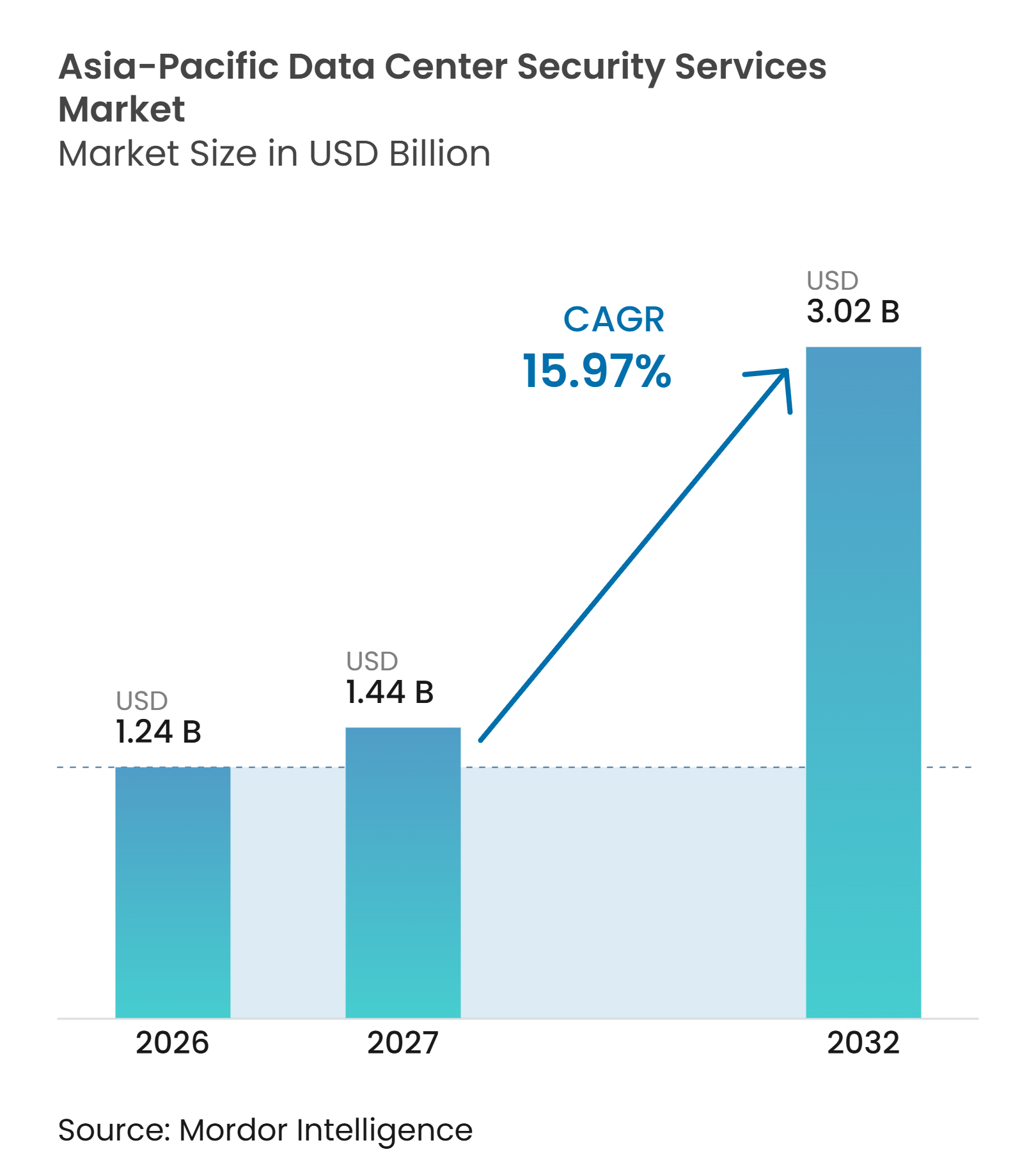
The Asia-Pacific data center security services market size was valued at USD 1.24 billion in 2026 and is estimated to grow from USD 1.44 billion in 2027 to reach USD 3.02 billion by 2032, at a CAGR of 15.97% during the forecast period (2027-2032). A record development pipeline is increasing the number of facilities that need security planning before they begin operations. Data localization rules in China, India, Vietnam, and Indonesia are making documented physical controls and recurring audits more important for operators. AI workloads are also increasing the need to connect access events, environmental monitoring, and network alerts in the same operating model. Providers that can support several locations with consistent service levels are better placed to win regional contracts. The Asia-Pacific data center security services market is therefore moving toward managed, hybrid security models that combine automated monitoring with credentialed on-site support.
Key Report Takeaways
- By service type, manned guarding and physical security held 29.71% of the Asia-Pacific data center security services market share in 2026, while security operations center services are projected to expand at a 16.26% CAGR through 2032.
- By service delivery model, on-site security services accounted for 44.28% in 2026, while remote and centralized security services are projected to expand at a 16.92% CAGR through 2032.
- By contract type, dedicated site-level contracts held 38.74% in 2026, while managed service agreements are projected to expand at a 17.36% CAGR through 2032.
- By customer type, colocation providers accounted for 46.54% in 2026, while cloud service providers are projected to expand at an 18.59% CAGR through 2032.
- By data center size, hyperscale facilities accounted for 41.64% in 2026 and are projected to expand at a 17.27% CAGR through 2032.
- By geography, China held 37.64% in the Asia-Pacific data center security services market revenue in 2026, while India is projected to expand at a 19.86% CAGR through 2032.
Note: Market numbers in this report are based on Mordor Intelligence's proprietary estimation framework, which combines nine months of actuals with Q4 projections for base year 2026.
Market Trends and Insights
Drivers Impact Analysis of Asia-Pacific Data Center Security Services Market*
| Driver | (~) % Impact on CAGR Forecast | Geographic Relevance | Impact Timeline |
|---|---|---|---|
| Hyperscale and Colocation Capacity Expansion | +3.5% | Global, led by China, India, Malaysia, Singapore | Short term (≤ 2 years) |
| Cloud, AI, and 5G Data Growth | +3.2% | Global, concentrated in Asia-Pacific hyperscale hubs | Short term (≤ 2 years) |
| Escalating Cyber-Physical Attack Surface | +2.8% | Global, Asia-Pacific as a high-frequency attack region | Medium term (2-4 years) |
| Stricter Data Sovereignty and Critical Infrastructure Rules | +2.5% | China, India, Vietnam, Indonesia, Singapore | Medium term (2-4 years) |
| AI-Assisted Video Analytics and Biometric Access Adoption | +2.1% | Asia-Pacific core, expanding to Southeast Asia and India | Medium term (2-4 years) |
| Submarine Cable and Edge Site Proliferation | +1.5% | Indo-Pacific, with Japan, Singapore, and Australia as focal nodes | Long term (≥ 4 years) |
| Source: Mordor Intelligence | |||
Hyperscale and Colocation Capacity Expansion
Asia-Pacific data center construction is raising the need for security services at the same time as facilities are designed and equipped. The regional development pipeline reached 26.5 GW in the first half of 2026, including 4.8 GW under active construction and a wide range of projects moving through planning and fit-out stages. Operators increasingly procure multi-site security coverage before a site opens, rather than arranging a separate local service contract later, after operational risks and customer requirements are already established. This approach favors providers that can apply the same access, response, and audit procedures across several jurisdictions. Colocation providers held 46.54% of customer demand in 2026 because multi-tenant sites need detailed credentials and visitor controls. The Asia-Pacific data center security services market gains from this shift because security becomes part of a facility launch plan rather than a later operational purchase.
Cloud, AI, and 5G Data Growth
AI workloads are changing the physical and digital risk profile of data centers across the region because dense computing systems bring operational technology, power systems, and controlled access into the same risk environment. Dense computing environments require closer monitoring of power distribution, cooling equipment, access activity, and network events. Security operations center tools can bring these inputs into a single process, reducing the gap between an anomaly and a response decision while giving operators a clearer record of how an event was handled. Cloud service providers are projected to expand at an 18.59% CAGR through 2032, which supports demand for services that integrate access logs with operational telemetry. Automated alert triage can also direct scarce analyst capacity toward incidents that need human review. These operating needs are pushing the Asia-Pacific data center security services market toward outcome-based managed service agreements.
Escalating Cyber-Physical Attack Surface
Physical and digital threats now create connected risks for data center operators. INTERPOL recorded more than 6.5 billion cyber threats across Asia and the South Pacific during 2024, showing the scale of the regional threat environment.[1] The 2024 ransomware attack on Indonesia's National Data Center disrupted more than 280 government services, which demonstrated how an infrastructure incident can affect public operations. Large facilities also face perimeter risks that can affect several availability zones at once. Operators are responding by linking access records, surveillance, and network monitoring instead of treating them as separate functions. This creates demand for security operations center services and integrated response procedures within the Asia-Pacific data center security services market.
Stricter Data Sovereignty and Critical Infrastructure Rules
Data localization and critical infrastructure rules are making verifiable security controls a recurring operating requirement. China's Ministry of Industry and Information Technology required IDC operators to strengthen physical machine room safeguards, access controls, data classification, and incident response capabilities in 2025.[2] These obligations increase the need for audit records, specialist assessment support, and evidence that access, incident, and data-handling procedures were consistently followed. India's data center investment pipeline exceeded USD 180 billion in announced commitments by September 2026, increasing the number of facilities subject to local compliance expectations. Vietnam and Indonesia are also expanding local data and infrastructure requirements, which create distinct compliance needs by country. The Asia-Pacific data center security services industry benefits when suppliers can adapt operating procedures to each national framework.
Restraints Impact Analysis of Asia-Pacific Data Center Security Services Market*
| Restraint | (~) % Impact on CAGR Forecast | Geographic Relevance | Impact Timeline |
|---|---|---|---|
| High Upfront Integration and Retrofit Costs | -2.2% | Global, most acute in legacy facilities in Japan and Australia | Short term (≤ 2 years) |
| Shortage of Security Engineering and SOC Talent | -1.8% | Asia-Pacific-wide, most severe in Japan, Southeast Asia, and India growth markets | Medium term (2-4 years) |
| Fragmented National Compliance Requirements | -1.6% | Asia-Pacific core, with spillover to cross-border operators | Medium term (2-4 years) |
| Buyer Trust and Liability Concerns Around Autonomous Security Actions | -1.0% | Global, Asia-Pacific enterprise segment | Long term (≥ 4 years) |
| Source: Mordor Intelligence | |||
High Upfront Integration and Retrofit Costs
Modern security platforms can be costly to add to data centers built before 2020. Legacy sites in Japan, South Korea, and Australia often use proprietary building management systems that need custom middleware, careful testing, and close coordination between facilities and security teams. Engineering and licensing can account for 30-40% of a retrofit contract value. Each project can therefore have a longer sales cycle than a comparable greenfield installation. The lack of a unified physical security interoperability standard across the region leaves many retrofits as custom engineering work. Pre-integrated platforms with standard application programming interfaces can reduce this burden and strengthen a vendor's position in the Asia-Pacific data center security services market.
Shortage of Security Engineering and SOC Talent
The limited supply of security engineers and security operations center analysts constrains service delivery in several fast-expanding locations. Many operators have difficulty finding personnel who can configure video analytics, correlate cyber-physical events, and interpret different national compliance rules. This gap raises delivery costs for staffing-led providers, can slow new site mobilization, and makes it harder to maintain uniform response quality across a regional portfolio. It also makes outsourced monitoring more appealing, where a provider can spread specialist capacity across several customers. NTT DATA launched 4 autonomous AI-powered Cyber Defense Centers in India during December 2025, adding capacity for more than 800 security analysts. The shortage supports managed service adoption, even as it limits the availability of qualified personnel across the Asia-Pacific data center security services market.
*Our forecasts treat driver/restraint impacts as directional, not additive. The impact forecasts reflect baseline growth, mix effects, and variable interactions.
Asia-Pacific Data Center Security Services Market Segment Analysis
By Service Type:
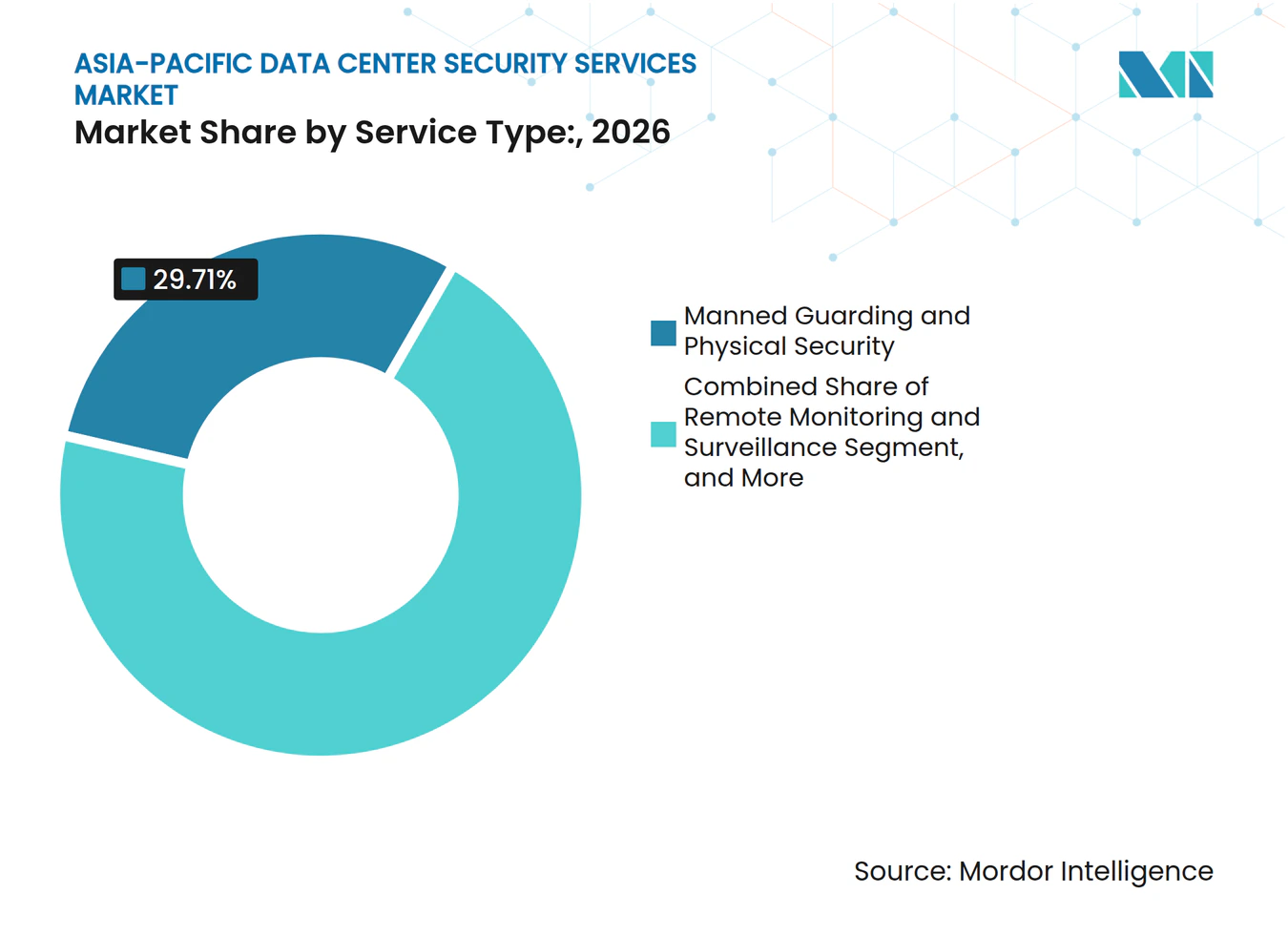
SOC Services Shift Demand Beyond Labor-Led ProtectionManned guarding and physical security led with 29.71% of the Asia-Pacific data center security services market share in 2026. Its position reflects the need for documented physical access governance in defense-in-depth security architectures. China and Southeast Asia place particular importance on credentialed personnel at sensitive sites. Security operations center services are projected to expand at a 16.26% CAGR through 2032. The segment addresses sequences that perimeter staffing may not identify, such as a building management system compromise before an attempted physical intrusion.
Security risk assessment and consulting also benefit when new rules require regular reviews of data controls, physical safeguards, access practices, incident processes, contractor responsibilities, and the evidence used to demonstrate compliance. ISO/IEC 27001 requirements for documented response procedures and access-control audits can support contract renewals. Access control and visitor management services increasingly feed behavioral analytics tools that identify unusual movement, repeated access attempts, and activity outside approved operating patterns. Security system maintenance and support provide recurring activity that supports larger managed service programs, including routine testing, software updates, device health checks, and the timely resolution of faults that could weaken facility protection. Genetec and Dataminr announced a September 2025 collaboration that integrated real-time risk intelligence into the Genetec Security Center platform.[3] The arrangement shows why the boundary between remote monitoring and security operations center services is becoming less distinct in the Asia-Pacific data center security services market.



By Service Delivery Model:
Hybrid Services Build on On-Site RequirementsOn-site security services accounted for 44.28% of the Asia-Pacific data center security services market size in 2026. This model supports facilities that need physical safeguards and records that can be reviewed during an audit. On-site teams also remain important where facility rules require a documented chain of custody for people and equipment, especially during equipment deliveries, maintenance work, visitor entry, and access to restricted data hall areas. Remote and centralized security services are projected to expand at a 16.92% CAGR through 2032. Secondary locations such as Johor, Bangkok, and Noida can use regional monitoring hubs where local specialist staffing is limited.
Hybrid security services appeal to enterprise facilities that cannot support full 24-hour guarding but still need documented oversight for sensitive rooms, equipment, contractors, and visitors. They combine remote video and alarm oversight with planned on-site inspections and credentialed responses, helping operators maintain visibility across smaller facilities without duplicating every specialist role at each location. AI-assisted video analytics can identify tailgating, unauthorized cabinet access, and unusual movement in near real time. This reduces the operational gap between hybrid and fully on-site models by allowing a regional team to review events, direct local action, and retain a documented record for customer and regulatory review. As these systems improve, more contract value can move toward centralized monitoring. The Asia-Pacific data center security services market is likely to retain on-site delivery for high-risk areas while using hybrid models to manage coverage across wider footprints.
By Contract Type:
Managed Agreements Change the Revenue ModelDedicated site-level contracts held 38.74% of the Asia-Pacific data center security services market share in 2026. Single-facility colocation and enterprise sites in China and Japan often use this procurement structure. The arrangement gives operators direct control over local requirements, personnel, and response procedures. Managed service agreements are projected to expand at a 17.36% CAGR through 2032. Operators value recurring cost visibility and service levels that are tied to defined outcomes, particularly when new capacity is being added faster than internal security teams can be expanded.
Multi-site and regional contracts are becoming more relevant where hyperscale facilities cluster around Johor-Singapore and Mumbai-Pune. These contracts reward suppliers that can maintain a common operating standard across several locations, including aligned staffing checks, escalation procedures, reporting formats, access policies, and audit records. Integrated service contracts can combine guarding, surveillance, security operations center functions, consulting, system maintenance, and access management under a common service framework and accountability model. They have high contract values because replacing one element can disrupt the wider security model, interrupt familiar workflows, and require a customer to recreate connected records, technology settings, and service responsibilities. Once systems, personnel procedures, and audit records are connected, retendering can be difficult. This gives integrated suppliers a stronger position in the Asia-Pacific data center security services market.
By Customer Type:
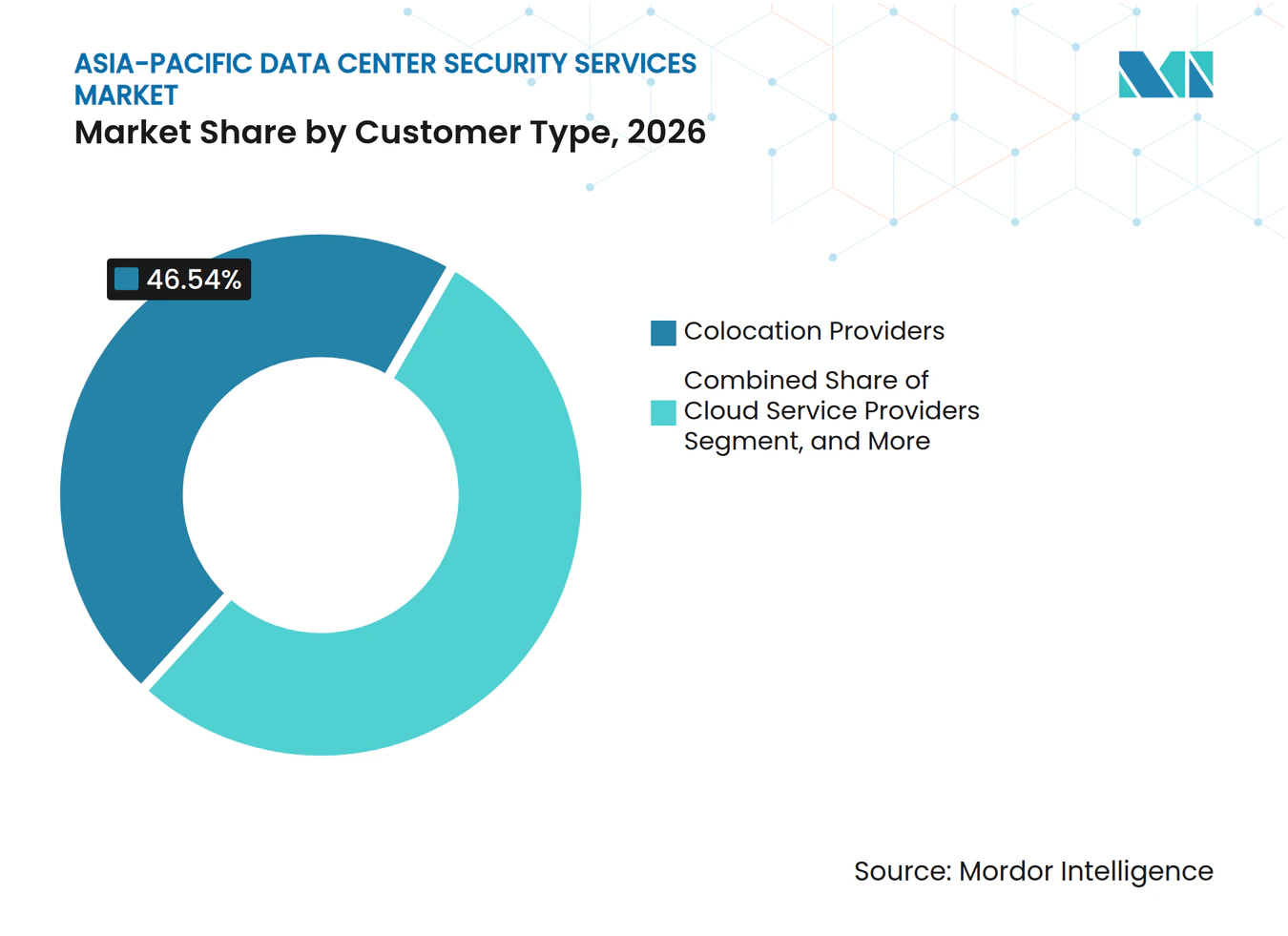
Colocation Demand Supports Volume While Cloud Providers Expand FasterColocation providers accounted for 46.54% of the Asia-Pacific data center security services market size in 2026. Multi-tenant facilities need configurable credentials, visitor records, and access rights for separate customers. Their security model must balance common site protection with controls that preserve tenant separation. Cloud service providers are projected to expand at an 18.59% CAGR through 2032. Their facilities increasingly need physical access events, thermal anomaly data, network alerts, and response documentation in a single analytical system that can support rapid investigation.
Enterprise and edge data center operators form a separate customer group that includes financial services, government, and healthcare organizations. These entities may build sovereign edge nodes to meet data residency needs, support latency-sensitive workloads, keep critical services closer to users, and maintain control over regulated information. Smaller internal teams can make fully outsourced managed service agreements the practical option because these arrangements offer trained personnel, formal escalation paths, recurring compliance reporting, and continuous monitoring without a large internal buildout. NTT DATA's December 2025 Cyber Defense Center expansion in India provides a scaled delivery model for this type of customer.[4] The Asia-Pacific data center security services market therefore has opportunities at both large cloud campuses and dispersed edge locations. Vendors must adapt the same core controls to customers with very different operating resources.

By Data Center Size:
Hyperscale Sites Create High-Value Security RequirementsHyperscale facilities held 41.64% of the Asia-Pacific data center security services market size in 2026 and are projected to expand at a 17.27% CAGR through 2032. This is the only size category that holds both the largest share and the highest projected expansion rate. Facilities exceeding 100 MW require layered protection around the perimeter, building, data hall, and rack, with clear rules for contractor access, equipment delivery, and incident escalation. They also require physical access information to work alongside network telemetry, environmental alarms, equipment status, and response workflows that provide a complete view of an event. These needs set a high qualification threshold for suppliers.
Small data centers and sovereign edge nodes add demand across locations that previously relied on centralized cloud capacity. Vietnam and Indonesia are relevant examples because localized data requirements encourage local infrastructure. Tier IV and ISO/IEC 27001 requirements can limit eligibility to providers with audit and certification capabilities, formal incident procedures, documented access controls, and experience working with critical facility operations. This favors established integrators with regional delivery coverage, while giving specialized local providers opportunities where they can offer certified staff and reliable support at a lower operating cost. At the same time, smaller sites need flexible services that do not rely on a large permanent guard force. The Asia-Pacific data center security services industry therefore needs suppliers that can serve both concentrated hyperscale campuses and distributed edge portfolios.
Geography Analysis
China
China accounted for 37.64% of the Asia-Pacific data center security services market share in 2026. Its lead reflects large data center infrastructure, a layered set of local compliance requirements, and an operating environment where documentation is central to critical infrastructure oversight. The 2025 Ministry of Industry and Information Technology notice requires IDC operators to implement physical safeguards, access controls, data classification, and structured incident response. Contracts must therefore accommodate China-specific audit practices and documentation, including how personnel access, facility safeguards, incident handling, and customer data responsibilities are recorded and reviewed. Domestic providers have an advantage where deep regulatory familiarity is a purchasing requirement.
India
India is projected to expand at a 19.86% CAGR through 2032, the fastest country-level rate in the Asia-Pacific data center security services market. Announced data center investment commitments exceeded USD 180 billion by September 2026. The country's capacity buildout raises the potential cost of security gaps at new facilities because operators must establish reliable procedures while capacity, customer workloads, tenant needs, and compliance expectations expand. NTT DATA established Cyber Defense Centers in Bengaluru, Hyderabad, Noida, and Mumbai in 2025. Godrej Enterprises Group also received a mandate in 2026 to deploy key management on Genetec Security Center across multiple Indian data center facilities.
Rest of the Asia-Pacific
Singapore remains an important regional hub for operators managing cross-border activity, regional monitoring, and shared service delivery for facilities across Southeast Asia. Japan's planned national certification system will create a security review requirement for facilities that serve regulated sectors, while its cybersecurity skills gap supports outsourced security operations center adoption. Vietnam and Indonesia create compliance-led demand as local data requirements expand, while Australia and South Korea remain premium markets for integrated platforms aligned with ISO/IEC 27001 practices. Together, these countries give the Asia-Pacific data center security services market a varied demand base that requires localized compliance, regional monitoring, and consistent service standards.
Competitive Landscape
Market Concentration
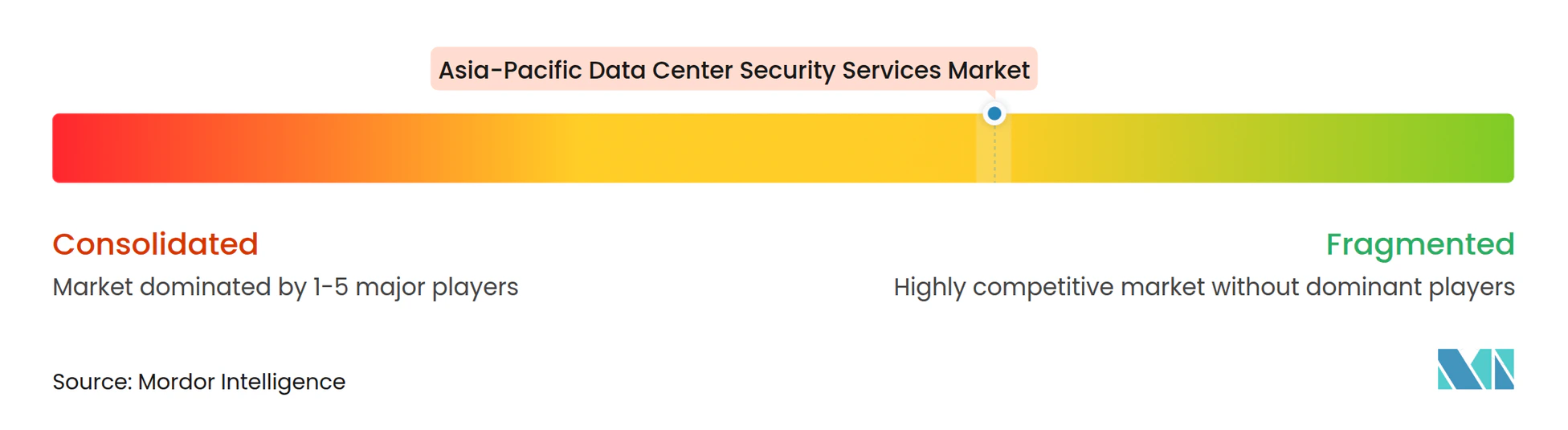
The Asia-Pacific data center security services market is moderately fragmented because global integrators, cybersecurity vendors, and regional specialists serve different parts of the value chain. Securitas Technology, Convergint Technologies, and Johnson Controls compete on integrated physical security, multi-site delivery, audit support, and the ability to mobilize consistent teams across several national markets. Palo Alto Networks, Fortinet, and NTT DATA extend security operations center and platform capabilities into data center environments. Suprema, Genetec, and NEC hold specialist positions in biometrics, unified security software, and AI-based surveillance. No supplier is positioned as the leading provider across every security service category and country, since local rules, technology choices, facility types, and staffing availability differ widely across the region.
Securitas launched its Global Clients Data Center Group in July 2025 to standardize technology-integrated security programs across 570 facilities in 36 countries. Palo Alto Networks introduced local Prisma AIRS availability in Singapore in March 2026 and Japan in June 2026, supporting data-residency needs for AI security deployments. Fortinet announced its Secure AI Data Center framework in November 2025, combining a high-capacity firewall platform with AI infrastructure security. These actions show how vendors are connecting facility protection with cloud, network, and security operations center capabilities, while also seeking to meet local data-residency needs and the specific operational requirements of dense AI environments. The Asia-Pacific data center security services market rewards vendors that can integrate these capabilities without making the operating model difficult for the customer.
Regional suppliers have durable roles where language, national rules, public-sector relationships, and established delivery networks are central to contract decisions. NTT DATA pairs local compliance experience with AI-assisted security operations center services in India. Suprema, Genetec, and NEC have defensible positions where their platforms must connect with regional certification standards. Mid-market enterprise and edge operators remain an opening for regional managed security service providers. These customers need outcome-based agreements but may not need the full bundled model offered by the largest integrators, creating room for providers that combine established technology partnerships with local service teams and transparent pricing.
Asia-Pacific Data Center Security Services Industry Leaders
-
Axis Communications AB
-
Zhejiang Dahua Technology Co., Ltd.
-
Securitas Technology
-
Bosch Sicherheitssysteme GmbH
-
Johnson Controls International
- *Disclaimer: Major Players sorted in no particular order
Asia-Pacific Data Center Security Services Market Companies Covered in this Report
- Axis Communications AB
- Zhejiang Dahua Technology Co., Ltd.
- Securitas Technology
- Bosch Sicherheitssysteme GmbH
- Johnson Controls International
- Honeywell International Inc.
- Schneider Electric SE
- Convergint Technologies LLC
- ASSA ABLOY AB
- Cisco Systems, Inc.
- ABB Ltd
- International Business Machines Corporation
- Hewlett Packard Enterprise Development LP
- Fortinet, Inc.
- Check Point Software Technologies Ltd.
- Microsoft Corporation
- Amazon Web Services, Inc.
- Palo Alto Networks, Inc.
- Trend Micro Incorporated
- NEC Corporation
- NTT DATA Corporation
- Suprema Inc.
- Genetec Inc.
- Huawei Technologies Co., Ltd.
Recent Industry Developments in Asia-Pacific Data Center Security Services Market
- October 2026: Japan's MIC and METI announced a national certification system for data centers and cloud services, effective from fiscal year 2027, requiring facilities serving finance and healthcare to pass security screening on risk management and equipment procurement. The initiative expands the compliance audit services market and is designed to structurally exclude infrastructure linked to geopolitical risk entities.
- August 2026: China's Cyberspace Administration, MIIT, and Ministry of Public Security jointly promulgated the Measures for Network Data Security Risk Assessment, effective August 20, 2026, institutionalizing mandatory annual risk assessments for all important data processors and IDC operators. This directly expands the recurring billable scope of security risk assessment and consulting services across China's data center sector.
- August 2026: Godrej Enterprises Group won a mandate from Yotta and NTT Data Center to deploy an integrated key management solution on the Genetec Security Center platform across multiple Indian data center facilities, targeting INR 500 million (USD 6 million) in data center security revenue over 2 years.
- April 2026: Indonesia's Ministry of Communications and Information Technology and OJK issued final data localization rules for financial services and cloud operations, requiring primary storage of customer transaction and financial data within Indonesian territory. This obligates all regulated data center operators to maintain domestic on-site security and compliance infrastructure.
Asia-Pacific Data Center Security Services Market Report Scope
The Asia-Pacific data center security services market includes revenue from security services deployed in data centers across China, Japan, India, Singapore, Australia, and other Asia-Pacific countries. Rapid hyperscale and colocation expansion, AI infrastructure investment, edge data center growth, and increasing cyber-physical threat exposure are the primary market drivers.
The Asia-Pacific Data Center Security Services Market Report is Segmented by Service Type (Manned Guarding and Physical Security, Remote Monitoring and Surveillance, Security Operations Center Services, Security Risk Assessment and Consulting, Access Control and Visitor Management Services, and Security System Maintenance and Support), Service Delivery Model (On-Site Security Services, Remote and Centralized Security Services, and Hybrid Security Services), Contract Type (Dedicated Site-Level Contracts, Multi-Site and Regional Contracts, Integrated Security Service Contracts, and Managed Service Agreements), Customer Type (Colocation Providers, Cloud Service Providers (CSPs), and Enterprise / Edge Data Center Operators), Data Center Size (Small, Medium, Large, and Hyperscale), and Country (China, Japan, India, Singapore, and Rest of Asia-Pacific). The Market Forecasts are Provided in Terms of Value (USD).
Segmentation Overview
| Manned Guarding and Physical Security |
| Remote Monitoring and Surveillance |
| Security Operations Center Services |
| Security Risk Assessment and Consulting |
| Access Control and Visitor Management Services |
| Security System Maintenance and Support |
| On-Site Security Services |
| Remote and Centralized Security Services |
| Hybrid Security Services |
| Dedicated Site-Level Contracts |
| Multi-Site and Regional Contracts |
| Integrated Security Service Contracts |
| Managed Service Agreements |
| Colocation Providers |
| Cloud Service Providers (CSPs) |
| Enterprise / Edge Data Center Operators |
| Small |
| Medium |
| Large |
| Hyperscale |
| China |
| Japan |
| India |
| Singapore |
| Rest of Asia-Pacific |
| By Service Type | Manned Guarding and Physical Security |
| Remote Monitoring and Surveillance | |
| Security Operations Center Services | |
| Security Risk Assessment and Consulting | |
| Access Control and Visitor Management Services | |
| Security System Maintenance and Support | |
| By Service Delivery Model | On-Site Security Services |
| Remote and Centralized Security Services | |
| Hybrid Security Services | |
| By Contract Type | Dedicated Site-Level Contracts |
| Multi-Site and Regional Contracts | |
| Integrated Security Service Contracts | |
| Managed Service Agreements | |
| By Customer Type | Colocation Providers |
| Cloud Service Providers (CSPs) | |
| Enterprise / Edge Data Center Operators | |
| By Data Center Size | Small |
| Medium | |
| Large | |
| Hyperscale | |
| By Country | China |
| Japan | |
| India | |
| Singapore | |
| Rest of Asia-Pacific |
Key Questions Answered in the Report
What is the Asia-Pacific data center security services market size?
The Asia-Pacific data center security services market size was valued at USD 1.24 billion in 2026 and is estimated to grow from USD 1.44 billion in 2027 to reach USD 3.02 billion by 2032, at a CAGR of 15.97% during the forecast period (2027-2032).
Which service type leads demand in Asia-Pacific data centers?
Manned guarding and physical security leads with 29.71% in 2026 because critical facilities still need controlled physical access. Security operations center services have the fastest projected expansion at a 16.26% CAGR as operators bring surveillance, access, and network alerts into connected workflows.
Why are managed security agreements becoming more important for data center operators?
They give operators defined service levels and recurring cost visibility, while allowing specialized providers to manage continuous monitoring, incident documentation, and limited specialist talent across more than one site.
Which country has the fastest projected expansion in Asia-Pacific?
India is projected to expand at a 19.86% CAGR through 2032. Announced data center investment commitments exceeded USD 180 billion by September 2026, and localization requirements raise the need for documented security controls.
How do data localization rules affect security service demand?
They increase the need for local access controls, audit records, risk assessment, compliance support, and evidence that sensitive data and facility access are handled under country-specific requirements.
What role do hybrid models play in data center protection?
Hybrid models combine centralized monitoring with on-site inspections, helping operators cover distributed facilities without relying only on permanent guard teams. They are relevant when a facility needs auditable access procedures but cannot justify full 24-hour on-site staffing.