
Asia-Pacific Data Center Renewable Energy Market Size and Share
Market Overview
| Study Period | 2021 - 2032 |
|---|---|
| Forecast Data Period | 2027 - 2032 |
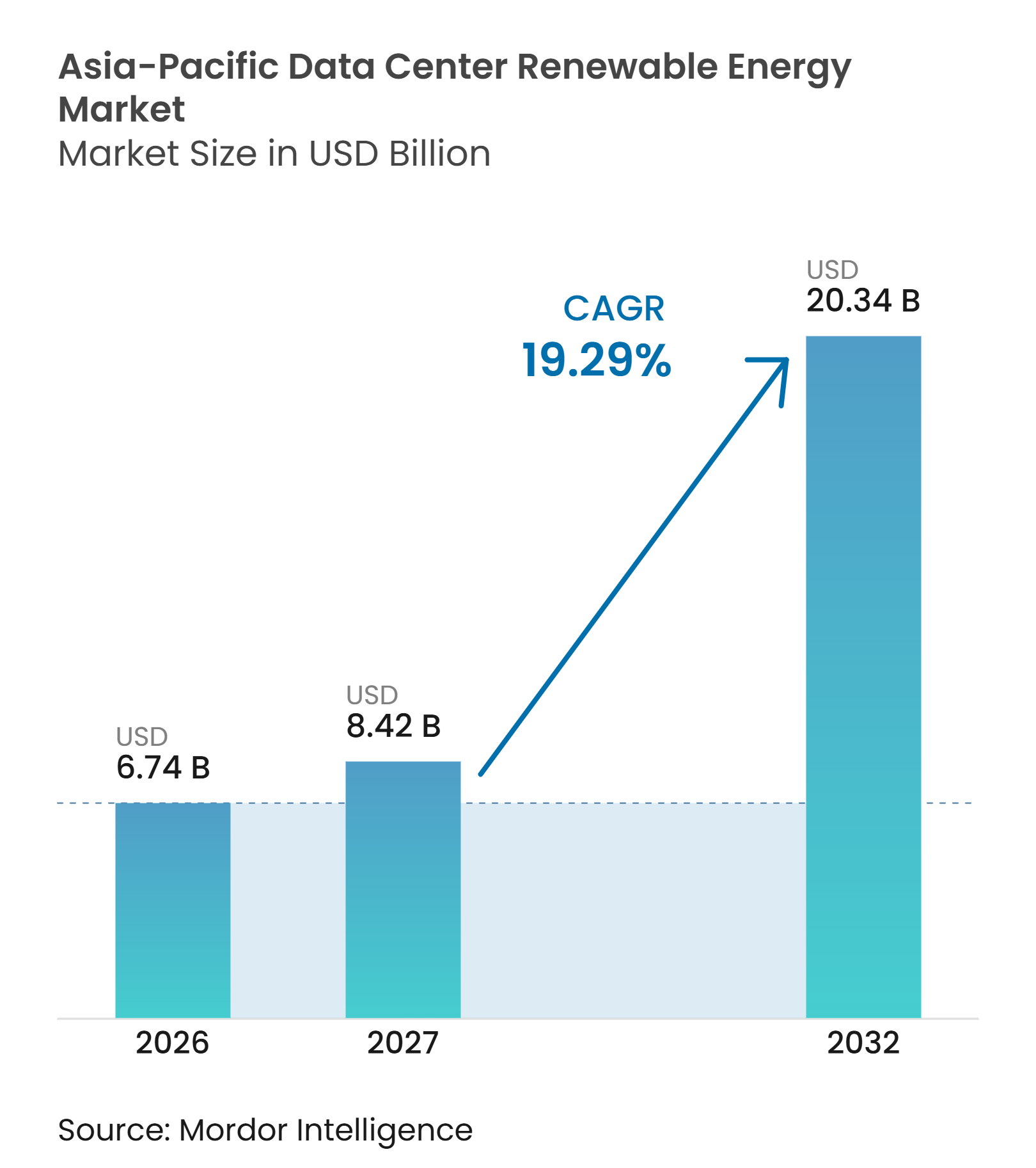
| Base Year Market Size (2026) | USD 6.74 Billion |
| Market Size (2027) | USD 8.42 Billion |
| Market Size (2032) | USD 20.34 Billion |
| Growth Rate (2027 - 2032) | 19.29 % |
| Market Concentration | Medium |
Major Players *Disclaimer: Major Players sorted in no particular order Image © Mordor Intelligence. Reuse requires attribution under CC BY 4.0. | |
Asia-Pacific Data Center Renewable Energy Market Analysis by Mordor Intelligence
The Asia-Pacific data center renewable energy market size is projected to expand from USD 6.74 billion in 2026 and USD 8.42 billion in 2027 to USD 20.34 billion by 2032, registering a CAGR of 19.29% between 2027 to 2032. Volume is projected to increase from 96,286 GWh in 2026 and 120,286 GWh in 2027 to 269,100 GWh by 2032, at a CAGR of 17.41%. Rising AI training and inference demand is increasing power density and makes dependable clean electricity central to site selection. Electricity demand is increasing faster than renewable supply in major regional data center locations, which raises the value of long-term power contracts and direct supply arrangements. Operators are moving beyond voluntary sustainability commitments because tenants, investors, and regulators increasingly require verifiable renewable coverage. The Asia-Pacific data center renewable energy market benefits from falling solar costs, wider corporate procurement options, and new storage projects, although grid connection delays, land constraints, and the cost of firmed power remain material limits on project execution.
Key Report Takeaways
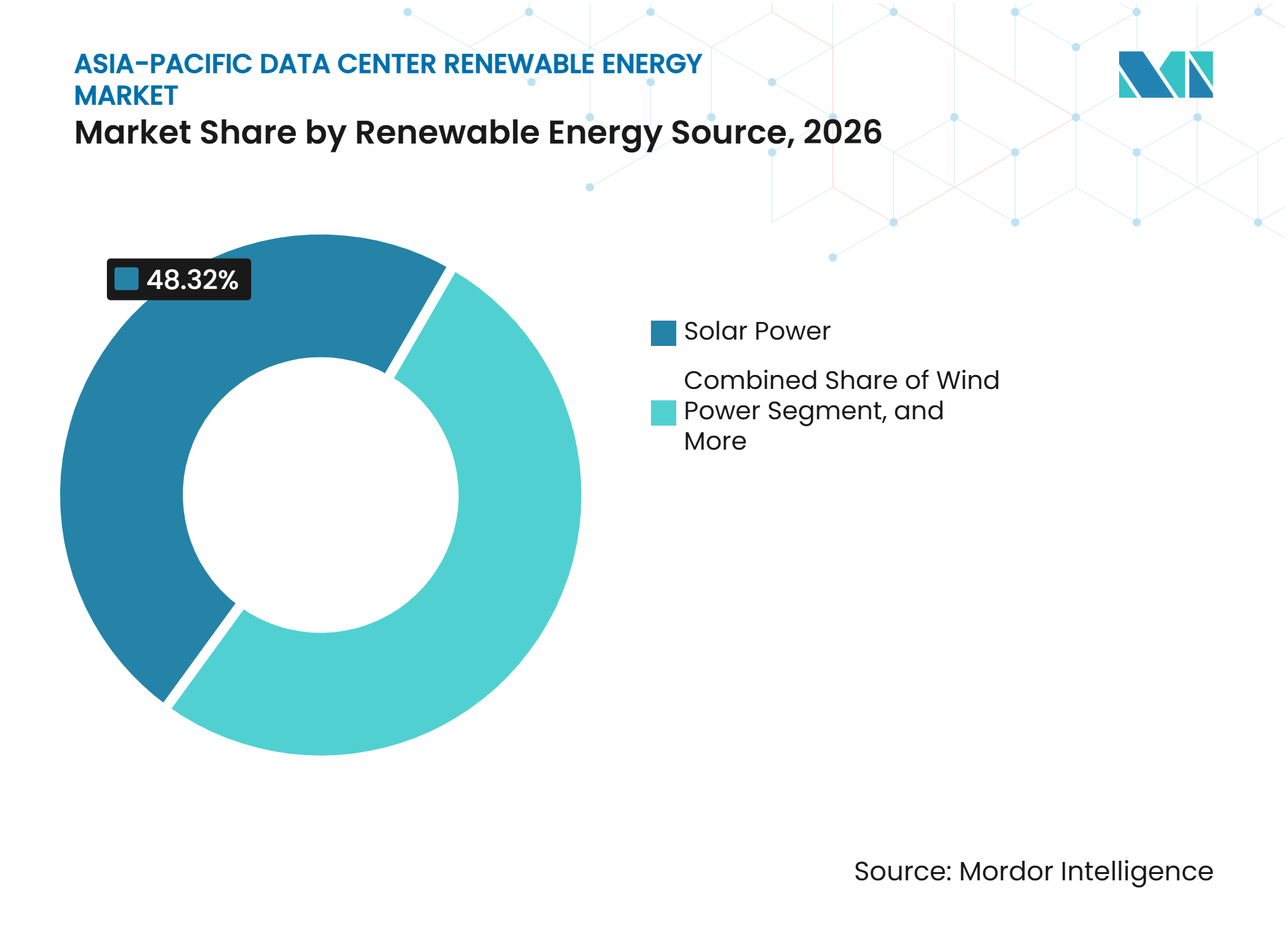
- Among renewable energy sources, solar power accounted for 48.31% of the Asia-Pacific data center renewable energy market share in 2026.
- By procurement model, virtual and financial PPAs held a 34.52% market share in 2026 and are projected to expand at a 20.38% CAGR through 2032.
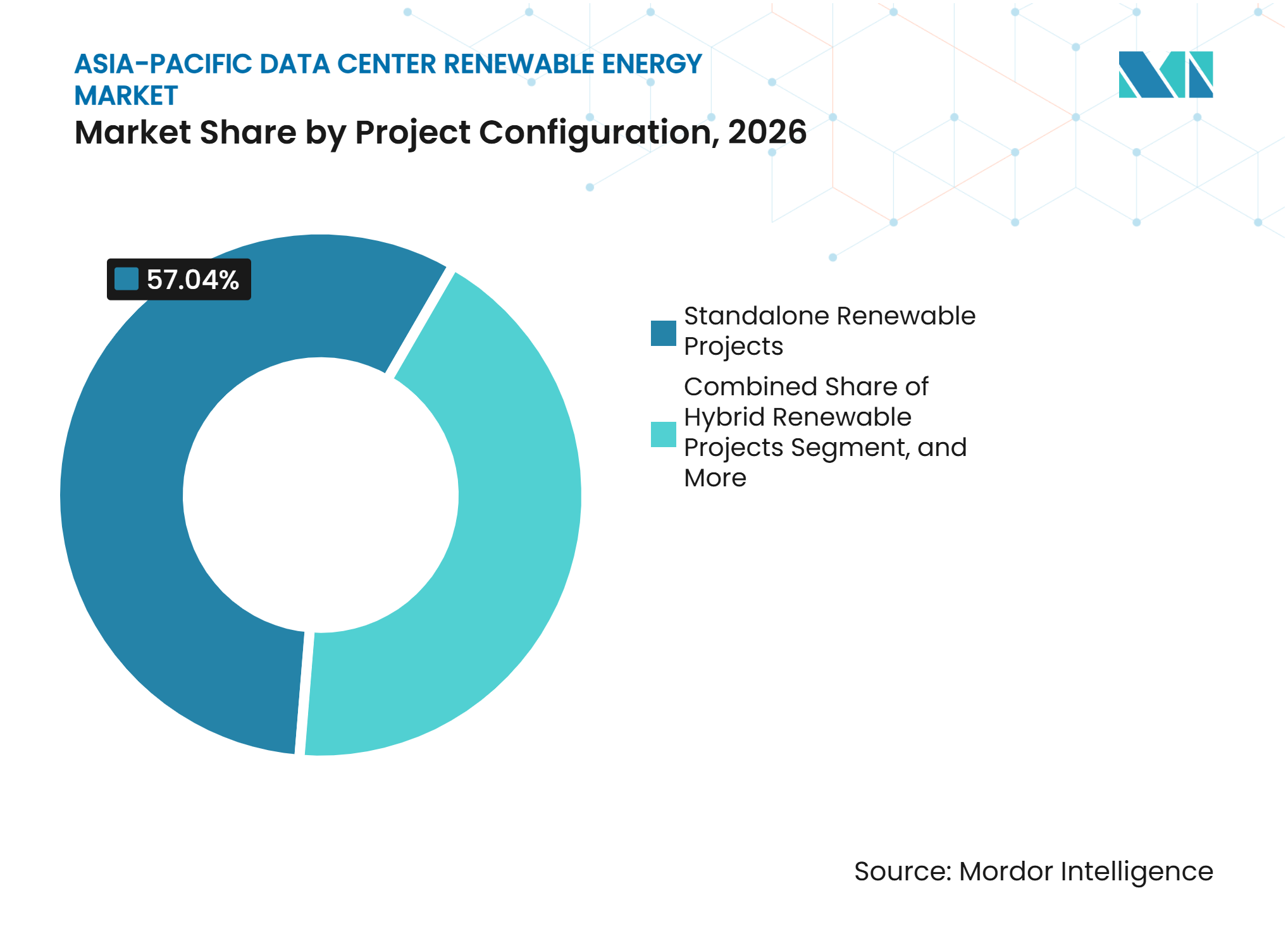
- By project configuration, standalone renewable projects held a 57.04% market share in the Asia-Pacific data center renewable energy market in 2026, while battery-storage-enabled projects are projected to expand at a 20.07% CAGR through 2032.
- By contract duration, long-term contracts held 54.63% market share in 2026, and the segment is expected to reach a c
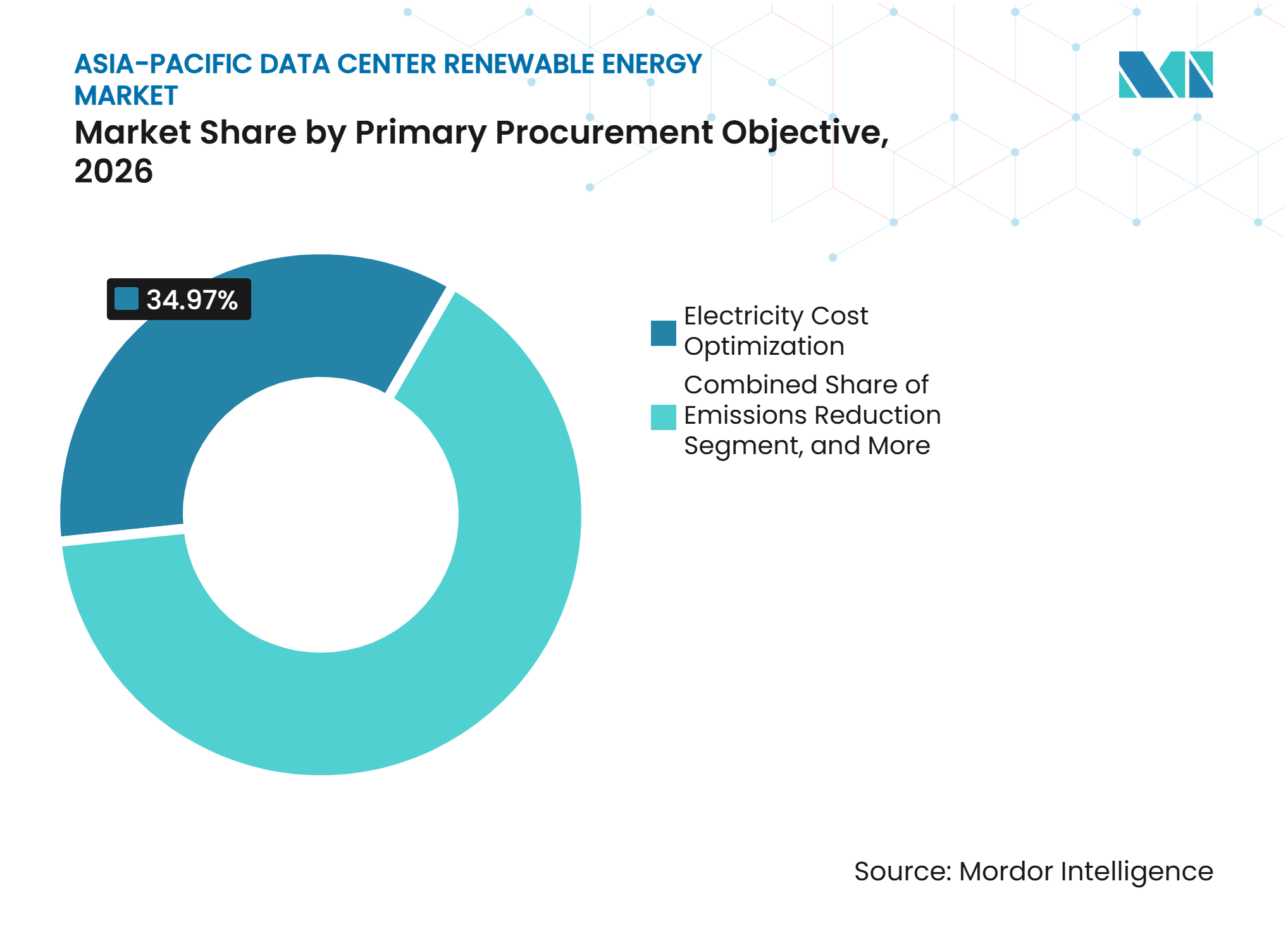
- By primary procurement objective, electricity cost optimization held 34.97% market share in 2026, while renewable energy matching is projected to expand at a 20.29% CAGR through 2032.
- By data center size, hyperscale facilities held 48.24% market share in 2026.
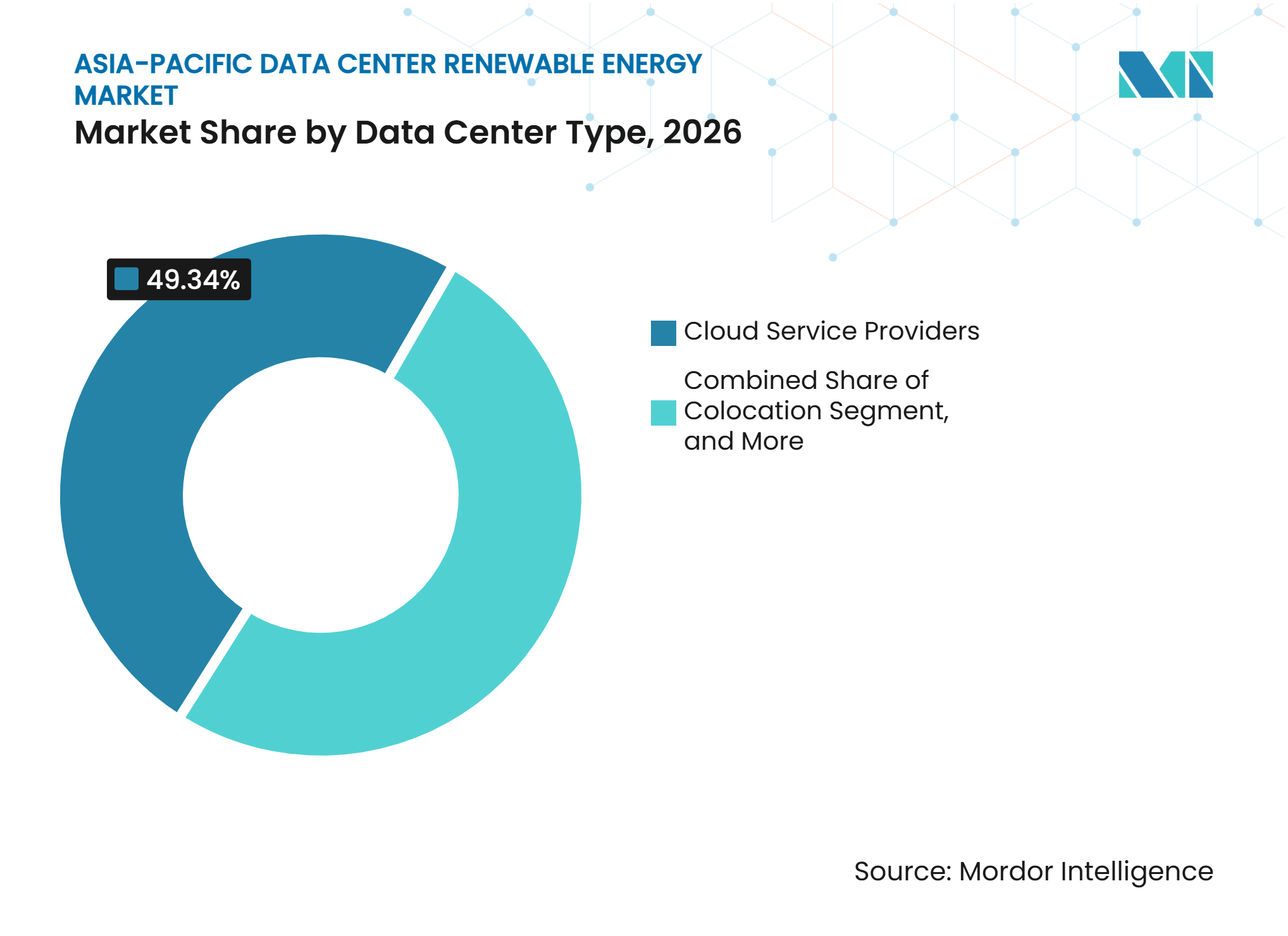
- By data center type, cloud service providers held 49.34% market share in 2026 in the Asia-Pacific data center renewable energy market and are projected to expand at a 20.17% CAGR through 2032.
- By geography, China held a 37.69% market share in 2026, while India is projected to expand at a 20.78% CAGR through 2032.
Note: Market numbers in this report are based on Mordor Intelligence's proprietary estimation framework, which combines nine months of actuals with Q4 projections for base year 2026.
Market Trends and Insights
Drivers Impact Analysis of Asia-Pacific Data Center Renewable Energy Market*
| Driver | (~) % Impact on CAGR Forecast | Geographic Relevance | Impact Timeline |
|---|---|---|---|
| AI and High-Density Workloads Increasing Renewable Power Demand | +4.2% | Global, concentrated in China, Japan, India, Australia, and Malaysia | Short term (≤ 2 years) |
| Hyperscale and Colocation Capacity Expansion | +3.5% | China, India, Malaysia, Indonesia, and Australia | Short term (≤ 2 years) |
| Net-Zero Mandates, Green Incentives, and Corporate Targets | +2.8% | Global, with early concentration in China, Japan, and South Korea | Medium term (2-4 years) |
| Declining Solar Costs and Renewable Investment Pipelines | +2.3% | India, Southeast Asia, China, and Australia | Medium term (2-4 years) |
| Cross-Border Renewable Procurement for Constrained Hubs | +0.9% | Singapore, South Korea, Malaysia, and Indonesia | Long term (≥ 4 years) |
| Renewable-Backed Power and Storage Co-Location | +0.6% | Australia, Japan, India, and Malaysia | Long term (≥ 4 years) |
| Source: Mordor Intelligence | |||
AI and High-Density Workloads Increasing Renewable Power Demand
AI workloads are increasing electricity demand due to far higher rack densities than in earlier cloud deployments. The ASEAN guide expects per-rack power density to rise from 8 kW in 2021 to as much as 50 kW by 2027.[1] This shift makes renewable procurement a capacity-planning issue rather than solely a sustainability measure. The International Energy Agency expects renewables to meet nearly half of global data center electricity demand growth through 2035, adding more than 450 TWh. Training loads can vary sharply over time, which strengthens the case for contracts that can manage volume and price variability. The Asia-Pacific data center renewable energy market is therefore seeing more interest in virtual PPAs and storage-backed arrangements.
Hyperscale and Colocation Capacity Expansion
Large data center campuses are creating renewable demand that individual projects must serve at scale. Microsoft reported that it had contracted more than 34 GW of carbon-free electricity across 24 countries by September 2025. This procurement scale affects colocation providers because hyperscale tenants increasingly expect documented renewable coverage. Providers without comparable power strategies risk losing customers that have enterprise climate commitments. Larger contracts can also support project financing and improve the commercial case for new wind, solar, and battery assets. Consequently, the Asia-Pacific data center renewable energy market links tenant acquisition more closely to renewable contract execution.
Net-Zero Mandates, Green Incentives, and Corporate Renewable Targets
Policy requirements are reducing the time available for operators to arrange renewable electricity supply. China requires new data centers in national hub nodes to consume at least 80% green electricity under its 2025 renewable electricity consumption responsibility weights. Japan’s 7th Strategic Energy Plan positions renewable energy deployment as part of its long-term energy transition and identifies digital infrastructure as a key demand area. These settings encourage developers and operators to consider direct supply, certificates, and long-duration PPAs together. They also favor renewable-rich locations when new facilities are planned. Compliance expectations can make the availability of clean electricity as important as fiber connectivity and land access.
Declining Solar Costs and Renewable Investment Pipelines
Lower solar costs are improving the case for long-term procurement across several regional markets. India had more than 203 GW of non-hydro renewable capacity by November 2025, which provides a larger potential supply base for corporate offtake. Solar projects can be developed more quickly than many other generation technologies and are suitable for both on-site and off-site structures. Battery storage is becoming increasingly important because it helps convert daytime output into power that more closely matches continuous data center demand. Malaysia’s CRESS framework and the planned solar and storage portfolio of Gamuda Energy and Gentari show how supply offerings are adapting to hyperscale requirements. The Asia-Pacific data center renewable energy market can benefit where developers assume more of the curtailment and storage risk within firm power contracts.
Restraints Impact Analysis of Asia-Pacific Data Center Renewable Energy Market*
| Restraint | (~) % Impact on CAGR Forecast | Geographic Relevance | Impact Timeline |
|---|---|---|---|
| Grid Interconnection Delays and Renewable Curtailment Risk | -2.1% | Asia-Pacific core, with Malaysia, Indonesia, Vietnam, and Thailand most affected | Short term (≤ 2 years) |
| High Upfront Cost of Firmed Renewable Power | -1.4% | Global, most acute in Japan, South Korea, and Singapore | Medium term (2-4 years) |
| Limited Land, Transmission Capacity, and Renewable Siting Near Hubs | -0.9% | Singapore, South Korea, and high-density coastal markets | Medium term (2-4 years) |
| Certification, Additionality, and Attribute-Tracking Fragmentation | -0.5% | Asia-Pacific core, with spillover to Southeast Asia and South Asia | Long term (≥ 4 years) |
| Source: Mordor Intelligence | |||
Grid Interconnection Delays and Renewable Curtailment Risk
Grid access is the immediate physical constraint on clean power procurement in several fast-developing hubs. The National Energy Administration reported that China’s Ulan Qab project combines generation, grid, load, and storage, illustrating the need for integrated solutions where conventional connections are inadequate.[2] Delayed interconnection can hold back both new data center capacity and the renewable projects intended to serve it. Developers may face uncertainty over dispatch rights, curtailment exposure, and the timing of transmission upgrades. This environment encourages operators to seek equity positions or direct partnerships with power suppliers. It also gives established utilities and developers an advantage when they can secure capacity and connection arrangements early.
High Upfront Cost of Firmed Renewable Power
Firm renewable supply requires more capital than an intermittent solar or wind contract because storage, balancing, and backup arrangements are needed. Australia’s Clean Energy Finance Corporation estimated that 3.2 GW of additional renewable capacity and 1.9 GW of battery storage would be required to neutralize data center emissions growth through 2035. Hyperscale operators can commit to long contracts and finance more complex structures. Smaller colocation and enterprise operators often have less contract volume and may rely on short-term green tariffs or certificates. These options may support reporting requirements but do not always add new generation capacity. The cost gap can slow the adoption of 24/7 matching in locations with expensive land, limited grid capacity, or restrictive procurement rules.
*Our forecasts treat driver/restraint impacts as directional, not additive. The impact forecasts reflect baseline growth, mix effects, and variable interactions.
Asia-Pacific Data Center Renewable Energy Market Segment Analysis
By Renewable Energy Source:
Solar Leads While Dispatch Needs Broaden Supply MixesSolar power held 48.31% of the Asia-Pacific data center renewable energy market share in 2026. Its broad availability, short construction time, and competitive economics support use in India’s open-access corridors and Japanese utility-scale projects. Wind is the next important resource in China and Australia, where it can complement solar output and support physical or virtual PPA structures. Hydropower remains useful as dispatchable supply in China and Malaysia. Biomass, biogas, and newer sources such as offshore wind remained smaller parts of the supply mix in 2026.
Solar output is strongest during the day, while data centers require uninterrupted power, creating a clear timing gap that becomes more evident when AI systems run beyond normal business hours. This leads operators to combine renewable resources, storage, and contracts with different delivery terms, rather than treating annual renewable volumes as a complete measure of supply quality. Japan’s policy direction supports a more diverse renewable portfolio rather than an exclusive reliance on solar. Geothermal supply can be relevant where operators need more stable renewable generation and where local resource conditions permit development. The segment’s next stage depends on whether storage and flexible grid services become affordable enough for wider deployment across both established and emerging data center locations.



By Procurement Model:
Virtual PPAs Expand Where Physical Delivery Is RestrictedVirtual and financial PPAs held a 34.52% market share in 2026 and are projected to expand at a 20.38% CAGR through 2032. These agreements allow buyers to contract for renewable attributes and financial settlement without requiring electricity to travel physically to the facility. This is valuable in Japan and South Korea, where service territories and electricity rules can limit direct delivery. The Clean Energy Buyers Association identifies corporate PPA structures as a route to broader clean energy procurement across Asia-Pacific electricity markets. Equinix’s 121 MW agreement with ENEOS Renewable Energy in Japan shows how virtual structures can support large commitments in a fragmented market.
On-site generation has a limited role because large data center campuses often lack sufficient land and face restrictions on captive capacity. Physical off-site PPAs remain central in Australia, India, and Malaysia, where third-party access is more workable, and project developers can offer direct contractual structures. Utility green tariffs offer a simpler starting point for smaller operators that cannot negotiate a complex bilateral contract or assume long-term volume commitments. The Asia-Pacific data center renewable energy market will continue to use several models because electricity regulation varies sharply by country, by utility territory, and by the rules governing renewable attribute transfer. Operators must also assess the quality and credibility of attributes purchased through each arrangement.
By Project Configuration:
Storage-Integrated Projects Gain RelevanceStandalone renewable projects held 57.04% of market share in 2026 because conventional solar and wind assets continue to have the largest installed base. They offer economical renewable supply where grid flexibility is sufficient, including China’s western provinces and India’s solar regions. Hybrid wind-and-solar projects can improve output patterns and are increasingly relevant to large buyers. India’s hybrid tendering activity has created a pipeline that can serve data center offtakers. Standalone assets still provide a practical entry point for many operators.
Renewable projects with battery storage are projected to expand at a 20.07% CAGR through 2032. Such configurations address the gap between intermittent generation and continuous computing loads by shifting electricity to periods of lower solar or wind output. China’s Ulan Qab project combines wind, solar, and storage with data center demand through a direct-connection model. Storage can reduce curtailment exposure and provide more reliable delivery during periods of low renewable output, although its value depends on local tariffs and dispatch rules. Wider deployment will depend on battery economics, interconnection permissions, and contract structures that allocate performance risk fairly between developers and data center buyers.

By Contract Duration:
Long-Term PPAs Support New Project FinancingLong-term contracts held 54.63% of market share in 2026. Renewable developers need durable, creditworthy offtake commitments to secure financing for new assets. Contract periods of 15 to 21 years are common when buyers want new capacity to satisfy additionality expectations. Equinix’s 15-year Japanese virtual PPA and DayOne’s 21-year arrangement in Malaysia demonstrate this financing logic. Long periods also provide greater visibility over future energy prices.
Medium-term contracts are useful where corporate PPA rules are still developing, and buyers require time to understand the effect of new access rules on energy costs. Thailand’s direct PPA consultation process is an example of a market where contractual options are evolving. Short-term certificates and green tariff subscriptions remain relevant for operators that need compliance support without long-term project commitments, especially where the available supply is limited. Long contracts can create obligations if demand forecasts or regulations change, so buyers must assess flexibility alongside price certainty. Their continued adoption depends on whether buyers value supply security and new capacity more than the flexibility of shorter arrangements.
By Primary Procurement Objective:
Matching Requirements Increase Portfolio ComplexityElectricity cost optimization held 34.97% of market share in 2026, while renewable energy matching is projected to expand at a 20.29% CAGR through 2032. Cost savings remain important in India and Southeast Asia, where solar PPAs can compare favorably with commercial grid tariffs. Renewable matching reflects a more demanding objective because it considers whether clean generation aligns with consumption in time and geography. Emissions reduction remains essential for operators reporting Scope 2 emissions. Long-term supply security is also becoming more important in grid-constrained locations.
Operators commonly combine several instruments rather than selecting a single procurement method because no one contract can consistently meet cost, reporting, reliability, and additionality needs across multiple sites. ST Telemedia Global Data Centres reported that its India portfolio used captive PPAs, third-party PPAs, utility green tariffs, and energy attribute certificates to reach 70% renewable energy in 2025. This approach can manage diverse objectives across facilities and load profiles, including the needs of sites at different stages of development. It also increases the need for procurement, verification, and contract management capabilities. The Asia-Pacific data center renewable energy market is likely to place greater value on tools that verify the source, timing, and location of contracted power.
By Data Center Size:
Hyperscale Buyers Set Procurement TermsHyperscale facilities held 48.24% of market share in 2026. Their large power demand allows them to negotiate multi-year PPAs, engage directly with developers, and sometimes participate in project ownership. These buyers can also secure favorable connection and supply terms in competitive markets because developers can plan against a substantial, relatively predictable load. Their contracts can establish price and duration benchmarks for other operators and influence the renewable capacity that reaches financial close. Medium and large facilities face pressure to strengthen renewable programs when serving hyperscale tenants.
Smaller sites often rely on utility green products and renewable certificates because they cannot offer the volume required for project-scale bilateral PPAs. This can provide a lower-complexity route to renewable claims but may not support new generation development or provide the same degree of long-term price certainty. In November 2025, CtrlS and NTPC Green Energy signed a memorandum focused on up to 2 GW of renewable projects, underscoring the scale of demand concentrated among large buyers. Such arrangements may reduce the pool of readily available capacity for smaller customers. Aggregation models could help smaller operators secure better terms over time by consolidating separate loads into a more credible purchasing package.
By Data Center Type:
Cloud Providers Lead, Colocation Providers AdaptCloud service providers held 49.34% of market share in 2026 and are projected to expand at a 20.17% CAGR through 2032. Their corporate renewable targets and high electricity demand enable them to commit to capacity at a scale that supports new projects, often across multiple locations and contract structures. Microsoft has stated that it contracted more than 34 GW of carbon-free electricity globally. These providers often pass clean energy expectations through to colocation partners, especially when they need consistent renewable claims for regional customer operations. Tenant requirements therefore affect renewable investment across the wider data center supply chain.
Colocation operators must create portfolio-level purchasing programs because their load comes from many customers, each with different duration, reporting, and reliability requirements. Equinix has used virtual PPAs in Japan and physical agreements in India to support renewable coverage across varied regulatory environments. Enterprise and edge facilities remain smaller users of renewable procurement in 2026. However, their customers increasingly face supply-chain reporting requirements and may seek evidence that contracted renewable volumes are credible. This can gradually increase demand for credible green tariffs, certificates, and aggregated PPA solutions, particularly where individual facilities are too small to support a dedicated renewable project and need a shared route to more dependable, documented clean electricity supply.
Geography Analysis
China
China held 37.69% of Asia-Pacific data center renewable energy market share in 2026. National hub-node data centers must use at least 80% green electricity under the 2025 renewable electricity responsibility weights. The East Data, West Computing program directs major workloads to areas including Inner Mongolia, Ningxia, and Gansu, where renewable resources are more abundant. This approach can bring demand closer to large solar and wind resources. The Ulan Qab direct-connection project entered operation in July 2026 and combines source, grid, load, and storage components. These policies favor integrated energy arrangements that reduce dependence on conventional PPA structures. State-owned telecommunications companies and large cloud providers face strong regulatory and reputation incentives to maintain green electricity ratios.
India
India is projected to expand at a 20.78% CAGR through 2032. Its open-access framework, solar economics, and developing data center pipeline support increased corporate procurement. Digital Edge signed an 83 MW solar PPA for its Navi Mumbai campus in February 2026. STT GDC India and CleanMax expanded their hybrid capacity partnership to more than 130 MW in April 2026. The Central Electricity Regulatory Commission and state regulators shape the open-access conditions used by facilities in Mumbai, Hyderabad, Chennai, and Bengaluru. Rules differ by state, which makes multi-site contracting harder. India remains attractive because buyers can access a deep renewable development base and structure projects around large, long-term loads.
Japan, Australia, South Korea, Malaysia, Indonesia, and Other Asia-Pacific Markets
Japan has an active virtual PPA market, as evidenced by Equinix’s 121 MW agreement with ENEOS Renewable Energy in February 2026.[3] Australia is expanding its data center base and needs additional generation and storage to manage the related emissions burden. South Korea’s February 2025 grid legislation improves the policy setting for expanded renewable access. Malaysia’s CRESS framework supports bilateral arrangements, including DayOne’s renewable energy supply contract with TNB Renewables. Indonesia, Thailand, the Philippines, and Vietnam remain earlier in their corporate PPA development. Their opportunity depends on clearer connection rules, investment in transmission, and stronger methods for tracking renewable attributes. Singapore’s land constraints make regional procurement, storage, and low-carbon fuel options especially relevant.
Competitive Landscape
Market Concentration
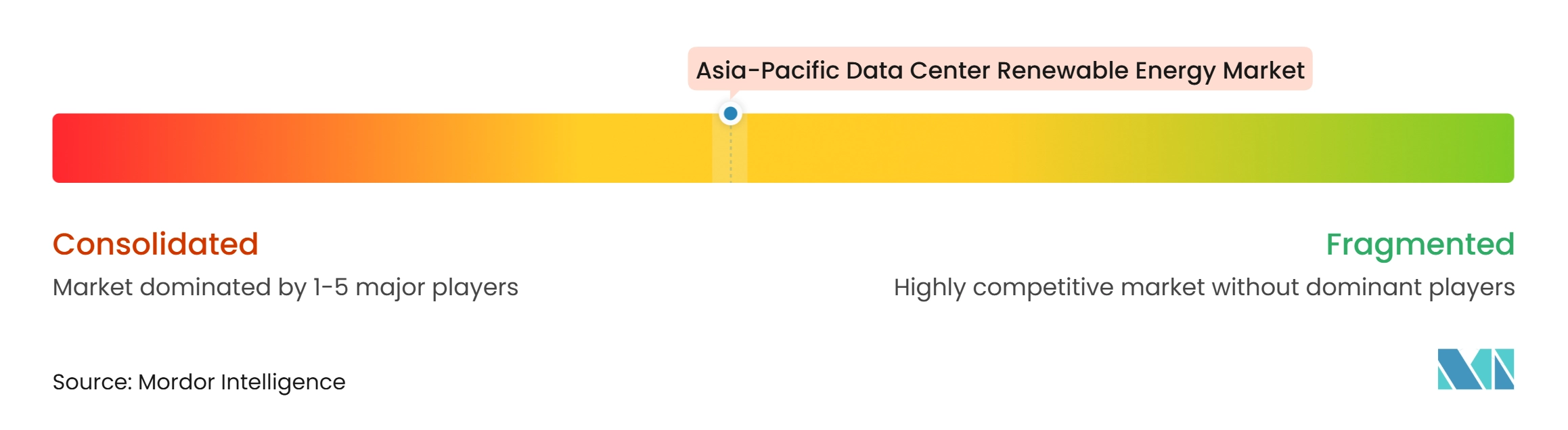
The Asia-Pacific data center renewable energy market is moderately concentrated in contracted renewable volume, but it remains fragmented by national regulation, grid conditions, and local developer access. Hyperscale cloud providers have the purchasing scale to sign large contracts and influence project development. Local utilities, renewable developers, and PPA advisers remain essential because each market has different delivery and compliance conditions. Colocation providers are scaling their own procurement programs to retain tenants with renewable coverage targets. The result is a market where size alone does not guarantee execution without country-level energy expertise.
Equinix signed a 15-year virtual PPA for 121 MW of solar with ENEOS Renewable Energy in Japan during February 2026. Digital Edge signed an 83 MW solar PPA in India during the same month and took a minority interest in related projects. DayOne signed a 21-year bilateral supply contract for up to 500 MW with TNB Renewables under Malaysia’s CRESS framework. These moves show that leading operators are combining long-term offtake, local development partnerships, and, in some cases, equity participation. Storage-backed and directly connected supply are becoming more important as operators seek better control over delivery risk.
Digital energy management can strengthen competitiveness by improving generation forecasts and matching contracted supply with facility demand. Microsoft has described using an Azure-based platform to improve solar and wind forecasting and reduce grid imbalances. Keppel Data Centres and Huawei announced a collaboration on solar PV and battery storage solutions connected to Keppel’s Operations Nerve Centre in May 2025. No input evidence gives a combined top-player market share, so a numeric market concentration score cannot be assigned without creating an unsupported estimate. The competitive position of major participants depends on whether they can secure dependable clean power, demonstrate attribute quality, and apply the resulting offer across several countries.
Asia-Pacific Data Center Renewable Energy Industry Leaders
-
Amazon Web Services, Inc.
-
Microsoft Corporation
-
Google LLC
-
Equinix, Inc.
-
Digital Realty Trust, Inc.
- *Disclaimer: Major Players sorted in no particular order
Asia-Pacific Data Center Renewable Energy Market Companies Covered in this Report
- Amazon Web Services, Inc.
- Microsoft Corporation
- Google LLC
- Equinix, Inc.
- Digital Realty Trust, Inc.
- NTT DATA Group Corporation
- Alibaba Cloud Computing Co., Ltd.
- Huawei Technologies Co., Ltd.
- China Telecom Corporation Limited
- China Mobile Limited
- GDS Services Limited
- ST Telemedia Global Data Centres
- Keppel Data Centres Holding Pte. Ltd.
- AirTrunk Operating Pty Ltd.
- NEXTDC Limited
- DayOne Data Centers
- BDx Data Centers
- Tenaga Nasional Berhad
- Sembcorp Industries Ltd.
- Gentari Sdn. Bhd.
- Trina Solar Co., Ltd.
- HEXA Renewables
- Banpu Public Company Limited
- Schneider Electric SE
- Eaton Corporation plc
Recent Industry Developments in Asia-Pacific Data Center Renewable Energy Market
- October 2026: DayOne Data Centers signed a 21-year Bilateral Energy Supply Contract with TNB Renewables to secure up to 500 MW of solar-backed renewable energy for its Malaysia campuses under the national CRESS framework, the first corporation to execute a BESC under CRESS and a commercial benchmark for large-scale data center renewable procurement in Southeast Asia.
- February 2026: Digital Edge signed an 83 MW solar PPA with Hexa Climate Solutions to power the first phase of its 350 MW AI-ready hyperscale campus in Navi Mumbai. Delivery is expected from December 2026, with Digital Edge taking a minority equity stake in associated renewable projects.
- February 2026: Equinix signed a 15-year virtual PPA with ENEOS Renewable Energy Corporation for 121 MW of solar from the Sanda Mega Solar Power Plant in Hyogo Prefecture, Japan, the largest single-unit vPPA in Japan’s data center sector, advancing Equinix’s 100% renewable energy coverage in one of Asia’s most challenging PPA markets.
- November 2025: CtrlS Datacenters and NTPC Green Energy signed an MoU targeting up to 2 GW or more of jointly developed grid-connected renewable energy projects to supply captive renewable power to CtrlS’s data center portfolio across India.
Asia-Pacific Data Center Renewable Energy Market Report Scope
The Asia-Pacific Data Center Renewable Energy Market comprises renewable electricity generation, procurement, and supply solutions designed to meet the growing energy needs of data centers across the region. It includes renewable electricity derived from solar, wind, hydropower, geothermal, biomass, and biogas sources, obtained through on-site renewable energy systems or third-party procurement mechanisms, such as off-site physical power purchase agreements (PPAs), virtual or financial PPAs, utility green power programs, renewable energy certificates (RECs), and Guarantees of Origin (GOs).
The Asia-Pacific Data Center Renewable Energy Market Report is Segmented by Renewable Energy Source (Solar Power, Wind Power, Hydropower, Geothermal Power, Biomass and Biogas Power, and Other Renewable Sources), Procurement Model (On-Site Renewable Generation, Off-Site Physical PPAs, Virtual or Financial PPAs, Utility Green Power Programs, and Renewable Energy Certificates and Guarantees of Origin), Project Configuration (Standalone Renewable Projects, Hybrid Renewable Projects, Renewable Projects with Battery Storage, and Renewable Projects with Other Firming Solutions), Contract Duration (Short-Term Contracts, Medium-Term Contracts, and Long-Term Contracts), Primary Procurement Objective (Electricity Cost Optimization, Emissions Reduction, Renewable Energy Matching, and Long-Term Supply Security), Data Center Size (Small, Medium, Large, and Hyperscale), Data Center Type (Colocation, Cloud Service Providers, and Enterprise and Edge), and Geography (China, India, Japan, Australia, South Korea, Malaysia, South Korea, Malaysia, Indonesia, Rest of Asia-Pacific). The Market Forecasts are Provided in Terms of Value (USD), and Volume (MWh/GWh).
Segmentation Overview
| Solar Power |
| Wind Power |
| Hydropower |
| Geothermal Power |
| Biomass and Biogas Power |
| Other Renewable Sources |
| On-Site Renewable Generation |
| Off-Site Physical PPAs |
| Virtual or Financial PPAs |
| Utility Green Power Programs |
| Renewable Energy Certificates and Guarantees of Origin |
| Standalone Renewable Projects |
| Hybrid Renewable Projects |
| Renewable Projects with Battery Storage |
| Renewable Projects with Other Firming Solutions |
| Short-Term Contracts |
| Medium-Term Contracts |
| Long-Term Contracts |
| Electricity Cost Optimization |
| Emissions Reduction |
| Renewable Energy Matching |
| Long-Term Supply Security |
| Small |
| Medium |
| Large |
| Hyperscale |
| Colocation |
| Cloud Service Providers (CSPs) |
| Enterprise and Edge |
| China |
| India |
| Japan |
| Australia |
| South Korea |
| Malaysia |
| Indonesia |
| Rest of Asia-Pacific |
| By Renewable Energy Source | Solar Power |
| Wind Power | |
| Hydropower | |
| Geothermal Power | |
| Biomass and Biogas Power | |
| Other Renewable Sources | |
| By Procurement Model | On-Site Renewable Generation |
| Off-Site Physical PPAs | |
| Virtual or Financial PPAs | |
| Utility Green Power Programs | |
| Renewable Energy Certificates and Guarantees of Origin | |
| By Project Configuration | Standalone Renewable Projects |
| Hybrid Renewable Projects | |
| Renewable Projects with Battery Storage | |
| Renewable Projects with Other Firming Solutions | |
| By Contract Duration | Short-Term Contracts |
| Medium-Term Contracts | |
| Long-Term Contracts | |
| By Primary Procurement Objective | Electricity Cost Optimization |
| Emissions Reduction | |
| Renewable Energy Matching | |
| Long-Term Supply Security | |
| By Data Center Size | Small |
| Medium | |
| Large | |
| Hyperscale | |
| By Data Center Type | Colocation |
| Cloud Service Providers (CSPs) | |
| Enterprise and Edge | |
| By Geography | China |
| India | |
| Japan | |
| Australia | |
| South Korea | |
| Malaysia | |
| Indonesia | |
| Rest of Asia-Pacific |
Key Questions Answered in the Report
What is the size of the Asia-Pacific data center renewable energy market?
The Asia-Pacific data center renewable energy market size is projected at USD 6.74 billion in 2026, USD 8.42 billion in 2027, and USD 20.34 billion by 2032. The forecast covers a period in which renewable procurement becomes more closely tied to new data center capacity, AI workloads, grid access, and the availability of long-duration power contracts that can support project development.
What CAGR is forecast for renewable power used by Asia-Pacific data centers?
The forecast indicates a 19.29% CAGR between 2027 and 2032. This expansion is supported by higher computing loads, policy requirements, wider renewable supply options, and long-term corporate power contracts, although transmission constraints and the cost of storage-backed supply can delay implementation in some locations.
Which renewable source has the largest role in data center procurement?
Solar power held 48.31% share in 2026 because it is widely deployable and cost competitive. Its daytime generation profile increases the need for batteries, mixed supply portfolios, and contracts that manage continuous facility demand, particularly when operators seek reliable renewable coverage instead of renewable certificates alone.
Why are virtual PPAs important for data center operators?
They enable financial settlement and renewable attribute procurement where direct physical delivery is limited by electricity market rules. This makes them particularly useful in jurisdictions with fragmented service areas or restricted third-party access, while allowing operators to support renewable projects beyond the grid area where a facility consumes electricity.
Which country has the fastest forecast expansion in this sector?
India is projected to expand at a 20.78% CAGR through 2032, supported by solar economics and open-access procurement options. Its renewable development base, growing corporate offtake, and large data center projects support PPA activity, although state-level rules, interconnection processes, and differing charges still add complexity for operators with multiple sites.
What limits the shift to 24/7 renewable power for data centers?
Grid interconnection delays, transmission constraints, and the higher cost of storage-backed renewable supply remain important barriers. These factors can delay project delivery, restrict capacity near major demand centers, and make comprehensive hourly matching harder for smaller buyers that do not have the purchasing scale of a hyperscale operator in the A