
Asia-Pacific Data Center On-Site Power Generation Market Size and Share
Market Overview
| Study Period | 2027 - 2032 |
|---|---|
| Forecast Data Period | 2027 - 2032 |
| Base Year Market Size (2026) | USD 6.52 Billion |
| Market Size (2027) | USD 7.45 Billion |
| Market Size (2032) | USD 13.51 Billion |
| Growth Rate (2027 - 2032) | 12.64 % |
| Market Concentration | Medium |
Major Players *Disclaimer: Major Players sorted in no particular order Image © Mordor Intelligence. Reuse requires attribution under CC BY 4.0. | |
Asia-Pacific Data Center On-Site Power Generation Market Analysis by Mordor Intelligence
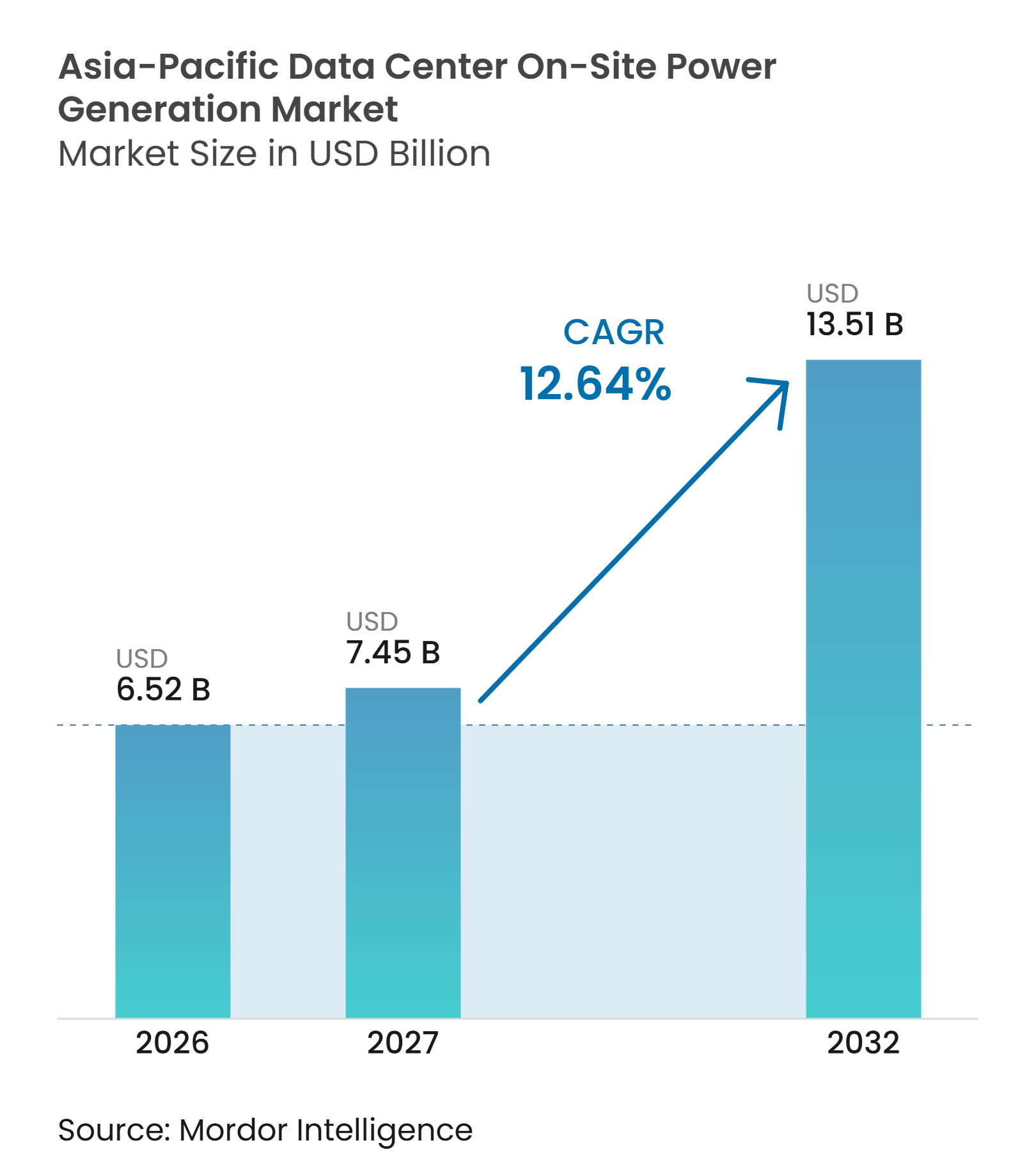
The Asia-Pacific data center on-site power generation market size was valued at USD 6.52 billion in 2026 and is estimated to expand from USD 7.45 billion in 2027 to reach USD 13.51 billion by 2032, at a CAGR of 12.64% during the forecast period 2027-2032. Volume, measured as installed capacity, is projected to increase from 19.72 million MW in 2026 to 21.93 million MW in 2027 and 38.14 million MW by 2032, at a CAGR of 11.71%. Value is expected to advance faster than installed capacity as large campuses specify fuel cells, gas turbines, and high-output gas engines. This pattern also reflects greater use of continuous and prime-power systems rather than standby-only equipment. AI workloads, longer grid-connection timelines, and uneven power quality are making on-site power generation in Asia-Pacific data centers a core infrastructure decision. Equipment suppliers are responding with modular systems, lower-carbon fuels, and solutions that can be deployed before a permanent grid connection is available.
Key Report Takeaways
- By generation technology, diesel generator sets held 34.82% of the Asia-Pacific data center on-site power generation market share in 2026, while fuel cells are projected to expand at a 13.84% CAGR through 2032.
- By installed generation capacity, the 5-20 MW segment accounted for 33.21% of revenue in 2026, while the above-20 MW segment is projected to expand at a 13.43% CAGR through 2032.
- By fuel type, diesel held 63.94% of revenue in 2026 in the Asia-Pacific data center on-site power generation market, while hydrogen and hydrogen blends are projected to expand at a 13.66% CAGR through 2032.
- By application, emergency backup power accounted for 68.09% of the Asia-Pacific data center on-site power generation market share in 2026, while continuous power is projected to expand at a 13.28% CAGR through 2032.
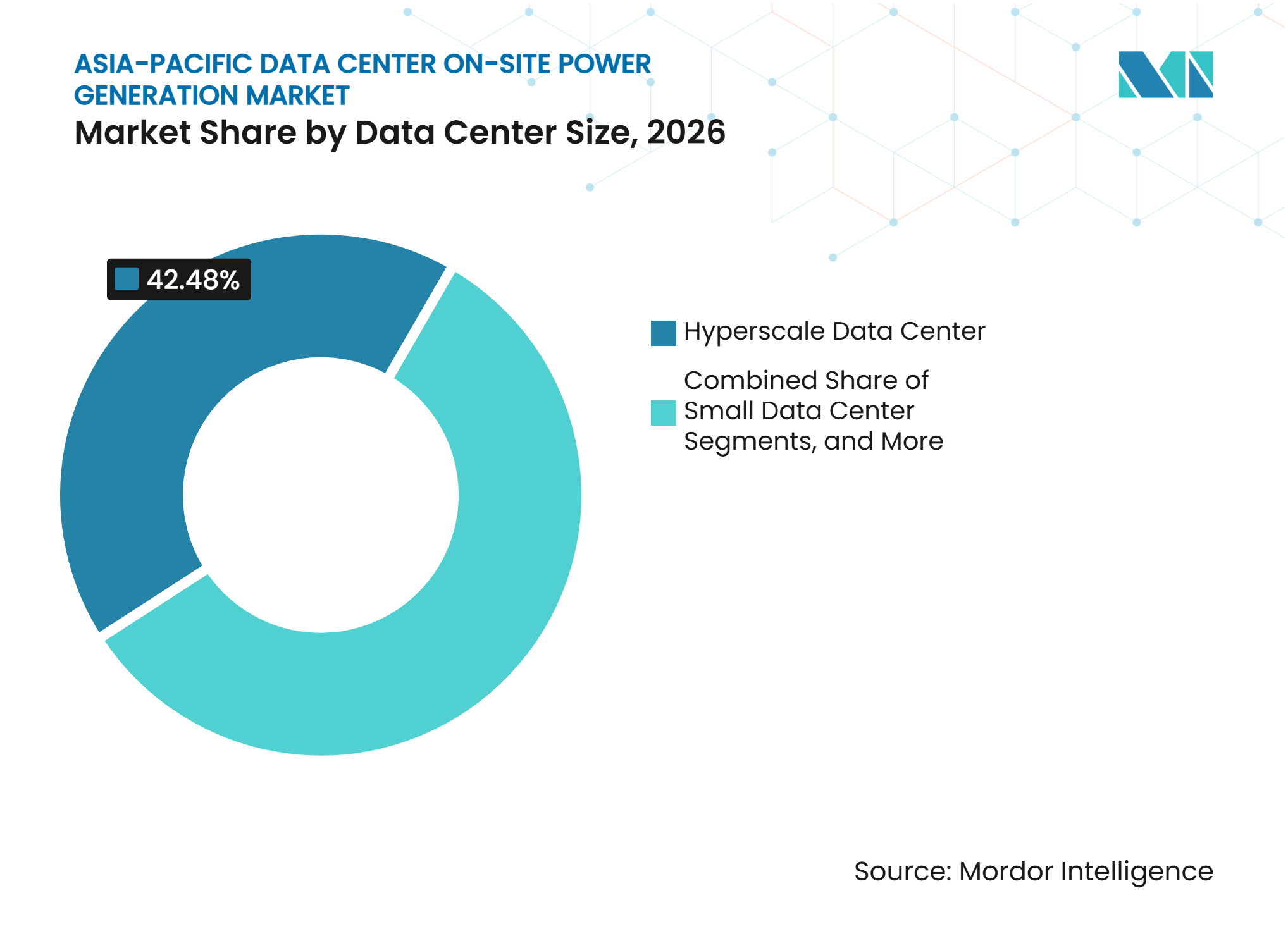
- By data center size, hyperscale facilities held 42.48% of revenue in 2026 and are projected to expand at a 13.34% CAGR through 2032.
- By data center type, cloud service providers held 44.63% of revenue in 2026 and are projected to expand at a 13.18% CAGR through 2032.
- By geography, China held 35.89% of revenue in 2026, while India is projected to expand at a 12.98% CAGR through 2032.
Note: Market numbers in this report are based on Mordor Intelligence's proprietary estimation framework, which combines nine months of actuals with Q4 projections for base year 2026.
Market Trends and Insights
Drivers Impact Analysis of Asia-Pacific Data Center On-Site Power Generation Market*
| Driver | (~) % Impact on CAGR Forecast | Geographic Relevance | Impact Timeline |
|---|---|---|---|
| AI and High-Performance Computing Power-Density Growth | +3.5% | Global, concentrated in China, Japan, Singapore, and India | Short term (≤ 2 years) |
| Hyperscale and Colocation Capacity Expansion | +2.8% | Asia-Pacific-wide, accelerating in Malaysia, Indonesia, South Korea, and Australia | Short term (≤ 2 years) |
| Grid-Interconnection Queues and Local Grid Reliability Gaps | +2.2% | China, India, and Southeast Asia core markets | Short term (≤ 2 years) |
| 5G-Enabled Edge Data Center Deployment | +1.5% | China, Japan, South Korea, India, and Southeast Asia | Medium term (2-4 years) |
| Demand for Lower-Carbon Prime and Backup Generation | +1.0% | Singapore, Australia, Japan, and South Korea | Medium term (2-4 years) |
| Faster Deployment Through Modular and Prefabricated Data Centers | +0.8% | Southeast Asia, India, and Australia | Medium term (2-4 years) |
| Source: Mordor Intelligence | |||
AI and High-Performance Computing Power-Density Growth
AI workloads are changing on-site generation from a reserve asset into a required part of power planning. GPU clusters that use 500 kW-2,000 kW per rack can create load changes that challenge utility supply. The Asia Pacific Energy Research Centre projects regional data center electricity demand to increase 140% between 2025 and 2035.[1] The International Energy Agency projects global data center electricity consumption to approach 945 TWh by 2030, with AI as an important source of additional demand.[2] Tier certification and TIA-942 requirements set redundancy thresholds that expand with facility power density. The Asia-Pacific data center on-site power generation market therefore benefits from demand that is tied to facility design and operating continuity rather than voluntary sustainability targets.
Hyperscale and Colocation Capacity Expansion
New hyperscale and colocation projects need dependable power before, during, and after a utility connection is secured. Larger campuses also have to match power systems to different tenant load profiles and commissioning schedules. This favors modular generator sets and containerized fuel-cell arrays that can be added in defined increments. Bridge Data Centers introduced its PowerCore 5.0 prefabricated module in 2026 to reduce delivery time and support staged campus deployment.[3] The Asia-Pacific data center on-site power generation market can benefit where developers select equipment that avoids waiting for a large, single power plant. Suppliers with proven logistics, service coverage, and rapid commissioning capabilities are likely to be better positioned for these projects.
Grid-Interconnection Queues and Local Grid Reliability Gaps
Grid queues are moving on-site systems toward continuous and prime-power applications in several Asia-Pacific locations. Developers may need batteries, load-shedding systems, or alternate generation to protect a project schedule and manage local supply quality. India’s transmission and distribution losses were reported at 16.64% in a 2025 policy study, which points to the importance of power-quality planning outside established hubs. GRID-INDIA has also identified the system-stability implications of facilities rapidly transferring load to backup power during a fault. The Asia-Pacific data center on-site power generation market gains relevance in Tier-2 cities where critical workloads are rising ahead of grid upgrades. APEC policy recommendations for 2026-2030 call for resilient backup systems in AI computing facility planning.
5G-Enabled Edge Data Center Deployment
5G deployment is creating demand for smaller, distributed facilities that need a different power configuration from a hyperscale campus. These edge sites commonly require 500 kW-5 MW of on-site capacity and often have limited urban space. Containerized diesel units and small gas engines fit this requirement because they can be transported and commissioned in constrained locations. GSMA expects 5G connections in Asia-Pacific to rise from 27% of total connections in 2025 to 50% by 2030. Edge sites still require high availability, even where utility connections are less robust than those serving core facilities. This expands the Asia-Pacific data center on-site power generation market beyond large campuses and supports demand for compact, modular platforms.
Restraints Impact Analysis of Asia-Pacific Data Center On-Site Power Generation Market*
| Restraint | (~) % Impact on CAGR Forecast | Geographic Relevance | Impact Timeline |
|---|---|---|---|
| Permitting, Emissions, and Noise Restrictions on Fossil-Fuel Generators | -1.8% | Singapore, India National Capital Region, South Korea Seoul, and Japan urban cores | Short term (≤ 2 years) |
| High Delivered Cost of Natural Gas and Hydrogen Infrastructure | -1.2% | Asia-Pacific, most acute outside existing LNG pipeline networks | Medium term (2-4 years) |
| Battery Energy Storage Displacing Short-Duration Generator Runtime | -0.7% | Singapore, Australia, and Japan | Medium term (2-4 years) |
| Land, Water, and Fuel-Logistics Constraints at Dense Urban Campuses | -0.5% | Singapore, Tokyo, Osaka, and Seoul | Long term (≥ 4 years) |
| Source: Mordor Intelligence | |||
Permitting, Emissions, and Noise Restrictions on Fossil-Fuel Generators
Restrictions on diesel operation are becoming more important in dense Asia-Pacific markets. These rules can limit generator use during air-quality episodes, including periods when a facility may need backup capacity most. Singapore’s Green Data Centre Roadmap places lower-carbon infrastructure at the center of its long-term data center policy. Hydrotreated vegetable oil provides a near-term option for compatible diesel assets. Rolls-Royce Power Systems states that this fuel can reduce CO₂ emissions by up to 90% relative to conventional diesel without hardware modification. The Asia-Pacific data center on-site power generation market must therefore accommodate emissions, noise, and test-run limits within its technology selection.
High Delivered Cost of Natural Gas and Hydrogen Infrastructure
Natural gas and hydrogen can lower emissions from continuous and backup generation, but availability remains uneven. Japan, South Korea, and Australia have stronger gas and hydrogen foundations than several Southeast Asian markets. In Indonesia, the Philippines, and Vietnam, many data center sites lack a direct gas connection and may need delivered LNG and regasification equipment. Wärtsilä and Tokyo Gas Engineering Solutions signed a 2026 memorandum to assess gas and dual-fuel solutions for Japanese data centers, showing that project-level feasibility remains important even in an established gas market. Incomplete adoption of IEC 62282 fuel-cell standards and ISO 14687 hydrogen-fuel-quality standards can further delay deployments in Southeast Asia. The Asia-Pacific data center on-site power generation market is therefore likely to retain diesel and gas systems alongside hydrogen solutions during the forecast period.
*Our forecasts treat driver/restraint impacts as directional, not additive. The impact forecasts reflect baseline growth, mix effects, and variable interactions.
Asia-Pacific Data Center On-Site Power Generation Market Segment Analysis
By Generation Technology:
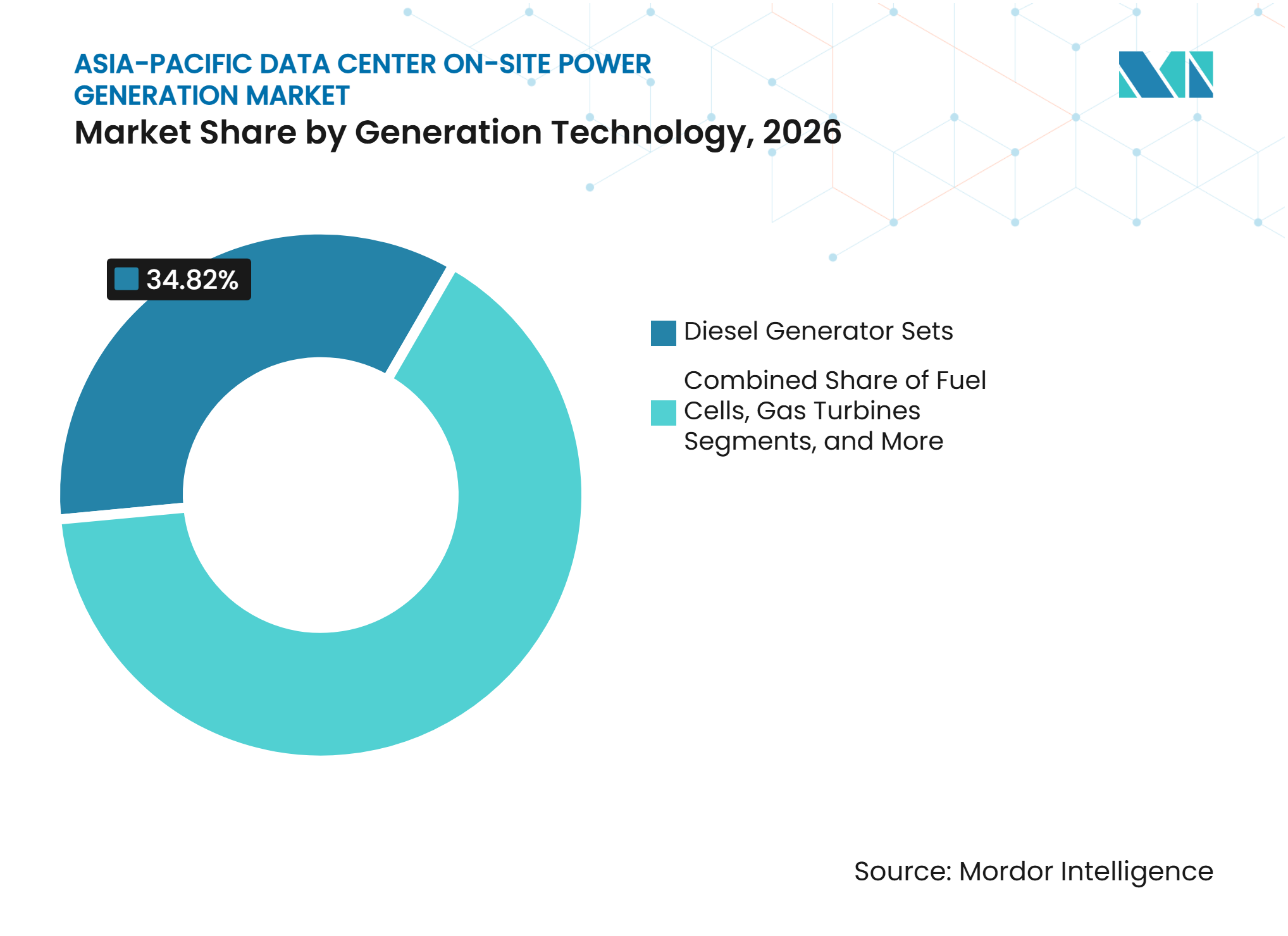
Diesel Remains Established as Fuel Cells Gain GroundDiesel generator sets held 34.82% of the Asia-Pacific data center on-site power generation market size in 2026. Their position reflects established reliability records, fuel logistics, and the ability to operate across varied regional climates. Diesel systems can also be installed quickly when a project cannot wait for a grid connection. China Yuchai International reported that its high-power generator sets supplied 200 MW for a Southeast Asian data center project in April 2026. The order demonstrated that diesel equipment remains relevant at hyperscale scale as well as in smaller facilities. Natural-gas generator sets and reciprocating engines are gaining consideration for large Japanese, South Korean, and Australian campuses. Siemens Energy and Eaton announced a 2025 partnership for standardized on-site power systems based on a 500 MW SGT-800 configuration with optional hydrogen capability.
Fuel cells are projected to expand at a 13.84% CAGR through 2032. They offer a route to firm generation where developers need rapid deployment and lower local emissions. DayOne secured a SGD 530 million (USD 398 million) green loan in 2026 for its Singapore facility, which is expected to use on-site solid oxide fuel-cell generation. FuelCell Energy also signed a 2026 agreement for up to 380 MW of on-site baseload fuel-cell power for data centers. Fuel cells can reduce the advantage held by traditional generator manufacturers in locations where emissions compliance is decisive. Microturbines and solar-diesel hybrids remain smaller niches, primarily supporting edge and off-grid requirements. The Asia-Pacific data center on-site power generation industry is consequently using more than one technology pathway rather than replacing diesel through a single transition.



By Installed Generation Capacity:
The 5-20 MW Range Holds the Largest Position While Larger Plants AccelerateThe 5-20 MW category accounted for 33.21% of revenue in 2026. This range aligns with many regional colocation and enterprise facilities. Operators can install these systems without the extended civil works and approvals that may accompany a large power plant. The band also supports phased additions as tenant demand becomes clearer. This makes it useful for developers that need flexibility across changing power requirements. The Asia-Pacific data center on-site power generation market is supported by this midrange segment because it addresses a broad share of the installed base. It also creates recurring demand for standardized generator packages and service support.
The above-20 MW segment is projected to expand at a 13.43% CAGR through 2032. Hyperscale campuses can exceed 100 MW of IT load and need power systems that match facility scale during the first construction phase. This shifts procurement toward gas turbines, large engines, and multi-block fuel-cell systems. Smaller 1-5 MW systems remain important for colocation facilities that add capacity in discrete stages. Below-1 MW installations serve 5G edge nodes and smaller enterprise facilities in India and Indonesia. Uptime Institute requirements continue to support minimum redundancy across capacity levels. The Asia-Pacific data center on-site power generation industry therefore needs suppliers that can serve both large projects and distributed smaller installations.
By Fuel Type:
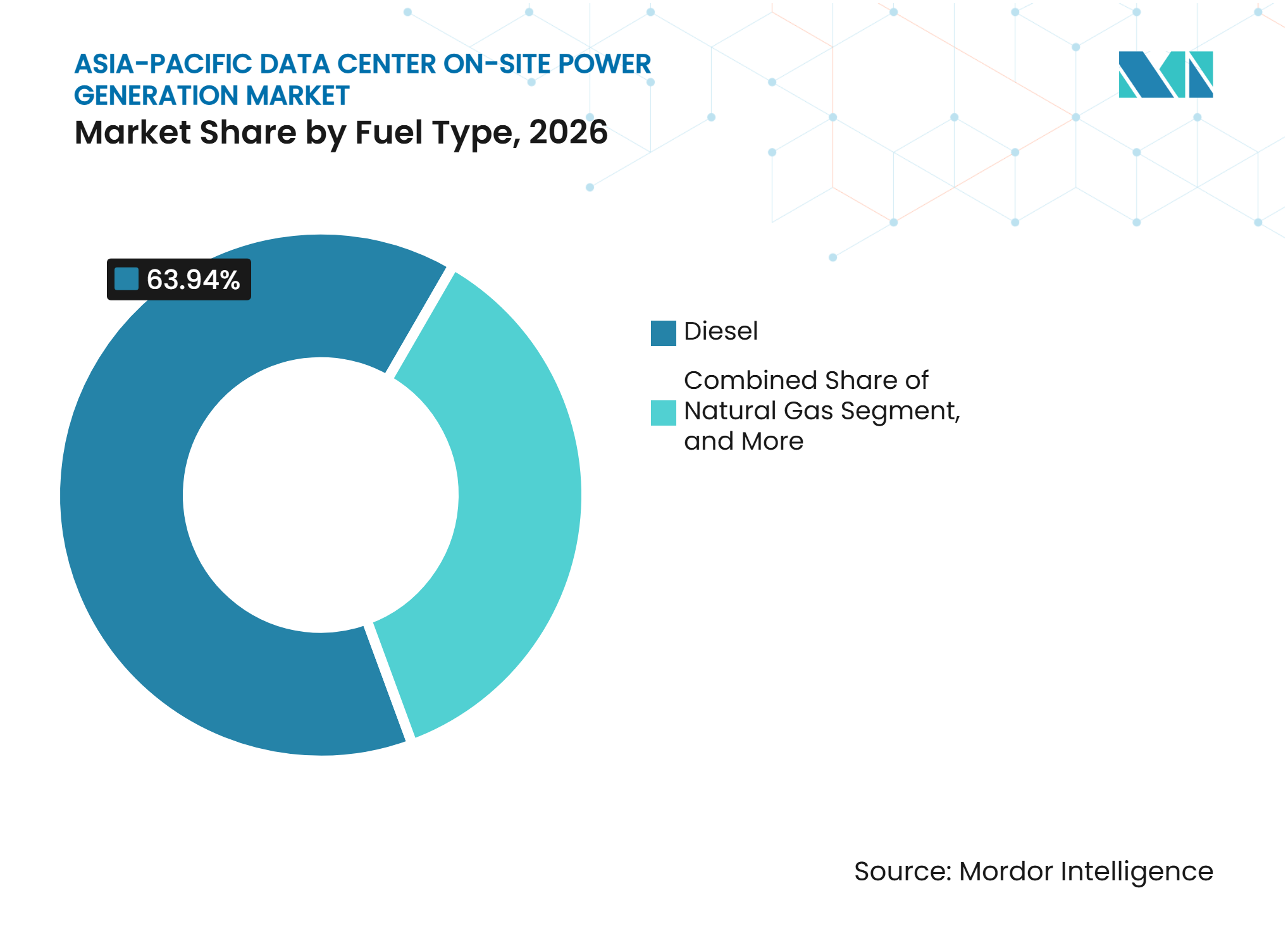
Diesel Holds the Largest Share While Hydrogen Blends Record Faster ExpansionDiesel held 63.94% of revenue in 2026, the largest revenue share by fuel type. Its installed base is supported by established delivery networks and lower initial equipment cost than gas or fuel-cell alternatives. Diesel also remains the standard reference point for backup capacity and Tier compliance. Bridge Data Centers completed a 2026 pilot with Ecoceres using waste-derived hydrotreated vegetable oil as backup fuel. The project indicated that operators can reduce emissions without immediately replacing existing generator equipment. Renewable diesel and biomethane can provide transition options where hydrogen is not yet practical. These options preserve the operating familiarity of diesel systems while responding to customer and regulatory expectations.
Hydrogen and hydrogen blends are projected to expand at a 13.66% CAGR through 2032. Japan, South Korea, and Singapore have policies that support hydrogen development for critical infrastructure. A Honda and Mitsubishi pilot in Japan used by-product hydrogen from Tokuyama Corporation’s electrolysis plant through March 2026. Standards adoption remains a limiting factor in several Southeast Asian countries. Operators also need assurance on fuel availability, purity, storage, and site safety before selecting hydrogen systems. Natural gas retains an important role in markets where pipelines can support behind-the-meter prime power. The Asia-Pacific data center on-site power generation market will therefore retain a mixed fuel base while infrastructure for hydrogen develops.

By Application:
Emergency Backup Power Leads Revenue While Continuous Power Gains RelevanceEmergency backup power accounted for 68.09% of revenue in 2026. The segment reflects the conventional design in which generators cover outage events and are not optimized for prolonged runtime. Its large position is reinforced by data-center requirements for redundant capacity. Diesel systems are well suited to this role because they can start quickly and rely on established fuel-storage arrangements. This application supports replacement demand as installed units age or as facilities increase redundancy. It also supports service revenue through testing, maintenance, and fuel-management contracts. The Asia-Pacific data center on-site power generation market continues to depend on backup capacity even as other applications expand.
Continuous power is projected to expand at a 13.28% CAGR through 2032. It becomes more attractive when grid connections take longer than 24 months or when workload continuity leaves little tolerance for supply interruptions. Gas engines, fuel cells, and selected turbine configurations can operate for longer periods than backup-only equipment. Prime power is also gaining interest in India, Indonesia, and the Philippines, where local grid conditions can fall short of Tier III expectations. Generators in continuous use may accumulate operating hours 5-10 times faster than backup-only systems. This shortens maintenance intervals and can increase aftermarket service revenue per installed MW. Equipment suppliers are adapting their commercial offering to account for this lifecycle requirement.
By Data Center Size:
Hyperscale Facilities Lead Both Revenue and Forecast ExpansionHyperscale data centers held 42.48% of revenue in 2026. They are the largest size category because AI investment is concentrated in large facilities with demanding power requirements. These campuses often require a dedicated on-site plant or several coordinated power blocks. The scale of the project supports demand for high-output engines, turbines, fuel cells, switchgear, and controls. Large facilities with 10-50 MW of IT load remain important for colocation providers seeking economies of scale. Their growth also supports the need for flexible systems that can be expanded by phase. The Asia-Pacific data center on-site power generation market benefits when these projects bring power systems into early site planning.
Hyperscale facilities are also projected to expand at a 13.34% CAGR through 2032. This makes them the only size category to hold both the largest share and the highest forecast rate. Medium facilities serve domestic cloud providers and enterprise deployments, especially in China, India, and South Korea. Small and edge facilities remain relevant in Tier-2 cities across India, Indonesia, and the Philippines. Singapore’s Green Mark for Data Centres 2024 standard is influencing power choices across several facility sizes. Equipment providers must therefore offer scalable solutions that meet both capacity and lower-carbon requirements. This range of facility sizes broadens the addressable demand for the Asia-Pacific data center on-site power generation market.
By Data Center Type:
Cloud Service Providers Set Procurement StandardsCloud service providers held 44.63% of revenue in 2026. Their position reflects their role as the largest builders of new regional data center capacity. They are also early adopters of large gas turbines, fuel cells, and other lower-carbon on-site power platforms. Their procurement requirements influence design choices made by colocation and enterprise operators. Baker Hughes reported USD 1 billion in data-center-related orders in 2025 and expected USD 3 billion in orders over 2025-2027. This illustrates the size of the equipment opportunity attached to cloud-provider projects. The Asia-Pacific data center on-site power generation market is closely linked to the pace and technology choices of these large buyers.
Cloud service providers are projected to expand at a 13.18% CAGR through 2032. Colocation providers are the next important group because power resilience helps them attract cloud tenants. Bridge Data Centers designed its PowerCore 5.0 platform for frequent, prefabricated campus expansion. Enterprise and edge facilities expand more moderately but sustain demand from financial services, sovereign cloud, and manufacturing automation. Their use cases help support private investment outside the hyperscaler cycle. Cloud-provider specifications may speed adoption of lower-carbon continuous-power options across other facility types. The Asia-Pacific data center on-site power generation industry therefore has to serve both highly standardized hyperscale tenders and varied private-site requirements.
Geography Analysis
China held 35.89% of revenue in 2026, giving it the largest geographic position in the Asia-Pacific data center on-site power generation market. Its scale is supported by a large hyperscale and colocation base and by domestic power-equipment manufacturing. China Yuchai International delivered 200 MW of diesel generator capacity to a Southeast Asian hyperscale project in 2026. The delivery shows that Chinese suppliers are also serving regional projects. Japan is an important testing ground for alternative-fuel continuous power. Wärtsilä and Tokyo Gas Engineering Solutions are evaluating gas and dual-fuel solutions for Japanese data centers. Singapore and South Korea influence equipment specifications through more stringent planning and sustainability conditions.
India is projected to expand at a 12.98% CAGR through 2032, the fastest geographic rate in the Asia-Pacific data center on-site power generation market. Rapid hyperscale development and local grid reliability needs support demand for generators. A 2025 policy study reported that India’s transmission and distribution losses were 16.64%. This increases the importance of dependable site-level power design, particularly outside major hubs. Air-quality restrictions in the National Capital Region can limit diesel-generator operation during severe pollution periods. This reinforces the business case for gas-based backup and fuel cells where fuel infrastructure is available. India therefore offers a large opportunity but requires equipment designs that address both reliability and local emissions requirements.
Australia, South Korea, and Southeast Asia offer distinct opportunities for the Asia-Pacific data center on-site power generation market. Australia’s reporting framework and corporate decarbonization priorities support interest in natural gas and renewable-compatible configurations. South Korea is developing a domestic hydrogen ecosystem for critical infrastructure. Bloom Energy and the American Chamber of Commerce in Korea signed a memorandum in 2025 to examine on-site fuel cells for AI data centers. Grid reliability varies across Vietnam, Thailand, the Philippines, and Indonesia, which keeps diesel backup important for high-availability facilities. Proximity to Chinese manufacturing can support shorter equipment lead times in these markets. These locations also offer scope for modular systems that can be deployed before local grid capacity is expanded.
Competitive Landscape
Market Concentration
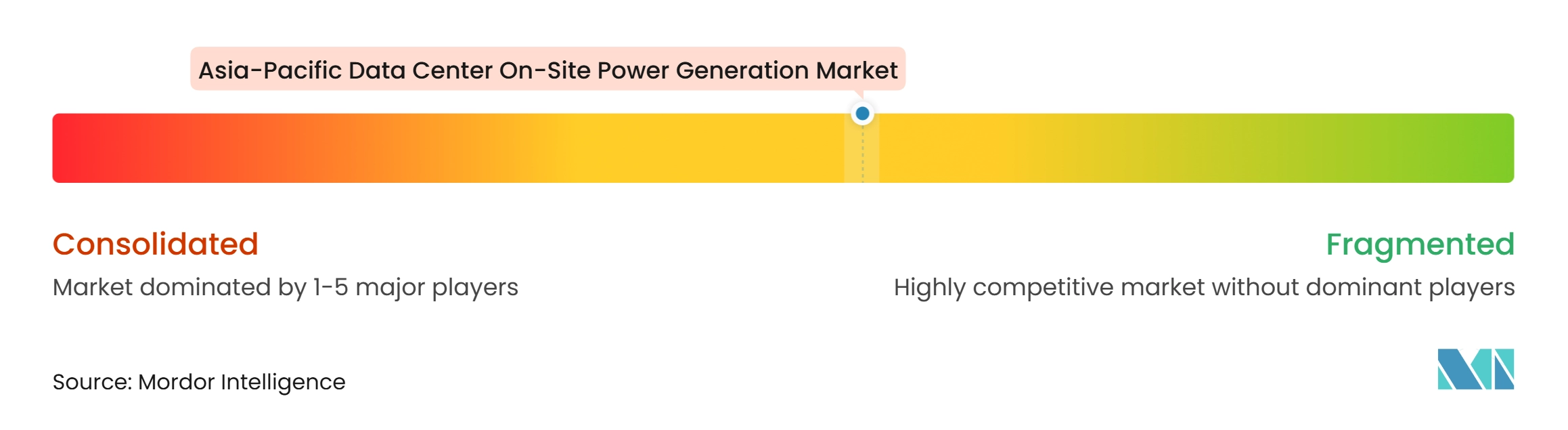
The Asia-Pacific data center on-site power generation market is moderately fragmented. Caterpillar, Cummins, Mitsubishi Heavy Industries, and Wärtsilä form the established generator and gas-engine group. Bloom Energy and FuelCell Energy represent a growing fuel-cell group. Mitsubishi Heavy Industries Engine System Asia launched its MGS2500R containerized solution in 2025. The 2,500 kVA system was designed for Tier III and Tier IV standby applications in a 40-foot high-cube container. Siemens Energy and Eaton also announced their standardized 500 MW on-site configuration in 2025. These actions show that incumbents are focusing on rapid deployment, large-scale integration, and compatibility with lower-carbon fuels.
Chinese suppliers such as Weichai Power and Yuchai International compete on delivery speed and price while expanding their regional presence. Yuchai’s 2026 200 MW supply to a Southeast Asian project demonstrated its ability to support hyperscale deployments. Fuel-cell suppliers are attracting attention as data center operators seek lower-emission firm power. Brookfield Asset Management committed up to USD 5 billion to Bloom Energy in 2025 to support fuel-cell deployment for AI data centers. Modular integrators are also changing the competitive field. Bridge Data Centers, CHINT, and CIMC Digital Power have introduced prefabricated systems that combine electrical equipment, controls, and site delivery.
Wärtsilä’s 2026 memorandum with Tokyo Gas Engineering Solutions reflects a co-development approach for alternative-fuel power in Japan. Competition is not limited to individual equipment items because customers also assess fuel access, commissioning time, controls, financing, and long-term maintenance. The Asia-Pacific data center on-site power generation market has an opening in the 10-50 MW modular segment in India and Southeast Asia. Large global suppliers and fuel-cell specialists have not fully standardized commercial models for sites with shorter investment horizons. Suppliers that combine reliable equipment with staged deployment and local service capacity can compete effectively. No combined market-share figure for the leading companies is available in the supplied evidence.
Asia-Pacific Data Center On-Site Power Generation Industry Leaders
-
Caterpillar Inc.
-
Cummins Inc.
-
Rolls-Royce Holdings plc
-
Rehlko
-
Generac Holdings Inc.
- *Disclaimer: Major Players sorted in no particular order
Asia-Pacific Data Center On-Site Power Generation Market Companies Covered in this Report
- Caterpillar Inc.
- Cummins Inc.
- Rolls-Royce Holdings plc
- Rehlko
- Generac Holdings Inc.
- Mitsubishi Heavy Industries, Ltd.
- GE Vernova Inc.
- Siemens Energy AG
- Wärtsilä Corporation
- INNIO Group Holding GmbH
- Bloom Energy Corporation
- FuelCell Energy, Inc.
- China Yuchai International Limited
- Weichai Power Co., Ltd.
- Kirloskar Oil Engines Limited
- HIMOINSA, S.L.
- Atlas Copco AB
- Aggreko plc
- Yanmar Holdings Co., Ltd.
- Doosan Corporation
- Mitsui E&S Co., Ltd.
- Toshiba Energy Systems & Solutions Corporation
- Panasonic Holdings Corporation
- Plug Power Inc.
- Baker Hughes Company
Recent Industry Developments in Asia-Pacific Data Center On-Site Power Generation Market
- October 2026: CHINT unveiled its factory-built Power Pod at Data Centre World Asia 2026 in Singapore, a containerized system covering 500 kW-4,000 kW integrating switchgear, transformer, and circuit protection in a pre-assembled, factory-tested unit. The product cuts on-site installation time by up to 60% versus field-built systems, targeting AI data center operators in Asia-Pacific facing electrical equipment shortages and compressed delivery timelines.
- October 2026: CIMC Digital Power showcased integrated campus-scale prefabricated modular data center solutions at Data Centre World Asia 2026, covering MW-scale power, generator modules, battery energy storage, and modular cooling under a single EPC delivery platform for AI data centers.
- September 2026: Wärtsilä and Tokyo Gas Engineering Solutions signed a Memorandum of Understanding to jointly evaluate gas and dual-fuel engine-based power generation solutions for data centers under development by TGES in Japan. The agreement directly addresses grid connection constraints and lengthy power procurement timelines that are accelerating operator interest in on-site and off-grid solutions across Japan's AI data center build-out.
- September 2026: Weichai Power's French subsidiary Baudouin presented one-stop data center power solutions at Data Centre World Asia 2026 in Singapore across high-reliability power, integrated systems, and low-carbon energy as part of Weichai's Southeast Asia market expansion drive.
Asia-Pacific Data Center On-Site Power Generation Market Report Scope
The Asia-Pacific Data Center On-Site Power Generation Market comprises solutions that enable data centers to generate electricity within or adjacent to their facilities to ensure a reliable, resilient, and uninterrupted power supply. These systems support operational continuity by reducing dependence on external grids, mitigating the risk of power outages, and addressing the growing energy demands of digital infrastructure. The market includes technologies designed for backup, primary, and continuous power generation, helping operators enhance energy security, optimize operational efficiency, support sustainability objectives, and meet the increasing power requirements of modern, high-density computing environments.
The Asia-Pacific Data Center On-Site Power Generation Market Report is Segmented by Generation Technology (Diesel Generator Sets, Natural Gas Generator Sets, Gas Turbines, Reciprocating Gas Engines, Fuel Cells, and Other Generation Technologies), Installed Generation Capacity (Below 1 MW, 1–5 MW, 5–20 MW, and Above 20 MW), Fuel Type (Diesel, Natural Gas, Renewable Fuels and Biogas, Hydrogen and Hydrogen Blends, and Other Fuel Types), Application (Emergency Backup Power, Prime Power, Continuous Power, and Temporary and Bridge Power), Data Center Size (Small, Medium, Large, and Hyperscale), Data Center Type (Colocation, Cloud Service Providers, and Enterprise and Edge), and Geography (China, India, Japan, Australia, Singapore, South Korea, Malaysia, Indonesia, and Rest of Asia-Pacific). The Market Forecasts are Provided in Terms of Value (USD) and Volume (MW).
Segmentation Overview
| Diesel Generator Sets |
| Natural Gas Generator Sets |
| Gas Turbines |
| Reciprocating Gas Engines |
| Fuel Cells |
| Other Generation Technologies |
| Below 1 MW |
| 1-5 MW |
| Above 5-20 MW |
| Above 20 MW |
| Diesel |
| Natural Gas |
| Renewable Fuels and Biogas |
| Hydrogen and Hydrogen Blends |
| Other Fuels |
| Emergency Backup Power |
| Prime Power |
| Continuous Power |
| Temporary and Bridge Power |
| Small |
| Medium |
| Large |
| Hyperscale |
| Colocation |
| Cloud Service Providers (CSPs) |
| Enterprise and Edge |
| China |
| India |
| Japan |
| Australia |
| Singapore |
| South Korea |
| Malaysia |
| Indonesia |
| Rest of Asia-Pacific |
| By Generation Technology | Diesel Generator Sets |
| Natural Gas Generator Sets | |
| Gas Turbines | |
| Reciprocating Gas Engines | |
| Fuel Cells | |
| Other Generation Technologies | |
| By Installed Generation Capacity | Below 1 MW |
| 1-5 MW | |
| Above 5-20 MW | |
| Above 20 MW | |
| By Fuel Type | Diesel |
| Natural Gas | |
| Renewable Fuels and Biogas | |
| Hydrogen and Hydrogen Blends | |
| Other Fuels | |
| By Application | Emergency Backup Power |
| Prime Power | |
| Continuous Power | |
| Temporary and Bridge Power | |
| By Data Center Size | Small |
| Medium | |
| Large | |
| Hyperscale | |
| By Data Center Type | Colocation |
| Cloud Service Providers (CSPs) | |
| Enterprise and Edge | |
| By Geography | China |
| India | |
| Japan | |
| Australia | |
| Singapore | |
| South Korea | |
| Malaysia | |
| Indonesia | |
| Rest of Asia-Pacific |
Key Questions Answered in the Report
What is the size of the Asia-Pacific data center on-site power generation market?
The market is valued at USD 6.52 billion in 2026 and is projected to reach USD 13.51 billion by 2032 at a 12.64% CAGR, with installed capacity projected to reach 38.14 million MW.
Which generation technology leads regional demand?
Diesel generator sets lead with 34.82% revenue share in 2026, supported by their established reliability and fuel logistics.
Which fuel type is expanding fastest for on-site data center power?
Hydrogen and hydrogen blends are projected to expand at a 13.66% CAGR through 2032, although infrastructure and standards remain uneven.
Why is continuous power becoming more important for data centers?
It helps developers manage long grid-connection timelines and power-quality concerns while supporting workloads that cannot tolerate interruption. It also supports commissioning schedules when utility upgrades do not match the pace of new campus construction.
Which country has the fastest projected expansion through 2032?
India is projected to expand at a 12.98% CAGR, supported by hyperscale development and the need for reliable site-level power.
How are suppliers reducing the environmental impact of backup generation?
Suppliers are offering fuel cells, gas and dual-fuel engines, hydrogen-ready configurations, and hydrotreated vegetable oil for compatible diesel systems.