
Asia-Pacific Data Center Insurance Market Size and Share
Market Overview
| Study Period | 2021 - 2032 |
|---|---|
| Forecast Data Period | 2027 - 2032 |
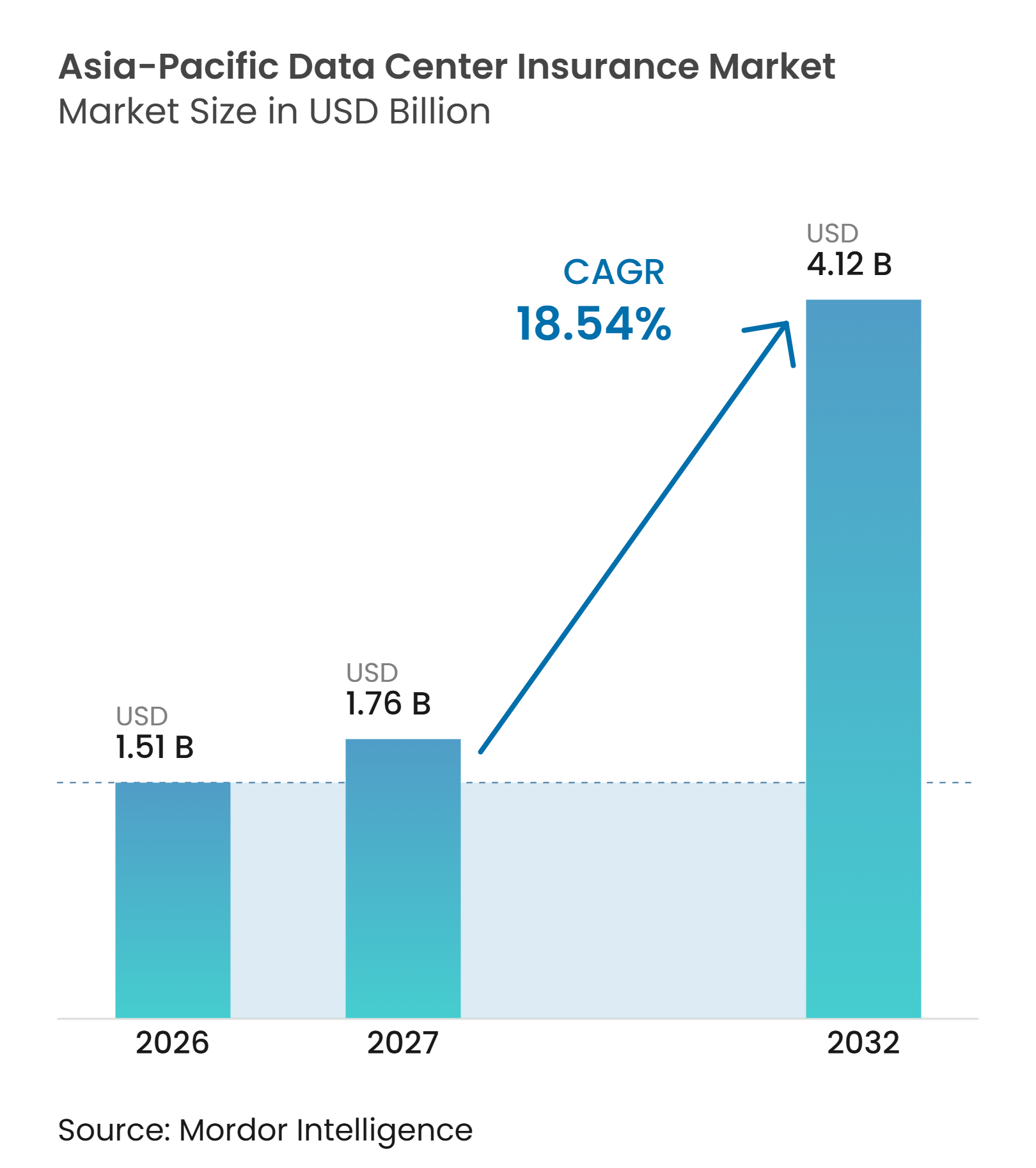
| Base Year Market Size (2026) | USD 1.51 Billion |
| Market Size (2027) | USD 1.76 Billion |
| Market Size (2032) | USD 4.12 Billion |
| Growth Rate (2027 - 2032) | 18.54 % |
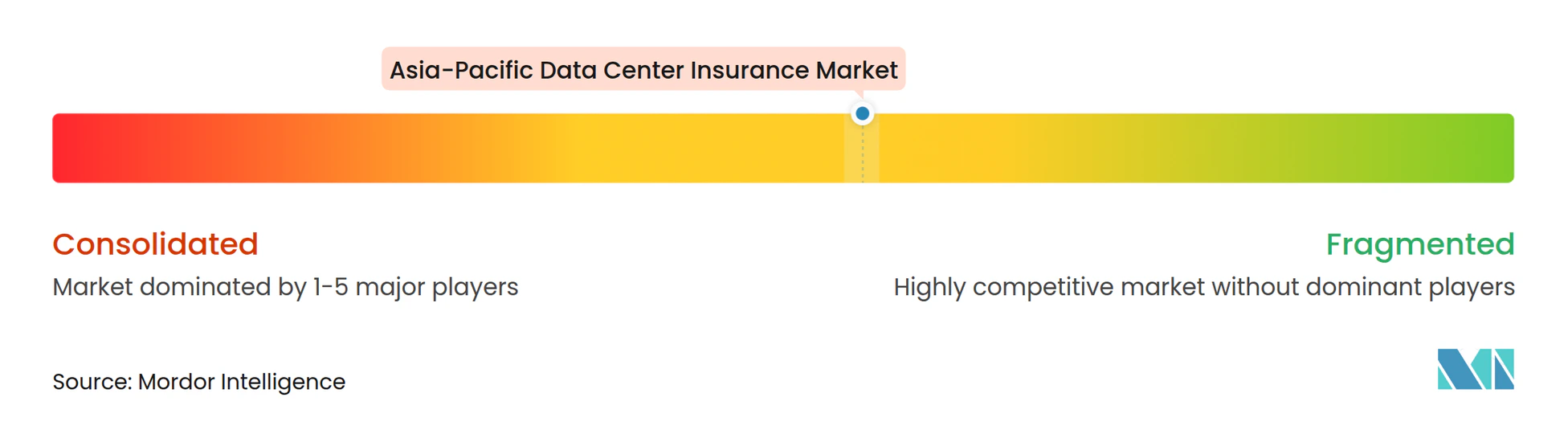
| Market Concentration | Medium |
Major Players *Disclaimer: Major Players sorted in no particular order Image © Mordor Intelligence. Reuse requires attribution under CC BY 4.0. | |
Asia-Pacific Data Center Insurance Market Analysis by Mordor Intelligence
The Asia-Pacific data center insurance market size is projected to expand from USD 1.51 billion in 2026 to USD 1.79 billion in 2027 and USD 4.12 billion by 2032, registering a CAGR of 18.54% from 2027 to 2032. The Asia-Pacific data center insurance market is being reshaped by AI infrastructure spending, which is increasing the value and technical complexity of individual facilities. Demand is moving beyond conventional property cover because operators need protection for construction, equipment, business interruption, cyber events, and natural hazards. Lenders are also requiring coverage that runs from construction through operations, which favors coordinated lifecycle programs. Power access, cooling design, climate exposure, and digital service reliability are becoming material underwriting considerations. The Asia-Pacific data center insurance market, therefore, offers scope for insurers that can assess concentrated and interconnected risks without relying on standard commercial property terms.
Key Report Takeaways
- By insurance type, property damage insurance held 36.43% of the Asia-Pacific data center insurance market share in 2026, while cyber insurance is projected to expand at a 19.26% CAGR through 2032.
- By coverage structure, combined property and business interruption policies held 39.82% of the Asia-Pacific data center insurance market in 2026, while parametric insurance is projected to expand at a 19.13% CAGR through 2032.
- By risk exposure, electrical and mechanical equipment failure accounted for 22.31% of the market in 2026, while cyber-related operational disruption is projected to expand at a 19.43% CAGR through 2032.
- By policyholder, data center owners and operators held 34.61% of the market in 2026, while cloud service providers are projected to expand at a 19.83% CAGR through 2032.
- By insurance distribution channel, insurance brokers and consultants held 49.23% of the market in 2026, while managing general agents and specialist underwriting agencies are projected to expand at a 19.48% CAGR through 2032.
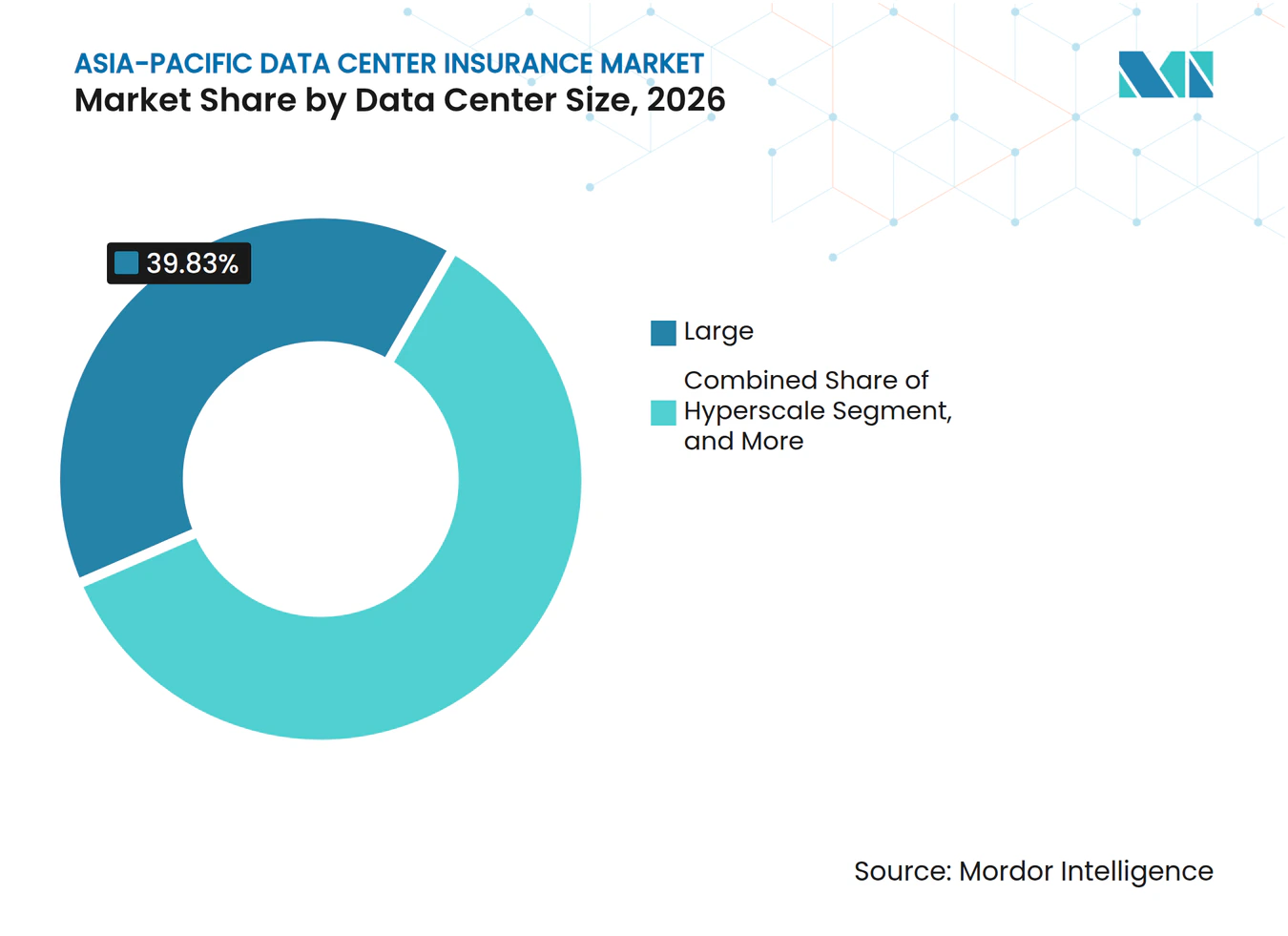
- By data center size, large data centers held 39.83% of the market in 2026, while hyperscale data centers are projected to expand at a 19.67% CAGR through 2032.
- By data center type, colocation data centers held 41.37% of the market in 2026, while cloud service provider-operated facilities are projected to expand at a 19.15% CAGR through 2032.
- By geography, China held 38.43% of the market in 2026, while India is projected to expand at a 19.87% CAGR through 2032.
Note: Market numbers in this report are based on Mordor Intelligence's proprietary estimation framework, which combines nine months of actuals with Q4 projections for base year 2026.
Market Trends and Insights
Drivers Impact Analysis of Asia-Pacific Data Center Insurance Market*
| Driver | (~) % Impact on CAGR Forecast | Geographic Relevance | Impact Timeline |
|---|---|---|---|
| AI-Led Hyperscale Capacity Expansion | +6.0% | Global, with primary concentration in China, India, Singapore, and Malaysia | Short term (≤ 2 years) |
| Cloud and Digital-Service Dependence on High Availability | +4.5% | APAC core, with particular intensity in Australia, Japan, South Korea, and India | Medium term (2-4 years) |
| Rising Insured Values of Dense Compute and Power Infrastructure | +3.5% | Global, with highest per-site concentration in China, Australia, Japan, and Singapore | Medium term (2-4 years) |
| Financing Requirements for Integrated Lifecycle Insurance | +2.5% | APAC core, with spillover to Southeast Asia as greenfield investment accelerates | Medium term (2-4 years) |
| Parametric Demand for Grid and Natural-Catastrophe Disruption | +2.0% | APAC-wide, with highest urgency in Japan, the Philippines, Indonesia, and coastal Australia | Long term (≥ 4 years) |
| Insurance Demand from High-Density Liquid Cooling and Battery Systems | +1.5% | APAC-wide, with rapid adoption in hyperscale and AI-oriented facilities across China and India | Long term (≥ 4 years) |
| Source: Mordor Intelligence | |||
AI-Led Hyperscale Capacity Expansion
AI-related buildouts are creating insurance exposures that are larger and more concentrated than those associated with conventional data centers. AWS, Google, Microsoft, and Oracle committed more than USD 160 billion to infrastructure in APAC between January 2024 and May 2026. Google also announced a USD 15 billion investment in an AI data center in Andhra Pradesh, scheduled for October 2026. A modern AI campus can approach USD 50 billion in replacement value once dense computing equipment is installed. Construction all-risk, delay in start-up, property damage, and business interruption cover must therefore respond to a greater accumulation of value at each site. The Asia-Pacific data center insurance market is benefiting because each stage of the project requires specialized capacity and engineering review.
Cloud and Digital-Service Dependence on High Availability
Financial services, retail, healthcare, and public services increasingly rely on uninterrupted digital infrastructure. More than 98% of APAC data centers have redundant systems, but outages can still occur from events that do not meet the physical damage requirements of a property policy. Such events can leave operators exposed to service-level agreement costs and revenue losses. Cyber incidents add another layer of exposure because they can affect multiple jurisdictions simultaneously. Aon reported that APAC cyber claims increased 233% in 2025 and rose a further 80% in the first half of 2026. This pattern supports demand for non-damage business interruption, cyber, and service-level agreement cover in the Asia-Pacific data center insurance market.
Rising Insured Values of Dense Compute and Power Infrastructure
GPU clusters, high-density power systems, and advanced cooling equipment are raising insured values per megawatt. Average facilities require USD 500 million to USD 2 billion to construct, while some AI campuses exceed USD 20 billion in construction cost before equipment is added. Construction costs in the region rose 10% year over year in 2025 as projects required more specialized power and cooling systems. Equipment also has different replacement characteristics than traditional building assets because it can become obsolete quickly and may have long procurement lead times. These factors require more frequent valuation reviews and longer delay-in-start-up protection. The resulting complexity is expanding the role of risk engineering and technical underwriting in the Asia-Pacific data center insurance market.
Financing Requirements for Integrated Lifecycle Insurance
Project finance lenders are making insurance a condition of funding for large facilities. More than USD 100 billion is needed to fund the existing Asia-Pacific data center pipeline over the next 5-7 years. Lenders seek continuity between construction all-risk cover and operational property protection, as a gap can delay financing or weaken the project's risk profile. Aon launched its Data Center Lifecycle Insurance Program in July 2025 and expanded it to USD 2.5 billion in January 2026.[1] The facility coordinates construction, cargo, cyber, property, business interruption, liability, and technology exposures. This structure supports the Asia-Pacific data center insurance market by consolidating several insurance needs into a single lender-ready placement.
Restraints Impact Analysis of Asia-Pacific Data Center Insurance Market*
| Restraint | (~) % Impact on CAGR Forecast | Geographic Relevance | Impact Timeline |
|---|---|---|---|
| Limited Loss History for AI Workloads and Interdependent Risks | -1.0% | Global, with greatest underwriting constraint in India, Southeast Asia, and emerging APAC markets | Short term (≤ 2 years) |
| Concentration Risk in Hyperscale Campuses and Shared Infrastructure | -0.6% | APAC core, including China, Singapore, Japan, Australia, and rapidly expanding markets in Malaysia | Medium term (2-4 years) |
| Cross-Policy Trigger and Coverage-Interpretation Uncertainty | -0.4% | APAC-wide, with particular exposure in multi-tenant colocation markets | Medium term (2-4 years) |
| Grid, Water, Carbon, and Permitting Constraints on Insurability | -0.3% | National-level, with early pressure in Singapore, Hong Kong, and Greater Seoul | Long term (≥ 4 years) |
| Source: Mordor Intelligence | |||
Limited Loss History for AI Workloads and Interdependent Risks
Insurers have limited claims experience for GPU-dense facilities that have operated at scale over long periods. Pricing, therefore, depends heavily on engineering judgment, scenario analysis, and dependency mapping rather than on mature historical loss data. The issue is pronounced in India, Malaysia, and Indonesia, where large new projects are being developed before consistent standards for AI-specific hazards have emerged. Liquid-cooled GPU fires, battery energy storage system thermal runaway, and interconnected software failures all require more specialized assessment. This uncertainty can constrain the capacity that insurers offer to individual sites. It may also slow growth in the Asia-Pacific data center insurance market when underlying infrastructure demand is strong.
Concentration Risk in Hyperscale Campuses and Shared Infrastructure
Hyperscale campuses can place USD 20 billion to USD 30 billion in insurable value at a single location. Shared grids, cooling infrastructure, cloud services, and specialist suppliers can connect multiple insurance programs to the same event. The risk is amplified in typhoon corridors, seismic areas, and heat-stressed zones where many new facilities are being developed. Allianz Commercial identified chronic heat and drought stress across 89% of APAC data center capacity. Separate building, equipment, and power policies can also make a carrier's accumulated exposure harder to identify. Reinsurers are responding with more detailed reporting requirements and, in some cases, limits on data center values in treaty cover.
*Our forecasts treat driver/restraint impacts as directional, not additive. The impact forecasts reflect baseline growth, mix effects, and variable interactions.
Asia-Pacific Data Center Insurance Market Segment Analysis
By Insurance Type:
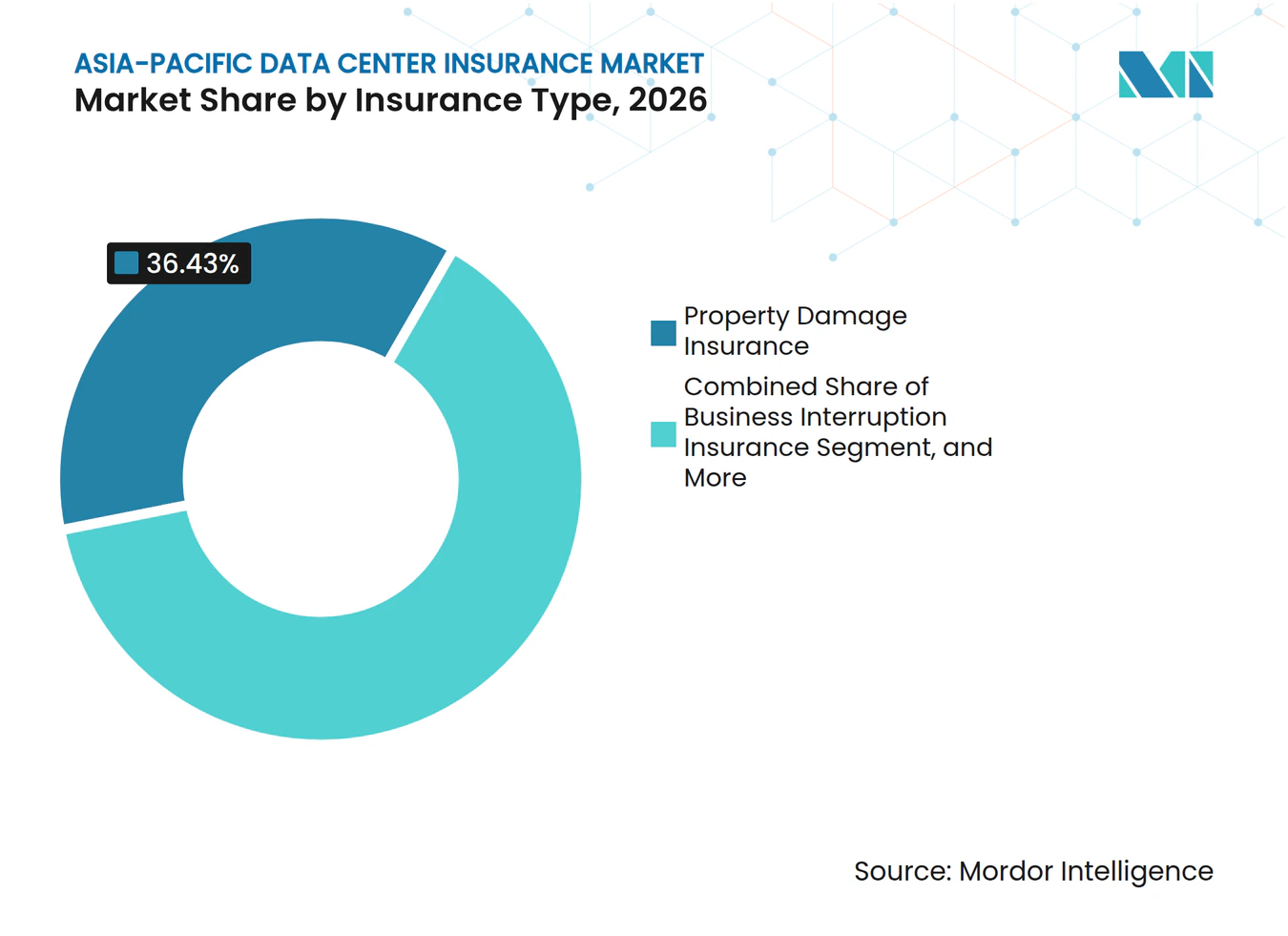
Cyber Insurance Outpaces Traditional LinesProperty damage insurance held 36.43% of the Asia-Pacific data center insurance market share in 2026. It covers server halls, cooling infrastructure, power distribution equipment, and the building fabric, which together represent a large portion of a facility's insured value. Lenders and investors generally require this protection before releasing capital for a project. Fire remains a major driver of severity because it can damage essential systems and cause extended downtime. Business interruption cover is usually paired with property protection because physical damage may affect customer contracts and operating revenue. Equipment breakdown cover is also becoming more important as facilities deploy complex mechanical and electrical systems.
Cyber insurance is projected to grow at a CAGR of 19.26% through 2032. Cyber-induced outages often do not meet the physical damage trigger under traditional property terms, creating a distinct protection need for dependent interruption and service-level agreement costs. Natural catastrophe cover remains important in markets exposed to typhoons, flooding, and earthquakes, where property programs may carry sublimits. General liability coverage is increasingly relevant when operators face claims related to wastewater, noise, or other local impacts. Construction and erection all-risk cover supports new capacity, while the IEC 62443 framework and TIA-942 specifications increasingly influence risk engineering discussions. The Asia-Pacific data center insurance industry is consequently using a wider mix of policies rather than treating property cover as sufficient on its own.



By Coverage Structure:
Parametric Solutions Reshape Bundled ProgramsCombined property and business interruption policies held 39.82% of the market in 2026. This structure provides the basic protection expected by institutional lenders and operators because it links physical damage with lost income from downtime. It performs well when a physical event damages equipment or a building, preventing operations. Its limitation is the physical damage requirement, which may not cover grid failures, cooling events, or other disruptions that leave no visible damage. Standalone policies can suit large operators that retain selected risks within diversified portfolios. Package policies can provide smaller facilities with simpler administration across several lines.
Parametric insurance is projected to grow at a CAGR of 19.13% through 2032. It uses pre-agreed triggers and can provide fast liquidity when specified events occur without requiring evidence of physical damage. Descartes Underwriting launched parametric cover in January 2026 with a capacity of up to USD 140 million per policy across up to 20 natural perils.[2] Retail and wholesale providers with uptime obligations have a clear need for this approach because payment can support urgent service-level agreement costs. Captive and self-insurance arrangements may also expand among major technology groups for selected interruption and technology losses. These solutions are widening the Asia-Pacific data center insurance market beyond conventional indemnity-based structures.
By Risk Exposure:
Cyber Disruption Overtakes Equipment-Led ClaimsElectrical and mechanical equipment failure accounted for 22.31% of the market in 2026. Data centers rely on power distribution units, uninterruptible power supplies, generators, chillers, and cooling systems that must work continuously under high load. Cooling failures are particularly important in AI-intensive environments because dense computing systems require more complex thermal management. Fire and explosion events occur less often but can be costly, especially where cooling systems or hot works are involved. Power disruption, flooding, severe weather, and earthquake risks add to the regional exposure profile. Japan, the Philippines, Indonesia, and coastal Australia combine several of these hazards with active data center development.
Cyber-related operational disruption is projected to grow at a CAGR of 19.43% through 2032. Ransomware caused 60% of large claim values globally in the first half of 2025, and double extortion was linked to 40% of large claims. Multi-tenant colocation sites can face elevated exposure because an attack may move across shared systems or affect many customer workloads. Semiconductor supply chain dependencies pose a distinct operational concern because advanced chip production is concentrated in earthquake-prone regions. A disruption could affect construction schedules as well as the resilience of operating sites. This risk mix requires the Asia-Pacific data center insurance market to assess digital, supply chain, and physical losses together.
By Policyholder:
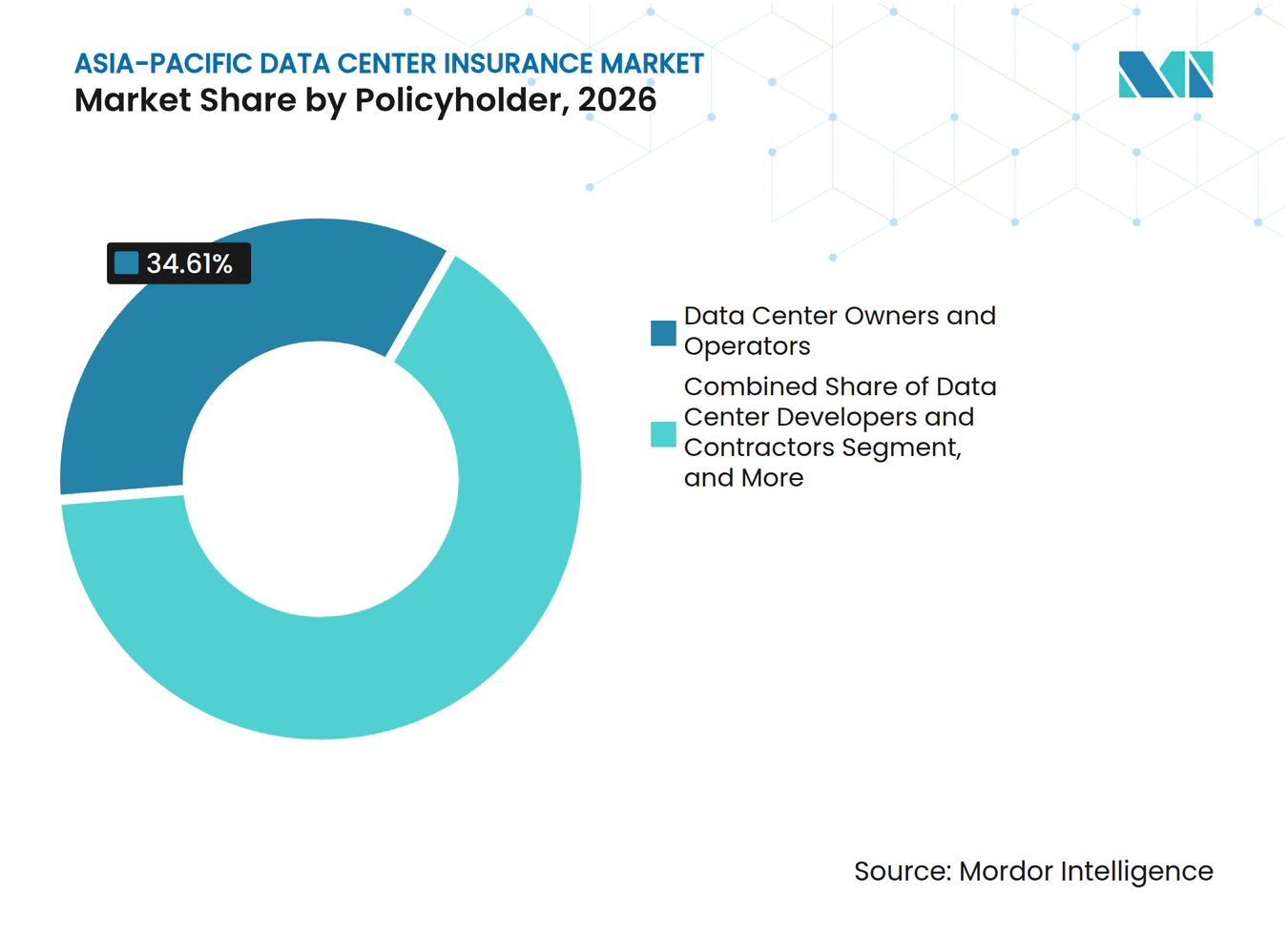
Cloud Providers Fuel the Fastest Premium GrowthData center owners and operators held 34.61% of the market in 2026. They hold the primary insurable interest in land, buildings, power systems, cooling plants, and structural fit-out. Their protection needs to cover property damage, equipment breakdown, business interruption, and construction exposures simultaneously. Colocation providers carry additional liability and service-level agreement exposure because they host multiple tenants on shared infrastructure. Developers and contractors need all-risk construction and erection cover during the build phase. Equipment and service providers may need product liability, professional indemnity, and technology errors and omissions protection.
Cloud service providers are projected to expand at a CAGR of 19.83% through 2032. Large cloud platforms have committed more than USD 160 billion to infrastructure in APAC since January 2024, thereby increasing insurance demand during construction and operations. A disruption at a hyperscale facility can affect thousands of downstream businesses at once. This can lead to correlated claims across property, cyber, and liability policies. The largest operators also require coverage that can operate across several jurisdictions and respond to long supply chains. Their scale is encouraging insurers to design broader lifecycle programs within the Asia-Pacific data center insurance market.

By Insurance Distribution Channel:
Brokers Anchor, MGAs AccelerateInsurance brokers and consultants held 49.23% of the market in 2026. Their role is important because a major campus may require several insurance lines, primary carriers, co-insurers, and reinsurers. Brokers coordinate technical information between operators and capacity providers. They also help structure coverage across property, cyber, construction, business interruption, and liability exposures. Direct insurance remains relevant for smaller enterprises and edge facilities with more standardized risk profiles. These sites can often use established commercial property arrangements, although their requirements are also changing as capacity becomes denser.
Managing general agents and specialist underwriting agencies are projected to grow at a CAGR of 19.48% through 2032. Their growth reflects demand for underwriting expertise in non-damage interruption, parametric triggers, service level agreement payouts, and liquid-cooling risks. Reinsurance-backed programs are becoming more common as the insured value of individual campuses approaches USD 30 billion. No single insurer can absorb the full exposure of the largest sites. Specialist platforms can pool capacity into coordinated programs that brokers can access. This channel development is supporting a more technical Asia-Pacific data center insurance industry.
By Data Center Size:
Hyperscale Builds Strain Traditional CapacityLarge data centers held 39.83% of the market in 2026. Established APAC locations have a significant installed base of wholesale and multi-tenant sites that were developed before the current AI investment cycle. These facilities have a better understanding of property risk profiles and established loss engineering practices. Their scale also attracts more competitive insurance capacity. Medium-sized facilities remain common in Japan, South Korea, and Australia, where corporate technology policies and data sovereignty priorities support self-hosted infrastructure. Small facilities and edge sites account for less premium volume but are important for low-latency inference workloads.
Hyperscale data centers are projected to grow at a CAGR of 19.67% through 2032. APAC's development pipeline reached 19.4 GW in 2025, with Malaysia, Thailand, and Indonesia supporting a large share of Southeast Asia's capacity under construction. Vantage Data Centers completed a USD 1.6 billion investment in the APAC platform in November 2025 and acquired a campus in Johor with more than 300 MW of potential capacity. Such projects need construction all-risk, delay-in-start-up, and operational property protection that can support a single large accumulation. Multiple power feeds, cooling trains, and network connections improve engineering quality but also increase the insured value per megawatt. The Asia-Pacific data center insurance market must therefore secure deeper and more coordinated capacity for hyperscale risks.
By Data Center Type:
Colocation Leads, Cloud Operators Drive ExpansionColocation data centers held 41.37% of the market in 2026. They host enterprise workloads, content delivery networks, and internet exchange points across established regional hubs. A cooling failure, fire, or flood can affect hundreds of customers at a single site. This creates simultaneous exposures to property, business interruption, cyber, and contractual liability. Enterprise and edge data centers provide corporate infrastructure and latency-sensitive workloads with closer proximity to users. Their insurance requirements are usually more standardized, but AI inference is adding new power and cooling demands at distributed locations.
Cloud service provider-operated facilities are projected to grow at a 19.15% CAGR through 2032. China has the region's largest cloud infrastructure base by power capacity, while India is adding capacity in Mumbai, Hyderabad, Chennai, Delhi-NCR, and Visakhapatnam. These facilities increasingly combine training, inference, and data processing in one location. This convergence makes traditional distinctions between cloud-specific and data center policies less useful. Underwriters are starting to assess these sites as a separate risk tier because computing density and outage consequences are both greater. The Asia-Pacific data center insurance market is responding with products that combine physical and digital risk protection.
Geography Analysis
China held 38.43% of the regional market in 2026. Its position reflects its large power-capacity base and substantial expansion of AI infrastructure. Property damage and equipment breakdown cover remain central because liquid-cooled GPU systems increase the exposure to fluid damage and thermal events. The market also requires greater attention to cyber wording because Chinese law prohibits indemnity for cyber fines in the jurisdiction. This compliance factor can affect how cross-border operators structure their policies. The Asia-Pacific data center insurance market size in China is supported by the concentration of domestic cloud platforms and continued investment in high-density computing.
India is projected to grow at a CAGR of 19.87% through 2032. Operational data center capacity reached nearly 1.8 GW in the first half of 2026, compared with 400 MW in 2019. The country also had a development pipeline of nearly 3.9 GW across projects under construction and planned. Investment commitments reached USD 38 billion in the first half of 2026 and USD 173 billion cumulatively since 2021. Google's October 2026 investment announcement in Andhra Pradesh illustrates the move toward large AI-focused sites. State data center policies, infrastructure incentives, and the Digital Personal Data Protection Act are supporting investment while raising the importance of consistent compliance and lifecycle risk programs.
Japan combines earthquake, typhoon, and flood exposures, while government plans for AI infrastructure investment are increasing the insured asset base. Australia has more than 300 operating data centers, and Sydney and Melbourne remain key locations for hyperscale development. Climate exposure, including heat and drought stress, is influencing premium terms for operational sites. Singapore is pursuing growth through densification and energy efficiency because power supply is limited under its Government Data Center Framework. South Korea's restriction on projects above 10 MW in Greater Seoul is directing activity toward secondary locations with less established risk engineering infrastructure.
Competitive Landscape
Market Concentration
The Asia-Pacific data center insurance market is moving from separate policy placements toward integrated lifecycle programs. Leading insurers, reinsurers, brokers, and specialist underwriters are differentiating themselves through engineering capability, balance-sheet capacity, and accumulation management. FM increased its capacity for FM Intellium to USD 5 billion in January 2026, creating a large single-carrier limit for qualifying risks.[3] Aon expanded its Data Center Lifecycle Insurance Program to USD 2.5 billion in January 2026. These actions illustrate demand for coordinated facilities that can cover construction, operational property, cyber, cargo, and business interruption needs. The main competitive advantage lies in assessing the whole site and its dependencies rather than pricing each policy in isolation.
APAC-native carriers, including Tokio Marine Holdings, MS&AD Insurance Group, Sompo Holdings, and QBE Insurance Group, compete alongside Chubb, AIG, Allianz, AXA, and Munich Re. QBE created a global data centers director position in August 2026 to coordinate underwriting, risk engineering, claims, and distribution. Chubb stated in February 2026 that it had strengthened its end-to-end data center offering across property, engineering, marine, surety, and professional liability. Sompo is extending its construction and power-generation underwriting capability into data center risks that also include energy and battery systems. These moves show that insurers are adapting their organizational structures as coverage needs become more technical. They also suggest that general commercial property terms will be less suitable for major AI-oriented campuses.
Parametric protection is an important competitive opening because grid outages, cooling failures, and service level agreement losses may not trigger ordinary property policies. Descartes Underwriting introduced its data center parametric product in January 2026, with limits of up to USD 140 million and protection against 20 natural perils. Risk carriers also need to manage concentrated values at hyperscale sites, where a single event may involve several owners, tenants, insurers, and reinsurers. The competitive field is not dominated by a small group with disclosed combined shares. Product breadth, technical assessment, and reinsurance access are therefore more visible measures of capability than a published leader table.
Asia-Pacific Data Center Insurance Industry Leaders
-
American International Group, Inc.
-
Allianz SE
-
Arch Capital Group Ltd.
-
Assicurazioni Generali S.p.A.
-
AXA SA
- *Disclaimer: Major Players sorted in no particular order
Asia-Pacific Data Center Insurance Market Companies Covered in this Report
- American International Group, Inc.
- Allianz SE
- Arch Capital Group Ltd.
- Assicurazioni Generali S.p.A.
- AXA SA
- Berkshire Hathaway Inc.
- Chubb Limited
- FM Insurance Company Limited
- Hannover Rück SE
- Liberty Mutual Holding Company Inc.
- MS&AD Insurance Group Holdings, Inc.
- Munich Reinsurance Company
- QBE Insurance Group Limited
- SCOR SE
- Sompo Holdings, Inc.
- Swiss Re AG
- Tokio Marine Holdings, Inc.
Recent Industry Developments in Asia-Pacific Data Center Insurance Market
- October 2026: Sompo Holdings presents data center risk assessment practice at the PARIMA Singapore conference, with the company's head of construction underwriting stating that data center risks now extend beyond traditional property lines into power generation, energy, and engineering coverage, requiring integrated multi-line solutions distinct from standard commercial property programs.
- August 2026: QBE Insurance Group Limited creates a newly established global data centers director role, appointing Jamie Thompson, formerly head of Financial Lines for QBE International Markets, with a mandate to consolidate underwriting, risk engineering, claims, and distribution into a single, integrated global proposition designed to address the full data center lifecycle rather than treating construction, operational property, business interruption, and cyber as separate placements.
- May 2026: AIG launches a dedicated data center insurance solution, integrating risk engineering support and coordinated claims capabilities across the construction, commissioning, and operations lifecycle, targeting data center developers and operators requiring end-to-end coverage support.
- January 2026: Aon plc expands its Data Center Lifecycle Insurance Program by USD 1 billion, bringing total capacity to USD 2.5 billion, covering construction all risks, delay in start-up, operational property damage, business interruption, cyber property damage, technology errors and omissions, service level agreement violation coverage, third-party liability, and project cargo and transport under a single coordinated facility.
Asia-Pacific Data Center Insurance Market Report Scope
The Asia-Pacific data center insurance market provides risk transfer and coverage solutions tailored to protect digital infrastructure. It encompasses policies for property damage, business interruption, cyber liability, equipment breakdown, and construction risks associated with data center facilities across the region.
The Asia-Pacific Data Center Insurance Market Report is Segmented by Insurance Types (Property Damage Insurance, Business Interruption Insurance, Equipment Breakdown Insurance, Cyber Insurance, Natural Catastrophe Insurance, General and Third-Party Liability Insurance, Construction and Erection All-Risk Insurance, and Other Insurance Types), Coverage Structure (Standalone Policies, Combined Property and Business Interruption Policies, Package Policies, Parametric Insurance, and Captive and Self-Insurance Arrangements), Risk Exposure (Fire and Explosion, Electrical and Mechanical Equipment Failure, Power Supply Disruption, Flooding and Water Damage, Windstorms and Severe Weather, Earthquakes and Other Geophysical Hazards, Cyber-Related Operational Disruption, and Third-Party and Supply Chain Disruption), Policyholder (Data Center Owners and Operators, Colocation Providers, Cloud Service Providers, Data Center Developers and Contractors, and Data Center Equipment and Service Providers), Insurance Distribution Channel (Direct Insurance, Insurance Brokers and Consultants, Managing General Agents and Specialist Underwriting Agencies, and Reinsurance-Supported Insurance Programs), Data Center Size (Small, Medium, Large, and Hyperscale), Data Center Type (Colocation, Cloud Service Providers (CSPs), and Enterprise and Edge), and Geography (China, India, Japan, Australia, Singapore, South Korea, and Rest of Asia-Pacific). The Market Forecasts are Provided in Terms of Value (USD).
Segmentation Overview
| Property Damage Insurance |
| Business Interruption Insurance |
| Equipment Breakdown Insurance |
| Cyber Insurance |
| Natural Catastrophe Insurance |
| General and Third-Party Liability Insurance |
| Construction and Erection All-Risk Insurance |
| Other Insurance Types |
| Standalone Policies |
| Combined Property and Business Interruption Policies |
| Package Policies |
| Parametric Insurance |
| Captive and Self-Insurance Arrangements |
| Fire and Explosion |
| Electrical and Mechanical Equipment Failure |
| Power Supply Disruption |
| Flooding and Water Damage |
| Windstorms and Severe Weather |
| Earthquakes and Other Geophysical Hazards |
| Cyber-Related Operational Disruption |
| Third-Party and Supply Chain Disruption |
| Data Center Owners and Operators |
| Colocation Providers |
| Cloud Service Providers |
| Data Center Developers and Contractors |
| Data Center Equipment and Service Providers |
| Direct Insurance |
| Insurance Brokers and Consultants |
| Managing General Agents and Specialist Underwriting Agencies |
| Reinsurance-Supported Insurance Programs |
| Small |
| Medium |
| Large |
| Hyperscale |
| Colocation |
| Cloud Service Providers (CSPs) |
| Enterprise and Edge |
| China |
| India |
| Japan |
| Australia |
| Singapore |
| South Korea |
| Rest of Asia-Pacific |
| By Insurance Type | Property Damage Insurance |
| Business Interruption Insurance | |
| Equipment Breakdown Insurance | |
| Cyber Insurance | |
| Natural Catastrophe Insurance | |
| General and Third-Party Liability Insurance | |
| Construction and Erection All-Risk Insurance | |
| Other Insurance Types | |
| By Coverage Structure | Standalone Policies |
| Combined Property and Business Interruption Policies | |
| Package Policies | |
| Parametric Insurance | |
| Captive and Self-Insurance Arrangements | |
| By Risk Exposure | Fire and Explosion |
| Electrical and Mechanical Equipment Failure | |
| Power Supply Disruption | |
| Flooding and Water Damage | |
| Windstorms and Severe Weather | |
| Earthquakes and Other Geophysical Hazards | |
| Cyber-Related Operational Disruption | |
| Third-Party and Supply Chain Disruption | |
| By Policyholder | Data Center Owners and Operators |
| Colocation Providers | |
| Cloud Service Providers | |
| Data Center Developers and Contractors | |
| Data Center Equipment and Service Providers | |
| By Insurance Distribution Channel | Direct Insurance |
| Insurance Brokers and Consultants | |
| Managing General Agents and Specialist Underwriting Agencies | |
| Reinsurance-Supported Insurance Programs | |
| By Data Center Size | Small |
| Medium | |
| Large | |
| Hyperscale | |
| By Data Center Type | Colocation |
| Cloud Service Providers (CSPs) | |
| Enterprise and Edge | |
| By Geography | China |
| India | |
| Japan | |
| Australia | |
| Singapore | |
| South Korea | |
| Rest of Asia-Pacific |
Key Questions Answered in the Report
What is the Asia-Pacific data center insurance market size?
The Asia-Pacific data center insurance market is projected to grow from USD 1.51 billion in 2026 to USD 4.12 billion by 2032, at a CAGR of 18.54% from 2027 to 2032.
Which insurance type is growing fastest for APAC data centers?
Cyber insurance is projected to record the highest growth among insurance types, at a 19.26% CAGR through 2032.
Why do data centers need lifecycle insurance programs?
Lenders and operators need continuous protection from construction through operations, including property, cyber, cargo, delay-in-start-up, and business interruption exposures.
Which policy structure is growing fastest in the region?
Parametric insurance is projected to expand at a 19.13% CAGR through 2032 because it can respond to specified disruption events without a physical damage trigger.
Which country is growing fastest for data center insurance in Asia-Pacific?
India is projected to expand at a 19.87% CAGR through 2032, supported by major data center capacity additions and investment commitments.