
Asia-Pacific Data Center Grid Infrastructure and Interconnection Market Size and Share
Market Overview
| Study Period | 2021 - 2032 |
|---|---|
| Forecast Data Period | 2027 - 2032 |
| Base Year Market Size (2026) | USD 12.86 Billion |
| Market Size (2027) | USD 15.02 Billion |
| Market Size (2032) | USD 28.27 Billion |
| Growth Rate (2027 - 2032) | 13.48 % |
| Market Concentration | High |
Major Players *Disclaimer: Major Players sorted in no particular order Image © Mordor Intelligence. Reuse requires attribution under CC BY 4.0. | |
Asia-Pacific Data Center Grid Infrastructure and Interconnection Market Analysis by Mordor Intelligence
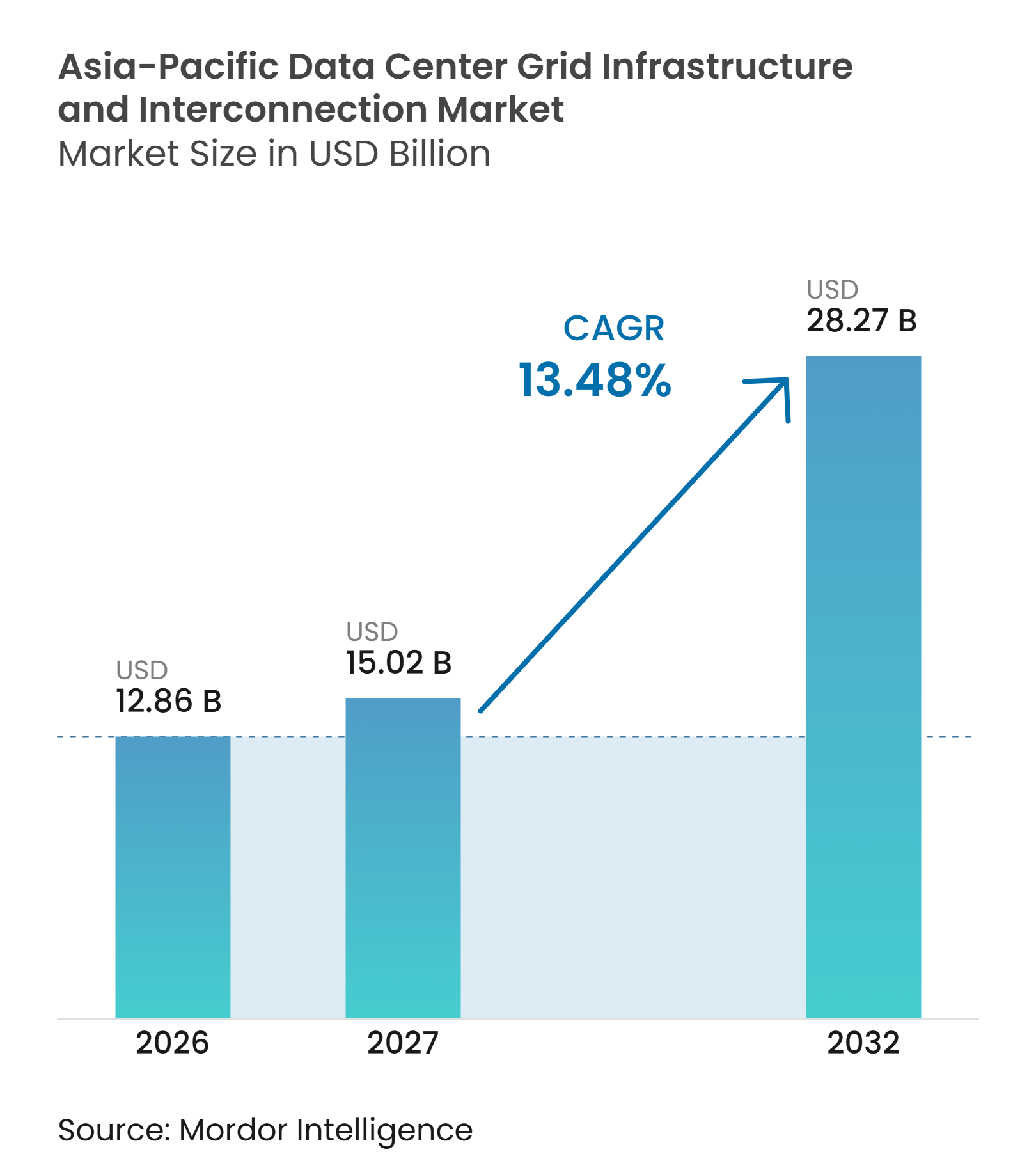
The Asia-Pacific data center grid infrastructure and interconnection market size was valued at USD 12.86 billion in 2026 and estimated to expand from USD 15.02 billion in 2027 to reach USD 28.27 billion by 2032, at a CAGR of 13.48% during the forecast period 2027-2032. The Asia-Pacific data center grid infrastructure and interconnection market is being shaped by larger campuses, higher computing loads, and a shift toward dedicated high-voltage connections. Power availability now carries more weight in site selection than land availability, especially where grid connection decisions take several years. National data localization rules and sovereign AI programs keep demand tied to individual national grids, which reduces the ability to move workloads to power-rich locations. This supports durable demand for substations, transformers, transmission links, and control systems across the region. Competition favors suppliers that can meet utility qualification requirements and provide equipment, engineering, commissioning, and long-term support as one package, while developers increasingly need to coordinate site selection, connection design, procurement, commissioning, and staged load additions from the earliest project planning stage, rather than treating interconnection as a later construction activity.
Key Report Takeaways
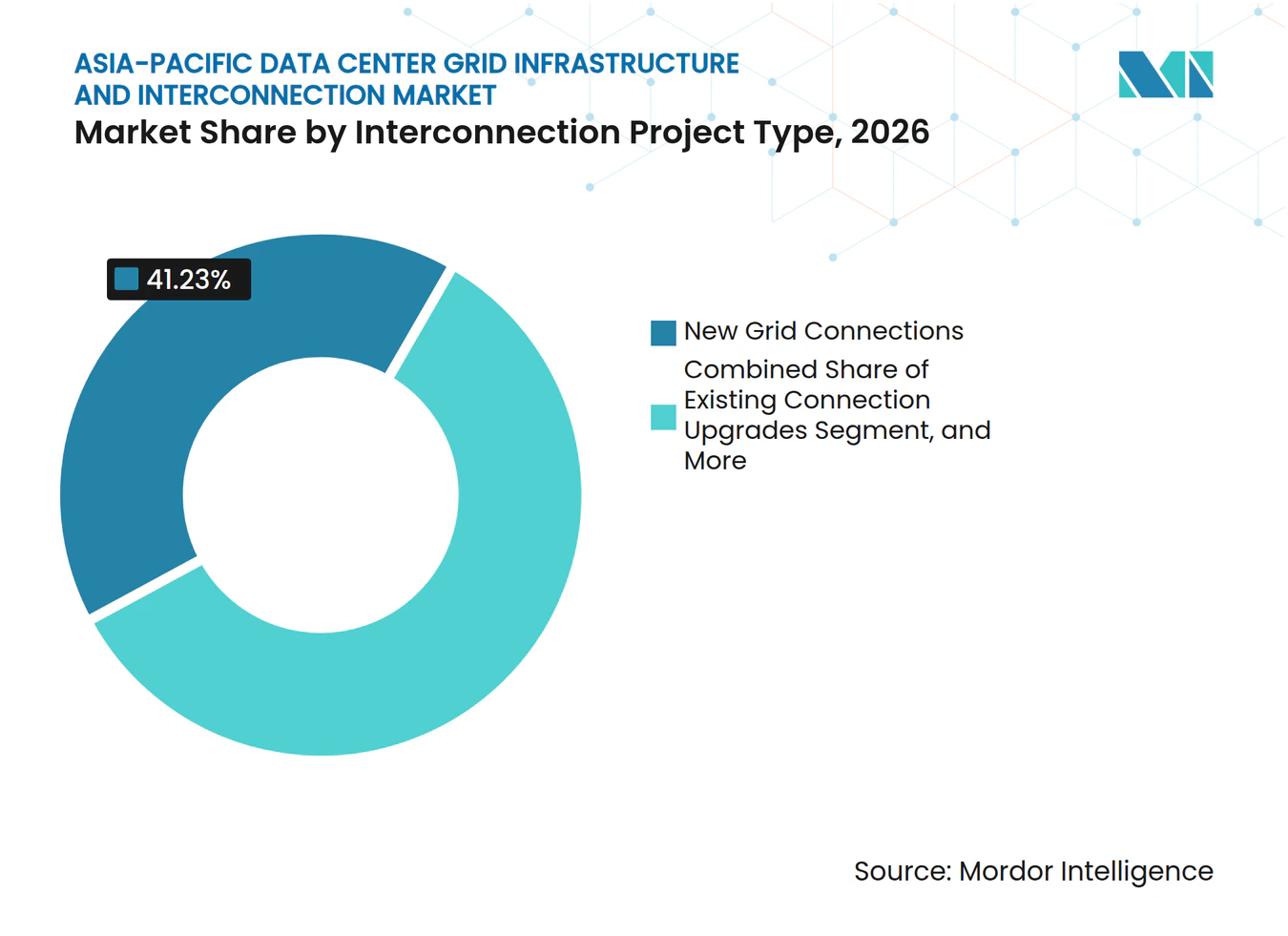
- By interconnection project type, new grid connections held 41.23% of the Asia-Pacific data center grid infrastructure and interconnection market share in 2026, while transmission lines and cables are projected to expand at a 14.28% CAGR through 2032.
- By infrastructure component, substations and switchyards accounted for 31.09% of the Asia-Pacific data center grid infrastructure and interconnection market size in 2026, while grid connection, control, and monitoring systems are projected to expand at a 14.37% CAGR through 2032.
- By voltage level, high voltage accounted for 46.79% of revenue in 2026, while extra-high voltage is projected to expand at a 14.17% CAGR through 2032.
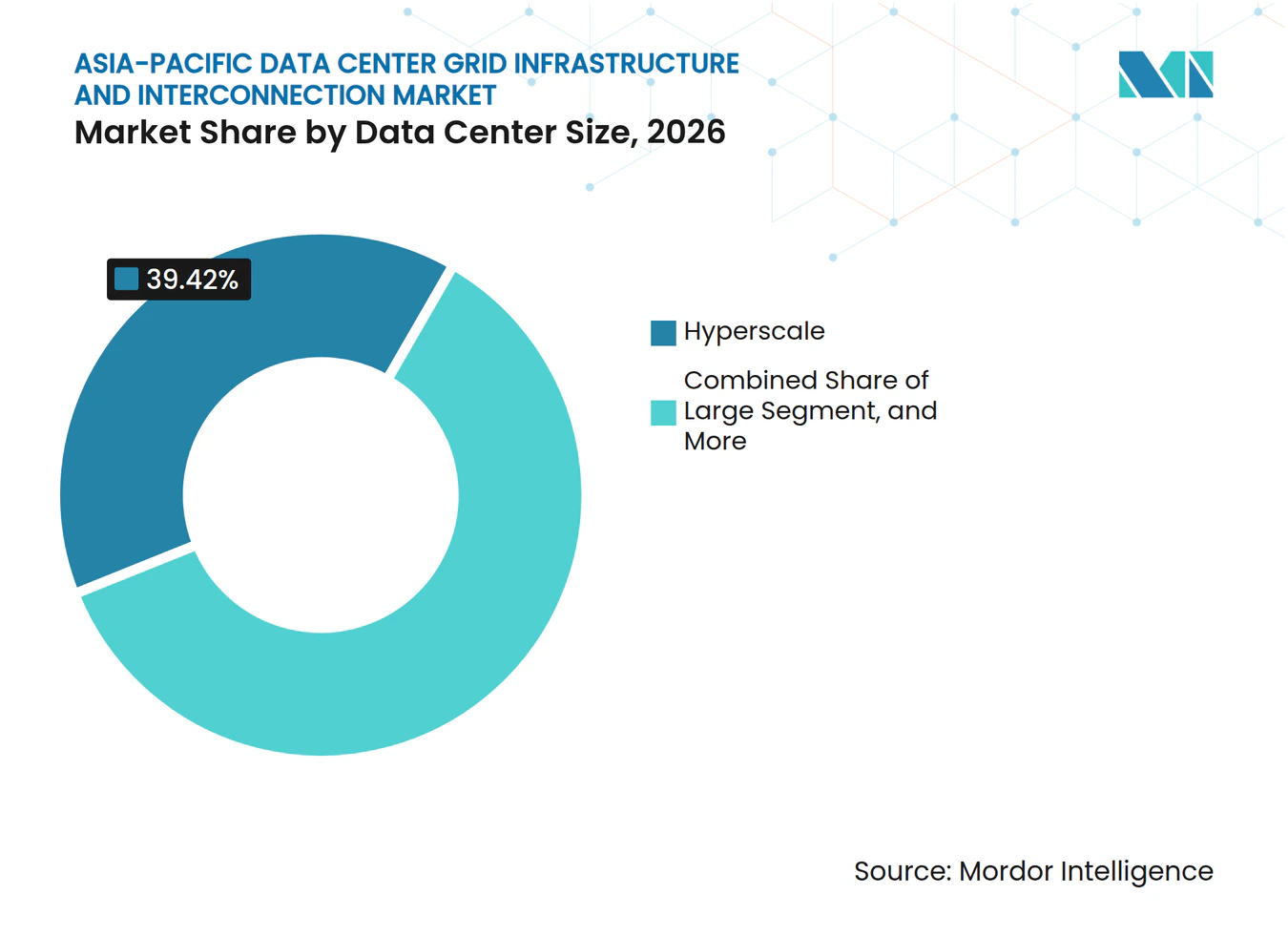
- By data center size, hyperscale facilities held 39.42% revenue share in 2026 and are projected to expand at a 14.26% CAGR through 2032.
- By data center type, colocation facilities held 48.40% revenue share in 2026, while cloud service providers are projected to expand at a 14.22% CAGR through 2032.
- By geography, China held 45.51% revenue share in 2026, while India is projected to expand at a 15.13% CAGR through 2032.
Note: Market numbers in this report are based on Mordor Intelligence's proprietary estimation framework, which combines nine months of actuals with Q4 projections for base year 2026.
Market Trends and Insights
Drivers Impact Analysis of Asia-Pacific Data Center Grid Infrastructure and Interconnection Market*
| Driver | (~) % Impact on CAGR Forecast | Geographic Relevance | Impact Timeline |
|---|---|---|---|
| Hyperscale and AI-Led Data Center Expansion | +3.5% | Global, concentrated in China, Japan, Australia, and Singapore | Short term (≤ 2 years) |
| Greenfield Data Center Construction in Emerging Asia-Pacific Markets | +2.8% | India, Malaysia, Indonesia, Thailand, Vietnam | Medium term (2-4 years) |
| Rising Power Density and High-Voltage Connection Requirements | +2.3% | Asia-Pacific core, with spillover to India, South Korea, and Australia | Medium term (2-4 years) |
| Data Localization and Digital Infrastructure Incentives | +1.9% | India, Indonesia, Japan, South Korea, at national level | Medium term (2-4 years) |
| Grid Modernization and Renewable Energy Integration | +1.5% | China, Australia, Japan, and Southeast Asia | Long term (≥ 4 years) |
| Grid Connection Delays Driving Modular and Onsite Power Solutions | +0.8% | Japan, Singapore, South Korea, with spillover to Australia | Short term (≤ 2 years) |
| Source: Mordor Intelligence | |||
Hyperscale and AI-Led Data Center Expansion
The Asia-Pacific data center grid infrastructure and interconnection market is responding to large new loads from hyperscale and AI-focused campuses. Individual campuses now exceed 100 MW in some cases, and Australian proposals have approached 800 MW. A dedicated substation for a single digital campus can therefore match the scale once planned for an industrial district, with high-voltage equipment selected around the expected computing load and future expansion. This shifts procurement from a facilities decision to a grid-planning requirement, and it increases demand for transmission-grade equipment in the Asia-Pacific data center grid infrastructure and interconnection market. It also requires early coordination among the developer, utility, equipment supplier, and construction teams.
Greenfield Data Center Construction in Emerging Asia-Pacific Markets
Greenfield construction outside China, Japan, Singapore, and Australia is expanding the need for new connection infrastructure. India’s Ministry of Power projected 26.3 GW of additional data center electricity demand by 2031-32, and 17 GW of connectivity applications had been submitted to State Transmission Utilities by May 2026. Announced Indian data center investment exceeded USD 180 billion by September 2026, and commitments recorded in the first 9 months of 2026 were 3.3 times the full-year 2025 level. New 400 kV and 765 kV substations in Andhra Pradesh, Odisha, and Madhya Pradesh are being planned on 12-36 month schedules to serve announced projects. The timing of grid connection, rather than funding, has become the main condition for project activation in these locations. Greenfield projects also require new transmission corridors that do not follow existing utility rights-of-way, broadening the scope of spending in the Asia-Pacific data center grid infrastructure and interconnection market.
Rising Power Density and High-Voltage Connection Requirements
AI training and inference clusters require far more power per rack than traditional enterprise deployments. The International Energy Agency reported that AI server power density increased 11-fold between 2020 and 2025. Larger AI clusters can require electricity at the scale of a mid-sized urban center. This moves facilities from 66 kV connections toward 220 kV or 400 kV dedicated transformer and substation arrangements. Andhra Pradesh Transco is designing a phased 765 kV, 400 kV, and 220 kV network for the Visakhapatnam cluster, which is planned to serve a 15 GW IT power load by 2036-37. Higher voltage requirements increase the role of specialized engineering, protection systems, and utility coordination within the Asia-Pacific data center grid infrastructure and interconnection market.
Data Localization and Digital Infrastructure Incentives
Data localization rules and public digital programs make grid connectivity a policy priority in several Asian economies. China’s National Energy Administration requires coordinated grid and data center planning in its computing-power and electricity pilot program in Inner Mongolia, Qinghai, Xinjiang, and Heilongjiang. The program requires new national-hub data centers to obtain 80% of their electricity from green sources. Tamil Nadu Transmission Corporation announced a 400/230-110 kV gas-insulated substation at Ambattur Industrial Estate for a requested data center load of 1,036 MVA. These requirements direct project developers toward specified grid nodes and make the related infrastructure difficult to relocate. The resulting investment is more durable than discretionary capacity because the workloads must remain within the country or policy-defined region. This supports recurring demand across the Asia-Pacific data center grid infrastructure and interconnection market, even when cloud capacity decisions change elsewhere.
Restraints Impact Analysis of Asia-Pacific Data Center Grid Infrastructure and Interconnection Market*
| Restraint | (~) % Impact on CAGR Forecast | Geographic Relevance | Impact Timeline |
|---|---|---|---|
| Long Utility Approval and Grid-Connection Lead Times | -2.5% | Japan, South Korea, Australia, with spillover to India | Medium term (2-4 years) |
| High Capital Intensity and Specialized Engineering Requirements | -1.8% | Global, most acute in emerging Asia-Pacific markets | Long term (≥ 4 years) |
| Transformer and High-Voltage Equipment Supply Constraints | -1.4% | Asia-Pacific core, amplified in import-dependent markets | Short term (≤ 2 years) |
| Cybersecurity and Utility Acceptance Risks for Digital Substations | -0.9% | Japan, South Korea, Australia, Singapore, expanding to India and Southeast Asia | Medium term (2-4 years) |
| Source: Mordor Intelligence | |||
Long Utility Approval and Grid-Connection Lead Times
Grid approval processes remain a persistent operating constraint for developers and equipment suppliers. Data center applications in Greater Tokyo reached 15.4 million kW by June 2025, which was 27% of the area’s 2025 peak electricity demand. Projects can wait up to 10 years for a supply commencement decision after technical and regulatory review. In South Korea, 63% of planned data centers are seeking connections in the Seoul metropolitan area, where capacity review can take up to 2 years, and more than 53% of first-pass applications received a supply-unavailable decision.[1] Developers may order transformers and switchgear before site approval is certain, which ties limited equipment capacity to uncertain project schedules. These delays reduce equipment utilization and extend project timelines across the Asia-Pacific data center grid infrastructure and interconnection market.
High Capital Intensity and Specialized Engineering Requirements
Transmission-level connections require specialized equipment and qualified delivery teams. A 100 MW hyperscale campus with a 220 kV connection can require a gas-insulated substation, high-voltage transformers, protection relays, grid studies, and site-specific utility approvals. Major technology companies spent more than USD 400 billion globally on capital expenditure in 2025, and the International Energy Agency projected a further 75% increase in 2026. The limiting resources are not only capital but also qualified grid engineers, substation integration firms, and high-voltage installers. Smaller colocation developers in Indonesia, Vietnam, and Thailand can face longer routes to utility acceptance than large operators with established engineering partners. This gives suppliers with regional service capability and utility experience a clear advantage in the Asia-Pacific data center grid infrastructure and interconnection market.
*Our forecasts treat driver/restraint impacts as directional, not additive. The impact forecasts reflect baseline growth, mix effects, and variable interactions.
Asia-Pacific Data Center Grid Infrastructure and Interconnection Market Segment Analysis
By Interconnection Project Type:
New Connections Support Capacity AdditionsNew grid connections accounted for 41.23% of the Asia-Pacific data center grid infrastructure and interconnection market share in 2026. This reflects the need to bring large new data center capacity onto transmission and distribution networks. New connection projects commonly include substations, transformers, protection systems, dedicated feeders, utility studies, and contractual capacity arrangements. The infrastructure must be ordered and tested before data halls are commissioned, even when server deployment follows a staged schedule. They are especially important in India, Malaysia, Indonesia, Thailand, and Vietnam, where new campuses are being built outside mature urban clusters. The required scope varies by network condition, but it commonly extends beyond the data center boundary to the designated utility connection point.
Transmission lines and cables are projected to expand at a 14.28% CAGR through 2032. Greenfield campuses frequently require dedicated high-voltage corridors, rather than limited upgrades to existing utility connections. IREN signed a connection agreement with ElectraNet in June 2026 for its 800 MW Bundey campus in South Australia, securing 4 330 kV feeder exits without network upgrades. This type of agreement shows the scale and specific design of new campus connections. Existing connection upgrades remain relevant in Japan and Singapore, where land for new substations is limited. Dedicated lines are gaining importance as hyperscalers seek single-tenant access that avoids capacity-sharing limits at utility-managed substations.



By Infrastructure Component:
Digital Monitoring Systems Outpace Physical EquipmentSubstations and switchyards accounted for 31.09% of the Asia-Pacific data center grid infrastructure and interconnection market in 2026. They form the interface between transmission systems and high-voltage data center intakes. Power transformers, transmission lines and cables, and switchgear and protection systems make up the rest of the main physical infrastructure requirement. Each component must meet local utility standards and coordinate with the site’s planned power profile. Gas-insulated equipment is important in land-constrained areas, particularly in dense markets. Suppliers also need local commissioning and service capability because connection assets are operated under utility acceptance conditions.
Grid connection, control, and monitoring systems are projected to expand at a 14.37% CAGR through 2032. Utilities are increasingly requiring real-time monitoring, automated fault isolation, and IEC 61850 communication capabilities for large new loads. Research in the IEEE Internet of Things Journal noted that IEC 61850 digital substation architecture can improve operations while expanding the cyberattack surface, which requires layered controls. This adds cybersecurity and data management requirements to the engineering scope. Japan’s TEPCO Power Grid and Korea Electric Power Corporation are among utilities seeking to integrate advanced monitoring as part of connection approval. The segment is therefore both a compliance requirement and a point of differentiation for providers serving the Asia-Pacific data center grid infrastructure and interconnection market.
By Voltage Level:
Extra-High Voltage Gains Ground With Campus ScaleHigh-voltage connections accounted for 46.79% of revenue in 2026. They remain the main connection choice for hyperscale and large colocation sites across the region. High-voltage equipment provides the capacity and power quality required for dense computing loads. It also supports a direct connection structure that reduces reliance on lower-voltage distribution assets. Utilities use these arrangements to define the data center’s point of connection and protection responsibilities. The Asia-Pacific data center grid infrastructure and interconnection market continues to rely on high-voltage configurations, in which campuses require substantial, stable loads.
Extra-high voltage is projected to expand at a 14.17% CAGR through 2032. Larger AI campuses favor transmission-level connections that reduce distribution losses and support high-density GPU loads. Andhra Pradesh Transco’s planned 765 kV, 400 kV, and 220 kV network for Visakhapatnam illustrates this change. The Maharashtra Electricity Regulatory Commission approved a 400/220 kV gas-insulated substation at Ambernath under a dedicated distribution facility framework. Low and medium-voltage connections will remain relevant for enterprise and edge sites. Their share of spending is likely to decline as average campus power requirements rise.
By Data Center Size:
Hyperscale Facilities Lead Demand and ExpansionHyperscale data centers accounted for 39.42% of revenue in 2026 and are projected to grow at a 14.26% CAGR through 2032. This makes hyperscale the largest and fastest-expanding data center size category in the Asia-Pacific data center grid infrastructure and interconnection market. Large campuses need dedicated substations, high-voltage feeders, and carefully coordinated transformer capacity. The concentration of demand in these projects keeps suppliers focused on equipment capable of handling large, continuous loads, with capacity allowances for phased additions. It also means that each site can require planning normally associated with a local industrial network. The large connection requirement can make the delivery sequence of grid assets as important as the data center's construction sequence.
Large data centers form the next level of connection demand. These operators have outgrown medium-voltage configurations but may not need the full architecture of a hyperscale campus. Small and medium-sized facilities are becoming more relevant as edge computing and data localization programs shift workloads to secondary cities. This is visible in India, Indonesia, and Vietnam, where local capacity can support services that cannot be located solely in regional hubs. The equipment requirement per site is smaller, but the number of projects can be significant. Suppliers will need product ranges that suit both major campuses and distributed facilities without weakening compliance with utility standards.

By Data Center Type:
Colocation Retains Scale While CSPs Add Direct ConnectionsColocation facilities held 48.40% of the market revenue in 2026. Their position reflects established interconnection frameworks and a large supply pipeline across core Asia-Pacific locations. Colocation providers typically deploy dedicated high-voltage substations as part of campus infrastructure. This creates long-duration demand for transformers, switchgear, monitoring systems, and cables. Their multi-tenant model supports repeatable infrastructure designs, even though each utility connection must be approved locally. The Asia-Pacific data center grid infrastructure and interconnection market benefits from this base of operational and planned colocation capacity.
Cloud service providers are projected to expand at a 14.22% CAGR through 2032. Hyperscaler self-build programs are increasingly using direct transmission connections rather than relying solely on colocation relationships. This creates demand for customized, often extra-high-voltage connection packages. Neocloud providers have added another source of high-performance computing demand between traditional cloud and colocation formats. Enterprise and edge facilities continue to serve lower-voltage requirements, especially in secondary cities. Together, these formats create a broad range of grid connection needs, from standardized colocation substations to single-campus transmission projects.
Geography Analysis
China held 45.51% of the Asia-Pacific data center grid infrastructure and interconnection market share in 2026. Its position is supported by national directives that coordinate computing capacity and power grid planning at the provincial level. The National Energy Administration introduced pilots in Inner Mongolia, Qinghai, Xinjiang, Heilongjiang, Beijing-Tianjin-Hebei, and the Yangtze River Delta. Beijing data centers consumed 534 million kWh of green electricity in the first quarter of 2026. New national hub data centers are expected to meet an 80% green-electricity target under the Green Certificate framework.[2] This policy structure links demand to grid investment, making it less exposed to short-term capacity cycles.
India is projected to expand at a 15.13% CAGR through 2032, the highest rate among the covered geographies. Operational data center capacity reached 1,789 MW in the first half of 2026, with 509 MW under construction and 3,351 MW in the planned pipeline. The Ministry of Power projected 26.3 GW of added data center electricity demand by 2031-32. India also had 154 interstate transmission projects under construction, covering 39,792 circuit km and 401,510 MVA of transformation capacity. Data center approvals can take months, while transmission projects take years to commission. Japan held the third-largest regional position, and 8 large power companies committed in July 2026 to build or expand 30 substations, adding 15 million kW of capacity.
Australia had 9 GW of data center capacity in the Australian Energy Market Operator connection queue as of June 30, 2026, covering 17 projects in New South Wales, Victoria, and South Australia. AusNet had 8 GW of data center connection requests in its pipeline. Hyosung Heavy Industries signed a 5-year exclusive supply agreement valued at KRW 310 billion (USD 224 million) with AusNet for ultra-high-voltage transformers and reactors. Malaysia had 49 data centers with electricity supply agreements totaling 7.1 GW of maximum potential demand as of September 2025, and government estimates put possible data center electricity demand at 12.9 GW by 2030. Singapore, South Korea, Indonesia, and the Rest of Asia-Pacific account for the remaining demand. Singapore uses a call-for-applications process and requires new facilities to meet a power usage effectiveness of 1.3 or lower, while South Korea faces concentrated demand in Seoul.
Competitive Landscape
Market Concentration
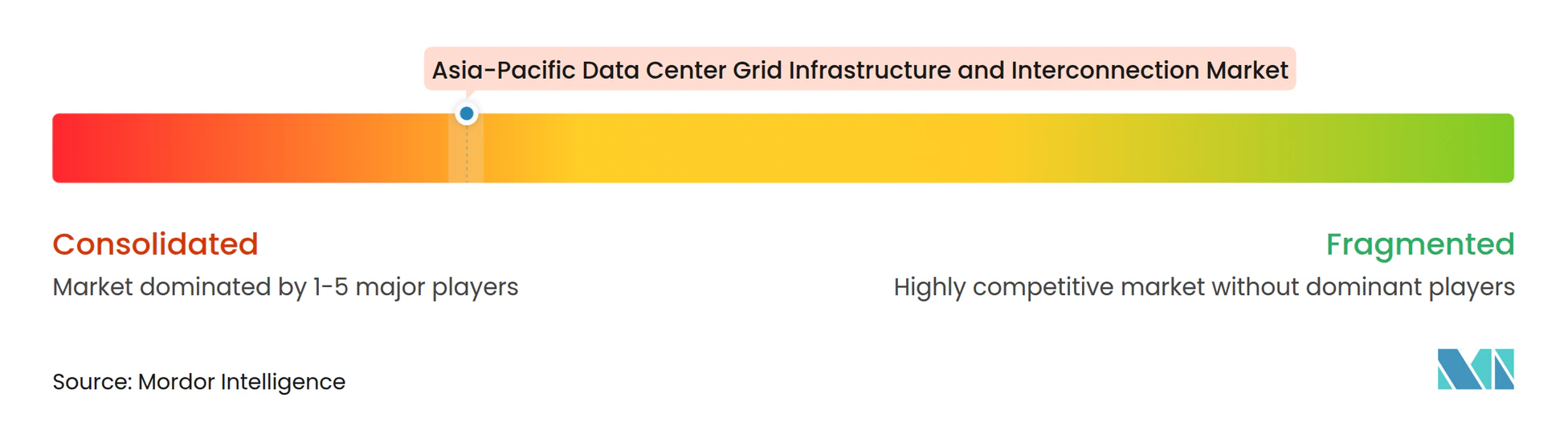
The Asia-Pacific data center grid infrastructure and interconnection market has a concentrated leading tier and a broad group of regional execution specialists. Schneider Electric, Hitachi Energy, Siemens Energy, ABB, and GE Vernova hold leading positions in high-voltage substations, transformers, and grid integration services. TBEA, NR Electric, LS ELECTRIC, Hyosung Heavy Industries, and Larsen and Toubro contribute much of the regional project execution volume. IEC 61850 requirements, factory acceptance tests, and local type certification pose practical barriers to entry. Japan, Australia, and Singapore require equipment suppliers to demonstrate compliance with utility requirements before participating in tenders. This makes regional service networks and past utility relationships important competitive assets.
Leading suppliers are moving toward integrated delivery models that combine equipment, engineering, commissioning, and long-term service. GE Vernova signed a 3+2-year master supply agreement with DCI Data Centers in July 2026 for gas-insulated switchgear, transformers, and transmission solutions in Australia and Asia-Pacific.[3] The arrangement illustrates a shift from stand-alone equipment orders to managed infrastructure supply. Eaton and Siemens Energy also announced a partnership in June 2025 for integrated modular data center construction and standardized onsite 500 MW power generation. These offers are relevant where grid connection timing is uncertain. They can help developers stage capacity while utility upgrades are being completed.
Korean suppliers are pursuing technologies that may reduce land and connection limits in dense locations. LS ELECTRIC opened a fully direct-current distribution factory in Cheonan in July 2026. Korea Electric Power Corporation, LS ELECTRIC, and LS Cable and System signed a technical cooperation agreement in July 2025 to develop a data center superconducting power grid using 23 kV cable for 154 kV-equivalent capacity. Hitachi Energy invested THB 455 million (USD 14 million) to increase transformer production capacity in Thailand by 60% by the end of 2027.
Asia-Pacific Data Center Grid Infrastructure and Interconnection Industry Leaders
-
Schneider Electric SE
-
Hitachi Energy Ltd.
-
Siemens Energy
-
ABB Ltd.
-
GE Vernova Inc.
- *Disclaimer: Major Players sorted in no particular order
Asia-Pacific Data Center Grid Infrastructure and Interconnection Market Companies Covered in this Report
- Schneider Electric SE
- Hitachi Energy Ltd.
- Siemens Energy AG
- ABB Ltd.
- GE Vernova Inc.
- Eaton Corporation plc
- Mitsubishi Electric Corporation
- Toshiba Energy Systems and Solutions Corporation
- Hyosung Heavy Industries Corporation
- TBEA Co., Ltd.
- NR Electric Co., Ltd.
- LS ELECTRIC Co., Ltd.
- Vertiv Holdings Co.
- Powell Industries, Inc.
- Legrand SA
- Huawei Technologies Co., Ltd.
- Delta Electronics, Inc.
- Cummins Inc.
- Caterpillar Inc.
- Larsen and Toubro Limited
Recent Industry Developments in Asia-Pacific Data Center Grid Infrastructure and Interconnection Market
- October 2026: Malaysia's trade minister announced that data center investors are now required to bear the cost of transmission upgrades and pay for allocated grid capacity even if not fully utilized, directly raising the upfront capital commitment for grid interconnection projects in the country's fastest-growing data center market.
- August 2026: L&T secured an order valued at up to INR 150 billion (USD 1.57 billion) from cloud platform Together AI to host an AI data center at its Chennai campus using 10,000 NVIDIA B300 chips, the largest GPU deployment in India, under L&T's Vyoma AI subsidiary, underscoring India's emergence as a hyperscale AI infrastructure destination.
- July 2026: Japan's 8 major power companies, including Tokyo Electric Power Company Holdings, committed to building or expanding 30 substations nationwide to meet AI data center demand, adding 15 million kW of transmission capacity, more than double projected data center electricity demand, by the early 2030s.
- July 2026: GE Vernova signed a 3+2-year Master Supply Agreement with DCI Data Centers covering gas-insulated switchgear, transformers, and power transmission solutions for hyperscale campus deployments across Australia and the Asia-Pacific region, securing critical equipment supply in a globally constrained market.
Asia-Pacific Data Center Grid Infrastructure and Interconnection Market Report Scope
The Asia-Pacific Data Center Grid Infrastructure and Interconnection Market includes the value of grid infrastructure and interconnection systems developed, installed, upgraded, and maintained to link data centers to utility power grids throughout the Asia-Pacific region.
The Asia-Pacific Data Center Grid Infrastructure and Interconnection Market Report is Segmented by Interconnection Project Type (New Grid Connections, Existing Connection Upgrades, Dedicated Transmission Infrastructure, and Substation and Grid Interconnection Upgrades), Infrastructure Component (Substations and Switchyards, Power Transformers, Transmission Lines and Cables, Switchgear and Protection Systems, and Grid Connection, Control and Monitoring Systems), Voltage Level (Low and Medium Voltage, High Voltage, and Extra-High Voltage), Data Center Size (Small, Medium, Large, and Hyperscale), Data Center Type (Colocation, Cloud Service Providers [CSPs], and Enterprise and Edge), and Geography (China, India, Japan, AUstralia, Singapore, South Korea, malaysia, Indonesia, and Rest of Asia-Pacific). The Market Forecasts are Provided in Terms of Value (USD).
Segmentation Overview
| New Grid Connections |
| Existing Connection Upgrades |
| Dedicated Transmission Infrastructure |
| Substation and Grid Interconnection Upgrades |
| Substations and Switchyards |
| Power Transformers |
| Transmission Lines and Cables |
| Switchgear and Protection Systems |
| Grid Connection, Control, and Monitoring Systems |
| Low and Medium Voltage |
| High Voltage |
| Extra-High Voltage |
| Small |
| Medium |
| Large |
| Hyperscale |
| Colocation |
| Cloud Service Providers (CSPs) |
| Enterprise and Edge |
| China |
| India |
| Japan |
| Australia |
| Singapore |
| South Korea |
| Malaysia |
| Indonesia |
| Rest of Asia-Pacific |
| By Interconnection Project Type | New Grid Connections |
| Existing Connection Upgrades | |
| Dedicated Transmission Infrastructure | |
| Substation and Grid Interconnection Upgrades | |
| By Infrastructure Component | Substations and Switchyards |
| Power Transformers | |
| Transmission Lines and Cables | |
| Switchgear and Protection Systems | |
| Grid Connection, Control, and Monitoring Systems | |
| By Voltage Level | Low and Medium Voltage |
| High Voltage | |
| Extra-High Voltage | |
| By Data Center Size | Small |
| Medium | |
| Large | |
| Hyperscale | |
| By Data Center Type | Colocation |
| Cloud Service Providers (CSPs) | |
| Enterprise and Edge | |
| By Geography | China |
| India | |
| Japan | |
| Australia | |
| Singapore | |
| South Korea | |
| Malaysia | |
| Indonesia | |
| Rest of Asia-Pacific |
Key Questions Answered in the Report
What is the size of the Asia-Pacific data center grid infrastructure and interconnection market?
The market was valued at USD 12.86 billion in 2026 and is estimated to reach USD 28.27 billion by 2032, with a 13.48% CAGR from 2027 to 2032.
What is driving grid infrastructure spending for data centers in Asia-Pacific?
Hyperscale construction, AI power density, data localization requirements, and the need for dedicated high-voltage connections are increasing infrastructure demand.
Which interconnection project type is the largest in Asia-Pacific?
New grid connections held 41.23% revenue share in 2026 because new campuses require transmission and distribution assets before operations begin.
Which data center type is expected to expand the fastest?
Cloud service providers are projected to expand at a 14.22% CAGR through 2032 as hyperscalers increasingly pursue direct transmission connections.
Which country leads regional demand for data center interconnection infrastructure?
China held 45.51% revenue share in 2026, supported by policies that coordinate data center locations with grid investment and renewable electricity planning.
Which country is projected to expand the fastest through 2032?
India is projected to expand at a 15.13% CAGR through 2032 as data center capacity and power infrastructure investment advance in parallel.