
Asia-Pacific Data Center Disaster Resilience and Business Continuity Market Size and Share
Market Overview
| Study Period | 2021 - 2032 |
|---|---|
| Forecast Data Period | 2027 - 2032 |
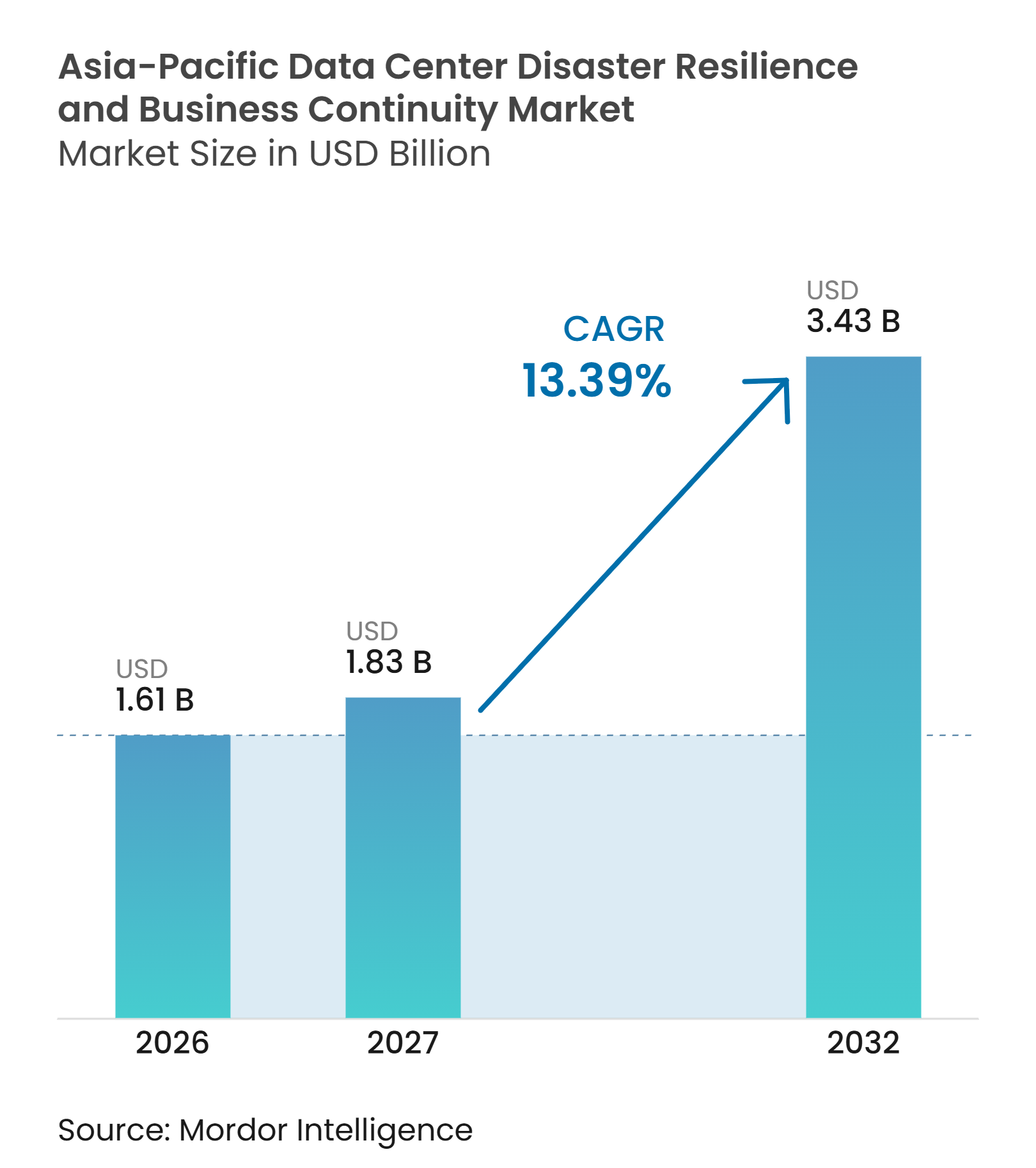
| Base Year Market Size (2026) | USD 1.61 Billion |
| Market Size (2027) | USD 1.83 Billion |
| Market Size (2032) | USD 3.43 Billion |
| Growth Rate (2027 - 2032) | 13.39 % |
| Market Concentration | Medium |
Major Players *Disclaimer: Major Players sorted in no particular order Image © Mordor Intelligence. Reuse requires attribution under CC BY 4.0. | |
Asia-Pacific Data Center Disaster Resilience and Business Continuity Market Analysis by Mordor Intelligence
The Asia-Pacific data center disaster resilience and business continuity market size is projected to expand from USD 1.61 billion in 2026 and USD 1.83 billion in 2027 to USD 3.43 billion by 2032, registering a CAGR of 13.39% between 2027 to 2032. The Asia-Pacific data center disaster resilience and business continuity market is moving from plan-based continuity toward tested recovery capabilities that can restore workloads under real operating conditions. Cyber incidents, cloud concentration, and rising infrastructure density are increasing the cost of service disruption for enterprises and public institutions. Buyers are placing greater emphasis on recovery orchestration, dependency mapping, and repeated testing because backup copies alone do not prove that operations can resume. Providers are responding by packaging software, managed recovery, security controls, and advisory support into broader service relationships. Regulatory requirements in financial services are also shifting procurement toward evidence that critical activities can remain available during disruption.
Key Report Takeaways
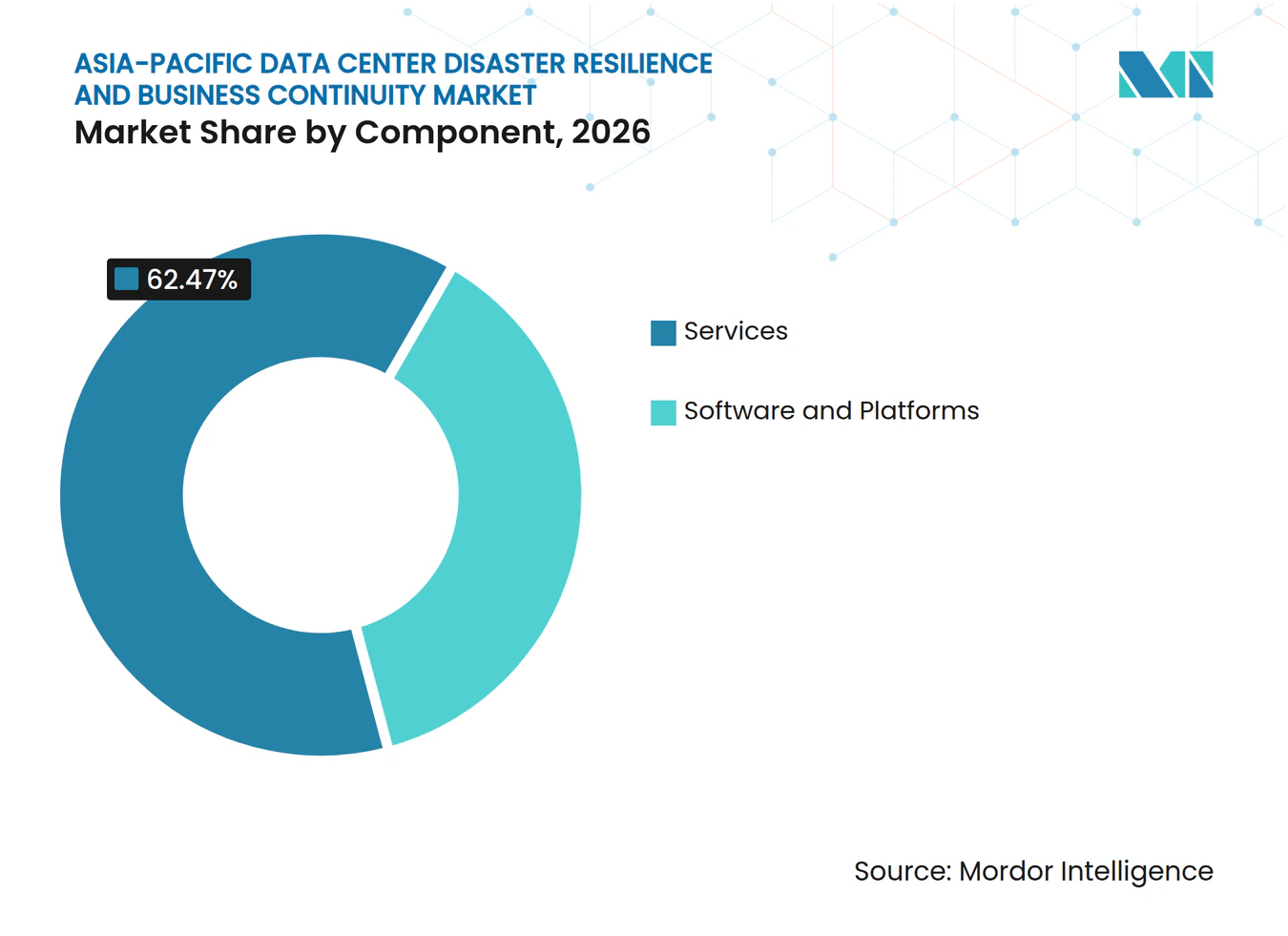
- By component, services held 62.47% of the Asia-Pacific data center disaster resilience and business continuity market share in 2026, while software and platforms are projected to be the fastest-expanding component through 2032.
- By deployment mode, cloud accounted for 53.39% of revenue in 2026 in the Asia-Pacific data center disaster resilience and business continuity market and is projected to remain the fastest-growing deployment mode through 2032.
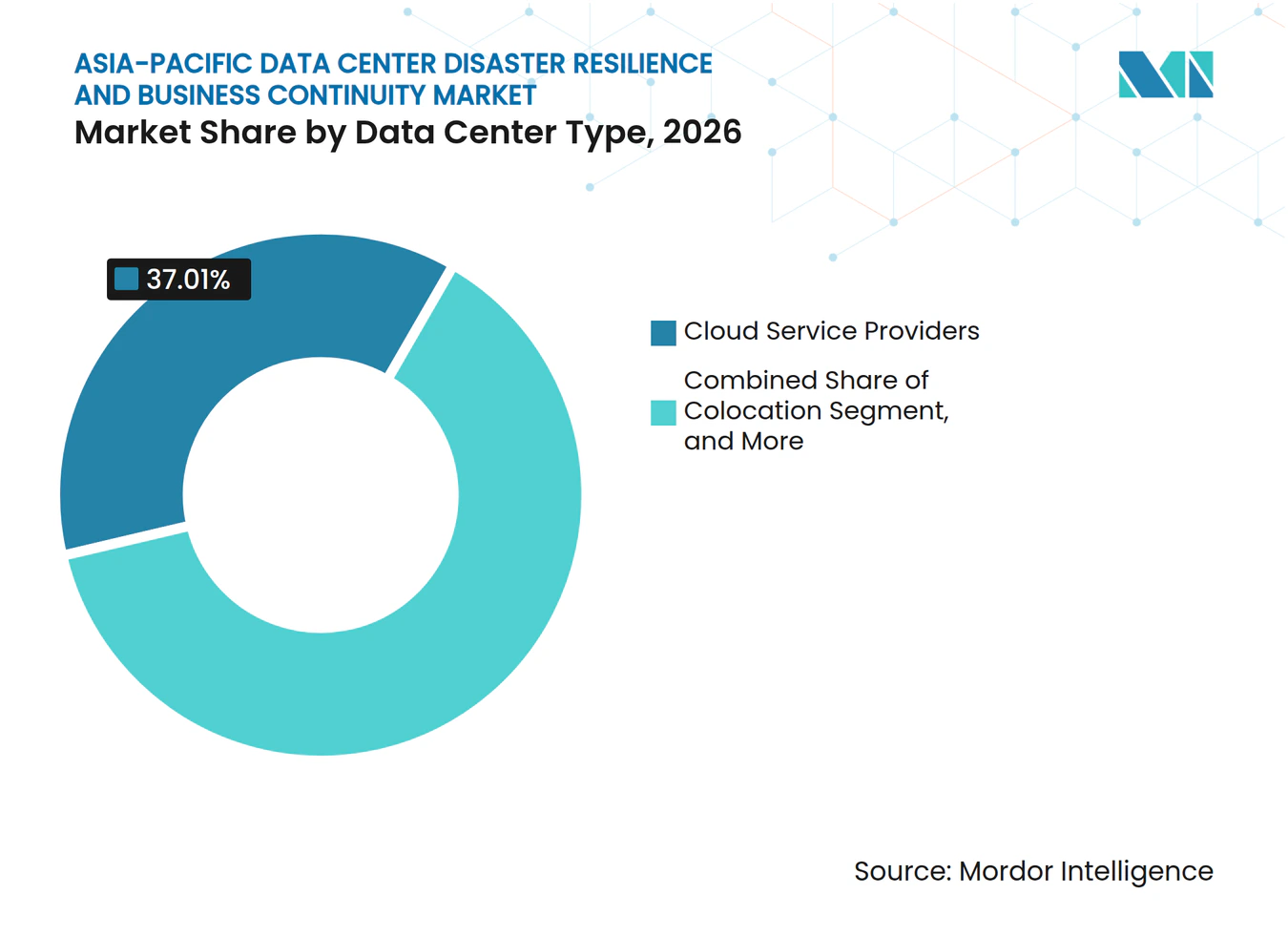
- By data center type, cloud service providers accounted for 37.01% of revenue in 2026 and are projected to be the fastest-growing data center type through 2032.
- By end-user industry, BFSI accounted for 26.61% of revenue in 2026 and is projected to remain the fastest-expanding vertical through 2032.
- By geography, China held 29.83% of revenue in 2026, while India is projected to expand at a 14.92% CAGR through 2032.
Note: Market numbers in this report are based on Mordor Intelligence's proprietary estimation framework, which combines nine months of actuals with Q4 projections for base year 2026.
Market Trends and Insights
Drivers Impact Analysis of Asia-Pacific Data Center Disaster Resilience and Business Continuity Market*
| Driver | (~) % Impact on CAGR Forecast | Geographic Relevance | Impact Timelein |
|---|---|---|---|
| Rising Ransomware and Cyberattack Exposure | +3.8% | Asia-Pacific-wide, acute in India, Japan, Australia, and South Korea | Short term (≤ 2 years) |
| Expansion of Cloud and Hybrid IT Workloads | +3.2% | Asia-Pacific-wide, concentrated in China, India, Singapore, and Australia | Medium term (2-4 years) |
| Accelerating Data Center and Digital Infrastructure Investment | +2.5% | India, Malaysia, Japan, Australia, Indonesia, and Southeast Asia | Medium term (2-4 years) |
| Stricter Data Protection and Critical Infrastructure Requirements | +1.8% | Australia, Singapore, Hong Kong, Malaysia, and South Korea | Medium term (2-4 years) |
| Power, Cooling, and Network Dependency Coupling | +1.2% | Singapore, Seoul, Tokyo, and Sydney | Long term (≥ 4 years) |
| Low Adoption of Compound-Shock Testing | +0.9% | Asia-Pacific-wide, acute in Japan, Indonesia, and the Philippines | Long term (≥ 4 years) |
| Source: Mordor Intelligence | |||
Rising Ransomware and Cyberattack Exposure
Ransomware is making validated recovery capability a central procurement requirement across the Asia-Pacific data center disaster resilience and business continuity market. Cyble recorded 238 ransomware attacks across Asia and the Pacific in the first quarter of 2026, 165% higher than in the first quarter of 2025. India recorded 45 attacks, while manufacturing, IT, and IT-enabled services experienced substantial exposure. The October 2026 disruption at IDCF Cloud in Japan showed how a cloud incident can affect many organizations through one shared service environment. The event affected 225 databases, 3.6 PB of data, 16,000 virtual machine disks, and 495 enterprise and government clients. Companies are therefore placing more weight on isolated recovery environments, validated recovery sequences, and automated failover rather than relying only on backup frequency.
Expansion of Cloud and Hybrid IT Workloads
Cloud adoption is broadening the scope of business continuity planning because applications, identities, data, and network paths now span multiple environments. The Asia-Pacific data center disaster resilience and business continuity market is affected by shared-responsibility boundaries that require customers to clearly define their own recovery procedures. Large organizations also need to account for interdependencies between cloud services and on-premises systems. AWS expanded Elastic Disaster Recovery into Bangkok, Malaysia, New Zealand, and Taipei during July 2026. The expansion improved the availability of cloud-native recovery options in locations where in-country recovery capacity matters for customers. Hybrid architectures are sustaining demand for tools that can coordinate recovery across cloud and local systems without leaving gaps between teams.
Accelerating Data Center and Digital Infrastructure Investment
New data center investment is increasing the number of facilities requiring resilience controls built into their operating model. Large campuses require coordinated plans for power, cooling, network connectivity, storage, and workload recovery because disruption in one layer can affect several services. Adani Enterprises announced in February 2026 that it planned to invest USD 100 billion in AI-ready data centers in India by 2035. This pipeline supports demand for early-stage resilience assessments, facility design reviews, and recovery testing before workloads become operational. It also creates a longer-term need for managed continuity services as tenants move into new sites. The Asia-Pacific data center disaster resilience and business continuity market benefits when continuity controls are specified during design rather than added after a service failure.
Stricter Data Protection and Critical Infrastructure Requirements
Operational resilience rules are giving financial institutions clearer reasons to test their ability to maintain critical services during disruption. Bank Negara Malaysia’s revised Risk Management in Technology policy requires redundancy, multiple distribution paths, and stand-in processing arrangements for critical services by September 30, 2027.[1] These expectations favor services that help organizations map critical processes, assess third parties, and document evidence of recovery. The Asia-Pacific data center disaster resilience and business continuity market is also supported by requirements that prioritize testing over written policies alone. Financial institutions must consider service-provider dependencies because cloud and colocation arrangements can affect their ability to meet disruption tolerances. This regulatory influence is likely to increase demand for simulation exercises and managed continuity programs.
Restraints Impact Analysis of Asia-Pacific Data Center Disaster Resilience and Business Continuity Market*
| Restraint | (~) % Impact on CAGR Forecast | Geographic Relevance | Impact Timeline |
|---|---|---|---|
| High Implementation and Assurance Costs | -2.4% | Asia-Pacific-wide, acute in Vietnam, Indonesia, and the Philippines | Short term (≤ 2 years) |
| Data Sovereignty and Regulatory Fragmentation | -1.8% | China, India, Vietnam, and Indonesia | Medium term (2-4 years) |
| Cross-Jurisdiction Recovery Bandwidth and Dependency Constraints | -1.3% | Multi-country enterprise operators across Southeast Asia and North Asia | Medium term (2-4 years) |
| Shortage of Resilience Engineering and Recovery Operations Talent | -1.0% | Asia-Pacific-wide, acute in tier-2 markets | Long term (≥ 4 years) |
| Source: Mordor Intelligence | |||
High Implementation and Assurance Costs
A credible multi-region recovery program requires investment in software, managed support, testing, security controls, and external assurance. Those costs can be difficult for mid-sized organizations that operate across several national jurisdictions. The Asia-Pacific data center disaster resilience and business continuity market, therefore, has a clear gap between large institutions with mature programs and smaller organizations with limited testing capacity. Costs increase when customers need different configurations for separate cloud regions, local data rules, and facility providers. Organizations may adopt recovery controls in stages, leaving some applications outside a tested program. Managed services and phased implementation can reduce this burden, although they do not remove the need for internal ownership of recovery decisions.
Data Sovereignty and Regulatory Fragmentation
Data localization rules can restrict where an organization stores copies of critical information and where it performs recovery. ASEAN markets apply different approaches to domestic storage, financial-sector backups, and cross-border transfers.[2] This variation may require separate recovery designs rather than a single regional architecture. ISO 22301 provides a common governance approach for business continuity management systems, but it cannot resolve national restrictions on data routing. These compliance factors add cost, design complexity, and time to deployment. Organizations operating across several jurisdictions may need to test each recovery route against the rules that apply to their specific data and service.
*Our forecasts treat driver/restraint impacts as directional, not additive. The impact forecasts reflect baseline growth, mix effects, and variable interactions.
Asia-Pacific Data Center Disaster Resilience and Business Continuity Market Segment Analysis
By Component:
Services Support Tested Recovery Programs as Platforms AdvanceServices held 62.47% of revenue in 2026. This position reflects enterprise demand for guidance and operating support that extends beyond a software deployment. Advisory services help organizations identify critical applications, dependencies, owners, and recovery priorities. Business impact analysis and resilience assessments also help translate broad continuity expectations into specific recovery objectives. Plan development services support crisis-response structures, communication procedures, and escalation paths. Managed continuity programs provide ongoing oversight for organizations without large internal resilience teams. Resilience testing, simulation, and training services remain relevant because a documented plan does not establish whether staff and suppliers can execute it under pressure. Financial-sector requirements are increasing the importance of exercises that show whether essential services remain within defined disruption limits. The Asia-Pacific data center disaster resilience and business continuity industry is therefore retaining a strong need for specialist implementation and assurance support.
Software and platforms are projected to be the fastest-expanding component through 2032. Integrated continuity and resilience management platforms can consolidate dependency mapping, recovery orchestration, test records, and plan documentation into a single operating environment. This consolidation reduces the need to manage disconnected tools across business impact analysis, planning, crisis response, and exercises. NetApp and Commvault announced a strategic alliance in March 2026 that combined Autonomous Ransomware Protection with Synthetic Recovery workflows. Their approach reflects buyer interest in linking detection, recovery, and validation steps more closely. Platform adoption does not eliminate the demand for services, as organizations still need to configure policies, test outcomes, and update processes. It does, however, give providers a route to make continuity work more repeatable across distributed environments. The component is gaining importance as enterprises seek a common view of resilience performance across cloud and on-premises assets.


By Deployment Mode:
Cloud Extends Its Lead While Hybrid Needs PersistCloud accounted for 53.39% of revenue by deployment mode in 2026. Its lead reflects the ongoing migration of applications and data to public cloud environments. Cloud-based continuity services allow organizations to provision recovery capacity without maintaining all standby infrastructure in their own facilities. They also make it easier to automate recovery sequences across geographically separated regions. The model introduces new responsibilities because customers must understand provider service limits, identities, configurations, and application dependencies. Recovery plans must address the possibility that a single-provider event can affect many tenants simultaneously. The Asia-Pacific data center disaster resilience and business continuity market size for cloud solutions is supported by enterprises that need regular proof that cloud workloads can be recovered. In-country recovery availability is also important where customers face data residency and latency requirements.
Cloud is projected to be the fastest-growing deployment mode through 2032 as the pool of cloud workloads needing protection grows. AWS’s regional expansion of Elastic Disaster Recovery gives customers in four additional Asia-Pacific locations access to managed recovery tooling. On-premises deployment remains relevant for sensitive data and regulated workloads that cannot be replicated freely across borders. Hybrid deployment is also gaining use among enterprises that retain legacy systems while moving selected applications to cloud platforms. These organizations need a coordinated failover that can manage both environments simultaneously. The operating pattern is changing from recovery back to a primary site toward cloud-to-cloud and hybrid recovery paths. This change favors managed recovery services and platforms that can track dependencies across different infrastructure layers. It also requires customers to test network capacity, access controls, and application sequence rather than assuming that replicated data alone is sufficient.
By Data Center Type:
Cloud Service Providers Integrate Recovery CapabilitiesCloud service providers held 37.01% of revenue by data center type in 2026. Hyperscale operators host a large and expanding share of enterprise applications, data, and digital services. Their recovery offerings are becoming an important part of the overall cloud service proposition. Customers often prefer native recovery services because they can be integrated with existing cloud storage, networking, and identity settings. This can simplify implementation for organizations that already use one primary platform. It can also create concentration risk when many critical services depend on a common provider region. The Asia-Pacific data center disaster resilience and business continuity market is responding with demand for recovery designs that account for provider outages and tenant-level failures. Cloud service providers are projected to remain the fastest-expanding data center type through 2032.
Colocation operators are important because many organizations place critical systems in third-party facilities rather than operate their own sites. Their resilience role includes facility redundancy, service-level commitments, connectivity options, and incident coordination. Enterprise and edge data centers also need tailored continuity plans as computing moves closer to users and devices. Distributed locations may lack the redundancy found on large hyperscale campuses. Huawei and the Industrial and Commercial Bank of China released the Resilient DC White Paper in September 2025. The paper introduced a maturity model that covers business continuity, security, adaptive operations, and AI operations. This type of framework can influence how buyers evaluate resilience capabilities in facilities and managed environments. Providers that combine infrastructure expertise with proven recovery processes can differentiate themselves in regulated and high-availability workloads.


By End-User Industry:
BFSI Maintains Demand Leadership Through Compliance NeedsBFSI accounted for 26.61% of revenue by end-user industry in 2026. Banks, insurers, and other financial institutions depend on uninterrupted transaction processing, secure customer access, and clear evidence of operational controls. Their exposure to financial loss, consumer harm, and supervisory action makes recovery testing a continuing requirement. Regulatory expectations in Australia, Hong Kong, and Malaysia have increased attention to critical process mapping, supplier management, and continuity exercises. Bank Negara Malaysia’s policy requires controls over critical systems and processing arrangements to support service continuity. TCS enabled ICICI Lombard to implement automated multi-region disaster recovery on AWS Cloud during August 2025. The deployment illustrates the use of automated recovery in insurance operations. BFSI is projected to remain the fastest-expanding vertical through 2032.
IT and telecommunications organizations also have direct exposure because their services depend on the continuous availability of networks, applications, and data. Government and public administration bodies are likely to examine shared cloud recovery arrangements more closely following service disruptions affecting multiple agencies. Healthcare and life sciences organizations need to protect patient information and maintain access to critical clinical systems. Manufacturers must consider the continuity of plant operations, supply chains, and connected production systems. Retail and e-commerce firms require transaction availability during periods of high customer activity. Energy and utilities organizations face additional pressure because data center operations depend on reliable power systems. Each vertical has a different recovery priority, but all need clear ownership, tested procedures, and supplier coordination. This range of use cases broadens the addressable base for resilience services and platforms across the region.
Geography Analysis
China
China held 29.83% of the Asia-Pacific data center disaster resilience and business continuity market share in 2026. Its position is tied to the scale of domestic computing infrastructure and government-backed digital development. The Digital China program reported social investment above CNY 1 trillion (USD 137 billion) during the 14th Five-Year Plan period. It also reported more than 10.43 million standard computing racks, 18.5% above the 2024 total. New clusters in Inner Mongolia, Guizhou, and Gansu add to the need for coordinated recovery approaches across dispersed capacity. Domestic data and security requirements favor locally designed resilience architectures for sensitive workloads. Financial institutions also face business continuity management requirements, which support demand for advisory work and platform modernization. Huawei and ICBC’s resilience maturity model shows that local technology firms are seeking a stronger role in defining resilience requirements. Compliance and technology-sourcing conditions can limit cross-border designs, making domestic recovery capability particularly important.
India
India is projected to expand at a 14.92% CAGR through 2032, making it the fastest-expanding geography in the regional analysis. Data center development is creating a larger installed base of applications that need tested recovery procedures. Adani Enterprises’ stated plan for USD 100 billion of AI-ready data center investment through 2035 indicates the scale of new infrastructure being considered. New facilities create demand for resilience controls during design, commissioning, and tenant onboarding. Financial services, public digital services, and large enterprises are likely to require automated recovery as their use of the cloud expands. TCS’s work with ICICI Lombard showed a practical model for multi-region cloud recovery in the insurance sector. The opportunity is moderated by the cost of operating multi-region architectures and by uneven specialist skills across locations. Managed services and repeatable automation can help organizations build capability without establishing large internal teams.
Japan, South Korea, Australia, Singapore, Malaysia, Indonesia, and Other Asia-Pacific Markets
Japan has an established resilience environment, but the IDCF Cloud incident has sharpened attention on recovery validation and shared-service exposure. South Korea faces constraints on new data center projects in Greater Seoul, which can increase interest in cloud-based recovery alternatives. Australia’s operational resilience settings have increased scrutiny of critical service providers and continuity planning. Singapore remains a regional cloud and connectivity hub, although power access and land availability shape decisions on new capacity. Malaysia and Indonesia are gaining importance as data center and cloud locations for organizations seeking regional distribution. Veeam launched Veeam Data Cloud in Indonesia in September 2025 with locally hosted Microsoft 365 backup and recovery. The launch addressed in-country data residency needs through Microsoft Azure. AWS also extended disaster recovery availability into Malaysia, Bangkok, New Zealand, and Taipei during 2026. These developments show that local compliance and service availability are shaping recovery architectures across mixed markets in Asia-Pacific.
Competitive Landscape
Market Concentration
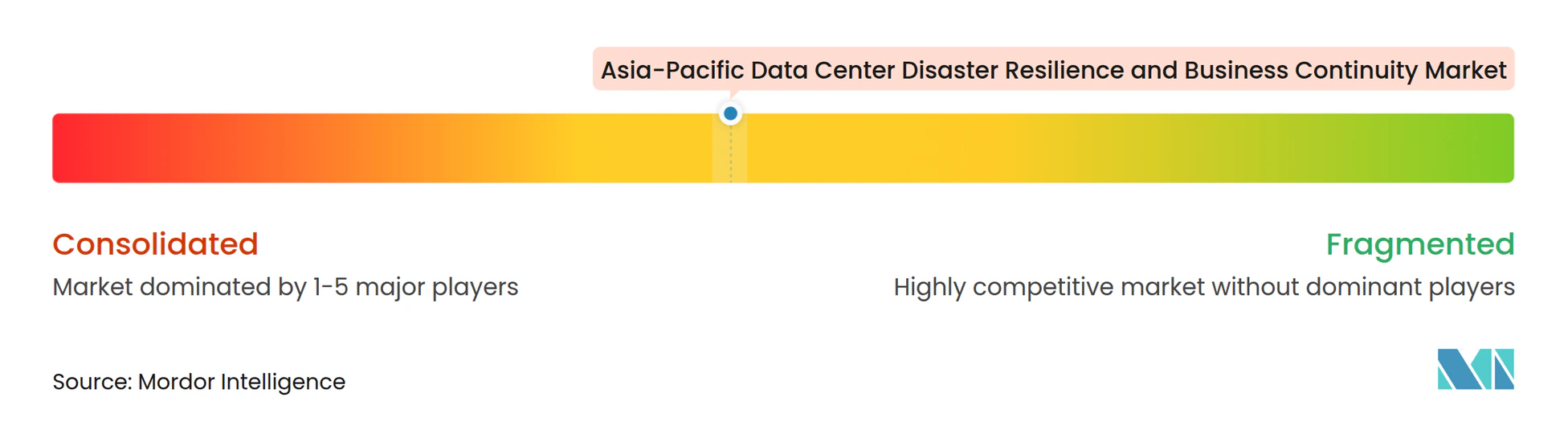
The Asia-Pacific data center disaster resilience and business continuity market is moderately concentrated. IBM, Microsoft, Amazon Web Services, Cisco, and Google have an advantage because continuity capabilities can be packaged with cloud, security, infrastructure, and managed-service contracts. Customers who have standardized on a hyperscale platform often select its native recovery tools for operational simplicity. That decision can reduce the addressable opportunity for independent vendors within a single cloud environment. Specialist companies such as Commvault, Veeam, NetApp, and Acronis compete through recovery depth, portability, and integration across environments. Their value proposition is strongest for organizations that need to avoid dependence on a single provider or operate a mixed infrastructure. NetApp and Commvault’s March 2026 alliance combined ransomware protection and synthetic recovery workflows. The move demonstrates how vendors are building combined offerings rather than relying on standalone backup products.
Regional services firms, including Fujitsu, NTT DATA, Tata Consultancy Services, HCL Technologies, and Wipro, compete through local delivery coverage and established client relationships. This model is particularly relevant in BFSI and government accounts, where operational knowledge and on-site support can influence supplier selection. TCS’s automated recovery deployment for ICICI Lombard is an example of a services-led strategy integrated with a client’s cloud environment. Huawei and ICBC’s 2025 resilience white paper is another strategic move that places a Chinese provider at the center of discussions on facility maturity criteria.[3] Providers are also using ISO 22301 alignment to demonstrate common business continuity management practices. A supplier’s ability to support exercises, evidence collection, and recovery coordination can matter as much as its software features. The Asia-Pacific data center disaster resilience and business continuity market, therefore, rewards vendors that can combine technology with operational support.
There is room for differentiation in compound-shock testing, which simulates multiple disruptions simultaneously. Cyber incidents can overlap with power failures, network disruption, flooding, earthquakes, or supplier outages across several Asia-Pacific locations. Many plans remain focused on a single failure scenario, leaving important dependencies untested. Vendors that support realistic simulations can help customers identify gaps before a major event occurs. Cloud providers are expanding regional recovery services, while specialists are emphasizing independent orchestration and portable recovery data. Veeam’s launch in Indonesia shows how vendors can tailor offerings to local data residency requirements.
Asia-Pacific Data Center Disaster Resilience and Business Continuity Industry Leaders
-
IBM Corporation
-
Microsoft Corporation
-
Amazon Web Services, Inc.
-
Fujitsu Limited
-
NTT DATA Corporation
- *Disclaimer: Major Players sorted in no particular order
Asia-Pacific Data Center Disaster Resilience and Business Continuity Market Companies Covered in this Report
- IBM Corporation
- Microsoft Corporation
- Amazon Web Services, Inc.
- Cisco Systems, Inc.
- HP Inc.
- Google LLC
- Oracle Corporation
- Verizon Communications Inc.
- Broadcom Inc.
- Fujitsu Limited
- NTT DATA Corporation
- Tata Consultancy Services Limited
- HCL Technologies Limited
- Wipro Limited
- Huawei Technologies Co., Ltd.
- Dell Technologies Inc.
- Commvault Systems, Inc.
- Veeam Software AG
- NetApp, Inc.
- Acronis International GmbH
Recent Industry Developments in Asia-Pacific Data Center Disaster Resilience and Business Continuity Market
- July 2026: AWS expanded Elastic Disaster Recovery to four new Asia-Pacific regions, Bangkok, Malaysia, New Zealand, and Taipei, bringing the service to 36 global regions. The expansion addressed in-country data recovery requirements in high-growth Asia-Pacific markets where cloud-native disaster recovery had previously been unavailable.
- March 2026: NetApp and Commvault announced a strategic alliance at the RSA Conference to deliver a closed-loop cyber resilience architecture combining AI-powered Autonomous Ransomware Protection with Commvault Synthetic Recovery. The joint solution targeted hybrid environments requiring automated and validated recovery with minimized data loss.
- February 2026: Asahi Group Holdings disclosed root-cause findings for the September 2025 ransomware attack that encrypted its Japan data center systems and exposed data of 1.52 million customers. The disclosure reinforced the business continuity implications of data center ransomware incidents across manufacturing operations.
- February 2026: Adani Enterprises announced a USD 100 billion commitment to build AI-ready data centers in India by 2035. The investment will increase the need for embedded disaster resilience capabilities across new large-scale facilities entering service during the forecast period.
Asia-Pacific Data Center Disaster Resilience and Business Continuity Market Report Scope
The Asia-Pacific Data Center Disaster Resilience and Business Continuity Market refers to the industry that provides software, platforms, and services to help data centers across the Asia-Pacific region prevent, withstand, respond to, and recover from disasters, system failures, cyberattacks, and operational disruptions.
The Asia-Pacific Data Center Disaster Resilience and Business Continuity Market Report is Segmented by Component (Software and Platforms, and Services), Deployment Mode (Cloud, On-Premises, and Hybrid), Data Center Type (Cloud Service Provider, Colocation, and Enterprise and Edge), End User Industry (BFSI, IT and Telecom, Government and Public Administration, Healthcare and Life Sciences, Manufacturing, Energy and Utilities, and Other End User Industries), and Geography (China, Japan, India, South Korea, Australia, Singapore, Malaysia, Indonesia, and Rest of Asia-Pacific). The Market Forecasts are Provided in Terms of Value (USD).
Segmentation Overview
| Software and Platforms | Integrated Continuity and Resilience Management Platforms |
| Standalone Business Impact Analysis and Dependency Mapping Software | |
| Standalone Continuity Planning and Documentation Software | |
| Standalone Crisis Response and Incident Coordination Software | |
| Others (Standalone Resilience Exercise and Testing Management Software, etc) | |
| Services | Advisory, Business Impact Analysis, and Resilience Assessment Services |
| Continuity and Crisis Response Plan Development Services | |
| Software Implementation and Systems Integration Services | |
| Resilience Testing, Simulation, and Training Services | |
| Managed Continuity Program Services |
| Cloud |
| On-Premises |
| Hybrid |
| Cloud Service Provider |
| Colocation |
| Enterprise and Edge |
| IT and Telecom |
| BFSI |
| Government and Public Administration |
| Healthcare and Life Sciences |
| Manufacturing |
| Retail and E-Commerce |
| Energy and Utilities |
| Other End User Industries |
| China |
| Japan |
| India |
| South Korea |
| Australia |
| Singapore |
| Malaysia |
| Indonesia |
| Rest of Asia-Pacific |
| By Component | Software and Platforms | Integrated Continuity and Resilience Management Platforms |
| Standalone Business Impact Analysis and Dependency Mapping Software | ||
| Standalone Continuity Planning and Documentation Software | ||
| Standalone Crisis Response and Incident Coordination Software | ||
| Others (Standalone Resilience Exercise and Testing Management Software, etc) | ||
| Services | Advisory, Business Impact Analysis, and Resilience Assessment Services | |
| Continuity and Crisis Response Plan Development Services | ||
| Software Implementation and Systems Integration Services | ||
| Resilience Testing, Simulation, and Training Services | ||
| Managed Continuity Program Services | ||
| By Deployment Mode | Cloud | |
| On-Premises | ||
| Hybrid | ||
| By Data Center Type | Cloud Service Provider | |
| Colocation | ||
| Enterprise and Edge | ||
| By End User Industry | IT and Telecom | |
| BFSI | ||
| Government and Public Administration | ||
| Healthcare and Life Sciences | ||
| Manufacturing | ||
| Retail and E-Commerce | ||
| Energy and Utilities | ||
| Other End User Industries | ||
| By Geography | China | |
| Japan | ||
| India | ||
| South Korea | ||
| Australia | ||
| Singapore | ||
| Malaysia | ||
| Indonesia | ||
| Rest of Asia-Pacific | ||
Key Questions Answered in the Report
What is the size of the Asia-Pacific data center disaster resilience and business continuity market?
The market is projected to increase from USD 1.61 billion in 2026 and USD 1.83 billion in 2027 to USD 3.43 billion by 2032, at a 13.39% CAGR.
What is driving demand for data center disaster resilience in Asia-Pacific?
Ransomware exposure, cloud and hybrid workloads, new data center capacity, and stricter continuity requirements are increasing demand for tested recovery capabilities.
Which component leads Asia-Pacific data center disaster resilience spending?
Services held 62.47% of revenue in 2026 because organizations need advisory support, testing, exercises, and managed continuity programs.
Why is cloud important for disaster recovery in Asia-Pacific?
Cloud accounted for 53.39% of revenue in 2026 and supports automated recovery across regional environments, although customers must address shared-responsibility and data residency requirements.
Which end-user sector has the largest role in this field?
BFSI held 26.61% of revenue in 2026 and is expected to expand fastest as financial institutions face stronger operational resilience and third-party risk requirements.
Which Asia-Pacific country is expanding fastest for data center resilience services?
India is projected to expand at a 14.92% CAGR through 2032, supported by new data center development and rising use of cloud-based recovery architectures.