
Asia-Pacific Data Center Demand Response and Energy Management Market Size and Share
Market Overview
| Study Period | 2021 - 2032 |
|---|---|
| Forecast Data Period | 2027 - 2032 |
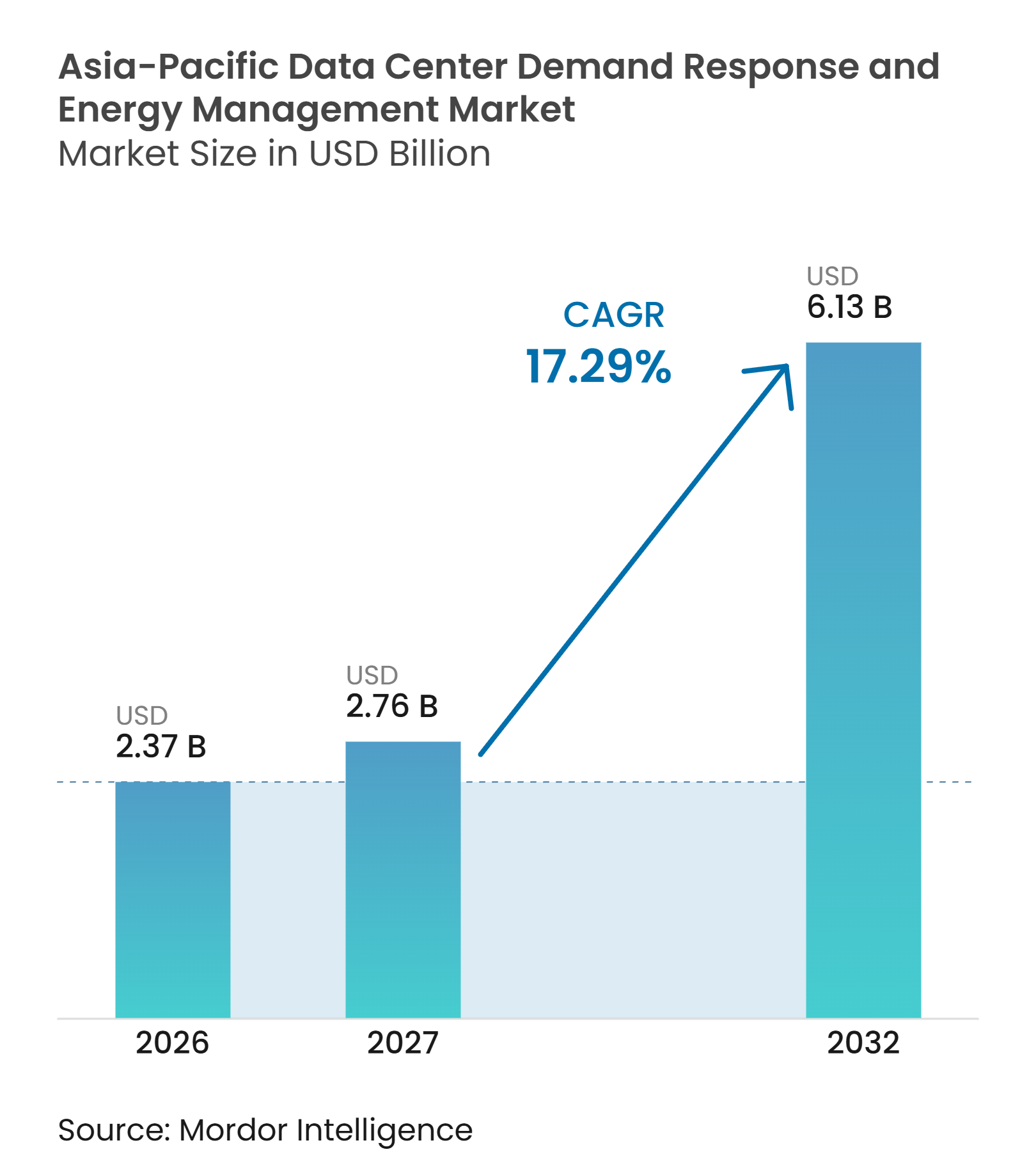
| Base Year Market Size (2026) | USD 2.37 Billion |
| Market Size (2027) | USD 2.76 Billion |
| Market Size (2032) | USD 6.13 Billion |
| Growth Rate (2027 - 2032) | 17.29 % |
| Market Concentration | Medium |
Major Players *Disclaimer: Major Players sorted in no particular order Image © Mordor Intelligence. Reuse requires attribution under CC BY 4.0. | |
Asia-Pacific Data Center Demand Response and Energy Management Market Analysis by Mordor Intelligence
The Asia-Pacific data center demand response and energy management market size is expected to grow from USD 2.37 billion in 2026 to USD 2.76 billion in 2027, and is forecast to reach USD 6.13 billion by 2032, at a 17.29% CAGR over 2027-2032. The Asia-Pacific data center demand response and energy management market is being shaped by the gap between rapidly increasing computing loads and the time required to expand transmission and distribution infrastructure. AI workloads are increasing facility power density and making short, synchronized changes in electricity demand more difficult to manage through conventional utility contracts. Grid operators are therefore placing greater value on facilities that can reduce, shift, or schedule flexible load without affecting priority computing work. Platform suppliers are responding by linking energy monitoring, forecasting, battery control, renewable procurement, and utility dispatch in a single operating layer. The Asia-Pacific data center demand response and energy management market also faces uneven rules between countries, which requires providers to map tariff arrangements, dispatch rules, reporting methods, cybersecurity safeguards, and utility data interfaces for every jurisdiction without compromising data center continuity standards, raising integration costs and slowing the rollout of common regional platforms across large and distributed facility portfolios.
Key Report Takeaways
- By solution component, software held 66.15% of the Asia-Pacific data center demand response and energy management market share in 2026, while services are projected to expand at a 19.24% CAGR through 2032.
- By software solution type, energy management software accounted for 58.22% of the Asia-Pacific data center demand response and energy management market revenue share in 2026, while energy forecasting and optimization software is projected to expand at an 18.61% CAGR through 2032.
- By demand response program type, incentive-based programs held 68.29% of the Asia-Pacific data center demand response and energy management market revenue share in 2026 and are projected to expand at a 19.85% CAGR through 2032.
- By automation level, manual and non-automated solutions held 70.11% of the Asia-Pacific data center demand response and energy management market revenue share in 2026, while automated and advanced demand response solutions are projected to expand at a 20.14% CAGR through 2032.
- By primary application, energy cost optimization accounted for 38.31% of the Asia-Pacific data center demand response and energy management market revenue share in 2026, while renewable energy integration is projected to expand at an 18.33% CAGR through 2032.
- By data center size, hyperscale facilities held 56.17% of the Asia-Pacific data center demand response and energy management market revenue share in 2026 and are projected to expand at an 18.90% CAGR through 2032.
- By data center type, colocation facilities held 67.14% of the Asia-Pacific data center demand response and energy management market revenue share in 2026, while cloud service providers are projected to expand at a 19.57% CAGR through 2032.
- By geography, China held 32.44% of the Asia-Pacific data center demand response and energy management market revenue share in 2026, while India is projected to expand at an 18.05% CAGR through 2032.
Note: Market numbers in this report are based on Mordor Intelligence's proprietary estimation framework, which combines nine months of actuals with Q4 projections for base year 2026.
Market Trends and Insights
Drivers Impact Analysis of Asia-Pacific Data Center Demand Response and Energy Management Market*
| Driver | (~) % Impact on CAGR Forecast | Geographic Relevance | Impact Timeline |
|---|---|---|---|
| AI Data Center Load Growth and Rising Power Density | +5.5% | Asia-Pacific, concentrated in China, Singapore, Japan, Australia, and India | Short term (≤ 2 years) |
| Power Grid Congestion and Flexible Load Procurement | +3.5% | Asia-Pacific, acute in Singapore, Japan, Australia, and South Korea | Short term (≤ 2 years) |
| Expansion of Automated Demand Response and Virtual Power Plants | +3.0% | China, Japan, and Australia, with spillover to India and South Korea | Medium term (2-4 years) |
| Renewable Integration and Battery-Backed Flexibility | +2.5% | China, India, Australia, South Korea, and Southeast Asia | Medium term (2-4 years) |
| Data Center Sustainability Commitments and Energy Attribute Reporting | +1.8% | Hyperscalers across Asia-Pacific, with regulatory pressure in Singapore and Japan | Medium term (2-4 years) |
| Power-Constrained Data Center Development | +1.5% | Singapore, Japan, India, and Australia | Long term (≥ 4 years) |
| Source: Mordor Intelligence | |||
AI Data Center Load Growth and Rising Power Density
AI workloads are changing the electricity profile of large facilities in the Asia-Pacific data center demand response and energy management market. GPU clusters can create sharp, correlated changes in demand that older facility controls were not designed to handle. These changes increase the value of systems that forecast load and move noncritical work across time or location. Research on virtual power plant scheduling confirms that coordinated data center flexibility can reduce costs while enabling greater use of renewable energy. The Asia-Pacific data center demand response and energy management market is therefore moving toward controls that can respond at the speed of computing operations. Facility operators still need to maintain service levels for priority workloads, making workload classification and operational safeguards central to deployment.
Power Grid Congestion and Flexible Load Procurement
Grid access has become a practical limit on new data center development in several Asia-Pacific markets. Operators can improve their connection case by demonstrating that load can be reduced or recovered in a controlled manner during grid events. Singapore has tied new capacity allocation to green electricity sourcing and virtual power plant participation, which links commercial access to operating flexibility. The Asia-Pacific data center demand response and energy management market benefits when such requirements make energy controls part of the connection process, rather than an optional efficiency project. Japan faces a different version of the same issue because long connection timelines make flexible operation more valuable. Annual power-use effectiveness reporting under Japan's Energy Conservation Act also strengthens the case for systems that give operators dependable consumption data and auditable controls.
Expansion of Automated Demand Response and Virtual Power Plants
Virtual power plants allow data centers to offer verified flexible capacity to a grid operator or aggregator. Shanghai's User-Side Virtual Power Plant Construction Implementation Plan identifies data centers as a core resource category and targets 1.6 million kW of adjustable capacity by 2026 and 2.2 million kW by 2027. By the end of 2025, 24 data centers had connected to the Shanghai platform and declared 183.5 MW of adjustable load. The plan creates a direct reason for the Asia-Pacific data center demand response and energy management market to support measurement, verification, and dispatch coordination. An IEEE study also showed how large Shanghai data centers can use backup generator switching in virtual power plant participation. Workload transfer offers another option by allowing selected compute tasks to be shifted between regions rather than curtailed at a single site.
Renewable Integration and Battery-Backed Flexibility
Renewable procurement is making energy flexibility more important for data center operators. When wind or solar output changes, battery systems and adjustable loads can help align electricity use with available supply. A Japanese simulation found that combining location planning with spatiotemporal workload shifting reduced system costs by 16.9% and surplus power supply by 32%. The finding supports the use of location-aware controls in the Asia-Pacific data center demand response and energy management market, especially where grids have large renewable shares or limited interconnection. Energy management platforms can integrate forecasts, storage schedules, and work queues to reduce reliance on fossil-fuel generation during peak periods. The value of this approach is strongest when it can deliver verifiable performance without interrupting workloads that require immediate computing capacity.
Restraints Impact Analysis of Asia-Pacific Data Center Demand Response and Energy Management Market*
| Restraint | (~) % Impact on CAGR Forecast | Geographic Relevance | Impact Timeline |
|---|---|---|---|
| Cybersecurity and Operational Technology Integration Risk | -1.8% | Asia-Pacific, acute in China, Japan, and South Korea | Short term (≤ 2 years) |
| Fragmented Tariffs and Uneven Demand Response Market Rules | -1.5% | Asia-Pacific, most pronounced across Southeast Asia | Medium term (2-4 years) |
| Availability and Reliability Constraints on Flexible Backup Assets | -0.8% | India and Southeast Asia, moderate in Japan and South Korea | Medium term (2-4 years) |
| Limited Tolerance for Compute Curtailment in Mission-Critical Workloads | -0.6% | Asia-Pacific, acute in financial services and real-time inference data centers | Long term (≥ 4 years) |
| Source: Mordor Intelligence | |||
Cybersecurity and Operational Technology Integration Risk
Demand response requires a closer connection between information technology systems and facility control systems. That connection can expose building management, metering, and power controls to external signals and wider cyber risk. A U.S. Department of Energy technical report identified interconnection architecture, fragmented IT and OT governance, load stability, regulation, and supply chains as cross-cutting concerns for data center operators.[1] The Asia-Pacific data center demand response and energy management market must address these risks through clear network separation, authentication, monitoring, and incident procedures. IEC 62443 is a recognized reference for securing industrial automation and control systems, although implementation remains uneven across older facilities. Operators will favor suppliers that can show how grid interfaces are protected without weakening operational visibility or delaying a required response.
Fragmented Tariffs and Uneven Demand Response Market Rules
Different tariffs, meter rules, and program terms make regional deployment more expensive. South Korea's long-term plan uses demand-reduction targets, while China relies more heavily on virtual power plant incentives, and Australia has focused on grid-support obligations. Southeast Asian systems are also at different stages of renewable integration and demand response development. The International Energy Agency reported that solar capacity across ASEAN member states reached nearly 38 GW in 2025, but policy and system readiness remain uneven. This fragmentation limits the Asia-Pacific data center demand response and the energy management market's ability to use a single software configuration across all countries. Suppliers need local tariff interfaces, reporting workflows, and program participation protocols, which can divert product resources from other improvements.
*Our forecasts treat driver/restraint impacts as directional, not additive. The impact forecasts reflect baseline growth, mix effects, and variable interactions.
Asia-Pacific Data Center Demand Response and Energy Management Market Segment Analysis
By Solution Component:
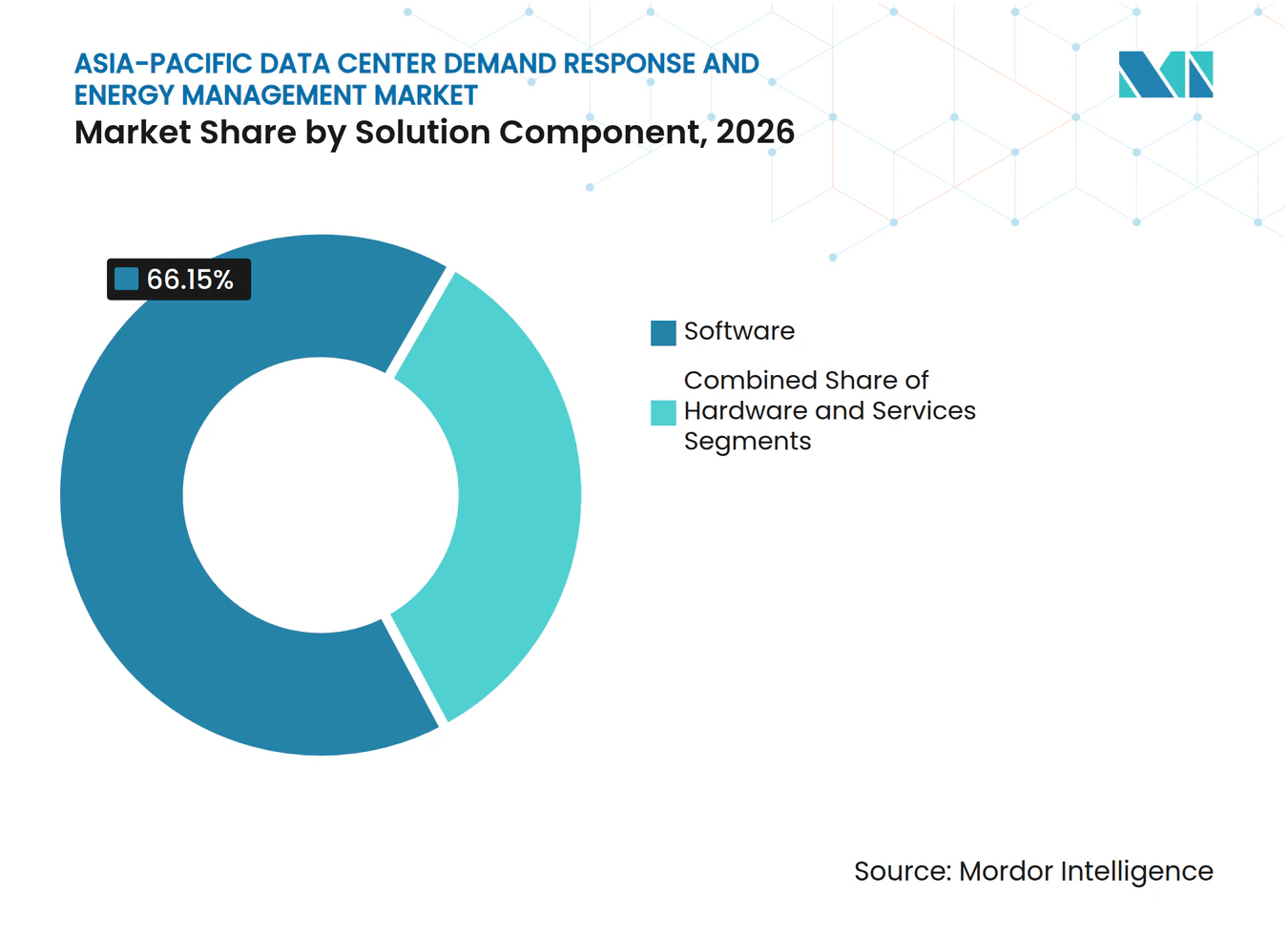
Software Holds the Core Platform ValueSoftware held 66.15% of revenue in 2026, making it the leading solution component in the Asia-Pacific data center demand response and energy management market. Operators need software to combine facility information from building systems, utility meters, cooling equipment, and power distribution units. The resulting operating layer supports monitoring, control, reporting, and utility-facing workflows from a common interface. This position reflects a preference for systems that coordinate assets rather than isolated hardware upgrades. Hardware remains essential because sensors, gateways, smart meters, storage interfaces, and controllers provide the data and physical connection needed for automated action.
Services are projected to expand at a 19.24% CAGR through 2032, reflecting the need for deployment, program enrollment, performance verification, and ongoing operational support. The Asia-Pacific data center demand response and energy management market size for services is expected to benefit when operators manage sites under different utility rules and technical protocols. Many operators do not have teams capable of continuously managing dispatch events, metering submissions, and market communications. Managed service providers can fill this gap while helping customers align their operations with local compliance requirements. As programs move from occasional curtailment toward continuous scheduling of storage, renewable supply, and flexible load, service support becomes more important.



By Software Solution Type:
Energy Management Software Provides the Operating BaseEnergy management software accounted for 58.22% of the software solution type segment in 2026. It is the core system for monitoring consumption, controlling equipment, and producing internal or regulatory reports. Operators use it to bring together data from cooling systems, power distribution units, and utility meters. These capabilities are needed before a facility can reliably participate in a grid program or optimize its electricity purchases. Japan's reporting requirements and China's green data center framework further increase the need for consistent consumption records and performance measures.
Energy forecasting and optimization software is projected to expand at a 18.61% CAGR through 2032. Its role is to anticipate computing demand, tariff periods, renewable availability, and potential demand response events. This enables operators to decide which loads can move on time, which work can shift in location, and which loads must remain uninterrupted. A scientific study of data center demand response in virtual power plants found that AI-based scheduling can increase renewable energy use and reduce carbon-related costs. The Asia-Pacific data center demand response and energy management market is likely to place greater value on forecasting systems as AI clusters make electricity demand more variable and less forgiving of manual planning.
By Demand Response Program Type:
Incentive-Based Programs Lead Scale and ExpansionIncentive-based programs accounted for 68.29% of revenue in 2026 and are projected to grow at a 19.85% CAGR through 2032. This combination makes them the only program segment to lead both current-scale and forecast expansion. Utilities can offer capacity payments or dispatch fees when a data center provides a measurable reduction or flexibility. Operators can use that revenue to offset part of their energy and infrastructure costs. Incentive-based programs appeal because they offer a defined payment for verified performance.
Price-based programs held the remaining 31.71% of the segment in 2026. These programs use time-of-use or real-time prices to encourage voluntary shifts in electricity use. They are less predictable for operators who must maintain service levels and cannot expose critical schedules to price fluctuations. Their use may expand where AI training or other deferrable work accounts for a larger share of the site load. Shanghai's plan shows how formal capacity targets and dispatch systems can provide a clearer operating framework than price signals alone.
By Automation Level:
Manual Operations Create an Upgrade PathManual and non-automated solutions held 70.11% of revenue in 2026. This indicates that many facilities still rely on staff-led procedures to respond to demand events or manage energy controls. Human processes can work for planned events, but they are harder to use for sub-minute responses or repeated adjustments. The installed base also reflects the caution of operators who manage sensitive workloads and complex facility equipment. The Asia-Pacific data center demand response and energy management market has a large group of sites that can move from basic visibility toward closed-loop controls.
Automated and advanced demand response solutions are projected to expand at a 20.14% CAGR through 2032. Their appeal increases when a grid program requires quick, reliable action, and a manual response cannot meet the required timing. The IEEE work on Shanghai data center participation supports the technical role of automated control and flexible backup assets in a virtual power plant setting. Automation also needs safeguards that separate priority workloads from deferrable load and permit operator intervention. Facilities will adopt it more readily when suppliers prove that control actions can be audited, reversed, and secured.
By Primary Application:
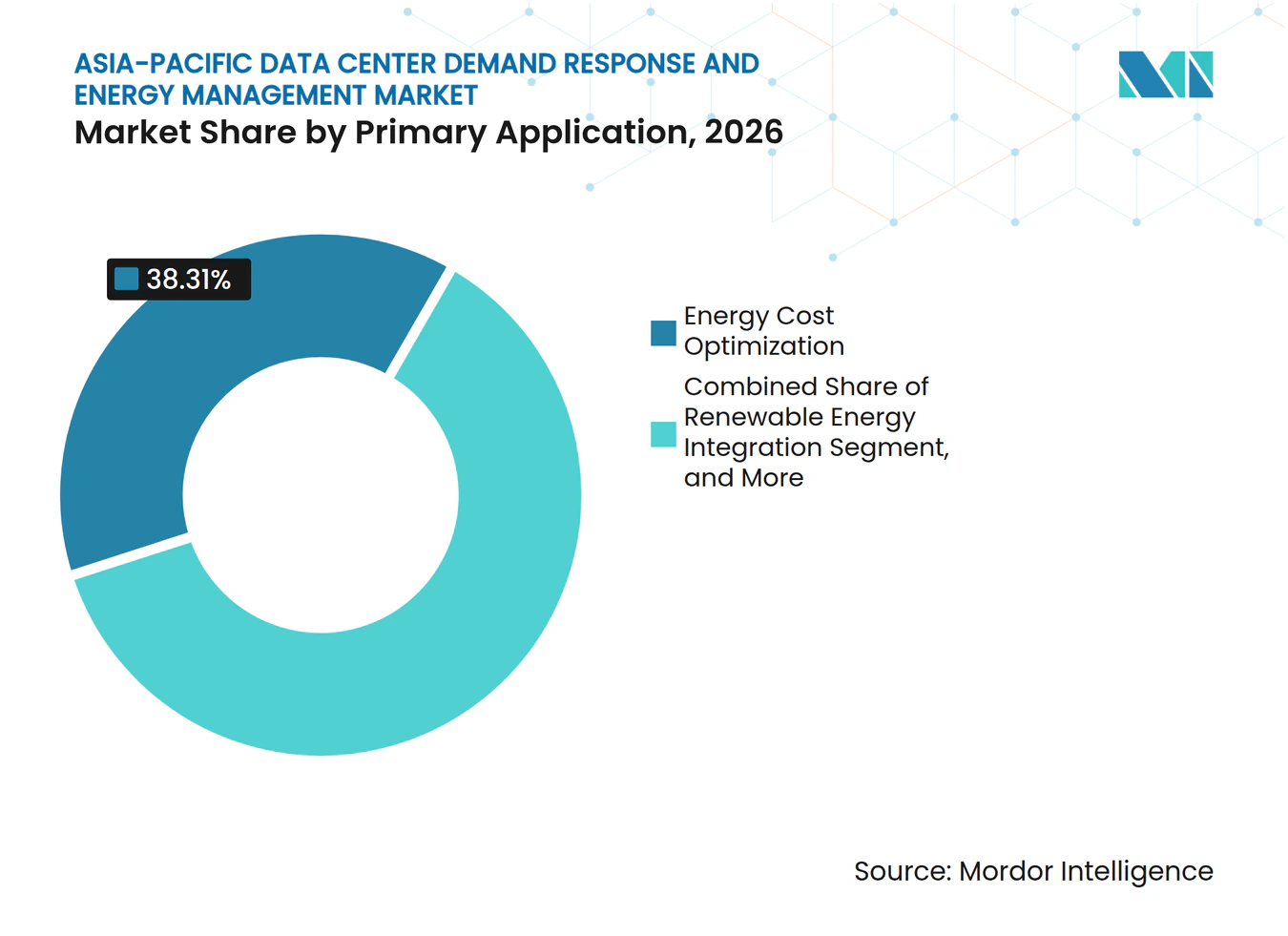
Cost Optimization Is Established While Renewable Integration AdvancesEnergy cost optimization held 38.31% of revenue in 2026. Operators use energy management platforms to avoid peak demand charges, manage time-of-use tariffs, and improve the timing of high-load activities. These uses provide a direct financial case for a facility to participate in a formal grid program. Peak load management, emergency load reduction, capacity market participation, and ancillary services extend this case to broader grid-support needs. The Asia-Pacific data center demand response and energy management market continues to use cost management as the practical entry point for many customers.
Renewable energy integration is projected to expand at a 18.33% CAGR through 2032. It links consumption schedules and storage operations to the availability of contracted renewable generation. This application is relevant when operators need to align electricity use more closely with renewable supply and document energy attributes. Research in Japan found that location planning and workload shifting can lower system costs while reducing surplus supply in a renewable-focused data center system. The approach makes demand response part of electricity procurement and carbon management rather than a separate emergency tool.

By Data Center Size:
Hyperscale Facilities Combine Scale With Compliance PressureHyperscale facilities accounted for 56.17% of revenue in 2026 and are projected to expand at an 18.90% CAGR through 2032. Large sites can spread the cost of advanced controls across significant electricity consumption and compute capacity. They are also more likely to face direct scrutiny when their connection demand affects local grid planning. Requirements in Singapore and the grid-support direction of Australian policy make flexibility a relevant operating condition for large developments. The Asia-Pacific data center demand response and energy management market, therefore, has a strong commercial base among facilities with high loads and large capital budgets.
Large data centers can also provide meaningful blocks of flexible capacity without the procurement scale of hyperscalers. Medium and small sites face a different challenge because the integration cost of a full automation platform can be difficult to justify at lower loads. Cloud-delivered tools and API-based modules may reduce this barrier by connecting to existing building management systems. This creates room for providers that can offer modular services instead of bespoke engineering. The segment will depend on products that reduce operational complexity while still satisfying utility measurement and control requirements.
By Data Center Type:
Colocation Has the Installed Base While Cloud Providers Have Control of the WorkloadColocation facilities held 67.14% of revenue in 2026. Their footprint across major metropolitan markets gives them a large base of power, cooling, and backup assets that can support energy programs. The operating model is complicated because the provider manages physical infrastructure while tenants control much of the computing load. Any response plan must define how the operator, tenant, and utility share responsibilities. This makes contractual rules and clear service protections important in the Asia-Pacific data center demand response and energy management market.
Cloud service providers are projected to expand at a 19.57% CAGR through 2032. They often control both the infrastructure and the computing workload, making it easier to connect grid signals with job scheduling. Renewable contracting structures can help cloud and colocation operators link energy procurement to facility operations. Enterprise and edge facilities may gain relevance as 5G and local AI inference create more distributed load that can be managed as a portfolio.
Geography Analysis
China
China held 32.44% of revenue in 2026, the largest Asia-Pacific data center demand response and energy management market share among the covered geographies. The national compute-power and electricity synergy policy connects data center development with electricity system needs, and the National Development and Reform Commission, the National Energy Administration, and the National Data Bureau have advanced pilots across Beijing-Tianjin-Hebei, the Yangtze River Delta, Inner Mongolia, Qinghai, and Xinjiang. The policy direction supports green power supply, multi-source coordination, and source-load interaction at computing hubs. Shanghai's virtual power plant program included data centers as adjustable resources, with 24 connected data centers and 183.5 MW of declared adjustable load by the end of 2025. These developments support products that coordinate computing and energy data while meeting local dispatch and reporting needs.
India
India is projected to expand at a 18.05% CAGR through 2032, with 1,789 MW of operating data center capacity and 3,860 MW under construction or planned in the first half of 2026, while announced investment exceeded USD 180 billion by September 2026. The Ministry of Power revised its data center load estimate to 26.3 GW by 2031-32, with 17 GW of connectivity applications filed with State Transmission Utilities, according to the source material provided. India does not yet have consistent state-level rules for data center demand response or green tariffs, creating an opening for suppliers that can demonstrate to regulators and operators practical, measurable operating models. The Asia-Pacific data center demand response and energy management market size in India will depend on whether connection rules, metering, and tariffs develop alongside new capacity.
Japan, Australia, Singapore, South Korea, and the Rest of Asia-Pacific
Japan's Tokyo connection timeline has reached 10 years, and its amended Energy Conservation Act requires annual reporting on power-use effectiveness against a 1.4 benchmark. Australia is considering requirements for facilities above 30 MW to remain connected during grid disturbances, while Singapore's Data Center-Call for Application 2 allocated 200 MW to operators that source at least 50% of their electricity from green sources and participate in virtual power plant dispatch. South Korea's long-term plan targeted a 16.3 GW reduction in peak demand and 110.6 TWh in electricity savings through demand response programs, according to the provided source material. Thailand's 2025 draft rules for direct renewable purchase agreements and Malaysia's 85% electricity utilization requirement show that Southeast Asia is also developing demand-side conditions, while ASEAN solar capacity reached nearly 38 GW in 2025.[2] The Asia-Pacific data center demand response and energy management market must accommodate this varied regulatory setting through configurable tariff interfaces, energy-attribute records, and flexible reporting controls.
Competitive Landscape
Market Concentration
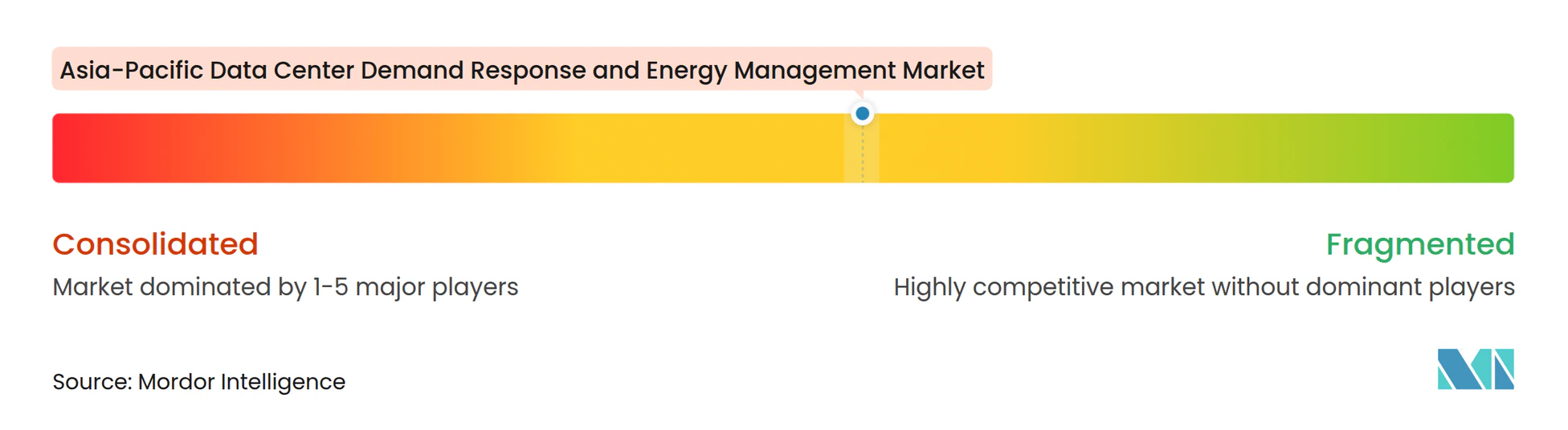
The Asia-Pacific data center demand response and energy management market has moderate concentration at the platform and integration layer. Schneider Electric, Siemens, ABB, Hitachi Energy, and Honeywell offer broad portfolios that combine power management, automation, building controls, and energy software, while specialized aggregators and AI-focused vendors serve narrower technical or local regulatory needs. Schneider Electric acquired a controlling interest in Motivair in February 2025 and introduced its full liquid cooling portfolio in September 2025.[3] The move brought cooling hardware and EcoStruxure software closer together for high-performance computing environments. It shows how established suppliers are combining thermal, power, and software capabilities to manage facility energy use and AI-related cooling requirements.
Eaton and Siemens Energy announced a partnership in June 2025 to provide modular power systems, on-site generation, and an optional clean-air grid-connection module for data centers. The companies stated that the offering could reduce time-to-power by up to 2 years in major markets. This approach addresses grid connection delays that can delay new capacity in the Asia-Pacific data center demand response and energy management market. Honeywell and LS ELECTRIC also formed a global partnership in October 2025 to develop power monitoring and battery energy storage systems for data centers. These moves increase pressure on demand response specialists who do not offer wider facility integration.
Open areas remain in lightweight modules for medium and small colocation sites, regional aggregation platforms, and systems that connect hourly renewable energy records with demand response performance. State Grid Shanghai's work with China Telecom demonstrated a task transfer from Shanghai Lingang to Hubei Shiyan within 3 minutes, highlighting the potential for computing work to serve as a flexible grid resource. Cybersecurity is also becoming a differentiator because grid dispatch creates a closer link between operational technology and external systems. Products that align with IEC 62443 and separate critical controls from external interfaces will be better placed as compliance scrutiny increases.
Asia-Pacific Data Center Demand Response and Energy Management Industry Leaders
-
Siemens AG
-
Schneider Electric SE
-
Honeywell International Inc.
-
Eaton Corporation plc
-
ABB Ltd.
- *Disclaimer: Major Players sorted in no particular order
Asia-Pacific Data Center Demand Response and Energy Management Market Companies Covered in this Report
- Schneider Electric SE
- Siemens AG
- Hitachi Energy Ltd.
- ABB Ltd.
- AutoGrid Systems, Inc.
- Eaton Corporation plc
- Mitsubishi Electric Corporation
- Itron, Inc.
- Landis+Gyr Group AG
- Yokogawa Electric Corporation
- Honeywell International Inc.
- Johnson Controls International plc
- Vertiv Holdings Co
- Delta Electronics, Inc.
- Huawei Technologies Co., Ltd.
- Modius, Inc.
- EkkoSense Ltd.
- GridPoint, Inc.
- Encycle Corporation
- Voltus, Inc.
Recent Industry Developments in Asia-Pacific Data Center Demand Response and Energy Management Market
- October 2026: Wood Mackenzie confirmed that Asia-Pacific has over 32 GW of planned data center capacity, with Australia's AEMO 2026 Integrated System Plan projecting approximately USD 300 billion in new transmission investment, where rising line costs of 25%-55% are reinforcing operator incentives to invest in demand response as an alternative to pure transmission-led grid reinforcement.
- September 2026: RMI published analysis confirming that data center flexibility pilots across Southeast Asia demonstrated peak load reductions exceeding 30% without meaningful uptime loss, and that Google had contracted a cumulative 1 GW of demand response capacity into utility contracts as of March 2026, establishing a benchmark for hyperscaler-grade grid-support commitments in Asia-Pacific.
- June 2026: China's National Energy Administration published policy analysis confirming that the "compute-power and electricity synergy" framework has been elevated to national new infrastructure policy in the 2026 Government Work Report and the 15th Five-Year Plan, formalizing requirements for spatiotemporal workload shifting and VPP participation across data centers in national grid hub nodes.
- February 2026: Deloitte published the report Powering Asia Pacific's Data Center Boom, projecting that regional data center electricity consumption will exceed 1,000 TWh by the mid-2030s and recommending that operators build battery storage and demand-flexibility capabilities from the outset as a prerequisite for securing grid-connection approvals across the region.
Asia-Pacific Data Center Demand Response and Energy Management Market Report Scope
The Asia-Pacific Data Center Demand Response and Energy Management Market comprises solutions and services designed to optimize power consumption, automate demand response participation, and improve energy efficiency across data centers in China, Japan, India, Australia, Singapore, South Korea, and the rest of Asia-Pacific. The market is driven by rapid hyperscale and AI-ready data center expansion, rising electricity demand, renewable energy adoption, and the need for intelligent energy management systems that enable peak-load optimization, grid participation, operational resilience, and sustainability improvements.
The Asia-Pacific Data Center Demand Response and Energy Management Market Report is Segmented by Solution Component (Hardware, Software, and Services), Software Solution Type (Demand Response Management Platforms, Energy Management Software, Energy Monitoring and Analytics Software, and Energy Forecasting and Optimization Software), Demand Response Program Type (Price-Based Programs, and Incentive-Based Programs), Automation Level (Manual and Non-Automated Solutions, and Automated and Advanced Demand Response Solutions), Primary Application (Peak Load Management, Emergency Load Reduction, Capacity Market Participation, Ancillary Services, Energy Cost Optimization, and Renewable Energy Integration), Data Center Size (Small, Medium, Large, and Hyperscale), Data Center Type (Colocation, Cloud Service Providers [CSPs], and Enterprise and Edge), and Geography (China, Japan, India, Australia, Singapore, South Korea, and Rest of Asia-Pacific). The Market Forecasts are Provided in Terms of Value (USD).
Segmentation Overview
| Hardware |
| Software |
| Services |
| Demand Response Management Platforms |
| Energy Management Software |
| Energy Monitoring and Analytics Software |
| Energy Forecasting and Optimization Software |
| Price-Based Programs |
| Incentive-Based Programs |
| Manual and Non-Automated Solutions |
| Automated and Advanced Demand Response Solutions |
| Peak Load Management |
| Emergency Load Reduction |
| Capacity Market Participation |
| Ancillary Services |
| Energy Cost Optimization |
| Renewable Energy Integration |
| Small |
| Medium |
| Large |
| Hyperscale |
| Colocation |
| Cloud Service Providers (CSPs) |
| Enterprise and Edge |
| China |
| Japan |
| India |
| Australia |
| Singapore |
| South Korea |
| Rest of Asia-Pacific |
| By Solution Component | Hardware |
| Software | |
| Services | |
| By Software Solution Type | Demand Response Management Platforms |
| Energy Management Software | |
| Energy Monitoring and Analytics Software | |
| Energy Forecasting and Optimization Software | |
| By Demand Response Program Type | Price-Based Programs |
| Incentive-Based Programs | |
| By Automation Level | Manual and Non-Automated Solutions |
| Automated and Advanced Demand Response Solutions | |
| By Primary Application | Peak Load Management |
| Emergency Load Reduction | |
| Capacity Market Participation | |
| Ancillary Services | |
| Energy Cost Optimization | |
| Renewable Energy Integration | |
| By Data Center Size | Small |
| Medium | |
| Large | |
| Hyperscale | |
| By Data Center Type | Colocation |
| Cloud Service Providers (CSPs) | |
| Enterprise and Edge | |
| By Geography | China |
| Japan | |
| India | |
| Australia | |
| Singapore | |
| South Korea | |
| Rest of Asia-Pacific |
Key Questions Answered in the Report
What is the size of the Asia-Pacific data center demand response and energy management market?
The market is valued at USD 2.37 billion in 2026 and is forecast to reach USD 6.13 billion by 2032, at a 17.29% CAGR over 2027-2032.
What is driving adoption of data center demand response systems in Asia-Pacific?
AI-related power density, constrained grid access, renewable integration, and formal virtual power plant programs are increasing the need for controllable and measurable facility load.
Which solution component leads the sector?
Software leads with 66.15% revenue share in 2026 because it connects facility data, controls, reporting, and utility-facing workflows.
Which demand response program type has the strongest outlook?
Incentive-based programs held 68.29% revenue share in 2026 and are projected to expand at a 19.85% CAGR through 2032.
Which country leads regional demand response and energy management adoption?
China led with 32.44% revenue share in 2026, supported by compute-power and electricity synergy policies and virtual power plant development.
Why is automation important for data center electricity management?
Automated and advanced systems are projected to expand at a 20.14% CAGR through 2032 because they can respond faster than manual processes and support grid dispatch requirements.