
Asia-Pacific Data Center Counter-Drone and Airspace Security Market Size and Share
Market Overview
| Study Period | 2021 - 2032 |
|---|---|
| Forecast Data Period | 2027 - 2032 |
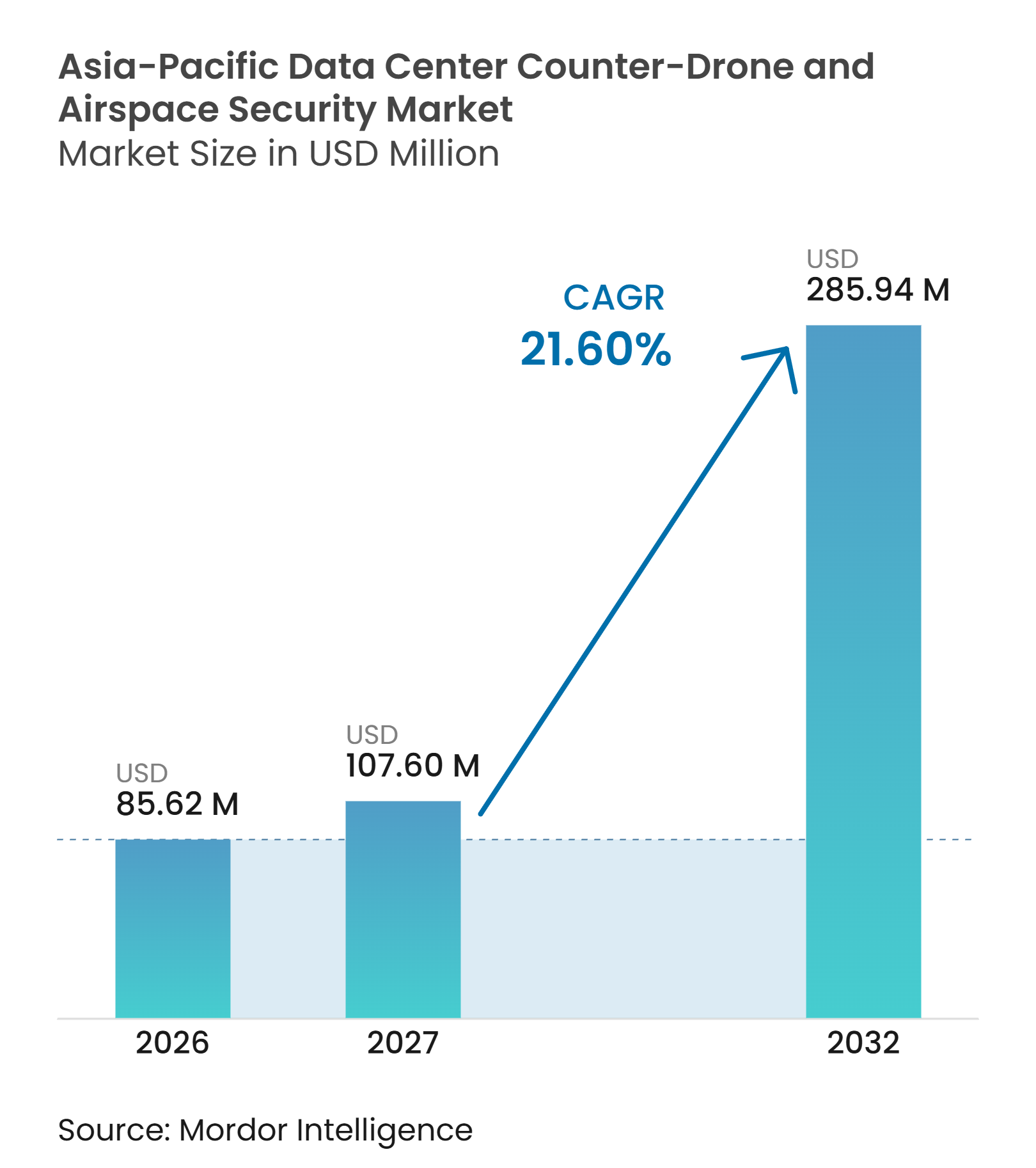
| Base Year Market Size (2026) | USD 85.62 Million |
| Market Size (2027) | USD 107.60 Million |
| Market Size (2032) | USD 285.94 Million |
| Growth Rate (2027 - 2032) | 21.60 % |
| Market Concentration | Medium |
Major Players *Disclaimer: Major Players sorted in no particular order Image © Mordor Intelligence. Reuse requires attribution under CC BY 4.0. | |
Asia-Pacific Data Center Counter-Drone and Airspace Security Market Analysis by Mordor Intelligence
The Asia-Pacific Data Center Counter-Drone and Airspace Security Market size was valued at USD 85.62 million in 2026 and is estimated to expand to USD 285.94 million by 2032, at a CAGR of 21.60% during the forecast period 2027-2032. Demand is tied to the concentration of high-value digital assets in new data center campuses, where operators must protect physical infrastructure as well as network systems, cooling equipment, and service continuity. Recent drone incidents affecting data center facilities have made airspace exposure a practical security consideration for operators, particularly because a single event can disrupt a shared site with many customers. The Asia-Pacific Data Center Counter-Drone and Airspace Security Market also benefits from the shift toward multi-sensor detection that can identify and classify aircraft before a response is required and place alerts within existing site-security processes. Government counter-unmanned aircraft programs are strengthening procurement standards that private operators can use when assessing site protection, while also improving the availability of tested systems and operating practices. Regulatory limits on jamming still keep many commercial deployments focused on detection, monitoring, and alerting systems, which makes non-disruptive tools central to near-term procurement.
Key Report Takeaways
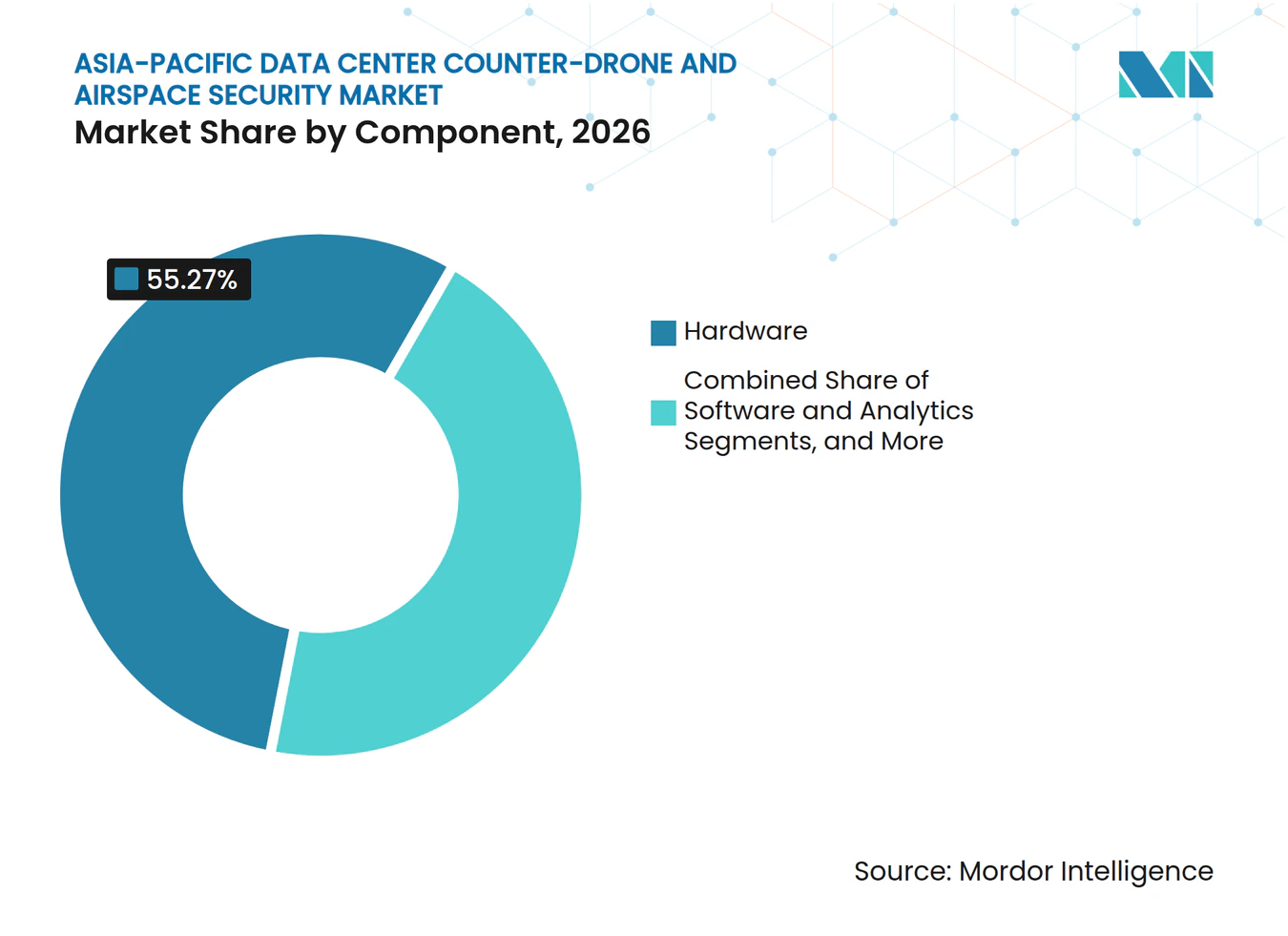
- By component, hardware held 55.27% of the Asia-Pacific Data Center Counter-Drone and Airspace Security Market share in 2026, while software and analytics is projected to expand at a 22.82% CAGR through 2032.
- By technology, radio-frequency detection accounted for 29.48% share in 2026, while integrated multi-sensor systems is projected to expand at a 22.93% CAGR through 2032.
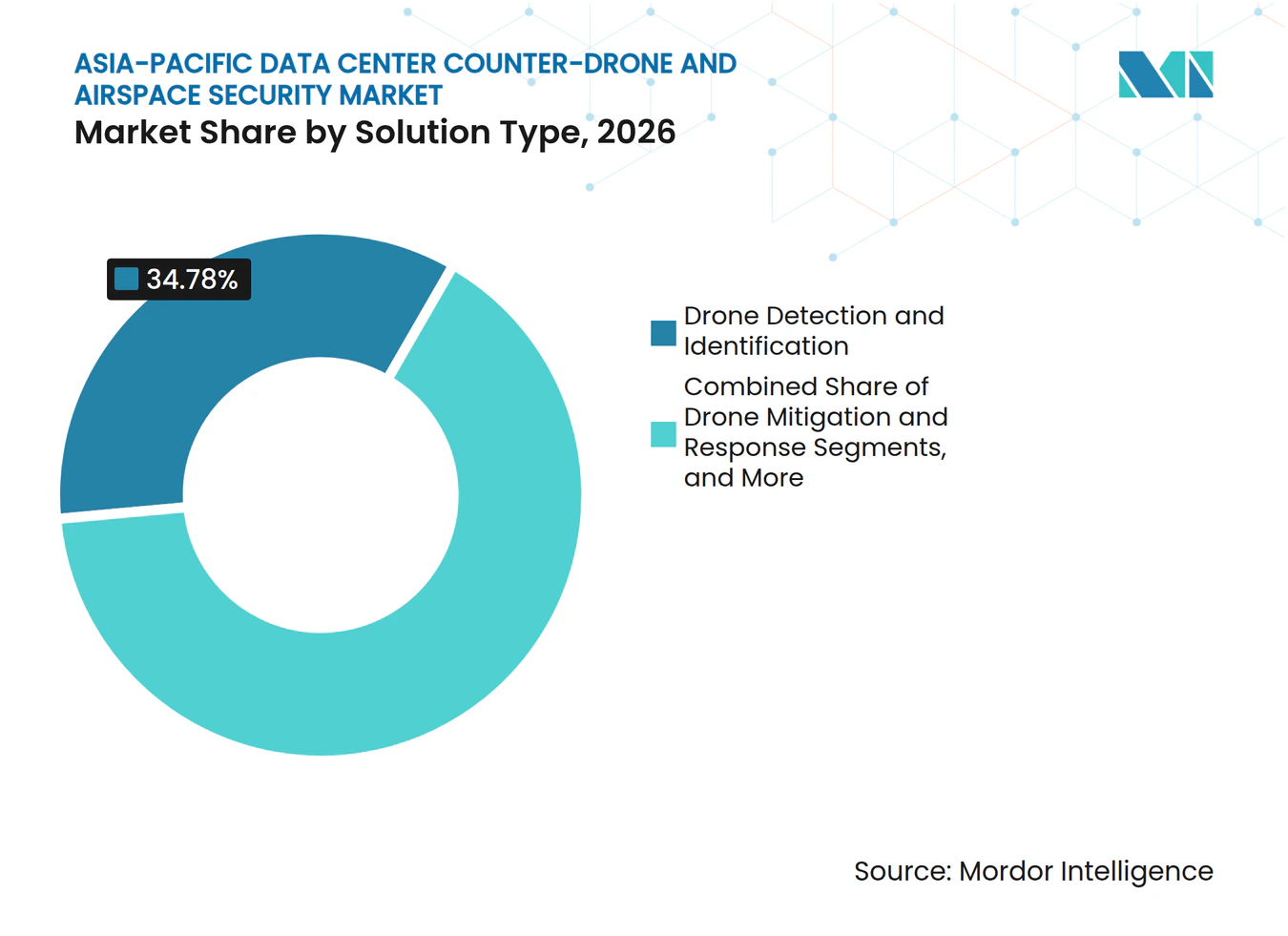
- By solution type, drone detection and identification held 34.78% share in 2026, while integrated counter-drone platforms is projected to expand at a 22.34% CAGR through 2032.
- By deployment type, fixed installations accounted for 78.36% share in 2026, while mobile and portable systems is projected to expand at a 22.91% CAGR through 2032.
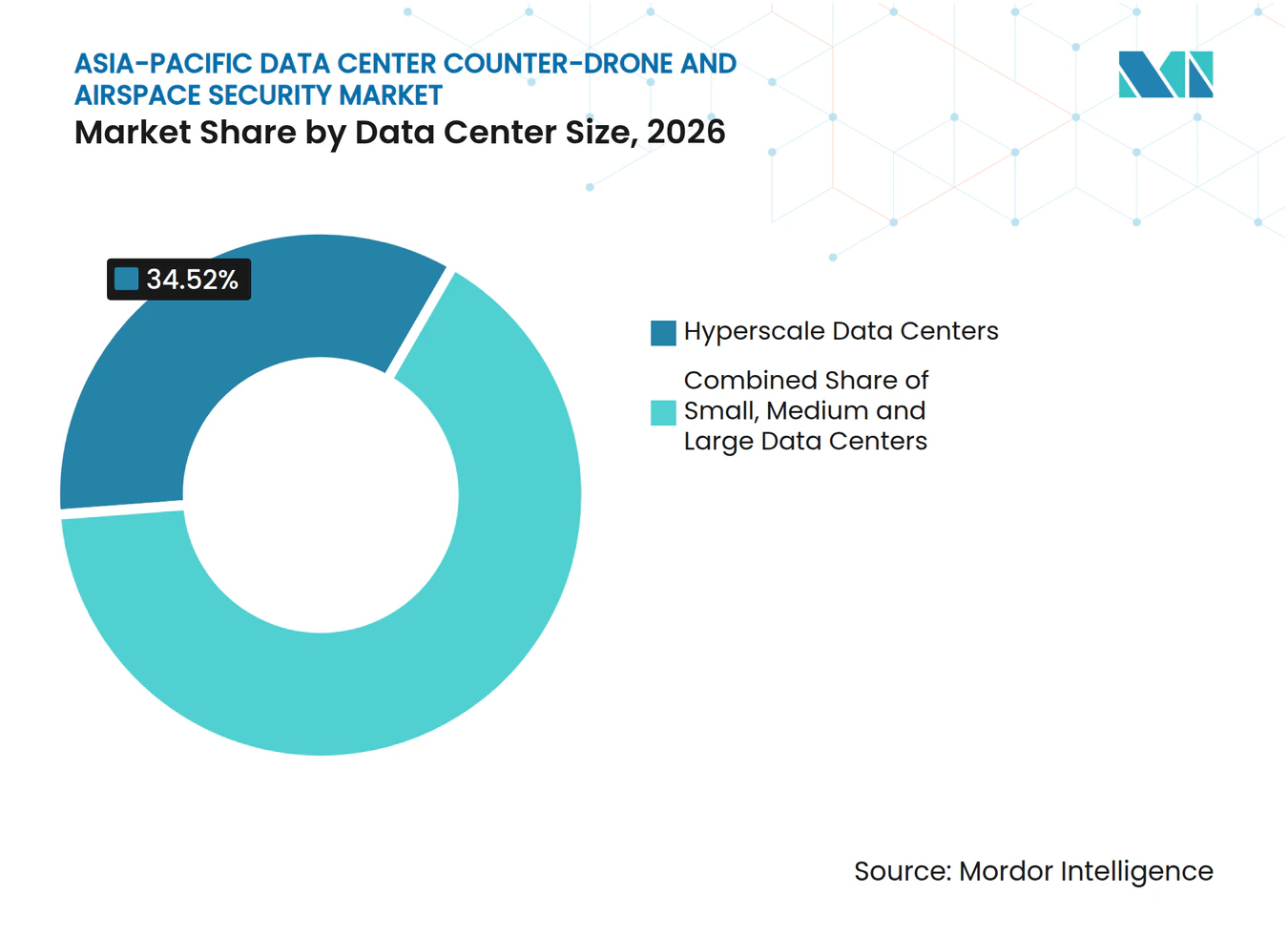
- By data center size, hyperscale data centers held 34.52% share in 2026 and is projected to expand at a 22.81% CAGR through 2032.
- By data center type, colocation data centers accounted for 42.34% share in 2026, while cloud service providers is projected to expand at a 22.49% CAGR through 2032.
- By geography, China held 32.56% share in 2026, while India is projected to expand at a 22.84% CAGR through 2032.
Note: Market numbers in this report are based on Mordor Intelligence's proprietary estimation framework, which combines nine months of actuals with Q4 projections for base year 2026.
Market Trends and Insights
Drivers Impact Analysis of Asia-Pacific Data Center Counter-Drone and Airspace Security Market*
| Driver | (~) % Impact on CAGR Forecast | Geographic Relevance | Impact Timeline |
|---|---|---|---|
| Rising Drone Intrusions Around Critical Infrastructure | +5.5% | Global, with heightened urgency in India, China, and Australia | Short term (≤ 2 years) |
| Expansion of Hyperscale and Colocation Data Centers | +5.0% | Asia-Pacific-wide, strongest in India, Malaysia, Japan, and Australia | Medium term (2-4 years) |
| Government Focus on Counter-UAS and Airspace Protection | +3.5% | Australia, India, Japan, and Singapore, with spillover to South Korea and Thailand | Medium term (2-4 years) |
| Adoption of AI-Enabled Multi-Sensor Detection | +3.0% | Asia-Pacific-wide, with early adoption concentrated in China and Australia | Medium term (2-4 years) |
| Data Center Cyber-Physical Security Convergence | +2.0% | Japan, Singapore, and Australia | Long term (≥ 4 years) |
| Growing Requirement for Non-Disruptive Detection Near Sensitive Facilities | +1.5% | Singapore, Japan, South Korea, and urban Australia | Medium term (2-4 years) |
| Source: Mordor Intelligence | |||
Rising Drone Intrusions Around Critical Infrastructure
The March 2026 drone strikes on AWS data centers in the Middle East showed that aerial risks to data centers can have direct operational consequences. The event prompted Asia-Pacific operators to review the protection of campus airspace and sensitive equipment. India’s Ministry of Defence recorded 791 drone intrusions in 2025, including 5 that carried ammunition, which illustrates the varied threat profile faced by critical infrastructure.[1] Airports Council International Asia-Pacific stated that no single technology provides complete mitigation coverage for unauthorized drone incidents. This finding supports layered configurations that combine different sensing methods around data center perimeters. Dedrone reported a 4.3x rise in DIY drone detections across its Europe, Middle East, and Asia sensor network during 2025, while commercial data center incidents can remain unreported when operators lack detection tools or a reason to disclose events.[2]
Expansion of Hyperscale and Colocation Data Centers
The Asia-Pacific Data Center Counter-Drone and Airspace Security Market is supported by the continuing build-out of hyperscale and colocation facilities. New campuses place valuable computing equipment, cooling systems, and network assets within defined physical perimeters. Multi-tenant colocation sites can distribute airspace monitoring costs across customers, which can support approval for shared protection systems. This approach can also turn airspace monitoring into an amenity that improves a facility’s security proposition. Google announced a USD 15 billion investment in an Andhra Pradesh AI data center in October 2026, described as its largest AI hub outside the United States.[3] Such large projects make dedicated monitoring more relevant from the construction phase through ongoing operations.
Government Focus on Counter-UAS and Airspace Protection
Government programs are shaping the specifications and operating expectations used in the Asia-Pacific Data Center Counter-Drone and Airspace Security Market. Australia established the LAND 156 Standing Offer Panel in January 2026 and committed AUD 918.8 million, equivalent to USD 584 million, over 10 years to the program. Japan expanded drone no-fly zones to 1,000 meters around key facilities in March 2026. Its Nuclear Regulation Authority also required drone detection systems at 22 nuclear and research sites. Singapore formed the SAF Counter-UAS Development and Operations Group in 2025, bringing sensors, jammers, and weapon solutions into a dedicated capability. These programs provide established threat-assessment models that private infrastructure owners can use in their own procurement decisions.
Adoption of AI-Enabled Multi-Sensor Detection
The Asia-Pacific Data Center Counter-Drone and Airspace Security Market is increasingly shaped by systems that combine radar, radio-frequency, optical, infrared, and acoustic inputs. A single sensing method can leave gaps because radio-frequency tools may not find optically guided drones, acoustic sensors can be affected by city noise, and radar alone may not identify an aircraft’s intent. Dedrone states that its platform combines radar, radio-frequency, and optical inputs and achieves 99.7% detection accuracy using millions of labeled flight samples. An IEEE EPEC 2025 study found that radio-frequency, electro-optical, infrared, and acoustic fusion improved detection performance over individual sensing methods while retaining fast detection times. ZTE and the China Academy of Information and Communications Technology also published a 2025 white paper on 5G-A communication-sensing integration for low-altitude protection, suggesting that some operators may obtain sensing capabilities through their communications environment.
Restraints Impact Analysis of Asia-Pacific Data Center Counter-Drone and Airspace Security Market*
| Restraint | (~) % Impact on CAGR Forecast | Geographic Relevance | Impact Timeline |
|---|---|---|---|
| Regulation of Radio-Frequency Jamming and Airspace Interference | -2.0% | China, Japan, South Korea, and Southeast Asia, at national scope | Short term (≤ 2 years) |
| High Integration Complexity Across Physical Security Systems | -1.5% | Asia-Pacific-wide, most acute in large colocation and enterprise data centers | Medium term (2-4 years) |
| Limited Data Center-Specific Counter-Drone Incident Disclosure | -1.0% | Asia-Pacific-wide | Short term (≤ 2 years) |
| Low False-Alarm Performance in Dense Urban Environments | -1.0% | Singapore, Tokyo, Shanghai, Mumbai, and Sydney central business districts | Medium term (2-4 years) |
| Source: Mordor Intelligence | |||
Regulation of Radio-Frequency Jamming and Airspace Interference
Regulatory restrictions constrain the mitigation portion of the Asia-Pacific Data Center Counter-Drone and Airspace Security Market. China’s UAS Temporary Regulations limit counter-drone equipment to military, police, and specifically authorized anti-terrorism entities. Private data center operators may therefore detect an aircraft but cannot independently deploy neutralization systems. Japan’s Radio Law imposes related limits, and Tokio Marine identified these restrictions as a central operational bottleneck in Japan’s counter-drone posture. China’s revised Civil Aviation Law took effect in July 2026 and provides a clearer formal framework, but it does not change the near-term limits on commercial mitigation equipment. The restriction favors detection-only systems and lowers the immediate revenue scope for response products.
High Integration Complexity Across Physical Security Systems
Data centers use layered security systems that include access control, video surveillance, building management, and operational technology networks. Counter-drone tools must work across those systems if they are to provide useful situational awareness instead of isolated alerts. A 2025 Security Industry Association study identified outdated specifications, siloed systems, and limited vendor familiarity with data center needs as major issues that delay physical-security upgrades. Large integration programs can last 12-18 months, which can delay a purchase even where the security case is clear. Vendors that pre-certify their systems for standard physical security information management and video management platforms can reduce this burden. The operational requirement remains important because data center operators need airspace alerts to fit established security workflows.
*Our forecasts treat driver/restraint impacts as directional, not additive. The impact forecasts reflect baseline growth, mix effects, and variable interactions.
Asia-Pacific Data Center Counter-Drone and Airspace Security Market Segment Analysis
By Component:
Hardware Establishes the Initial Security LayerHardware held 55.27% of Asia-Pacific Data Center Counter-Drone and Airspace Security Market share in 2026 because operators typically establish the physical detection layer before adding advanced analytics. Radar arrays, radio-frequency monitoring units, electro-optical cameras, and acoustic sensors accounted for much of this early deployment activity. These devices give the operator visibility across a defined campus perimeter, particularly where a facility has not previously monitored low-altitude airspace. Initial hardware procurement also helps operators develop operating procedures before they expand their security architecture. Integration and support services are often included in hardware contracts, which can understate their separate contribution.
Software and analytics is projected to expand at a 22.82% CAGR through 2032, the fastest rate among components. Operators that installed sensors during 2025 and 2026 are moving toward AI-supported classification, multi-site command and control, and software-based alerting. This shift allows a security team to manage inputs from several locations through a more unified operational view. DroneShield launched DroneSentry-C2 Enterprise in October 2025 as a software-as-a-service platform for connecting geographically dispersed counter-drone installations into a national-scale network. The Asia-Pacific Data Center Counter-Drone and Airspace Security Market can therefore see recurring software revenue added to established sensor deployments.



By Technology:
Radio-Frequency Detection Supports Accessible MonitoringRadio-frequency detection accounted for 29.48% of the Asia-Pacific Data Center Counter-Drone and Airspace Security Market in 2026. The technology is passive, does not interfere with nearby communications, and can be used across the region’s varied regulatory settings. It identifies transmissions associated with many drone platforms and provides an accessible first layer of monitoring. This makes it relevant to commercial operators that cannot use jamming systems. Radio-frequency detection also helps security teams assess activity before determining whether other sensors should be activated.
Radar-based detection supplies three-dimensional location data, while electro-optical and infrared systems support visual classification. Acoustic detection can address shorter-range needs, particularly where other systems have limits. Integrated multi-sensor systems is projected to expand at a 22.93% CAGR through 2032, reflecting demand for systems that can combine these capabilities. The IEEE EPEC study found that combined radio-frequency, electro-optical, infrared, and acoustic methods improved detection compared with single methods. The wider use of layered specifications supports the Asia-Pacific Data Center Counter-Drone and Airspace Security Market as operators seek reliable detection across different drone profiles.
By Solution Type:
Detection Remains the Starting Point for ResponseDrone detection and identification held 34.78% of the Asia-Pacific Data Center Counter-Drone and Airspace Security Market share in 2026. A facility must first identify an aircraft before it can track, classify, alert, or respond to it. Detection systems establish the basic information required for every later action. They are also suitable for jurisdictions where commercial operators are limited to non-disruptive monitoring. This makes detection a central purchase category for data center campuses.
Drone tracking and classification adds spatial and behavioral information after initial identification. Airspace monitoring and alerting provides the continuing baseline against which security teams can flag unusual activity, often through managed services. Drone mitigation and response faces the strongest regulatory limits across important regional markets. Integrated counter-drone platforms is projected to expand at a 22.34% CAGR through 2032 as large operators seek to reduce integration work and vendor-management demands. Consolidated platforms can support multi-year contracts rather than renewals for individual point solutions, moving the Asia-Pacific Data Center Counter-Drone and Airspace Security Market toward systems that bring detection and operational coordination together.

By Deployment Type:
Fixed Systems Provide Continuous Campus CoverageFixed installations captured 78.36% of the Asia-Pacific Data Center Counter-Drone and Airspace Security Market in 2026. Data centers have stable, geographically defined perimeters that favor permanent sensor infrastructure. A fixed radar, radio-frequency, electro-optical, and infrared configuration can watch a campus without continuous staffing at every sensor point. The installation can provide consistent coverage throughout the facility’s useful life. It also allows the security team to build a reliable baseline for normal airspace activity.
Mobile and portable systems is projected to expand at a 22.91% CAGR through 2032. These systems are useful during campus construction, contractor access events, and the movement of high-value equipment. They can also provide coverage where a permanent system has not yet been installed or cannot cover a temporary risk area. DroneShield’s July 2025 LAND 156 activity illustrates the role of handheld equipment in filling gaps around fixed systems. The Asia-Pacific Data Center Counter-Drone and Airspace Security Market will continue to need both formats because temporary and permanent security needs are not the same.
By Data Center Size:
Hyperscale Facilities Lead on Scale and ExpansionHyperscale data centers held 34.52% of Asia-Pacific Data Center Counter-Drone and Airspace Security Market share in 2026. The same segment is projected to expand at a 22.81% CAGR through 2032, making it the only category that leads on both share and forecast expansion. Hyperscale campuses combine large security budgets with a high concentration of critical computing equipment. A drone event can affect an extensive facility footprint and create a material operational concern. New campuses can also include airspace security in their design and construction plans from the outset.
Large data centers also have substantial security budgets because an airspace incident can create a liability issue for multiple tenants. Medium and small facilities remain more cautious because initial hardware costs can be difficult to justify. Service-led offerings may make monitoring more accessible to these operators through 2030. The segment pattern shows why vendors are concentrating direct sales resources on the largest campuses while retaining a later opportunity to tailor lower-cost offerings for smaller sites. The Asia-Pacific Data Center Counter-Drone and Airspace Security Market retains a broad customer base, even though its early spending is concentrated among larger facilities.
By Data Center Type:
Colocation Facilities Benefit From Shared Security EconomicsColocation data centers accounted for 42.34% of Asia-Pacific Data Center Counter-Drone and Airspace Security Market share in 2026. Multi-tenant facilities can spread airspace security costs across a paying customer base. This improves the business case for persistent monitoring and makes the system part of a shared facility service. Operators can also position airspace monitoring alongside ISO/IEC 27001 or SOC 2 physical-security controls. That combination can strengthen the site’s procurement position with customers that require formal security practices.
Cloud service providers is projected to expand at a 22.49% CAGR through 2032. Hyperscalers are standardizing security expectations across their global real estate portfolios and can incorporate counter-drone requirements into new campus briefs. This can lead to higher spending per campus than in current colocation deployments. Enterprise and edge data centers remain mostly outside active procurement because their site economics are less favorable, making managed services the clearest route to serving those operators. The Asia-Pacific Data Center Counter-Drone and Airspace Security Market is consequently led by settings where security costs can be shared or standardized at scale.
Geography Analysis
China held 32.56% of Asia-Pacific Data Center Counter-Drone and Airspace Security Market share in 2026. Its position reflects extensive data center infrastructure and a domestic counter-drone ecosystem that includes Hikvision, ZTE, CETC, and other providers aligned with local rules. ZTE and the China Academy of Information and Communications Technology released a 2025 white paper on 5G-A communication-sensing integration for low-altitude protection, signaling that state-endorsed sensing approaches will influence supplier access to Chinese operators. Beijing municipal guidance published in August 2026 described a three-layer defense architecture that covers high-altitude, low-altitude, and ground-level risks. Commercial limits on neutralization remain in place, but China’s scale continues to support the largest regional position.
India is projected to expand at a 22.84% CAGR through 2032, the fastest rate among the regional markets. Its demand is supported by hyperscale investment, domestic defense capability development, and documented drone activity. The Ministry of Defence recorded 791 drone intrusions in 2025, including 5 carrying ammunition, while the Central Industrial Security Force included drone and counter-drone training in its 2026-2030 modernization plan. Bharat Electronics Limited received an INR 770 crore contract, equivalent to USD 90.6 million, for radar systems for the Indian Army in October 2026, while Zen Technologies launched ZEN CITADEL in August 2026 as a counter-drone system for data centers and semiconductor fabs.
Japan, Australia, and Singapore are creating compliance-led procurement conditions for the Asia-Pacific Data Center Counter-Drone and Airspace Security Market. Japan required detection systems at 22 nuclear and research sites and expanded no-fly zones to 1,000 meters around key facilities in March 2026. Australia’s LAND 156 program has committed AUD 918.8 million, equivalent to USD 584 million, over 10 years, and its 2026 legislative proposal provided enduring authority for countermeasures over sensitive defense sites. Singapore established its dedicated SAF Counter-UAS group in 2025 and enforces a 5 km aerodrome no-fly zone. Johor’s capacity more than doubled to 897 MW in 2025, and research has proposed specific counter-unmanned aircraft architectures for Indonesia, the Philippines, and Vietnam, extending the opportunity beyond the largest markets as infrastructure and operating frameworks develop.
Competitive Landscape
Market Concentration
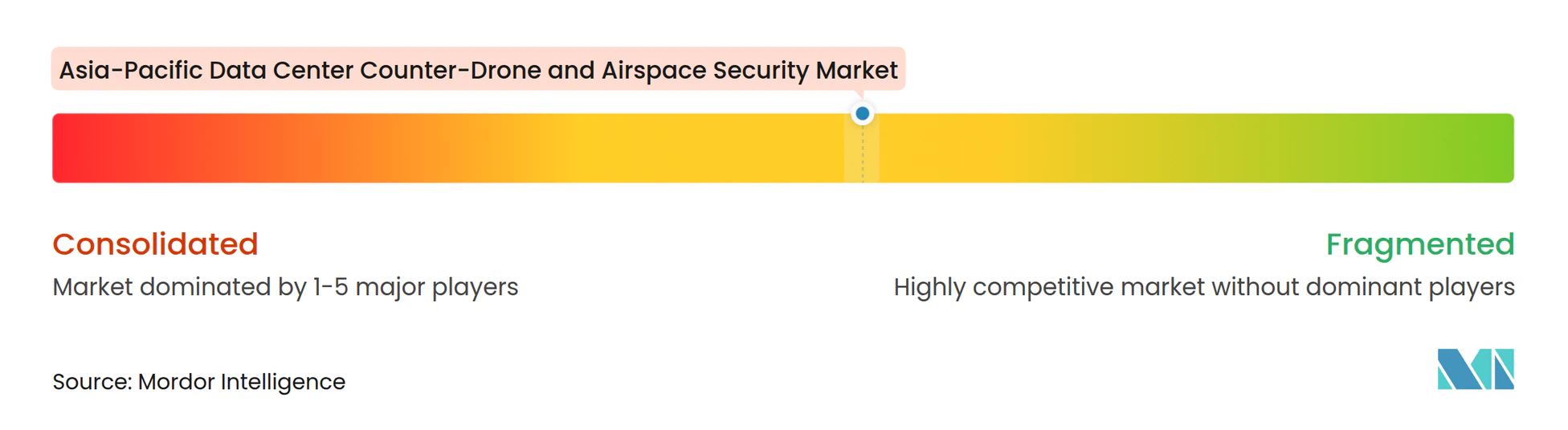
The Asia-Pacific Data Center Counter-Drone and Airspace Security Market is moderately fragmented because global defense primes, specialist counter-drone suppliers, and domestic Asian providers serve different buyer groups and geographies. RTX and Thales offer systems engineering depth and government credibility, although their procurement cycles can be longer than those of specialist suppliers. DroneShield, Dedrone, Fortem Technologies, and Echodyne compete through detection performance, product maturity, and software-based operating models. Dedrone reports 99.7% detection accuracy through multi-sensor fusion, while DroneShield’s selection to Australia’s LAND 156 Standing Offer Panel in January 2026 demonstrates its ability to serve government and civilian infrastructure needs.
Motorola Solutions completed its acquisition of D-Fend Solutions for USD 1.5 billion in August 2026. The transaction brings D-Fend’s radio-frequency cyber-takeover technology, deployed in more than 30 countries, into Motorola Solutions’ public-safety distribution network. The combined offer can provide a detection-to-mitigation option through established critical-infrastructure procurement channels. Anduril expanded in the region during 2025 with offices in Japan and South Korea and manufacturing in Sydney, positioning its Lattice AI sensor-fusion platform for defense-adjacent civilian infrastructure, including data center airspace management.
White-space opportunities remain in colocation-based airspace monitoring services, edge and small data centers, and integration with building management systems. These areas have not yet attracted broad purpose-built offerings because their operating needs and per-site economics differ from those of major campuses. Suppliers that reduce integration effort can address a practical constraint in the Asia-Pacific Data Center Counter-Drone and Airspace Security Market, while domestic providers retain a relevant role where local regulation, government procurement, and accepted sensing standards affect market access. Hikvision is relevant in China and Southeast Asia because it markets layered data center counter-drone systems designed for Chinese compliance needs. Indrajaal, developed by Grene Robotics in India, is positioned for area-wide critical infrastructure protection and has emerging commercial deployment traction in regional data center security.
Asia-Pacific Data Center Counter-Drone and Airspace Security Industry Leaders
-
RTX Corporation
-
Rafael Advanced Defense Systems Ltd.
-
Israel Aerospace Industries Ltd.
-
DroneShield Limited
-
Thales S.A.
- *Disclaimer: Major Players sorted in no particular order
Asia-Pacific Data Center Counter-Drone and Airspace Security Market Companies Covered in this Report
- RTX Corporation
- Rafael Advanced Defense Systems Ltd.
- Israel Aerospace Industries Ltd.
- DroneShield Limited
- Thales S.A.
- Leonardo S.p.A.
- Lockheed Martin Corporation
- Northrop Grumman Corporation
- Bharat Electronics Limited
- Zen Technologies Limited
- China Electronics Technology Group Corporation
- ST Engineering Ltd.
- Dedrone Holdings, Inc.
- D-Fend Solutions AD Ltd.
- Anduril Industries, Inc.
- Elbit Systems Ltd.
- Saab AB
- Airbus Defence and Space GmbH
- Fortem Technologies, Inc.
- Echodyne Corp.
- Teledyne FLIR LLC
Recent Industry Developments in Asia-Pacific Data Center Counter-Drone and Airspace Security Market
- October 2026: India's Ministry of Defence signed an INR 770 crore, equivalent to USD 90.6 million, contract with Bharat Electronics Limited for Improved Low Level Light Weight Radars capable of detecting mini and micro drones, directly strengthening the critical infrastructure airspace monitoring capability available to the CISF and private operators.
- October 2026: The Australian Government introduced the Defence Legislation Amendment (Accelerating Capability and Protecting Bases) Bill 2026, providing enduring legislative authority to conduct countermeasures against uncrewed systems over sensitive defense sites following documented drone incursions at defense bases.
- August 2026: Motorola Solutions completed the acquisition of D-Fend Solutions for USD 1.5 billion, combining D-Fend's radio-frequency cyber-takeover counter-drone technology, trusted by government and enterprise organizations across more than 30 countries, with Motorola Solutions' global public safety ecosystem.
- August 2026: Zen Technologies launched ZEN CITADEL, a customizable anti-drone system designed for data centers and semiconductor fabs, featuring radio-frequency scanning across 400 MHz to 6 GHz, detection up to 5 km, and omni-directional jamming up to 3 km for 24x7 all-weather operation.
Asia-Pacific Data Center Counter-Drone and Airspace Security Market Report Scope
The Asia-Pacific Counter-Drone and Airspace Security Market comprises the deployment, integration, and management of technologies and services designed to detect, identify, track, monitor, mitigate, and neutralize unauthorized or potentially hostile unmanned aerial vehicles (UAVs) across civilian, commercial, military, and critical infrastructure environments throughout the Asia-Pacific region.
The Asia-Pacific Data Center Counter-Drone and Airspace Security Market encompasses hardware, software, and services for detecting, identifying, tracking, monitoring, and mitigating unauthorized drones across data centers in the China, India, Japan, Australia, Singapore, and Rest of Asia-Pacific. The market is Segmented by Component (Hardware, Software and Analytics, and Integration and Support Services), Technology (Radar-Based Detection, Radio Frequency Detection, Electro-Optical and Infrared Detection, Acoustic Detection, and Integrated Multi-Sensor Systems), Solution Type (Drone Detection and Identification, Drone Tracking and Classification, Airspace Monitoring and Alerting, Drone Mitigation and Response, and Integrated Counter-Drone Platforms), Deployment Type (Fixed Installations, and Mobile and Portable Systems), Data Center Size (Small, Medium, Large, and Hyperscale), Data Center Type (Colocation, Cloud Service Providers (CSPs), and Enterprise and Edge), Geography (China, India, Japan, Australia, Singapore, and Rest of Asia-Pacific). The Market Forecasts are Provided in Terms of Value (USD).
Segmentation Overview
| Hardware |
| Software and Analytics |
| Integration and Support Services |
| Radar-Based Detection |
| Radio-Frequency Detection |
| Electro-Optical and Infrared Detection |
| Acoustic Detection |
| Integrated Multi-Sensor Systems |
| Drone Detection and Identification |
| Drone Tracking and Classification |
| Airspace Monitoring and Alerting |
| Drone Mitigation and Response |
| Integrated Counter-Drone Platforms |
| Fixed Installations |
| Mobile and Portable Systems |
| Small Data Centers |
| Medium Data Centers |
| Large Data Centers |
| Hyperscale Data Centers |
| Colocation Data Centers |
| Cloud Service Providers |
| Enterprise and Edge Data Centers |
| China |
| India |
| Japan |
| Australia |
| Singapore |
| Rest of Asia-Pacific |
| By Component | Hardware |
| Software and Analytics | |
| Integration and Support Services | |
| By Technology | Radar-Based Detection |
| Radio-Frequency Detection | |
| Electro-Optical and Infrared Detection | |
| Acoustic Detection | |
| Integrated Multi-Sensor Systems | |
| By Solution Type | Drone Detection and Identification |
| Drone Tracking and Classification | |
| Airspace Monitoring and Alerting | |
| Drone Mitigation and Response | |
| Integrated Counter-Drone Platforms | |
| By Deployment Type | Fixed Installations |
| Mobile and Portable Systems | |
| By Data Center Size | Small Data Centers |
| Medium Data Centers | |
| Large Data Centers | |
| Hyperscale Data Centers | |
| By Data Center Type | Colocation Data Centers |
| Cloud Service Providers | |
| Enterprise and Edge Data Centers | |
| By Geography | China |
| India | |
| Japan | |
| Australia | |
| Singapore | |
| Rest of Asia-Pacific |
Key Questions Answered in the Report
What is the Asia-Pacific data center counter-drone and airspace security market size?
The Asia-Pacific Data Center Counter-Drone and Airspace Security Market was valued at USD 85.62 million in 2026 and is forecast to reach USD 285.94 million by 2032 at a 21.60% CAGR.
What is driving demand for counter-drone systems at Asia-Pacific data centers?
Drone intrusions near critical infrastructure, new hyperscale campuses, government counter-unmanned aircraft programs, and wider use of multi-sensor detection support demand.
Which component has the largest share of data center counter-drone spending?
Hardware held 55.27% share in 2026, reflecting the need for radar, radio-frequency sensors, cameras, and acoustic systems before software layers are added.
Which deployment model is expanding fastest for data center counter-drone protection?
Mobile and portable systems is projected to expand at a 22.91% CAGR through 2032 because these systems support construction sites, contractor access, and temporary coverage needs.
Which Asia-Pacific country is projected to expand fastest through 2032?
India is projected to expand at a 22.84% CAGR through 2032, supported by hyperscale investment, indigenous capability development, and recorded drone intrusions.
Why do commercial operators use detection systems more often than jamming systems?
Rules in China, Japan, and several other regional jurisdictions restrict jamming and neutralization, leaving most commercial operators focused on detection, monitoring, and alerting.