
Asia-Pacific Data Center Copper and Electrical Materials Market Size and Share
Market Overview
| Study Period | 2021 - 2032 |
|---|---|
| Forecast Data Period | 2027 - 2032 |
| Base Year Market Size (2026) | USD 5.84 Billion |
| Market Size (2027) | USD 6.63 Billion |
| Market Size (2032) | USD 11.12 Billion |
| Growth Rate (2027 - 2032) | 10.90 % |
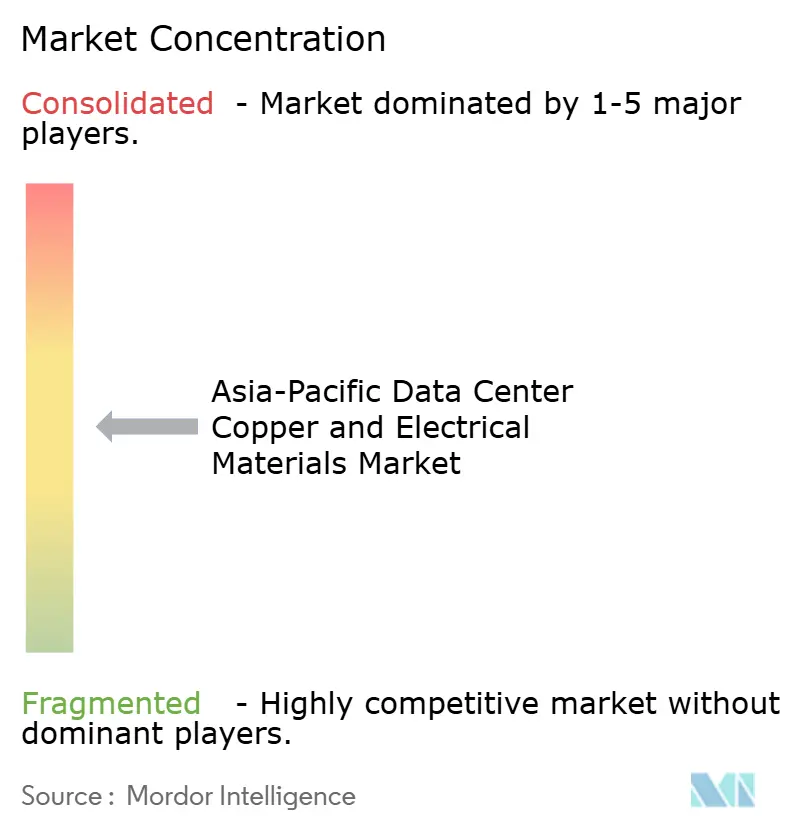
| Market Concentration | Medium |
Major Players *Disclaimer: Major Players sorted in no particular order Image © Mordor Intelligence. Reuse requires attribution under CC BY 4.0. | |
Asia-Pacific Data Center Copper and Electrical Materials Market Analysis by Mordor Intelligence
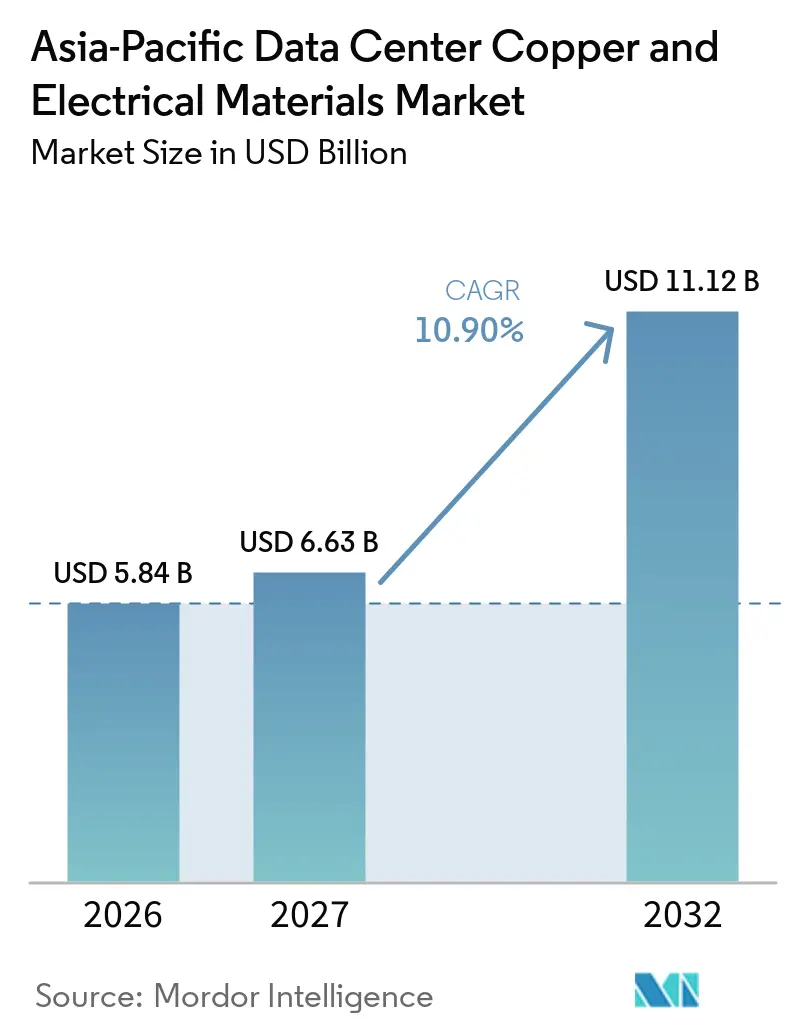
The Asia-Pacific data center copper and electrical materials market size was valued at USD 5.84 billion in 2026 and is estimated to grow from USD 6.63 billion in 2027 to reach USD 11.12 billion by 2032, at a CAGR of 10.90% during the forecast period (2027-2032). The Asia-Pacific data center copper and electrical materials market is supported by the regional expansion of AI computing sites, which need denser and more resilient electrical systems than conventional facilities. Higher rack loads are changing demand from basic cables toward busways, switchgear, power distribution units, and high-current connections. Large cloud operators are also specifying more of their own electrical packages, which raises the importance of qualified suppliers that can support design, testing, and delivery across several countries. Grid upgrades and renewable-power connections broaden demand beyond the data hall because new sites need stronger interconnection and on-site distribution systems. Copper cost movements, limited grid capacity, and lengthy qualification cycles remain material constraints, particularly for price-sensitive cable orders.
Key Report Takeaways
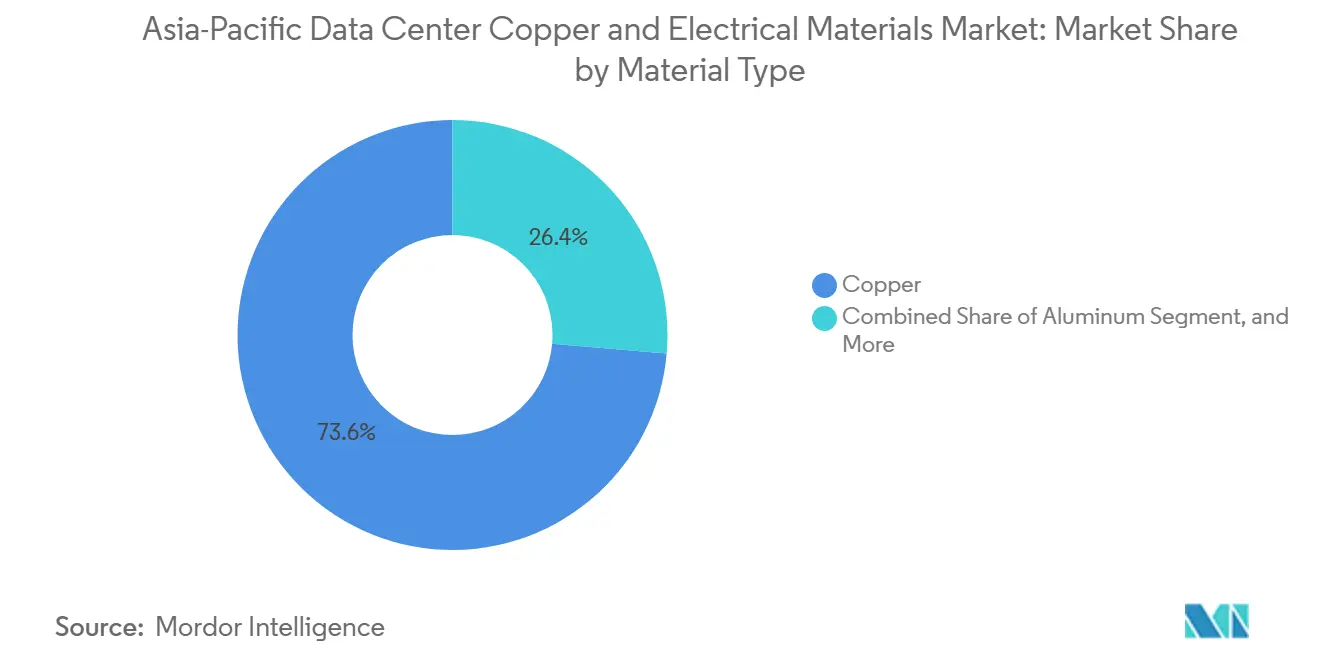
- By material type, copper held 73.62% of the Asia-Pacific data center copper and electrical materials market share in 2026, while aluminum is projected to expand at an 11.70% CAGR through 2032.
- By product type, electrical cables and conductors held a 45.14% revenue share in 2026, while busbars and busways are projected to expand at an 11.49% CAGR through 2032.
- By application, power distribution accounted for 46.91% of the Asia-Pacific data center copper and electrical materials market size in 2026.
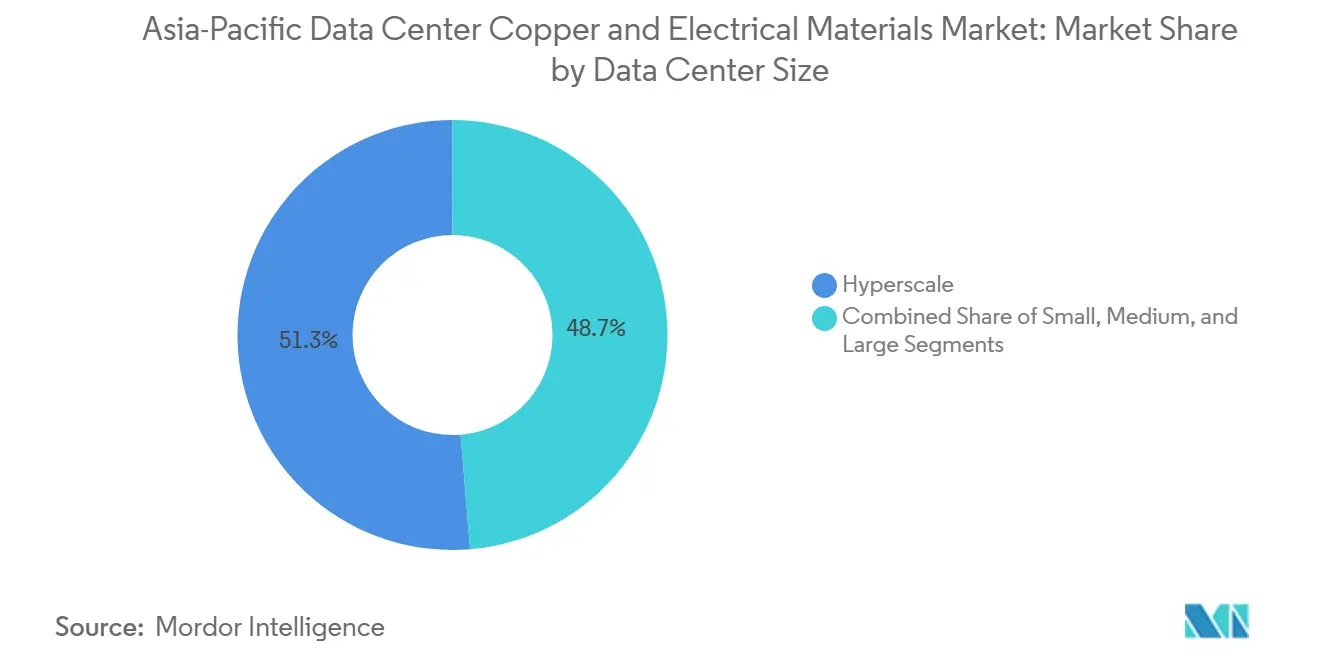
- By data center size, hyperscale facilities held 51.30% of demand in 2026 and are projected to expand at a 12.34% CAGR through 2032.
- By data center type, colocation held a 43.32% share in 2026, while cloud service providers are projected to expand at a 12.67% CAGR through 2032.
- By geography, China held 34.92% of the Asia-Pacific data center copper and electrical materials market share in 2026, while India is projected to expand at a 13.12% CAGR through 2032.
Note: Market numbers in this report are based on Mordor Intelligence's proprietary estimation framework, which combines nine months of actuals with Q4 projections for base year 2026.
Market Trends and Insights
Drivers Impact Analysis of Asia-Pacific Data Center Copper and Electrical Materials Market*
| Driver | (~) % Impact on CAGR Forecast | Geographic Relevance | Impact Timeline |
|---|---|---|---|
| AI and Hyperscale Data Center Expansion | +3.2% | China, India, Japan, Australia | Short term (≤ 2 years) |
| Cloud Adoption and Digital Infrastructure Investment | +2.3% | Southeast Asia, India, China | Short term (≤ 2 years) |
| Rising Rack Power Density and Modular Power Distribution | +1.5% | China, Singapore, Japan | Medium term (2-4 years) |
| Grid Modernization and Renewable Energy Interconnection | +1.2% | China, India, Australia | Medium term (2-4 years) |
| Power-Advantaged Data Center Clusters | +0.9% | India, Malaysia, Indonesia, Thailand | Medium term (2-4 years) |
| Prefabricated Electrical Systems | +0.5% | Asia-Pacific hyperscale deployments | Medium term (2-4 years) |
| Source: Mordor Intelligence | |||
AI And Hyperscale Data Center Expansion
The Asia-Pacific data center copper and electrical materials market benefits as AI deployments require more electricity distribution equipment per site. High-density GPU clusters need larger-gauge feeders, higher-current busbars, and more complex distribution paths than conventional installations. New large campuses also procure electrical packages earlier because power capacity and reliability are central to site design. The resulting orders extend across cable, switchgear, busway, and connection hardware rather than a single component category. Eaton introduced an 800 VDC architecture for AI factories that includes rack-level power distribution, showing how suppliers are adapting to the higher electrical demands of AI systems.[1] This change gives qualified equipment makers a stronger role in the Asia-Pacific data center copper and electrical materials market.
Cloud Adoption And Digital Infrastructure Investment
Cloud providers increasingly develop large facilities with their own operating and expansion requirements. Self-built sites typically require electrical systems that can be extended without replacing the original distribution backbone. This approach increases the value of modular equipment and of suppliers able to coordinate delivery across construction phases. Schneider Electric reported 19.7% organic data center revenue growth in China and East Asia in its 2026 half-year results, linking the performance to large hyperscale projects and AI infrastructure deployment. Singapore also uses energy-efficiency and renewable-power performance when allocating new data center capacity, so electrical design choices affect project eligibility. These conditions support demand for efficient distribution equipment in the Asia-Pacific data center copper and electrical materials market.
Rising Rack Power Density And Modular Power Distribution
Higher rack density is moving power systems toward overhead busway designs that can be adjusted without a shutdown. The configuration can support changing aisle loads and avoid repeated cable installation work within a live facility. It also requires equipment that manages heat and current reliably at higher ratings. Vertiv introduced PowerBar Track with configurations up to 2,500 A under IEC 61439-6, including copper and aluminum conductor options for high-density facilities. IEEE guidance similarly identifies busbar and PDU architecture as a key element of modular data center electrical design. Busbars and busways therefore have a clear role in the Asia-Pacific data center copper and electrical materials market.
Grid Modernization And Renewable Energy Interconnection
Grid spending creates a second demand channel for conductors, switchgear, and transformer connections. China has identified grid modernization as a priority under its 15th Five-Year Plan, with a focus on transmission capacity and digital distribution upgrades. New data centers also need more resilient links to renewable generation and local networks. These projects increase the need for high-voltage equipment before power reaches the facility. In Australia, the energy system plan identifies major transmission development needs as the power system changes. The Asia-Pacific data center copper and electrical materials market gains where data center investment and grid reinforcement occur together.
Restraints Impact Analysis of Asia-Pacific Data Center Copper and Electrical Materials Market*
| Restraint | (~) % Impact on CAGR Forecast | Geographic Relevance | Impact Timeline |
|---|---|---|---|
| Copper Price Volatility and Aluminum Substitution | -1.5% | Price-sensitive Asia-Pacific markets | Short term (≤ 2 years) |
| Grid Connection Delays and Limited Power Availability | -1.0% | Malaysia, Singapore, Japan, Australia, India | Medium term (2-4 years) |
| Long-Lead Qualification of High-Current Electrical Packages | -0.5% | Hyperscale facilities across Asia-Pacific | Medium term (2-4 years) |
| Sulfuric Acid, Mineral Processing and Regional Trade Disruptions | -0.3% | Asia-Pacific procurement supply chains | Medium term (2-4 years) |
| Source: Mordor Intelligence | |||
Copper Price Volatility And Aluminum Substitution
Copper remains central to high-current and mission-critical electrical pathways, but its cost exposure affects purchasing decisions. Buyers can use aluminum in some medium- and low-voltage cable applications by increasing conductor size. This substitutes material where weight, space, and operating conditions allow it. Reuters reported that high copper prices have encouraged manufacturers to consider aluminum in selected applications. Copper nevertheless remains preferred for critical busbars, high-performance connectors, and demanding power routes because conductivity and reliability requirements are more stringent. The Asia-Pacific data center copper and electrical materials market must therefore balance premium copper demand against wider use of aluminum in cost-sensitive segments.
Grid Connection Delays And Limited Power Availability
A completed data center requires firm power access before its electrical materials can be installed. Delayed network connections postpone purchases of cables, transformers, busways, and switchgear. Constraints are particularly relevant in established locations where grid upgrades require more time than facility construction. Japan faces this mismatch as data center development proceeds while network reinforcement has longer lead times. The Australian Energy Market Operator identifies the need for coordinated transmission planning and investment as the system incorporates new demand and generation.[2] Operators may respond with substations, batteries, or microgrids, which can raise the technical value of a project even when project timing is delayed.
*Our forecasts treat driver/restraint impacts as directional, not additive. The impact forecasts reflect baseline growth, mix effects, and variable interactions.
Asia-Pacific Data Center Copper and Electrical Materials Market Segment Analysis
By Material Type:
Copper Retains Its Core Role While Aluminum Broadens Its UseCopper held 73.62% of the Asia-Pacific data center copper and electrical materials market share in 2026. Its conductivity, thermal performance, and mechanical strength support high-current systems in main switchrooms, UPS feeders, and busbar assemblies. These attributes are important where failure risks are unacceptable. Copper is also used in precision strips and connection points that support liquid-cooled infrastructure, and Ningbo Jintian Copper reported 94% year-over-year growth in rack busbar copper substrate sales during the first half of 2026. The result reflects the increase in AI-related electrical requirements.
Aluminum is projected to expand at an 11.70% CAGR through 2032. Its lower cost and lighter weight support its use in long cable runs and selected distribution systems. Suppliers can increase conductor cross-section where lower conductivity can be accommodated. Hindalco stated that aluminum substitution has been occurring in long-distance conductor cables and some distribution wiring systems, while copper remains important in high-performance uses. Specialty conductive materials support connectors, terminations, and bonding parts, allowing the Asia-Pacific data center copper and electrical materials market to serve both high-reliability installations and cost-conscious designs.

By Product Type:
Cables Remain Essential While Busways Address Higher LoadsElectrical cables and conductors held 45.14% of the Asia-Pacific data center copper and electrical materials market share in 2026. They connect utility supply, medium-voltage equipment, UPS systems, and rack-level power distribution. The category is required at every layer of a facility, and Polycab identifies data centers as an important source of demand for wires and cables in its annual reporting. KEI commissioned its Sanand Phase I plant in December 2025 to add cable capacity for infrastructure demand.
Busbars and busways are projected to expand at an 11.49% CAGR through 2032. High-density racks need a flexible method to supply and redistribute power across a data hall. Overhead busway systems allow live tap-off changes, which can reduce disruption when equipment layouts change. Vertiv designed its PowerBar Track platform for colocation and hyperscale environments with evolving AI workloads. Copper rods and strips support the upstream fabrication of transformers and busbars. Connectors and termination materials also need higher ratings as individual rack connections handle greater current.
By Application:
Power Distribution Holds The Largest Spending RolePower distribution accounted for 46.91% of the Asia-Pacific data center copper and electrical materials market size in 2026. The application covers the route from utility entry through transfer switches, UPS equipment, PDUs, busway, and rack connections. Each layer uses conductors sized for the current carried by the system, while higher rack loads require larger transformer ratings, stronger cabling, and busbars with sustained high-ampacity performance. Electrical distribution remains the central demand application for the Asia-Pacific data center copper and electrical materials market.
Power backup systems remain copper intensive because they link UPS batteries, generators, and transfer equipment. Grid connection equipment includes substations, outdoor switchgear, and high-voltage interconnects that prioritize dependable operation. Grounding and bonding limit electrical noise around sensitive computing equipment, while structured copper cabling supports in-rack and inter-rack connectivity. UL Solutions sets testing and certification requirements for prefabricated modular power distribution assemblies through UL 2140.[3] Such compliance frameworks make factory-tested assemblies more relevant to facility developers.
By Data Center Size:
Hyperscale Facilities Concentrate Demand And ExpansionHyperscale facilities held 51.30% of total demand in 2026 and are projected to expand at a 12.34% CAGR through 2032. These sites require extensive cable routes, large busway systems, and precision copper in switchgear and contacts. Their electrical needs also extend into substations and dedicated utility connections. The larger the campus, the greater the need to plan power distribution for later expansion and to create demand for equipment that can be delivered in repeatable modules. The Asia-Pacific data center copper and electrical materials market is therefore strongly linked to hyperscale construction schedules.
Large facilities in the 10-50 MW range maintain a substantial installed base for conventional cable and switchgear products. They often need robust but less customized electrical packages than the biggest campuses. Medium and small facilities serve enterprise, edge, government, and distributed computing requirements, and their regional spread creates recurring procurement activity. Prefabricated systems can reduce construction risk where site labor is constrained, and Vertiv's OneCore platform combines power, thermal, and IT infrastructure in factory-assembled blocks for deployments ranging from 5 MW to 50 MW. This supports a more standardized delivery model across several facility sizes.
By Data Center Type:
Colocation Leads Today While Cloud Providers Build FasterColocation providers held 43.32% of the Asia-Pacific data center copper and electrical materials market share in 2026. Their facilities must accommodate tenants with different loads and expansion plans. Flexible distribution designs are valuable because capacity may be reallocated during a lease term. Modular busways are particularly useful in this operating model. Colocation operators need reliability across multiple customer environments, sustaining demand for cables, switchgear, and adaptable power systems.
Cloud service providers are projected to expand at a 12.67% CAGR through 2032. Large providers increasingly define their own electrical specifications and buy equipment at project scale. Their facilities are designed for GPU clusters and future expansion, raising requirements for high-current distribution. Schneider Electric stated that AI infrastructure and major hyperscale projects supported its data center growth in China and East Asia. Enterprise and edge sites require highly dependable equipment for financial services, manufacturing, and public-sector workloads, while the Asia-Pacific data center copper and electrical materials industry benefits from both large cloud builds and the broad base of specialized deployments.
Geography Analysis
China
China held 34.92% of the Asia-Pacific data center copper and electrical materials market share in 2026. The country combines large internet platforms, state-backed computing programs, and grid modernization activity. National investment in transmission and digital distribution supports the electrical infrastructure needed by new facilities. China’s National Energy Administration influences project design through renewable-power requirements for new data centers. These requirements increase attention to grid connections, storage, and power management, and suppliers with certified high-current equipment can benefit as large sites standardize their designs.
India
India is projected to expand at a 13.12% CAGR through 2032. The country attracts large data center projects through an established digital economy and a cost base that supports new capacity. Domestic cable makers are increasing high-tension and extra-high-voltage capabilities to serve data centers, grid upgrades, and renewable projects, and KEI expects its Sanand Phase II to support cables up to 500 kV when it is commissioned in March 2027. Schneider Electric opened a Motivar liquid cooling factory in Bengaluru in 2026, strengthening local supply for high-density AI infrastructure.[4] The local manufacturing base can shorten supply chains for the Asia-Pacific data center copper and electrical materials market.
Japan, Australia, Singapore, And Other Asia-Pacific Markets
Japan needs more power infrastructure as data center development advances faster than grid reinforcement in some locations, creating a role for on-site generation, storage, and microgrids, which require additional distribution equipment. Australia is planning new transmission as its generation mix changes, and its system planning provides a regulatory influence on how large power users connect. Singapore limits new capacity through efficiency, green-energy, and grid-impact requirements, favoring well-capitalized operators with stronger electrical designs. Malaysia, Indonesia, and Thailand offer new site options, but grid availability and permitting can shape development pace, while these markets give the Asia-Pacific data center copper and electrical materials market a broader set of demand locations and supply-chain choices.
Competitive Landscape
The Asia-Pacific data center copper and electrical materials market has a moderately concentrated systems-integration layer and a more fragmented cable and conductor layer. Schneider Electric, Vertiv, Eaton, ABB, Siemens, and Legrand compete on electrical system design, equipment breadth, and execution capability. Prysmian, LS Cable and System, Polycab India, and other regional manufacturers compete more directly in cables and conductive materials. Suppliers are shifting from individual components toward coordinated power, thermal, and distribution packages. This approach addresses demand for faster construction, tested interfaces, and predictable operational performance, and the Asia-Pacific data center copper and electrical materials market favors vendors that can support these requirements across multiple countries.
Eaton's 800 VDC reference architecture positions its electrical portfolio for AI factory requirements and busbar-based distribution. Vertiv launched OneCore in August 2025 as a prefabricated platform that integrates power, thermal, and IT infrastructure for deployments from 5 MW to 50 MW. ABB announced an investment of USD 495 million in October 2026 to acquire a 51% stake in a low-voltage power distribution joint venture with Mitsubishi Electric, targeting Japan and the wider regional opportunity. This adds low-voltage distribution capabilities in a large Asian market and shows that supplier competition extends beyond the copper component itself.
Regional manufacturers are differentiating through high-temperature cables, rack busbar materials, and integrated cable-to-connector solutions. Ningbo Jintian Copper reported expanded sales of products used in rack busbars and computing-power cooling during the first half of 2026. UL 2140 and UL 2755 certification frameworks favor suppliers with factory-test capabilities and documented assembly processes. This can raise entry requirements for firms that depend on site-built systems, while the Asia-Pacific data center copper and electrical materials industry remains competitive because conductors can be supplied by many firms, while project specification and certification offer more defensible positions.
Asia-Pacific Data Center Copper and Electrical Materials Industry Leaders
-
Legrand SA
-
Schneider Electric SE
-
Vertiv Group Corp.
-
Eaton Corporation plc
-
LS Cable & System Ltd.
- *Disclaimer: Major Players sorted in no particular order
Asia-Pacific Data Center Copper and Electrical Materials Market Companies Covered in this Report
- Legrand SA
- Schneider Electric SE
- Vertiv Group Corp.
- Eaton Corporation plc
- LS Cable & System Ltd.
- Prysmian S.p.A.
- Nexans S.A.
- Siemens AG
- ABB Ltd.
- Furukawa Electric Co., Ltd.
- Sumitomo Electric Industries, Ltd.
- Fujikura Ltd.
- HENGTONG GROUP CO., LTD.
- Jiangsu Zhongtian Technology Co., Ltd.
- Taihan Cable & Solution Co., Ltd.
- Polycab India Limited
- KEI Industries Limited
- Finolex Cables Limited
- Hindalco Industries Limited
- Ningbo Jintian Copper (Group) Co., Ltd.
Recent Industry Developments in Asia-Pacific Data Center Copper and Electrical Materials Market
- September 2026: Schneider Electric launched the Motivair liquid cooling solutions factory in Bengaluru, India, its first production site for this technology globally outside Italy and the United States, positioning India as a manufacturing and export hub for high-density AI infrastructure cooling equipment.
- September 2026: LS Cable & System has signed an MoU with the AI Factory Frontier (AFF) consortium, a group of five specialized companies, to target the AI data center power infrastructure market. The centerpiece of the partnership is LS Cable & System's superconducting system, the first to be commercialized, which can transmit large-capacity power at 23 kV medium voltage with virtually no loss equivalent to conventional 154 kV high-voltage transmission.
- September 2026: Doosan announced that it will invest KRW 968.4 billion (USD 0.71 billion) to expand production capacity for copper-clad laminates (CCLs) used in artificial intelligence (AI) data centers.
- August 2026: Japan’s Mitsui Kinzoku 5706.T announced its plans to expand production capacity for its high-performance copper foil products beyond 2030 by building a new plant in Malaysia to meet growing demand from the artificial intelligence and chip sectors.
Asia-Pacific Data Center Copper and Electrical Materials Market Report Scope
The Asia-Pacific data center copper and electrical materials market encompasses the procurement, regional distribution, and deployment of specialized copper, aluminum, and alternative conducting materials engineered for high-density computing infrastructure across key regional hubs in the Asia-Pacific region. The market tracks the supply chain of critical electrical cables, busbars, rods, and grounding components utilized in power distribution, backup systems, and grid connections across small, medium, large, and hyperscale facilities operating under colocation, enterprise, and cloud service frameworks.
The Asia-Pacific Data Center Copper and Electrical Materials Market Report is Segmented by Material Type (Copper, Aluminum, and Other Electrical Conductive Materials), Product Type (Electrical Cables and Conductors, Busbars and Busways, Copper Rods and Strips, Electrical Connectors and Termination Materials, and Other Electrical Materials), Application (Power Distribution, Power Backup Systems, Grid Connection and Electrical Infrastructure, Grounding and Bonding, and Other Electrical Applications), Data Center Size (Small, Medium, Large, and Hyperscale), Data Center Type (Colocation, Cloud Service Providers [CSPs], and Enterprise / Edge), and Country (China, India, Japan, Australia, Singapore, and Rest of Asia-Pacific). The Market Forecasts are Provided in Terms of Value (USD).
Segmentation Overview
| Copper |
| Aluminum |
| Other Electrical Conductive Materials |
| Electrical Cables and Conductors |
| Busbars and Busways |
| Copper Rods and Strips |
| Electrical Connectors and Termination Materials |
| Other Electrical Materials |
| Power Distribution |
| Power Backup Systems |
| Grid Connection and Electrical Infrastructure |
| Grounding and Bonding |
| Other Electrical Applications |
| Small |
| Medium |
| Large |
| Hyperscale |
| Colocation |
| Cloud Service Providers (CSPs) |
| Enterprise / Edge |
| China |
| India |
| Japan |
| Australia |
| Singapore |
| Rest of Asia-Pacific |
| By Material Type | Copper |
| Aluminum | |
| Other Electrical Conductive Materials | |
| By Product Type | Electrical Cables and Conductors |
| Busbars and Busways | |
| Copper Rods and Strips | |
| Electrical Connectors and Termination Materials | |
| Other Electrical Materials | |
| By Application | Power Distribution |
| Power Backup Systems | |
| Grid Connection and Electrical Infrastructure | |
| Grounding and Bonding | |
| Other Electrical Applications | |
| By Data Center Size | Small |
| Medium | |
| Large | |
| Hyperscale | |
| By Data Center Type | Colocation |
| Cloud Service Providers (CSPs) | |
| Enterprise / Edge | |
| By Country | China |
| India | |
| Japan | |
| Australia | |
| Singapore | |
| Rest of Asia-Pacific |
Key Questions Answered in the Report
What is the Asia-Pacific data center copper and electrical materials market size?
The market size is USD 6.63 billion in 2027 and is forecast to reach USD 11.12 billion by 2032, at a CAGR of 10.90%.
Which material accounts for the largest share of regional demand?
Copper holds 73.62% of demand in 2026 because critical power pathways need high conductivity and reliable thermal performance.
Why are busbars and busways gaining importance in AI data centers?
They are projected to expand at an 11.49% CAGR as high-density racks require flexible, high-current distribution that can be adapted without shutdowns.
Which data center customer group is expanding fastest?
Cloud service providers are projected to expand at a 12.67% CAGR through 2032 as hyperscalers build more self-operated AI facilities.
Which country offers the fastest forecast expansion?
India is projected to expand at a 13.12% CAGR through 2032, supported by new capacity, local manufacturing, and cable investment.
What may limit demand for copper electrical products?
Copper cost volatility, aluminum substitution in selected cable uses, and grid connection delays can postpone procurement or shift material choices.