
Asia-Pacific Data Center Construction Materials Supply Chain Market Size and Share
Market Overview
| Study Period | 2021 - 2032 |
|---|---|
| Forecast Data Period | 2027 - 2032 |
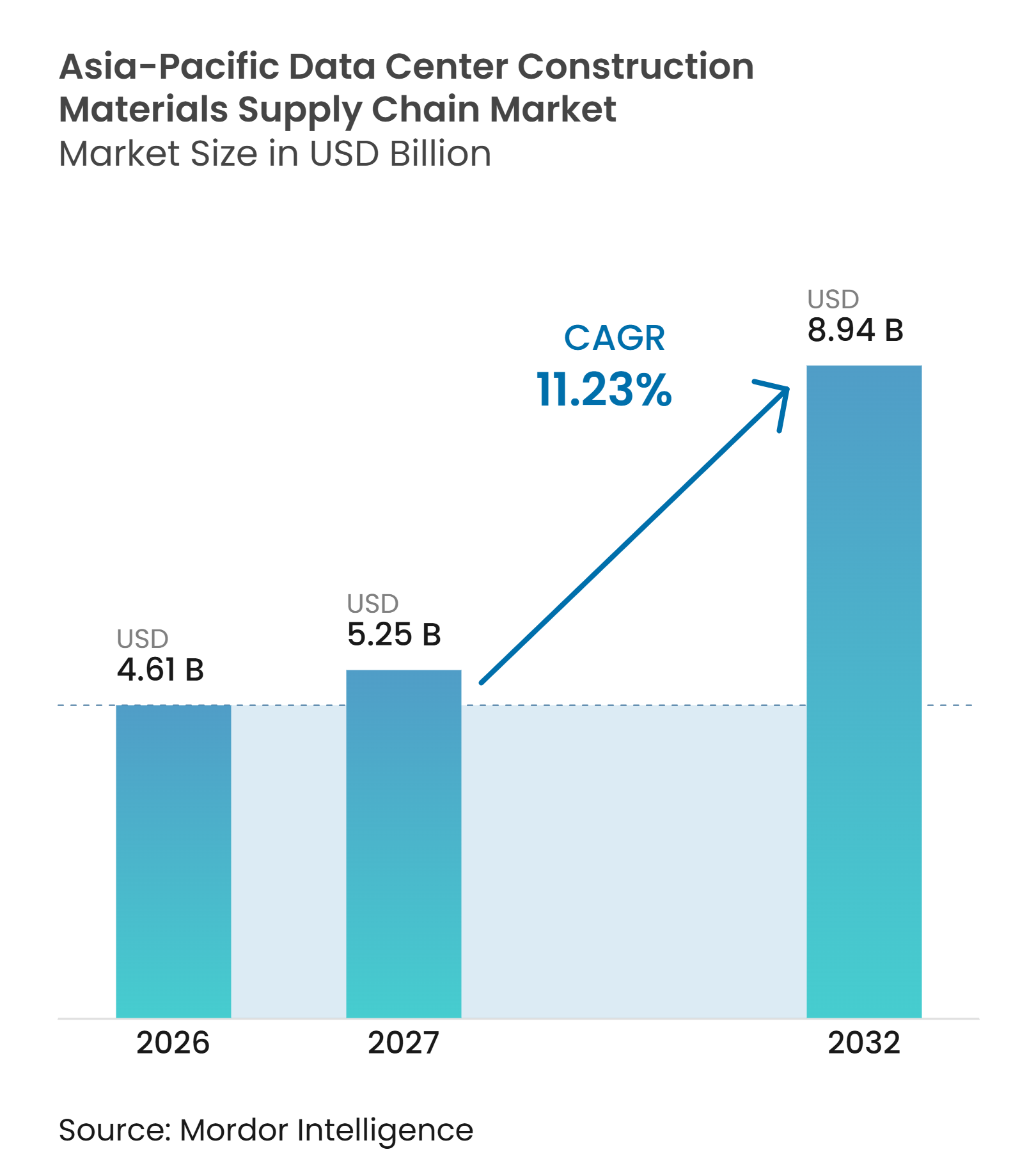
| Base Year Market Size (2026) | USD 4.61 Billion |
| Market Size (2027) | USD 5.25 Billion |
| Market Size (2032) | USD 8.94 Billion |
| Growth Rate (2027 - 2032) | 11.23 % |
| Market Concentration | Low |
Major Players *Disclaimer: Major Players sorted in no particular order Image © Mordor Intelligence. Reuse requires attribution under CC BY 4.0. | |
Asia-Pacific Data Center Construction Materials Supply Chain Market Analysis by Mordor Intelligence
The Asia-Pacific data center construction materials supply chain market size is expected to grow from USD 4.61 billion in 2026 to USD 5.25 billion in 2027 and is forecast to reach USD 8.94 billion by 2032 at 11.23% CAGR over 2027-2032. The Asia-Pacific data center construction materials supply chain market is supported by the construction of larger facilities built for AI workloads, which require more demanding structural and mechanical specifications. Higher rack density raises requirements for reinforced floors, cooling infrastructure, power distribution routes, and materials that can support heavier equipment. Digital infrastructure programs and data-residency requirements are also expanding the construction pipeline across China, India, and Southeast Asia. Developers are balancing speed, energy performance, supply availability, and compliance when selecting materials and delivery models. These conditions favor suppliers that can support repeatable specifications, prefabrication, and dependable regional delivery.
Key Report Takeaways
- By material type, structural steel and reinforcement steel held 32.71% of the Asia-Pacific data center construction materials supply chain market share in 2026, while precast concrete products are projected to expand at an 11.89% CAGR through 2032.
- By construction phase, structural construction accounted for 42.16% of the Asia-Pacific data center construction materials supply chain market size in 2026 and is projected to expand at a 12.21% CAGR through 2032.
- By procurement model, EPC-led procurement held 54.29% of the Asia-Pacific data center construction materials supply chain market share in 2026, while direct procurement by data center developers and operators is projected to expand at a 12.48% CAGR through 2032.
- By data center size, hyperscale data centers held 49.58% of the Asia-Pacific data center construction materials supply chain market share in 2026 and are projected to expand at a 12.83% CAGR through 2032.
- By data center type, cloud service providers held 51.33% of the market in 2026 and are projected to expand at a 13.11% CAGR through 2032.
- By geography, China held 36.74% of the market in 2026, while India is projected to expand at a 13.45% CAGR through 2032.
Note: Market numbers in this report are based on Mordor Intelligence's proprietary estimation framework, which combines nine months of actuals with Q4 projections for base year 2026.
Market Trends and Insights
Drivers Impact Analysis of Asia-Pacific Data Center Construction Materials Supply Chain Market*
| Driver | (~) % Impact on CAGR Forecast | Geographic Relevance | Impact Timeline |
|---|---|---|---|
| AI-Ready Hyperscale Construction and Higher Rack Densities | +3.5% | Global, concentrated in China, India, and Southeast Asia | Medium term (2-4 years) |
| Government-Led Digital Infrastructure and Data-Residency Programs | +2.5% | China and India primarily, with secondary influence across Southeast Asia and Japan | Long term (≥ 4 years) |
| Migration Toward Secondary Asia-Pacific Data Center Hubs | +2.0% | Malaysia, Thailand, Indonesia, and Vietnam, with spillover to the Philippines and Bangladesh | Short term (≤ 2 years) |
| Green Building Standards and Energy-Efficiency Requirements | +1.5% | Singapore, Australia, and Japan, with rising compliance pressure in China and India | Long term (≥ 4 years) |
| Accelerating Adoption of Prefabricated and Modular Construction | +1.2% | Asia-Pacific, with early adoption in Malaysia, Singapore, and South Korea | Short term (≤ 2 years) |
| Expansion of Regional Cloud, Colocation, and Edge Capacity | +1.0% | Asia-Pacific, including tier 2 and 3 cities in India and China | Medium term (2-4 years) |
| Source: Mordor Intelligence | |||
AI-Ready Hyperscale Construction and Higher Rack Densities
The Asia-Pacific data center construction materials supply chain market is being reshaped by campuses designed for AI workloads and higher rack densities. These facilities require stronger floor systems, more complex mechanical routes, and additional capacity for liquid-cooling infrastructure. The resulting specifications increase demand for structural steel, reinforcement products, precast components, specialized flooring, and materials used in power and cooling systems. L&T's Vyoma.AI project in Chennai began with a 52 MW AI-ready design that includes direct-to-chip liquid cooling and renewable energy integration, showing how high-density requirements are influencing civil and MEP scope. Large campuses also encourage suppliers to standardize specifications across successive phases. This shift places greater importance on material performance, delivery certainty, and coordination between structural and mechanical packages.
Government-Led Digital Infrastructure and Data-Residency Programs
Public policy supports the Asia-Pacific data center construction materials supply chain market by treating compute capacity as strategic infrastructure. China has advanced compute-power coordination through national policy that links computing infrastructure with energy systems. The national computing network agenda also supports development across regions rather than concentrating facilities in a small number of coastal locations. These programs can increase the need for structural materials, envelope products, and electrical infrastructure in new construction zones. India is also attracting investment for larger data center campuses, including projects structured around AI and high-density computing. Policy support can give developers more visibility on the long-term construction pipeline, although delivery remains dependent on power access and local approvals.
Migration Toward Secondary Asia-Pacific Data Center Hubs
Capacity constraints in established locations are directing projects toward Johor, Bangkok, Ho Chi Minh City, and other secondary hubs. This shift expands the Asia-Pacific data center construction materials supply chain market into places where data center-grade supply chains are less established. New locations often need more work on site preparation, civil works, utility interfaces, and local distribution before construction can proceed at scale. Leighton Asia's 57.6 MW Johor Bahru project covers six colocation buildings at a greenfield site, illustrating the multi-building format now moving into Malaysia. Gamuda has also secured large hyperscale contracts in Malaysia, including work covering shell, core, site infrastructure, and MEP scope. Local manufacturing and distribution capacity can therefore become more relevant as project activity spreads beyond mature hubs.
Green Building Standards and Energy-Efficiency Requirements
Energy rules are changing the material specifications used in the Asia-Pacific data center construction materials supply chain market. Singapore's Green Mark framework has helped establish a national approach to building energy performance and lower-carbon construction.[1] For data centers, compliance factors can affect insulation, cladding, roofing, waterproofing, thermal control, and the integration of renewable-energy systems. The focus on lower energy use also increases interest in prefabricated systems that reduce site waste and improve installation consistency. Schneider Electric and the National University of Singapore have collaborated on sustainable data center operations, reflecting the regional push to test energy-management approaches in operating facilities. Suppliers that can document product performance and support certification requirements are better placed to meet these specifications.
Restraints Impact Analysis of Asia-Pacific Data Center Construction Materials Supply Chain Market*
| Restraint | (~) % Impact on CAGR Forecast | Geographic Relevance | Impact Timeline |
|---|---|---|---|
| Specialist Contractor and MEP Labor Shortages | -0.8% | Asia-Pacific, most acute in Japan, Singapore, and emerging Southeast Asian hubs | Medium term (2-4 years) |
| Grid Connection, Water Availability, and Utility-Approval Delays | -0.7% | Japan, India, Australia, and Vietnam, especially congested urban markets | Long term (≥ 4 years) |
| Volatile Long-Lead Equipment and Construction-Material Costs | -0.5% | Global, with concentrated impact in Japan, Singapore, and Australia | Short term (≤ 2 years) |
| Fragmented Regulations and Cross-Border Procurement Risk | -0.4% | Southeast Asia, including Indonesia, Vietnam, and the Philippines | Medium term (2-4 years) |
| Source: Mordor Intelligence | |||
Specialist Contractor and MEP Labor Shortages
Labor shortages can delay schedules even when the required materials are available. This affects the Asia-Pacific data center construction materials supply chain market because delayed installation can lead to storage, re-handling, and respecification costs. The constraint is particularly relevant for MEP packages, which require experienced electrical, cooling, controls, and commissioning teams. Off-site fabrication is becoming one response because it transfers more work into controlled factory settings. Aurecon's work on the K2 JHR01-03 prefabricated 60 MW data center in Johor involved coordinating 7 contractors and 1,000 workers, demonstrating the scale of coordination required for modular delivery. The Asia-Pacific data center construction materials supply chain industry is likely to place more value on suppliers that can deliver prefabricated assemblies and provide installation support.
Grid Connection, Water Availability, and Utility-Approval Delays
Power and water availability can defer construction starts and disrupt planned procurement. This creates uncertainty for suppliers in the Asia-Pacific data center construction materials supply chain market because project demand can move when utility approvals change. Projects may then need faster deliveries once grid access becomes available and committed capacity dates approach. Singapore has continued to direct development through controlled allocation, including new data center activity supported by economic-development policy. Such controls reinforce the need for developers to align land, utilities, design, and material orders earlier in the project cycle. The delay risk also favors delivery models that allow structural and MEP packages to be manufactured in parallel with approval processes.
*Our forecasts treat driver/restraint impacts as directional, not additive. The impact forecasts reflect baseline growth, mix effects, and variable interactions.
Asia-Pacific Data Center Construction Materials Supply Chain Market Segment Analysis
By Material Type:
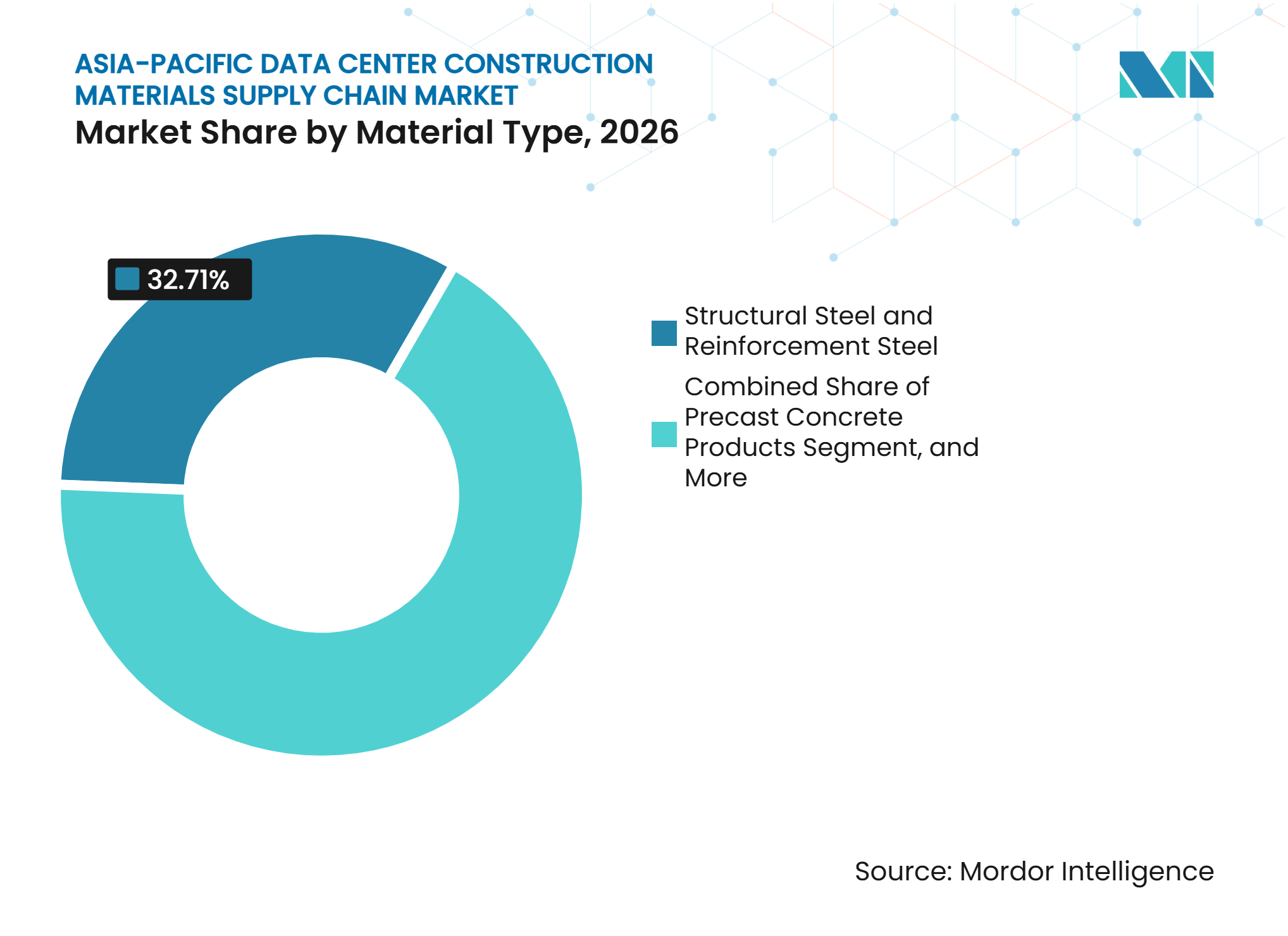
Steel Leads, While Precast Supports Faster DeliveryStructural steel and reinforcement steel held 32.71% in 2026, making this the largest material category in the Asia-Pacific data center construction materials supply chain market. Steel supports high floor loads, multistory layouts, equipment platforms, and the reinforcement needs associated with dense power and cooling systems. Its importance rises in AI-ready facilities because structural systems must accommodate heavier racks and more demanding internal services. Cement, concrete, and aggregates remain essential for foundations, slabs, and civil works. Roofing, waterproofing, insulation, façade, cladding, flooring, and interior materials are also required as a facility moves from structural completion into its operational shell. The material mix therefore extends beyond the building frame and depends on thermal, moisture, fire, acoustic, and resilience requirements.
Precast concrete products are projected to expand at an 11.89% CAGR through 2032. Their role is tied to reducing on-site work and bringing structural components into a more repeatable manufacturing process. IJM Construction's Johor contract used a full precast system that included columns, beams, and hollow-core slabs. This model can be useful where contractor capacity is tight, or delivery windows are short. Precast methods also require early design coordination because component dimensions, transport, lifting, and connections must be established before site work advances. Demand for these products is likely to be most visible in large, standardized facilities where developers can reuse proven designs across several phases.



By Construction Phase:
Structural Work Anchors Spending and ActivityStructural construction accounted for 42.16% of the Asia-Pacific data center construction materials supply chain market size in 2026. It is also projected to expand at a 12.21% CAGR through 2032, making it both the largest and fastest-growing construction phase. This reflects the high material intensity of reinforced foundations, frames, slabs, roof structures, and related civil works. AI-focused designs add further complexity through heavier equipment loads, more technical floors, and integrated routes for power and cooling services. Site preparation and civil works remain important, particularly at greenfield projects in emerging hubs. These tasks shape the quantity and timing of concrete, aggregates, steel, drainage, and utility-related material orders.
Building envelope and roofing work follow the structural phase and increasingly involve performance requirements for heat, moisture, weather, and energy use. Singapore's building policy has helped drive attention to energy performance across the built environment. Interior and fit-out works then convert a powered shell into usable data hall capacity. Prefabricated electrical and mechanical modules can shorten this stage when designs are standardized. This creates a closer link between the structural program and the availability of modular MEP packages. Suppliers that understand these handoffs can better plan delivery sequences for each construction phase.
By Procurement Model:
EPC Remains the Main Route, While Direct Buying ExpandsEPC-led procurement held 54.29% of the Asia-Pacific data center construction materials supply chain market in 2026. This model gives owners a single party responsible for delivering civil, structural, architectural, and MEP work under coordinated specifications. It is especially relevant on large campuses where schedule coordination and technical interfaces create commercial risk. Leighton Asia's India contract includes civil, structural, architectural, and MEP scope, which reflects the broad package often managed by EPC contractors.[2] EPC procurement can also give contractors greater influence over approved materials, supplier lists, and logistics planning. For materials producers, this means technical engagement with designers and contractors remains central to winning specifications.
Direct procurement by data center developers and operators is projected to expand at a 12.48% CAGR through 2032. Large owners can use direct buying to standardize recurring material categories across multiple sites and phases. This approach is most practical when an operator has sufficient construction volume, technical staff, and supplier relationships. It can be used for common categories such as reinforcement steel, concrete, and selected electrical components. More specialized assemblies may stay within EPC scope because contractors manage detailed design, warranty coordination, and installation responsibility. The Asia-Pacific data center construction materials industry will therefore continue to have a mixed procurement structure rather than one model replacing all others.
By Data Center Size:
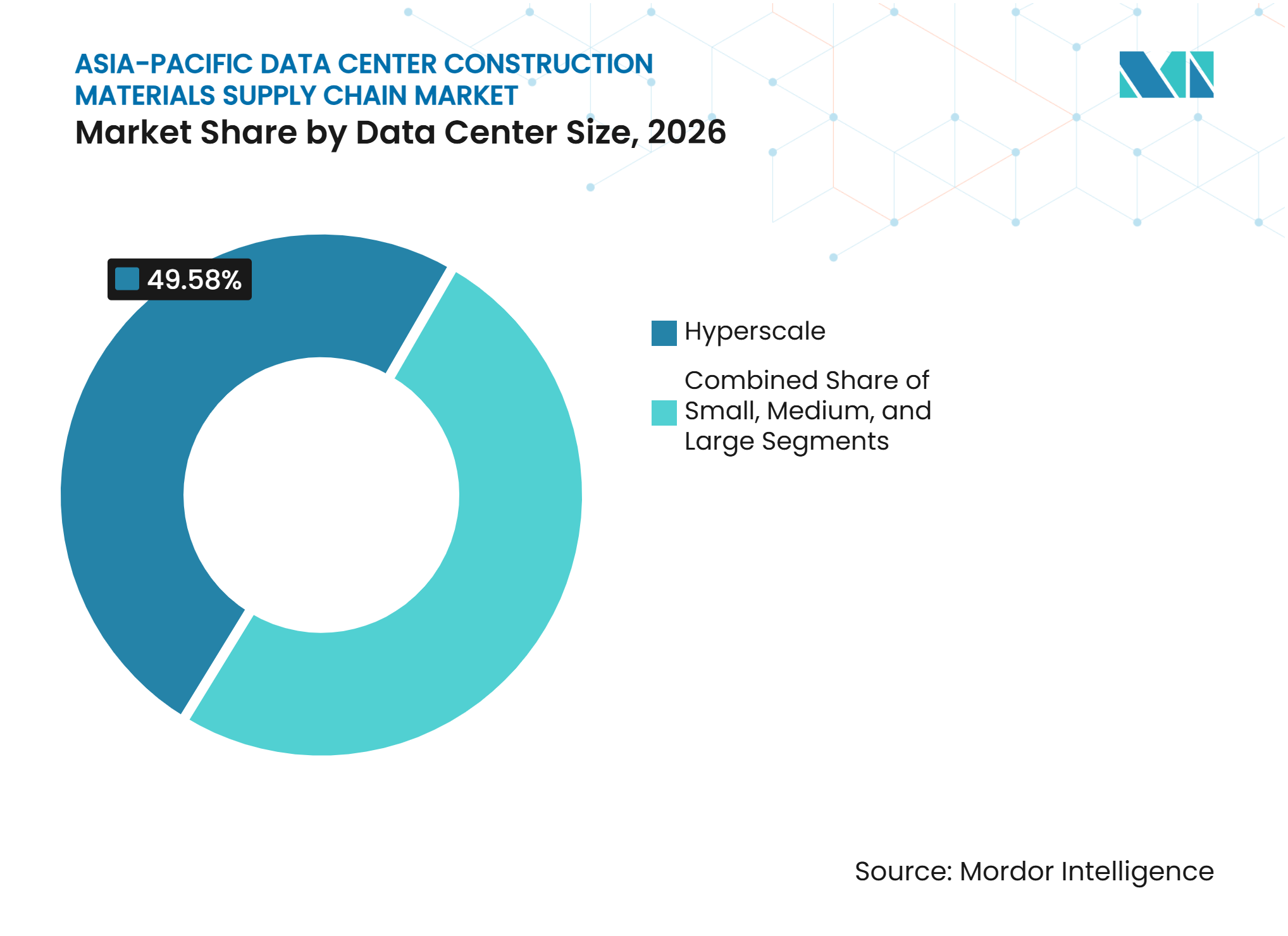
Hyperscale Facilities Set the Material Demand PatternHyperscale facilities held 49.58% of the Asia-Pacific data center construction materials supply chain market in 2026. They are projected to expand at a 12.83% CAGR through 2032, reflecting their role in cloud and AI infrastructure. These campuses use large volumes of structural steel, concrete, insulation, roofing, and MEP-support materials because they are built in multiple halls or buildings. Their construction programs can be phased over several years, which gives suppliers visibility but also creates concentrated order cycles. L&T's planned AI Factory campus in Chennai has 150 MVA of power infrastructure in place, indicating the infrastructure scale associated with high-density developments. These facilities also require close coordination between site design, utility capacity, structural engineering, and equipment planning.
Large data centers remain important for colocation operators and regional cloud providers. Medium and small facilities serve enterprise, telecom, and edge requirements, especially in tier 2 and 3 cities. Their material needs are lower per project but can be distributed across more sites. Urban facilities may also require compact layouts, multi-story construction, acoustic treatment, and tighter access planning. The mix of facility sizes prevents demand from being limited only to major hyperscale campuses. It also creates room for local suppliers that can serve smaller projects with shorter lead times and regional technical support.

By Data Center Type:
Cloud Service Providers Lead, While Other Formats Broaden DemandCloud service providers held 51.33% of the Asia-Pacific data center construction materials supply chain market in 2026. The segment is projected to expand at a 13.11% CAGR through 2032, the highest rate among the data center types covered. CSP campuses need reliable structural systems, redundancy-ready electrical materials, and building envelopes that can meet local energy and safety standards. Their design standards often apply across several countries, which supports repeatable product specifications. Chindata and HEC began construction on an advanced computing campus in Yidu that combines computing infrastructure with an AI showcase and academic exchange center.[3] Such projects show that cloud and computing facilities increasingly include integrated technology, energy, and site-development requirements.
Colocation operators are upgrading existing facilities and adding new capacity in regional hubs. These projects can require structural reinforcement, improved subfloors, power-distribution upgrades, cooling modifications, and moisture-control materials. Enterprise and edge data centers are structurally different because their smaller footprints often sit closer to users or telecom infrastructure. They may require compact façade solutions, rooftop plant enclosures, and acoustic treatment in urban locations. The construction material requirement varies by operating model, but reliable power, cooling, safety, and environmental performance remain common design needs. This variety supports demand across both standardized construction products and specialized, project-specific materials.
Geography Analysis
China: National Compute Programs Support Large Construction Programs
China held 36.74% of the Asia-Pacific data center construction materials supply chain market in 2026. The country's scale is supported by national policies that link computing capacity, energy systems, and a more integrated national computing network. This framework encourages large projects across regions and can distribute material demand beyond the main coastal data center clusters. Renewable-energy integration also affects the design of roofs, power infrastructure, insulation, and water-management systems. The National Energy Administration has described the move from the concept of compute-power coordination toward implementation. Contractors and suppliers must therefore address both high-volume construction needs and evolving energy-performance requirements. Prefabricated modules can help standardize delivery where large campus designs are repeated. The Asia-Pacific data center construction materials supply chain market benefits in China when these programs translate policy direction into permitted, powered, and fully specified projects.
India: Investment Commitments Support the Fastest Forecast Expansion
India is projected to expand at a 13.45% CAGR through 2032. The country is attracting data center investment across major locations and new cities, supporting a wide construction pipeline. ST Telemedia Global Data Centers India has agreed to invest up to INR 5,000 crore (USD 526.80 million), as provided in the source material, in campuses across Mumbai and Pune. It also signed an agreement for a 100 MW AI-ready Hyderabad campus with a planned investment of up to INR 3,500 crore (USD 368.76 million) stated as part of its wider decadal outlook. These developments support demand for steel, concrete, precast elements, enclosure materials, and MEP inputs. Chennai, Mumbai, Hyderabad, Pune, and other locations are relevant because they combine digital demand with developer activity. The main structural requirement is to align construction schedules with utility capacity, approvals, and local contractor availability.
Japan, Australia, Singapore, and Emerging Southeast Asia: Different Conditions Shape Regional Demand
Japan is characterized by technically demanding designs, including seismic requirements and constrained urban sites. Goodman began construction on the 61 MW SYD01 campus in northern Sydney, with the first 12.2 MW phase targeted for service in Q2 2028, showing continued development in Australia. Singapore combines limited land and energy controls with a strong focus on sustainable operation, which keeps compliance factors central to material selection. Schneider Electric has also worked with Digital Edge on a dual-certified facility in the Philippines, illustrating how efficiency and certification are becoming part of regional project positioning.[4] Malaysia is drawing large multi-building projects, while Thailand, Vietnam, and Indonesia are attracting construction as capacity spreads across Southeast Asia. Leighton Asia has expanded its Southeast Asian portfolio through work in Thailand and Malaysia. These mixed geographies create demand for flexible regional sourcing, local compliance knowledge, and supply chains that can serve both large campuses and smaller expansion projects.
Competitive Landscape
Market Concentration
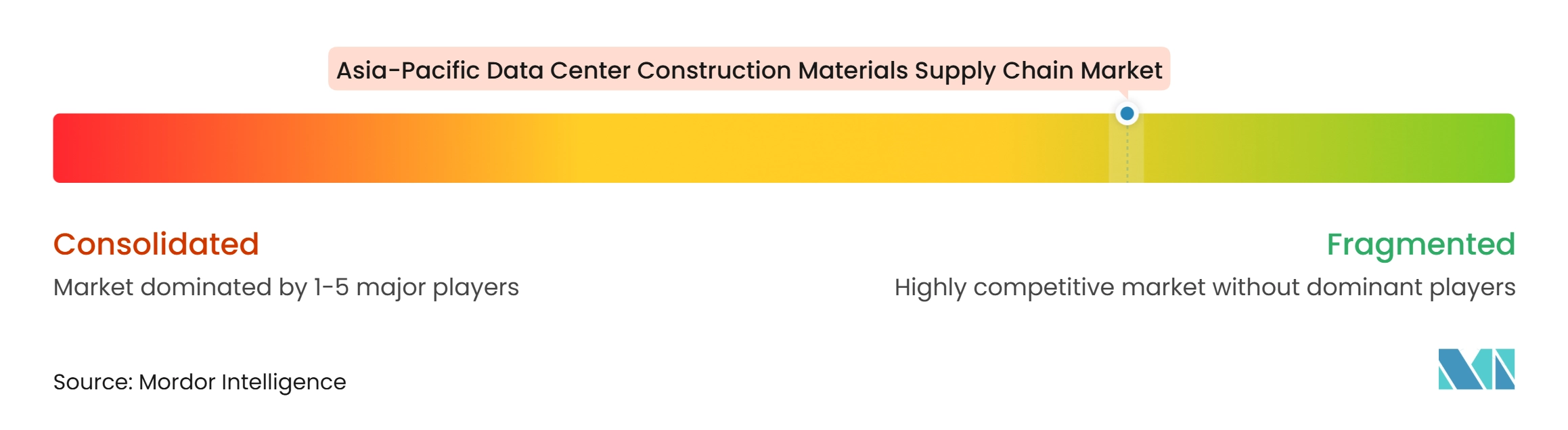
The Asia-Pacific data center construction materials supply chain market remains fragmented at the materials-production level. Influence is more concentrated among EPC contractors, engineering firms, and systems providers that shape specifications and procurement packages. Leighton Asia has secured projects across Malaysia, India, and Thailand, giving it a regional delivery platform for civil, structural, and MEP packages. Gamuda has won successive hyperscale projects in Malaysia, including contracts for shell, core, infrastructure, and MEP work. This structure makes contractor relationships important for material suppliers seeking specification access.
Technology-integrated companies compete by combining power, cooling, management systems, and service capability. Schneider Electric has partnered with the National University of Singapore on sustainable data center operations and worked with Digital Edge in the Philippines on a dual-certified facility. These activities position system providers closer to project design decisions, rather than only as equipment vendors. Engineering firms can also differentiate through modular delivery expertise and coordination capability. Aurecon's award-winning Johor project demonstrated the use of prefabrication at a 60 MW facility. The ability to coordinate structural materials, MEP modules, logistics, and site execution is becoming a practical source of competitive strength.
Regional localization is a central competitive issue for the Asia-Pacific data center construction materials supply chain market. Suppliers that establish fabrication, warehousing, and technical support near Johor, Hyderabad, Bangkok, or other growth centers can reduce delivery complexity. Cross-border partnerships are also being used to enter markets where local approvals and contractor relationships matter. Chindata's integration with HEC combines data center operations with advanced materials and renewable-energy capabilities in China. Developers and contractors are likely to favor partners that can provide reliable supply alongside compliance documentation and installation support. The Asia-Pacific data center construction materials supply chain market is therefore shaped by a combination of local execution capacity and the ability to meet repeatable global standards.
Asia-Pacific Data Center Construction Materials Supply Chain Industry Leaders
-
AECOM
-
DPR Construction Inc.
-
Turner Construction Company
-
Exyte GmbH
-
Hibiya Engineering, Ltd.
- *Disclaimer: Major Players sorted in no particular order
Asia-Pacific Data Center Construction Materials Supply Chain Market Companies Covered in this Report
- AECOM
- DPR Construction Inc.
- Turner Construction Company
- Exyte GmbH
- Leighton Asia (CIMIC Group)
- Woh Hup (Private) Limited
- Jacobs Solutions Inc.
- Larsen and Toubro Limited
- Aurecon Group Pty Ltd
- Gamuda Berhad
- YTL Power International Berhad
- Goodman Group
- China Communications Services Corporation Limited
- ST Engineering Ltd.
- ST Telemedia Global Data Centres
- Chindata Group Holdings Limited
- Hibiya Engineering, Ltd.
- DCI Indonesia
- Citramas Group
- Schneider Electric SE
Recent Industry Developments in Asia-Pacific Data Center Construction Materials Supply Chain Market
- October 2026: L&T's data center subsidiary Vyoma.AI broke ground on a 52 MW AI-ready green data center in Chennai featuring direct-to-chip liquid cooling and renewable energy integration, forming part of a planned gigawatt-scale AI Factory campus in Chennai with 150 MVA of power infrastructure already in place. This marks a material escalation in L&T's civil and MEP construction capability for high-density AI facilities.
- September 2026: Leighton Asia was awarded a data center construction contract in Hyderabad, India, to be delivered in a joint venture with Sterling and Wilson for a multinational technology corporation. The scope covers full civil, structural, architectural, and MEP works at a facility in a market that recorded significant hyperscale absorption.
- August 2026: Goodman Group reported data center work in progress approaching USD 20 billion globally and signed a 20-year lease for the first 50 MW phase of its 1 GW Tsukuba Tech Central project in Tokyo with a global hyperscaler, with construction of the powered shell and MEP fit-out underway.
- April 2026: Gamuda Engineering secured a RM 1.72 billion (USD 389 million) construction contract for a hyperscale data center at Port Dickson, Malaysia, covering site infrastructure, building core and shell, and full MEP fit-out. The project is scheduled for completion in Q1 2028.
Asia-Pacific Data Center Construction Materials Supply Chain Market Report Scope
The Asia-Pacific data center construction materials supply chain market comprises the end-to-end sourcing, logistics, and distribution of structural, architectural, and specialized materials required for data center development across the Asia-Pacific region. This market evaluates the regional flow of critical components while analyzing the impacts of localized regulatory frameworks, rapid digital transformation, and cross-border trade dynamics on lead times and project delivery.
The Asia-Pacific Data Center Construction Materials Supply Chain Market Report is Segmented by Material Type (Structural Steel and Reinforcement Steel, Cement, Concrete, and Aggregates, Precast Concrete Products, Roofing and Waterproofing Materials, Insulation Materials, Façade and Cladding Materials, Flooring and Interior Construction Materials, and Other Construction Materials), Construction Phase (Site Preparation and Civil Works, Structural Construction, Building Envelope and Roofing, and Interior and Fit-Out Works), Procurement Model (Direct Procurement by Data Center Developers and Operators, Engineering, Procurement, and Construction-Led Procurement, and Distributor and Supplier-Led Procurement), Data Center Size (Small, Medium, Large, and Hyperscale), Data Center Type (Colocation, Cloud Service Providers [CSPs], and Enterprise / Edge), and Country (China, India, Japan, Australia, Singapore, and Rest of Asia-Pacific). The Market Forecasts are Provided in Terms of Value (USD).
Segmentation Overview
| Structural Steel and Reinforcement Steel |
| Cement, Concrete, and Aggregates |
| Precast Concrete Products |
| Roofing and Waterproofing Materials |
| Insulation Materials |
| Façade and Cladding Materials |
| Flooring and Interior Construction Materials |
| Other Construction Materials |
| Site Preparation and Civil Works |
| Structural Construction |
| Building Envelope and Roofing |
| Interior and Fit-Out Works |
| Direct Procurement by Data Center Developers and Operators |
| Engineering, Procurement, and Construction-Led Procurement |
| Distributor and Supplier-Led Procurement |
| Small |
| Medium |
| Large |
| Hyperscale |
| Colocation |
| Cloud Service Providers (CSPs) |
| Enterprise / Edge |
| China |
| India |
| Japan |
| Australia |
| Singapore |
| Rest of Asia-Pacific |
| By Material Type | Structural Steel and Reinforcement Steel |
| Cement, Concrete, and Aggregates | |
| Precast Concrete Products | |
| Roofing and Waterproofing Materials | |
| Insulation Materials | |
| Façade and Cladding Materials | |
| Flooring and Interior Construction Materials | |
| Other Construction Materials | |
| By Construction Phase | Site Preparation and Civil Works |
| Structural Construction | |
| Building Envelope and Roofing | |
| Interior and Fit-Out Works | |
| By Procurement Model | Direct Procurement by Data Center Developers and Operators |
| Engineering, Procurement, and Construction-Led Procurement | |
| Distributor and Supplier-Led Procurement | |
| By Data Center Size | Small |
| Medium | |
| Large | |
| Hyperscale | |
| By Data Center Type | Colocation |
| Cloud Service Providers (CSPs) | |
| Enterprise / Edge | |
| By Country | China |
| India | |
| Japan | |
| Australia | |
| Singapore | |
| Rest of Asia-Pacific |
Key Questions Answered in the Report
What is the Asia-Pacific data center construction materials supply chain market size?
The Asia-Pacific data center construction materials supply chain market is expected to increase from USD 4.61 billion in 2026 to USD 8.94 billion by 2032, at an 11.23% CAGR over 2027-2032.
Which material category has the largest share in Asia-Pacific data center construction?
Structural steel and reinforcement steel held 32.71% in 2026 because data centers require foundations, frames, slabs, and support for dense power and cooling equipment.
Which construction material is expected to expand the fastest?
Precast concrete products are projected to expand at an 11.89% CAGR through 2032, supported by faster and more standardized delivery.
Why are hyperscale facilities important for construction material demand?
Hyperscale data centers held 49.58% in 2026 and are projected to expand at a 12.83% CAGR, creating large requirements for structural, enclosure, and MEP-support materials.
Which country leads demand for data center construction materials in Asia-Pacific?
China held 36.74% in 2026, supported by national computing-network and compute-power coordination programs.
Which country is forecast to expand the fastest through 2032?
India is projected to expand at a 13.45% CAGR through 2032, supported by new AI-ready and high-density campus development.