
Asia-Pacific Data Center Automation Market Size and Share
Market Overview
| Study Period | 2021 - 2032 |
|---|---|
| Forecast Data Period | 2027 - 2032 |
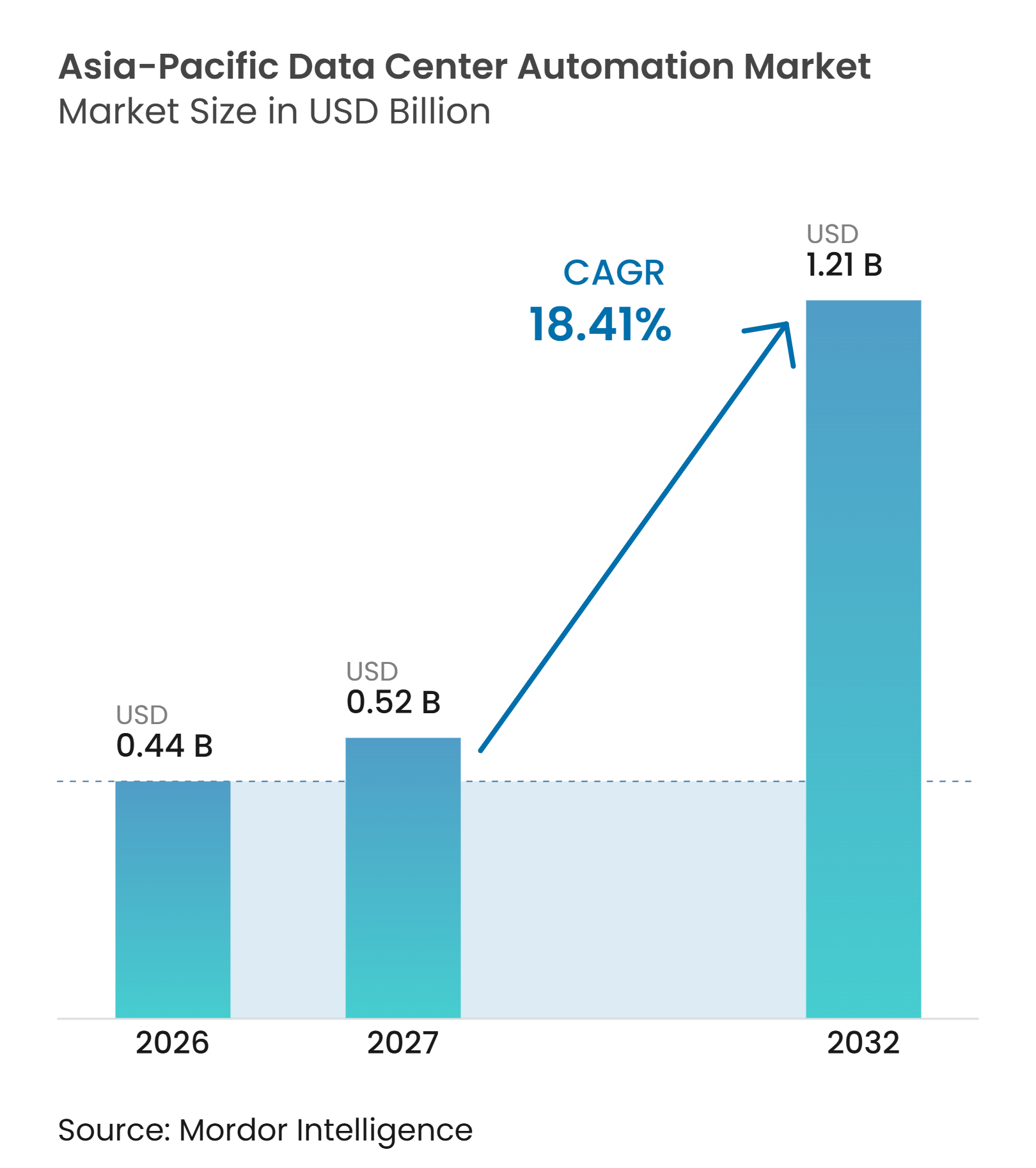
| Base Year Market Size (2026) | USD 0.44 Billion |
| Market Size (2027) | USD 0.52 Billion |
| Market Size (2032) | USD 1.21 Billion |
| Growth Rate (2027 - 2032) | 18.41 % |
| Market Concentration | Medium |
Major Players *Disclaimer: Major Players sorted in no particular order Image © Mordor Intelligence. Reuse requires attribution under CC BY 4.0. | |
Asia-Pacific Data Center Automation Market Analysis by Mordor Intelligence
The Asia-Pacific Data Center Automation Market size is valued at USD 0.44 billion in 2026 and is forecast to reach USD 1.21 billion by 2032, at a CAGR of 18.41% during 2027-2032. Demand is shifting from stand-alone site controls to platforms that coordinate power, cooling, and compute across multiple facilities. Generative AI workloads increase the need for real-time thermal control, power allocation, and fault management, making manual processes less practical in dense facilities. New hyperscale and colocation projects present an early opportunity for automation, as operators can incorporate software, control systems, and sensing equipment into the initial fit-out. National AI programs also support demand for locally managed systems that meet data residency and operating requirements. Upfront integration costs, cybersecurity exposure, legacy controls, and a shortage of skilled engineers remain material barriers for the Asia-Pacific Data Center Automation Market.
Key Report Takeaways
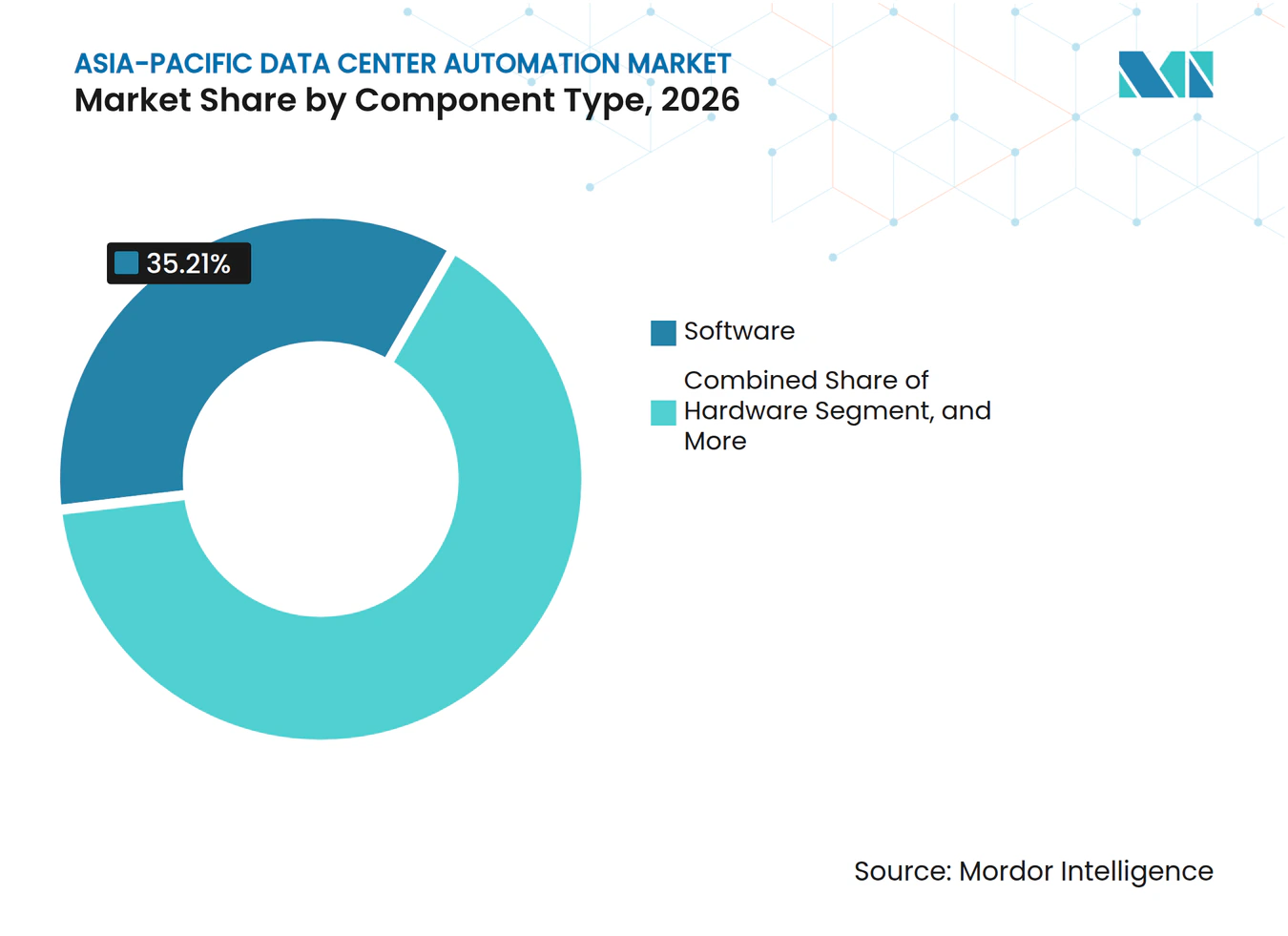
- By component type, software held 35.21% of the regional automation market in 2026 and is projected to expand at a 25.41% CAGR through 2032.
- By data center size, hyperscale facilities accounted for 45.18% of the regional automation market in 2026 and are projected to grow at a 25.58% CAGR through 2032.
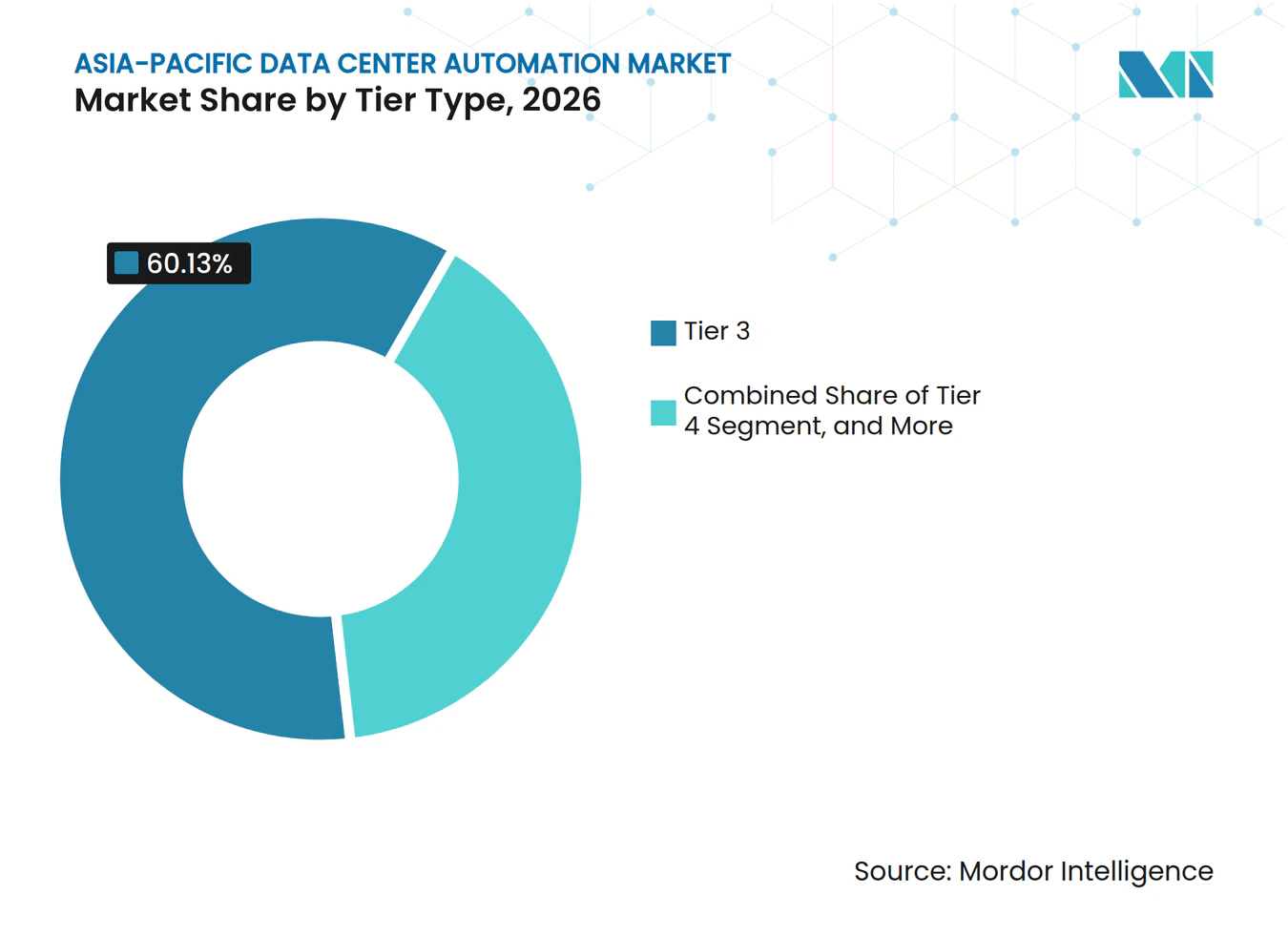
- By tier type, Tier 3 facilities held 60.13% of the regional automation market in 2026, while Tier 4 facilities are projected to expand at a 25.35% CAGR through 2032.
- By geography, China held 30.78% of the regional automation market in 2026, while India is projected to expand at a 27.16% CAGR through 2032.
Note: Market numbers in this report are based on Mordor Intelligence's proprietary estimation framework, which combines nine months of actuals with Q4 projections for base year 2026.
Market Trends and Insights
Drivers Impact Analysis of Asia-Pacific Data Center Automation Market*
| Driver | (~) % Impact on CAGR Forecast | Geographic Relevance | Impact Timeline |
|---|---|---|---|
| Cloud, AI, and Digital-Workload Expansion | +4.5% | Global, with concentration in China, India, and Southeast Asia | Long term (≥ 4 years) |
| Hyperscale and Colocation Capacity Expansion | +3.8% | China, India, Malaysia, Thailand, and Indonesia | Medium term (2-4 years) |
| Reliability and Energy-Efficiency Requirements | +3.2% | Global, with a regulatory focus in Singapore, Japan, and Australia | Medium term (2-4 years) |
| Data Center Labor Constraints and Remote Operations | +2.5% | Asia-Pacific, with acute pressure in Japan, South Korea, and India | Short term (≤ 2 years) |
| Liquid-Cooling and High-Density Power Automation Needs | +2.0% | China, Japan, Malaysia, and Australia | Medium term (2-4 years) |
| Cross-Border Workload Orchestration | +1.5% | Southeast Asia and India, with spillover to Japan and South Korea | Long term (≥ 4 years) |
| Source: Mordor Intelligence | |||
Cloud, AI, and Digital-Workload Expansion
Generative AI changes how operators manage power, cooling, and equipment availability in the Asia-Pacific Data Center Automation Market, as training and inference workloads require timely power allocation, thermal responsiveness, and fault handling across large asset bases. These workloads become harder to manage when facilities operate high-density GPU systems and cannot rely on manual checks. Conventional halls often operate within a 5-10 kW rack density range, while AI-oriented halls may require 50-120 kW. The increase places greater pressure on cooling loops, uninterruptible power systems, and electrical distribution equipment. Automation enables faster adjustments when temperatures, loads, or fault conditions change and connects infrastructure data with operating decisions. The Asia-Pacific Data Center Automation Market gains as operators adopt platforms for predictive maintenance, remote response, and coordination across the power, cooling, and compute environment.
Hyperscale and Colocation Capacity Expansion Across Asia-Pacific
New hyperscale and colocation facilities build DCIM, SCADA, building management systems, and digital models into the original design rather than treating automation as a later upgrade. This approach reduces the disruption a retrofit can cause at an active facility and gives suppliers the opportunity to provide a larger share of the control architecture. Large campuses need these systems to manage complex infrastructure and maintain consistent operating practices across new locations. Colocation providers also depend on monitoring because their contracts include availability commitments to several customers. A standard platform can identify conditions that could affect service levels and support repeatable operations across sites. This supports recurring demand across software, hardware, and services in the Asia-Pacific Data Center Automation Market, while creating room for local implementation partners that understand country-specific conditions.
Reliability and Energy-Efficiency Requirements for High-Density Compute
High-density computing makes reliable cooling and power control essential for safe facility operation, as AI racks can generate thermal loads beyond the design limits of older control systems. Automation helps operators balance cooling capacity, manage electrical loads, and detect abnormal conditions in real time. Singapore introduced energy-efficiency requirements for IT equipment that support lower power use and safe operation at higher server temperatures.[1] Johnson Controls states that its Sustainable Tropical Data Center Testbed 2.0 work evaluates cooling and intelligent controls under tropical operating conditions. The company also stated that a 1 GW reference design could redirect waste heat into productive cooling and reduce cooling-related electrical demand through coordinated system control. These requirements encourage operators to replace fragmented tools with integrated control, analytics, and optimization systems.
Data Center Labor Constraints and Need for Remote Operations
A shortage of skilled operations staff supports investment in remote monitoring and automation because Uptime Institute reported that 46% of operators struggled to find qualified candidates in 2025, while 37% reported retention challenges. Operations management had the largest reported skills gap at 39%, followed by electrical skills at 35%. These constraints make it harder to scale on-site teams as facilities add capacity. Remote platforms allow a smaller group to monitor and respond across several locations, provided they receive dependable data and clear alarms from sensors, controllers, cooling systems, and power equipment. Automation can reduce routine work and let experienced engineers focus on higher-risk tasks. The Asia-Pacific Data Center Automation Market is supported by avoided headcount growth as well as energy savings, particularly where specialized local talent has not kept pace with construction.
Restraints Impact Analysis of Asia-Pacific Data Center Automation Market*
| Restraint | (~) % Impact on CAGR Forecast | Geographic Relevance | Impact Timeline |
|---|---|---|---|
| High Upfront Integration and Retrofit Costs | -3.5% | Asia-Pacific, with heightened pressure in Southeast Asia and India | Short term (≤ 2 years) |
| Cybersecurity and Operational-Technology Exposure | -2.8% | Global, with high exposure in Asia-Pacific multi-tenant facilities | Medium term (2-4 years) |
| Legacy Controls and Interoperability Debt | -2.0% | China, Japan, and Australia | Long term (≥ 4 years) |
| Shortage of Automation Engineers and Local Service Talent | -1.5% | Vietnam, Indonesia, the Philippines, and Thailand | Short term (≤ 2 years) |
| Source: Mordor Intelligence | |||
High Upfront Integration and Retrofit Costs
Capital requirements can delay automation projects, especially at active brownfield facilities where a retrofit may require operators to connect older building management and control systems before using a new platform. This work can be more difficult than installation in a new site because downtime is limited. Smaller colocation companies and enterprise-owned facilities can face tighter financing conditions than hyperscale operators. Subscription-based DCIM licensing and automation-as-a-service models can lower the initial outlay, but regional adoption remains in an early stage. Regional integrators can help customers stage implementation in manageable phases and weigh the cost against better energy performance, fewer manual tasks, and a lower risk of equipment failure. These conditions can slow the Asia-Pacific Data Center Automation Market, where near-term budgets focus on capacity and power procurement.
Cybersecurity and Operational-Technology Exposure
Automation connects IT and operational technology systems, expanding the range of systems that need protection. Uptime Institute reported that information-security issues accounted for 5% of impactful data center outages in 2025. Its 2025 security survey stated that the cost of the most impactful incidents exceeded USD 50 million for the first time.[2] Multi-tenant facilities face a greater concern because a compromised building management system could affect several customer environments. Suppliers need to show that their platforms provide access controls, network segmentation, logging, and a clear response process. The Asia-Pacific Data Center Automation Market requires cybersecurity capabilities as part of the base offering, as concerns can slow vendor selection and make buyers cautious about connecting older controls to enterprise networks.
*Our forecasts treat driver/restraint impacts as directional, not additive. The impact forecasts reflect baseline growth, mix effects, and variable interactions.
Asia-Pacific Data Center Automation Market Segment Analysis
By Component Type:
Software Leads the Control StackSoftware held 35.21% of the Asia-Pacific Data Center Automation Market share in 2026 and is projected to expand at a 25.41% CAGR through 2032. This position reflects the shift from separate equipment controls to integrated operating platforms that provide monitoring, optimization, and decision support. DCIM software is moving beyond passive asset tracking toward active management of complex facilities. Digital models help operators assess changes in cooling and power before committing to costly modifications. Analytics and optimization tools also support predictive maintenance in energy-intensive facilities. Huawei states that NetEco6000 applies AI model training and inference to automate data center operations and improve resource utilization.
Digital twin tools are especially relevant when operators prepare for direct liquid cooling and high-density upgrades, as they allow teams to test conditions before work begins at a live facility. SCADA and analytics applications can identify problems earlier and coordinate responses across equipment groups, while software supports consistent reporting across several locations. Hardware remains essential because control platforms need dependable telemetry from sensors and controllers. Programmable logic controllers, direct digital controllers, remote input-output modules, and sensor arrays provide the physical data layer for automated operations. Services covering design, system integration, installation, and retrofit modernization are important where older facilities need new controls without operational downtime. This combination of software, hardware, and services gives suppliers several routes to participate in the Asia-Pacific Data Center Automation Market.



By Data Center Size:
Hyperscale Establishes the Operating StandardHyperscale facilities held 45.18% of the Asia-Pacific Data Center Automation Market share in 2026 and are projected to expand at a 25.58% CAGR through 2032. A facility with 100 MW or more can manage thousands of power, cooling, and compute variables, making automation necessary for routine operations and incident response. These sites need platforms that coordinate equipment across a large physical footprint and support high-density compute with greater use of liquid cooling. Large operators also need consistent design and operating practices across a regional portfolio. This favors suppliers that can combine controls, software, data management, and professional services. AI-focused cloud providers that lease colocation capacity reinforce this requirement, as their deployments must be ready from the first day.
Large data centers support cloud-adjacent enterprise workloads and managed services, with high uptime needs but less scope for a fully proprietary automation stack. Modular systems can offer these operators a route to expand monitoring and control as demand rises. Medium and small facilities present a large-volume opportunity across Southeast Asia, where enterprise-owned sites in Vietnam, Indonesia, and the Philippines are adopting entry-level DCIM and building management tools to meet sustainability requirements. These facilities can have limited in-house automation expertise and need practical implementation support. Regional providers can benefit from a lower cost base, proximity to customers, and an ability to integrate an existing equipment base. This part of the Asia-Pacific Data Center Automation Market may have a lower value per site, but its installed base can create steady demand.
By Tier Type:
Tier 3 Holds the Largest Base, While Tier 4 Attracts Premium DemandTier 3 facilities held 60.13% of the regional automation market in 2026, supported by colocation operators that use N+1 redundancy and must meet contractual uptime commitments. Automation helps these operators monitor equipment conditions and maintain the availability standards included in service agreements. A monitoring gap can create direct operational and financial risks, particularly when a site manages multiple tenants with varying load patterns. Tier 3 providers use controls to manage redundant equipment while retaining visibility into normal operations. They need clear alarms, dependable power information, cooling data, and performance records for customers. This makes the tier a central source of demand for DCIM, SCADA, building management, and related services.
Tier 4 facilities are projected to expand at a 25.35% CAGR through 2032 as sovereign AI projects and financial-sector users require fully fault-tolerant operations and no-concurrency maintenance windows. These facilities need automation that manages dual-path power and cooling without relying on manual intervention. The configuration can include redundant SCADA, building management, and emergency response systems, supporting a higher automation spend per facility. Tier 1 and Tier 2 sites remain relevant because operators in India's and Southeast Asia's secondary cities are upgrading classifications as enterprise requirements become stricter. A tier upgrade can require SCADA reconfiguration, redundant building-management integration, and a revised digital model. This adds recurring modernization work alongside the premium demand associated with Tier 4 sites.

Geography Analysis
China Data Center Automation Market
China held 30.78% of the regional automation market in 2026, supported by domestic hyperscale projects and public backing for digital infrastructure. In April 2026, 4 Chinese ministries issued the Action Plan for Promoting Mutual Empowerment Between Artificial Intelligence and Energy. The plan encouraged computing facilities to use grid-forming storage and direct green-power connections. These requirements need more sophisticated energy management at each site. China also offers opportunities in Ulanqab, Zhongwei, and Guizhou, where the availability of renewable energy can attract AI training workloads.
APAC Data Center Automation Market
Japan, Australia, and Singapore are mature markets that increasingly need software and services rather than basic hardware replacement. Their operators focus on power-usage effectiveness, carbon reporting, and liquid-cooling management. Singapore announced an additional 200 MW of data center capacity as part of its Sustainable Tropical Data Center Testbed 2.0 work. This supports demand for tropical-condition cooling controls and real-time energy monitoring. India is projected to expand at a 27.16% CAGR through 2032, supported by sovereign compute needs and greenfield capacity in Mumbai, Hyderabad, and Chennai. AirTrunk acquired Lumina CloudInfra in 2025, adding planned capacity across India's major data center cities.[3]
ASEAN and Taiwan Data Center Automation Market
Malaysia, Indonesia, Thailand, Vietnam, Taiwan, and the Philippines form a growing group of emerging locations. These markets are attracting hyperscaler land acquisition, colocation demand, and national digitalization investment. Johor's 2025 increase in live capacity illustrates the scale of new commissioning activity in Malaysia. Indonesia is developing an EDGNEX AI data center project in Jakarta, with its first phase expected to be operational by December 2026. Vietnam, Thailand, and the Philippines are building enterprise colocation demand as their digital economies expand. Local system integrators have an advantage where customers need affordable DCIM and building-management deployments.
Competitive Landscape
Market Concentration
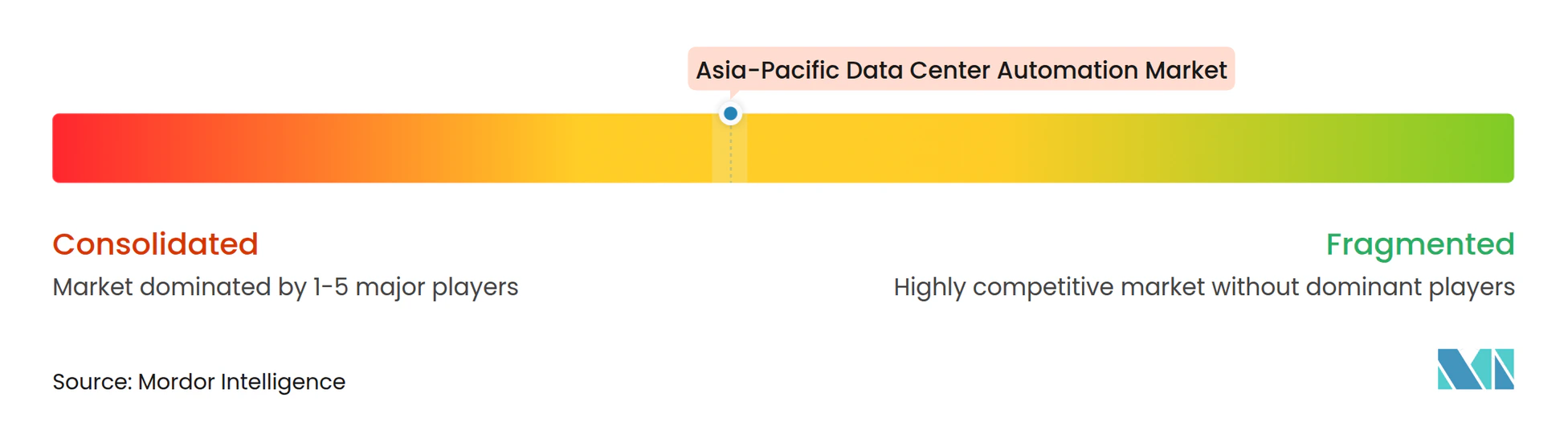
The Asia-Pacific Data Center Automation Market is moderately consolidated at the leading end of the supplier base. Schneider Electric, ABB, Siemens, Huawei, Vertiv, and Johnson Controls compete for large facility and hyperscale contracts. Regional system integrators and specialist software providers compete more actively in the mid-market and in emerging geographies. Global suppliers seek to provide integrated platforms rather than individual products. Their offerings combine power systems, cooling, controls, software, and service capability. Customers may still choose local partners when project conditions require tailored implementation.
Schneider Electric announced a collaboration with NVIDIA and AVEVA in March 2026 for validated blueprints for gigawatt-scale AI factories.[4] The work includes digital twin integration, agentic AI for alarm management, and reference designs for AI facilities. In June 2026, Schneider Electric and Hon Hai Technology Group announced a collaboration on next-generation AI data center reference architectures. ABB launched its Infinitus direct-current portfolio in 2026, positioning the company for changing power-distribution needs in AI facilities. These actions show that large suppliers are investing in design-to-operation solutions and direct-current infrastructure.
Liquid-cooling-native controls remain underserved because many traditional building-management and SCADA products do not natively manage coolant distribution, leak detection, and heat reuse. Cross-border workload orchestration is another open area, as operators need to maintain data residency obligations across fragmented infrastructure. Managed automation services for small and medium facilities in Southeast Asia are also in their early stages. Johnson Controls announced an investment of up to SGD 60 million (USD 44 million) over 5 years in its Singapore Innovation Center for cooling, thermal management, and intelligent automation. The investment shows that suppliers are adapting research and development to regional requirements. The Asia-Pacific Data Center Automation Market offers opportunities for both global OEMs and local integrators, as customers need solutions suited to local operating conditions.
Asia-Pacific Data Center Automation Industry Leaders
-
Schneider Electric SE
-
Huawei Technologies Co., Ltd.
-
Vertiv Holdings Co
-
Siemens AG
-
Johnson Controls International plc
- *Disclaimer: Major Players sorted in no particular order
Asia-Pacific Data Center Automation Market Companies Covered in this Report
- ABB Ltd.
- AirTrunk Operations Pty Ltd
- Alibaba Cloud (Singapore) Private Limited
- Cisco Systems, Inc.
- Digital Edge (Singapore) Holdings Pte. Ltd.
- Equinix, Inc.
- Fujitsu Limited
- GDS Services Limited
- Huawei Technologies Co., Ltd.
- Johnson Controls International plc
- Keppel Data Centres Holding Pte. Ltd.
- Microsoft Corporation
- NTT DATA Corporation
- Schneider Electric SE
- Siemens AG
- ST Telemedia Global Data Centres Pte. Ltd.
- Sify Technologies Limited
- Vertiv Holdings Co
- YTL Power International Berhad
- CtrlS Datacenters Limited
Recent Industry Developments in Asia-Pacific Data Center Automation Market
- September 2026: Schneider Electric unveiled the world's first software-defined medium-voltage switchgear, RM AirSeT 38 Software Defined, at YOTTA 2026, deployed in a live Equinix colocation data center. The solution extends SF₆-free gas-insulated switchgear to 38 kV, enabling electrical control systems to evolve at the same pace as AI factory power loads, directly relevant for Asia-Pacific hyperscale operators deploying high-voltage distribution at campus scale.
- September 2026: Johnson Controls announced participation in the Sustainable Tropical Data Centre Testbed 2.0 at the National University of Singapore's College of Design and Engineering. The live testbed on Jurong Island evaluates next-generation AI data center automation and cooling technologies under tropical conditions, with Johnson Controls contributing thermal-management technologies and smart controls to inform future facility designs across Singapore and Asia-Pacific.
- September 2026: Vertiv announced an agreement to acquire UtilityInnovation Group for USD 1.45 billion in cash, plus up to USD 1.15 billion in additional EBITDA-linked consideration. UIG adds microgrid controls, onsite generation orchestration, and behind-the-meter power architecture, extending Vertiv's automation stack upstream to grid interconnect and enabling AI data center operators to access power independently from utility interconnection timelines.
- September 2026: Keppel DC REIT announced the acquisition of an 88.62% effective interest in Tokyo Data Center 4 and Tokyo Data Center 5, 2 freehold hyperscale colocation facilities in Inzai City, Greater Tokyo. The deal is expected to raise Japan's contribution to Keppel DC REIT's portfolio rental income from 9% to 23%, expanding its exposure to DCIM and automation services in one of Asia-Pacific's tightest supply markets.
Asia-Pacific Data Center Automation Market Report Scope
The Asia-Pacific data center automation market comprises hardware, software, and services used to automate, monitor, manage, and optimize data center operations across the region. It includes automation solutions for IT infrastructure management, facility management, power and cooling systems, workload orchestration, network management, and monitoring, aimed at improving operational efficiency, reliability, scalability, and energy efficiency while reducing human intervention and operating costs.
The Asia-Pacific Data Center Automation Market Report is Segmented by Component Type (Hardware, Software, and Services), Data Center Size (Hyperscale, Large, Medium, and Small), Tier Type (Tier 1 and 2, Tier 3, and Tier 4), and Geography (China, India, Japan, Indonesia, Australia, Singapore, Malaysia, Vietnam, Thailand, Taiwan, Philippines, and Rest of Asia-Pacific). The Market Forecasts are Provided in Terms of Value (USD).
Segmentation Overview
| Hardware | Programmable Logic Controllers (PLCs) |
| Direct Digital Controllers (DDCs) | |
| Remote I/O and Field Controllers | |
| Sensors and Monitoring Devices | |
| Gateways and Communication Devices | |
| Human Machine Interface (HMI) Panels | |
| Other Automation Hardware (Others include industrial PCs (IPCs), edge controllers, protocol converters, industrial network switches, embedded automation controllers, among others) | |
| Software | Building Management and Automation Systems (BMS/BAS) |
| Supervisory Control and Data Acquisition (SCADA) | |
| Data Center Infrastructure Management (DCIM) | |
| Digital Twin Platforms | |
| Analytics and Optimization Software | |
| Other Automation Software (Others include engineering and configuration software, historian software, alarm management software, among others) | |
| Services | Design and Consulting Services |
| System Integration Services | |
| Installation and Commissioning Services | |
| Monitoring, Maintenance, and Support Services | |
| Retrofit and Modernization Services |
| Hyperscale |
| Large |
| Medium |
| Small |
| Tier 1 and 2 |
| Tier 3 |
| Tier 4 |
| China |
| India |
| Japan |
| Indonesia |
| Australia |
| Singapore |
| Malaysia |
| Vietnam |
| Thailand |
| Taiwan |
| Philippines |
| Rest of Asia-Pacific |
| By Component Type | Hardware | Programmable Logic Controllers (PLCs) |
| Direct Digital Controllers (DDCs) | ||
| Remote I/O and Field Controllers | ||
| Sensors and Monitoring Devices | ||
| Gateways and Communication Devices | ||
| Human Machine Interface (HMI) Panels | ||
| Other Automation Hardware (Others include industrial PCs (IPCs), edge controllers, protocol converters, industrial network switches, embedded automation controllers, among others) | ||
| Software | Building Management and Automation Systems (BMS/BAS) | |
| Supervisory Control and Data Acquisition (SCADA) | ||
| Data Center Infrastructure Management (DCIM) | ||
| Digital Twin Platforms | ||
| Analytics and Optimization Software | ||
| Other Automation Software (Others include engineering and configuration software, historian software, alarm management software, among others) | ||
| Services | Design and Consulting Services | |
| System Integration Services | ||
| Installation and Commissioning Services | ||
| Monitoring, Maintenance, and Support Services | ||
| Retrofit and Modernization Services | ||
| By Data Center Size | Hyperscale | |
| Large | ||
| Medium | ||
| Small | ||
| By Tier Type | Tier 1 and 2 | |
| Tier 3 | ||
| Tier 4 | ||
| By Geography | China | |
| India | ||
| Japan | ||
| Indonesia | ||
| Australia | ||
| Singapore | ||
| Malaysia | ||
| Vietnam | ||
| Thailand | ||
| Taiwan | ||
| Philippines | ||
| Rest of Asia-Pacific | ||
Key Questions Answered in the Report
What is the Asia-Pacific data center automation market size?
The Asia-Pacific Data Center Automation Market is valued at USD 0.44 billion in 2026 and is forecast to reach USD 1.21 billion by 2032 at an 18.41% CAGR.
What is driving adoption of data center automation in Asia-Pacific?
AI workloads, hyperscale and colocation construction, energy-efficiency requirements, and limited availability of skilled operations personnel support adoption.
Which component leads Asia-Pacific data center automation demand?
Software holds the largest share at 35.21% in 2026 and is projected to expand at a 25.41% CAGR through 2032.
Which data center size has the strongest outlook?
Hyperscale facilities hold 45.18% in 2026 and are projected to expand at a 25.58% CAGR through 2032.
Which country is expanding fastest in the region?
India is projected to expand at a 27.16% CAGR through 2032, supported by sovereign compute needs and new capacity in Mumbai, Hyderabad, and Chennai.
What are the main barriers to automation projects?
High retrofit and integration costs, operational-technology cybersecurity exposure, legacy controls, and shortages of automation engineers can delay deployment.